Oxidation of Alcohol by using a Rapid and Efficient
Methodology at Room Temperature
Nibedita Gogoi, Chimi Rekha Gogoi, Taskia Rahman and Pradip K. Gogoi
Department of Chemistry,
Dibrugarh University, Dibrugarh-786004, Assam, INDIA. email: [email protected], [email protected]
(Received on: November 9, 2017)
ABSTRACT
A mild, efficient metal and additive free ecofriendly methodology has been developed for the oxidative transformation of alcohols to their corresponding carbonyl compounds using a mixture of acid activated Mont K-10 and charcoal in the ratio of 60:40. This catalytic system was found to be very effective for conversion of both primary and secondary alcohols into corresponding aldehydes and ketones with good conversion. We have also compared this result with Cu incorporated Mont K- 10 catalyst, which unlike the present protocol, requires drastic condition like high temperature, presence of oxidant and transition metal. The catalyst can be separated from the product by simple centrifugation and can be reused upto fifth cycle without loss of activity.
Keywords: Transition metal free methodology, Recyclable heterogeneous catalyst, Alcohol oxidation, Mont K-10-charcoal.
1. INTRODUCTION
The selective oxidation of alcohol to aldehyde or ketone is one of the most widely used organic synthetic routes of fine chemicals1 and has several industrial application and academic significance. For alcohol oxidation numerous stoichiometric metal oxidants namely chromate 2 or permanganate are used but the cost of these are very high and are not environment friendly, as toxic substances are associated with them 3. Extensive research on transition metals catalyzed oxidation of alcohols such as Fe 4-6, Mo, 7 Ru8,9, Pt10
,Pd 11-13,V14,15
form has excellent catalytic efficiency in various organic syntheses due to its strong acidity 25. It is inexpensive, non corrosive, gives high yield and with selectivity. Acid-treated montmorillonite clay finds industrial applications as catalysts, catalytic supports, and adsorbents. The clay is treated with mineral acids which imparts acidity to the surface of the clay and it has been widely used in various organic synthesis supported on easily available charcoal. The development of transition metal free heterogeneous catalyst with high catalytic activity is of prime importance. In this research article we report the development of a green, low-cost, heterogeneous catalyst with easily available acid modified Mont K-10 clay-charcoal (in the ratio of 60:40) composite, which is free from transition metal to efficiently catalyze a number of alcohol oxidation reactions. The most advantageous feature of this catalytic protocol is that the reaction goes well under room temperature with reuse of catalyst upto fifth cycle without loss of activity.
2. EXPERIMENTAL
2.1. Acidification of Montmorillonite Clay
Montmorillonite K-10 (Mont K-10) was slurried with water and then mixed with conc.H2SO4 at acid/clay ratio of 0.3 followed by heating on a water bath for 16h with constant stirring. At the end of the reaction time the activation was stopped by adding a large amount of distilled water (five times of the reaction mixture volume), the resulting slurry was repeatedly centrifuged in hot deionized water until free of sulphate ion. The acid activated clay was dried at oven for 2-3 hours at 115ᴼC.
2.2. Preparation of charcoal
The charcoal (2g) was boiled in 0.5N HCl (50 ml) followed by washing for 4-5 times with distilled water (20 ml) for 40-45 minutes and dried in an oven.
Preparation of acid activated MontK-10 supported charcoal
The acid modified clay and charcoal is mixed in the ratio of 60:40 in a grinder with a few drop of water and grounded it for half an hour and then dried it in an oven. The acidity of acid activated MontK-10 supported charcoal was determined by following acid-base titrations using phenolphthalein as indicator and was found to be 0.0216 M.
2.3. Preparation of Cu- Mont K 10 catalyst
2.4. General procedure for oxidation of alcohol
1mmol of the alcohol was taken in a 50 ml round bottom flask. To it, 3ml of the solvent, 40 mg catalyst and oxidant were added. Then the mixture was stirred at 60οC. The progresses of the reactions were monitored by thin layer chromatography using alumina coated TLC plates under UV light. After completion of the reaction, the catalyst was separated by filtration and the residual solid was washed several times with the solvent used in the reaction. The filtrate was diluted with water and extracted with ethyl acetate. The extract was then dried over Na2SO4. Then the solvent was evaporated in a rotary evaporator and using column chromatography, we obtained the desired product.
3. RESULTS AND DISCUSSION
3.1. FT-IR study: From the FT-IR study it was clear that on modification of layered structure of clay by acidification, the intensity of the peaks obtained decreases (Figure 1). A broad peak obtained at 3630 cm-1 due to ѵOH in Mont K-10. After acidification this peak area and intensity decreased, indicating protonation of Mont K-10.
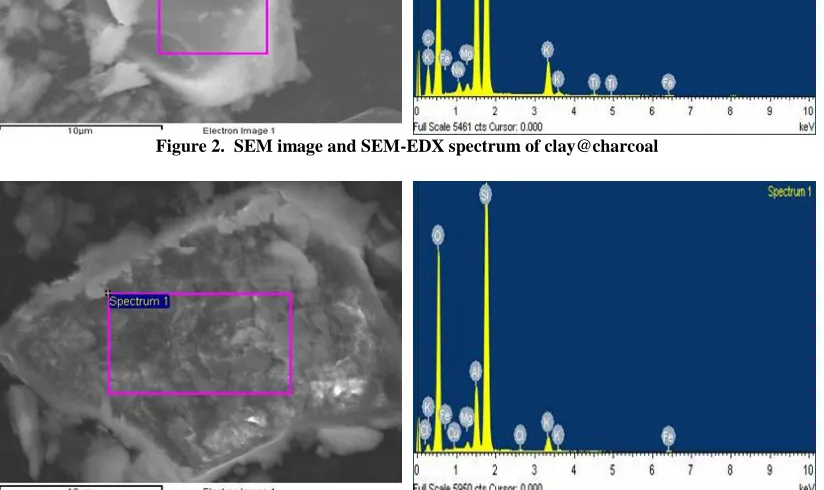
3.2. SEM-EDX of the catalyst: From the SEM-EDX pattern it is observed that all the elements expected for Mont K-10-charcoal nanocomposites like Si, Al, O, C, Fe, Mg, K etc. are present (Figure 2). Incorporation of Cu in clay was confirmed by SEM-EDX spectra of Cu- Mont K-10 catalyst (Figure 3).
Figure 2. SEM image and SEM-EDX spectrum of clay@charcoal
Figure 3. SEM image and SEM-EDX spectrum of Cu- Mont K 10 catalyst
3.3.Catalyst screening and solvent optimization
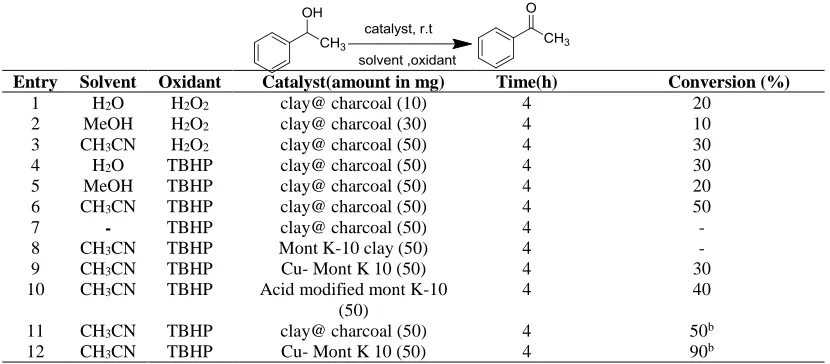
We have taken 1-phenyl ethanol as a standard substrate to study the effectiveness of the catalyst for oxidation of alcohol. Reactions were performed under various reaction conditions and results are depicted in Table 1. We have used different oxidizing agents like hydrogen peroxide (H2O2) and t-butyl hydroperoxide (TBHP) to know its effect in alcohol oxidation reactions. In the optimization process it was seen that H2O2 was less effective than TBHP (Table 1, entry 6).
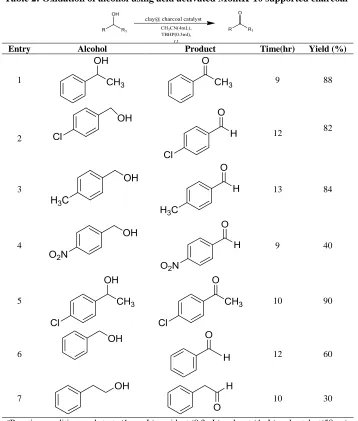
index of 9.0.The poor solubility could be due to the formation of hydrogen bonding by the substrate and TBHP in water. In the absence of solvent the reaction did not proceed (Table 1, entry 7). The amount of catalyst also played an important role in oxidation reaction. It was found that on decreasing the amount of catalyst from 50mg to 10mg the reaction does not show any appreciable progress (Table 1, entries 1-3). To know the nature of catalyst we have performed the reaction in presence of blank mont K- 10 clay (without acidification) and also in presence of Cu- Mont K 10 catalyst (Table 1, entries 8-12). From the result it was clear that mont K-10 clay itself does not act as catalyst (Table 1, entries 8). But in presence of acid modified mont K-10, it converts 40% to product (Table 1, entry 10). On increasing the temperature (to 60οC) no significant improvement of the result was found in presence of clay@charcoal catalyst (Table 1, entries 11, 12). In presence of Cu- Mont K 10 catalyst, conversion was increased at temperature 60οC (Table 1, entry 12) while at room temperature it converts only 30 % (Table 1, entry 9). After optimizing the reaction condition taking 1-phenyl ethanol as a standard substrate, various substituted primary and secondary alcohols were oxidized in presence of the clay@ charcoal (50 mg) and TBHP as an oxidant at room temperature in presence of acetonitrile as solvent (Table 2). From Table 2 we have seen that both primary and secondary alcohols on oxidation convert into corresponding aldehydes and ketones. Moreover it was observed that secondary alcohol was found to be more reactive towards oxidation under same reaction condition than primary alcohols. Substrates containing both the electron withdrawing and electron donating substituents such as p-Cl, p-Me, p-NO2 were taken for the oxidation reaction and showed good conversion. It seems that benzyl alcohol bearing electron withdrawing group (like p-Cl) give better yield than that of electron donating group (like p-CH3) (Table 2, entries 1,2,3,5). It was observed that p-NO2 benzyl alcohol and 2-phenyl ethanol give poor conversion than other substrates (Table 2, entries 4,7).
Table 1: Optimization of Oxidation of 1-phenyl ethanola
Entry Solvent Oxidant Catalyst(amount in mg) Time(h) Conversion (%) 1 H2O H2O2 clay@ charcoal (10) 4 20
2 MeOH H2O2 clay@ charcoal (30) 4 10 3 CH3CN H2O2 clay@ charcoal (50) 4 30
4 H2O TBHP clay@ charcoal (50) 4 30
5 MeOH TBHP clay@ charcoal (50) 4 20
6 CH3CN TBHP clay@ charcoal (50) 4 50
7 - TBHP clay@ charcoal (50) 4 -
8 CH3CN TBHP Mont K-10 clay (50) 4 -
9 CH3CN TBHP Cu- Mont K 10 (50) 4 30
10 CH3CN TBHP Acid modified mont K-10 (50)
4 40
11 CH3CN TBHP clay@ charcoal (50) 4 50b 12 CH3CN TBHP Cu- Mont K 10 (50) 4 90b
Table 2: Oxidation of alcohol using acid activated MontK-10 supported charcoala
Entry Alcohol Product Time(hr) Yield (%)
1 CH
3 OH
CH3
O
9 88
2 12
82
3 13 84
4 9 40
5 10 90
6
OH O
H 12 60
7
OH H
O
10 30
aReaction conditions: substrate (1mmoL) , oxidant (0.3mL), solvent (4mL) and catalyst(50mg) 3.4. Oxidation of alcohol using Cu-Mont K-10 catalyst
3.5. Reusability of the catalyst
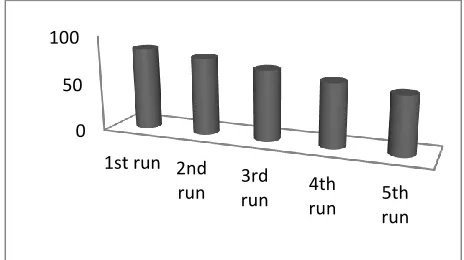
Since reusability of a catalyst is a major and attractive criterion for heterogeneous catalytic system, we studied the same up to 5th cycle using 1-phenylethanol as model substrate (Figure 4). For this purpose, the catalysts were separated from the reaction mixture by centrifuging followed by drying in an oven. After drying, it was again used for fresh alcohol oxidation reaction following same procedure. The conversion seems to be decreasing as the number of cycles increases as shown in bar diagram due to physical loss of the catalyst during recycling process.
Figure 4. Bar diagram for reusability test of 1-phenyl ethanol using clay@ charcoal
4. CONCLUSION
We have developed a heterogeneous transition metal free activated Montmorillonite K-10 supported charcoal catalyst for selective oxidation of alcohol to their corresponding aldehydes and ketones with very good yield. The most advantageous features of this protocol are (1) the reactions occur at room temperature and (2) the system proceeds in absence of transition metal. (3) The catalyst could be recycled successfully up to fifth cycle without significant loss of activity. This methodology will find application in both academic as well as in industry due to its cost effectiveness as it involves only activated clay and charcoal.
Supporting information: Supplementary data contains experimental details and 1H NMR spectra of products
ACKNOWLEDGEMENTS
The authors acknowledge to SAIF-IIT Bombay for carrying out SEM-EDX and NMR analysis. N. Gogoi also thanks to UGC, New Delhi for financial assistance in the form of UGC-BSR (RFSMS) Fellowship.
REFERENCES
1. Hoover, J. M., Ryland, B. L., Stahl, S.S.,Mechanism of Copper(I)/TEMPO-Catalyzed Aerobic Alcohol Oxidation.J. Am. Chem. Soc., 2: 2357-2367(2013).
0 50 100
1st run 2nd
run 3rdrun 4th
2. Bowden, K., Heilbron, I.M., Jones, E. R. H.,Weedon, B.C.L., Researches on Acetylenic Compounds. Part I. The Preparation of Acetylenic Ketones by Oxidation of Acetylenic Carbinols and Glycols. J. Chem. Soc.,39-45(1946) .
3. Carley, A. F., Edwards, J.K., Enache, D. I.,Herzing, A. A., Hutchings, G.J., Kiely, C.J., Knight, D.W., Landon, P., Watanabe, M., Solvent-Free Oxidation of Primary Alcohols to Aldehydes Using Au-Pd/ TiO2. Catalysts Science, 311: 362-365(2006)
4. Zhao, H.,Miao, C., Sun, W., Zhao, Q., Aerobic oxidation of secondary alcohols using NHPI and iron salt as catalysts at room temperature. J. Mol. Catal. A: Chem., 2014, 393: 62-67 (2014).
5. Herried, M. E., McGaff, R. W., Neve, R.L.,Peterson, B.M., Oxidation of primary and secondary benzylic alcohols with hydrogen peroxide and tert-butyl hydroperoxide catalyzed by a “helmet” phthalocyaninato iron complex in the absence of added organic solvent. Dalton Trans,43: 17899-17903(2014).
6. Chen, J., Liang, X., Liu, R., Wang, N., NaNO2-activated, iron–TEMPO catalyst system for aerobic alcohol oxidation under mild conditions. Chem. Commun,(2005).
7. Avecilla, F.,Dhaka, S., Maurya, M. R., Oxidation of secondary alcohols by conventional and microwave-assisted methods using molybdenum complexes of ONO donor ligands.
New J. Chem., 39:2130-2139(2015).
8. Arends, I. W. C. E., Dijksman, A., Gonzalez, A.M., Payeras, A.M., Sheldon, R.A., Efficient and Selective Aerobic Oxidation of Alcohols into Aldehydes and Ketones Using Ruthenium/TEMPO as the Catalytic System.J. Am. Chem.Soc., 123:6826-6833(2001). 9. Kim D, Kim Y, Jung K, Choi M.Y, Park M, Lee B. Y, Kim T. H and Kwon K. Y
Bull.Korean Chem., Soc. 36:1-2(2015).
10. Besson, M., Chibani, S., Delbecq, F., Michel, C., Pinel, C., The key role of hydroxyl groups on platinumcatalysed alcohol oxidation in aqueous medium.Catal. Sci. Technol, 3: 339-350(2013).
11. Liu C, Tang S and Lei A Oxidant controlled Pd-catalysed selective oxidation of primary alcohols.Chem. Commun.,49: 1324-1326(2013).
12. Alvarez, E.,Campora, J., Melero, C., Palma, P., Shishilov, O. N., Well-defined alkylpalladium complexes with pyridine-carboxylate ligands as catalysts for the aerobic oxidation of alcohols.Dalton Trans., 41: 14087-14100(2012).
13. Muzart, J., Palladium-catalysed oxidation of primary and secondary alcohols.
Tetrahedron, 59:5789-5816 (2003).
14. Madhavi, V., Soleimani, S., Novel synthesis of manganese and vanadium mixed oxide (V2O5/OMS-2) as an efficient and selective catalyst for the oxidation of alcohols in liquid phase. Mater. Res. Bull. 51:153-160(2014).
15. Bharadwaj, S. K., Bora, U., Dewan, A., Gogoi, A., Sarmah, G., An efficient and reusable vanadium based catalytic system for room temperature oxidation of alcohols to aldehydes and ketones.Tetrahedron Lett. ,55:5029-5032(2014).
17. Loua, J. D., Xub, Z. N., Solvent free oxidation of alcohols with manganese dioxide.
Tetrahedron Lett. ,43:6149-6150(2002).
18. Begum, T.,Bora, U.,Dutta, S., Gogoi, N., Gogoi, P.K., Rice Husk Derived Nanosilica Supported Cu (II) Complex: An Efficient Heterogeneous Catalyst For Oxidation Of Alcohols Using TBHP RSC Adv.,5:95344(2015).
19. Clark,J.H., Elhamifar,D.,Hunt, A.J.,Karimi, B., Palladium containing periodic mesoporous organosilica with imidazolium framework (Pd@PMO-IL): an efficient and recyclable catalyst for the aerobic oxidation of alcohols.Org. Biomol. Chem.,9:7420-7426 (2011).
20. Abedi, S., Clark, J. H., Karimi, B., Zamani, A., Aerobic oxidation of alcohols using various types of immobilized palladium catalyst: the synergistic role of functionalized ligands, morphology of support, and solvent in generating and stabilizing nanoparticles.
Green Chem., 11: 109-119(2009).
21. Hara, T., Lchikuni, N., Nakamura, Y., Sawada, J., Shimazu, S., An anionic D-valine– palladium(II) complex supported on a hydroxy double salt with a Brønsted basic phosphate anion: application for a heterogeneous catalyst toward aerobic alcohol oxidation.Catal. Sci. Tech., 1:1376-1382(2011).
22. Bruce, D. W., Hondow, N. S.,Lee, A. F., Newton, M. A., Parlett, C. M. A., Wilson, K.,Mesoporous Silicas as Versatile Supports to Tune the Palladium-Catalyzed Selective Aerobic Oxidationof Allylic Alcohols.ChemCatChem., 5:939-950(2013).
23. Ding C., Li, Y.,Wang Y, Wen X., Zhang, G., Dual-functional click-triazole: a metal chelator and immobilization linker for the construction of a heterogeneous palladium catalyst and its application for the aerobic oxidation of alcohols.Chem. Commun., 48:2979-2981(2012).
24. Li, F., Wang, Y., Zhang, Q., Size dependence in solvent-free aerobic oxidation of alcohols catalyzed by zeolite-supported palladium nanoparticles. Appl. Catal., A. 334:217-226 (2008).