THE INFLUENCE OF CLIMATIC CONDITIONS ON SHEEP
MILK PRODUCTION
Daniela Jitariu1, Radu Raducu2, Carmen Ana Pivoda2, Camelia Zoia Zamfir2
1 Ovidius University of Constanţa, The Faculty of Natural and Agricultural Sciences,
Mamaia Blvd., Constanţa, 900527, Romania, [email protected] 2 The Palas Research Institute of Sheep and Goat Breeding Constanta (ICDCOC Palas Constanta)
Abstract
Important climatic factors, temperature and humidity, are acting complexly and cumulatively on the sheep body, on fodder crops and pastures, in terms of quantity and quality production. The research in this paper aims at the influence of the climatic conditions on the Palas Merino sheep breed and on the Dairy Palas sheep breed productivity. The experiments were conducted at the Palas Research Institute for Sheep and Goat Breeding Constanta. From the thermal point of view, the annual average temperature over the ten years studied was between 11°C and 4°C, which shows the studied area is one of the hottest in the country. Humidity acts in close contact with temperature. From one year to another the milk production in the two sheep breeds had variations and was significantly influenced by climate variability and particularly by the occurrence of climate events. In 2014, the highest milk production was obtained in the Palas Merino breed: total milk production 97.46 ± 2.54 liters, 42.66 liters of milked milk in 92.8 days of lactation, with 5.79±0.10% protein and 6.32±0.14% milk fat. In the Dairy Palas breed: total milk production 227.46±2.54 liters, 142.66 liters of milked milk in 232 days of lactation, with 5.89±0.10% protein and 6.12 ± 0.14% fat.
Key words: climatic, condition, influence, milk, production.
Introduction
The paper aims at the knowledge of how the climatic factors (temperature and humidity) influence the sheep organism, and the variation in the quantity and quality of milk production. The indirect influence of climate changes on the livestock is known, as it is manifested in the quantitative and qualitative effect on forage plants and pastures and by their action on animal systems and metabolic processes, as well as their influence on productions.
Humidity acts in close contact with temperature. Under low humidity conditions, the animal’s resistance is higher, regardless of the temperature value. Humidity greatly affects the health of animals and their productions. At the ovine species, which, due to the farming methods is most of the time under the influence of climatic factors, it is important to know the influences of climatic factors on production, in order to prevent and reduce the consequences on them.
In the current national and international economic context which is aimed at developing sheep rearing, their production must increase in order to enhance the profitability of the agricultural farms and their contributions to the food production.
variability affects milk production in the Palas Merino sheep breed and in the Dairy Palas sheep breed, from ICDCOC Palas Constanta.
Material and Methods
To achieve the objectives of this paper, we used existing climatological data from the ANM archive (the National Meteorology Administration) and daily weather bulletins (Ciulache, Ionac, 2001). For the conditions of ICDCOC Palas Constanta, the variation of monthly and annual temperatures are recorded at the agro-meteorological station Valu lui Traian.
The sheep of the two breeds, which are lactating, were followed individually, registering data regarding the quantitative milk production control based on the Romanian ”coefficient control” method (Nica-Dermengi). The method is based on the ratio of the daily milk production and the quantity of milk obtained in one milking on the same day (Taftă, 1998).
During lactation, sheep from the experimental and control lots received the same feed ration (Burlacu, 1998): 1.68 SU, 1.62 UNL, 118 g PDIN, 147g PDIE, 14.8 g calcium and 7 g phosphorus.
Results and discussions
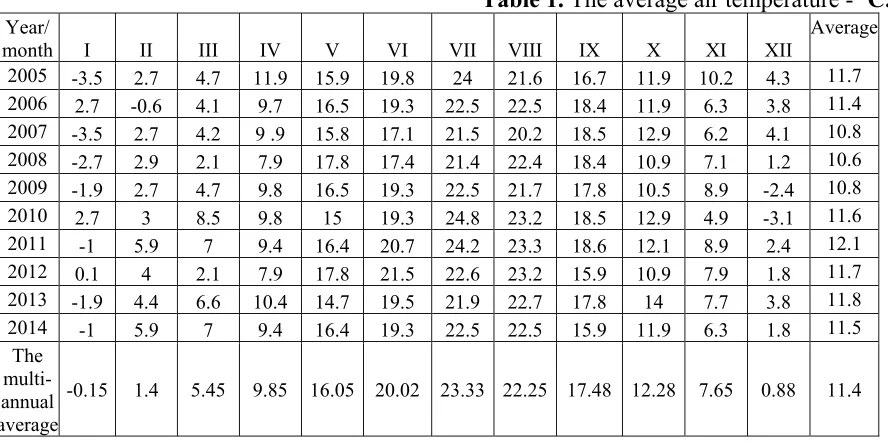
The variation of monthly and annual average temperatures during the 2005-2014 period in the area where ICDCOC Palas Constanta is placed it is shown in Table 1.
In terms of thermal values, the multi-annual average temperature of the ten years studied was 11.40C, which shows that ICDCOC Palas Constanta is in one of the hottest areas of Romania.
Table 1. The average air temperature - ˚C.
Year/
month I II III IV V VI VII VIII IX X XI XII
Average
2005 -3.5 2.7 4.7 11.9 15.9 19.8 24 21.6 16.7 11.9 10.2 4.3 11.7
2006 2.7 -0.6 4.1 9.7 16.5 19.3 22.5 22.5 18.4 11.9 6.3 3.8 11.4
2007 -3.5 2.7 4.2 9 .9 15.8 17.1 21.5 20.2 18.5 12.9 6.2 4.1 10.8
2008 -2.7 2.9 2.1 7.9 17.8 17.4 21.4 22.4 18.4 10.9 7.1 1.2 10.6
2009 -1.9 2.7 4.7 9.8 16.5 19.3 22.5 21.7 17.8 10.5 8.9 -2.4 10.8
2010 2.7 3 8.5 9.8 15 19.3 24.8 23.2 18.5 12.9 4.9 -3.1 11.6
2011 -1 5.9 7 9.4 16.4 20.7 24.2 23.3 18.6 12.1 8.9 2.4 12.1
2012 0.1 4 2.1 7.9 17.8 21.5 22.6 23.2 15.9 10.9 7.9 1.8 11.7
2013 -1.9 4.4 6.6 10.4 14.7 19.5 21.9 22.7 17.8 14 7.7 3.8 11.8
2014 -1 5.9 7 9.4 16.4 19.3 22.5 22.5 15.9 11.9 6.3 1.8 11.5
The multi-annual average
-0.15 1.4 5.45 9.85 16.05 20.02 23.33 22.25 17.48 12.28 7.65 0.88 11.4
autumns, and the usually sudden transition from spring to summer, with an accentuated warm weather in June (Lungu, 2009).
The absence of precipitation in this period increases the dry nature of the area. The constant high temperatures in July and August associated with hot winds adversely affect plant vegetation (evapotranspiration is increased and plant water supply is reduced which causes the twisting and wilting of their leaves if there is no rainfall or irrigation).
At ICDCOC Palas Constanta, the highest average temperatures of over 200C are recorded in July and August, with limits between 20.20C and 24.80C.
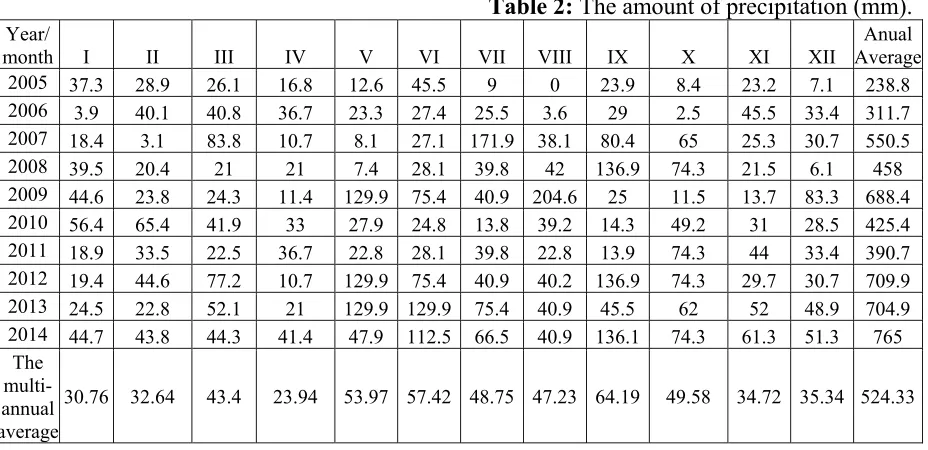
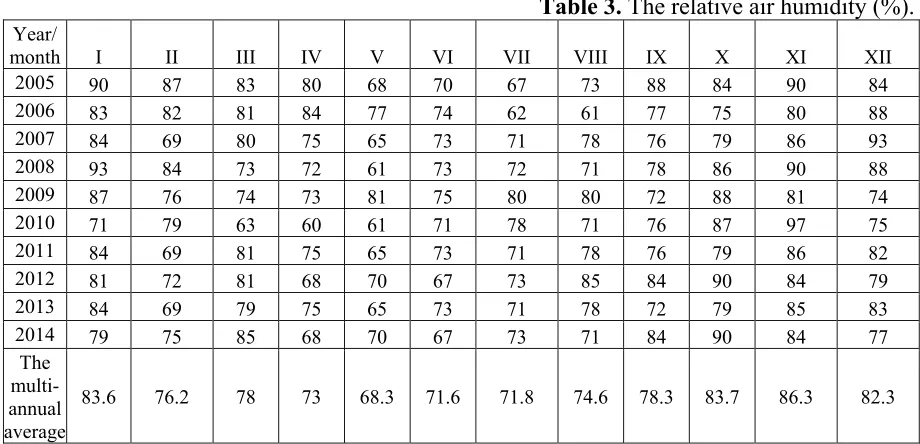
Also, for 2005-2014 periods, the annual regime of average monthly precipitation amounts are shown in Table 2 and the monthly and annual averages of relative humidity are shown in Table 3.
The regime's annual average monthly precipitation amounts show a rainy period in late spring and early summer, driven by the intensification of front (while stepping up cyclone activity) and thermal convection (due to higher radiative balance sheet values).
Table 2: The amount of precipitation (mm).
Year/
month I II III IV V VI VII VIII IX X XI XII Average Anual
2005 37.3 28.9 26.1 16.8 12.6 45.5 9 0 23.9 8.4 23.2 7.1 238.8
2006 3.9 40.1 40.8 36.7 23.3 27.4 25.5 3.6 29 2.5 45.5 33.4 311.7
2007 18.4 3.1 83.8 10.7 8.1 27.1 171.9 38.1 80.4 65 25.3 30.7 550.5
2008 39.5 20.4 21 21 7.4 28.1 39.8 42 136.9 74.3 21.5 6.1 458
2009 44.6 23.8 24.3 11.4 129.9 75.4 40.9 204.6 25 11.5 13.7 83.3 688.4
2010 56.4 65.4 41.9 33 27.9 24.8 13.8 39.2 14.3 49.2 31 28.5 425.4
2011 18.9 33.5 22.5 36.7 22.8 28.1 39.8 22.8 13.9 74.3 44 33.4 390.7
2012 19.4 44.6 77.2 10.7 129.9 75.4 40.9 40.2 136.9 74.3 29.7 30.7 709.9
2013 24.5 22.8 52.1 21 129.9 129.9 75.4 40.9 45.5 62 52 48.9 704.9
2014 44.7 43.8 44.3 41.4 47.9 112.5 66.5 40.9 136.1 74.3 61.3 51.3 765
The multi-annual average
30.76 32.64 43.4 23.94 53.97 57.42 48.75 47.23 64.19 49.58 34.72 35.34 524.33
Dobrogea is considered a dry area, due to the small amounts of precipitation and their uneven distribution during the year. The action of sea breezes front on land is mitigated and if accompanied by thermal inversions, it prevents cloudiness and thermal convection intense rains. Water from rainfall in this area is not an important reserve to the soil, which is why irrigation is required.
The largest amounts of water fall in early summer. The rains have a torrential character, which makes Dobrogea a region with one of the highest amounts of water from rainfall in a day. During crops vegetation, droughts are frequent, sometimes lasting 2-3 months, causing an atmospheric drought with significant influence on soil moisture and on agricultural production.
From Table 2, concerning monthly and annual rainfall averages in the last decade, the year 2014 shows the highest amount of rainfall (765 mm), followed by 2012 (709.9 mm) and 2013 (704.9 mm). The average amount of precipitation in the last ten years was 524.33 mm.
distinguished by high values, determined on the background of the maximum frequency of droughts of Romania. A major role in the distribution of relative humidity rests on the local regular air circulation, in the form of breezes.
Table 3. The relative air humidity (%).
Year/
month I II III IV V VI VII VIII IX X XI XII
2005 90 87 83 80 68 70 67 73 88 84 90 84
2006 83 82 81 84 77 74 62 61 77 75 80 88
2007 84 69 80 75 65 73 71 78 76 79 86 93
2008 93 84 73 72 61 73 72 71 78 86 90 88
2009 87 76 74 73 81 75 80 80 72 88 81 74
2010 71 79 63 60 61 71 78 71 76 87 97 75
2011 84 69 81 75 65 73 71 78 76 79 86 82
2012 81 72 81 68 70 67 73 85 84 90 84 79
2013 84 69 79 75 65 73 71 78 72 79 85 83
2014 79 75 85 68 70 67 73 71 84 90 84 77
The multi-annual average
83.6 76.2 78 73 68.3 71.6 71.8 74.6 78.3 83.7 86.3 82.3
Monthly and annual humidity averages are shown in Table 3. In 2005 the highest value of relative humidity were recorded, and the months with the highest values throughout the studied period of ten years were January (83.6%), August (83.7%), November (86.3%) and December (82.3%).
To follow the influence of climatic conditions on sheep milk, production was controlled for the Palas Merino sheep breed and for the Dairy Palas sheep breed. From one year to another, milk production had variations, being significantly influenced by climate variability and particularly by climate events.
It is known that animal production decreases when the outside temperature exceeds, for a period of time, critical limits specific to each species and animal category. In the case of sheep, prolonged temperatures of over 32°C in temperate conditions, reduce the rhythm of wool growth (Mireşan, 2001).
Humidity is often closely related to temperature. In conditions of low humidity the environmental resistance of the animal is higher both at high and low temperature, the air humidity greatly influencing not only the animal health but also their productions.
In the ovine specie, which, due to the farming methods practiced mostly under the influence of climatic factors, it was found that, in temperate areas with relative high humidity, the best adapted breeds are sheep with thick wool (Ţurcană breed for example) (Pădeanu, 2000). Tables 4 and 5 show the milk production in the Palas Merino sheep breed and the Dairy Palas sheep breed.
Table 4. Palas Merino sheep breed milk production.
Year
Palas Merino sheep breed (n=15)
Total milk
production (l) Milking dairy production (l) Days of lactation Fat (%) Proteins (%)
X ±Sx Cv% X ±Sx Cv% X ±Sx Cv% X ±Sx Cv% X ±Sx Cv%
2005 79.02±2.91 14.24 36.12±1.3 13.94 88.2±0.9 3.95 6.07±0.16 9.93 5.46±0.10 6.79
2006 81.27±4.17 19.20 37.85±1.2 12.28 89.6±1.2 5.19 6.07±0.17 10.18 5.51±0.14 8.98
2007 87.74±3.36 14.83 39.24±1.6 15.79 87.3±1.2 5.32 6.13±0.12 8.54 5.69±0.08 6.30
2008 86.45±3.93 17.01 38.14±2.1 21.32 90.2±2.1 9.02 6.22±0.18 10.96 5.64±0.09 6.13
2009 88.75±3.07 14.68 40.2±1.3 12.52 89.5±2.4 10.39 6.20±0.14 8.98 5.79±0.11 7.80
2010 83.46±3.37 17.13 41.5±2.1 16.60 89.2±2.1 9.12 6.13±0.12 8.54 5.79±0.11 7.80
2011 81.61±2.06 10.68 39.7±1.8 17.56 88.2±1.5 6.59 6.04±0.13 8.44 5.59±0.09 6.25
2012 91.38±3.54 14.98 40.22±1.9 18.30 90.2±1.2 5.15 6.20±0.14 8.98 5.77±0.11 6.81
2013 91.94±2.69 12.43 41.1±1.5 14.13 93.2±0.9 3.74 6.39±0.19 11.39 5.85±0.08 5.81
2014 97.46±2.54 11.07 42.66±1.6 14.53 92.8±1.2 5.01 6.32±0.14 9.42 5.79±0.10 7.63
Of course, not only the influence of climatic conditions contributed to these productions, but also the enhanced nutritional value of green mass grazed by dairy sheep, pasture vegetation in these favorable climatic conditions having a high nutrient content and a high degree of palatability (Taftă, 2008).
Table 5. Dairy Palas sheep breed milk production.
Year
Dairy Palas sheep breed (n=25)
Total milk
production (l) Milking dairy production (l) Days of lactation Fat (%) Proteins (%)
X ±Sx Cv% X ±Sx Cv% X ±Sx Cv% X ±Sx Cv% X ±Sx Cv%
2005 211.02±2.91 6.90 130.20±1.21 4.65 229.3±1.8 3.92 6.05±0.16 13.22 5.44±0.10 9.19
2006 215.27±4.17 9.65 132.50±1.23 4.64 227.3±1.5 3.30 6.07±0.17 14.01 5.51±0.14 12.70
2007 219.74±3.36 7.65 134.80±1.39 5.16 229.2±1.8 3.93 6.08±0.12 9.87 5.67±0.08 7.05
2008 222.45±3.93 8.83 137.30±2.10 7.65 226.3±1.5 3.31 6.09±0.18 14.78 5.61±0.09 8.02
2009 221.75±3.07 6.92 135.60±1.81 6.67 228.2±1.2 2.63 6.08±0.14 11.51 5.78±0.11 9.52
2010 218.46±3.37 7.71 133.61±1.21 4.53 225.5±1.6 3.55 6.10±0.12 9.84 5.79±0.11 9.50
2011 219.61±2.06 4.69 136.22±1.35 4.96 231.5±1.9 4.10 6.09±0.13 10.67 5.61±0.09 8.02
2012 225.38±3.54 7.85 138.42±2.10 7.59 229.3±2.1 4.58 6.11±0.14 11.46 5.77±0.11 9.53
2013 224.94±2.69 5.98 140.24±1.28 4.56 230.7±2.5 5.42 6.10±0.11 9.02 5.85±0.08 6.84
2014 227.46±2.545.58 142.66 ±1.20 4.21 232.2±1.2 2.58 6.12±0.14 11.44 5.89±0.10 8.45
The qualitative and quantitative determinations of milk production in the Dairy Palas sheep breed in 2014 achieved the highest yields: 227.46 ± 2.54 liters of total milk with 142.66 liters of milking milk in 232 days of lactation, with 5.89 ± 0.10% protein and 6.12±0.14% fat.
Conclusion
ICDCOC Palas Constanta is located in one of the hottest areas of Romania, the multiannual average temperature was 11.40C between 2005-2014.
Determining the monthly and annual averages of the past ten years, 2014 shows the highest amount of rainfall (765 mm), followed by 2012 (709.9 mm) and 2013 (704.9 mm). The average amount of precipitation in the last ten years was 524.33 mm.
In 2014, when precipitations had the highest value (765 mm), the average temperature in July and August was 22.5°C and the relative humidity in the same month had values of 73% and 71%. That year, the Palas Merino sheep breed achieved the highest milk production, a total of 97.46 ± 2.54 liters, with 42.66 liters of milk milked in 92.8 days of lactation, 5.79 6.32 ± 0.10% protein and 6.32 ± 0.14% fat; the Dairy Palas sheep breed obtained the highest total milk production throughout the year 2014: 227.46 ± 2.54 liters, 142.66 liters of milking milk in 232 days of lactation, with 5.89 ± 0.10% protein and 6.12 ± 0.14% fat.
Bibliography
1. Bogdan, Octavia (2001), Individualitatea climatică a Podişului Dobrogean, Rev. Geografică/2000, VII, Bucureşti, 76-86.
2. Burlacu, Gh. şi colab. (1998), Ghid pentru alcătuirea raţiilor de hrană la ovine şi caprine, Editura IBNA şi SIAT, Bucureşti.
3. Ciulache, S., Ionac, Nicoleta (2003), Dicţionar de meteorologie şi climatologie, Editura Ars Decendi, Bucureşti.
4. Lungu, M. (2009), Fenomene climatice de risc din Dobrogea, Editura Universitară, Bucureşti.
5. Mireşan, V. (2001), Fiziologia animalelor domestice – funcţii de relaţie, Editura AcademicPres, Cluj-Napoca.
6. Pădeanu, I. (2000), Producţiile ovinelor şi caprinelor, Editura Mirton, Timisoara. 7. Taftă, V. (1998), Tehnica evaluării performanţelor productive la ovine, Editura
Ceres, Bucureşti.