and anxiety mother of children with developmental
coordination disorders
Narges Zamani1, Zolfaghar Abyar2, Hossein Jenaabadi3, Saeed Zamani4
Abstract
Caring of children with psychiatric disorders have significant impact on caregivers especially mothers. So aim of this study was to investigate efficacy of impulse control training on depression and anxiety in mothers of children with developmental coordination disorders (DCD). The study is quasi-experimental by using pretest and posttest with control group. The study population consisted of mothers and children with developmental coordination disorder in rehabilitation clinics in the Hamedan city. Of these 16 participants assigned to experimental and control groups were selected by convenience sampling. Psychological evaluation includes clinical interviews, according to the America Psychological Association and DSM-V Beck Anxiety Inventory (BDI-II) and Beck Depression Inventory (BAI). Impulse control was done according to Spray treatment protocol in the experimental group with 8 sessions of 90 minutes and the control group received no training. Scores of pretest, posttest and follow-up of 3 weeks after training in both grofollow-ups were analyzed. Results showed that treatment of impulse control in reducing anxiety 8.71 and depression 10.46 in experimental group was effective in comparison of control group that efficacy of this treatment was maintained during follow-up. So the treatment of impulse control has been effective in the treatment of anxiety and depression. According to results of this study and previous researches impulse control treatment program can be program of interventions for depression and anxiety disorders and can promote mental health in patients with psychiatric disorders.
Keywords: Depression, Anxiety, Developmental Coordination Disorders
Journal of Research & Health Social Development & Health Promotion
Research Center Vol. 7, No. 5, Sep & Oct 2017
Pages: 1012- 1020 DOI: 10.18869/acadpub.jrh.7.5.1012
Original Article
1. Correspondence to: Young Researchers and Elite Club, Hamedan Branch, Islamic Azad University, Hamedan, Iran
Email: [email protected]
2. Departmant of Psychology, Ahvaz Branch, Islamic Azad University, Ahvaz, Iran
3. Department of Educational Sciences, Faculty of Educational Sciences and Psychology, University of Sistan and Baluchestan, Zahedan, Iran
4. Departmant of Psychology, Hamedan Branch, Islamic Azad University, Hamedan, Iran
Received: 11 Nov 2014 Accepted: 30 May 2015
How to cite this article: Zamani N, Abyar Z, Jenaabadi H, Zamani S. The effectiveness of Impulse control training on depression and anxiety in mothers of children with developmental coordination disorders (DCD). J Research & Health2017; 7(5): 1012- 1020.
Introduction
Neurodevelopment disorders (NDD) are disorders in which growth, normal development of brain and central nervous system is impaired,, this disorder refers to problems in the function and nervous system that simultaneously with individual growth has been negatively affected
include: 1) developmental motor coordination disorder. 2) Stereotyped movement disorder and tic disorders [2]. Patients in skills that need to coordinate physical movements. The delay suggests that the problems causing delays in the academic success and necessary activities of life. These problems should not be due to neurological, sensory or mental impairment [3]. Children with developmental coordination disorders (DCD) show these defects neurological symptoms as involuntary reactions, clumsy or poor quality physical movements in physical work, hypertonia, weak muscle tonus means amount of muscle rigidity and consistency or muscle at rest, learning disabilities and attention deficit hyperactivity disorder [4]. Many children with this disorder pass through their growth stages well and the greatest delay in coordination skills at age 3 or 4 years show that the child is expected to perform complex motor skills [3]. Delays in motor skills such as dressing, or activities such as running and cycling fast or defects in motor planning skills will eat while walking or land happens to others doing the movements in the community creates phenomenon is stigma spread down the length of generation and much larger part of the extended family [5].
According to researches, parents of children with neurodevelopment disorders, experience more depression and anxiety in comparison to parents of children with healthy [6-8]. However, this effect varies according to the nature of disorders in children and some family variables [5]. Disorders which are acute in the beginning have different effects on family life compared with chronic diseases [4]. Since these are chronic disorders have greater impact on the mental health of family caregivers especially mothers [5]. Early treatment of these disorders can prevent risky behaviors [9]. The World Health Organization estimated that depression and anxiety are top of the list of psychological disorders and was allocated about 25% of patients referred to health centers in the world [10-11]. Statistics showed that these disorders rounded out the top four in 1990 [12] which this statistics in the past decade became the second
common psychological disorders that nearly 121 million people suffer it in the world that in 2010 depression was the second most costly disease [11] and anxiety was costly treatments in 2013 among all psychiatric diseases [3]. The data showed that the mood disorders start in situation in which happened a pretty big change in human life [12] and birth of child is most important change in the couple's life that is along with high anxiety and excitement and parents are often blamed for their children's disease and deliberately were excluded from the therapy plan [13].
Women exposed in two large groups of stress, means stress caused by biological identity and the stress of professional responsibilities. Reproductive action is stress symptoms in women and the other sources of stress in women are professional responsibilities and housework which are care of the elderly and children with special needs Khodayari [14] and the prevalence of mild depression that caused by depression and anxiety in women is more than men that is manifested in children in many ways, such as visiting multiple doctors and authoritarian parenting style [15] which could be for this reason that there is positive relationship between occurrence negative stress and onset of depression and about 20 to 50% of people who experience severe stress suffer from depression [11].
most common disorders in Iran as the most global studies [19].
According to the above, depression and anxiety disorders are increasing and the extent of this disorder has caused numerous treatments including pharmacotherapy and psychotherapy has been presented and evaluated it. Nevertheless, although that research supporting the efficacy of existing therapies, the efficacy, relative, and there is still no treatment that can be attributed solution to the treatment of these disorders [20]. On the one hand, it has numerous side effects of drug therapy [21] and high costs [3] on the other hand, despite the fact that much psychotherapy are effective for the treatment of mood disorders, it is still faced with high levels of anxiety and depression relapse [22].
In fact, while in the treatment of disorders, the aim should be complete healing, many patients fail to achieve or keep without indication [23] or show their problems in different ways such as physical disorders and the presence of residual symptoms of this disorder, even in patients who show complete recovery is common. The residual symptoms are strong predictor of relapse. The rate of recurrence in patients with residual symptoms is three to six times greater in patients who are without symptoms [24]. These results referred inadequate of current treatments and need for more effective treatments for these disorders. Impulse control training is one of those treatments of mood disorders disorders that can be semi anxiety and depression and doesn't have been of researchers' interest.
Impulse control training is kind of the cognitive behavioral intervention and also is an intervention that was created by Spray with aim of Identification of impulsive motives, delay and ultimately reducing cravings and involuntary for action [25]. This study by accepting and providing field of mothers' understanding and awareness and accepting the pain due of negative and destructive emotions and familiar with understanding the thoughts and feelings that cause impulsive and self-destruct behaviors helped to reduce negative emotions and
internalized depression of mothers externalize after frustration birth of child with psychiatric disorders and feeling of inadequacy and guilt and anxiety about the future drawn into the present and would be reduce by examining the thoughts, feelings and explaining and identifying coping responses which were internal and external and lead to conflict . Goldstein and Goldstein [26] believe that frequently unstable is the result of the poor impulses control behavior. Studies about treatment of mood disorders field showed that this treatment is effective for mood disorders and anxiety disorders [27]. Also cognitive-behavioral interventions have effect on thoughts, cognitions, beliefs and causes its increasing [28-30]. Other researches showed that training of self-control causes to improve behavioral self-efficacy and emotional behavior [31].
In general the negative effects of mood disorders on different aspects of life, few researches about mental health of mothers with children below the threshold of mental disorders, lack of research about effects impulse control training in various fields of this disorder on human life, by using the results of this research in consulting, and healthcare environments to provide context for further research are the reasons for this research. This study sought to answer this question whether training of impulse control is effective to improve anxiety and depression disorders in mothers of children with developmental coordination disorder?
Method
in intervention and also qualified individuals were invited in the experimental group (gaining one standard deviation score above the mean). The sample group consisted of 16 mothers of children with developmental disorders that were selected by convenience sampling method (during five months in the clinic that after falling to 14 participants who were assigned to two groups of impulse control training and control group.
Inclusion criteria included: 1) having diagnostic criteria of the developmental coordination disorders in children. 2) At least secondary school in the mothers' education level. 3) The lack of psychological
treatment at the same time with the aim of anxiety, depression disorder treatment after satisfaction of participants. Exclusion criteria were as follows: 1) Mothers with more than one child with special needs. 2) Divorced women or widow. 3) Mothers who had outside jobs. 4) Patients who were under psychotherapy. 5) Females who are heads of households.
The method of treatment based on the model of impulse control was based on Spray's treatment Protocol [25] which were taught at 8 sessions as a group by the center clinical psychologist that had counseling with these people more than 5 months.
Table 1 Intervention program during the 8 sessions Training contents according to treatment Protocol
The first training session: This meeting aimed to introducing clients with researcher and paving the way for mutual understanding and researcher’s expectations expressed.
The second training session: Monitoring and evaluation of thoughts and feelings which lead to impulsive behavior and declining
The third training session: Evaluation of thoughts and feelings and explanation and introducing coping responses that are internal or external, people were asked at this stage note all of the thoughts and feelings that lead to inconsistency in them.
The fourth training session: Delaying and Opposition of impulsive responses: in this session it was taught that oppose with responses which lead to impulsive behavior.
The fifth training session: by practice and feedback, was helped to control their impulsive behaviors and provide feedbacks to achieve a reasonable level of mastery and control over their own.
The sixth training session : therapist awareness about impulsive-based behavior incentives, if motivation of self-destructive behaviors has been defined less dangerous methods can be replaced to former behaviors and very likely that would be replaced by adaptive behaviors
The seventh training session: Establishment; at this stage actual situation presented and described in classes which patients have been faced with them. Also in this phase, group feedback and reinforcement methods were used and students were asked to extend the pattern of impulse control in all of their life’s stages.
The eighth session of training: Conclusion, practice and implementation of the posttest.
Regarding the purposes of this study, Beck Depression Inventory-II and the Beck's Anxiety Questionnair were used for Anxiety.
Beck Depression Inventory-II: It is one of the best tools for depression reflection. The questionnaire contains 21 items which evaluate physical, behavioral and cognitive depression. Each item has 4 choices which determines various level of depression from mild to severe [32]. This questionnaire concerns the psychological characteristics of depression more than the physical and psychological problems. Its correlation with the Hamilton questionnaire is 75%.21itmes of Beck Depression Inventory were classified into
3 groups of emotional, cognitive and physical symptoms. The results of meta-analysis on the Beck Depression Inventory showed that the internal consistency coefficient was 73% to 93% with the mean of 86% and Cronbach's alpha was reported for patients 86% for the patient group and 81% for non-patient. Results in study on students of Tehran University and Allameh Tabatabai University to evaluate the second edition of reliability and validity of the Beck Depression Inventory among Iranian population showed 78% for Cronbach's alpha and 73% for test-retest interval of two weeks [33].
designed in 1998. This test consists of 21 signs and symptoms of anxiety. Participant should answer these items as; high, medium, mild, never. As these options are scored as; 0 1 2 3. In this test, the score of 0 to 23 indicates mild anxiety, Score of 24 to 28 indicates moderate anxiety and score higher than 29 indicates morbid anxiety Beck's anxiety questionnaire was translated in to Persian by Ghomri Givi and Lotfalizadeh in Iran. Its correlation coefficient test with physiological parameters was obtained %89 [33].
Impulse control training: it is intervention that aimed to identify of incentives impulse, delay and ultimately reducing cravings and involuntary for action [25]. The Data was used by using descriptive statistic (mean and frequency test and standard deviation of
depression and anxiety components) and mixed ANOVA.
Results
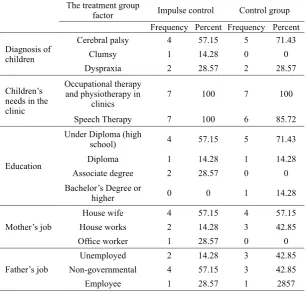
Totally, 16 participants among mothers of children with developmental coordination disorders who have been studied in mental work therapy clinics, neurology specialist and psychiatrist which were reduced to 14 participants (each group 7 has ptients) after the loss in treatment process Characteristics of subjects were evaluated in terms of education, employment status. Mean age of mothers in intervention was 32-41 that mean in experimental group was 34.73±3.02 years and in control group was 35.13±3.42 years and their children's age were 4 to 12 years. Table 2 Comparison of the frequency groups separately disorders in children, education
level, and occupation, number of children, mothers and fathers
Control group Impulse control
The treatment group factor
Percent Frequency
Percent Frequency
71.43 5
57.15 4
Cerebral palsy Diagnosis of
children Clumsy 1 14.28 0 0
28.57 2
28.57 2
Dyspraxia
100 7
100 7
Occupational therapy and physiotherapy in
clinics Children’s
needs in the clinic
85.72 6
100 7
Speech Therapy
71.43 5
57.15 4
Under Diploma (high school)
Education Diploma 1 14.28 1 14.28
0 0
28.57 2
Associate degree
14.28 1
0 0
Bachelor’s Degree or higher
57.15 4
57.15 4
House wife
Mother’s job House works 2 14.28 3 42.85 0 0
28.57 1
Office worker
42.85 3
14.28 2
Unemployed
Father’s job Non-governmental 4 57.15 3 42.85 2857 1
28.57 1
Employee
In this study, descriptive statistics mean and standard deviation frequency test for components of depression and anxiety in the pretest, posttest, and follow-up was used (Table 3).
According to Table 3, it can be concluded that anxiety and depression in the experimental group has been reduced after the intervention, training and treatment of impulse control (In the experimental group after the intervention of
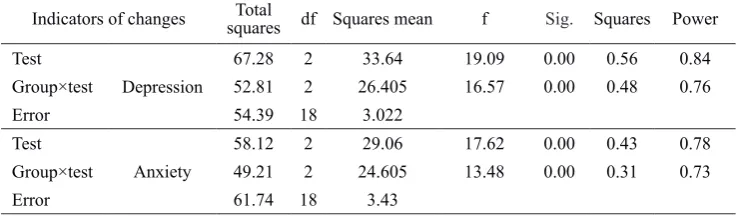
tests. Mixed analysis of variance was used to
evaluate efficacy of research on depression scores in three pretest, posttest and follow-up which results are presented in Table 4. Table 3 The mean and standard deviation component of depression and anxiety in the pretest, posttest and
follow-up (3 weeks)
Control group Test group Posttest Follow-up Pretest Follow-up Posttest Pretest SD M SD M SD M SD M SD M SD M 3.12 23.92 3.32 24.82 3.45 24.42 3.02 24.42 3.12 15.71 2.53 25.65 Depression 3.45 24.62 3.71 24.07 3.63 23.52 3.25 23.52 3.03 13.53 3.04 22.05 Anxiety
Table 4 Results of mixed analysis of variance to evaluate effectiveness of research on depression scores in three pretest, posttest and follow-up Statistical
Power Squares Sig. f Squares mean df Total squares Indicators of changes
0.84 0.56 0.00 19.09 33.64 2 67.28 Depression Test 0.76 0.48 0.00 16.57 26.405 2 52.81 Group×test 3.022 18 54.39 Error 0.78 0.43 0.00 17.62 29.06 2 58.12 Anxiety Test 0.73 0.31 0.00 13.48 24.605 2 49.21 Group×test 3.43 18 61.74 Error
As Table 4, differences between two groups of experimental and control, on the pretest, posttest and follow-up in depression is significant. Thus according to Table 3 it can be said that, this intervention resulted in a significant reduction in depression in the experimental group compared to the control group. Scores of experimental group in pretest, posttest and follow-up were (15.19,15.71,25.65) and in control group are (23.92,24.82,24.42) that in experimental group has reduced to 10.46. In anxiety, differences between two groups-experimental and control– in pretest, posttest, follow-up were significant. Scores of pretest, posttest and follow-up are 13.34, 13.54, 22.05 and in control group are 24.62, 24.07, 23.52 that it reduced to 8.79 in experimental group. So according to Table 4, it can be said that this intervention resulted in a significant reduction in anxiety in the experimental group compared to the control group.
Discussion
Aim of this study was to investigate efficacy of impulse control training on depression and anxiety in mothers of children with developmental coordination disorders (DCD). The results of current research showed that training impulse
is consistent with Spray's research [25] that the treatment of cognitive behavioral therapy is one of the most important and half in patients with clinical disorders (psychological disorders that people suffer it in period of their life) is effective on the mental health influence. Newman Vidiom and Nathan's research [34] showed that impulse control training skills were effective in problem-solving skills and enhances life skills. Mueller, Bart and Dugerty [35] in this study showed that other impulsive control training are effective on sudden behavior,mood disorders and other disorders [26].
Goldstein and Goldstein [26] showed that impulse control training has key role in decreasing behavioral and anxiety disorders which the efficacy of this treatment can cause changes in thoughts and feelings and acceptance. The most important ability of the training to clients is that this training let participants to delay emotions and finally train reduction of severe and involuntary tendency to do and brought back the anxiety about future to the present by examining thoughts and feelings and to identifying and explain the inner and outer coping responses and leads to reduction of inconsistent.
Pooshanha and colleagues also showed efficacy of impulse control training at unsteady behaviors and sudden impulses, depression and anxiety disorders which this effect had remained in follow-up period. This study by accepting and providing understanding and accepting of mothers and accepting pain of negative emotions and introduction to understanding the thoughts and feelings that leads to self-destructive behavior and impulsive and has helped to reduce negative emotions and externalize the insidious depression.
The studies of Najami, Ramsi and Rosan and Biderman and colleagues showed the efficacy of this treatment on beliefs of those sudden and risky behaviors and suggested that this treatment is effective in chronic and persistent disorders over time and train accepting skills, change and problem solving to patients and families with chronic patients and is preserved in follow-up period. Mothers of children with ADHD are highly sensitive to any reaction which this treatment
is not only to train parenting to mothers and respond to child but also it's effective in other social situations. Because these mothers due to lack of problem solving attitude and stigma of society and social environments in which they are expected to find an elusive presence and solitary and the efficacy of this study is that mothers of children with Developmental Coordination Disorder done that to a large extent been neglected and professionals in the centers focus on children's disorders to children and families. Limitation of this study was that the pretest was conducted in the first week after admission that the patient's clinical condition were not good so it's likely that effect the element of time to pretest anxiety and depression scores is shown higher than it is. Since the factors of causes of mood disorders in mothers (Such as the exclusion of the spouse, frustration, guilt and weakness), may be different so it's recommended for future researches in addition to the above limitation, this way would be used in families of mental and physical and other mood disorders.
Conclusion
This study showed that anxiety and depression in mothers of children with developmental coordination disorder are high and mothers' mental health were low and the treatment of impulse control has reduced the severity of symptoms of depression and anxiety.
Acknowledgments
The authors are deeply thankful of the cooperation of participants in this study.
Contribution
Study design: NZ, SZ
Data collection and analysis: NZ, HJ Manuscript preparation: NZ, ZA
Conflict of Interest
"The author declares that they have no competing interests."
Funding
for the research, authorship and/or publication of this article.
References
1- Sadock BJ, Sadock VA, Ruiz P. Kaplan and Sadock comperehensive Text book of psychiatry. Vol 2. US, Philadelphia: Lippincott Williams & Wilkins; 2012. 2- American Psychiatric Association, Diagnostic and Statistical Manual of Mental Disorders 5 edition, (Dsm-5). New York: American Psychologist; 2013.
3- Ganji M. Abnormal psychology based on DSM-5. Tehran: Savalan publications; 2013.
4- Zamani N, Habibi M. Compare the influence of both dialectic and cognitive behavior therapies to maintain mothers’ mental health whose childrenwith special needs.
Journal of Research & Health Social Development & Health Promotion Research Center.
5- Sartorius N, Leff J, Lopez J, Ibor L, Maj M, Okasha A. Family & Mental Disorders: from burden to empowerment.chichester. UK; Wiley: 2008.
6- Dowdell EB. Caregiver burden: grandmothers raising their height risk grandchildren. J Psychosoc Nurs Ment Health Serv1995; 33(3): 27-30.
7- Hankin CS. ADT-ID and its impact on the family.
Drug Benefits Trends2001; 13: 15-6.
8- Sanders JL, Morgan SB. Family stress and adjustment as perceived by parents of children with autism or Down syndrome: implicatiations for intervention. Child Fam Behav Ther1997; 19(4): 15-32.
9- Zamani N, Farhadi M, Jamilian HR.The Effectiveness of Dialectical Behavior Group Therapy on Expulsive Anger and Impulsive Behaviors. [dissertation]. Hamedan: Islamic Azad University, College of clinical psychology 2012.
10- Lambert KG. Rising rates of depression in today’s society: Consideration of roles of effort-based rewards and enhanced resilience in day-to-day functioning.
Neurosci Biobehav Rev2006; 30(4): 497-510
11- Young JE, Klosko JS, Weishaar ME. Translate: Hamidpoor H. Schema therapy: A Practitioner’s guide. New York: Guilford press; 2003.
12- Zamani N, Ahmadi V, Ataie Moghanloo V, Mirshekar S. Comparing the Effectiveness of two Therapeutic Methods of Dialectical Behavior Therapy and Cognitive Behavior Therapy on the Improvement of Impulsive Behavior in the Patients Suffering from Major Depressive Disorder (MDD) Showing a Tendency to Suicide.
Journal of Ilam University of Medical Sciences2014; 22(5): 45-54.
13- Lavretsky H, Kumar A. Clinically significant non-major depression: Old concepts, new insights. Am J Geriatr Psychiatry2002:10(22): 239-55.
14- Khodayarifard M, Parand A. Stress. Teharn:
Publication Teharn university; 1386.
15- World Health Organization. Mental Health: Facing the challenges, Building solutions, WHO Pub; 2010. 16- Sadock BJ, Sadock AV. Synopsis of psychiatry behavior and science 1clinical psychiatry, 9ed. US, Philadelphia: Lippincott Williams and Wilkins; 2007. 17- Macnee CL, Cabe S. Understanding Nursing Research, Reading and Using Research in Evidence Based practice. 2nd Ed. US, Philadelphia: Lippincott Williams & Wilking; 2006.
18- Wells A. Metacognitive therapy for anxiety and depression 2009. Translated by Akbari M, Mohammadee A, Andooz Z. Tehran: Arjmand pub; 2012.
19- Zamani N, Farhadi M, Jamilian H R, Habibi M. Effectiveness of Group Dialectical Behavior Therapy (Based on Core Distress Tolerance and Emotion Regulation Components) on Expulsive Anger and Impulsive Behaviors. Arak Medical University Journal2015; 17(11): 53-61
20- Barron WB. Effect of religious coping skills training with group cognitive behavioral therapy for treatment of depression. [dissertation]. USA: Northcentral University, College of psychology 2007; pp:7-12.
21- Zamani N, Zamani S, Habibi M, Abedini S. Comparison in stress of caring mothers of children with developmental, external and internal disorders and normal children. Journal of Research & Health2017; 7(2): 688-94
22- Chew CE. The effect of dialectical behavioral therapy on moderately depressed adults: A multiple baseline design. [dissertation]. USA: University of Denver, College of psychology 2006.
23- Traner R, O’Donova C‚ Chandarana P‚ Kennedy S. Prevalence and outcome of partial remission in depression. J Psychiatr Neurosci2002; 27(4): 241-7. 24- Zamani N, Habibi M, Darvishi M. To Compare the effectiveness of Dialectical Behavior Therapy and Cognitive Behavioral Group Therapy in Reducing Depression in Mothers of Children with Disabilities.
Arak Medical University Journal2015; 18(1) :32-42 25- Sperry L. Cognitive behavior therapy of DSM-IV personality disorders. USA: Brunner/Mazel; 1999. 26- Goldstein S, Goldstein M. Managing attention deficit hyperactivity disorder in children: A Guide for practitioner. 2nd Ed. NY: Wiley; 1998.
27- Poushaneha K, Ghobari Bonab B, Hasanzadeh Namin F. Effect of training impulse control on increase attention of children with attention–deficit/ hyperactivity disorder. Procedia Social and Behavioral Sciences2010, 5, 983–7.
hyperactivity disorder and social dysfunctioning. Clin Psychol Rev2008; 28(4): 692-708.
29- Ramsay J, & Rostain N. Psychosocial treatments for attention-deficit/hyperactivity disorder in adults: current education and future direction, professional psychology.
Research and Practice2007; 38(4): 338-46.
30- Biederman J, Monuteaux MC, Mick E, et al. Young adult outcome of attention deficit hyperactivity disorder: a controlled 10-year follow-up study. Psychol Med2006; 36(2): 167-79.
31- Lee S & Hinshaw S. Predictors of Adolescent Functioning in Girls with Attention-deficit/Hyperactivity Disorder (ADHD): The Role of Childhood ADHD,
Conduct Problems, and Peer Status. J Clin Child Adolesc Psychol2006; 35(3): 356–68.
32- Beck AT, Steer RA, Brown GK. Manual for the beck depression inventory-II. San Antonio, TX: The psychological corporation; 1996.
33- Fathiashtiani A, Dadsetan M. Psychological Tests personality and mental health. Besat pub; 2009. 34- Newman JP, Widom CS, Nathan S. Passive avoidance in syndromes of disinhibition: psychopathy and extraversion. J Pers Soc Psychol1985; 48(5): 1316-27. 35- Moeller FG, Barratt ES, Dougherty DM, Schmitz JM, Swann AC. Psychiatric aspects impulsivity. Am J Psychiatry2001; 158(11): 1783-93.