*Corresponding author:Arul G ISSN:0976-3031
ResearchArticle
EXPERIMENTAL STUDY OF THE THERMO PHYSICAL AND ACOUSTICAL PROPERTIES OF
BINARY MIXTURES
Yackobu S
1, Arul G
2*and SyedAhamedHussainI
31
Department of Physics, Thiru. A. Govindasamy Government Arts College, Tindivanam
2Department of Physics, Government Arts College (Autonomous), Kumbakonam
3Department of Chemistry, Thiru. A. Govindasamy Government Arts College, Tindivanam
DOI: http://dx.doi.org/10.24327/ijrsr.2018.0908.2452
ARTICLE INFO ABSTRACT
Ultrasonic velocity (U), Density (ρ) and Viscosity (ɳ) have been measured in binary liquid mixtures of Propylene glycol mono propyl ether (PGPE) + Aniline (ANI) and PGPE + 1-Amino-2-propanol (MIPA) at 303.15 K and 313.15 K. From these values, acoustical parameters such as Adiabatic compressibility (β), Free length (Lf), Acoustical impedance (Z) and Molar volume (V) were calculated using standard relations. Excess values such as ZE, LfE, ɳE, UE and VE were also determined. The results are interpreted in terms of molecular interaction such as dipole - dipole interaction or hydrogen bonding between the components of mixture.
INTRODUCTION
Ultrasonic investigation of liquid mixtures containing polar solvent and weakly interacting components are of considerable interest to researchers in order to understand the intermolecular interaction and binary forces prevailing between the atoms or molecules (1–3). Knowledge about the intermolecular interaction between the components is very much important in several industrial and technological processes (4–7). Ultrasonic velocity and its related parameterslike Adiabatic compressibility (β), Free length (Lf), Acoustical impedance (Z)
and Molar volume (V) helps in characterizing thermodynamic and physico – chemical aspects of binary liquid mixtures such as molecular association and dissociation (8-9). Hence, the intermolecular interaction existing between the components of these binaries has to be revealed in order to understand any physico- chemical process in these mixtures.
The present work deals with the study of ultrasonic velocity and its related parameter like Adiabatic compressibility(β), Free length (Lf), Acoustical impedance (Z), Molar volume (V)
and their excess values like ZE ,LfE, ɳE, UE and VE in the binary
system of propylene glycol mono propyl ether (PGPE) +
aniline (ANI) and propylene glycol mono propyl ether (PGPE) + 1-Amino-2-propanol (MIPA) at two different temperatures viz., 303.15K and 313.15K.ANI is a popular industrial organic solvent and hence its interaction with neighbouring components in a mixture has to be exposed to know the significance of its compositional behaviour (10). PGPE is a polar solvent and the hydroxyl group of PGPE forms hydrogen bonding with the hydrogen atom of weak base components such as amino group of 1-Amino-2-propanol and aniline. The – OH group of PGPE forms hydrogen bonding with the –OH group of 1-Amino-2-propanol. PGPE is soluble in ANI and MIPA due to the presence of electronegative force between the components.
Experimental details
PGPE, ANI and MIPA were obtained from Sigma Aldrich Chemicals Ltd. Various concentration of the binary mixtures were prepared in terms of mole fractions. The ultrasonic velocities in liquid mixtures were measured using an Mittal type ultrasonic interferometer model M-84 at 2 MHz frequency with an accuracy of ±0.1 ms-1. Densities and Viscosities were determined using specific gravity bottle and Ostwald’s
Available Online at http://www.recentscientific.com
International Journal of
Recent Scientific
Research
International Journal of Recent Scientific Research
Vol. 9, Issue, 8(B), pp. 28389-28394, August, 2018
Copyright © Yackobu S, Arul G and Syed AhamedHussain I, 2018, this is an open-access article distributed under the terms of the Creative Commons Attribution License, which permits unrestricted use, distribution and reproduction in any medium, provided the original work is properly cited.
DOI: 10.24327/IJRSR
CODEN: IJRSFP (USA)
Article History:
Received 13thMay, 2018 Received in revised form 11th June, 2018
Accepted 8thJuly, 2018
Published online 28th August, 2018
Key Words:
viscometer with an accuracy of ± 0.1Kgm-3& ± 0.001NSm-2 respectively. All the measurements were made at two different temperatures (303.15K and 313.15K) with the help of an electronically operated digital constant temperature bath (Guna make model) having the operating temperature range from 1oC to100oC with an accuracy of ± 0.1K.Each observation is repeated for five times and the average is taken as final value. Using the measured data, the acoustical parameter such as Acoustical impedance (Z), Adiabatic compressibility (β), Molar volume (V) and Free length (Lf) were calculated from
the following standard thermophysical expressions
Z = U.ρ1
Where U = Ultrasonic velocity ρ = Density of liquid
β = 1/U2ρ 2
V = Meff /ρmix 3
Where Meffis effective molecular weight given as
Meff= ∑Mi xi
In the above expression, Mi& xi are the molecularweight and
mole fraction of individual constituents respectively.
Lf =KT√ 4
Where KT is a Jacobson’s constant.
The excess values of the parameter are computed from the following expressions
ɳE =ɳmix - (x1ɳ1 +x2ɳ2) 5
ZE = (ρmixU mix) – (X1ρ1U1+X2ρ2U2) 6
VE = (X1M1+X2M2/ρmix) – (X1M1/ρ1 + X2M2/ρ2) 7
Where
ρmix = Density mixtures
ρ1 = Density of first components
ρ2 = Density of second components
M1= Molecular weight of first components
M2 = Molecular weight of second components
LfE = K/(U2mixρmix)1/2 – (X1 K/(U21ρ1)1/2 +( X2 K/( U22ρ2)1/2) 8
Where
Z K = Jacobson’s constant = 200×10-8 at 303.15K =203×10-8 at 313.15K
UE = U–(X1U1+X2U2) 9
From the review of literature, the values for the Density and Speed of MIPA, ANI and PGPE are given in table 1 (11).
Table 1 Density and Speed of MIPA, ANI and PGPE
T (K) Ρ (Kgm-3) U (Ms-1)
MIPA
303.15 951 952.39
1526 ---
313.15 944 944.30
1493 ---
ANILINE
303.15 1011 1010.9
1612 1614
313.15 1006 ---
1581 ---
PGPE
303.15 879 ---
1215 ---
313.15 872 ---
1186 ---
RESULTS AND DISCUSSION
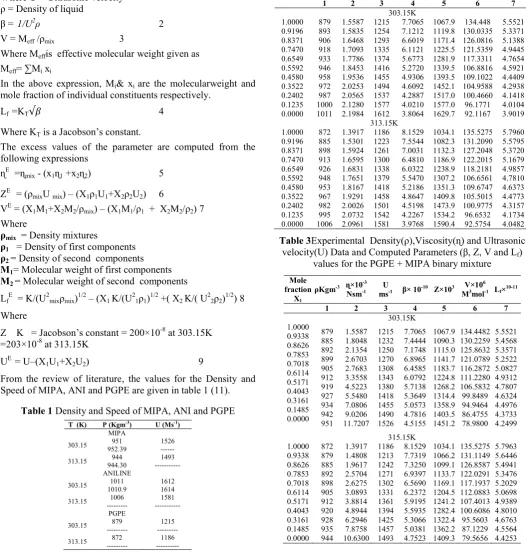
The experimental density (ρ), viscosity (ɳ), and Ultrasonic velocity (U) values and computed parameters β,Z, V & Lfof
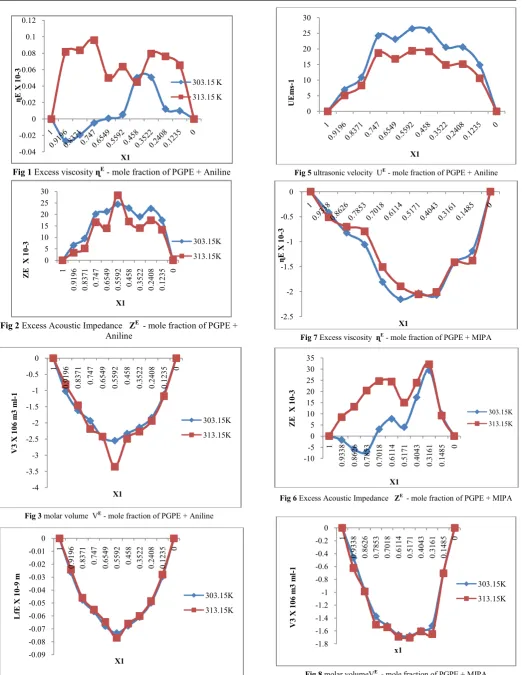
PGPE in ANI and PGPE in MIPA at 303.15K & 313.15K are given in Table 2 and 3 respectively. All the excess values of the parameter VE, LfE, ZE, ɳE and UE at 303.15K & 313.15K are
given in Table 4 and 5.
Table 2Experimental Density(ρ),Viscosity(ɳ) and Ultrasonic velocity(U) Data and Computed Parameters (β, Z, V and
Lf)values for thePGPE + ANI binary mixture
Mole fractionX1ρ Kgm
-3 ɳ×10-3
Nsm-1 Ums
-1 β× 10-10 Z×103 V×106
M3mol-1 Lf× 10
-11
1 2 3 4 5 6 7
303.15K 1.0000 0.9196 0.8371 0.7470 0.6549 0.5592 0.4580 0.3522 0.2402 0.1235 0.0000 879 893 906 918 933 946 958 972 987 1000 1011 1.5587 1.5835 1.6468 1.7093 1.7786 1.8453 1.9536 2.0253 2.0565 2.1280 2.1984 1215 1254 1293 1335 1374 1416 1455 1494 1537 1577 1612 7.7065 7.1212 6.6019 6.1121 5.6773 5.2720 4.9306 4.6092 4.2887 4.0210 3.8064 1067.9 1119.8 1171.4 1225.5 1281.9 1339.5 1393.5 1452.1 1517.0 1577.0 1629.7 134.448 130.0335 126.0816 121.5359 117.3311 106.8816 109.1022 104.9588 100.4660 96.1771 92.1167 5.5521 5.3371 5.1388 4.9445 4.7654 4.5921 4.4409 4.2938 4.1418 4.0104 3.9019 313.15K 1.0000 0.9196 0.8371 0.7470 0.6549 0.5592 0.4580 0.3522 0.2402 0.1235 0.0000 872 885 898 913 926 948 953 967 982 995 1006 1.3917 1.5301 1.5924 1.6595 1.6831 1.7651 1.8167 1.9291 2.0026 2.0732 2.0961 1186 1223 1261 1300 1338 1379 1418 1458 1501 1542 1581 8.1529 7.5544 7.0031 6.4810 6.0322 5.5470 5.2186 4.8647 4.5198 4.2267 3.9768 1034.1 1082.3 1132.3 1186.9 1238.9 1307.2 1351.3 1409.8 1473.9 1534.2 1590.4 135.5275 131.2090 127.2048 122.2015 118.2181 106.6561 109.6747 105.5015 100.9775 96.6532 92.5754 5.7960 5.5795 5.3720 5.1679 4.9857 4.7810 4.6373 4.4773 4.3157 4.1734 4.0482
Table 3Experimental Density(ρ),Viscosity(ɳ) and Ultrasonic velocity(U) Data and Computed Parameters (β, Z, V and Lf)
values for the PGPE + MIPA binary mixture
Mole fraction
X1
ρKgm-3 ɳ×10-3
Nsm-1
U
ms-1 β× 10-10 Z×103
V×106
M3mol-1 Lf×10-11
1 2 3 4 5 6 7
Table 4 Excess acoustic impedance (ZE),excess viscosity(ɳE ), excess Molar volume(VE), excess free lenth(LfE) and excess
Ultrasonic velocity(UE) values of the PGPE + ANI binary mixture
303.15 K Mole
fraction X1
ZE
X103 ɳE X10-3
VE X106
m3 mol-1
LfE X10 -9m
UE
ms-1
1.0000 0.9196 0.8371 0.7470 0.6549 0.5592 0.4580 0.3522 0.2402 0.1235 0.0000
0 6.510 9.521 20.151 21.240 24.423 22.743 18.980 22.557 17.459
0
0 -0.0267 -0.0193 -0.0048 0.0008 0.0054 0.0501 0.0506 0.0122 0.0099
0
0 -1.0200 -1.6088 -1.9351 -2.4438 -2.5471 -2.3285 -2.1405 -1.8419 -1.1213
0
0 -0.0261 -0.0475 -0.0565 -0.0678 -0.0732 -0.0676 -0.0608 -0.0498 -0.0295
0
0 6.920 10.912 24.234 23.125 26.486 26.118 20.534 20.598 14.836
0 313.15K
1.0000 0.9196 0.8371 0.7470 0.6549 0.5592 0.4580 0.3522 0.2402 0.1235 0.0000
0 3.279 5.181 16.579 13.933 28.363 16.924 14.055 17.456 13.305
0
0 0.0816 0.0836 0.0958 0.0499 0.0636 0.0450 0.0795 0.0762 0.0653
0
0 -0.8117 -1.4543 -2.1878 -2.4214 -3.3524 -2.4893 -2.2676 -1.9378 -1.1724
0
0 -0.0241 -0.0459 -0.0551 -0.0646 -0.0769 -0.0659 -0.0600 -0.0485 -0.0280
0
0 5.085 8.283 18.649 16.792 19.358 19.174 14.854 15.116 10.573
0
Table 5Excess acoustic impedance (ZE),excess viscosity(ɳE ), excess Molar volume(VE), excess free lenth(Lf
E
) and excess Ultrasonic velocity(UE) values of the PGPE + MIPA binary
mixture
303.15K Mole
fraction X1 Z
E X103 ɳE X10-3 VE X106
m3 mol-1
LfE X10 -9m
UE
ms-1
1.0000 0.9338 0.8626 0.7853 0.7018 0.6114 0.5171 0.4043 0.3161 0.1485 0.0000
0 -1.726 -5.931 -7.084 3.070 7.759 3.994 17.334 29.468 9.847
0
0 -0.4160 -0.8218 -1.0584 -1.8077 -2.1529 -2.0338 -2.0711 -1.4231 -1.1863
0
0 -0.4665 -0.9714 -1.3726 -1.5186 -1.6615 -1.6768 -1.5952 -1.5200 -0.6927
0
0 -0.0016 -0.0053 -0.0050 -0.0240 -0.0364 -0.0555 -0.0463 -0.0512 -0.0216
0
0 -2.214 -8.036 -10.245
1.938 6.992 3.067 16.821 27.917 10.793
0 313.15K
1.0000 0.9338 0.8626 0.7853 0.7018 0.6114 0.5171 0.4043 0.3161 0.1485 0.0000
0 8.466 13.144 20.395 24.671 24.421 15.005 23.937 32.173 9.185
0
0 -0.5128 -0.7013 -0.7941 -1.5072 -1.8933 -2.0532 -2.0068 -1.4109 -1.3779
0
0 -0.6236 -0.9873 -1.5011 -1.5428 -1.6887 -1.7040 -1.6063 -1.6475 -0.7043
0
0 -0.0179 -0.0362 -0.1641 -0.0567 -0.0613 -0.0725 -0.0573 -0.0571 -0.0223
0 -
0 8.020 13.519 20.580 26.094 25.550 16.253 24.224 29.639 10.186
0
From the tables 2 and 3, it is found that the ultrasonic velocity (U), density (ρ) and viscosity (ɳ) are increasing with increasing in mole fraction of ANI and MIPA. The increase in velocity perhaps is due to structural changes occurring in the mixture, resulting in weakening of intermolecular forces (12). However, in both the binary systems, ultrasonic velocity (U) decreases with increase of temperature at all noted concentration. This is because of the increase in spacing between molecules and increase in enthalpy of its structural arrangement. Other
parameters such as density (ρ) and viscosity (ɳ) decreases with increase of temperature. This indicates that the intermolecular forces decreases due to increases in thermal vibrations of the system, which also causes an increase in volume expansion and hence increase in free path length.
In PGPE + ANI system, when mole fraction of aniline is increased, an increasing trend is observed in density, viscosity and velocity. It reveals that the addition of aniline increases the effective molecular space. This can be attributed to both relatively higher dielectric constant of aniline (13,14) and its electron donor nature. When ANI is mixed with PGPE, ANI exhibits significant interactions such as dipole – dipole interaction and hydrogen bonding in the liquid mixture.
However, Adiabatic compressibility (β) and Free length (Lf) of
PGPE + MIPA decreases with increase in concentration of MIPA. This shows significantinteraction between solute and solvent molecules and is found also in other binary system. Acoustic impedance (Z) is the ratio of the effective sound pressure at a point to the effective particular velocity at that point. In both the binary systems, on increasing the mole fraction of ANI and MIPA, the acoustic impedance (Z) also increases. This shows the weakening of intermolecular forces (15).
The decrease in molar volume (V), adiabatic compressibility (β) and free length (Lf) and increase in acoustic impedance (Z)
with the mole concentration of both binary systems reveals the presence of specific interactions between the components in these mixtures.
An examination of data in tables 4 & 5 suggests that the excess acoustic impedance (ZE) of PGPE + MIPA was initially negative and increases with increase in the mole fraction of MIPA and finally becomes positive. When temperature is increased, the entire range of excess acoustic impedance (ZE) becomes positive. Meanwhile the excess acoustic impedance (ZE) of PGPE + ANI is positive in the entire range of composition. Positive value of ZE in mole concentration of both binary systems reveals the possibility of the presence of strong attractive force between the components. The ɳE value of PGPE + ANI was initially negative and on increasing the mole fraction of ANI, the value of ɳE becomes positive. This reveals the presence of both strong attraction forces between the molecules and specific interaction such as formation of hydrogen bonding between OH and N. The negative value of ɳEof PGPE + MIPA suggest the mutual loss of specific interactions between unlike molecules (16,17). Negative deviation in viscosity may also occur where dispersion forces are dominant, particularly for the system having different molecular sizes (17,18). It reveals the presence of weak interaction between the molecules.
It is noticed from Table 4 and 5 that the behaviour of excess acoustic impedance (ZE) is similar to excess ultrasonic velocity UE. The positive value of UEalso indicates strong attraction among the components of a mixture (22).
The behaviour of excess values of ZE, Lf E
Fig 3 molar volume VE - mole fraction of PGPE + Aniline
Fig 4 Free Length LfE - mole fraction of PGPE + Aniline
Fig 5 ultrasonic velocity UE - mole fraction of PGPE + Aniline
Fig 7 Excess viscosity ɳE - mole fraction of PGPE + MIPA
Fig 6 Excess Acoustic Impedance ZE - mole fraction of PGPE + MIPA
Fig 8 molar volumeVE - mole fraction of PGPE + MIPA
-4 -3.5 -3 -2.5 -2 -1.5 -1 -0.5 0
1
0
.9
1
9
6
0
.8
3
7
1
0.
7
4
7
0
.6
5
4
9
0
.5
5
9
2
0.
4
5
8
0
.3
5
2
2
0
.2
4
0
8
0
.1
2
3
5 0
V3
X
1
0
6
m
3
m
l-1
X1
303.15K
313.15K
-0.09 -0.08 -0.07 -0.06 -0.05 -0.04 -0.03 -0.02 -0.01 0
1
0.
91
96
0.
8
3
71
0
.7
47
0.
6
5
49
0.
5
5
92
0
.4
58
0.
3
5
22
0.
2
4
08
0.
1
2
35 0
Lf
E
X
10
-9
m
X1
303.15K
313.15K
0 5 10 15 20 25 30
UEm
s-1
X1
-2.5 -2 -1.5 -1 -0.5 0
ɳE
X
10
-3
X1
-10 -5 0 5 10 15 20 25 30 35
1
0
.9
33
8
0
.8
62
6
0
.7
85
3
0
.7
01
8
0
.6
11
4
0
.5
17
1
0
.4
04
3
0
.3
16
1
0
.1
48
5 0
Z
E X
1
0
-3
X1
303.15K
313.15K
-1.8 -1.6 -1.4 -1.2 -1 -0.8 -0.6 -0.4 -0.2 0
1
0
.9
33
8
0
.8
62
6
0
.7
85
3
0
.7
01
8
0
.6
11
4
0
.5
17
1
0
.4
04
3
0
.3
16
1
0
.1
48
5 0
V3
X
10
6
m
3
m
l-1
x1
303.15K
313.15K
Fig 1 Excess viscosity ɳE - mole fraction of PGPE + Aniline
Fig 2 Excess Acoustic Impedance ZE - mole fraction of PGPE + Aniline
-0.04 -0.02 0 0.02 0.04 0.06 0.08 0.1 0.12
ɳE
X
1
0
-3
X1
303.15 K
313.15 K
0 5 10 15 20 25 30
1
0
.9
1
9
6
0
.8
3
7
1
0
.7
4
7
0
.6
5
4
9
0
.5
5
9
2
0
.4
5
8
0
.3
5
2
2
0
.2
4
0
8
0
.1
2
3
5 0
Z
E X
1
0
-3
X1
303.15K
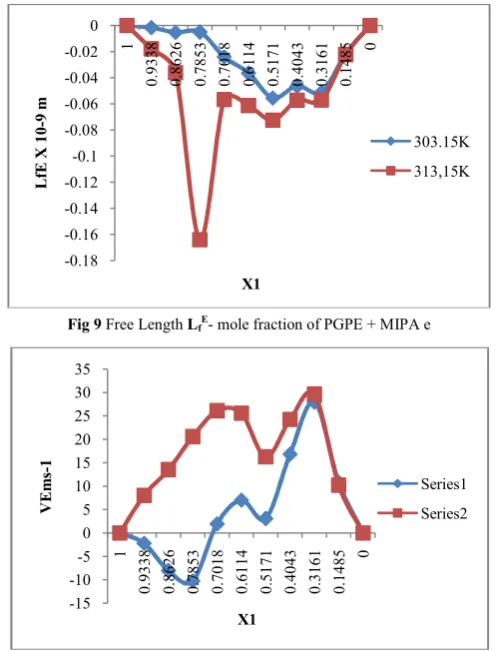
Fig 9 Free Length LfE- mole fraction of PGPE + MIPA e
Fig10 ultrasonic velocity UE - mole fraction of PGPE + MIPA
The value of VE is the resultant contribution from several opposing effects namely chemical, physical and structural. The chemical or specific interaction result in volume concentration, leading to negative excess volume and these interactions include charge transfer complexes, dipole – dipole and dipole – induced dipole interaction, proton acceptor interaction and H – bonding between unlike molecules.
The more negative VE value of both systems viz., PGPE + Aniline and PGPE + MIPA at 303.15K and 313.15K reveals the presence of two CH3 groups increases the electron density
at the oxygen atom of hydroxyl group. Hence it may be concluded that the interaction between PGPE with ANI and MIPA under study increases when hydroxyl group is attached to a carbon atom with greater number of CH3 groups.
The numerical values of VE become more negative as the temperature is increased and they vary in the following order PGPE + Aniline ˂ PGPE + MIPA. The excess intermolecular free length LfEare negative in both binary systems, at over the
entire range of compositions. The negative excess values are due to the associated molecules, which accounts for the existence of strong molecular interaction (19), whereas positive excess values causes weak interaction between unlike molecules. The sign of excess intermolecular free length LfE
play a vital role in assessing the interaction between the components due to hydrogen bonding, charger transfer, dipole - dipole interaction and dipole–induced dipole interaction, intertial accommodation and orientationalordering (20). Therefore negative value of excess intermolecular free length LfE in present work suggest that dipole – dipole interaction are
prevailing through H – bonding in the liquid mixtures (21).
CONCLUSION
The densities, viscosities, speed of sound, acoustic impedance, molar volume, intermolecular free length, and adiabatic compressibility at 303.15 K & 313.15K have been measured for two binary mixtures. From these measured data excess acoustic impedance, excess molar volume, deviation in viscosities, excess ultrasonic velocity and excess intermolecular free length have been calculated. These results have been used to discuss the nature of interaction between unlike molecules in terms of hydrogen bonding, dipole – dipole interaction and proton acceptor interaction of molecules.
Acknowledgement
The author gratefully acknowledge the Minor Research Project (MRP) No: 5236/14 (UGC – SERO) Hyderabad, for providing financial assistance.
References
1. A.Awasthi and J,P Shukla (Ultrasonics, 41 (2003), 477.
2. P.Venkatesu. G.Chandrasekar and M.V.PrabakareRao. Phys&chem..of liquids : 44(2006), 287.
3. G.Arul and L.PalaniappanJ.Acoust. Soc.India, 28 (2000), 393.
4. A. Malandu pal and Guruchandrandas. J.pure&Applied Ultrasonics 1990, 21,9 – 15.
5. V K Syal, M S Chanhan, BK Cchandra, and S.ChanhanJ Pure& applied ultrasonic 1996,18 104 -107.
6. R.Ezhilpavai and S.Renuka, Ind J of Res in phy chem., 2011 1(1), 32-37.
7. Mr.Praharaj, A. Satapathy, S.Mishra and PR Mishra J of chem. & Phar res 2012 4(4), 1910 -1920.
8. ManoharMurthi N and NagabhushnamIndian J .Chem1984, 23, 510.
9. Khasare SB, Indian J pure& Applied phy 1987 25,182.
10. PalaniappanLakshmanan and
MahandiranGovindasamyTubitaic35(2011),303 -310. 11. Estrella Alvarez, Fernando carderia,Diego Gomez -
Diaz and Jose M. NavazaJ . Chem. Eng Data 2010 55, 2567 - 2575.
12. M. Aravinthraj, N. Dineshbabu, R. Kubendran, S.Venkatesan and F.Liakath Ali khan Scholar Research Lib,Archives of phy research 2011, 2(1) 254 -261.
13. Palaniappan L. Ind.J.pure& applied phy 2002, 40,828. 14. Palaniappan L. Ind.J .phy, 2001, 75 B, 515.
15. Manoj KU. Praharaj, Abhiramsatapathy, Prativaranimishra and Sarmishthamishra Jour of chem. &pharma research, 2013, 5(1): 49 -56.
16. H.Illoekhani.K.D Reddy and M.V.P.Raophys. Chem. Liq. 14 181 (1985)
17. R.J.Fort and W.R Moore. Trans Faraday. Soc, 62 1112 (1966)
18. B.Gonzaleg, A.Domlnguez and J.Tojo.J.chem. Eng. Data 49,1590 (2004)
19. U.Sridevi, K.Samatha and VisvanantasarmaJ. Pure & applied. Ultrasonics,26, 1 (2004).
-0.18 -0.16 -0.14 -0.12 -0.1 -0.08 -0.06 -0.04 -0.02 0
1
0
.9
3
3
8
0
.8
6
2
6
0
.7
8
5
3
0
.7
0
1
8
0
.6
1
1
4
0
.5
1
7
1
0
.4
0
4
3
0
.3
1
6
1
0
.1
4
8
5 0
Lf
E
X
1
0
-9
m
X1
303.15K
313,15K
-15 -10 -5 0 5 10 15 20 25 30 35
1
0.
93
3
8
0.
86
2
6
0.
78
5
3
0.
70
1
8
0.
61
1
4
0.
51
7
1
0.
40
4
3
0.
31
6
1
0.
14
8
5 0
VEm
s-1
X1
Series1
20. R.J. Fort and W.R Moore. Trans Faraday. Soc, 61 2102 (1965).
21. P.S.Nikam, V.M.Kapade, and
MehdimhasanIndianJ.Pure Applied Ultrasonics 7, 16 (2000).
22. T.Ramanujappa,J.A. Bhavani, E.Rajagopal and N.Monaharamurthi, Indian J.Pure.Appliedphy, 38, 301 (2000).
How to cite this article:
Yackobu S, Arul G and Syed AhamedHussain I. 2018, Experimental Study of the Thermo Physical and Acoustical Properties of Binary Mixtures.Int J Recent Sci Res. 9(8), pp.28389-28394.DOI: http://dx.doi.org/10.24327/ijrsr.2018.0908.2452