99
Applying Mitigation Devices in Request Speech Act: Do
Gender and Language Proficiency Have any Effect?
Parisa Abdolrezapour 1
(1) Salman Farsi University of Kazerun, Kazerun, Iran, [email protected]
Abstract. This study aims to examine how Iranian EFL learners perceive and apply mitigation devices in request speech act in 4 asymmetrical situations. Role-play interactions and questionnaires were used to elicit the required data from Iranian informants (male vs. female). The results obtained from the analysis of data revealed that in identical situations, male requestors were comparably more certain than females that the addressee would not be offended form their requests using fewer mitigation devices. In addition, the perception of social power and social distance variables by men and women differed; females were more concerned about the social power and social distance between the interlocutors. Moreover, it was found that language proficiency played an important role in the type of request strategy applied by Iranian EFL learners. Advanced learners were found to use more externally mitigated requests than intermediate and elementary levels.
Keywords: Gender, language proficiency, mitigation devices, politeness, request speech act.
1. Introduction
attempts to discover a universal theory to be applied in diverse cultures and languages (Brown & Levinson, 1987; Grice, 1975; Leech, 1983) have culminated in the idea that every culture has its own norms and different cultures have different realizations of politeness. The strategies appropriate for maintaining face and the relative sensitivity of different aspects of face may vary from culture to culture and such differences should be considered in EFL instruction.
A great deal of research has been done on different speech acts and has shown that there are cross-cultural differences with regards to either speech act production or the realization of various speech acts (Abdolrezapour, 2012; Abdolrezapour & Eslami-Rasekh, 2012; Abdolrezapour & Vahid Dastjerdi, 2013; Blum-Kulka & Olshtain, 1984; Blum-Kulka & House, 1989; Wierzbicka, 1991). Different perceptions of speakers from heterogeneous backgrounds concerning the contextual appropriateness of various politeness strategies might cause communication breakdowns.
The focus of this attempt is on mitigation devices applied in request speech act, which has previously appeared in the literature (Abdolrezapour & Eslami-Rasekh, 2012; Economidou-Kogetsidis, 2008; Márquez-Reiter, 2000; Usó-Juan, 2007). Requests are face-threatening acts (Brown & Levinson, 1987, 978), which endanger both the requestor's and the requestee's face as his/her request might be rejected. This study is the first attempt at investigating the production of mitigation devices by Iranian EFL learners. Moreover, the effect of informant's gender and their language proficiency on applying and perceiving mitigation devices will be scrutinized.
2. Literature Review
2.1. Request speech act
researchers and applied linguists have addressed the question of appropriate norms of performing speech acts in various studies.
A request may be seen as a speech act through which the speaker wants to get the addressee to do something that is generally in the interest of the speaker and demands a certain effort or exertion on the part of the addressee (Haverkate, 1979; Searle, 1976). This speech act is important both from a sociolinguistic perspective, as they are sensitive to social factors such as age, gender, social power as well as social distance between the interlocutors, and from a pragmatic perspective, as different forms are used to make a request to be in accord with matters of politeness.
A number of studies have been devoted to identifying, and trying to explain, the cross-cultural differences which exist between Persian and English, focusing on the request speech act (Abdolrezapour & Eslami-Rasekh 2012; Ahangar & Amoo Ali Akbari, 2007; Eslami-Eslami-Rasekh, 1993). Eslami-Rasekh (1993), comparing American and Persian speakers’ request strategies, posited that Persian society is less individualistic and more psychologically dependent on group mentality, which leads to strategies of positive politeness as opposed to negative politeness used by American society. In fact, in her study, Persian speakers were found to use direct strategies 70% of the time, compared to 12% of the tested cases for American speakers. Her results were in disagreement with a later attempt by Ahangar and Amoo Ali Akbari (2007), who found that Iranian requestors use more negative politeness strategies. In a recent study, Abdolrezapour and Eslami-Rasekh (2012) documented differences in the type of mitigation devices used in the request speech acts by Persian and American native speakers. Also, their results indicated different perceptions of politeness in situations involving the social power and social distance variables by these groups, as will be explained later in this study.
2.2. Mitigation devices in request speech act
The notion of mitigation has been used technically since the late 1970s, when the concept of illocutionary act was operationalized in discourse analysis. This term was introduced in pragmatics by Fraser (1990) referring to those linguistic devices used by speakers to protect themselves against various interactional risks. Holmes (1984) regards mitigation as a particular case of attenuation which is used when the predictable consequences of a speech act utterance are negative. Brown and Levinson (1987 [1978]) treat mitigation as a synonym of politeness and it is the core of Goffmanʼs (1967) notion of face and Leechʼs (1983) maxims of politeness, in particular, the Tact Maxim.
occur within the speech act itself (e.g., Could you possibly give me your pen?) (Blum-Kulka et al., 1989). Both kinds of modifiers (i.e. internal and external) could either soften or intensify the force of the whole request.
Brown and Levinson (1987 [1978]) argued that the degree to which interlocutors use mitigation devices and the type of mitigation devices used can be affected by some contextual factors such as social distance, social power and the degree of imposition of the act. The crux of their argument was that there is a direct and linear relationship among these social variables, such that the greater the hearer’s power, the social distance between interlocutors and the degree of imposition of the act, the greater the face-threat will be and the greater the degree of indirectness and modifications to be employed by the speaker. Following Brown and Levinson (1987 [1978]), Nikula (1996, cited in Salazar Campillo 2007, p.211) proposes the following five contextual factors that may affect the appropriate use of peripheral modification devices:
a) Power: those who have more power can express themselves without employing modifiers (for example, boss-employee)
b) Social distance: those who are strangers will tend to use more modifiers
c) Ranking of imposition: how demanding the request is implies that more or less modification will be used
d) Type of interaction: whether the interaction is for transactional or interactional purposes will have an impact on the use of peripheral modification devices
e) Type of speech act: the more the speech act is face-threatening, the more modifying devices are needed.
devices used correlates positively with the power of the requestee and imposition of the request in the Iranian culture while Americans were found to be less concerned with the power of the requestee and considered themselves at the same social level with no interlocutor exerting power over the other. In another study on refusal speech act, Abdolrezapour and Vahid Dastjerdi (2013) reported that social variables such as social power and social distance made a difference in the way Iranians used mitigation devices when refusing while Americans’ refusals did not change considerably with regard to social variables. Afghari (2007) investigated the possible effects of the two context-external variables, namely, the social distance and dominance between the interlocutors, on the frequency of the apology intensifiers and found that the most intensified apologies were offered to friends and the least intensified apologies were offered to strangers. In addition, he found that the addressee’s dominance over the speaker resulted in a more intensified apology utterances.
The modification of a speech act has been the focus of a number of studies (Blum-Kulka, et al., 1989; Caffi, 1999; Holmes, 1984). This area of research is of central importance in cross-cultural studies for finding the appropriate norm of using language in communication, as a number of studies have pointed to the existing cross-cultural differences with regard to using mitigation devices in a number of speech acts such as request (Abdolrezapour & Eslami-Rasekh, 2012; Economidou-Kogetsidis, 2008) and refusal (Abdolrezapour & Vahid Dastjerdi, 2013; Bella, 2011). Investigating the form and function of requests in British English and Uruguayan Spanish, Márquez-Reiter (2000) found that the Britons employed higher levels of modifiers across the role-play situations than the Uruguayans did and a preference for external over internal modification was observed. She concluded that Uruguayans, who used mitigation less frequently, appeared to be less motivated by considerations of ‘negative’ politeness as compared to the British.
softening devices were used. Addition of a softening device led to a decrease in the degree of certainty expressed by their participants.
2.3. Gender differences in request speech act
As noted before, there have been considerable number of cross-cultural studies on various speech acts (e.g. Abdolrezapour, 2012; Abdolrezapour, Dabaghi & Kassaian, 2012; Blum-Kulka & Olshtain, 1984; Blum-Kulka & House, 1989; Wierzbicka, 1991) and due to the degree of imposition that making a request places upon requestees, there have been numerous cross-gender and cross-cultural studies on this speech act (Abdolrezapour & Eslami-Rasekh, 2012; Economidou-Kogetsidis, 2008; Márquez-Reiter et al, 2005). As Mills (2003) argues, there is no general rule about the general behavior of men and women for all cultures, rather “decisions about what is appropriate or not are decided upon strategically within the parameters of the community of practice” (p.235). However, considering gender as an influential factor in determining language production or perception for all women and men makes research and experimental work simpler; thus, different attempts have been made to find the effect of gender on the performance of different speech acts and most have found that female speakers do use more positive politeness strategies than males in the context under investigation (e.g. Baxter, 2000; Mikako, 2005).
With regard to request speech act, a multitude of studies were conducted to identify and explain differences in the request strategies applied by men and women. Lakoff (1973) found that female speech "sounds much more 'polite' than men's" because of features such as tag questions and the greater use of compounded requests (p. 56). And according to Fishman, "[O]ut of a total of 370 questions asked in twelve and a half hours of conversation, the women asked 263" (1990 , p.36).
2.4. Language proficiency and speech act performance
According to Bachman (1990), communicative language ability is considered to be multi-componential in the sense that it encompasses two main areas including organizational competence and pragmatic competence. Organizational competence, as Bachman argues, refers to both linguistic units and the rules which are used to put these units together in the form of well-structured sentences. Pragmatic competence, on the other hand, comprises illocutionary competence and sociolinguistic competence. Previous studies have indicated that learners of a second language use pragmatic knowledge differently from native speakers of the target language (Ellis, 1994; Kasper & Dahl, 1991); hence, their communication with a native speaker might fail due to these differences.
Research Questions
Taking into account the contribution of previous studies, this study addresses the following research questions:
1. Does the gender of Iranian EFL learners have any effect on the type of mitigation device applied when requesting?
2. Does Iranian EFL learners' proficiency level affect the type of mitigation device applied when requesting?
3. Method
3.1. Participants
Sixty five Iranian EFL learners were selected based on a stratified sampling procedure. The informants were all full-time EFL learners enrolled in undergraduate and graduate courses at the University of Isfahan (Iran) for the 2012 academic year. Participants ranged in age from 18 to 36 years (Mean= 25) and approximately half of them were male (31) and half female (34). They were chosen as the target population in order to ensure as much homogeneity as possible in terms of educational background, social class and their possible future occupation.
3.2. Instruments
The data were collected via open role plays1 and questionnaires. The role-play tasks comprised four situations resulting in the elicitation of requests and responses to these requests. The situations realized in the role plays were assessed before conducting the study to make sure that they were natural in the foreign language context. Initially, we had six situations which were used mainly in the Iranian culture. We asked ten American native speakers to assess the naturalness of the situations by assigning a number from 1, indicating that the situation occurs rarely, and 5, showing that the occurrence of the situation is highly probable and two situations which were unnatural in American culture were excluded.
The situations described in the role-play (see Appendix) reflect everyday occurrences of the type expected to be familiar to both American and Iranian university students. They vary according to the social distance between the speakers, the relative social power of the interlocutors and the rank of imposition of the request. Table 1 presents a description of the contextual variables involved.
Table 1. Classification of role-plays according to contextual variables
Situation Social Power Social distance Rank of Imposition
Borrow a book S < H +SD Low
Type the letters S = H - SD High
Swap seats S = H +SD Low
Give a lecture S > H +SD High
S= Speaker, H= Hearer, SD= Social Distance.
In the first situation (Borrow a book) a student needs a book and asks the lecturer to lend him/her the book. Whereas the second situation (Type the letters) concerns the interaction between two friends: one asking his/her friend to type some letters for him. Two students are in the school bus in the third situation (Swap seats) with one requesting the other to swap their seats. And the fourth situation (Give a lecture) concerns the interaction between a lecturer and his/her student; the lecturer asking the student to give his/her lecture sooner.
In these situations, social distance is a function of how well interlocutors know each other: either close (-SD) or distant (+SD); social power, on the other hand, refers to the ‘‘vertical disparity between the participants in a hierarchical structure’’ (Scollon & Scollon, 2001, p.52).
3.3. Data collection and coding procedure
of mitigation devices used, i.e. request with no mitigation, requests containing internal mitigation and requests with external mitigation devices. Then, in order to establish whether the frequency of the use of each type of mitigation differs significantly between the two genders, i.e. to answer the first research question, Chi-square tests were used. Participants' language proficiency level was checked applying the grammar part of the ‘Oxford Placement Test 2’ (Allan, 1992) and their responses were scored on a scale of 100 points. Scores higher than 75 were taken as advanced learners; those of 50 to 75 were taken as intermediate group and the scores lower than 50 were known as the elementary EFL learners. The second research question dealt with the effect of EFL learners' proficiency level on the type of mitigation device applied when requesting, for which Kruskal-Wallis tests were applied.
4. Results and Discussion
This section presents the results of data analysis pertaining to each research question. The frequency and the types of mitigation devices used by both groups of informants are measured.
4.1. Gender and the type of mitigation device applied
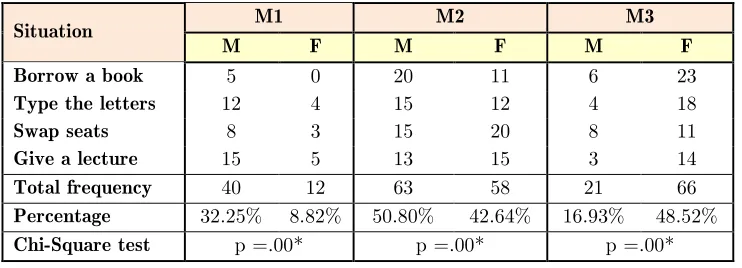
In order to answer the first research question, role plays were analyzed and the frequency of the use of each type of mitigation device, based on the taxonomy provided by Márquez-Reiter (2000), was calculated. Then, chi-squares were run to determine the significance of differences.
Table 2. General results for each type of modification used by female and male requestors
Situation M1 M2 M3
M F M F M F
Borrow a book 5 0 20 11 6 23
Type the letters 12 4 15 12 4 18
Swap seats 8 3 15 20 8 11
Give a lecture 15 5 13 15 3 14
Total frequency 40 12 63 58 21 66
Percentage 32.25% 8.82% 50.80% 42.64% 16.93% 48.52%
Chi-Square test p =.00* p =.00* p =.00*
M1= Requests with no modification M2= Requests with internal modification M3= Requests with external modification. M= Male participants
F= Female participants
* Indicates that the percentages of the two groups differ significantly (p<0.05).
This part of results which confirm the difference between the speech act performance of males and females is in line with previous request speech act studies (Fishman, 1990; Ishikawa, 2013; Lakoff, 1973; Macaulay, 2001). The results obtained showed that women generally make more use of mitigation devices (8.82% direct requests as compared to 91.18% modified ones) and they are more likely to apply external mitigation devices when requesting someone, compared to men (48.52% vs. 16.93%). Such difference is more evident when addressing someone of higher/lower status (situations one and four) in which females applied significantly higher number of externally modified requests. The findings obtained here contradicts a number of previous attempts, namely, Abdolrezapour et al (2012) who found no gender specific difference in the perception of complaint politeness and Ishikawa (2013) in that he pointed to the more use of direct requests by females.
differences between the perceptions of these three groups (Elementary, Intermediate, and Advanced) were significant or not.
Table 3. General results for each type of modification used by elementary, intermediate and advanced requestors
Situation M1 M2 M3
E I A E I A E I A
Borrow a book 8 4 2 5 8 10 4 11 13
Type the letters 8 4 7 5 10 12 4 9 6
Swap seats 11 5 7 3 11 11 3 7 7
Give a lecture 12 10 5 3 5 9 2 8 11
Total frequency 39 23 21 16 34 42 13 35 37
Percentage 57.35% 25% 21% 23.52% 36.95% 42% 19.11% 38.04% 37%
Chi-Square test p =.00* p =.04* p =.02*
M1= Requests with no modification M2= Requests with internal modification M3= Requests with external modification. E= Elementary students
I= Intermediate students A= Advanced students
* Indicates that the percentages of the three groups differ significantly (p<0.05).
5. Conclusion
Contrasting the female and male requesting strategies was the main objective of this study. Overall, a careful analysis of the role play interactions has provided an insight into the preferred requesting strategies and perceptions about appropriate requesting style in the foreign language (i.e. English) by female and male Iranian EFL learners. Also, it gives us an understanding about the effect of social power and social distance in each group. Investigating the female and male speech act strategy preferences for requesting across the four situations show that social distance and social power are the determining factors in the way the females request while it is not the case for males. Women generally used more externally mitigated requests than men did in all situations.
Moreover, it was found that language proficiency plays in important role in the type of request strategy applied by Iranian EFL learners. Advanced learners were found to use more externally mitigated requests than intermediate and elementary levels. Considering previous cross-cultural studies on Iranian and American requestive strategies, which pointed to the higher tendency toward using mitigated requests by Iranians, the importance of mitigation devices and indirect strategies in their requests can be primarily attributed to the desire to save face and their tendency to be respectful when interacting with someone of higher status or someone with distant relationship.
References
[1] Abdolrezapour, P. (2012). The effect of expectation of compliance on the preferred request strategy: Cross-cultural and situational variation in Iranian and American speech communities. Australian Journal of Linguistics, 32 (3), 383-404.
[2] Abdolrezapour, P., & Eslami-Rasekh, A. (2012). The effect of using mitigation devices on request compliance in Persian and American English. Discourse Studies, 14 (2), 145-163.
[3] Abdolrezapour, P., & Vahid Dastjerdi, H. (2013). Examining mitigation in refusals: A cross-cultural study of Iranian and American speech communities. Sociolinguistic Studies, 6(3), 512-541. [4] Abdolrezapour, P., Dabaghi, A., & Kassaian, Z. (2012). Variation in perceptions of complaint politeness: Do gender and social variables have any effect? Gema-online (Journal of Language Studies), 12(2), 711-725.
[5] Afghari, A. (2007). A sociopragmatic study of apology speech act realization patterns in Persian. Journal of Pragmatics, 49 (3), 175-185.
[6] Ahangar, A.A. & Amoo Ali Akbari, S. (2007). Linguistic politeness in Persian: Requestive speech act strategies employed by male and female Persian speakers. Second International Conference on Iranian Linguistics Hamburg-Germany, 17 – 19 August, 2007.
[7] Allan, D. (1992). Oxford placement test. Oxford: Oxford University Press.
[8] Baxter, J. (2000). Gender inequality in Australian society. In J. Najman & J. Western (Eds.), A sociology of Australian society (pp. 89-113). Melbourne: Macmillan.
[9] Bella, S. (2011). Mitigation and politeness in Greek invitation refusals: Effects of length of residence in the target community and intensity of interaction on non-native speakers’ performance. Journal of Pragmatics, 43, 1718-1740.
Kasper (Eds.), Cross-cultural pragmatics: Requests and apologies (pp. 123-154). Norwood, NJ: Ablex.
[11] Blum-Kulka, S., & Olshtain, E. (1984). Requests and apologies: A cross-cultural study of speech act realization patterns (CCSARP). Applied Linguistics, 5,196–213.
[12] Blum-Kulka, S., House, J., & Kasper, G. (1989). Cross-cultural pragmatics: Requests and apologies. Norwood, NJ: Ablex.
[13] Brown, P., & Levinson, S. (1978). Universals in language usage: politeness phenomena. In E. N. Goody (Ed.), Questions and politeness: Strategies in social Interaction (pp. 56–310). Cambridge: Cambridge University Press.
[14] Brown, P., & Levinson, S. (1987). Politeness: Some universals in language. Cambridge: Cambridge University Press.
[15] Caffi, C. (1999). Modulazione, mitigation, litote. In Conte M. E., Giacalone Ramat, A. & Ramat, P. (Eds.), Dimensioni della linguistica (pp. 169-199). Milano: Angeli.
[16] Economidou-Kogetsidis, M. (2008). Internal and external mitigation in interlanguage request production: The case of Greek learners of English. Journal of Politeness Research, 4, 111-138.
[17] Ellis, R. (1994). The study of second language acquisition. Oxford: Oxford University Press.
[18] Eslamirasekh, Z. 1993. A cross-cultural comparison of requestive speech act realization
[19] patterns in Persian and American English. Pragmatic and Language Learning 4, 85-103.
[20] Fishman, P. (1990). Conversational insecurity. In D. Cameron (Ed.), The feminist critique of Language (pp.234-241). London: Routledge. [21] Fraser, B. (1990). Perspectives on politeness. Journal of Pragmatics,
14, 219–36.
[22] Fukushima, S. (2000). Requests and culture: Politeness in British English and Japanese. Bern: Peter Lang.
[24] Grice, H. P. (1975). Logic and conversation. In Cole, P. Morgan J.L. (Eds.), syntax and semantics3: Speech acts. New York: Academic Press.
[25] Haverkate, H. (1979). Impositive sentences in Spanish. Amsterdam: North-Holland.
[26] Holmes, J. (1984). Hedging your bets and sitting on the fence: some evidence for hedges as support structures. Te Reo, 27, 47-62.
[27] Hymes, D. (1972). On communicative competence. In J. B. Bride & J. Holmes (Eds.), Sociolinguistics (pp. 269-93). Harmondsworth: Penguin.
[28] Ishikawa, Y. (2013). Gender differences in request – A statistical analysis of American English in the NICT JLE corpus. International Journal of Humanities and Management Sciences (IJHMS), 1(1), 57-62.
[29] Kasper, G., & Dahl, M. (1991). Research methods in interlanguage pragmatics. Studies in Second Language Acquisition, 13 (2), 215– 247.
[30] Lakoff, R. (1973). Language and woman's place. Language in Society, 2, 45-80.
[31] Leech, G. (1983). Principles of pragmatics. New York: Longman. [32] Macaulay, M. (2001). Tough talk: Indirectness and gender in
requests for information. Journal of Pragmatics, 33(2), 293-316. [33] Márquez-Reiter, R. (2000). Linguistic politeness in Britain and
Uruguay: A contrastive study of requests and apologies. Philadelphia, PA: John Benjamins.
[34] Márquez-Reiter, R., Rainey, I., and Fulcher, G. (2005). A comparative study of certainty and conventional indirectness: Evidence from British English and Peninsular Spanish. Applied Linguistics, 26(1), 1-31.
[35] Mikako, N. (2005). Similarities and differences between Japanese and Americans on their use and perception of polite speech. Unpublished Ph.D dissertation, Depaul University. Retrieved 10 October 2010, from
&startpage=1&ver=1&vname=PQD&RQT=309&did=1037885191&
exp=11-152016&scaling=FULL&vtype=PQD&rqt=309&cfc=1&TS=132150 8233&clientId=46431
[36] Mills, S. (2003). Gender and politeness. Cambridge: Cambridge University Press.
[37] Nikula, T. (1996). Pragmatic force modifiers. A study in interlanguage pragmatics. University of Jyväskylä, Jyväskylä. [38] Rose, K. R. (2000). An exploratory cross-sectional study of
interlanguage pragmatic development. Studies in Second Language Acquisition, 22, 27-67.
[39] Salazar Campillo, P. (2007). Examining mitigation in requests: A focus on transcripts in ELT course books. In E. Alcón Soler and M.P. Safont Jordà (Eds.), Intercultural language use and language learning (pp.207-222). The Netherlands: Springer.
[40] Scollon, R., and Scollon, S. (2001). Intercultural communication: A discourse approach (2nd ed.). Malden, MA: Blackwell.
[41] Searle, J.R. (1976). A classification of illocutionary acts. Language and Society, 5, 1-23.
[42] Sifianou, M. (1992). Politeness phenomena in England and Greece: A cross-cultural perspective. Oxford: Clarendon Press.
[43] Thomas, J. (1983). Cross-cultural pragmatic failure. Applied Linguistics, 4, 91-112.
[44] Trosborg, A. (1995). Interlanguage pragmatics: Requests, complaints, and apologies. New York: Mouton de Gruyter.
[45] Usó-Juan, E. (2007). The presentation and practice of the communicative act of requesting in textbooks: Focusing on modifiers. In E. Alcón Soler and M.P. Safont Jordà (Eds.), Intercultural language use and language learning (pp.223–243). The Netherlands: Springer.
Appendix: Open role plays
Instructions
You will be asked to read some brief situations in which there are two participants. You will role play one of the participants and another person will role play the other. You both know who you are and where you are; however, one of you does not know what the other one wants. The interaction will be recorded. You will have to act as you would in an actual situation: you will have to act the situation and interact with the other person, thus expect there could be some social chat. Do not think too much and try to be as spontaneous as possible.
Situation 1 (Borrow a book) Informant A:
You are a university student. Your lecturer recommended you a book which would be helpful for your research. The library is closed and the only person who has the book is your lecturer. On the way to his/her office you meet him/her in the hallway. What do you say?
Informant B:
You are a university lecturer. While leaving your office you meet one of your students in the hallway. Respond to him/her.
Situation 2 (Type the letters) Informant A:
You have been put in charge of a project at university. You go to the desk of a classmate of yours who cooperates with you and ask him/her to type a few letters for you. What do you say to him/her?
Informant B:
Situation 3 (Swap seats) Informant A:
You are on the school bus with one of your friends. There are plenty of seats on the bus but there are not any for two people together. You ask a passenger who is sitting on his/her own on a two seater to change seats with you so that you can sit next to your friend. What do you say to him/her?
Informant B:
You are on the school bus. You are sitting on your own on a seat for two people. There are plenty of seats on the bus but there are not any for two people together. A passenger talks to you. Respond to him/her. Situation 4 (Give a lecture)
Informant A:
You are a professor in a university. Because you have to attend an important conference, you ask your student to give his lecture earlier than scheduled. What do you say to him/her?
Informant B:
You are a university student. One of your professors comes to you and talks to you. Respond to him/ her.