FORMULATION DEVELOPMENT OF POLY HERBAL GEL FOR EFFECTIVE
MANAGEMENT OF ACNE
Shailbala Singh Baghel*, Shweta Larya, Roshni Bhadouriya
Department of Chemistry, Sarojini Naidu Government Girls P.G. (Autonomous) College, Bhopal (M.P.)
ABSTRACT
Herbal remedies are more acceptable in the view that they are safe with fewer side effects than the synthetic ones. The present work deals with the development and evaluation of poly-herbal anti-acne formulation (gel) containing aqueous extract of Gloriosa superb flower and aqueous extract from bark of Litsea glutinosa. Aqueous extracts of
Gloriosa superba and Litsea glutinosa were formulated in an aqueous based carbopol-934 gel system. Three formulations of the gel were prepared by varying the proportions of polymers and evaluated for their physicochemical properties like colour, consistency, washability, pH, spreadability and microbial assay. Based on these tests, formulation F-3 containing 1.5% carbopol-934 was selected as best formulation. The microbial assay of all the poly herbal formulations demonstrated better inhibitory activity against Propionibacterium acne and Staphylococcus epidermidis compared to the marketed clindamycin phosphate gel in equivalent amounts of application. It was concluded from the study that aqueous extract of Gloriosa superba and Litsea glutinosa can be formulated in an aqueous based gel system for topical therapy of mild acne vulgaris.
Keywords: Gloriosa superba, Antiacne, Litsea glutinosa, Gel, Topical INTRODUCTION
Acne vulgaris is a common skin condition, causing changes in pilosebaceous units (PSU) and skin structure
consisting of a hair follicle and its associated sebaceous gland, via androgen stimulation. It is characterized by
noninflammatory follicular papules or comedones and by inflammatory papules, pustules and nodules in its more
severe forms. The opportunistic bacteria Propionibacterium acne (P. acne) residing within the pilosebaceous follicle
cause inflammation when exposed to the dermis with ruptured follicle.1 The P. acne produces substances that
promote inflammation, including chemotactic factors along with lipolytic and proteolytic enzymes. The enzyme
hydrolytic action of P. acne converts triglycerides residing in the glands into free fatty acids that stimulate
inflammation 2 and edema that results into breakdown of the follicular wall.3
Acne may also arise due to change in dietary habits, climate, allergy, mental stress and can cause embarrassment
and depression leading to social withdrawal.4 Many synthetic drugs like benzoyl peroxide, antibiotics,
anti-androgens are used to treat this disorder but exhibit several side effects like dryness of skin, dermatitis, bleaching
cloth, darkening of skin and recurrence after withdrawal. 5
In the literature review it was found that Gloriosa superba is used in wounds, skin related problems, fever,
inflammation, piles, blood disorders, uterine contractions, general body toner, poisoning. 6, 7Gloriosa superba Linn.
is an important medicinal plant belonging to the family Liliaceae. It is a semi-woody herbaceous branched climber
reaching approximately 5 meters height, with brilliant wavy-edged yellow and red flowers.8
Paste prepared by grinding bark of Litsea glutinosa with water is used as a plaster in cases of sprain, bruises,
wounds, inflammation, back pain, rheumatic and gouty joints, bone fractures etc. Litsea glutinosa (Lour.) C.B. Rob
is an aromatic tree belongs to the family Lauraceae and is found to be sparsely distributed in the Western Ghats,
India. L. glutinosa is an evergreen medium-sized tree and plant can attain a height of 20 meters.9
Considering the above mentioned fact efforts were made to separate incorporate Gloriosa superba and Litsea
glutinosa aqueous extract into a topical gel with the purpose to develop a safe, effective and cheaper remedy for
healing acne. The results will be useful in designing specific, novel and effective herbal anti-acne formulation for
cosmetic and dermatological application with the aim to prevent the adverse effects of existing non herbal
formulations.
Development of poly herbal formulation (Gel)
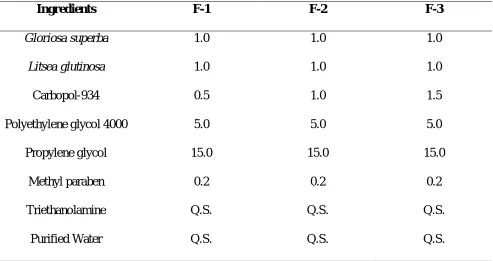
Various formulation batches were prepared according to the Table 1.11, 12 The desired concentration of
gelling agents were weighed accurately and dispersed in hot purified water (not more than 60 °C; 50 %
weight of the batch size) with moderate stirring, avoiding air entrapment and allowed to soak overnight.
Desired quantity of methyl paraben was dissolved in remaining amount of water by gentle heating.
Desired quantity of polyethylene glycol 4000, propylene glycol and herbal extracts were added to the
above mixture. This was finally mixed with previously soaked gel formulation. Triethanolamine was
added at last to adjust the pH. Prepared formulations were filled in a suitable container and labeled
accordingly.
Table 1: Composition of developed poly herbal formulations (Gel) (Quantity taken per 100 gm gel (in
grams)
Ingredients F-1 F-2 F-3
Gloriosa superba 1.0 1.0 1.0
Litsea glutinosa 1.0 1.0 1.0
Carbopol-934 0.5 1.0 1.5
Polyethylene glycol 4000 5.0 5.0 5.0
Propylene glycol 15.0 15.0 15.0
Methyl paraben 0.2 0.2 0.2
Triethanolamine Q.S. Q.S. Q.S.
Evaluation of poly herbal formulations (Gel)
Physical evaluation
Physical parameters such as colour, appearance and consistency were checked visually.
Washability
Formulations were applied on the skin and then ease and extent of washing with water were checked
manually.
pH
pH of 1% aqueous solution of the formulation was measured by using a calibrated digital pH meter at
constant temperature.13
Spreadability
Spreadability was determined by an apparatus suggested by Perez et al.14 The apparatus consist of a
wooden block with a fixed glass slide and movable glass slide with one end tied to weight pan rolled on
the pulley, which was in horizontal level with fixed slide. The spreadability of the formulated gel was
measured on the basis of ‘Slip and Drag’ characteristics of gel. An excess of gel (about 2g) under study
was placed on this ground slide. The gel was then sandwiched between two slides. One kg weight was
placed on the top of the two slides for 5 min to expel air and to provide a uniform film of the gel between
the slides. Excess of the gel was scrapped off from the edges. The top plate was then subjected to pull off
50 gm. (M) with the help of string attached to the hook and the time (T, in seconds) required by the top
slide to move a distance (L) of 7.5 cm be noted. A shorter interval indicated better spreadability.
Spreadability (S) was calculated using the following formula:
S = M × L / T.
Microbial assay
The antibacterial activities of different formulations were determined by modified agar well diffusion
method. In this method, nutrient agar plates were seeded with 0.2 ml of 24 h broth culture of
Propionibacterium acne and Staphylococcus epidermidis. The agar plates were allowed to solidify. A
sterile 8 mm borer was used to cut wells of equidistance in each of plates. 0.5 ml of poly herbal
formulations and marketed clindamycin gel were introduced into the wells. The plates were incubated at
37 °C for 24 hours. The antibacterial activities were evaluated by measuring the zones of inhibition (in
mm). The results of evaluation are displayed in Table 3. 13, 14
RESULTS AND DISCUSSION
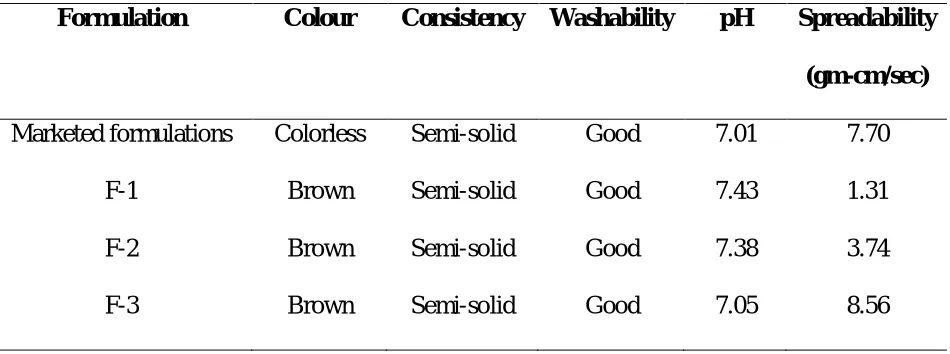
Formulation F-1-F-3 had semisolid consistency. All the formulations were found homogenous, easily
physiology. All the formulations F-1, F-2 and F-3 had very optimum spreadability. All the formulations
showed considerable zone of microbial inhibition. The antimicrobial property of the aqueous extract of
Gloriosa superb and Litsea glutinosa was reconfirmed as depicted in Table 3. Poly herbal formulation
F-3 of Gloriosa superba (flower) and Litsea glutinosa (bark) showed better antibacterial activity.
Table 2: Evaluation of formulations
Formulation Colour Consistency Washability pH Spreadability
(gm-cm/sec)
Marketed formulations Colorless Semi-solid Good 7.01 7.70
F-1 Brown Semi-solid Good 7.43 1.31
F-2 Brown Semi-solid Good 7.38 3.74
F-3 Brown Semi-solid Good 7.05 8.56
Table 3:Microbial Studies on the poly herbal formulation (Gel)
Zone of Inhibition (mm) of poly herbal formulation (Gel) against Staphylococcus epidermidis
Formulation/S.No. Marketed
formulations
Polyherbal Formulation
25 mg/ml 50 mg/ml 100mg/ml
1 9 7 8 9
Zone of Inhibition (mm) of poly herbal formulation (Gel) against Propionibacterium acne
Formulation/S.No. Marketed
formulations
Polyherbal Formulation
25 mg/ml 50 mg/ml 100mg/ml
1 10 8 9 10
The results of the antimicrobial studies obtained for the aqueous extract of Gloriosa superb and Litsea
glutinosa reflect the potential for its delivery as a topical agent for treatment of acne vulgaris which forms
the basis of our study. The topical approach is effective because the medication is applied directly to the
lesions and the herbs are less likely to cause side effects. The formulated herbal gel also has the added
advantage over the currently used antibiotic treatment in the fact that the bacteria which often develop
Conclusion
Acne vulgaris is a common skin disorder and many formulations are available in the global market but
existing non herbal formulations cause many side effects. Moreover development of antibiotic resistance
in acne causing organisms has been rising steadily since the 1980s. Hence development of polyherbal
topical formulation with synergistic effect is a very promising approach for its treatment. The present
study confirms the efficacy of polyherbal gel comprising of two aqueous extracts. It could be theorized
that the developed topical polyherbal gel is suitable for the treatment of moderate to severe type of acne.
Acknowledgment
I thank Mr. Prabhat Jain and Miss. Geeta Parkhe for his guidance and I would also like to thank the whole
team members of Scan Research Laboratories, Bhopal (M.P.).
References
1. Christy C, Riddle MD, Kathani Amin and Schweiger ES. A review of azithromycin for the treatment
of acne vulgaris. Cosmetic Dermatology. 2009; 20(5): 299-302
2. Kaur P, Kaur S, Kumar S and Singh P. Rubia cordifolia L. and Glycyrrhiza glabra L. medicinal plants
as potential source of COX-2 inhibitors, American J Biomed Sci. 2010; 2(2): 108-120.
3. Yuangang Zu, Huimin Yu, Liang Lu, Yujie Fu, Efferth T, Liu X and Nan Wu. Activities of ten
essential oils towards Propionibacterium acne and PC-3, A-549 and MCF-7. Cancer Cells. 2010; 15:
3200-3210.
4. Mamgain RK. Acne vulgaris and its treatment by indigenous drugs SK-34 (Purim) and SK-235
(Clarina). The Antiseptic. 2000; 3: 76-78.
5. Said HK. Traditional medicine in the service of health, Hamadard foundation press. 2005: 73-75.
6. Haroon K, Murad AK and Iqbal H. Enzyme inhibition activities of the extracts from rhizomes of
Gloriosa superba Linn (Colchicaceae). J Enzyme inhibition Med Chem. 2008; 22(6): 722-725.
7. Srivastava UC and Chandra V. Gloriosa superba Linn. (Kalihari) - An important colchicine producing
plant. J Res Indian Med. 1977; 10: 92-95.
8. Rajak RC and Rai MK. Herbal Medicines Biodiversity and Conservation Strategies. International
Book Distributors. 1990, 75-79
9. Pradeepa K, Krishna V, Venkatesh, Girish Kumar K, Thirumalesh BV and Naveen Kumar KJ.
Antibacterial screening of the stem bark and leaves extracts of Litsea glutinosa (Lour.)C.B. Rob – an
ethnomedicinally important tree of the Western Ghats. Phcog J. 2011; 3(21): 72-76.
10.Kokate CK. Practical Pharmacognosy. Vallabh Prakashan, New Delhi, India. 1994; 54.
11.Josias A Hamman. Composition and Application of Aloe vera leaf gel. Molecules. 2008;
12.WHO Monograph on selected Medicinal Plants. Department of essential Drugs and medicines Policy,
World Health Organization. www.google.co.in. ,206-216.
13.Pratchayasakul W, Pongchaidecha A, Chattipakorn N and Chattipakorn S. Ethnobotany and
ethnopharmacology of Tabernaemontana divaricata. Ind J Med research. 2008;127:317-335.
14.Perez C, Pauli A and Bazerque P. An antibiotic assay by agar well diffusion method. Acta Biol Med