The Effects of VAK Learning Style and Input Type
on Causative Construction Development by Iranian
EFL Learners
Motahar Khodashenas Tavakoly
PhD Student of TEFL, Science and Research Branch, Islamic Azad University, Tehran, Iran
Gholamreza Kiany
Associate Professor of Applied Linguistics, Tarbiat Modares University, Tehran, Iran
Seyyed Mohammad Reza Hashemi
Assistant Professor of Applied Linguistics, Kharazmi University, Tehran, Iran
Abstract
Long’s Interactional Input Hypothesis and Smith’s Input Enhancement Hypothesis hold both foci on Zellig Harris's (1976) formalist approach. Accordingly, the pivotal role of learner’s attention as one of the subcomponents of focus-on-form approach may have confused instruction types. However, whether such learning theories on drawing the learners' attention on target language forms suit all types of learners, has not been adequately investigated. Of interest were to explore the significant effect of the two input types as interactionally modified input (IM) and textual input enhancement (TIE) and the interactional effect of learning styles of either visual, auditory, or kinesthetic (VAK) style on knowledge gain of causative constructions. A hundred and twenty female subjects were selected as a homogenous sample out of the 300-member population based on the TOEFL test. A pretest and two posttests were conducted immediately and about one month after the instructional interventions based on either IM technique or TIE technique. To address research questions, two paired samples t-tests and a two-way ANOVA were conducted. Considering the learner’s VAK learning style, the results revealed TIE and IM techniques positively facilitated the development of knowledge of the target features immediately after the instructional interventions. The results, however, failed to indicate the merging effect of the two input types of the study with the leaner’s VAK learning style and the learner’s gain of target grammar knowledge marginally decreased over time. The findings may contribute to the understanding of the integration of learning styles and input-based instructional programs in foreign language education policy.
Keywords: Perceptual VAK learning style; textual input enhancement; interactionally modified input; causative construction
INTRODUCTION
For over a decade, research on language training concerned that overtly emphasizes linguistic or forms related features of the input in the context of meaningful communication has been central to the study of language learning (Shintani, 2015). The goal of this training, termed form-focused instruction, is to draw learners’ attention to a particular problematic linguistic feature, offering learners an opportunity to notice this feature in the input. Such an interest in the form-focused instruction was initiated by research findings that exposure to input alone may not guarantee learners' success in second language L2 acquisition especially with regards to the accuracy of certain grammatical features in learners' speech. Such consideration is indeed at the core of influential pedagogic proposals known as (textual or typographical) input enhancement (Lantolf, 2000; Sharwood Smith, 1993) and interactional input (Doughty, 2000; Radwan, 2005). As Sharwood Smith (1993) hypothesizes, a way to stimulate input processing for form as well as meaning, and therefore language learning, is through improving the quality of input. Specifically, she proposes input enhancement, an operation whereby the saliency of linguistic features is augmented through, for example, textual enhancement (e.g. color-coding, boldfacing) for visual input, and phonological manipulations (e.g. oral repetition) for aural input. The underlying assumption is that noticing is a prerequisite for intake (Gass, 1997; Schmidt, 1990; Sharwood Smith, 1981). On the other hand, there is another input-based instruction technique called interactionally modified input (IM) that aims to facilitate the process of L2 learning through verbal interaction, and out of the interaction syntactic structures are developed (Chaudron, 1988). Based on Interaction Hypothesis (Long, 1982), interaction fosters the acquisition when a communication problem arises and learners are engaged in negotiating for meaning and interactional modifications.
learning environment. VAK theory is now a favorite of the accelerated learning community because its principles and benefits extend to all types of learning and development, far beyond its early applications. The Visual-Auditory-Kinesthetic learning style model does not overlay Gardner's multiple intelligences or Kolb's theory; rather the VAK model provides a different perspective for understanding and explaining a person's preferred or dominant thinking and learning style. Teaching and learning styles should be of the greatest interest to educators, particularly the relationship between the two. However, one of the weaknesses of learning style research is the lack of investigation into the matching of teaching and learning styles (Logsdon, 2008; May, 2002).
Although there are many empirical research findings on attention raising mechanisms via input enhancement, the pertinent findings on the target techniques (i.e., TIE and IM) are not only inconclusive but also too sporadic, especially in Iranian EFL setting such that further studies are warranted. Relying on this rationale on one hand and motivated by the claims in favor of the effect of VAK learning style in grammatical development on the other (Izumi, 2002; Oxford, 2001; Reid, 1987; Terrell, 1991), this study was designed to investigate the effect of TIE/IM in order to see whether they are significantly and individually effective in developing target structure knowledge. The other concern of this research was to examine the merging effect of TIE and IM with VAK learning style in learner’s gain of causative construction knowledge
.
LITERATURE REVIEW
Pedagogic Concerns on Form-focused Instruction
Textual input enhancement is a pedagogic technique with the aim of enhancing input deliberately to draw learners' attention to the formal features of the language to help the development of L2 knowledge (Nassaji & Fotos, 2011; Sharwood Smith, 1993). Typographical or textual enhancement is a type of input enhancement which has received some attention in the past two decades (Gascoigne, 2006; Izumi, 2002; Lee, 2007; Lee & Huang, 2008; Simard, 2009). As Peart (2008) asserts, “an advantage for textual enhancement is that it can be easily integrated into different instructional approaches and course materials regardless of any particular teaching approaches” (p. 86).
Among different techniques in the explicit discussion of target forms is the pivotal role of interaction devised by Long Interaction Hypothesis (1982). Ellis (2001) suggests that “in this way, we promote learner's attention to the target structure and meanwhile engage learners in meaning-focused interaction to mediate environmental contributions to acquisition” (p.32). In addition, Long (1982, 1983) also emphasizes that modifications are likely to occur more in two-way tasks which oblige NSs and NNSs to negotiate for meaning in order to make their speech more comprehensible to their interlocutors. Many researchers (Carroll, 2000; Ellis, 1997; Larsen-Freeman & Long, 1991; Leow, 2001; McDonough & Mackey, 2000) hold a similar view on the significance of input modifications which result from the negotiation process in interaction.
pedagogical techniques, the pertinent findings on target input types (TIE & IM) are inconclusive. Relying on this rationale on one hand and motivated by debates in the field of cognitive psychology that learning styles should focus more on the sensory input and output rather than a response to the situation thereby improving an individuals’ learning process (Fleming, 2001), this study was designed to investigate the role of two different input types on developing grammar ability in order to see whether they are significantly effective. Additionally, it seems that data are thin on the ground as to the merging effect of input types in relation to VAK learning style that no study to date has been devoted to the investigation of such effects as far as the acquisition of the target structure is concerned.
VAK Learning Style
by participants as the effect of instruction may have been due to the individual differences, or the mismatches between cognitive and instructional styles.
Textual Input Enhancement
Input enhancement is grounded on the theories that deliberate attention to target forms is a necessary condition for learning target forms (Lee, 2007; Leow, 1999; Lyddon, 2011; Santis, 2008; Sharwood Smith, 1993; Simard, 2009). For example, Lee (2007) found positive effects of VIE on Korean EFL students’ learning of passive form. Likewise, the results of the study conducted by Santis (2008) revealed that VIE facilitated the learners’ awareness of the target form in reading. In contrast, other researchers reported no positive effects of VIE (Izumi, 2002; White, 1998). Leow (2001) investigated the effects of textual enhancement on learning Spanish formal imperatives and found no advantage for enhanced text over unenhanced text. Barcroft (2003), by the same token, compared two types of focus on form strategies on the learning of English relativization, finding that the visual enhancement did not result in gains in accuracy using the target form. Thus, the results of the studies on textual enhancement suggest that, while this strategy may promote noticing of grammatical forms, it may not be sufficient for their acquisition.
Interactionally Modified Input
between a degree of uptake and the acquisition of target lexical items. These authors reported that learners' behavior in interaction varies from actively asking questions to passively attending the negotiations.
Other studies have argued that modification of the conversational structure is more beneficial to learners than simplified input (Gasss, 2003; Morris & Tarone, 2003; Sullivan, 2000). Similarly, Van den Branden (2000) tried to make distinctions between unmodified input condition, interactional input condition and pair negotiation condition. It was found that learners displayed significantly higher scores on comprehension tests with the chance to negotiate the meaning of unknown words and phrases than being merely exposed to either the unmodified texts or the interactional texts. Such results indicate that more professional research should be carried out to examine the effects of interactionally modified input not only in response to different types of grammar features but also in different classroom contexts.
Causative Construction
PURPOSE OF THE STUDY
The review of the current literature on the role of TIE, IM input in respect to VAK learning style in fostering non-native English learners’ causative construction knowledge indicated the dearth of empirical research on this area of investigation. To fill this gap, the present study assessed and examined the effectiveness of two input types of the study namely as interactionally modified input (IM) and textual input enhancement (TIE) considering VAK learning style in fostering the noticing and learning gain of English causative constructions by Iranian EFL learners. Thus, this study aimed to address the following research questions:
1. Does textual input enhancement in view of VAK learning style have any significant effect on developing causative constructions in the immediate posttest?
2. Does interactionally modified input in view of VAK learning style have any significant effect on developing causative constructions in the immediate posttest?
3. Is there any significant interaction between VAK learning style and input type on developing causative constructions in the delayed posttest?
METHOD
Participants
This study with a quasi-experimental design included a pretest, posttest and delayed posttest. The independent variables were training EFL learners through two input-based instructional techniques and VAK learning style aimed at learning causative constructions as the dependent variable. In what follows, the details are presented of the selection of participants, instrumentation, the instructional materials used, and data collection procedure in two experimental groups of the study.
gained their consent to carry out the present study in the respective institutes. The sampling method was non-random convenient sampling due to availability and manageability reasons. The participants shared Persian as their vernacular language whose selection was based on the results of the PBT TOEFL test according to which those who scored the cut-off criterion were considered as the acceptable L2-sample participants for the purpose of the study. PLSPQ questionnaire was given to participants. Then, they were divided into two groups (TIE &IMI) of 60 each. Each group of 60 participants was further divided into three subgroups consisting of thirty learners. Each of these subgroups also had ten participants from each of the Visual, Auditory, and Kinesthetic learning styles.
Instrumentation
PBT TOEFL
Two subsections of paper-based TOEFL taken from Broukal (1997) were used as a means of homogenizing the pool of initial participants. The items were randomly selected from among 150 items provided in this book which are claimed to be similar to real TOEFL in terms of content and difficulty, hence evidence for its construct validity. The test consisted of 90 items and included 30 items of structure and written expressions and 50 items of reading comprehension. Each item had a weight of 1 point and accordingly had a scaling of 0 to 90 for scoring. K-R 21 was utilized to estimate the reliability of the test, which was estimated to be 0.82 in the piloting phase which is a satisfactory level of reliability (Brown, 2000). To ensure the content validity of this test, it was examined by four English teachers holding Ph.D. degrees. The feedback of these teachers was considered to locate any possible instances of ambiguity, ambivalence or infelicity and rewording a few of the items in terms of item characteristics of a test.
PLSPQ Questionnaire
Learning and Individual learning. For the purpose of the present study, categories that were relevant to perceptual modality were needed. Thus the three major perceptual styles of visual, auditory, and kinesthetic (VAK) were used. The overall reliability of the questionnaire proved to be 0.90 in the piloting phase as the acceptable level of reliability. PLSPQ has been the central instrument for many studies in EFL contexts and validated by several researchers (Peacock, 2001; Honey & Mumfords, 2000). For the purpose of content and face validity of the questionnaire, it was looked over by two ELT professionals so as to be valid for the present study purpose.
Causative Structure Test
Treatment for the Target Structure
VanPatten points out that, “the human mind may be predisposed to placing agents and subjects in a first noun position” (2002, p.15). Thus, English causatives are good examples for investigating this principle. In these structures, the first noun is not the real agent of the sentence and this makes their comprehension and production difficult. Causative is one of the English structures that does not frequently appear in instructional materials and these structures might be problematic for EFL learners. Majority of the studies on causative constructions have dealt with the way in which causative constructions are employed by English native speakers. (Altunkol, 2013; Anyanwu, 2012; Hemmings, 2013; Zibin, & Altakhaineh, 2016). Therefore, fewer investigations have focused on the use of these constructions by English non-native speakers which is mainly due to the complexities of causatives both within particular languages and cross-linguistically (Kemmer & Ferhagen, 1994). The targeted forms were the English causative verbs have, get and make to which the participants had not been exposed before, according to the placement test of the institutes which placed them at the same level. All participants in each group took the pretest before the beginning of the instructional phase in order to make sure that they were not familiar with the target structures. Given the important role of input and the fact that causative structures pose challenges for EFL learners, the present study sought to investigate the effect of input type in view of VAK learning style on learning causative structures by Iranian upper-intermediate learners.
Data Collection Procedure
"Active Skills for Reading" consisting of causative structures. Eight of such texts were used for both groups. In TIE group, the causative structures used in the texts were textually enhanced drawing on Sharwood Smith's (1993) guidelines such as underlining, italicization, capitalization, and other strategies to increase the noticing of the target structure. After reading the passage, the TIE group answered a multiple-choice exercise, without looking back the text they just read. In IMI group, a text was read at normal speed by the instructor. While the text was being read, learners took notes. The tasks after reading the passages were some scrambled, transformational or reconstruction exercises to be done with their peers and make the modifications required through interaction.
Data Analysis
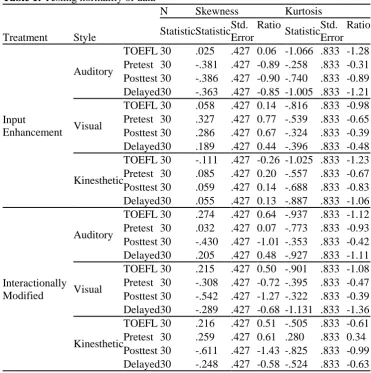
Before running any of the needed analyses for each research question, the necessary assumptions were observed by checking the ratios of skewness and kurtosis for normality of distribution of data and graphical representation by Q-Q plots. Then, to investigate the effect of textual input enhancement and interactionally modified input in view of VAK learning style on target structure, two paired-sample t-tests were conducted. A two-way ANOVA was also applied to probe the interaction between VAK learning style and input type on developing causative constructions in the delayed posttest.
RESULTS
Results of the Normality Test
Table 1: Testing normality of data
Treatment Style
N Skewness Kurtosis
Statistic Statistic Std. Error
Ratio
Statistic Std. Error
Ratio
Input
Enhancement
Auditory
TOEFL 30 .025 .427 0.06 -1.066 .833 -1.28
Pretest 30 -.381 .427 -0.89 -.258 .833 -0.31 Posttest 30 -.386 .427 -0.90 -.740 .833 -0.89 Delayed 30 -.363 .427 -0.85 -1.005 .833 -1.21
Visual
TOEFL 30 .058 .427 0.14 -.816 .833 -0.98
Pretest 30 .327 .427 0.77 -.539 .833 -0.65 Posttest 30 .286 .427 0.67 -.324 .833 -0.39 Delayed 30 .189 .427 0.44 -.396 .833 -0.48
Kinesthetic
TOEFL 30 -.111 .427 -0.26 -1.025 .833 -1.23 Pretest 30 .085 .427 0.20 -.557 .833 -0.67 Posttest 30 .059 .427 0.14 -.688 .833 -0.83 Delayed 30 .055 .427 0.13 -.887 .833 -1.06
Interactionally Modified
Auditory
TOEFL 30 .274 .427 0.64 -.937 .833 -1.12
Pretest 30 .032 .427 0.07 -.773 .833 -0.93 Posttest 30 -.430 .427 -1.01 -.353 .833 -0.42 Delayed 30 .205 .427 0.48 -.927 .833 -1.11
Visual
TOEFL 30 .215 .427 0.50 -.901 .833 -1.08
Pretest 30 -.308 .427 -0.72 -.395 .833 -0.47 Posttest 30 -.542 .427 -1.27 -.322 .833 -0.39 Delayed 30 -.289 .427 -0.68 -1.131 .833 -1.36
Kinesthetic
TOEFL 30 .216 .427 0.51 -.505 .833 -0.61
Pretest 30 .259 .427 0.61 .280 .833 0.34 Posttest 30 -.611 .427 -1.43 -.825 .833 -0.99 Delayed 30 -.248 .427 -0.58 -.524 .833 -0.63
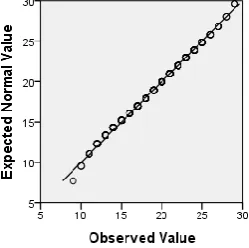
Figure1.The normal Q-Q plot of the TOEFL test
Figure 2. The normal Q-Q plot of the pretest
According to the figures above, although very few points have departed from the reference line, the degree of their departure is not great. Therefore, their distribution was normal.
First Research Question
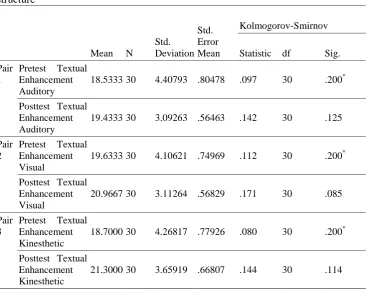
Table 2: Descriptive statistics of TIE group’s pretest and posttest of causative structure
Mean N
Std. Deviation
Std. Error Mean
Kolmogorov-Smirnov
Statistic df Sig. Pair
1
Pretest Textual Enhancement Auditory
18.5333 30 4.40793 .80478 .097 30 .200*
Posttest Textual Enhancement Auditory
19.4333 30 3.09263 .56463 .142 30 .125
Pair 2
Pretest Textual Enhancement Visual
19.6333 30 4.10621 .74969 .112 30 .200*
Posttest Textual Enhancement Visual
20.9667 30 3.11264 .56829 .171 30 .085
Pair 3
Pretest Textual Enhancement Kinesthetic
18.7000 30 4.26817 .77926 .080 30 .200*
Posttest Textual Enhancement Kinesthetic
21.3000 30 3.65919 .66807 .144 30 .114
As Table 2 shows there was a statistically significant increase in TIE mean scores from pretest to posttest. In the auditory group it was found that their pre-test scores (M=18.53, SD=4.40) were significantly higher than their post-test (M=19.43, SD=3.092). A significant difference was found between the pretest scores of visual (M=19.63, SD=4.10) and kinesthetic groups (M=18.70, SD=4.26) and the posttest scores of visual (M=20.96,
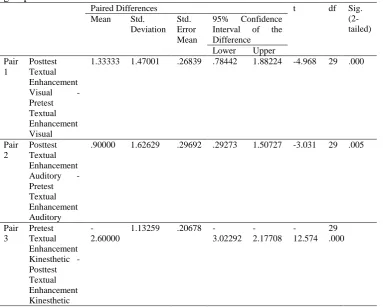
Table 3: Paired-samples t-test pretest and posttest of causative structure in TIE group
Paired Differences t df Sig.
(2-tailed) Mean Std.
Deviation Std. Error Mean
95% Confidence Interval of the Difference Lower Upper Pair
1
Posttest Textual Enhancement Visual - Pretest Textual Enhancement Visual
1.33333 1.47001 .26839 .78442 1.88224 -4.968 29 .000
Pair 2
Posttest Textual Enhancement Auditory - Pretest Textual Enhancement Auditory
.90000 1.62629 .29692 .29273 1.50727 -3.031 29 .005
Pair 3
Pretest Textual Enhancement Kinesthetic - Posttest Textual Enhancement Kinesthetic -2.60000
1.13259 .20678 -3.02292 -2.17708 -12.574 29 .000
The t-observed values are represented in Table 3 as they are in the case of learners with visual style (t =-4.96, p<0.05), with auditory style (t =-3.031, p<0.05) and learners with kinesthetic style (t=-12.57, p<0.05). Statistically speaking, the first null hypothesis was rejected; indicating that TIE instruction had a significant effect on noticing causative constructions in view of VAK learning style.
Second Research Question
the respective descriptive statistics.
Table 4: Descriptive statistics of IM group’s pretest and posttest of causative structure
Mean N
Std. Deviation
Std. Error Mean
Kolmogorov-Smirnov
Statistic df Sig.
Pair 1
Pretest
Interactionally Modified Auditory
19.3000 30 4.21941 .77036 .074 30 .200*
Posttest Interactionally Modified Auditory
21.9667 30 3.54754 .64769 .144 30 .116
Pair 2
Pretest
Interactionally Modified Visual
18.9333 30 4.19304 .76554 .089 30 .200*
Posttest Interactionally Modified Visual
21.1667 30 3.75163 .68495 .175 30 .120
Pair 3
Pretest
Interactionally Modified Kinesthetic
19.5000 30 4.34503 .79329 .083 30 .200*
Posttest Interactionally Modified Kinesthetic
21.1667 30 3.39455 .61976 .130 30 .200*
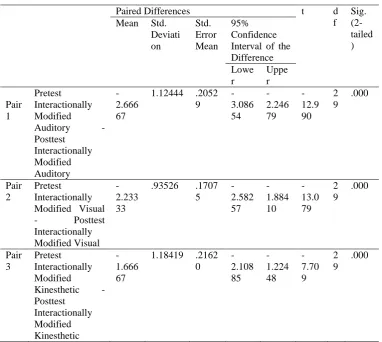
post-test (M=21.96, SD=3.54). A significant difference was found between the pretest scores of both visual (M=18.93, SD=4.19) and kinesthetic groups (M=19.50, SD=4.34) and the posttest scores of visual (M=21.16, SD=3.75) and kinesthetic groups (M=21.16, SD=3.39). Table 5 provides the paired samples t-test statistics conducted to answer the second research question.
Table 5: Paired-samples t-test pretest and posttest in IM group
Paired Differences t d
f Sig. (2-tailed ) Mean Std.
Deviati on Std. Error Mean 95% Confidence Interval of the Difference Lowe r Uppe r Pair 1 Pretest Interactionally Modified
Auditory - Posttest Interactionally Modified Auditory -2.666 67
1.12444 .2052 9 -3.086 54 -2.246 79 -12.9 90 2 9 .000 Pair 2 Pretest Interactionally Modified Visual - Posttest Interactionally Modified Visual
-2.233 33
.93526 .1707 5 -2.582 57 -1.884 10 -13.0 79 2 9 .000 Pair 3 Pretest Interactionally Modified
Kinesthetic - Posttest Interactionally Modified Kinesthetic -1.666 67
1.18419 .2162 0 -2.108 85 -1.224 48 -7.70 9 2 9 .000
interactionally modified input had a significant effect on noticing causative constructions in view of VAK learning style.
Third Research Question
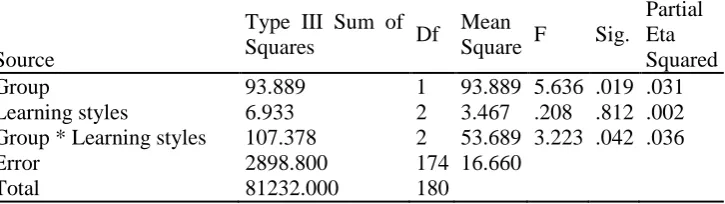
A two-way analysis of variances (two-way ANOVA) was run on the delayed posttest scores of causative construction in order to probe the last three research questions. Before discussing the results, it should be noted that the assumption of homogeneity of variances was met. The results of the Levene's test (p > .05) indicated that there were not any significant differences between the groups' variances on delayed posttest; hence homogeneity of their variances.
Table 6: Tests of between-subjects effects: Delayed posttest by groups by learning styles
Source
Type III Sum of
Squares Df
Mean
Square F Sig.
Partial Eta Squared
Group 93.889 1 93.889 5.636 .019 .031
Learning styles 6.933 2 3.467 .208 .812 .002
Group * Learning styles 107.378 2 53.689 3.223 .042 .036
Error 2898.800 174 16.660
Total 81232.000 180
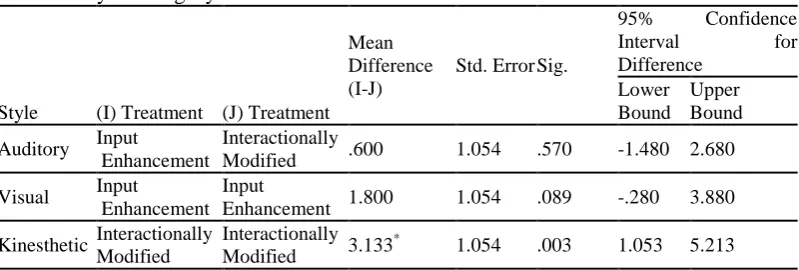
Table 7: Pair-wise comparisons: Delayed posttest scores of causative construction by treatment by learning style
Style (I) Treatment (J) Treatment Mean Difference (I-J)
Std. Error Sig.
95% Confidence Interval for Difference
Lower Bound
Upper Bound
Auditory Input
Enhancement
Interactionally
Modified .600 1.054 .570 -1.480 2.680
Visual Input
Enhancement Input
Enhancement 1.800 1.054 .089 -.280 3.880
Kinesthetic Interactionally Modified
Interactionally Modified 3.133
* 1.054 .003 1.053 5.213
In Table 7, the auditory group means (Mean Difference = .600, p = .570) and the visual group means (Mean Difference = 1.80, p = .089) indicated that the types of treatments did not have any significant effect on the auditory group’s performance on the delayed posttest. However, the kinesthetic group means (Mean Difference = 3.13, p = .003) represented that the types of treatments had a significant effect on the kinesthetic group’s performance on the delayed posttest.
DISCUSSION
Izumi, 2002; Park, 2004). Areas of mismatch among the findings of the effectiveness of TIE in this study and those of the previous researches might be attributed to methodological issues. For example, Kim (2006) reported negative effects since he incorporated lexical elaboration into textual enhancement in the acquisition of form. The researcher considered VAK learning style of the learners in addition to input enhancement, so it is safe to ascertain the positive effects of both on target structure. Consequently, when exposed to externally enhanced input, learners may or may not notice it, or may notice it partially. This justification can be supported by the claim by Sharwood Smith (1991) that a mismatch may arise between the intentions lying behind teacher or textbook generated enhancement of the input and the actual effect it comes to have on the learner cognitive system. The results of the second research question indicated statistically significant effects of IM technique in view of VAK learning styles. This goes in line with Long’s (1983) premise about interactional modification and Reid’s (1987) proxy of perceptual styles known as VAK. As Long (1996) has pointed out, the role of interaction is claimed only to be facilitative stemming from learner-internal factors. This finding was also in accordance with the studies on the positive link between instructional techniques and the perceptual profile of the learners (Ford & Chen, 2001; Grasha, 1996; Lighbown & Spada, 2006; Logsdon, 2009). Felder and Henriques (1995) suggest the need for balancing concrete information as sensing and conceptual information as intuition. The balance does not have to be equal and in some courses, it may be shifted heavily toward the sensing side, but there should periodically be something to capture the intuition's interest.
learning styles theory (Fleming, 2001; Hyland, 1993; Strati, 2007) and there are notions against the theory (Cohen, 2003; Keri, 2002). This initiates the call for responsiveness and adaptability in instruction to address learner diversity. Similar to our research, the study conducted by Keri (2002) also indicated that kinesthetic learning was the major learning style among the learners and auditory learning was the least preferred learning style. On the other hand, none of the subjects were visual learners. In addition, Massa and Mayer (2006) found no support for any kind of interactions despite the exhaustive analysis of nearly 200 individual-difference measures that spanned their proposed facets of verbalizer, visualize and verbalizer-visualize learning styles. To provide a justification to such observations, May (2002) argues that learning categories are not definitive and it does not mean that an individual cannot learn through a different means if they are placed into one learning style, it simply means that through careful investigation, this is their learning preference. Going beyond instructional interventions, Bishka (2010) makes the case that neuroimaging shows that the various sensing modalities (visual/auditory/kinesthetic) are actually interlinked in the brain so that they are triggered in unison, suggesting no single mode can operate in isolation.
CONCLUSION AND IMPLICATIONS
techniques in view of perceptual learning styles are either helpful or unhelpful. Future research should seek to test the robustness of these insights. This effort will lead researchers into ascertaining psycholinguistic contingencies under which input type is able to trigger a chain of cognitive processes that result ultimately in acquisition.
There are, however, a number of limitations to this study. One of the limitations is related to the target forms which represent only a small part of the overall range of the causative structures. Furthermore, factors such as gender, the number of participants, their level of proficiency, and the time of the tests’ administration must be taken into account. The use of similar pretest and posttests could have had an effect on the participants’ memory. Future research should involve manipulation of test items to discourage the influence of item familiarity which could have affected students’ performance. Therefore, future studies could address all these limitations via a wider span, and choose new forms to gain more insights in different EFL contexts.
References
Ahmad, A. (2011). Language learning style preferences of Low English
proficiency (LEP) students in a tertiary institution. Malaysian Journal of ELT Research,7(2), 33-62.
Alavinia, P., & Farhadi, S. (2012). On the would-be bonds between emotional intelligence and learning style. Theory and Practice in Language Studies, 2(5), 956-964.
Alexander, L. G. (1990). Longman English Grammar Practice. UK: Pearson Education Limited. Altunkol, E. (2013). The role of explicit instruction in the acquisition of causative/inchoative transitivity. JSMAL, 3(1), 1-13.
Anyanwu, O. (2012). Causative and anti-causative verb alternations. English Linguistics Research, 1(2), 25-34.
Barcroft, J. (2003). Distinctiveness and bidirectional effects in input enhancement for vocabulary learning. Applied Language Learning, 13, 133-159.
Berent, G. P., & Kelly, R. R. (2008). The efficiency of visual input enhancement in teaching learners of L2 English. In Z.H. Han (Ed.), Understanding second language process (pp. 80-105). Clevedon: Multilingual Matters.
Bishka, A. (2010). Learning styles fray: Brilliant or batty? Performance Improvement, 49, 9-13.
Brown, H. D. (2000). Principles of language learning and teaching. New York: Longman.
Carroll, S. (2000). Input and evidence: The raw material of second language acquisition. Philadelphia: John Benjamins.
Cassidy, S. (2004). Learning styles: An overview of the theories, models and measures. Educational Psychology, 24, 419-444.
Castro, O., & Peck, V. (2005). Learning styles and foreign language learning difficulties. Foreign Language Annals, 38, 401-409.
Chaudron, C. (1988). Second language classrooms research on teaching and learning. Cambridge: Cambridge University Press.
Cho, M. Y. (2010). The effects of input enhancement and written recall on
noticing and acquisition. Innovation in Language Learning and Teaching, 4(1), 71-87.
Cohen, A. D. (2003). The learner’s side of foreign language learning: Where do styles, strategies, and tasks meet? IRAL, 4(4), 279-292.
Combs, Ch. (2008). Topic familiarity and input enhancement: An empirical investigation. Applied Linguistics, 8(2), 1-51.
Doughty, C., & Williams, J. (1998). Pedagogical choices in focus on form. In C. Doughty & J. Williams (Eds.), Focus on form in classroom second language acquisition (pp.197-261). Cambridge: Cambridge University Press.
Doughty, C. (2000). Negotiating the L2 linguistic environment. University of Hawaii Working Papers in ESL, 18, 47-83.
Ellis, R. (1997). SLA research and language teaching. Oxford: Oxford University Press.
Ellis, R. & Heimbach, R. (1997). Bugs and birds: Children’s acquisition of second language vocabulary through interaction. System, 25, 247-259.
Ellis, R. (2001). Investigating form-focused instruction. Language Learning, 51, 1-46.
Ellis, N. (2002). Frequency effects in language processing. Studies in Second Language Acquisition, 24, 143-188.
Ellis, R. (2006). Controversies in grammar teaching. TESOL Quarterly, 54, 109- 223.
Felder, R. M., & Henriques, E. R. (1995). Learning and teaching styles in foreign and second language education. Foreign Language Annals, 32, 43-54.
Fleming, N. D. (2001).Teaching and learning styles: VAK strategies. Studies in Second Language Acquisition, 21, 285-301.
Ford, N., & Chen, S.Y. (2001). Matching/mismatching revised: An empirical study of learning and teaching styles. British Journal of Educational Technology, 32, 5-22.
learning styles rhetoric and practice. Journal of Philosophy of Education, 32, 21-27.
Furuta, Y. (2008). Differences between the causatives Make and Get. Language Education and Technology, 45, 95-112.
Gascoigne, C. (2006). Explicit input enhancement: Effects on target and non target aspects of second language acquisition. Foreign Language Annals, 39(4), 551- 564.
Gass, S. (1997). Input, interaction, and the second language learner. Mahwah, NJ: Lawrence Erlbaum Associates.
Gass, S. (2003). Input and interaction. In C. Doughty & M. Long (Eds.), The handbook of second language acquisition (pp.224-255). Massachusetts: Blackwell Publishing.
Grasha, A.F. (1996). Teaching with style. Pittsburgh, PA: Alliance Publishers. Harris, Z.S. (1976). A theory of language structure. American Philosophical Quarterly, 13, 237-255.
Hemmings, C. (2013). Causatives and applicatives: The case for polysemy in Javanese. SOAS Working Papers in Linguistics, 6(2), 167-196.
Honey, P., & Mumfords, A. (2000). The learning styles helper’s guide. Maidenhead: Peter Honey Publications.
Hyland, K. (1993). Culture and learning: A study of the learning style preferences of Japanese students. RELC Journal, 24(2), 69-91.
Ingram, J.C.L. (2007). Neurolinguistics: An introduction to spoken language processing and its disorders. Cambridge: Cambridge University Press. Izumi, S. (2002). Output, input enhancement, and the noticing hypothesis: An experimental study on ESL relativization. Studies in Second Language Acquisition, 24, 541–577.
Juffs, A. (1996). Learnability and the lexicon: Theories and second language acquisition research. Philadelphia, PA: John Benjamins.
Kara, S. (2009). Learning style and teaching styles: A case study in foreign language classroom.Applied Linguistics, 34, 77-82.
Kemmer, S., & Verhagen, A. (1994). The grammar of causatives and conceptual structure of events. Cognitive Linguistics, 5(2),115-156.
Keri, G. (2002). Male and female college students’ learning styles differ: An
opportunity for instructional diversification. College Student Journal, 36(3), 433-441.
Kim, Y. (2006). Effects of input elaboration on vocabulary acquisition through reading by Korean learners of English as a foreign language. TESOL Quarterly, 40, 341-373.
Larsen-Freeman, D., & Long, M. (1991). An introduction to the second language acquisition research. New York: Longman.
Lee, S. K. (2007). Effects of textual enhancement and topic familiarity on Korean EFL students’ reading comprehension and learning of passive voice. Language Learning, 57, 87-118.
Lee, S., & Huang, H. (2008). Visual input enhancement and grammar learning: A metaanalytic review. Studies in Second Language Acquisition, 30(3), 307-331. Leow, R. P. (1999). The effects of input enhancement and text length on adult L2 readers’comprehension and intake in second language acquisition. Applied Language Learning, 8, 151-182.
Leow, R. (2001). Do learners notice enhanced forms while interacting with the L2? An on-line and off-line study of the role of written input enhancement in L2 reading. Hispania, 84, 496-509.
Lightbown, S., & Spada, M. (2006). How languages are learned. Oxford:Oxford University Press.
Logsdon, A. (2009). Multisensory technique make multisensory teaching materials. Second Language Research, 12, 135-142.
Long, M. (1982). Native speaker/non-native speaker conversation in the second language classroom. In M. Long & C. Richards (Eds.), Methodology in TESOL: A book of readings (pp. 339-354). New York: Newbury House. Long, M. (1983). Native speaker/non-native speaker conversation and the negotiation of comprehensible input. Applied Linguistics, 4, 126-141.
Long, M., & Robinson, P. (1998). Focus on form: Theory, research, and practice. In C. Doughty, & L. Williams (Eds.), Focus on form in classroom second language acquisition (pp. 15-41). Cambridge: Cambridge University Press. Loschky, L. C. (1994). Comprehensible input and second language acquisition: What is the relationship? Studies in Second Language Acquisition, 16, 303-325. Lyddon, P. (2011). The efficacy of corrective feedback and textual enhancement in promoting the acquisition of grammatical redundancies. The Modern Language Journal, 95, 104-129.
Massa, L.J., & Mayer, E. (2006).Testing the ATI hypothesis: Should multimedia instruction accommodate verbalizer-visualizer cognitive style? Learning and Individual Differences, 16, 321-336.
May, S. (2002). Learning styles and writing in modern foreign languages. International Journal of Applied Linguistics, 11(1), 3-14.
McDonough, K., & Mackey, A. (2000). Communicative tasks, conversational interaction and Linguistic form: An empirical study of Thai. ForeignLanguage Annals, 33(1), 82-92.
Morris, F. A. & Tarone, E. E. (2003). Impact of classroom dynamics on the effectiveness of recasts in second language acquisition. Language Learning, 53(2), 325-368.
Murphy, R. (2004). Grammar in Use Intermediate. UK: Cambridge University Press.
Nassaji, H., & Fotos, S. (2011). Teaching grammar in second language
classrooms: Integrating form-focused instruction in a communicative context. London: Routledge.
Norman, G. (2009).When will learning style go out of style? Advances in Education, 14(1), 1-4.
Oxford, R. L. (2001). Language learning styles and strategies. In M. Celce-Murcia (Ed.), Teaching English as a second or foreign language (pp. 350-367).
Boston: Heinle & Heinle.
Park, E. S. (2004). Constraints of implicit focus on form: Insights from a study of input enhancement. Applied Linguistics, 42, 87-95.
Peacock, M. (2001). Match or mismatch? Learning style and teaching style in EFL. International Journal of Applied Linguistics, 11(1), 1-20.
Peart, S. M. (2008). The relative effects of enhanced and non-enhanced structured input on L2 Acquisition of Spanish past tense. Modern Language Journal, 43, 102-221.
Pinker, S. (1989). Learnability and cognition: The acquisition of argument structure. Cambridge, MA: MIT Press.
Radwan, A. A. (2005). The effectiveness of explicit attention to form in language learning. System, 33, 69-87.
Rakap, S. (2010). Impacts of learning style and computer skill on adult students’ learning online. The Turkish Online Journal ofEducational Technology, 9, 108-115.
Rao, Z. (2002). Bridging the gap between teaching and learning styles in East Asian contexts. TESOL Journal, 11(2), 5-1.
Reber, A. (1993). Implicit learning and tacit knowledge: An essay on the cognitive unconscious. Oxford: Clarendon Press.
Reid, J. M. (1987). The learning style preferences of EFL students. TESOL Quarterly, 21(1), 87-111.
Santis, P. D. (2008). Text enhancement and the acquisition of English verbal inflection by L1 Haitian creole speakers. Applied Language Learning, 18(1), 27-49.
Sarasin, L. C. (1998). Learning style perspectives. Impact in the classroom. Madison: Atwood Publishing.
Schmidt, R. (1990). The role of consciousness in second language learning. Applied Linguistics, 11(2), 17-46.
Schmidt, R. (1993). Consciousness, learning and interlanguage pragmatics. Interlanguage pragmatics, 21, 42.
Schmidt, R. (1995). The role of consciousness in second language learning. Applied Linguistics, 11, 17–45.
Schmidt, R. (2001).Attention. In Robinson, P. (Ed.), Cognition and second language instruction (pp. 3-32), Cambridge: Cambridge University Press.
Sen, S., & Yilmaz, A. (2012). The effect of learning styles on students’ misconceptions and self-efficacy for learning and performance. Social and Behavioral Sciences, 46, 1482-1486.
Sharwood Smith, M. (1981). Consciousness raising and second language acquisition theory. Applied Linguistics, 7, 239-256.
Sharwood Smith, M. (1991). Speaking to many minds: On the relevance of different types of language information for the L2 learner. Second Language Research, 72, 118-132.
Sharwood Smith, M. (1993). Input enhancement in instructed SLA: Theoretical bases. Studies in Second Language Acquisition, 15, 165-179.
Shintani, N. (2015). The effectiveness of processing instruction and production based instruction on L2 grammar acquisition. Applied Linguistics, 36(3), 306- 325.
Simard, D. (2009). Differential effects of textual enhancement formats on intake. System, 37, 124-135.
Song, M. (2007). Getting learners’ attention: Typographical input enhancement, output, and their combined effects. English Teaching, 62, 193-215.
Strati, A. (2007). Sensible knowledge and practice-based learning. Management Learning, 38(1), 61-77.
Sullivan, P. (2000). Playfulness as mediation communicative language teaching in classroom. Second Language Learning, 10, 35-76.
Swan, M. (2005). Practical English usage (3rd ed). New York: Oxford University Press.
Terrell, T. D. (1991). The role of grammar instruction in a communicative approach. The Modern Language Journal, 75, 52-63.
Tight, D.G. (2007). The role of perceptual learning style preferences and instructional method in the acquisition of L2 Spanish vocabulary. Modern Language Journal, 67, 98-112.
Van den Branden, K. (2000). Does negotiation of meaning promote reading comprehension? A Study of multilingual primary school classes. Reading Research Quarterly, 35, 426-443.
research. Norwood, NJ: Ablex.
VanPatten, B. (2002). Processing instruction: An update. Language Learning, 52, 755-803.
White, J. (1998). Getting the learners’ attention: A typographical input enhancement study. In C. Doughty & J. Williams (Eds.), Focus on form in classroom second language acquisition (pp. 85-113). Cambridge: Cambridge University Press.