DOI: 10.22092/ijfs.2019.118285
The effects of feeding rates on growth performance, feed
conversion efficiency and body composition of juvenile snow
trout, Schizothorax zarudnyi
Khandan Barani H.
1*; Dahmardeh H.
2; Miri M.
3; Rigi M.
1Received: May 2016 Accepted: January 2017
Abstract
This study was performed to investigate the effects of feeding rates on growth performance, feed conversion and body composition of juvenile snow trout (Schizothorax zarudnyi). For this purpose, fish with an initial body weight of 2.17±0.1
g were fed a commercial diet (40% protein, 3.8 Kcal g-1 diet) at five ration sizes of 2%,
4%, 6%, 8% and 10% of their body weight per day, for 60 days. The feeding trial was conducted in triplicate. Maximum weight gain, best feed conversion ratio (FCR), best specific growth rate (SGR %), highest energy retention (ERE %) and protein efficiency ratio (PER %) were evident for rations of 4–6% body weight. Second-degree polynomial regression analysis for PER, FCR and ERE indicated the break-points
occurred at 4.9, 5.1 and 5.2% BW day−1, respectively. Maximum body protein content
was obtained for 4% and 6% rations. Body moisture, fat and ash content remained
unchanged. Based on the above results,it may be concluded that the 4.9-5.2% body
weight per day ration is optimal for the growth, conversion efficiencies and body
composition of juvenile S. zarudnyi and it entails favorable economic benefits.
Keywords: Growth, Body composition, Ration, Schizothorax zarudnyi
1-Department of Fisheries, Hamoun International Wetland Research Institute, University of Zabol, Zabol, Iran
2-Department of Fisheries, Faculty of Natural Resources, University of Zabol, Zabol, Iran.
3-Department of Natural ecosystems management, Hamoun International Wetland Research Institute, University of Zabol, Zabol, Iran.
*Corresponding author's Email:[email protected]
Introduction
A crucial factor in commercial
aquaculture is feeding, especially when it affects growth, health of fish and
production costs (Cho et al., 2003;
Khan and Abidi, 2010; Tian et al.,
2015). Feed costs make up a large fraction of the total fish production costs (40-50 % of production costs)
(Anderson et al., 1997). Moreover, in
practical fish farming, growth
optimization is important to ensure
profitability (Wang et al., 2009). The
growth of fish at all stages in its life history is largely regulated by a number of factors, such as food type, food intake, feeding rate, feeding frequency and its ability to absorb nutrients
(Gelineau et al., 1998; Akbulut et al.,
2013). Among these, feeding rate is an important factor for the survival and growth of fish at the early life stages (Goddard, 1996). The influence of
feeding rate on fish growth
performance has received much
attention (Goddard, 1996; Oberg et al.,
2014; Luo et al., 2015; Li et al., 2016).
Most studies of feeding rate have confirmed that there should be optimal
feeding rates in fish culture.
Determination of optimal values for this factor helps to enhance growth (Saether and Jobling, 1999) or feed utilization (Fiogbé and Kestemont, 2003); to
reduce feeding costs (Silva et al., 2007;
Luo et al., 2015) or to improve water
quality (Allan et al., 1995; Zakes et al.,
2006) and reduce fish size variations
(Johnston et al., 2003). Consequently,
for the commercial success of any aquaculture venture, it is important to
have adequate knowledge of the optimal ration level.
Several studies have been conducted to evaluate the effect of feeding rate on the growth, survival, feed intake, body composition, among other parameters, in various culturable finfish species, such as common carp (Desai and Singh, 2009), mangrove red snapper (Abbas
and Siddiqui, 2009), pigfish (Oberg et
al., 2014), blunt snout bream (Tian et
al., 2015), hybrid sturgeon (Luo et al.,
2015). It has been shown in these studies that optimum rate might vary based on fish species, size, age, feed quality and culture system. Thus, to achieve optimum production, it is
important that feeding rate be
standardized for the target species in aquaculture.
It is important to choose new fish
species with good potential for
aquaculture to develop this growing
industry. Schizothorax zarudnyi, also
known as snow trout, is a native fish of southeast Iran and Afghanistan that belongs to the cyprinid family. In general, cyprinid species have high commercial value and their meat is appreciated by human consumers. Also, snow trout has high market value and is a promising candidate species for
Iranian aquaculture diversification
(Aghili, 2013; Rahdari et al., 2014).
However, there is no information on the feeding application rates for juvenile snow trout. Therefore, the aim of this study was to assess the effects of feeding rate on the growth performance, feed conversion and body composition of juvenile snow trout, and determine the best feeding rate for this species
Iranian Journal of Fisheries Sciences 18(3) 2019 509
under commercial production
conditions. Fish nutritionists and
farmers will benefit from the results of this study.
Materials and methods
This study was performed at Hamoun
International Wetlands Research
Institute of Zabol University. Healthy juvenile of snow trout were obtained from a local commercial fish farm in Zehak city, Iran. Fish were acclimated for 14 days before the start of the experiment. During the acclimation and experimental period, the water quality parameters were maintained as follows:
temperature (22.6±1.5 °C), pH
(7.6±0.3), dissolved oxygen (6.9±0.5
mg L-1) and ammonia concentration
was kept around zero mg L-1. After the
acclimation period, fish with an average initial body weight of 2.17±0.3 g (mean±SD) were distributed randomly among 15, 80 L glass tanks at the rate of 20 fish per tank. There were no significant differences in the initial weight between groups. The study design included five feeding rates (2%, 4%, 6%, 8% and 10%) with three replicates for each treatment. The daily rations were supplied each day in two equal halves, at 08.00 and 17.00 hours. Fish were weighed every 2 weeks to regulate the feeding rates. The feeding trial lasted for 60 days. The fish were offered a commercial diet (Esfahan Mokammel Company, Isfahan, Iran), containing 40% protein, 12% lipid, 9– 10% moisture and 10% ash.
Body composition analysis
Before the start of the experiment, 20 stocked fish were killed and analyzed for initial body composition. At the end of the experiment, ten fishes from each replicate were sacrificed for the analysis of proximate composition of whole body. The ash, moisture, crude protein and lipid contents of fish were estimated by AOAC (2000).
Growth parameters
The growth parameters were evaluated
as follows: Survival (%)
(Survival%=100×(final fish number/ initial fish number), Weight gain rate
(WGR=100×(average final body
weight−average initial body
weight)/average initial body weight), Feed conversion ratio (FCR=total feed intake/total weight gain), Specific growth rate (SGR=100×(ln final mean weight−ln initial mean weight)/days),
Energy retention efficiency
(ERE=100×(energy gain/total energy in the diet), Protein efficiency ratio (PER=100×(weight gain/protein fed) (Tacon, 1990; De Silva and Anderson, 1995; Khan and Abidi, 2010).
Data analysis
Data were analyzed by one-way (ANOVA) using SPSS, version 16 for Windows, and Duncan's test was used to compare differences between the
means at 5% probability. All
experimental values are expressed as mean ± SD. The estimation of optimum feeding rate for growth and feed conversion efficiency of snow trout was
carried out using second-degree
polynomial regression analysis (Y=aX2
+bX+c) (Zeitoun et al., 1976).
Results
Growth performance and feed
conversion efficiencies of juvenile S.
zarudnyi subjected to different feeding rates are presented in Table 1. All fish survived throughout the trial. Maximum weight gain rate (%) was recorded with
a diet of 6% BW day-1. Best FCR, and
highest specific growth, Energy
retention efficiency (ERE) and Protein efficiency ratio (PER) where obtained for fish fed by 4-6% ration. Feed conversion ratio (FCR) decreased as the
ration rose up to 6%. No significant
(p>0.05) improvement in FCR was seen
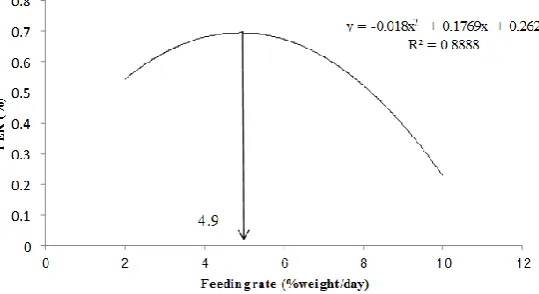
for fish fed with the 8% ration and increasing the ration further indicated in no improvement or even poor FCR. In order to obtain more exact information on the ration level, second-degree polynomial regression analysis was conducted for the growth parameters. Using the second-order polynomial regression analysis model, the optimal feeding rate for juvenile snow trout based on PER, FCR and RER was estimated to be 4.9, 5.1 and 5.2 % BW
day−1, respectively (Figs. 1, 2 and 3).
Figure 1: Second-order polynomial fitting of protein efficiency ratio to feeding rate of Schizothorax zarudnyi.
Table 1: Growth, conversion efficiencies and nutrient retention efficiency of juvenile Schizothorax zarudnyi fed at different feeding rates.
Parameters Feeding rate (%weight day-1)
2 4 6 8 10
Initial body weight (g) 2.21±0.07 2.13±0.10 2.14±0.17 2.20±0.06 2.09±0.06 Final body weight (g) 2.75±0.07a 3.73±0.24b 4.36±0.14c 4.09±0.19c 3.48±0.15b Weight gain (%) 54±3.46a 152±15.39b 222.33±4.50d 188.6±22.2
3c
139±19.15b
Feed conversion ration 4.82±0.49b 3.48±0.24a 3.47±0.35a 5.67±0.83c 9.13±1.36d Specific growth rate
(%)
0.36±0.02a 0.86±0.05b 1.19±0.08c 1.02±0.10bc 0.84±0.10b
PER (%) 52.49±0.05b 71.27±0.05c 73.79±0.04c 42.63±0.09b 27.87±0.04a ERE (%) 16.19±0.01b 21.46±0.02c 22.31±0.005c 14.51±0.01b 8.76±0.01a Mean value±SEM from three replicate analyses; mean values with the same superscript are not significantly different (p>0.05)
Iranian Journal of Fisheries Sciences 18(3) 2019 511
y = 0.2098x2- 1.9804x + 7.958 R² = 0.9977
0 1 2 3 4 5 6 7 8 9 10
0 2 4 6 8 10 12
FCR
Feeding rate (% weight/day)
5.1
Figure 2: Second-order polynomial fitting of feed conversion efficiency to feeding rate of Schizothorax zarudnyi.
y = -0.0055x2+ 0.0549x + 0.076 R² = 0.9437
0 0.05 0.1 0.15 0.2 0.25
0 2 4 6 8 10 12
RE
R
(%
)
Feeding rate (% weight / day) 5.2
Figure 3: Second-order polynomial fitting of energy retention to feeding rate of Schizothorax zarudnyi.
Whole-body composition of juvenile snow trout is shown in Table 2. Whole-body protein content was found to be
significantly higher (p<0.05) for 4%
and 6% rations compared with fish fed with other rations. Body ash, fat and Moisture did not differ among fish fed with different rations.
Table 2: Whole body composition of juvenile Schizothorax zarudnyi fed different feeding rates
Parameters Feeding rate (%weight/day)
2 4 6 8 10
Moisture (%) 76.41±0.52 76.85±0.28 76.12±0.20 77.41±0.63 77.90±0.46 Protein (%) 66.79±1.25a 69.58±1.09bc 71.24±1.38c 68.14±1.2ab 68.38±1.03b
Fat (%) 9.78±0.33 9.74±0.42 9.49±0.11 9.16±0.82 9.38±0.16
Ash (%) 3.01±0.19 2.86±0.26 2.80±0.19 2.63±0.27 2.79±0.12
Mean values±SEM from three replicate analyses; mean values with the same superscript are not significantly different (p>0.05)
Discussion
Feeding rate is an important factor affecting growth in fish. Determination of optimal values for this factor is necessary to the success of aquaculture production. In the present study, ration levels had significant effects on the
growth, SGR, FCR, ERE and PER of S.
zarudnyi. Similarly, studies by Ahmed
(2007) on Labeo rohita, Khan and
Abidi (2010) on Heteropneustes fossilis
and Oberg et al. (2014) on pigfish
reported that ration levels very often
affect the growth performances,
survival, feed intake and conversion efficiencies of cultured fish.
Our study revealed that growth in terms of final weight and other weight related indices SGR and WGR in juveniles of snow trout could be improved when they were reared with increasing feeding ration up to a certain
level as was observed in Cirrhinus
mrigala (Khan and Abidi, 2004) and
hybrid sturgeon (Luo et al., 2015).
However, significant growth
improvement was recorded with
increasing rations up to 6%, and was not significantly different from that
achieved by fish fed at 4% BW day−1.
This indicates that feeding fish in the
range of 4–6% BW day−1 results in
maximum utilization of food for growth. On subjecting PER, FCR and RER data to second degree polynomial regression analysis, however, break-points occurred for rations of 4.9, 5.1 and 5.2%, respectively. These break-points show that rations in the range
4.9–5.2% BW day−1 are optimal for
growth of snow trout. This enables producers to grow healthy fish as
quickly and/or efficiently as desired and
using optimal ration prevents
overfeeding, which is costly and reduces water quality. The above range is higher than the ration allocation
reported for grass carp,
Ctenopharyngodon idella (1.97%) (Du
et al., 2006), Atlantic salmon, Salmo salar (2%) (Austreng et al., 1987), Nile
tilapia, O. niloticus (2%) (El-Saidy and
Gaber, 2005), European sea bass,
Dicentrarchus labrax (3–3.5%)
(Eroldogan et al., 2004), hybrid
sturgeon (3.7%) (Lue et al., 2015), in
the range determined for big head carp,
Aristichthyes nobilis (2-5.7%) (Opuszynski and Shireman, 1991), and
lower than the values for H. fossilis
(5.9-6.8%) (Khan and Abidi, 2010),
Common carp, Cyprinus carpio (6%)
(Desai and singh, 2009), Indian major
carp, Labeo rohita (6.5-7%) (Ahmed,
2007), African catfish, Clarias
gariepinus (6%) (Al-Hafedh and Ali,
2004), white sturgeon, Acipenser
transmontanus (6%) (Deng et al.,
2003), Tambaqui, Colossoma
macropomum (10%) (Silva et al.,
2007), clownfish, Amphiprion percula
(10.26%) (Johnston et al., 2003) and
brown trout, Salmo trutta (11.3%)
(Elliot, 1975). Thus, the difference in nutrient requirement could also be related to species and age of fish, composition of the diet, stock density and water quality.
In this study, poor growth and FCR for fish fed lower rations of 4% BW
day−1, lower rations than the optimum,
suggests these rations approximate to maintenance requirements only and that most of the ingested nutrients are used
Iranian Journal of Fisheries Sciences 18(3) 2019 513
to maintain life and a small portion probably remained for growth. The present findings on snow trout also seem to be in agreement with the
observations of Khan et al. (2004) on
C. mrigala. Moreover, poor FCR for higher rations can be due to loss of nutrients and waste of food, because it takes longer for fish to consume food to reach satiation. Similar results were
also reported in Heteropneustes fossilis
(Khan and Abidi, 2010), Labeo rohita
(Ahmed, 2007) and Acipenser
transmontanus (Hung and Lutes, 1987). The whole-body composition of fish is known to indicate the fish quality. Many studies have confirmed that body composition is significantly affected by feeding rate (Ahmed, 2007; Desai and Singh, 2009; Khan and Abidi, 2010). The findings of the present study showed that ration significantly affects
whole-body protein content. The
highest protein contents were observed at 4%-6% feeding ration. Similar
observations were made by Khan et al.
(2004) in C. mrigala. Also in the
present study, ash, fat and moisture were not significantly influenced by ration level. This is in agreement with results of Desai and Singh (2009) who reported that ash and moisture content
remained insignificantly different
among the ration levels in common carp. Generally, lack of difference between fish fed with 4% and 6% ration indicates that all fishes in these treatment groups were adequately fed. In conclusion, results of the present study show that a feeding rate of
4.9-5.2% BW day−1 is the most efficient
feeding strategy for juvenile snow trout,
because it results in greater growth and production. Therefore the application of
this feeding rate for juvenile
Schizothorax zarudnyi would insure
optimum feed consumption with
minimum waste, improve nutritional
efficiency and food conversion
efficiency, decrease production cost and reduce water pollution.
Acknowledgements
The authors would like to thank Narjes Sanchooli, Alireza Noorafar and Mahdi Keikha for their help during the analyses.
References
Abbas, G. and Siddiqui, P.J.A., 2009. Effects of different feeding level on the growth, feed efficiency and body composition of juvenile mangrove
red snapper, Lutjanus
argentimaculatus (Forsskal 1775).
Aquaculture Research, 40, 781-789. Aghili, K., 2013. Replacement of snow
trout, Schizothorax zarudnyi, by
common carp in poly culture. Animal
Research, 26, 435-442 (In Persian). Ahmed, I., 2007. Effect of ration size
on growth, body composition, and energy and protein maintenance requirement of fingerling Indian
major carp, Labeo rohita (Hamilton).
Fish Physiology and Biochemistry, 33, 203–212.
Akbulut, B., Feledi, T., Lengyel, S. and Ronyai, A., 2013. Effect of feeding rate on growth performance, food utilization and meat yield of
starlet, Acipenser ruthenus (Linne,
1758). Journal of Fisher Scientific,
7, 216-224.
Al-Hafedh, Y.S. and Ali, S.A., 2004. Effects of feeding on survival,
cannibalism, growth and fed
conversion of African catfish,
Clarias gariepinus (Burchell) in
concrete tanks. Journal of Applied
Ichthyology, 20, 225–227.
Allan, G.L., Moriarty, D.J.W. and Maguire, G.B., 1995. Effects of pond preparation and feeding rate on
production of Penaeus monodon
fabricius, water quality, bacteria and benthos in model farming ponds.
Aquaculture, 130, 329-349.
Anderson, J.S., Higgs, D.A., Beams, R.M. and Rowshandeli, M. 1997. Fish meal quality assessment for
Atlantic salmon, Salmo salar, reared
in seawater. Aquaculture Nutrition,
3, 25-38.
AOAC, 2000. Official Methods of
Analysis. 17th Edition, The
Association of Official Analytical Chemists, Gaithersburg, MD, USA. Austreng, E., Storebakken, T. and
Asgard, T., 1987. Growth rate
estimates for cultured Atlantic
salmon and rainbow trout.
Aquaculture, 60, 157–160.
Cho, S.H., Lim, Y.S., Lee, J.H. and Park, S., 2003. Effect of feeding rate and feeding frequency on survival, growth, and body composition of
ayu post-larvae Plecoglossus
altivelis. Journal of the World Aquaculture Society, 34, 85–91. Deng, F., Koshio, S., Yokoyama, S.,
Bai, S.C., Shao, Q., Cui, Y. and Hung, S.S.O., 2003. Effects of feeding rate on growth performance
of white sturgeon Acipensor
transmontanus larvae. Aquaculture, 217, 589–598.
Desai, A.S. and Singh, R.K., 2009. The effects of water temperature and ration size on growth and body composition of fry of common carp,
Cyprinus carpio. Journal of Thermal Biology, 34, 276–280.
De Silva, S.S. and Anderson, T.A., 1995. In: fish nutrition in aquaculture. Chapman and Hall, London. 319 P.
Du, Z.Y., Liu, Y.J., Tian, L.X., He, J.G., Cao, J.M. and Liang, G.Y., 2006. The influence of feeding rate on growth, feed efficiency and boy composition of juvenile grass carp
Ctenopharyngodon idella.
Aquaculture International, 14, 247– 257.
Elliot, J.M., 1975. The growth rate of
brown trout Salmo trutta L. fed on
reduced rations. Journal of Animal
Ecology, 44, 823–842.
El-Saidy, D.M.S.D. and Gaber, M.A., 2005. Effect of dietary protein levels
and feeding rates on growth
performance, production traits and body composition of Nile tilapia,
Oreochromis niloticus cultured in
concrete tanks. Aquaculture
Research, 36, 163–171.
Eroldogan, O.T., Kumlu, M. and Aktas, M., 2004. Optimum feeding
rates for European sea bass
Dicentrarchus labrax L. reared in
seawater and freshwater.
Aquaculture, 231, 501–515.
Fiogbé, E.D. and Kestemont, P.,2003. Optimum daily ration for Eurasian
perch Perca fluviatilis L. reared at its
Iranian Journal of Fisheries Sciences 18(3) 2019 515
optimum growing temperature.
Aquaculture, 216, 243-252.
Gelineau, A., Corraze, G. and Boujar, T., 1998. Effects of
restricted ration, time-restricted
access and reward level on voluntary food intake, growth and growth
heterogeneity of rainbow trout
Oncorhynchus mykiss fed on demand
with self-feeders. Aquaculture, 167,
247–258.
Goddard, S., 1996. Feed Management in Intensive Aquaculture. Chapman and Hall, New York. 194 P.
Hung, S.S.O. and Lutes, P.B., 1987. Optimum feeding rate of hatchery produced juvenile white sturgeon
Acipenser transmontanus at 20 °C.
Aquaculture, 65, 307–317.
Johnston, G., Kaiser, H., Hecht, T., and Oellermann, L., 2003. Effect of ration size and feeding frequency on growth, size distribution and survival
of juvenile clownfish, Amphiprion
percula. Journal of Applied Ichthyology, 19, 40–43.
Khan, M.A. Ahmed, I. and Abidi, S.F., 2004. Effect of ration size on growth, conversion efficiency, and body composition of fingerling
mrigala, Cirrhinus mrigala
(Hamilton). Aquaculture Nutrition,
10, 47–53.
Khan, M.A. and Abidi, S.F., 2010. Optimum ration level for better growth, conversion efficiencies and body composition of fingerling
Heteropneustes fossilis (Bloch).
Aquaculture International, 18, 175– 188.
Li, X.F., Xu, C., Tian, H.Y., Jiang, G.Z., Zhang, D.D. and Liu, W.B.,
2016. Feeding rates affect stress and
non-specific immune responses of
juvenile blunt snout bream
Megalobrama amblycephala
subjected to hypoxia. Fish and
Shellfish Immunology, 49, 298-305. Luo, L., Li, T., Xing, W., Xue, M.,
Ma, Z., Jiang, N. and Li, W., 2015. Effects of feeding rates and feeding
frequency on the growth
performances of juvenile hybrid
sturgeon, Acipenser schrenckii
Brandt♀ × Acipenser baeri Brandt♂.
Aquaculture, 448, 229–233.
Oberg, E.W., Faulk, C.K. and Fuiman, L.A., 2014. Optimal dietary ration for juvenile pigfish
Orthopristis chrysoptera grow-out.
Aquaculture, 433, 335–339.
Opuszynski, K. and Shireman, J.V., 1991. Food passage time and daily
ration of bighead carp, Aristichthyes
nobilis, kept in cages. Environmental Biology of Fishes, 30, 387–393.
Rahdari, A., Gharaei, A. and
Ghaffari, M., 2014. Spawning latency period in hormonal induced
reproduction of snow trout,
Schizothorax zarudnyi Nikolskii,
1897. Iranian Journal of
Biotechnology, 12, 61-65.
Saether, B.S. and Jobling, M., 1999. The effects of ration level on feed
intake and growth, and
compensatory growth after restricted
feeding in turbot Scophthalmus
maximus L. Aquaculture Research, 30, 647-53.
Silva, C.R., Gomes, L.C. and
Brandao, F.R., 2007. Effect of feeding rate and frequency on
tambaqui Colossoma macropomum
growth, production and feeding costs during the first growth phase in
cages. Aquaculture, 264, 133–139.
Tacon, A.G.J., 1990. Standard method for nutritional and feeding of farmed fish and shrimp. Argent liberations press. Redmond, Wash, 1, 117. Tian, H.Y., Zhang, D.D., Li, X.F.,
Zhang, C.N., Qian, Y. and Liu,
W.B., 2015. Optimum feeding
frequency of juvenile blunt snout
bream Megalobrama amblycephala.
Aquaculture, 437, 60–66.
Wang, N., Xu, X. and Kestemont, P., 2009. Effect of temperature and
feeding frequency ongrowth
performances, feed efficiency and body composition of pikeperch
juveniles Sander lucioperca.
Aquaculture, 289, 70–73.
Zakes, Z., Demska-Zakes, K.,
Jarocki, P. and Stawecki, K., 2006. The effect of feeding on oxygen consumption and ammonia excretion
of juvenile tench Tinca tinca (L.)
reared in a water recirculating
system. Aquaculture International,
14, 127-140.
Zeitoun, I.H., Ullrey, D.E., Magee, W.T., Gill, J.L. and Bergen, W.G.,
1976. Quantifying requirements of
fish. Journal of the Fisheries
Research Board of Canada, 33, 167– 172