Introduction
Chronic obstructive pulmonary disease (COPD) is a leading cause of death and
disabil-ity worldwide and an important economic prob-lem which may lead to a major socioeconomic burden [1]. According to World Bank data, it is expected to move from its status in 2000 as the 4th and 12th most frequent cause of mortality
Medical Journal of the Islamic Republic of Iran.Vol. 22, No.1, May 2008. pp. 29-36
Determination of the factors affecting duration of hospitalization in
patients with chronic obstructive pulmonary disease (COPD) in Iran
Seyed Ali Javad Mousavi, MD.1, Seyed Mohammad Fereshtehnejad2, Neda Khalili3, Malihe Naghavi4, Hooman Yahyazadeh,
MD.5
Department of Internal Medicine, Pulmonary Science Research Center, Medical Student Research Committee, Iran University of Medical, Tehran, Iran
Abstract
Background: Chronic obstructive pulmonary disease (COPD) is a major cause of mor-bidity and mortality, and is an important health economic problem. Since 1960, there has been an increase in mortality associated with COPD, especially in men. Acute exacerba-tions form a major component of the socioeconomic burden of COPD which mainly results in long-term hospitalization. Despite the high number of COPD-related hospitalizations, relatively little is known about the mortality rate and related determinants of patients hospi-talized for this acute deterioration in the clinical course of COPD. The aim of this study was to evaluate the factors affecting duration of hospitalization in Iranian patients with COPD.
Methods: This cross-sectional study was performed on 68 COPD patients who were hospitalized in Rasool-e-Akram hospital in Tehran, Iran for the period 2005-2006. During hospitalization, patients’ chief complaint, symptoms and signs, results of physical exami-nations, spirometry, arterial blood gas (ABG) and ICU admission were recorded. Data were analyzed using Independent T-test, One Way ANOVA and Correlation tests.
Results: The patients were 41(60.3%) males and 27(39.7%) females with the mean age of 69.7(SD=13.52) years. The mean duration of hospitalization was 11.82(SD=5.49) days and 3(4.4%) patients died. The family history of pulmonary disease (P=0.018), habitual snoring (P=0.031), and mean baseline arterial PaO2(P=0.010, r= -0.361) were determined
as factors affecting duration of hospitalization. On the other hand, other factors such as smoking (P=0.992), patient’s gender (P=0.735) and spirometric indices did not significant-ly associate with duration of hospitalization.
Conclusion:The fact that people hospitalized with COPD have a subsequently in-creased risk of death compared with those not hospitalized suggests the former are an at-risk group and shows the importance of factors affecting duration of hospitalization. Our re-sults show that more attention must be paid on habitual snoring and low arterial pO2which
may have potential effects on duration of hospitalization in COPD patients.
Keywords: chronic obstructive pulmonary disease (COPD), hospitalization, morbidity.
1.Corresponding author, Associate Professor of Pulmonology, Pulmonary Science Research Center, Rasool-e- Akram Hospital, Iran Uni-versity of Medical Sciences, Tehran, Iran. Tel: +989123835274, email: [email protected].
2. Medical Student, Medical Student Research Committee, Iran University of Medical Sciences. 3. General Physician, Medical Student Research Committee, Iran University of Medical Sciences.
and morbidity, respectively, to be the 3rd and 5th leading cause of mortality and morbidity, respectively, and will be fifth among the condi-tions with a high burden to society in 2020 [1-3]. Hospitalization for acute exacerbations rep-resents a major component of this socioeco-nomic burden related to COPD [4]. Moreover, about 10% of all hospitalizations are directly or indirectly attributable to COPD [5].
The natural course of COPD is characterized by a progressive decline in pulmonary function and recurrent exacerbations. Acute respiratory failure may ensue, requiring admission to the ICU for assisted ventilation. The prognosis of this group of patients who require admission to the ICU is commonly believed to be grim [6]. Studies [7-18] have reported varying in-hospi-tal morin-hospi-tality rates of 20 to 82% because of dif-ferences in disease severity and heterogeneous patient mix.
Despite being the only major disease show-ing increasshow-ing trends and the high number of COPD-related hospitalizations, related deter-minants of hospitalizations, the short- and long-term outcomes of patients with COPD are not yet precisely understood. Identification of the factors that may influence survival in patients with COPD may enable clinicians to better as-sess life expectancy. This is extremely impor-tant, in that it may help offset the social and eco-nomic burden of COPD through the implemen-tation of more individualized and effective treatment strategies, as well as better mobiliz-ing healthcare resources.
Investigations into the factors predicting out-come in COPD patients have included follow-up studies on stable COPD patients and on COPD patients admitted to the intensive care unit (ICU), as well as on patients admitted to hospital with hypercapnic acute attacks.
Among the parameters thought to be related to mortality are forced expiratory volume in one second (FEV1) [19-21], age [20,21], carbon dioxide arterial tension (Pa,CO2), arterial oxy-genation [17,19], diffusion capacity [19],
car-diac status [8,19,20], body mass index (BMI) [22-25], serum albumin level, functional status [26] and the presence of other comorbid states [27]. In a study that directly addressed the long-term outcome for COPD patients admitted to hospital, the in-hospital and 2 years after-dis-charge mortality rates were found to be 11% and 49%, respectively [26]. One of the most re-cent studies have also shown that longer hospi-tal stay is an important risk factor for COPD-re-lated mortality [28].
Therefore, the aim of our study was to identi-fy factors affecting duration of hospital stay among COPD patients to assist the clinician in making the difficult decisions of instituting in-tensive care management in order to allow for better utilization of medical resources.
Methods
Patients and study protocol
This cross-sectional study was performed on 68 COPD patients who were hospitalized in Ra-sool-e-Akram Hospital in Tehran, Iran for the period 2005-2006. All patients had been admit-ted for an acute exacerbation of COPD to the pulmonology ward of Rasool-e-Akram Uni-versity Hospital. Besides its academic function, the Rasool-e-Akram University Hospital has an important function as a regional hospital, there-fore this patient population is representative of general pulmonary practices. Patients were in-cluded if the following criteria were met: diag-nosis of COPD, according to the criteria of the American Thoracic Society (ATS) [29]; and symptoms indicating an acute exacerbation of COPD. An exacerbation was defined by the presence of an increase in at least two of the three following symptoms: dyspnea; cough; and sputum purulence severe enough to warrant hospital admission. Patients were hospitalized for one or more of the following indications: se-verely increased symptoms; new onset of cyanosis and peripheral edema; confusion; lethargy; coma; use of accessory muscles for ventilation; significant comorbidities; failure to
respond to initial treatment; judgment that treatment at home is insufficient; acidosis; per-sistent or worsening hypoxemia and/or severe or worsening hypercapnia and new onset ar-rhythmias. COPD patients hospitalized for spe-cific (secondary) causes, such as pneumonia, pulmonary emboli, congestive heart failure or lung cancer, as the cause of acute exacerbation were excluded.
Each patient was included only once in the study, even if the patient had been hospitalized more than once. During hospital admission, pa-tients were treated with a standard protocol consisting of the IV administration of corticos-teroids (in a standardized dosage of 0.5 mg/kg), theophylline, and nebulized salbutamol and ipratropium bromide as bronchodilating agents. O2was titrated according to the results of blood gas analyses.
Moreover, the criteria of discharging the pa-tients were as follows:
-Remission of clinical signs and symptoms -Normal ABG lasting at least 24 hours -Need for salbutamol inhaler at a maximum dose of 4 puffs per day
-Having good and appropriate family care at home
-Changing intravenous drugs to oral agents In addition, all the patients were evaluated and assessed by a single group of pulmonolo-gists.
Prior to the beginning of the study, patients were fully informed of the conduct and conse-quences of the study and signed a consent form. This study was conducted following approval by the institutional review board and ethics committee and was in accordance with the ethi-cal principles described in the Declaration of Helsinki.
Data collection
Demographic and clinical data were collect-ed for all patients including: age; sex; availabil-ity of medical insurance; smoking status and load (pack-yrs); opium consumption and its
route, history of snoring, spirometric and arteri-al blood gas (ABG) anarteri-alysis at admission, and also last day ABG. In addition, baseline symp-toms and chief complaint, results of physical examination and pulmonary auscultation, ad-mission to the ICU and its outcome, and length of hospital stay were also noted for each patient. For the determination of the duration of tal stay, the date of first admission to the hospi-tal and the exact date of their discharge was used. This information, and time elapsed since hospitalization, were obtained from reviews of personal and official medical documents and by questioning the patients.
Measurements
On hospital admission, arterial blood gas (ABG) levels at rest were assessed by a punc-ture of the radial artery during room air breath-ing prior to nasal or mask oxygenation. Addi-tionally, arterial blood gas levels were also as-sessed on hospital admission and after recovery (immediately before hospital discharge). ABG results were including pH, PaCO2, PaO2, O2 sat-uration and HCO3−concentration.
Standard spirometric examination at admis-sion was performed using a Vmax 20c spirome-ter (SensorMedics Corp., Yorba-Linda, CA, USA), with the spirograms having the largest forced expiratory volume in one second (FEV1) and forced vital capacity (FVC), selected from at least two technically acceptable spirometric measurements being used in the analysis. If spirometric measurements could not be formed just after admission, they were per-formed as soon as possible within 24h. For each patient, FEV1, FVC, FEV1/FVC and vital ca-pacity (VC) were measured twice, before and after using a bronchodilator. These values were expressed as a percentage of the reference val-ues too.
Statistical analysis
All data are expressed as mean±SD. The dis-tribution of nominal variables was compared
using the Chi-squared test. In order to compare the mean values of quantitative variables the in-dependent t-test and one-way ANOVA proce-dures were performed. To better assess the fac-tors that may be related to duration of hospital-ization, correlation was also used. A two-sided P value<0.05 was considered to be statistically significant.
Results
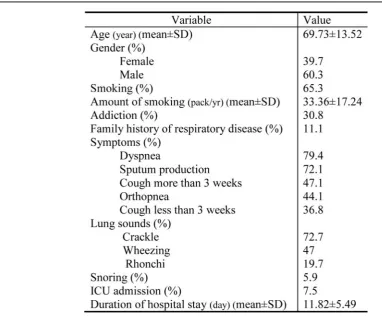
A total number of 68 COPD patients were in-cluded in our study. The patients were 41(60.3%) male and 27(39.7%) female with mean age of 69.73 (SD=13.52) years. As listed in Table 1, 60.3% of patients were current smokers with mean smoking amount of 33.36 (SD=17.24) pack/yr. Additionally, 30.8% of patients were also opium addicts.
Evaluating the patients’ medical records re-vealed that 11.1% of them had a family history of respiratory tract diseases; and 5.9% were
ha-bitual snorers.
Patients’ symptoms and signs are shown in Table 1. As listed, the most common symptoms were dyspnea (79.4%), sputum production (72.1%), cough more than 3 weeks (47.1%), or-thopnea (44.1%) and cough less than 3 weeks (36.8%). Moreover, crackles (72.7%) and wheezing (47%) were the most frequent sounds on their lung auscultation.
Out of 68 COPD patients, four (7.5%) were admitted in the intensive care unit (ICU) and three (4.4%) died. The mean duration of hospi-talization was 11.82 (SD=5.49) days.
The results of baseline and discharge ABG’s are shown in Table 2. The mean values of Pa-CO2and PaO2were 55.06 mmHg (SD=16.63) and 72.97 mmHg (SD=32.58) on admission, re-spectively. In addition, the mean baseline pH and O2 saturation were 7.41(SD=0.10) and 90.45% (SD=10.88), respectively. On the other hand, the mean values of PaCO2and PaO2were Table 1. Demographics and main clinical variables of COPD patients (values are expressed as mean±SD).
51.75 mmHg (SD=20.73) and 67.01mmHg (SD=22.70) on discharge, respectively. The mean of last pH and O2 saturation were also 7.43 (SD =0.09) and 91.58% (SD=6.70), re-spectively.
Spirometry was performed in all COPD pa-tients. The mean value of FEV1, before and af-ter using bronchodilator, was 45.72 (SD=3.33)% and 51.75% (SD=4.21) of predicted, respec-tively. Moreover, the mean value of FEV1/
FVC, before and after bronchodilator was 60.05% (SD=2.76) and 59.75% (SD=2.95), re-spectively. Other mean values of different spirometric indexes are shown in Table 2.
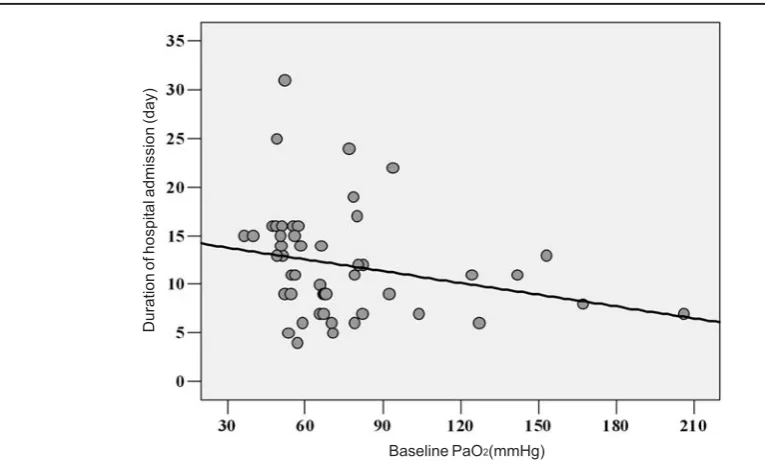
Analytical statistics were performed. Family history of pulmonary disease (P=0.018), habit-ual snoring (P=0.031), and mean baseline arte-rial PaO2(P=0.010, r= -0.361) were determined as factors affecting duration of hospitalization. Statistically significant adverse correlation be-tween baseline PaO2 and duration of hospital stay is shown in Figure 1. On the other hand, other factors such as smoking (P=0.992), pa-tient’s gender (P=0.735) and spirometric in-dices did not significantly associate with dura-tion of hospitalizadura-tion (P>0.05).
Discussion
Although many studies have evaluated fac-tors related to the survival and mortality of COPD patients, ours is one of the first to assess factors affecting duration of hospital stay among these patients. The results of our study show that factors such as positive family histo-ry of pulmonahisto-ry disease (P=0.018), habitual snoring (P=0.031), and lower baseline arterial PaO2(P=0.010) could potentially lead to longer duration of hospital stay among COPD pa-tients. Some of these factors were previously demonstrated as important risk factors for mor-tality in COPD patients, too. Moreover, the mortality rate of COPD patients in our study was 4.4%.
In a recent study by Gunen et al [28], the au-thors found that the in-hospital mortality rate for the patients was 8.3%. The rate of in-hospi-tal morin-hospi-tality for COPD patients hospiin-hospi-talized with acute exacerbation has been reported to be between 2.5% and 30%, depending on the methodology of data collection and the patient population [17,30]. Nonrespiratory organ sys-tem dysfunction and hospital days prior to ICU admission have been reported to be the most important predictors of in-hospital mortality,
Table 2. Results of ABG and spirometric indices of COPD-patients during their admission in the hospital
(Values are expressed as mean±SD).
On discharge
with the total in-hospital mortality rate being 24% [17]. Recently, a cross-sectional nation-wide study based on a national database report-ed a relatively low in-hospital mortality of 2.5% and identified older age, male sex, higher in-come, nonroutine admissions, and more co-morbid conditions as independent risk factors [30]. In another study on 2003, Groenewegen et al [27] concluded that Besides PaCO2and age, which were previously established as predic-tors of mortality, the long-term use of oral corti-costeroids was found to be an important inde-pendent risk factor for mortality. They also showed that sex, duration of hospital stay, FEV1, BMI, comorbidity index, and number of hospital readmissions had no influence on mor-tality. Sex and FEV1were also found not to af-fect duration of hospitalization in our study.
Gunen et al [28] concluded that in-hospital mortality of COPD patients hospitalized for acute exacerbation was mainly influenced by lower PaO2and SaO2, higher PaCO2, and longer length of hospital stay. Similar to this study, we also found lower PaO2as an important factor af-fecting duration of hospitalization, which also
may have a role in mortality.
Almost the same factors were demonstrated as risk factors of long-term mortality of COPD patients, too. A study on long-term survival of seriously ill, hospitalized COPD patients with PaCO2>_6.65 kPa showed that independent pre-dictors for survival were severity of illness, age, prior functional status, BMI, PaO2/inspiratory oxygen fraction, congestive heart failure, serum albumin level and presence of corpul-monale [26]. The patient selection and flexible margins for cause of hospitalization, however, make it difficult to generalize these results to all COPD patients.
Another important factor for longer duration of hospital stay found in our study is snoring, which is not mentioned in most previous and similar studies.
Numerous investigations have shown that loud habitual snoring may be due to nasal ob-struction [31-35]. Nasal obob-struction alters air-flow dynamics and may lead to open mouth breathing during sleep, which has been shown to increase upper airway collapsibility, decreas-ing the pharyngeal airway diameter and
result-Fig. 1. Statistically significant adverse correlation between baseline PaO2and duration of hospital stay (P=0.010, r = -0.361).
Baseline PaO2(mmHg)
Duration of hospit
al admission (day)
ing in obstructive sleep disordered breathing (SDB) [36-38]. During sleep, this can lead to loud snoring and irregular breathing, leading to SDB and its deleterious effects [39]. Addition-ally, snoring is associated with a spectrum of upper airway resistance and changes of its di-mensions. Therefore, snoring may be a sign of more serious airway obstruction which may lead to longer duration of hospital stay and fur-ther mortality in COPD patients.
Conclusion
The fact that people hospitalized with COPD have a subsequently increased risk of death compared with those not hospitalized suggests the former are an at-risk group and shows the importance of factors affecting duration of hos-pitalization. Our results show that more atten-tion must be paid to habitual snoring, positive family history of respiratory disease and proba-bly low arterial PaO2which may have potential effects on duration of hospitalization; and also perhaps their short-term and long-term mortali-ty in COPD patients.
References
1. Hurd S. The impact of COPD on lung health world-wide: epidemiology and incidence. Chest 2000;117: 1S–4S.
2. Murray CJL, Lopez AD. Evidence based health pol-icy: lessons from the Global Burden of Disease Study. Science 1996; 274:740–743
3. World Health Report. World Health Organisation, Geneva. 2000. www.who.int/whr/2000/en/statistics.htm Date accessed: January 2004
4. Rutten van Molken MP, Postma MJ, Joore MA et al. Current and future medical costs of asthma and chronic obstructive pulmonary disease in The Netherlands. Respir Med 1999; 93:779–787
5. Mannino DM. COPD: epidemiology, prevalence, morbidity, and mortality, and disease heterogeneity. Chest 2002;121:Suppl. 5:121S–126S
6. Chua Ai-Ping, Kang-Hoe Lee, Tow-Keang Lim. In-Hospital and 5-year mortality of patients treated in the ICU for acute exacerbation of COPD: a retrospective
study. Chest 2005; 128; 518-524
7. Burk RH, George RB. Acute respiratory failure in chronic obstructive pulmonary disease: immediate and long-term prognosis. Arch Intern Med 1973; 132: 865–868
8. Fuso L, Incalzi RA, Pistelli R et al. Predicting mor-tality of patients hospitalized for acutely exacerbated chronic obstructive pulmonary disease. Am J Med 1995; 98: 272–277
9. Moran JL, Green JV, Homan SD, et al. Acute exac-erbations of chronic obstructive pulmonary disease and mechanical ventilation: a reevaluation. Crit Care Med 1998; 26:71–78
10. Sluiter HJ, Blokzijl EJ, Dijl WV et al. Conserva-tive and respiratory treatment of acute respiratory insuf-ficiency in patients with chronic obstructive lung dis-ease: a reappraisal. Am Rev Respir Dis 1972; 105: 932–943
11. Hill AT, Hopkinson RB, Stableforth DE. Ventila-tion in a Birmingham intensive care unit 1993–1995: out-come for patients with chronic obstructive pulmonary disease. Respir Med 1998; 92: 156–161
12. Rieves RD, Bass D, Carter RR et al. Severe COPD and acute respiratory failure: correlates for survival at the time of tracheal intubation. Chest 1993; 104: 854–860
13. Kaelin RM, Assimacopoulos A, Chevrolet JC. Failure to predict six-month survival of patients with COPD requiring mechanical ventilation by analysis of simple indices: a prospective study. Chest 1987; 92: 971–978
14. Anon JM, Garcia de Lorenzo A, Zarazaga A et al. Mechanical ventilation of patients on long-term oxygen therapy with acute exacerbations of chronic obstructive pulmonary disease: prognosis and cost-utility analysis. Intensive Care Med 1999; 25: 452–457
15. Gottlieb LS, Balchum OJ. Course of chronic ob-structive pulmonary disease after first onset of respirato-ry failure. Chest 1973; 63:5–8
16. Menzies R, Gibbons W, Goldberg P. Determinants of weaning and survival among patients with COPD who require mechanical ventilation for acute respiratory fail-ure. Chest 1989; 95: 398–405
17. Seneff MG, Wagner DP, Wagner RP et al. Hospital and 1-year survival of patients admitted to ICUs with acute exacerbation of chronic obstructive pulmonary dis-ease. JAMA 1995; 274:1852–1857
18. Knaus WA. Prognosis with mechanical ventila-tion: the influence of disease, severity of disease, age, and chronic health status on survival from an acute ill-ness. Am Rev Respir Dis 1989; 140: S8–S13
19. Burrows B, Earle RH. Prediction of survival in pa-tients with chronic airway obstruction. Am Rev Respir Dis 1969; 99: 865– 871
20. Traver GA, Cline MG, Burrows B. Predictors of
mortality in chronic obstructive pulmonary disease: a 15-year follow-up study. Am Rev Respir Dis 1979;119: 895–902
21. Anthonisen NR, Wright EC, Hodgkin JE. Progno-sis in chronic obstructive pulmonary disease. Am Rev Respir Dis 1986; 133: 14–20.
22. Gray Donald K, Gibbons L, Shapiro SH, et al. Nu-tritional status and mortality in chronic obstructive pul-monary disease. Am J Respir Crit Care Med 1996; 153: 961–966
23. Hospers JJ, Schouten JP, Weiss ST, et al. Asthma attacks with eosinophilia predict mortality from chronic obstructive pulmonary disease in a general population sample. Am J Respir Crit Care Med 1999; 160: 1869–1874
24. Landbo C, Prescott E, Lange P, et al. Prognostic value of nutritional status in chronic obstructive pul-monary disease. Am J Respir Crit Care Med 1999; 160: 1856–1861
25. Schols A, Slangen J, Volovics L, et al. Weight loss is a reversible factor in the prognosis of chronic obstruc-tive pulmonary disease. Am J Respir Crit Care Med 1998; 157: 1791–1797
26. Connors AF, Dawson NV, Thomas C et al. Out-comes following acute exacerbation of severe chronic obstructive pulmonary disease. Am J Respir Crit Care Med 1996;154: 959–967.
27. Groenewegen KH, Schols AMWJ, Wouters EFM. Mortality and mortality-related factors after hospitalisa-tion for acute exacerbahospitalisa-tion of COPD. Chest 2003; 124: 459–467.
28. Gunen H, Hacievliyagil SS, Kosar F, Mutlu LC, Gulbas G, Pehlivan E et al. Factors affecting survival of hospitalised patients with COPD. Eur Respir J 2005; 26: 234–241
29. American Thoracic Society. Standards for the di-agnosis and care of patients with chronic obstructive pul-monary disease (COPD) and asthma: this official state-ment of the American Thoracic Society was adopted by the ATS Board of Directors, November 1986. Am Rev Respir Dis 1987; 136: 225–244
30. Patil SP, Krishnan JA, Lechtzin N, et al. In-hospi-tal morIn-hospi-tality following acute exacerbations of COPD. Arch Intern Med 2003; 163: 1180–1186
31. Taasan V, Wynne JW, Cassisi N, Block AJ. The ef-fect of nasal packing on sleep-disordered breathing and nocturnal oxygen desaturation. Laryngoscope 1981; 91: 1163-1172
32. Zwillich CW, Pickett C, Hanson FN, Weil JV. Dis-turbed sleep and prolonged apnea during nasal obstruc-tion in normal men. Am Rev Respir Dis 1981; 124:158-160
33. Lavie P, Fischel N, Zomer J, Eliaschar I.The ef-fects of partial and complete mechanical occlusion of
nasal passages on sleep structure and breathing in sleep. Acta Otolaryngol 1983; 95:161-166
34. Suratt PM, Turner BL, Wilhoit SC. Effect of in-tranasal obstruction on breathing during sleep. Chest 1986; 90: 324-329
35. Miljeteig H, Hoffstein V, Cole P. The effect of uni-lateral and biuni-lateral nasal obstruction on snoring and sleep apnea. Laryngoscope 1992; 102: 1150-1152
36. Meurice JC, Marc I, Carrier MG, Series F. Effects of mouth opening on upper airway collapsibility in nor-mal sleeping subjects. Am J Respir Crit Care Med 1996;153: 255-259
37. Block AJ, Faulkner JA, Hughes RL, Remmers JE, Thach B. Factors influencing airway closure. Chest 1984; 86:114-122
38. Kuna S, Remmers JE. Neural and anatomic factors related to upper airway occlusion during sleep. Med Clin North Am 1985; 69:1221-1242
39. Cillo JE, Finn R, Dasheiff RM. Combined open rhinoplasty with spreader grafts and laser-assisted uvulo-plasty for sleep-disordered breathing: long-term subjec-tive outcomes. J Oral Maxillofac Surg 2006; 64:1241-1247