R E S E A R C H
Open Access
Classification-based spoken text selection
for LVCSR language modeling
Vataya Chunwijitra
*and Chai Wutiwiwatchai
Abstract
Large vocabulary continuous speech recognition (LVCSR) has naturally been demanded for transcribing daily conversations, while developing spoken text data to train LVCSR is costly and time-consuming. In this paper, we propose a classification-based method to automatically select social media data for constructing a spoken-style language model in LVCSR. Three classification techniques, SVM, CRF, and LSTM, trained by words and parts-of-speech are comparatively experimented to identify the degree of spoken style in each social media sentence. Spoken-style utterances are chosen by incremental greedy selection based on the score of the SVM or the CRF classifier or the output classified as “spoken” by the LSTM classifier. With the proposed method, just 51.8, 91.6, and 79.9% of the utterances in a Twitter text collection are marked as spoken utterances by the SVM, CRF, and LSTM classifiers, respectively. A baseline language model is then improved by interpolating with the one trained by these selected utterances. The proposed model is evaluated on two Thai LVCSR tasks: social media conversations and a
speech-to-speech translation application. Experimental results show that all the three classification-based data selection methods clearly help reducing the overall spoken test set perplexities. Regarding the LVCSR word error rate (WER), they achieve 3.38, 3.44, and 3.39% WER reduction, respectively, over the baseline language model, and 1.07, 0.23, and 0.38% WER reduction, respectively, over the conventional perplexity-based text selection approach.
Keywords: Spoken language model, LVCSR, Classification
1 Introduction
Large vocabulary continuous speech recognition (LVCSR) systems now play an increasingly significant role in daily life. Many commercial applications of LVCSR are widely employed, e.g., medical dictation, getting weather information, data entry, speech transcription, speech-to-speech translation, railway reservation, etc. However, in some systems, e.g., a speech-to-speech translation and interactive voice response (IVR) for customer service, speech input is highly conversational while it is more of a written style in medical dictation. A spoken language and a written language are different in several aspects includ-ing the word choice and the sentence structure. Hence, it is important to consider the language style for creating an efficient language model (LM) for a LVCSR system.
Typical speech recognition uses a LM to introduce lin-guistic restrictions that helps the recognizer figure out
*Correspondence: [email protected]
NECTEC, National Science and Technology Development Agency (NSTDA), 112 Pahonyothin Road, Pathumthani 12120, Thailand
a word sequence. In general, a LM is built by using a text corpus, and its performance depends on the data size and text quality. For creating LVCSR systems in dif-ferent domains and styles, it is necessary to find appro-priate text sources well matched to the task domain as well as the style of speech input. A straightforward way to create a conversational text corpus is to transcribe recorded human conversations. However, transcribing is much costly and time-consuming, and thus it is quite difficult to get a large amount of conversational data to reliably train a LM. Much effort has been devoted to the unsupervised and semi-supervised acoustic model train-ing [1–3] to exploit the untranscribed data. Most of these works focus on generating better quality hypothesis and on improving confidence measure for better data selec-tion. In other direction, acquiring large text from the Internet is a popular way nowadays. Filtering text appro-priate for the targeted LM is also an important step towards effective use of these data. Word perplexity was used as a similarity criterion to select text for a target domain [4, 5]. Another approach based on comparing
the entropy between domain-specific and general domain LMs was proposed [6, 7]. The relative entropy-based crite-rion in [8] was also chosen for building topic-specific LMs. They showed that these techniques could produce a better domain-specific LM than that by random data selection.
This paper targets on building Thai LVCSR serving general daily conversations. To enlarge the LM training data suitable for this task, acquiring text, and filtering for spoken-style text are needed. Twitter, a well-known social media microblog, is attractive as the text length up to 140 characters tends to make the language more informal and sometimes produces incomplete sentences, which are one characteristic of the spoken language. Using the Twitter text, called tweets, to build LM was first introduced in [9], where the in-vocabulary hit rate was used as a criterion to select useful tweets. In addition to the classical entropy-based sentence selection methods previously proposed, in this paper, modern machine learning algorithms includ-ing support vector machines (SVM), conditional random fields (CRF), and long short-term memory neural net-work (LSTM) are comparatively investigated to improve the precision of spoken language sentence selection. With training data representing highly written language such as newspaper and highly spoken language such as telephone conversation, the trained model is expected to estimate the degree of spoken style of an input text. This model is suitable for selecting spoken sentences from mixed-style data such as tweets. The selected tweets are finally used to construct a spoken-style LM which is interpolated to a baseline LM to improve the overall Thai LVCSR perfor-mance. The resulted LM is comparatively evaluated with a LM trained by a set of exact spoken text, in terms of both the perplexity and the LVCSR word error rate (WER) on two different tasks.
This paper is organized as follows: we first briefly intro-duce the characteristics of spoken and written languages and also describe existing Thai large vocabulary speech corpora in Section 2. We present our process for collecting data from Twitter in Section 3. In Section 4, the proposed
method of style-based data selection for constructing spo-ken LM is explained. In Section 5, we describe the experi-ments to evaluate the proposed style classifier in terms of the classification accuracy, the perplexity of the LM, and the LVCSR recognition performance. We finally conclude our work and discuss our future direction in Section 6.
2 Thai spoken and written languages 2.1 Distinction between difference text styles
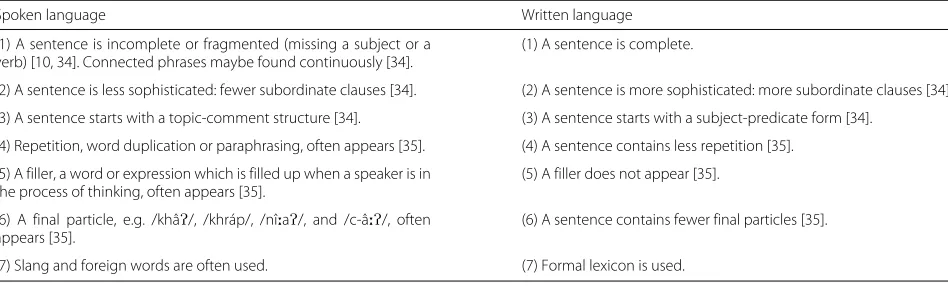
One of the sociolinguists, Prasithrathsint [10], suggested that it is better to recognize spoken and written languages in terms of language styles rather than communicative methods. For instance, we can talk using a written-style language as in giving a formal speech; on the other hand, we can write using a spoken-style language as in a personal letter. A spoken language and a written language are dif-ferent in several aspects including vocabulary choice and sentence structure. The spoken text uses words that would be inappropriate in a written text. The words employed in the conversation are simpler and shorter, and the speakers do not have much time in a conversation to choose their vocabulary carefully. Sentences are relatively unplanned, less structured and interactive. In contrast, the written text is planned, well organized and transactional. Some certain words used in the written text would seem unusual if they appeared in a conversation. The writers have more time to chose their vocabulary appropriate for their partic-ular purpose. There are also more nouns and longer words utilized in the written text than in the spoken text. The characteristics of Thai spoken and written languages [11] in general are shown in Table 1.
2.2 Thai Corpora for analysis of spoken and written styles Several Thai speech corpora have been developed for speech processing research. These corpora are different in terms of acoustic characteristics of speech signals, condi-tions of input channels, and application domains. Among these corpora, three of them, LOTUS [12], LOTUS-Cell 2.0 [13] , and LOTUS-SOC [14, 15], are considered large
Table 1Characteristics of Thai spoken language vs. written language
Spoken language Written language
(1) A sentence is incomplete or fragmented (missing a subject or a verb) [10, 34]. Connected phrases maybe found continuously [34].
(1) A sentence is complete.
(2) A sentence is less sophisticated: fewer subordinate clauses [34]. (2) A sentence is more sophisticated: more subordinate clauses [34].
(3) A sentence starts with a topic-comment structure [34]. (3) A sentence starts with a subject-predicate form [34].
(4) Repetition, word duplication or paraphrasing, often appears [35]. (4) A sentence contains less repetition [35].
(5) A filler, a word or expression which is filled up when a speaker is in the process of thinking, often appears [35].
(5) A filler does not appear [35].
(6) A final particle, e.g. /khâP/, /khráp/, /nî:aP/, and /c-â:P/, often appears [35].
(6) A sentence contains fewer final particles [35].
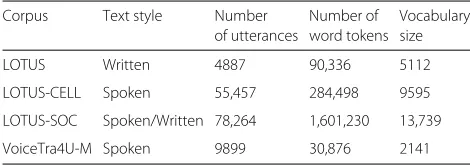
vocabulary speech corpora. The detail of each corpus is described below while their statistics are given in Table 2. LOTUS is a Large vOcabulary Thai continUous Speech corpus specially designed for developing Thai LVCSR. Utterances in the LOTUS corpus were recorded in a read-ing style where the readread-ing prompts were taken from a Thai text corpus, ORCHID [16]. This corpus contains articles from various sources, such as magazines, Thai encyclopedia, and journals, and thus can be considered as a general-domain written-style corpus. The LOTUS corpus contains 55 h of speech from 48 speakers.
LOTUS-Cell 2.0, or LOTUS-Cell for short in the con-text of this paper, is a large Thai telephone speech cor-pus. It contains three parts of speech data, answers to closed-ended questions, answers to open-ended questions and dialog speech. The questions and discussion topics were designed to elicit speech data which have their con-tents conformed to the domains of potential automatic speech recognition (ASR) applications such as trans-portation, tourism, and health care. The corpus contains recorded speech from 212 speakers with gender balance. The amount of recorded speech is 90 h.
LOTUS-SOC is a Large vOcabulary Thai ContinUous Speech SOCial media corpus which aims at reducing the effort in creating a conversational speech corpus so that a larger corpus could be collected. The LOTUS-SOC corpus is created by recording Thai native speakers uttering Twit-ter messages through a mobile application. By using this data collection method, we can avoid the process of seg-menting the recorded speech into utterances and also the need to transcribe the data. The corpus contains recorded speech from 208 speakers and approximately 172 h of speech. The age range of speakers is 11–58 years old.
VoiceTra4U-M (VT) is a speech translation application in sport and travel domains developed under the Uni-versal Speech Translation Advanced Research (U-STAR) consortium (http://www.ustarconsortium.com/qws/slot/ u50227/index.html). This consortium, consisting of 26 research institutes from 23 countries, aims to enable peo-ple in the world to communicate without any language barriers. The application allows five people to chat simul-taneously in 23 different languages including Thai. It is available on the iOS platform, but the consortium also plans to make it available on Android platform due to a
Table 2The amount of texts in Thai large vocabulary speech
corpora
Corpus Text style Number Number of Vocabulary of utterances word tokens size
LOTUS Written 4887 90,336 5112
LOTUS-CELL Spoken 55,457 284,498 9595
LOTUS-SOC Spoken/Written 78,264 1,601,230 13,739
VoiceTra4U-M Spoken 9899 30,876 2141
rapid growth of Android smartphones in many countries. The corpus contains speech from various Thai speakers and obtained approximately 22 h of speech recorded on mobile devices in real environments. The speech data were manually transcribed.
To be used in this paper, the LOTUS corpus was divided into two sets: LOTUS-TRN and LOTUS-DEV. Similarly, the LOTUS-Cell corpus was divided into CELL-TRN and CELL-DEV. The VoiceTra4U-M corpus was also divided into VT-DEV and VT-TST. SOC was randomly selected from the LOTUS-SOC corpus. The detail of each set is presented in Table 3.
3 Twitter data collection
Twitter data are used as a data source for performing style-based data selection to build our spoken LM. In this study, we collected approximately 2 million Thai tweets during February to March 2013 via the available Twitter REST API. This API allows us to specify desired keywords when acquiring the data. We will refer to this text collection as a Thai Twitter text corpus throughout the rest of this paper. 150,000 tweets were randomly selected as initial data for examining in our experiments.
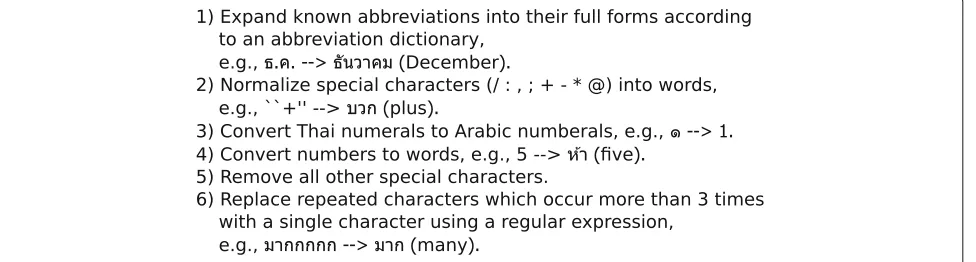
Before using the Twitter text for building a LM, it is nec-essary to perform data cleaning and text normalization. In the cleaning process, we have removed Twitter symbols, such as “RT” (re-tweet), mention markers (@username) and hashtag (#hashtag), and also URLs from the text. We perform duplicated sentence removal to avoid spams and re-tweets. Known abbreviations, numbers and spe-cial characters in Twitter messages were normalized into more suitable forms with a set of rules shown in Fig. 1. For the nonstandard words in tweets, extensive normal-ization is required to transform these words into their normalized forms which mean words in a dictionary. In this work, we used a similarity-based text normalization method to handle frequent nonstandard types in Thai tweets including homophonic, spelling error, and inser-tion [11]. The similarity between a nonstandard word and a normalized word in terms of spelling and pronuncia-tion are measured by an edit distance while the similarity in terms of context is measured by a Kullback-Leibler (KL) distance. With this cleaning and normalization tech-niques, a 3-g LM trained by preprocessed tweets has been improved regarding both the perplexity and WER performance [11].
Table 3The detail of each speech corpora set used in this study
Corpus Data set Usage Number of utterances
LOTUS LOTUS-TRN Training the classification model 4330
LOTUS-DEV Evaluation the classifier performance 557
LOTUS-CELL CELL-TRN Training the classification model 40,000
CELL-DEV Evaluation the classifier performance 15,475
VoiceTra4U-M VT-DEV Optimization the selection of confidence groups 7982
VT-TST Evaluation the recognition performance 1917
LOTUS-SOC SOC Evaluation the recognition performance 4000
based on CRF, to automatically identify word boundaries in tweet texts.
4 Style-based data selection
The goal of this work is to retrieve spoken-style text from social media data, Twitter, for building an appropriate LM in spoken-style LVCSR. Since Twitter data may also con-tain written-style text such as formal news tweets from news agencies, we first explore the use of text catego-rization to classify text into two categories: spoken and written. After that, the selected spoken-style sentences and the existing spoken text, CELL-TRN, are used to train the spoken LM. Finally, an interpolated LM between pre-pared baseline and spoken LMs is used as the final LM for LVCSR. An overall diagram, baseline LM construction, classification features, methods, and data selection are discussed in Sections 4.1, 4.2, 4.3, 4.4, and 4.5, respectively.
4.1 Overall diagram
The system overall diagram is shown in Fig. 2. The social media data, Twitter, is used as the text resource. It contains 150K utterances of Thai tweets collected from February to March 2013 via the Twitter REST API. The original data are preprocessed by removing unnecessary data such as extraneous tags and duplicated sentences, and then normalizing to suitable forms for reading as described in Section 3. Next, these data are segmented into word sequences by CRF-based word segmentation,
and afterwards the stylistic text classifications are applied. In this work, we compare three classification approaches, SVM [18], CRF [19], and LSTM [20]. The SVM or CRF classifier gives for each sentence an output score indicat-ing the degree of beindicat-ing a spoken style, i.e., a large score for “spoken” and a small score for “written.” In the LSTM case, each sentence is directly classified into “spoken” or “written” with no score.
In the case of SVM or CRF, sentences are separated into groups according to classification scores.
The group of sentences with the lowest perplexity scores on VT-DEV set are selected. In the LSTM case, only sen-tences classified as “spoken” are selected. After the above selection process, a spoken LM is built by using these selected sentences combined with CELL-TRN sentences. The spoken LM is then used to interpolate with a baseline LM to produce a final LM for the LVCSR system. A linear interpolation algorithm is employed as follows.
LM=λ·LMbaseline+(1−λ)·LMspoken (1)
whereLMbaselineis the baseline LM trained by the
exist-ing data as described in Section 4.2,LMspokenis the LM
trained by the selected spoken-style sentences combined with the CELL-TRN, and λ is the weighting factor for tuning the final model.
Fig. 2Overall diagram
4.2 Baseline LM
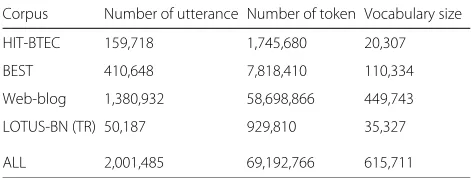
In this study, four large text corpora, HIT-BTEC, BEST, Web-blog, and LOTUS-BN, are used to build a baseline LM. To handle OOV words, a hybrid 3-gram LM tech-nique [21] was adopted. As these corpora cover a variety of domains, they are useful resources for open-vocabulary LVCSR. Table 4 summarizes the amount of text from each training corpus.
HIT-BTEC is a Thai translated version of the mul-tilingual Olympic-domain corpus developed by Harbin institute of technology (HIT) [22] and the Basic Travel Expression Corpus (BTEC) [23]. This corpus was initially created for speech-to-speech translation research. The HIT corpus includes utterances in five domains related to Olympic games, namely, traveling, dining, sports, traf-fic, and business. The Thai version of BTEC and HIT was constructed under the Universal Speech Transla-tion Advanced Research (USTAR) consortium. The total amount of data in the HIT-BTEC corpus is nearly 160,000 utterances.
BEST [24] is a Thai text corpus developed under the BEST (Benchmark for Enhancing the Standard of Thai language processing) project. Articles in BEST were collected from eight different genres: academic article, encyclopedia, novel, news, Buddhism, law, lecture, and Wikipedia. These articles were manually segmented into
Table 4Text resources for language model training
Corpus Number of utterance Number of token Vocabulary size
HIT-BTEC 159,718 1,745,680 20,307
BEST 410,648 7,818,410 110,334
Web-blog 1,380,932 58,698,866 449,743
LOTUS-BN (TR) 50,187 929,810 35,327
ALL 2,001,485 69,192,766 615,711
words by linguists. The total amount of available data is approximately 7 million words.
Web-blog is a large collection of Thai web text from chatting blog and discussion forum on a famous website in Thailand. The corpus consists of articles from eight differ-ent genres: mobile, travel, camera, films, residence, news, automobile, and woman’s life. This corpus was collected from June 2011 to March 2012. Tlex [17] was used to auto-matically identify word boundaries. The total amount of data in this corpus is nearly 140,000 utterances.
LOTUS-BN [25] is a Thai television broadcast news cor-pus which includes audio recordings of hour-long news programs and their transcriptions. Each news program is segmented into small parts, i.e., sections and utterances. There are 18 news topics in the corpus, for instance, politics, sport, and weather. The corpus contains approx-imately 156 h of speech from 43 female speakers and 38 male speakers. Data in LOTUS-BN are divided into 3 sets: a training set (TR), a development test set (DT), and an evaluation test set (ET). There is no overlapping speaker among the TR, DT and ET sets. Only the TR set (around 50,000 utterances) was used to train the LM.
4.3 Classification features
a POS tagger using CRF. We trained the CRF model with manually tagged data which contain 3 million words taken from the BEST corpus [24]. Articles in BEST were manually segmented into words and then POS tagged by linguists. The tagset consists of 35 POSs [26] which was modified from the 47-POS tagset used in the ORCHID corpus [16]. We use the word and its contexts, i.e. the previous word and the following word, as features for pre-dicting the POS of each word. Our CRF-based POS tagger has 97.6% accuracy.
4.4 Stylistic text classification methods
In this work, three machine learning approaches, SVM, CRF, and LSTM are compared for style classification. SVM is one of the most effective machine learning algo-rithms for many complex binary classification problems. One remarkable property of SVM is its ability to learn regardless of the dimensionality of the feature space. Given a category, each example belongs to one of two classes referred to as the positive and negative class.
For the kernal function in this study, we investigate two basic kernels, Linear and Radial Basis Function (RBF).
An input vector of the SVM classifier contains 40,964 elements representing all lexical words and all POSs. Each element value is the frequency of the word or POS in the input sentence. We train the SVM to predict two classes, a positive class (+) for a spoken text utterance and a neg-ative class (−) for a written one. Given an input utterance, the SVM outputs a real value of the decision function, the larger value the output of SVM is, the more spoken the utterance becomes. It is noted that the SVM output score used in this study is the predicted value that can be used to order the test utterance for ranking the spoken-like degree.
CRF is undirected graphical model for segmenting and labeling structured data [19]. The CRF model repre-sents a conditional distributionp(y|x)and dependencies over the observation sequence x. We assume that X = (x1,x1,. . .,xT) is a input sequence andY = (y1,y2,. . .,
yT)is a set of label sequence.
We train a CRF by maximizing the log-likelihood of a label sequence in the training data. Our CRF classifier works at word level.
Each word is labeled as “spoken” in spoken training utterances or “written” in written ones. We also use words and POSs as classification features. The current word, pre-vious word and the following word along with their POSs are used to predict a classification label, “spoken” or “writ-ten,” for each word. The output of CRF for each input sentence is a conditional probability; a high probability reflects “spoken” and a low reflects “written.”
LSTM is an alternative architecture for recurrent neu-ral network inspired by the human memory systems. The LSTM is a model that allows us to input a sequence of
inputs. At every step, the model will update its inter-nal representation of the input so far, giving it a form of memory.
Using the LSTM classifier in this work, both words and their POSs are also employed as classification features at an utterance level. We implemented the LSTM with a sin-gle hidden layer, 0.01 of learning rate for weight updates, and a stochastic gradient-based optimization algorithm [27] for weight optimization. Each training sentence is labeled as “1” for a spoken class and “2” for a written class. Since we are attempting to classify the whole sentence, not an individual word, we only consider the last output of the network as the actual classification result. The LSTM out-put contains class elements, a class “1” for a spoken-style and a class “2” for a written-style.
4.5 Data selection methods for building spoken LM After classifying, the utterances are organized into groups based on the scores from SVM or CRF, or the output classes from LSTM. From SVM and CRF classification process, the output score is a real value.
We can then, by observing, cluster the utterances into 10 groups as shown in Table 5.
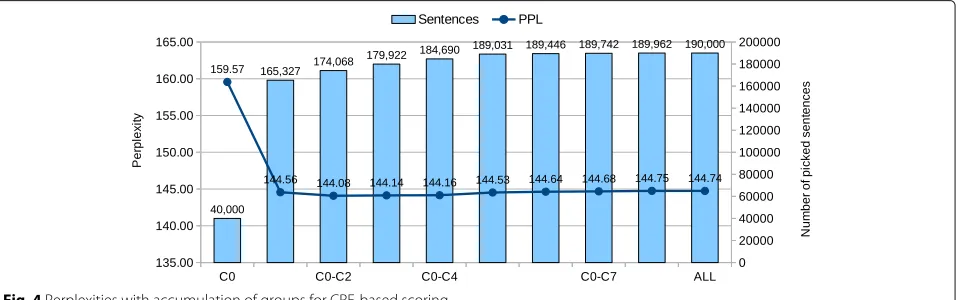
The top N groups having the highest spoken-style scores are selected for spoken LM training. To find an optimalN, we prepare accumulated groups of C0 to CN, denoting as C0, C0–C1, C0–C2, and so on. Each accumu-lated group is used to train a LM. The constructed LM is then evaluated by the perplexity of the VT-DEV which is a known spoken-style data set. The accumulated group giving the lowest perplexity is considered the optimal one. Figures 3 and 4 show the perplexity changes and the num-ber of picked sentences with the accumulations of groups for SVM- and CRF-based scoring, respectively. As shown in the figures, at the point of C0–C4 for SVM and C0-C2
Table 5The organized groups of SVM- and CRF-based scoring
calculated from Twitter text data
Group SVM-based scoring CRF-based scoring
C0 CELL-TRN data CELL-TRN data
C1 Score ≥4.0 Score ≥ 0.9
C2 4.0>score≥3.0 0.9>score ≥0.8 C3 3.0>score≥2.0 0.8>score ≥0.7 C4 2.0>score≥1.0 0.7>score ≥0.6 C5 1.0>score≥0.0 0.6>score ≥0.5 C6 0.0>score>−1.0 0.5>score ≥0.4 C7 −1.0≥ score>−2.0 0.4>score ≥0.3 C8 −2.0≥ score>−3.0 0.3>score ≥0.2 C9 −3.0≥ score>−4.0 0.2>score ≥0.1
Fig. 3Perplexities with accumulation of groups for SVM-based scoring
for CRF, the perplexity is the minimum. These accumu-lated groups, containing totally 98K sentences for SVM and 174K sentences for CRF, are regarded as the optimal clusters.
Using the LSTM classifier, the output contains class ele-ments, the class “1” for a spoken text utterance and the class “2” for a written one. Consequently, in this work, the spoken LM are trained from the union of the existing spoken-style corpus (CELL-TRN) and the selected sen-tences with the class “1.” With this technique, the total number of utterances for building spoken LM are 151K.
5 Experiments
We evaluate the proposed style classifier in terms of the classification accuracy, the perplexity of the result LM and the recognition performance. Experimental results are discussed in the following sub-sections.
5.1 Experimental conditions
Acoustic model training data of our LVCSR composes of 773 h of speech from LOTUS [12], LOTUS-BN [25], LOTUS-SOC [14], VoiceTra4U-M, and other unpublished sources. VoiceTra4U-M is a speech translation appli-cation in sport and travel domains developed under
the Universal Speech Translation Advanced Research (U-STAR) project (http://www.ustar-consortium.com/). Twenty-two h of speech were recorded on mobile devices in the real environment. We used the Kaldi Speech Recog-nition Toolkit [28] to first train a conventional GMM-based acoustic model. We then applied the Maximum Mutual Information (MMI) discriminative training tech-nique described in [29]. Each frame of speech data was converted into a sequence of 39 dimensional feature vec-tors of 12 MFCCs appended with a log energy, and their first and second derivatives. We used a 25-ms frame length with 10-ms window shift. Features from a con-text window of 3 frames to the left and right were also included. A Linear Discriminate Analysis (LDA) was also applied to the feature space to reduce feature dimensions to 40.
The baseline LM (Base) training data contain 9.4M words from three corpora, BEST [24], LOTUS-BN [25], and HIT-BTEC [23]. As these corpora cover a variety of domains, e.g. law, news, and travel, and the vocabulary size is as large as 121K, they are excellent resources for training a hybrid LM for open-vocabulary LVCSR system. For comparison, five sentence selection methods were applied on the same Twitter data set.
Table 6The classification performance of style classifiers evaluated on LOTUS-DEV and Cell-DEV sets
Classifier Precision (%) Recall (%) Fscore (%) Accuracy(%)
SVM-linear 99.17 99.45 99.31 98.67
SVM-RBF 99.25 99.52 99.39 98.81
CRF 99.44 99.31 99.38 98.79
LSTM 98.99 99.75 99.37 98.66
(1)ALL : All sentences containing both “written” and “spoken.”
(2)Random: A limited number of sentences randomly selected.
(3)PPL : Sentences selected by the perplexity-based method [4].
(4)SVM : Sentences selected by the SVM classifier. With this technique, 98K sentences are selected as spoken-style utterances.
(5)CRF : Sentences selected by the CRF classifier. In this case, 174K sentences are selected.
(6)LSTM : Sentences selected by the LSTM classifier. 151K sentences are chosen as spoken-style text.
As each selection techniques produces different num-bers of utterances, for fair comparison, the number of sentences fromRandomandPPLcases are varied at 98K, 151K, and 174K as inSVM,CRF, andLSTMtechniques, respectively.
For building each spoken LM, the CELL-TRN and the selected sentences from each method were adopted as described in Section 4.1. In the recognition step, the final LM is interpolated by these spoken LM to the baseline LM.
We evaluated our approaches in two different recog-nition tasks: Twitter posting (SOC) and VoiceTra4U-M speech-to-speech translation (VT). The evaluation data set is classified as either spoken or written utterances. It contained 4000 utterances from 5 speakers in the
office environment taken from the LOTUS-SOC and 1916 utterances from the VT-TST of the VoiceTra4U-M mobile application.
5.2 Classification accuracy
To train a style classifier, we used the LOTUS corpus as a representation of written-style utterances and the LOTUS-Cell as a representation of spoken-style utter-ances. Every utterance in the LOTUS corpus was labeled as “written” while every utterance in the LOTUS-Cell corpus was marked as “spoken.” Four thousand three hun-dred thirty utterances in the LOTUS-TRN set and 40,000 utterances in the Cell-TRN set, described in Section 2.2, were used to train classification models while 557 utter-ances in the LOTUS-DEV set and 15,475 utterutter-ances in the Cell-DEV set were used to evaluate the classifier performance.
For the LOTUS-DEV set, the classification accuracy is calculated from the number of utterances classified as “written.” On the other hand, the accuracy of the Cell-DEV set is computed from the number of utterances classi-fied as “spoken.” The average classification performance in terms of precision, recall,Fscore and accuracy of both the LOTUS-DEV set and the Cell-DEV set are shown in Table 6.
You can see that LSTM classifier has the lowest pre-cision value but its recall is the highest. The high value of recall indicates thatLSTMclassified the spoken utter-ance almost completely. However, many written sentences were also falsely classified as we can see from the low value of precision. On the other hand, we achieve the lowest recall and highest precision when using theCRF classifier. This indicates that a few written sentences were mixed selected, but not all the spoken utterances were selected. The results also demonstrated that both of the classificationFscores and accuracies, the results ofSVM, CRF, andLSTMclassifiers are comparable. Therefore, in this work, we chose to compare multiple classification models, since we are interested to see how each classifier does in predicting the spoken degrees that are assigned to the utterances. ForSVM, the RBF kernel has a slightly
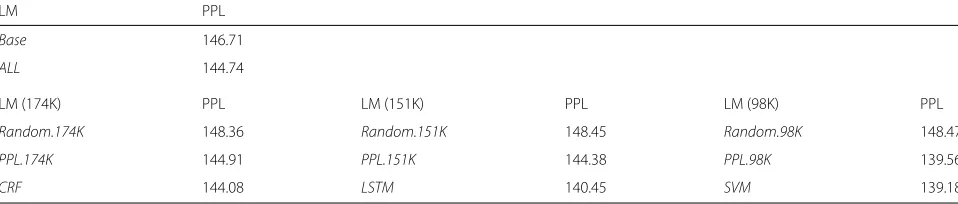
Table 7Perplexities of language models trained from mixed-style and spoken-style utterances evaluated on VT-TST and SOC sets
LM PPL
Base 146.71
ALL 144.74
LM (174K) PPL LM (151K) PPL LM (98K) PPL
Random.174K 148.36 Random.151K 148.45 Random.98K 148.47
PPL.174K 144.91 PPL.151K 144.38 PPL.98K 139.56
Fig. 5Recognition performance (WER) using 174K selected sentences
better performance than the linear one. Therefore, the RBF kernelwas used to select spoken utterances for LM training in the latter experiment.
5.3 Language model perplexity
In this experiment, the performance of the style classifier was evaluated in terms of LM perplexity with respect to a known spoken-utterance test set (VT-DEV). 51.84, 91.61, and 79.93% of the utterances in the corpus were classified as spoken utterances bySVM,CRF, andLSTMclassifiers respectively. We can see that the number of picked utter-ances of each classifier seem to be a difference due to our organized groups, shown in Table 5, which affect on the degree of spoken.
A trigram LM was trained by the SRILM toolkit [30] with modified Kneser-Ney discounting. Three LMs trained from spoken utterances selected byCRF,LSTM, andSVM classifiers respectively were interpolated with baseline LM (Base) and then evaluated on the VT-DEV set of spoken data. For comparison, we also investigated the LMs made with other selection methods,ALL, Ran-dom, and PPL, as described in Section 5.1. In cases of Random and PPL, we randomly selected 174K, 151K, and 98K utterances to train LMs to make the size of the training data comparable to each proposed method, CRF,LSTM, and SVM, respectively. These LMs were also
interpolated withBaseand then evaluated on the same VT-DEV set.
The perplexities are reported in Table 7. From this table, we can see that three interpolated LMs,CRF,LSTM, and SVM, trained from spoken utterances classified by CRF, LSTM, andSVMhave lower perplexities than theBaseand ALL. Moreover, comparing withRandomandPPLon each different size of training data, the proposed selections also have lowest perplexity in all cases.
5.4 Recognition performance
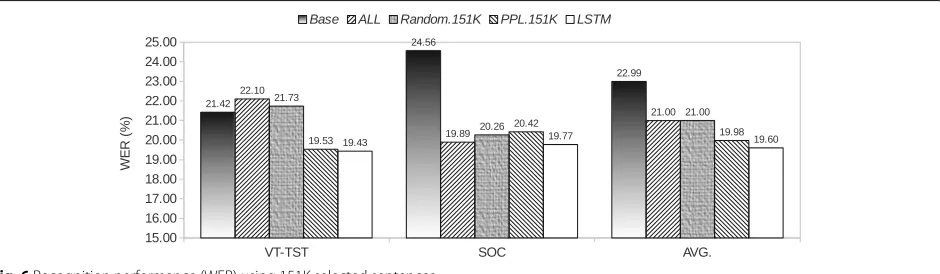
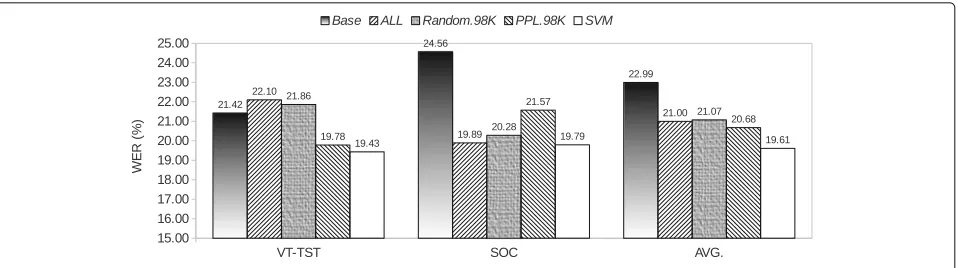
In this section, we observed the recognition performance in terms of speech recognition word error rate (WER). The same evaluation sets, SOC and VT, were used in this experiment. For fair comparison, we also selected the utterance sizes of theRandomandPPLcases at the same scale as each proposed methods. Figures 5, 6, and 7 show the recognition results of different data sizes.
From the results, we can see that all proposed classification-based selection methods effectively decreased the WER from those byBase, ALL, Random, andPPL in all test cases. In case of the VT test set, it is obvious that the ALL and Random selection methods deteriorate the performance of LM. However, in the SOC test set, the recognition results ofALLandRandom selection methods are quite better than that of thePPL.
Fig. 7Recognition performance (WER) using 98K selected sentences
The recognition results of our proposed techniques are also slightly improved compared to others. This might be due to the fact that we use a development set from the VoiceTra4U-M data (VT-DEV) to tune obtain an interpolation weight. However, the evaluation results on the SOC set demonstrate that the VT-DEV can be used even if in the open dataset. Compared with the Base, when no social media sentences were used, the average improvement with the proposedCRF,LSTM, and SVM were 3.44, 3.39, and 3.38%, respectively. With the increase of all social media data (ALL), which contains both “written” and “spoken” utterances, the average WER improvement of the proposed CRF, LSTM, and SVM became 1.44, 1.40, and 1.39%, respectively. This shows the fact that using a large amount of social media data from the Internet, without style-based classification, gives no benefit. Moreover, theCRF,LSTM, andSVMapproaches achieved a reduction of 0.23, 0.38, and 1.07% in average WER over a conventional perplexity-based approach, respectively. It can conclude that the proposed techniques can obviously improve the selection of spoken-style data and still achieve slightly better recognition accuracies.
6 Conclusions
In this paper, we explored the possibility of using data from social media such as Twitter to augment the lack of large text corpora for LVCSR language modeling. The problem of mixed-style text, written- and spoken-like, in tweets was handled through our data selection approaches to determine spoken-like sentences for building LM in LVCSR. Three particular classification techniques were investigated to identify spoken-style sentences in a Twitter corpus; SVM, CRF, and LSTM. We trained each style classifier using both words and parts-of-speech as input features. With style classification, we were able to clas-sify the spoken sentences based on output scores, of SVM or CRF.
For LSTM, spoken sentences were directly determined by the classifier.
The selected spoken-style text were used to construct a spoken LM, which was then interpolated with the baseline LM to build a final LM for the LVCSR system.
Our experiments showed that the LM constructed by our proposed techniques was efficient for conversational LVCSR as shown by the reduced LM perplexity and WER. Compared with the use of all data in the Twitter corpus, trigram language models trained from tweets selected by CRF, LSTM, and SVM methods achieved up to 0.66, 4.29, and 5.56% absolute perplexity improvement and 1.44, 1.40, and 1.39% absolute WER improvement, respectively. In summary, it was confirmed that the proposed approach efficiently improved the selection of spoken-like sentences, and improved the LVCSR performance on spoken-style tasks.
In the future, we plan to use more features such as syn-tactic features to improve style classification. Moreover, more advanced classification methods will be investi-gated. Active learning can also be conducted to refine classification labels assigned to each sentence in the corpus. Approaches focusing on transforming written to cope with speaking disfluencies such as inserting filled pause, repetition, repair, and false start, have been proposed [31–33]. This idea is attractive and could be added after the sentence selection process in order to increase the degree of spoken-style of the corpus.
Competing interests
The authors declare that they have no competing interests.
Publisher’s Note
Springer Nature remains neutral with regard to jurisdictional claims in published maps and institutional affiliations.
Received: 22 May 2017 Accepted: 5 October 2017
References
2. S Novotney, R Schwartz, J Ma, inAcoustics, Speech and Signal Processing, 2009. ICASSP 2009. IEEE International Conference On. Unsupervised acoustic and language model training with small amounts of labelled data (IEEE, 2009), pp. 4297–4300. https://scholar.google.co.th/scholar?hl=th& as_sdt=0%2C5&q=Unsupervised+acoustic+and+language+model+ training+with+small+amounts+of+labelled+data&btnG=
3. K Yu, M Gales, L Wang, PC Woodland, Unsupervised training and directed manual transcription for lvcsr. Speech Commun.52(7), 652–663 (2010) 4. J Gao, J Goodman, M Li, K-F Lee, Toward a unified approach to statistical
language modeling for chinese.1(1), 3–33 (2002). https://scholar.google. com/scholar?hl=en&as_sdt=0%2C5&q=Toward+a+unified+approach+ to+statistical+language+modeling+for+chinese&btnG=
5. T Misu, inInterspeech. Kawahara: A bootstrapping approach for developing language model of new spoken dialogue systems by selecting web text, (2006), pp. 9–13. https://scholar.google.com/scholar? hl=en&as_sdt=0%2C5&q=A+bootstrapping+approach+for+
developing+language+model+of+new+spoken+dialogue+systems+ by+selecting+web+text&btnG=
6. RC Moore, W Lewis, inProceedings of the ACL 2010 Conference Short Papers. Intelligent selection of language model training data, (2010),
pp. 220–224. https://scholar.google.com/scholar?hl=en&as_sdt=0%2C5& q=Intelligent+selection+of+language+model+training+data&btnG= 7. A Axelrod, X He, J Gao, inProceedings of the Conference on Empirical
Methods in Natural Language Processing, EMNLP ’11. Domain adaptation via pseudo in-domain data selection, (2011), pp. 355–362. https://scholar. google.com/scholar?hl=en&as_sdt=0%2C5&q=Domain+adaptation+ via+pseudo+in-domain+data+selection&btnG=
8. A Sethy, P Georgiou, SS Narayanan, inProceedings of the Human Language Technologies (HLT) Conference. Selecting relevant text subsets from web-data for building topic specific language models, (New York City, 2006), pp. 145–148. https://scholar.google.com/scholar?hl=en&as_sdt=0 %2C5&q=Selecting+relevant+text+subsets+from+webdata+for+ building+topic+specific+language+models&btnG=
9. A Jaech, M Ostendorf, Leveraging twitter for low-resource conversational speech language modeling. arXiv preprint arXiv:1504.02490 (2015). https://scholar.google.com/scholar?hl=en&as_sdt=0%2C5&q= Leveraging+twitter+for+lowresource+conversational+speech+ language+modeling&btnG=
10. A Prasithrathsint,Sociolinguistic Research on Thailand Languages. Language Sciences, (1998). (https://www.sciencedirect.com/science/ article/pii/0388000188900174)
11. A Chotimongkol, K Thangthai, C Wutiwiwatchai, inCo-ordination and Standardization of Speech Databases and Assessment Techniques (COCOSDA), 2014 17th Oriental Chapter of the International Committee for The. Utilizing social media data through similarity-based text normalization for lvcsr language modeling, (2014), pp. 1–6. https:// scholar.google.com/scholar?hl=en&as_sdt=0%2C5&q=Utilizing+social+ media+data+through+similaritybased+text+normalization+for+lvcsr+ language+modeling&btnG=
12. S Kasuriya, V Sornlertlamvanich, P Cotsomrong, S Kanokphara, N Thatphithakkul, inOriental COCOSDA. Thai speech corpus for Thai speech recognition, (2003), pp. 54–61. https://scholar.google.com/ scholar?hl=en&as_sdt=0%2C5&q=Thai+speech+corpus+for+Thai+ speech+recognition&btnG=
13. A Chotimongkol, N Thatphithakkul, S Purodakananda, C Wutiwiwatchai, P Chootrakool, C Hansakunbuntheung, A Suchato, P Boonpramuk, in
Oriental COCOSDA Held Jointly with 2010 Conference on Asian Spoken Language Research and Evaluation (O-COCOSDA/CASLRE), 2010 International Conference. The development of a large thai telephone speech corpus: Lotus-cell 2.0, (2010). https://scholar.google.com/scholar? hl=en&as_sdt=0%2C5&q=The+development+of+a+large+thai+ telephone+speech+corpus%3A+Lotus-cell+2.0&btnG= 14. A Chotimongkol, V Chunwijitra, S Thatphithakkul, N Kurpukdee,
C Wutiwiwatchai, inOriental COCOSDA Held Jointly with 2015 Conference on Asian Spoken Language Research and Evaluation (O-COCOSDA/CASLRE), 2015 International Conference. Elicit spoken-style data from social media through a style classifier, (2015), pp. 7–12. https://scholar.google.com/ scholar?hl=en&as_sdt=0%2C5&q=Elicit+spokenstyle+data+from+social+ media+through+a+style+classifier.&btnG=
15. P Chootrakool, V Chunwijitra, P Sertsi, S Kasuriya, C Wutiwiwatchai, in
Oriental COCOSDA Held Jointly with 2016 Conference on Asian Spoken
Language Research and Evaluation (O-COCOSDA/CASLRE), 2016
International Conference. Lotus-soc: A social media speech corpus for Thai lvcsr in noisy environments, (2016). https://scholar.google.com/scholar? hl=en&as_sdt=0%2C5&q=Lotus-soc%3A+A+social+media+speech+ corpus+for+Thai+lvcsr+in+noisy+environments.&btnG=
16. V Sornlertlamvanich, N Takahashi, H Isahara, inProc. Oriental COCOSDA 1998. Thai part-of-speech tagged corpus: ORCHID, (1998), pp. 131–138.
http://www.academia.edu/1215347/ORCHID_Thai_part-of-speech_tagged_corpus
17. C Haruechaiyasak, S Kongyoung, inin Proc. of SNLP. Tlex: Thai lexeme analyser based on the conditional random fields, (2009). https://scholar. google.com/scholar?hl=en&as_sdt=0%2C5&q=Thai+lexeme+analyser+ based+on+the+conditional+random+fields&btnG=
18. T Joachims,Advances in kernel methods, (1999), pp. 169–184. Chap. Making Large-scale Support Vector Machine Learning Practical. https:// scholar.google.com/scholar?hl=en&as_sdt=0%2C5&q=Advances+in+ kernel+methods+Joachims&btnG=
19. JD Lafferty, A McCallum, FCN Pereira, inProceedings of the Eighteenth International Conference on Machine Learning, ICML ’01. Conditional random fields: Probabilistic models for segmenting and labeling sequence data, (2001), pp. 282–289. https://scholar.google.com/scholar? hl=en&as_sdt=0%2C5&q=Conditional+random+fields%3A+
Probabilistic+models+for+segmenting+and+labeling+sequence+data.& btnG=
20. S Hochreiter, J Schmidhuber, Long short-term memory. Neural Comput. 9(8), 1735–1780 (1997)
21. K Thangthai, A Chotimongkol, C Wutiwiwatchai, inINTERSPEECH. A hybrid language model for open-vocabulary Thai LVCSR, (2013), pp. 2207–2211. https://scholar.google.com/scholar?hl=en&as_sdt=0%2C5&q=A+ hybrid+language+model+for+open-vocabulary+Thai+LVCSR&btnG= 22. M Yang, H Jiang, T Zhao, S Li, inChinese Spoken Language Processing: 5th
International Symposium, ISCSLP 2006, Singapore, December 13-16, 2006. Proceedings. Construct trilingual parallel corpus on demand, (2006), pp. 760–767. https://scholar.google.com/scholar?hl=en&as_sdt=0%2C5& q=Construct+trilingual+parallel+corpus+on+demand&btnG= 23. G Kikui, E Sumita, T Takezawa, S Yamamoto, inINTERSPEECH. Creating
corpora for speech-to-speech translation, (2003). https://scholar.google. com/scholar?hl=en&as_sdt=0%2C5&q=Creating+corpora+for+speech-to-speech+translation&btnG=
24. K Kosawat, M Boriboon, P Chootrakool, A Chotimongkol, S Klaithin, S Kongyoung, K Kriengket, S Phaholphinyo, S Purodakananda, T Thanakulwarapas, C Wutiwiwatchai, inSNLP. BEST 2009: Thai word segmentation software contest, (2009), pp. 83–88. https://scholar.google. com/scholar?hl=en&as_sdt=0%2C5&q=BEST+2009%3A+Thai+word+ segmentation+software+contest&btnG=
25. A Chotimongkol, K Saykhum, P Chootrakool, N Thatphithakkul, C Wutiwiwatchai, inOriental COCOSDA. LOTUS-BN: A Thai broadcast news corpus and its research applications, (2009), pp. 44–50. https://scholar. google.com/scholar?hl=en&as_sdt=0%2C5&q=LOTUS-BN%3A+A+Thai+ broadcast+news+corpus+and+its+research+applications&btnG= 26. P Boonkwan, Part-of-speech tagging guidelines for Thai. National
Electronics and Computer Technology, 1–34 (2012)
27. DP Kingma, J Ba, Adam: A method for stochastic optimization. CoRR. abs/1412.6980(2014). https://scholar.google.com/scholar?hl=en& as_sdt=0%2C5&q=A+method+for+stochastic+optimization&btnG= 28. D Povey, A Ghoshal, G Boulianne, L Burget, O Glembek, N Goel,
M Hannemann, P Motlicek, Y Qian, P Schwarz, J Silovsky, G Stemmer, K Vesely, inIEEE 2011 Workshop on Automatic Speech Recognition and Understanding. The Kaldi speech recognition toolkit, (2011). https:// infoscience.epfl.ch/record/192584
29. L Bahl, P Brown, P de Souza, R Mercer, inAcoustics, Speech, and Signal Processing, IEEE International Conference on ICASSP ’86. Maximum mutual information estimation of hidden markov model parameters for speech recognition, vol. 11, (1986), pp. 49–52. https://scholar.google.com/ scholar?hl=en&as_sdt=0%2C5&q=Maximum+mutual+information+ estimation+of+hidden+markov+model+parameters+for+speech+ recognition&btnG=
31. R Schwartz, L Nguyen, F Kubala, G Chou, G Zavaliagkos, J Makhoul, in
Proceedings of the Workshop on Human Language Technology. On using written language training data for spoken language modeling, (1994), pp. 94–98. https://scholar.google.com/scholar?hl=en&as_sdt=0%2C5& q=On+using+written+language+training+data+for+spoken+language+ modeling&btnG=
32. Y Akita, T Kawahara, in2007 IEEE International Conference on Acoustics, Speech and Signal Processing - ICASSP ’07, vol. 4. Topic-independent speaking-style transformation of language model for spontaneous speech recognition, (2007), pp. 33–36. https://scholar.google.com/ scholar?hl=en&as_sdt=0%2C5&q=Topicindependent+speakingstyle+ transformation+of+language+model+for+spontaneous+speech+ recognition.&btnG=
33. R Masumura, S Hahm, A Ito, inInterspeech. Training a language model using web data for large vocabulary japanese spontaneous speech recognition, (2011), pp. 1465–1468. https://scholar.google.com/scholar? hl=en&as_sdt=0%2C5&q=Training+a+language+model+using+web+ data+for+large+vocabulary+japanese+spontaneous+speech+ recognition.&btnG=
34. S Burusphat, Speech analysis: Nakhonpathom discourse analysis. Research Institute for Languages and Culture for rural development Mahidol University (1994). http://e-book.ram.edu/ebook/t/TH103/chapter11.pdf 35. S Chodchoey, inProc. of the Second International Symposium on Language