Volume 4 | Issue 1
Article 5
2017
Evaluating variables of patient experience and the
correlation with design
Dyutima Jha
[email protected]Amy Keller Frye
AB Design Research LLC, [email protected]
Jennifer Schlimgen
Kahler Slater, [email protected]
Follow this and additional works at:
https://pxjournal.org/journal
Part of the
Environmental Design Commons
,
Environmental Studies Commons
,
Health and
Medical Administration Commons
,
Health Policy Commons
,
Health Services Administration
Commons
,
Health Services Research Commons
,
Interior Architecture Commons
,
Medicine and
Health Commons
, and the
Other Architecture Commons
This Research is brought to you for free and open access by Patient Experience Journal. It has been accepted for inclusion in Patient Experience Journal by an authorized editor of Patient Experience Journal.
Recommended Citation
Jha, Dyutima; Frye, Amy Keller; and Schlimgen, Jennifer (2017) "Evaluating variables of patient experience and the correlation with design,"Patient Experience Journal: Vol. 4 : Iss. 1 , Article 5.
Research
Evaluating variables of patient experience and the correlation with design
Dyutima Jha,
Kahler Slater, [email protected]
Amy Keller Frye,
AB Design Research LLC, [email protected]
Jennifer Schlimgen,
Kahler Slater, [email protected]
Abstract
The objective of this paper was to understand the variables of patient experience by analyzing recent and relevant evidence and to identify design solutions within the hospital environment that positively impact those variables. A systematic review of literature published from 2008-present was conducted to identify variables that contribute to patient experience benefits. Identified variables were documented and categorized into a design, organizational, and outcome variable matrix. Interviews were conducted with professionals from healthcare institutions, architecture firms and organizations committed to improving the patient experience. Data from healthcare facilities, with high patient experience scores, was also examined to derive effective design solutions. The results showed patient engagement, satisfaction - patient and staff, clinical effectiveness, personalization, patient safety and, admission and discharge process were the variables that demonstrated a strong correlation with patient experience benefits. Analysis of the variables resulted in a range of design solutions, such as private and public interaction spaces, decentralized care models, designated staff areas etc. that could potentially improve the outcomes associated with each variable. This study illustrates that aspects of patient experience adopted before, during, and after the delivery of care have the ability to affect adherence, communication, and ultimately the relationship with the patient. It also shows that design of the physical space has a significant impact on the model of care and the overall experience of the patient and family.
Keywords
Patient experience, design, architecture, well-being, satisfaction, hospitality, hospital, caring, physical, emotional, spiritual, family-centered, patient engagement, interaction, universal design, care environment, access to information, accessibility, personalization, and empathy
Introduction
The patient experience is defined as, “the sum of all interactions, shaped by an organization’s culture, that
influence patient perceptions across the continuum of
care.” 1 It has also been described as patient centered care,
an orchestrated set of activities meaningfully customized for each patient, providing excellent customer service, and creating a healing environment.2 Today, traditional
processes are being challenged because patient outcomes have become the basis of healthcare reimbursements and incentives. While published research continually claims that patient experience is one of the main priorities of healthcare organizations, patients too, are persistently seeking high quality care and service from providers. It
was recently shown that, “U.S. hospitals that deliver “superior” customer experience achieve net margins that
are 50% higher, on an average, than those of hospitals
providing “average” customer service.”3 Therefore,
understanding which variables maximize patient experience matters now more than ever.
The purpose of conducting this study is twofold; to understand the variables of patient experience by analyzing
recent and relevant evidence and to identify design solutions within the hospital environment that positively impact those variables. The various aspects of patient experience that can be adopted before, during, and after the delivery of care are also discussed.
Research Methodology
The initial search yielded approximately 200 articles that focused on patient experience in a healthcare setting. The types of articles examined ranged from systematic literature reviews, meta-analyses, experimental and quasi-experimental studies, reports, and narratives. A more thorough analysis included 30 articles because they clearly defined patient experience, included variables related to the physical environment, and were published between 2010 and 2016. A few articles published between 2008 and 2009 were also included because they were referenced in the selected peer-reviewed articles and brought forth strong points for discussion in this study.
In addition to the literature review, phone interviews were conducted with professionals from nine organizations recognized for their commitment to improving the patient experience. The following organizations were included in this study: Planetree, Patient Experience Institute/ The Beryl Institute, The Clayton Christensen Institute, Sentara
Martha Jefferson Hospital in Virginia, SSM St. Mary’s
hospital in Wisconsin, Monroe Clinic in Wisconsin, Holy Family Memorial in Wisconsin, San Juan Regional Medical Center in New Mexico, and Sauk Prairie Hospital in Wisconsin. These healthcare organizations were included in the study given prior working knowledge of the
organizations and access to key leaders within their system. The primary questions asked of the participants ranged from what the patient experience encompasses, how the patient experience will change as healthcare trends evolve, and what outcomes are influenced by the patient
experience. Some of the interviews had supplemental questions asked based on the conversation, guided by the most frequently found variables in the peer-reviewed research. All interviews were recorded for future reference.
Conceptual Framework
The selected peer-reviewed research and general media publications were analyzed to generate a list of variables found to impact patient experience.Each variable was assessed individually and an appropriate category was assigned based upon the nature of the variable. This classification was carried out to separate the design variables from the overall list and to establish the other categories of variables influencing the patient experience. The three main categories identified were, design variables, organizational variables and outcome variables. Variables related to the physical environment were grouped as design variables, those associated with facility operations and policies were classified as organizational variables and patient and staff outcomes were included as outcome variables. This framework was conceptualized in a relationship matrix (see appendix).
The identified design variables were (in no particular order of hierarchy): clean hospital environment, single private rooms, decentralized nurse stations, accessible bathrooms, access to outdoors, use of pleasant artwork, noise reducing
features, space for collaboration and interaction, features to promote a healthy or active lifestyle, features to improve visibility and transparency, personalized or custom designed amenities, inviting landscape design and humane environment.
The identified organizational variables were (in no particular order of hierarchy): admissions and discharge process, patient-provider communication, customer service, patient - centered care, continuity of care, patient involvement in quality management, shared decision making, culture of respect, strong leadership, staff capacity, accountability, incentives, change management, communication of vision, humanizing data and technology involvement.
The identified outcome variables were (in no particular order of hierarchy): patient safety, patient and staff satisfaction, medication needs, depression and anxiety, holistic care, pain management, clinical effectiveness, care quality, communication, dignity, noise, sense of control, patient engagement, trust in provider, staff efficiency, wayfinding, respect and provider – patient relationship.
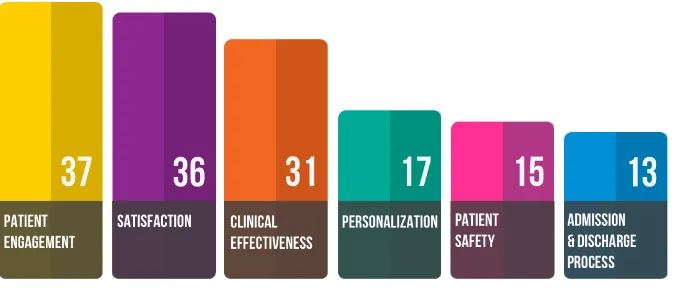
A content analysis was performed to determine the two most frequently mentioned variables in each article. Six variables were found to have the highest frequency of mention: patient engagement (organizational / outcome variable), satisfaction - patient and staff (outcome variable), clinical effectiveness (outcome variable), personalization (design variable), patient safety (outcome variable) and, admission and discharge process
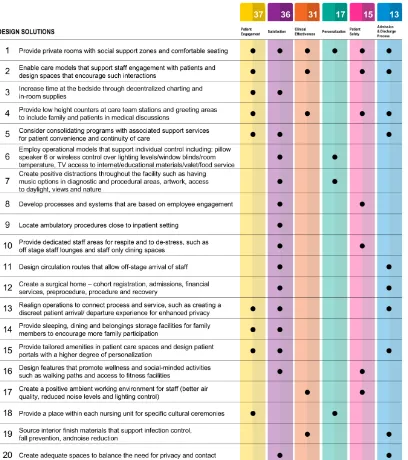
(organizational variable). These are discussed further in the findings section and the design solutions that can maximize these variables have been tabulated in the discussion section (Figure 1).
Research Findings
Patient engagement (Organizational / Outcome Variable)
One of healthcare’s latest hot topics, patient engagement, was identified as the most frequently mentioned variable in the analyzed data set. The key components of this unique variable, that can be considered both, an organizational and outcome variable at the same time, comprise shared decision – making, giving patients access to information andachieving the best possible results byempowering patients to take care of their own health.4 Studies show
that a culture of engagement drives the patient experience by supporting the exchange of ideas, alleviating
apprehension or fear, building patients’ confidence in the
provider and above all, in themselves. Establishing a
connection by understanding patients’ expectations is the
first step toward creating that culture.5 It is seen that clear
fact, communication is one of the top-ranking categories in the Hospital Consumer Assessment of Healthcare Providers and Systems (HCAHPS) survey, which directly impacts patient experience. According to Lisa Platt (April 2016), Director of Business Product Development at Planetree, there is now a shift from doing things for patients to doing things with patients, which stems from them being engaged. It has been found that patient engagement leads to better outcomes, quality of life and reduced costs.7
Effective engagement also entails giving
stakeholders/patient’s family members the opportunity to
participate in caregiving and express choices. This creates a respectful, empathic environment where individuals feel valued and cared for.4,8-9 In fact, engagement is successful
when it is practiced throughout the continuum of care and
not just during a patient‘s visit. Additionally, involving
individuals that are not seeking treatment can also
reinforce an organization’s culture of engagement. For
example, a hospice undergoing renovation established design drivers for their new space by surveying their current patients and relatives of previous patients. They received positive post - occupancy feedback from patients and families, who conveyed that the new design clearly
showed the organization’s commitment toward improving
care quality through patient engagement.10
Similarly, Sauk Prairie Hospital in Wisconsin involved community members in the design for the new
replacement hospital by arranging extensive community listening sessions. One of the outcomes of this
engagement was a new Patient Service Center that consolidated pre-admission testing, financial counseling and physical examination before procedure, creating better efficiencies. Larry Schroeder (June 2016), Chief Executive Officer at Sauk Prairie Hospital, noted that the hospital is consistently above the 95 percentile for patient
engagement and satisfaction.
Satisfaction—patient and staff (Outcome Variable)
Patient satisfaction, the second most frequently mentioned variable, is a measure of contentment based on the perceived quality of healthcare received by a patient. It is also described as an evaluation of the quality of
interactions experienced during a patient’s hospital stay.11
Improving patient satisfaction is a top priority for healthcare providers because higher satisfaction levels are linked to better care experiences.12 Satisfaction is also an
important metric in the HCAHPS survey tool. Patient satisfaction combined with other aspects of care, such as safety, quality, and clinical effectiveness, informs the overall patient experience.
A comprehensive review of over 600 studies by Ulrich and colleagues, conducted in 2008, positively linked patient outcomes, primarily satisfaction, with environmental factors such as, pleasant views to nature, noise reduction, easy way finding, and visibility of staff work stations from patient areas.12 Other factors such as, choice, sense of
control over the environment and engagement have also been associated with higher satisfaction levels and (perceived) superior quality of experience.13-15
Analyzed evidence shows that a significant aspect of patient satisfaction is its positive association with staff satisfaction.11,15-16 A patient - focused environment where
staff is educated and trained, accountable for actions and rewarded with incentives, yields greater job satisfaction and employee retention.17 When facilities are adequately
staffed, employees experience less burnout and greater satisfaction, and are able to dedicate more time to patients, enhancing the quality of their experience. Monroe Clinic in Wisconsin connects process and service with experience, which influences satisfaction both in patients and staff according to Cindy Werkheiser (June 2016), Director of Service Excellence and Process Improvement. Data from The Advisory Board Company's Employee Engagement Survey demonstrates that for every one-percent increase in employee engagement, an organization's overall hospital
HCAHPS rating increases by 0.33 percent, and patients' willingness to recommend increases by 0.25 percent.18
Another approach that healthcare facilities are adopting to improve satisfaction scores is to improve physician and staff efficiencies. Sentara Martha Jefferson Hospital (SMJH), Virginia, consolidated their Surgical and Procedural Center with other supporting services, including prep and recovery, and located the central sterile and associated bedded care horizontally adjacent. This streamlined a “one stop” patient experience, showed a
56% increase in on-time procedural starts and a 37% increase in HCAHPS patient satisfaction measures.19
Clinical Effectiveness (Outcome Variable)
The third most frequently mentioned variable, clinical effectiveness, is often described as a process or application that focuses on optimizing patient care quality while finding clinical solutions that are grounded in evidence. Researchsuggests that the patient’s experience is positively
associated with clinical effectiveness.4,16,20-21 Evidence
indicates that when hospitals perform well on patient care experience surveys, such as the HCAHPS survey, they also do better on clinical metrics.20 Higher levels of adherence
to prevention and treatments, better clinical outcomes, and improved patient safety have all been linked to better experiences for patients. Additionally, better patient experience scores could also indicate that a hospital has stronger teamwork, organizational leadership and
commitment to improvement, characteristics that could be associated with better quality measures and patient experience scores.21
As noted in the other sections of this study, building trust between the patient and healthcare provider can directly improve patient experience. Building trust with the consumer can also be important for the effectiveness of the healthcare system. Dr. Ashish Jha MD of the Harvard
T.H. Chan School of Public Health noted, “If the provider
of the organization, doctors, hospitals, are not focused on the experience that the patients have, that trust is
diminished, and the effectiveness of healthcare is
substantially reduced.”22 When San Juan Regional Medical
Center (SJRMC) in New Mexico provided a place within each nursing unit for Medicine Man ceremonies and private rooms with screened porches, they gave the Navajo community, which included both staff and patients, a way to celebrate their healing and cultural traditions. By addressing this significant cultural issue, the hospital achieved a 39% decrease in mortality rate and a 23% reduction in staff turnover. Thus, elevating the effectiveness of the healthcare system and improving the patient exerpience.23
Research conducted by Doyle highlighted a meta-analysis that showed positive correlations between clinician-patient communication and adherence to medical treatment.4 To improve communication, SSM St Mary’s Hospital in
Wisconsin, provided mobile charting areas inside patient rooms with the capability to lower bedside computers to a seated height so staff could address patients at eye level.
Jon Rozenfeld (June 2016), President of SSM St. Mary’s
Hospital, mentioned that patients are now beginning to receive tablets and iPads to take notes, obtain educational material, and access their medical records. These devices
“provide a great way to educate and have important medical discussions with patients and their families.” He also emphasized the importance of involving family members to increase adherence to medical treatment, by
saying, “we make sure we are always listening to the family, given that we realize the family members may be in
charge of that patient’s care 360 days out of the year, versus the 5 days that we may be in charge of their care.”
Personalization (Design Variable)
Personalization in healthcare is not only limited to
experiences that are specific to one’s preferences but also
offers a personalized treatment plan. Several studies suggest that training providers in delivering personalized care should be a priority because personalizing the patient experience improves outcomes.8,10,24-25 In conversation
with Jason Wolf (June 2016), President of the Beryl Institute, he mentioned that research by the Beryl Institute shows that 42% of people say that experience drives choices in healthcare.
A setting filled with personal favorites that welcomes families by providing tailored amenities could neutralize the negative effects of stress and anxiety while improving the comfort level of both patients and family members. Using pre-arrival patient surveys as a tool to inquire about patient preferences, such as a favorite magazine, food, color etc., to provide personalized patient rooms and other services, has been well received in healthcare
organizations.26 Schroeder at Sauk Prairie Hospital,
mentioned “a key contributor to recruit new physicians
and increase volume of patients in choice-based services
like obstetrics has been a nicely designed facility.” He
stated that there has been a 35% increase in new mothers choosing their facility based on looking for a more
personalized, “nicer” environment (Larry Schroeder, personal communication, June 2016).
As mentioned earlier, customization in healthcare also entails a personalized treatment plan. Offering a
personalized treatment plan through prevention programs and targeted clinical trials has the ability to improve clinical outcomes.27 Facilities can achieve a higher degree of
and flexibility is key for customization.If you treat a person as a generalization by not personalizing, you are starting in the negative (Jason Wolf, personal
communication, June 2016).
Patient safety (Outcome Variable)
The World Health Organization defines patient safety as
‘the prevention of errors and adverse effects to patients
associated with health care’.The Beryl Institute notes that patient safety, quality and service are all driving patient experience (Jason Wolf, personal communication, June 2016). Safety is often used as a measure of performance on patient experience surveys and review sites, making it an indicator of the quality of experience.20
It has been found that safe care environments impact
patients’ valuation of the received care by delivering better health outcomes, such as, fewer medical errors, patient falls, hospital acquired infections, readmissions and better pain management. Healthcare settings with artwork or views to nature can help to reduce stress, anxiety and medication needs, enhancing safety and satisfaction in patients.28 Additionally, wellness and preventive healthcare
services such as screening tests, regular immunization, and access to primary care, have also been positively associated with patient safety.4
A recent study by Carlsson and colleagues suggests that family members of patients play an active role in supporting safe care delivery when they are involved in caregiving and treatment planning through trustful communication.13 It is equally important to empower
patients with the required knowledge. Evidence suggests that when patients identify poor and unsafe practices it enhances effectiveness and safety.4
To improve patient safety, healthcare facilities are also introducing new and improved clinical and operational models. In 2011, SMJH recorded an 80% reduction in
falls, 43% below national average, by including patient’s
fall risk evaluation during admission, fall prevention kits in patient areas, rehab therapy evaluation, and after action reviews of all safety events.19 Similarly, a coronary care unit
with 56 acuity-adaptable rooms recorded a 75% decrease in patient falls and 70% reduction in medication errors after adopting a decentralized model of care.29 In fact,
positive ambient working environments with controlled noise and lighting levels have also been linked to better staff performance and fewer medical errors.30
Admission and discharge process (Organizational Variable)
The process of treatment matters to patients as much as the care delivery itself. Admission and discharge process, thesixth most frequently mentioned variable, shapes
patients’ experiences by creating the first and last
impression of a facility. Often, there is only one
opportunity at making a positive and lasting impression on a patient. Courtesy, responsiveness from staff and clear communication during appointment scheduling and admissions, can directly impact patient satisfaction and set the tone for the future patient-provider relationship.31-32
The demand for good service is moving healthcare organizations to understand and identify areas for improvement in the admission process. Vice President Professional and Support Services, Doug Frary (June 2016) shared that SJRMC is trying to improve the patient experience by exploring a lean study that examines the different wait times in the existing process. Similarly, Michael Devonas (February 2016), researcher with the Clayton Christensen institute mentioned that they are studying how individuals seek treatment in a retail health environment. He suggested imagining an admission
process where patients didn’t have to begin their trajectory
with a greeter. He also said that there were infinite numbers of pathways for individuals to take while seeking a service, whether it is a lab draw, an x-ray, or just a
check-up. Each starting point directly impacts the patient’s
experience.
Just like the admission process, there is a lot of discussion around discharge procedures and their impact on patient outcomes.20,33 Discharge processes that occur in private
and comfortable environments and include
communication related to paperwork and continuity of treatment to support recovery, can enhance patient experience by curbing the feeling of abandonment or confusion, providing adequate information for a healthy transition and reducing hospital readmissions.33,11,31-32,34
Effective post-discharge communication with patients and families ensures adherence to medication and allows continuity of safe care delivery.4 Transfer of patient
records between primary and secondary care providers for post-discharge communication can improve coordination
and continue to enhance the quality of the patient’s
experience after being discharged.13,34 The discharge
experience remains foremost in patients and families’
minds when receiving patient satisfaction surveys, which often arrive long after the episode of care. Amy Black (June 2016), Vice President and Chief Nursing Officer at SMJH, said that they give a binder with clearly defined instructions along with homemade banana bread, and a thank you note to each patient at discharge.
Discussion
patient. Experiences are highly personal and vary on an individual basis. Every effort to connect with patients, through conversation with staff, social media, or technology applications, builds upon their impression of the care being received.
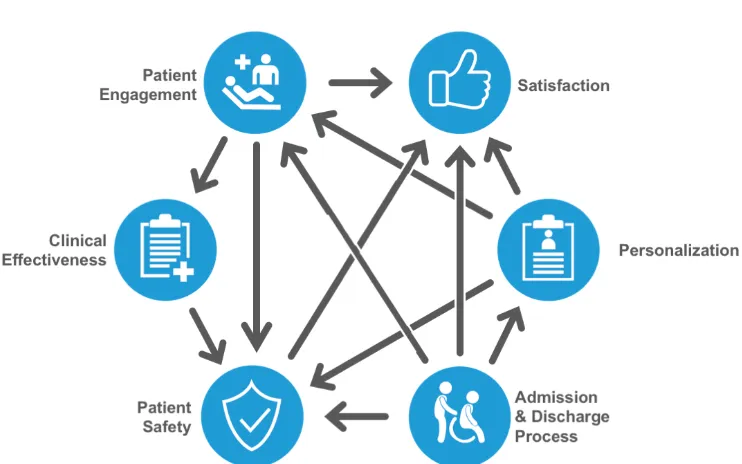
This study identifies three main categories of variables and six individual variables that can maximize the patient experience, which include, one organizational variable (admissions and discharge process), one design variable (personalization) and four outcome variables (patient engagement, satisfaction (patient and staff), clinical effectiveness and patient safety). The review of these three categories and analysis of each individual variable suggests that facility design in combination with operational models can generate outcomes that create a positive experience. The study also finds that the six identified variables demonstrate strong interrelationships and possess the ability to influence each other (Figure 2). For example, well-thought-out admissions and discharge processes that involve patients and their family members can achieve a higher degree of patient engagement and safety, generating more satisfaction and a better experience. Similarly, personalized treatment plans can assist in engaging patients more efficaciously, which in turn can increase the clinical effectiveness, create a safer environment and positively impact the quality of the experience. Essentially, patient experience can be improved by considering the entire spectrum of variables because patient experience is
the ‘sum of all interactions’. Addressing any one variable,
in isolation, may not generate the desired outcome.
The reviewed literature and comments from experts also give prominence to the effect of the physical environment on health outcomes. Design features can augment a
facility’s patient-centered culture, potentially shaping better care experiences. In fact, every touch point in a healthcare facility is an opportunity to deliver an experience.
Considering patients’ perspectives while planning touch
points can help organizations make better connections, and improve communication and collaboration.
Based on the literature review, interviews with experts and
the researchers’ prior working knowledge, some of the
design solutions that can positively impact the six identified variables of patient experience are tabulated below (Table 1).
Limitations of the Study
The articles reviewed only included published content from 2008 and beyond while other references outside of the publication time frame may have supported or refuted our findings. Some references found within the initial search were not always publically available as the full article to include for further analysis and therefore was omitted based on access. In addition, this study does not include an in-depth analysis of the current patient experience survey tools and their impact on
reimbursements. Also, the interviews conducted with industry experts, do not include representation from outside of the United States.Lastly, the cited project examples and representation of interviewees were primarily from acute care hospitals, however the results of
this study are generalized and can be applied to most healthcare environments of all sizes.
Direction for Further Research
While the majority of the patient experience studies are based on inpatient settings, performance measurement for ambulatory services requires further research to address the continuously shifting trend from inpatient to outpatient care. Investigation of patient wait-times, registration, consultation process and other design and organizational variables impacting patient experience in outpatient settings is recommended.
Healthcare is also witnessing a change in consumer profile. While facilities are primarily designed to cater to the Baby
Boomer and older population, Generation ‘X’ and Millennials are emerging as the next ‘user
group’. Understanding their mindset to stay agile and meet the needs of multiple generations will be important moving forward. Strategies to improve the patient experience for all generations, especially Millennials, require further study.
References
1. Defining Patient Experience. The Beryl Institute. Available at: http://Defining Patient Experience. 2. Robison J. What Is the "Patient
Experience"?. Gallup.com. 2010. Available at:
http://www.gallup.com/businessjournal/143258/pati ent-experience.aspx.
3. Francis J. U.S. Hospitals That Provide Superior Patient Experience Generate 50 Percent Higher Financial Performance Than Average Providers, Accenture Finds. Businesswire.com. 2016. Available at:
http://www.businesswire.com/news/home/2016051 1005122/en/U.S.-Hospitals-Provide-Superior-Patient-Experience-Generate.
4. Doyle C, Lennox L, Bell D. A systematic review of evidence on the links between patient experience and clinical safety and effectiveness. BMJ Open.
2013;3(1):e001570. doi:10.1136/bmjopen-2012-001570.
5. DeLao A. Is Healthcare Designing the Wrong Patient
Experience?. The Health Care Blog. 2015. Available at:
http://thehealthcareblog.com/blog/2015/05/26/is-healthcare-designing-the-wrong-patient-experience/.
6. Manary M, Boulding W, Staelin R, Glickman S. The
Patient Experience and Health Outcomes. New England Journal of Medicine. 2013;368(3):201-203. doi:10.1056/nejmp1211775.
7. New Era Of Patient Engagement. Health Affairs Blog. 2013. Available at:
http://healthaffairs.org/blog/2013/02/04/february-health-affairs-issue-new-era-of-patient-engagement/. Accessed December 7, 2016.
8. Luthra S. In Pursuit of Patient Satisfaction, Hospitals Update the Hated Hospital Gown. US News & World Report. 2015.
http://www.usnews.com/news/articles/2015/03/31 /in-pursuit-of-patient-satisfaction-hospitals-update-the-hated-hospital-gown.
9. Peters A. 5 Gorgeous Hospitals That Show How
Good Design Can Improve Patient's Lives. Fast Company. 2015. Available at:
http://www.fastcoexist.com/3048984/5-gorgeous- hospitals-that-show-how-good-design-can-improve-patients-lives.
10. Beach M. Patient experience key in hospice refurb. Health Estate. 2015;69(3):47-51.
11. Mazurenko O, Zemke D, Lefforge N, Shoemaker S,
Menachemi N. What Determines the Surgical Patient Experience? Exploring the Patient, Clinical Staff, and Administration Perspectives. Journal of Healthcare Management. 2015;60(5):332-346.
12. Van der Zwart J, van der Voordt T. Pre-Occupancy Evaluation of Patient Satisfaction in
Hospitals. HERD: Health Environments Research & Design Journal. 2015;9(1):110-124.
doi:10.1177/1937586715595506.
13. Carlsson E, Carlsson A, Prenkert M, Svantesson M. Ways of understanding being a healthcare
professional in the role of family member of a patient admitted to hospital. A phenomenographic
study. International Journal of Nursing Studies. 2016;53:50-60. doi:10.1016/j.ijnurstu.2015.10.004.
14. Davis J. 'Humanizing' patient experience: increasing the demand for CXOs. Healthcare IT News. 2015.
http://www.healthcareitnews.com/news/humanizing -patient-experience-increasing-demand-cxos.
15. Luxford K, Sutton S. How does patient experience fit into the overall healthcare picture? Patient Experience Journal. 2014;1(1):20-27.
16. Luxford K, Safran D, Delbanco T. Promoting
patient-centered care: a qualitative study of facilitators and barriers in healthcare organizations with a reputation for improving the patient
experience. International Journal for Quality in Health Care. 2011;23(5):510-515.
17. Jenkins L, Gunst C, Blitz J, Coetzee J. What keeps health professionals working in rural district hospitals in South Africa?. African Journal of Primary Health Care & Family Medicine. 2015;7(1).
18. Want to boost your HCAHPS scores? Focus on
employee engagement. Advisory Board. 2015. Available at:
https://www.advisory.com/talent-
development/employee-engagement- initiative/multimedia/2015/employee-engagement-and-patient-satisfaction.
19. Martha Jefferson Hospital - Health Care - Kahler Slater. Kahlerslater.com. Available at:
http://www.kahlerslater.com/expertise/healthcare/m artha-jefferson-hospital. Accessed July 27, 2016. 20. Anhang Price R, Elliott M, Zaslavsky A et al.
Examining the Role of Patient Experience Surveys in Measuring Health Care Quality. Medical Care Research and Review. 2014;71(5):522-554.
doi:10.1177/1077558714541480.
21. Mehta S. Patient Satisfaction Reporting and Its Implications for Patient Care. The AMA Journal of Ethic. 2015;17(7):616-621.
doi:10.1001/journalofethics.2015.17.7.ecas3-1507. 22. Jha, A.K. Highlights the Importance of Patient
Experience. Retrieved:
http://www.ajmc.com/newsroom/dr-ashish-k-jha-highlights-the-importance-of-patient-experience. 2016.
23. San Juan Regional Medical Center - Health Care - Kahler Slater. Kahlerslater.com. Available at:
http://www.kahlerslater.com/expertise/healthcare/sa n-juan-regional-medical-center.
24. Yocco V. How to Personalize the Online Patient Experience. Hospital & Health Networks. 2015.
http://www.hhnmag.com/articles/3357-how-to-personalize-the-online-patient-experience.
Little Effect on Patient Satisfaction. Johns Hopkins Medicine. 2015.
http://www.hopkinsmedicine.org/news/media/relea ses/johns_hopkins_researchers_find_new_patient_ce nt....
26. Wolf J, Palmer S. Voices of Practice: Exploring the Patient Experience in Action. The Beryl Institute. 2013. http://c.ymcdn.com/sites/theberylinstitute.site-ym.com/resource/resmgr/White_Papers/Voices_of_ Practice.pdf.
27. Donato C. Personalized Treatment Is Transforming Healthcare And Saving Lives. Forbes Business. 2015.
http://www.forbes.com/sites/sap/2015/03/27/pers onalized-treatment-is-transforming-healthcare-and-saving-lives/#6f02d53c2b9b.
28. Johnson, H. Two Ways the Patient Experience is Changing the Hospital
Environment. Avatar. Retrieved from
http://www.avatarsolutions.com/blog/two-ways-the-
patient-experience-is-changing-the-hospital-environment. 2015.
29. Ampt, A., Harris, P., & Maxwell, M. The Health Impacts of the Design of Hospital Facilities on Patient Recovery and Wellbeing, and Staff Wellbeing: A Review of the Literature. Sydney: Centre for Primary Health Care and Equity, University of New South Wales. 2008.
30. Chaudhury H, Mahmood A, Valente M. The Effect of
Environmental Design on Reducing Nursing Errors and Increasing Efficiency in Acute Care Settings: A Review and Analysis of the Literature. Environment and Behavior. 2009;41(6):755-786.
doi:10.1177/0013916508330392. 31. Cahnman S. Designing for the Patient
Experience. Healthcare Design Magazine. 2014. Available at:
http://www.healthcaredesignmagazine.com/article/d esigning-patient-experience.
32. Groene O, Arah O, Klazinga N et al. Patient Experience Shows Little Relationship with Hospital Quality Management Strategies. PLOS ONE. 2015;10(7):e0131805.
33. Holzer B, Minder C. A simple approach to fairer hospital benchmarking using patient experience data. International Journal for Quality in Health Care. 2011;23(5):524-530.
Appendix
Variable matrix: selected references
Reference Type of
Study Year of Publication Design Variables Organizational Variables Outcome Variables
Carlsson E, Carlsson A, Prenkert M, Svantesson M. Ways of understanding being a healthcare
professional in the role of family member of a patient admitted to hospital. A phenomenographic study. International Journal of Nursing Studies. 2016;53:50-60. doi:10.1016/j.ijnurstu.2015.10.004.
Qualitative study; interviews
2016 Private rooms,
multi-bed rooms Patient and family involvement in care planning,
Patient centered care, family centered culture, patient safety, patient satisfaction, staff satisfaction; sense of control, trustful and professional communication
Christie N, Beckett K, Earthy S et al. Seeking support after hospitalization for injury: a nested qualitative study of the role of primary care. British Journal of General Practice. 2015;66(642):e24-e31.
Qualitative study; semi-structured interviews
2016 Visitation, listening,
timely appointments, access to info, arranging physio sessions, difficult appointment scheduling, lack of contact, failing to listen; discharge
management, long wait times, continuity of care
Positive patient experience, negative experience, communication; pain management,
Beach M. Patient experience key in hospice
refurb. Health Estate. 2015;69(3):47-51. Case study 2015 Single rooms, multi-bed wards,
decentralized nurse station, landscape, end suite and/or accessible patient bathroom, access to outdoors including patients confined to bed, individual controls, multi-faith facilities
Personal touch, more choices, "homely", food prepared to order
Patient trust, choice and individuality, respect, dignity, privacy
Davis J. 'Humanizing' patient experience:
increasing the demand for CXOs. Healthcare IT
News. 2015.
http://www.healthcareitnews.com/news/humaniz ing-patient-experience-increasing-demand-cxos
Article 2015 Humanizing data, staff
coaching and
engagement, leadership skills, technology
Variable matrix: selected references
Reference Type of
Study Year of Publication Design Variables Organizational Variables Outcome Variables
DeLao A. Is Healthcare Designing the Wrong
Patient Experience?. The Health Care Blog. 2015.
Available at:
http://thehealthcareblog.com/blog/2015/05/26/is
-healthcare-designing-the-wrong-patient-experience/.
Opinion 2015 Spaces for
interaction Service, connect with patient via social media Improved patient connection, trust, relationships
Groene O, Arah O, Klazinga N et al. Patient Experience Shows Little Relationship with
Hospital Quality Management Strategies. PLOS
ONE. 2015;10(7):e0131805.
Cross-sectional, multi-level study
2015 Maturity of quality mgmt.
System, dept. Strategy for patient involvement in quality mgmt. Functions, patient-centered care strategies
Set of patient-reported experience measures: patient experience, patient-perceived discharge prep, perceived involvement in care and hospital recommendation
Jenkins L, Gunst C, Blitz J, Coetzee J. What keeps health professionals working in rural district hospitals in South Africa?. African Journal of Primary Health Care & Family Medicine. 2015;7(1).
Nominal group technique (cone workshop)
2015 Make a difference in local
community, "team-ness", culture of support incl. Feedback from managers/
colleagues/patients, opportunity to use clinical skills, empowerment factors
Staff satisfaction, staff retention, work-life balance
Johnson, H. Two Ways the Patient Experience is Changing the Hospital
Environment. Avatar. Retrieved from
http://www.avatarsolutions.com/blog/two-ways- the-patient-experience-is-changing-the-hospital-environment. 2015.
Opinion 2015 Humane
environment, artwork, noise reducing elements
Pain reduction, medication needs, depression, anxiety and costs, increase patient
satisfaction, enhance quality of care, communication, Holistic care
Luthra S. In Pursuit of Patient Satisfaction,
Hospitals Update the Hated Hospital Gown. US
News & World Report. 2015.
http://www.usnews.com/news/articles/2015/03/3
1/in-pursuit-of-patient-satisfaction-hospitals-update-the-hated-hospital-gown.
Opinion, general media report
2015 Hospital gown design Physical, mental comfort, better
Variable matrix: selected references
Reference Type of
Study Year of Publication Design Variables Organizational Variables Outcome Variables
Mazurenko O, Zemke D, Lefforge N, Shoemaker S, Menachemi N. What Determines the Surgical Patient Experience? Exploring the Patient, Clinical Staff, and Administration Perspectives. Journal of
Healthcare Management. 2015;60(5):332-346.
Qualitative study; focus groups, single case study
2015 Aesthetic, layout Customer care program,
patient preparation, interdisciplinary relationships
Patient satisfaction, staff satisfaction, patient experience, improved nurse-patient relationship, cleanliness, noise, communication, pain
management, cleanliness
Siddiqui Z, Brotman D. Johns Hopkins
Researchers Find New Patient-Centered Hospital Design Has Little Effect on Patient
Satisfaction. Johns Hopkins Medicine. 2015.
http://www.hopkinsmedicine.org/news/media/re leases/johns_hopkins_researchers_find_new_patie nt_cent....
Media
report 2015 Pleasing hospital setting, aesthetics Quality of care received from doctors, nurses, housekeeping support services, patient education, family involvement in care decisions
Patient satisfaction
Van der Zwart J, van der Voordt T. Pre-Occupancy Evaluation of Patient Satisfaction in
Hospitals. HERD: Health Environments Research
& Design Journal. 2015;9(1):110-124. doi:10.1177/1937586715595506.
Case study 2015 Visibility Easy wayfinding
Yocco V. How to Personalize the Online Patient Experience. Hospital & Health Networks. 2015.
http://www.hhnmag.com/articles/3357-how-to-personalize-the-online-patient-experience.
Opinion
article 2015 Personalized, web-based patient information portal Improve satisfaction, reduce patient effort, user behavior
Anhang Price R, Elliott M, Zaslavsky A et al. Examining the Role of Patient Experience Surveys
in Measuring Health Care Quality. Medical Care
Research and Review. 2014;71(5):522-554.
doi:10.1177/1077558714541480.
Literature
review 2014 Clean hospital environment Patient-provider communication, whole-person approach, preventive care, shared decision making, health plan info, customer service, discharge info, timely care, appropriate care
Variable matrix: selected references
Reference Type of
Study Year of Publication Design Variables Organizational Variables Outcome Variables
Cahnman S. Designing for the Patient
Experience. Healthcare Design Magazine. 2014.
Available at:
http://www.healthcaredesignmagazine.com/articl
e/designing-patient-experience.
Article 2014 Generational approach Noise, Communication, Staff
support, stress reduction
Luxford K, Sutton S. How does patient experience fit into the overall healthcare picture? Patient Experience Journal. 2014;1(1):20-27.
Literature
review 2014 Corporate wellness Patient satisfaction, staff experience, engagement
Doyle C, Lennox L, Bell D. A systematic review of evidence on the links between patient experience and clinical safety and effectiveness. BMJ Open. 2013;3(1):e001570. doi:10.1136/bmjopen-2012-001570.
Systematic review; surveys
2013 Observation of processes Patient experience, safety,
clinical effectiveness, patient communication
Holzer B, Minder C. A simple approach to fairer hospital benchmarking using patient experience data. International Journal for Quality in Health Care. 2011;23(5):524-530.
Secondary analysis using patient experience survey
2011 Admissions and discharge
process, organization, classification of hospital, patient characteristics management (age, gender, etc.),
Patient experience (process of admission, service area), communication, care, respect, cooperation
Luxford K, Safran D, Delbanco T. Promoting patient-centered care: a qualitative study of facilitators and barriers in healthcare organizations with a reputation for improving the patient
experience. International Journal for Quality in Health Care. 2011;23(5):510-515.
Qualitative Study; interviews
2011 Communication of vision,
regular feedback, strong leadership, staff capacity, accountability and incentives, culture supportive of change, employee mindset