INNOVATION IN
HEALTH INFORMATICS
An ‘integrated health neighbourhood’
framework to optimise the use of EHR data
Siaw-Teng Liaw
UNSW Medicine Australia, Sydney, NSW, Australia, and General Practice Unit, South Western Sydney Local Health District and Ingham Institute for Applied Medical Research, NSW, Australia
Simon de Lusignan
University of Surrey, Guildford, UKABSTRACT
General practice should become the hub of integrated health neighbourhoods (IHNs), which involves sharing of information to ensure that medical homes are also part of learning organisations that use electronic health record (EHR) data for care, decision making, teaching and learning, quality improvement and research.
The IHN is defined as the primary and ambulatory care services in a locality that relates largely to a single hospital-based secondary care service provider and is the logical denominator and unit of comparison for the optimal use of EHR data and health information exchange (HIE) to facilitate integration and coordination of care. Its size may vary based on the geography and requirements of the population, for example between city, suburban and rural areas.
The conceptual framework includes context; integration of data, information and knowledge; integration of clinical workflow and practice; and inter-professional inte -gration to ensure coordinated shared care to deliver safe and effective services that are equitable, accessible and culturally respectful.
We illustrate how this HIE-supported IHN vision may be achieved with an Australian case study demonstrating the integration of linked pseudonymised records with knowledge- and evidence-based guidelines using semantic web tools and informatics-based methods, researching causal links bewteen data quality and quality of care and the key issues to address. The data presented in this paper form part of the evaluation of the informatics infrastructure - HIE and data repository – for its reliability and utility in supporting the IHN.
An IHN can only be created if the necessary health informatics infrastructure is put in place. Integrated care may struggle to be effective without HIE.
Practical applications and discussions
Cite this article: Liaw S-T, de Lusignan S. An ‘integrated health neighbourhood’ framework to optimise the use of EHR data. J Innov Health Inform. 2016;23(3):547–554.
http://dx.doi.org/10.14236/jhi.v23i2.826
Copyright © 2016 The Author(s). Published by BCS, The Chartered Institute for IT under Creative Commons license http://creativecommons.org/ licenses/by/4.0/
Author address for correspondence Siaw-Teng Liaw
Academic General Practice Unit Ingham Institute,
1 Campbell Street, Liverpool, NSW, Australia.
Email: [email protected]
Accepted July 2016
Keywords: data analytics, EHR, integrated health neighbourhood, medical homes
on September 12, 2020 by guest. Protected by copyright.
INTRODUCTION
Persisting systems gaps and fragmentation of care within and between health care teams in primary and secondary care are the key issues being addressed by most national health systems, examples being the Australian primary health care (PHC) strategic framework,1 NSW State Health Plan2 and
eHealth blueprint.3 The long-suffering patient has to deal with
fragmented roles and responsibilities compounded by poor communication, fragmented programs and services. This fragmentation extends across interfaces for care, information provision, identification and handover, guidelines use and standards, access to their own records and privacy compli-ance.4,5 Fragmentation leads to poor and unsafe care and
inappropriate use of emergency and hospital services, which are often preventable. Continuity and coordination of patient-centred care requires effective communication, coordination, teamwork and judicious use of information and communica-tion technology4,5 within a medical home6 and across the
health neighbourhood.7,8 This requires the effective use of
electronic health records (EHRs), personal health records and electronic decision support tools to collect, share and use good quality information to provide safe, effective and coordinated care along ‘patient journeys’ and ‘care pathways’ in the health and social care system. However, while there is consensus about how EHRs and informatics structures and processes support good quality care, there is less agreement about implementation.9
Observational EHR data are also increasingly being mined, linked, aggregated, cleaned and used for audit, continuous quality improvement, health service planning, surveillance and epidemiological study, evaluation research and mea-surement and monitoring of quality of care, particularly of patients with chronic diseases. Fundamental questions about observational EHR data include:
(i) What are the data types?
(ii) How good are the data and metadata? (iii) How good are the data tools and systems? (iv) Is the information fit for purpose?
(v) Can poor data lead to poor care?
Despite improved informatics capability, data quality (DQ) in primary care10 and hospital systems11 has serious deficien
-cies. However, ontological data management methods can maximise its potential and ensure as far as possible fitness for purpose.12,13 Tools to collect/extract data and assess and
manage DQ are often inconsistent and should be validated in a transparent manner within a robust data and clinical gover-nance framework.11,14 There is also a de facto failure among
primary and secondary care clinicians to share data beyond the traditional referral letters, clinic letters and traditional structured documents such as discharge summaries.15 Key
issues and research questions exist around whether there are causal relationships between good data and good care, inter-professional relationships, information-sharing, health literacy and patient engagement/empowerment.
This paper describes our vision of an integrated health neighbourhood (IHN) underpinned by a community wide health information exchange (HIE) using a model of multi-level integration of data, information, clinical practice and dis-ciplines to support inter-professional coordinated care across primary, secondary and tertiary care settings. The care must be safe, evidence-based, continuous, coordinated, accessi-ble and equitaaccessi-ble. We see the IHN as a learning organisation using complex collections of EHR data optimally for service provision, education and research. The data presented in this paper form part of the evaluation of the informatics infrastruc-ture – HIE and data repository – for its reliability and utility in supporting the IHN.
Context for the vision
The context includes the regulations, policies, strategies and resources available to governments, funders, planners and implementers to achieve the mission of equitable access to well-coordinated safe and evidence-based care.
Primary health care framework: The Australian PHC
strate-gic framework1 describes:
i. a consumer-focused integrated PHC system; ii. improved access and reduce inequity;
iii. health promotion, prevention, screening and early intervention;
iv. quality, safety, performance and accountability.
Interactive model of access and equity: Access is an inter-action and a balance of demand and supply.16 Demand
includes the burden of disease and attributes of the popu-lation such as knowledge, attitudes, skills, capacities and self-care practices. Supply includes location, availability, cost and appropriateness of the services. The supply and demand provider-user dyads include:
i. approachability – ability to perceive; ii. acceptability – ability to seek;
iii. availability/accommodation – ability to reach; iv. affordability – ability to pay;
v. appropriateness – ability to engage.
Access and equity is further complicated by increasing health costs and demand arising from increased expectations of health and the ageing population with increased morbidity.
Purpose of EHR and information systems: EHR data would be used for:
i. accurate identification of an individual;
ii. supporting managerial functions and integration of data and systems;
iii. supporting clinical care and coordination; iv. supporting care of populations;
v. supporting research, evaluation and audit to inform DQ, governance, business models, policy and practice;
vi. creating a real-world evidence base around the management of complex comorbidity and frailty in an ageing population.17
on September 12, 2020 by guest. Protected by copyright.
http://informatics.bmj.com/
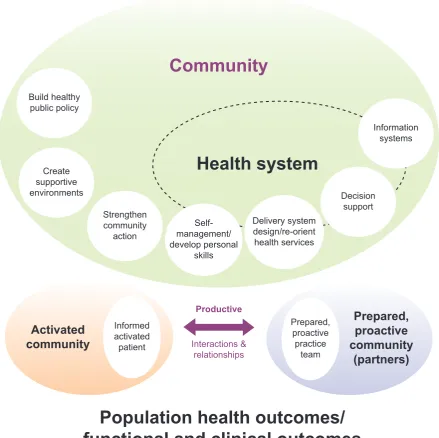
Expanded chronic care model: The chronic care model (CCM) (Figure 1) incorporates the policy, clinical and managerial systems and processes that must be in place to provide safe, effective and coordinated care to individuals and popu-lations.18 The health care team needs to be activated and
proactive to engage meaningfully with the activated and empowered patient to guide them through the health system to ensure access to and appropriate use of health services. This requires the integration of data/knowledge, clinical service and inter-disciplinary teamwork across the health neighbourhood.
Multilevel integration to support care: Figure 2 summarises the key levels of integration and the standards required at each level:
1. data and information system; 2. knowledge and evidence;
3. clinical services within the medical home; 4. inter-disciplinary team work across the health
neighbourhood.19
The vision is an IHN and an information enhanced learning organisation.
Integrated health neighbourhood: For translational and health services research, the IHN is the logical unit of data collection and denominator for data analysis. With the understanding of general practices as medical homes, the health neigh-bourhood is described as the actor network and information ecosystem20 created by secondary care health and hospital
services and the surrounding primary care, community health and general practice services.
The complexity of the EHR data collected from the IHN includes time and space dimensions, which we believe will require innovative ontology-based approaches to optimise their use.12 The IHN concept needs record linkage to enable the
track-ing of individual patients across different services in the IHN. This also enables the elimination of duplicates in prevalence/ incidence studies. The Fairfield IHN (FIHN) uses GRHANITE™ for probabilistic record matching and linkage through pseud-onymns created by the hashing of personal identifiers.21
Figure 1 Expanded Chronic Care Model (used with permission)
Community
Health system
Build healthypublic policy
Create supportive environments
Strengthen community
action
Self-management/ develop personal
skills
Delivery system design/re-orient health services
Decision support
Information systems
Population health outcomes/
functional and clinical outcomes
Productive
Interactions & relationships Informed
activated patient
Activated
community
Prepared, proactive practice
team
Prepared,
proactive
community
(partners)
on September 12, 2020 by guest. Protected by copyright.
http://informatics.bmj.com/
Case study: The Fairfield IHN
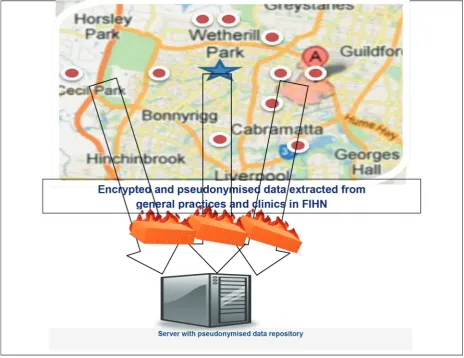
Methods: We established the FIHN (Figure 3) with support from the local hospital/health services and the local UNSW general practice-based research network. The informatics infrastructure – an electronic data repository, which links and manages data extracted from the Fairfield hospital admis -sions, emergency department and diabetes clinic ( ) and ten general practices ( ) in the Fairfield local government area – was installed.
Standard operating procedures are in place for DQ man-agement and governance to ensure compliance to quality, privacy and security standards. We focused initially on DQ assessment and management,13 validation of data
extrac-tion14 and management tools,10,11 and exploring the use of
ontologies to collect, link, manage, store and analyse com-plex personal clinical data from these multiple disparate EHRs.22,23 The FIHN database architecture was established
with ontology-based data access, using tools like SPARQL, to complement relational database access22 with algorithms
to create cohorts and to integrate data, information, practice and disciplines in the medical home and across the IHN. This work is ongoing to establish automated protocols to improve the DQ, through structured DQ reports (SDQRs) and feedback,24 to enable accurate epidemiological and cohort
studies.
Findings: In the following section, we describe examples of basic, informatics and applied projects to illustrate the systematic approach to developing and testing the tools to establish an informatics infrastructure to achieve this vision.
Example: Phenotyping and case finding: The accuracy of the FIHN phenotyping algorithm for Type 2 diabetes mellitus (T2DM) in the data repository was assessed using both biosta-tistical (sample size) with ontological (combination of attributes) methods.22 In addition to acceptable accuracy of the case find
-ing tool, we also confirmed the common understand-ing that
Inter - disciplinary integration (Local health neighbourhood)
Clinical services integration (Medical Home/GP)
Knowledge integration (EBM/EDS)
Data & CIS integration Display and reporting
standards, incl DQ
Communication and Interoperability standards
Data model and ontology development standards
Knowledge transfer and exchange (semantic)
standards
Reference terminology Data dictionary / metadata
EHR/CIS standards
Figure 2 Levels of integration and relevant standards
(Note: CIS = clinical information system; EBM = evidence-based medicine; EDS = electronic decision sup-port; and GP = general practice)
accuracy increased with increased sample size and increased number of attributes used in the query (Tables 1 and 2).
Comment: At this point, we would not recommend unsu-pervised use of the data for patient care. With some caveats on the DQ, especially the completeness and representative-ness, the data repository can be used for research, education and quality improvement purposes.
Example: Record linkage and patient journeys: The FIHN pseudonym-linked datasets21 enable the tracking of patients
journeys through primary care services in the neighbourhood (Table 3). This shows there is significant number of patients using a number of general practices in the neighbourhood, usually for access reasons. On the other hand, it could be an indication of doctor shopping.
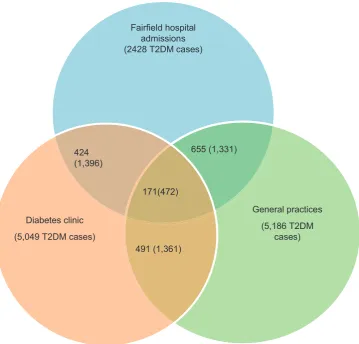
Similarly, patient journeys can be tracked through primary and secondary care services in the FIHN through linkage of general practice, diabetes outpatient and hospital data sets (Figure 4). We have defined a cohort of 5186 patients with T2DM (estimated prevalence of 3.5%) in the ten general practices (Nall ages = 151,616). There were 5049 in the diabe
-tes clinic, of these 2428 had at least one admission into the local hospital.
Developments are ongoing, using ontology-based meth-ods, to embed an assessment of temporal and spatial varia-tions in the patient journeys across the health system. This enhancement will improve the relevance and validity of the data for modelling, predictive and logitudinal studies.25
The data linkage is highly accurate as tested by both com-puter-based and manual (i.e. checking with the general prac-tice) methods. The main problem was similar and sound-alike names, especially with some ethnic communities in the FIHN, one of the most multicultural local government areas in Australia.
Example: Integrating data quality assessment: Ontology-based methods have been developed to embed an assess-ment of DQ in the manageassess-ment and analysis of the FIHN
on September 12, 2020 by guest. Protected by copyright.
http://informatics.bmj.com/
Table 1 Accuracy increases with sample size
Accuracy measures Practice 1 (N = 927) Practice 2 (N = 3699) Practice 3 (N = 7110) Practice 4 (N = 12057) Total (N = 23793)
Sensitivity 100.0 100.0 100.0 100.0 100.0
Specificity 98.0 99.8 99.8 99.8 99.7 Positive predictive
value 57.1 98.3 96.9 97.4 96.4
Negative
predictive value 98.2 100.0 100.0 100.0 100.0
Accuracy 98.1 99.8 99.8 99.8 99.8
Table 2 Accuracy increase with the number of attributes
Accuracy measures True positive False positive True negative False negative Sensitivity Specificity
Reason for visit (RFV) 2216 1263 145120 3017 42 99
RFV+ Medication (Rx) 5016 207 146176 217 96 99
RFV+Rx + Pathology 5233 183 146200 0 100 100
Figure 3 Fairfield IHN showing the informatics infrastructure and flow of data
on September 12, 2020 by guest. Protected by copyright.
http://informatics.bmj.com/
Table 3 Record linkage among practices in the FIHN – indicating shared patients
Suburb (postcode) Practice 1 (N=3863) Practice 2 (N=7028) Practice 3 (N=23162) Practice 4 (N=30717) Total (N=64770)
Practice 1 (2176) XXXXX 172 (3%) 142 (1%) 405 (13%) 722 (1%)
Practice 2 (2164) 173 (4%) XXXXX 327 (1%) 691 (2%) 1191 (2%)
Practice 3 (2171) 139 (3%) 333 (5%) XXXXX 3011 (10%) 3483 (5%)
Practice 4 (2176) 400 (10%) 692 (10%) 3005 (13%) XXXXX 4097 (6%)
Total 712 (18%) 1200 (17%) 3474 (15%) 4107 (13%) 9493 (15%)
Fairfield hospital admissions (2428 T2DM cases)
General practices (5,186 T2DM
cases) Diabetes clinic
(5,049 T2DM cases) 424 (1,396)
655 (1,331)
171(472)
491 (1,361)
Figure 4 T2DM cases linked across care settings
data repository; it has been shown to be feasible and accu-rate.23 The accuracy and robustness of the model is currently
being refined conceptually and testing with larger data sets, including natural language processing of text data.26–28
Example: Integrating the patient dimension: This is being implemented with feedback and reflection at the professional and practice organisation levels, using practice-focused and patient-centred SDQRs as the basis for discussion. This is a RACGP-recognised quality improvement and profes-sional development exercise, in collaboration with patients. Neighbourhood-constrained online strategies are being developed to engage patients and their carers in their care.
DISCUSSION: SOME KEY ISSUES TO
ADDRESS
Workshops with Australian29 and international collaborators30
highlighted common issues:
i. DQ, interoperability and fitness for use; ii. fragmented data and information governance; iii. proprietary software and transparency; iv. business model and sustainability;
v. multiple ethical perspectives;
vi. cognitive load on patients and clinicians from managing comorbidity and associated polypharmacy.17
on September 12, 2020 by guest. Protected by copyright.
http://informatics.bmj.com/
Solutions proposed include transparency, integrated DQ management and governance, sharing of tools, data and metadata, and partnerships to achieve consensus rules for sharing. This scenario is evolving and will be informed by this work on optimising the use of observational EHR data for clinical and population health purposes. Our work to date demonstrates the need for caution with data extraction tools; probabilistic data linkage is accurate, reliable and secure; and that unsupervised information exhange is not recommended for clinical purposes. However, recognising the limitations of data completeness, our program of work suggests that qual-ity improvement activities and cohort studies can be con-ducted with confidence, especially if combined with technical solutions, governance and organisational protocols.30 The
ultimate solution to improve data quality is a culture change in clinical and managerial practice plus good design of health information systems to embed good documentation into the clinical and managerial workflow, with a focus on the safety and quality of patient-centred care.
CONCLUSIONS
The IHN and HIE are being systematically achieved through the informatics infrasrtucture and development and validation of automated tools to extract and use EHR data for clincal, organisational, systems and population health research. The
focus of the FIHN is on primary and integrated care research, using cohorts to link models and processes of care to patient and health system outcomes. Replicating the FIHN across the health system, nationally and globally, will enable com-parative effectiveness research to be done logically and cost effectively.
The limitation of this publication is that it is based on a single area, though the experiential learning of the authors is that this approach and its principles are likely to be generalisable. However, we fully recognise that not all areas have a single hospital hub or in big cities, very large hospitals may have such large catchment areas that they support more than one community-based areas. In rural or underpopulated areas, other solutions may be required.
Notwitstanding the need to the inevitable customised solu-tions for localities, the approach described here is needed if we are to address the clinical and managerial challenges of optimal care for an ageing population with increased and increasing multimorbidity. Integrated care requires integrated health data, integrated systems, integrated services and inte-grated clinical and eHealth interventions.
Acknowledgments
Participating services in the FIHN, the IMIA PHC Informatics WG, Harshana Liyanage and the UNSW ePBRN team.
REFERENCES
1. Australia Department of Health. National Primary Health Care Strategic Framework Canberra: Australian Government Press. Available from: http://www.health.gov.au/internet/main/publish-ing.nsf/Content/nphc-strategic-framework. Accessed 04 July 2015.
2. NSW Department of Health. NSW State Health Plan: Towards 2021. Chatswood:NSW Department of Health. 2014.
3. NSW Department of Health. A Blueprint for eHealth in NSW. Chatswood:NSW Department of Health. 2013.
4. Kirby S, Vagholkar S, Bunker J, Dennis S, Mutimbe M and Liaw S. how integrated are services for patients with chronic obstructive pulmonary disease? perceptions of patients and health care providers. Australian Journal of Primary Health
2014;20(2):158–61.
5. Maneze D, Dennis S, Chen H, Taggart J, Vagholkar S, Bunker J et al. Multidisciplinary care: experience of patients with complex needs. Australian Journal of Primary Health 2014;20(1):20–6.
6. Arend J, Tsang-Quinn J, Levine C, Thomas D. The patient-centered medical home: history, components, and review of the evidence. Mount Sinai Journal of Medicine. 2012;79(4):433–50.
http://dx.doi.org/10.1002/msj.21326. PMid:22786733.
7. Sinsky CA. The patient-centered medical home neighbor: a primary care physician’s view. Annals of Internal Medicine
2011;154(1):61–2.
http://dx.doi.org/10.7326/0003-4819-154-1-201101040-00010. PMid:21200041.
8. Yee JHF. The patient-centered medical home neighbor: a subspecialty physician’s view. Annals of Internal Medicine
2011;154(1):63–4.
http://dx.doi.org/10.7326/0003-4819-154-1-201101040-00011. PMid:21200042.
9. Liyanage H, Correa A, Liaw ST, Kuziemsky C, Terry AL and de Lusignan S. Does informatics enable or Inhibit the delivery of patient-centred, coordinated, and quality-assured care: a
Delphi study. A contribution of the IMIA Primary Health Care Informatics Working Group. Yearbook of Medical Informatics International Medical Informatics Association 2015;10(1):22–9.
10. Liaw S, Taggart J, Dennis S and Yeo A. “Data quality and fit -ness for purpose of routinely collected data – a case study from an electronic Practice-Based Research Network (ePBRN)”, American Medical Informatics Association Annual Symposium, Washington DC: Springer Verlag, 2011.
11. Liaw S, Chen H, Maneze D, Taggart J, Dennis S, Vagholkar
S et al. Health reform: is current electronic information fit
for purpose? Emergency Medicine Australasia 2011;24(1):
57–63. http://dx.doi.org/10.1111/j.1742-6723.2011.01486.x. PMid:22313561.
12. Liyanage H, Liaw S, Kuziemsky C, de Lusignan S. Ontologies to improve chronic disease management research and quality improvement studies – a conceptual framework. In: Aronsky D and Leong S. (Editors) Medinfo 2013, Copenhagen: Elsevier Press, 2013.
13. Liaw S, Rahimi A, Ray P, Taggart J, Dennis S, de Lusignan S et al. Towards an ontology for data quality in integrated chronic disease: a realist review of the literature. International Journal of Medical Informatics 2013;82(1):10–24. http://dx.doi.
org/10.1016/j.ijmedinf.2012.10.001. PMid:23122633.
14. Liaw S, Taggart J, Yu H and de Lusignan S. Data extraction from electronic health records – existing tools may be unreli-able and potentially unsafe. Australian Family Physician
2013;42(11):820–3. PMid:24217107.
15. Halamka J, Overhage J, Ricciardi L, Rishel W, Shirky C and Diamond C. Exchanging health information: local dis-tribution, national coordination. Health Affairs (Millwood)
2005;24(5):1170–9. http://dx.doi.org/10.1377/hlthaff.24.5.1170.
PMid:16162560.
on September 12, 2020 by guest. Protected by copyright.
http://informatics.bmj.com/
16. Levesque J, Harris M, Russell G. Patient-centred access to health care: conceptualising access at the interface of health systems and populations. International Journal for Equity in Health 2013;12(18). http://dx.doi.org/10.1186/1475-9276-12-18
17. Schattner P, Barker F and de Lusignan S. Minimally disrup-tive medicine is needed for patients with multimorbidity: time to develop computerised medical record systems to meet this requirement. Journal of Innovation in Health Informatics
2015;22(1):250–4. http://dx.doi.org/10.14236/jhi.v22i1.136
PMid:25924558.
18. Barr V, Robinson S, Marin-Link B, Underhill L, Dotts A, Ravensdale D, et al. The Expanded Chronic Care Model: An Integration of Concepts and Strategies from Population Health Promotion and the Chronic Care Model. Healthcare Quarterly. 2003;7(1):73-82.
19. Liaw S-T, Taggart J, Yu H, Lusignan Sd, Kuziemsky C and Hayen A. Integrating electronic health record information to support integrated care: practical application of ontologies to improve the accuracy of diabetes disease registers. Journal
of Biomedical Informatics. 2014; 52(0):364–72. http://dx.doi. org/10.1016/j.jbi.2014.07.016. PMid:25089026.
20. Liyanage H, Liaw S and de Lusignan S. Accelerating the development of an information ecosystem in health care, by stimulating the growth of safe intermediate processing of health information (IPHI). Informatics in Primary Care 2012;20(2):
81–6. PMid:23710772.
21. Liaw S and Boyle D. Primary Care Informatics and integrated care of chronic disease. In: Hovenga E KM, Garde S and Cossio CHL (Ed). Health Informatics: An Overview. Studies in Health Technology and Informatics, Vol. 151. Amsterdam: IOSPress, 2010.
22. Rahimi A, Liaw S-T, Taggart J, Ray P and Yu H. Validating an ontology-based algorithm to identify patients with Type 2 Diabetes Mellitus in electronic health records. International Journal of Medical Informatics. 2014;83(10):768–78. epub
ahead of print.
23. Rahimi A, Ray P, Paramesh N, Taggart J, Yu H and Liaw S. Development of a methodological approach for data qual-ity ontology in diabetes management. International Journal of E-Health and Medical Communications 2014;5(3):77.
24. Taggart J, Liaw S-T and Yu H. Structured data quality reports to improve EHR data quality. International Journal of Medical Informatics 2015;84:1094–8. http://dx.doi.org/10.1016/j. ijmedinf.2015.09.008. PMid:26480872.
25. Jonnagaddala J, Liaw S and Ray P. Impact of data qual-ity assessment on development of clinical predictive models.
Studies in Health Technology and Informatics 2015(216):1069.
26. Jonnagaddala J, Liaw S, Ray P, Kumar M, Chang N and Dai H. Coronary artery disease risk assessment from unstructured electronic health records using text mining. Journal of Biomedical Informatics 2015; 58(Suppl:S203-10). PMid:26262368.
27. Jonnagaddala J, Liaw S, Ray P, Kumar M and Dai H. “HTNSystem: Hypertension information extraction system for unstructured clinical notes”, Technologies and Applications
of Artificial Intelligence, 19th International Conference, Taipei, Taiwan. Germany:Springer. 2014:219–27.
28. Jonnagaddala J, Liaw S, Ray P, Kumar M, Dai H and Hsu C.
Identification and Progression of Heart Disease Risk Factors in
Diabetic Patients from Longitudinal Electronic Health Records.
BioMed Research International 2015;25(10):636371. http:// dx.doi.org/10.1016/j.jbi.2015.08.003.
29. Liaw S, Powell-Davies G, Pearce C, Britt H, McGlynn L and Harris M. Optimising use of EHR data: current issues, evolving opportunities, strategies and scope for collaboration. Australian Family Physician 2015;45(3):153–6. http://dx.doi.org/10.14236/
jhi.v21i4.87.
30. Liaw S, de Lusignan S, Kuziemsky C, Grannis S. Optimizing the Use of Observational EHR Data: Current Issues and Evolving Strategies. Workshop conducted at Medinfo 2015, 2015 August, Sao Paolo, Brazil.
31. Liaw S, Pearce C, Liyanage H, Cheah-Liaw G and de Lusignan S. An integrated organisation-wide data quality management and information governance framework: theoretical underpin-nings. Journal of Informatics in Primary Care 2014;21(4):1–8.
on September 12, 2020 by guest. Protected by copyright.
http://informatics.bmj.com/