The rediscovery of
Uraria lacei
Craib (Leguminosae)
after 67 years from India
Jahnabi Gogoi1,2, Tikam Singh Rana1,2
1 Academy of Scientific and Innovative Research (AcSIR), Ghaziabad-201002, India 2 Molecular Systematics Laboratory, Plant Diversity, Systematics and Herbarium Division, CSIR-National Botanical Research Institute, Lucknow-226001, India
Corresponding author: Tikam Singh Rana ([email protected]; [email protected])
Academic editor: Clifford Morden | Received 13 May 2020 | Accepted 3 August 2020 | Published 8 September 2020
Citation: Gogoi J, Rana TS (2020) The rediscovery of Uraria lacei Craib (Leguminosae) after 67 years from India. PhytoKeys 160: 99–107. https://doi.org/10.3897/phytokeys.160.54237
Abstract
Manipur is one of the biodiversity-rich states in the North-Eastern region of India, and it is also part of the Indo-Burma biodiversity hotspot with rich plant diversity and endemism. Recent field exploration in the area has resulted in the rediscovery of Uraria lacei Craib after 67 years from its last collection in 1952. The rediscovery of this beautiful species fills a gap in the current distribution knowledge and should pave the way for its immediate conservation and propagation.
Keywords
Biodiversity hotspot, Fabaceae, Manipur, rediscovery, Uraria
Introduction
The genus Uraria Desv. (Fabaceae-Papilionoideae-Desmodieae) contains about 20 species distributed in tropical Africa, South East Asia and Australia (Ohashi et al. 2006). In India, the genus has eight to 12 species predominantly found in tropical and sub-tropical regions (Baker 1879, Sanjappa 1992, Gaur 1999, Kirtikar and Basu 2001). Uraria lacei Craib is a beautiful species with dark blue inflorescence and is distributed in India, China, Laos, Myanmar, Thailand and Vietnam. The
http://phytokeys.pensoft.net
the recent floras of Manipur (Singh et al. 2000) and Mizoram (Singh et al. 2002), these records were based on older collections. During a field study in November 2019 by the first author to North East India, the species was collected in flower-ing and fruitflower-ing stages from a hillslope at the only floatflower-ing National Park (Keibul Lamjao National Park, Bishnupur, Manipur) in the world. After compiling all the data available in the public domain and specimens in different herbaria, it was ob-served that the last collection was from 11 September 1952 (D.B. Deb 585, CAL!). In the past 67 years, the species was not recollected from its occurrence in India, therefore, this certainly raises questions about its current status, conservation and existence in nature. Detailed description, taxonomic notes and colour photographs
of U. lacei are provided here.
Methods
All the published literature were scrutinized for the probable localities or distribution
of Uraria spp. in India. With that distribution data, a field survey was conducted
during October–November 2019 in the states of Assam, Nagaland, Manipur and Meghalaya of India to collect plants of Uraria spp. Fresh specimens of U. lacei were collected in flowering and fruiting stages from Manipur. The flowering twigs were packed in airtight polybags, flowers and fruits were separately collected in collection tubes containing 70% ethanol for further studies. Field notes recorded included habit, habitat, number of individuals in the population, geo-coordinates, and elevation data. In transit camp, the specimens were pressed and dried on blotting sheets. Upon reach-ing the institute, they were processed in the herbarium followreach-ing standard herbarium procedures (Jain and Rao 1977). All the collected samples were dissected and were ex-amined under stereo microscope (LEICA S8 APO, Wetzler, Germany) and described. Taxonomic literature and protologues were studied and compared for identification (Hasskarl 1844; Clarke 1889; Lecomte 1920; Haines 1921; Deb 1961; Thuan et al. 1987; Sanjappa 1992; Sha 1994; Singh et al. 2000; Singh et al. 2002; Kumar and Sane 2003; Ohashi et al. 2006; Puhua et al. 2010).
Herbarium sheets were consulted which are available in GBIF as well as various Indian (AHMA, ARUN, APF, ASSAM, BSA, BSD, BSI, BSID, CAL, DD, FRC, LWG, MH and TBGT) and foreign digital herbaria (A, B, BM, BO, E, H, K, L, MO, NY, P and US) (acronym following Thiers 2018). The specimens of U. lacei
Taxonomy
Uraria lacei Craib, Bull. Misc. Inform. Kew 1910(8): 276 (1910)
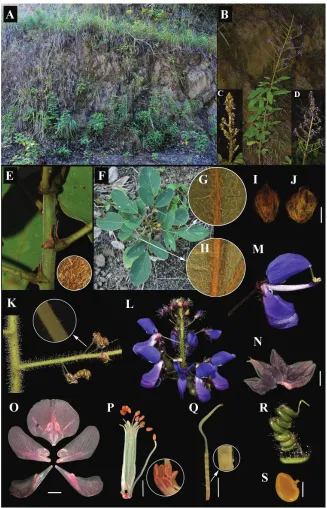
Figs 1, 2
Type. Myanmar. Maymyo Plateau, 3500 ft, 12 Oct 1908, J.H. Lace 4325 (lectotype, designated by Thuan et al. 1987, pg. 112: K! [K000858898]; isolectotypes: CAL! E! [E00301323, E00813650])
Synonyms. U. paniculata C.B. Clarke, J. Linn. Soc. Bot. 25: 15, tab. 4. 1889.
nom. illeg. Type: India. Kohima, 3000 ft, 19 Oct 1885, C.B. Clarke 40924 (K!). U.
clarkei Gagnepain in Lecomte, Fl. Gen. Indoch. 2: 542. 1920. Type: Vietnam. Tonkin:
Plateau de Kiendi, dans les paturages, 7 Oct 1891, B. Balansa 4430 (Holotype: P [P02142551]). U. pulchra Haines, Bull. Misc. Inform. Kew 1921 (8): 308. 1921. Type: India. Bihar, Someshwar Hills, H.H. Haines 3962 (ABD!). U. guangxiensis W.L. Sha in Guihaia 14: 23. 1994. Type: China. Guangxi, Nandan Xian, Yueli, 20 Sept 1977, Exped. Nandan 4–5–073; (Lectotype, designated by Ohashi et al. 2006, pg. 344: Herb. Guangxi Research Centre of Natural Materia Medica).
brown hairs underneath; midrib protruding underneath, with both dense long straight and hooked brown hairs; leaf blade adaxial (upper) surface pilose with both eglandular straight and hooked hairs, few scattered glandular straight hairs, blade with granular deposition; leaf blade abaxial (lower) surface tomentose soft hairs, shines white in sun-light. Stipules 2, not covering whole of stem width, triangular, caudate, 0.9–1.5 × 0.3– 0.6 cm with scabrous hooked and straight hairs; stipels elongated triangular, 0.3–0.5 cm long with scattered scabrous hairs. Inflorescence a very lax panicle, 17–40 × 6–24 cm, ferruginous hairy, young panicle with many bracts and short secondary rachis, mature panicle with deciduous bracts and longer secondary rachis, panicle terminal, sometimes axillary; secondary rachis green, with yellowish-white glandular hairs and short hooked brown hairs; flowers in pairs; pedicels 0.8–1.0 cm long, violet-purple, minutely bent to-wards calyx, with short hooked white hairs (0.017 cm long). Calyx valvate, 0.3–0.5 cm long, violet-purple, sepals 5, persistent, upper two lobes completely joined together ex-cept slightly at the tooth, lower three free at teeth, joined at tube, both lobes almost of equal length, lobes abaxially glandular hairy. Corolla dark blue, petals 5, standard suborbicular, 0.87–0.88 × 0.97–1.02 cm, with two white spots adaxially towards base; wings dark blue, purple, towards base white, 0.81–0.86 × 0.38–0.48 cm, auricle slightly drooped, up to 0.12 cm long; keel-petals 0.99–1.04 × 0.44–0.51 cm, auricle minute, up to 0.04 cm long. Androecium 9 + 1, filament 1.04–1.08 cm long, filament sheath 0.83–0.88 cm × 0.14–0.15 cm, filament tips 0.05–0.14 cm long; anthers 0.07–0.08 × 0.04–0.06 cm. Gynoecium 1.15–1.27 × 0.05 cm, ovary 0.51–0.55 cm long, with 4–8 ovules, slightly appressed hairy, style ca. 0.62 cm long, bent. Pods coiled, 4–8 arti-cles, 0.7–1.2 × 0.3–0.4 cm, green to brownish, with long glandular hairs (0.03–0.06 cm) and minute eglandular hooked (0.008–0.019 cm long) hairs on the joints; seeds yellow-ish, 0.23–0.25 × 0.18–0.20 cm.
Phenology. Flowering from October to November, fruiting from November to December.
Specimens examined. China. Yunnan: No locality, No altitude, 1897, A. Henry 9144 (CAL); Szemoa, A. Henry 9144A (US02055945); Mengtze, A. Henry 9144C
(MO-2331548, A00234907, A00234912); A. Henry 9144 (US-02055943, 02055944); Puerh, A. Henry 9144C (K000858912); Southern Yunnan, Between Muang Hai and Keng Hung, 15–17 Feb 1922, J.F. Rock 2492a (US-02055941); West of Talifu, Mekong watershed, en route to Youngchang and Tengyueh, Sept.-Oct. 1922, J.F. Rock 6615, 6585 (US-02055940, 02055942); India. Manipur: Manipur, Laimatak, 3–4000 ft, Nov 1907, A. Meebold 6245 (CAL); Myring Naga Hills, 5000 ft, Dec 1907, A. Meebold 9263 (CAL); Litan, 3000 ft, 12 Nov 1944, N.L. Bor 18132 (CAL); Palel, 3000 ft, 13 Nov 1945, A.H. Bullock 793 (L0477544); Karong, 3500 ft, 26 Sept 1950, Walter
N. Koelz 26287 (L0477545); Imphal, 11 Sept 1952, D.B. Deb 585 (CAL); Bishnupur
Plateau de kiendi, dans les paturges, 7 Oct 1891, B. Balansa 4430 (P02142551); N. du Tonkin, 900 m, 31 Dec 1937, M. Poilane 26958 (P02996196, P03089173).
Conservation status. Based on the available literature in the public domain, and our recent field studies, we suggest that U. lacei can be provisionally considered under the ‘Data deficient’ category of IUCN (IUCN 2019). However, a further assessment of the threat operating on the species in question needs to be done as per IUCN guidelines.
Discussion
Uraria lacei was first collected by C.B. Clarke on 19 Oct 1885 from Kohima,
Naga-land, India. He published the novelty as U. paniculata C.B. Clarke in 1890, but was unaware of the fact that the same name exists for a different type U. paniculata Hassk. in 1844, thus making it as a later homonym. Gagnepain, in 1920, realised this and renamed it U. clarkei Gagnepain, giving credit to C.B. Clarke. In the meantime, Craib (1910) already published it as U. lacei Craib, thereby it became the accepted name with priority. Uraria lacei was named after the collector of the type specimen, John Henry Lace, a famous botanist and forester in India, Myanmar, Pakistan, etc. His collection period was from 1889 to 1912. There are many species named after him including
Sty-rax lacei W.W. Smith (Styracaceae), Parastyrax lacei (W. W. Smith) W. W. Smith
(Sty-racaceae), Derris lacei Dunn (Fabaceae), and Euphorbia lacei Craib (Euphorbiaceae).
Uraria lacei is completely different from other species of Uraria in its inflorescence.
Although the panicle resembles U. oblonga (Wall. Ex Benth.) H. Ohashi & K. Ohashi, it differs in having trifoliolate leaves rather than the unifoliolate leaves of the latter. The field observation revealed that the rediscovered population had about 20 individual plants within 2 m2 area on the slope of a small hill at Keibul Lamjao National Park, Bishnupur. There were both young saplings as well as mature 2–3 m tall plants. Most of the plants were in flowering and fruiting condition. The soil was sliding due to clear-ance for road and mostly consisted of small pieces of rocks. The plants were growing with grasses and pines.
nor densely glandular hairy, but were scarcely glandular hairy. As observed in the field, the plants rarely have 4-foliolate leaflets (Fig 3).
As the plant has beautiful inflorescence and foliage, it would therefore be well-suited for domestication as an ornamental plant. Keibul Lamjao National Park, Manipur (In-dia) is itself a protected area but anthropogenic activities like tourism is allowed in the buffer zone, therefore the vulnerability of U. lacei still cannot be ruled out. We could not locate any other population nearby to the present location and, given its rarity, there is an urgent need to conserve the population of this species in its present locale. Furthermore, species specific habitats need to be identified using ecological niche modelling (ENM) tools and saplings multiplied using both macro as well micro-propagation techniques, should be planted in the specific habitats to ensure the in-situ conservation of the species.
Acknowledgements
Zentraleinrichtung der Freien Universität Berlin, Germany, Berlin (B); Botanical Survey of Central Circle, Allahabad, Uttar Pradesh (BSA); Botanical Survey of India-Northern Circle, Dehradun, Uttarakhand (BSD); Botanical Survey of India-Western Circle, Pune, Maharashtra (BSI); Botanical Survey of India-Deccan Centre, Hyderabad, Telangana (BSID); The Natural History Museum, U.K., England, London (BM); Re-search Centre for Biology, Indonesia, Cibinong (BO); Central National Herbarium, Howrah, West Bengal (CAL); Forest Research Institute, Dehradun, Uttarakhand (DD); Royal Botanic Garden Edinburgh, U.K., Scotland, Edinburgh (E); Institute of Forest Genetics and Tree Breeding-Fischer Herbarium, Tamil Nadu (FRC); University of Hel-sinki, Finland, Helsinki (H); Royal Botanic Gardens, U.K., England, Kew (K); Natu-ralis, Netherlands, Leiden (L); CSIR-National Botanical Research Institute, Lucknow, Uttar Pradesh (LWG); Missouri Botanical Garden, U.S.A., Saint Louis (MO); Botanical Survey of India-Southern Circle, Coimbatore, Tamil Nadu (MH); The New York Bo-tanical Garden, U.S.A. New York, Bronx (NY); Muséum National d’Histoire Naturelle, France, Paris (P); Tropical Botanic Garden and Research Institute, Trivandrum, Kerala (TBGT) and Smithsonian Institution, U.S.A., District of Columbia, Washington (US); and to the Director, CSIR-National Botanical Research Institute, Lucknow, India for facilities and encouragements. We extend our thanks to Mr A.S. Kanthraj, Ms Bhavya P. Mishra and Mr Ram Mohan for their help and support during the field survey; to Mr A.S. Kanthraj for helping in preparing the photo plate and map. Authors great-ly acknowledge the financial support of the Science and Engineering Research Board (SERB), New Delhi (CRG/2019/003918) and Department of Science and Technology (DST), New Delhi to Ms Jahnabi Gogoi as DST-INSPIRE fellowship (IF170235).
Manuscript Number: CSIR-NBRI_MS/2020/05/05.
References
Baker JG (1879) Leguminosae. In: Hooker JD (Ed.) The flora of British India. London: L. Reeve & Co. (2): 155–157.
Clarke CB (1889) On the plants of Kohima & Muneypore. Journal of the Linnean Society, Botany 25: 15–16. [Plate 4] https://doi.org/10.1111/j.1095-8339.1889.tb00793.x Craib WG (1910) Decades Kewenses. Bulletin of Miscellaneous Information 276.
Deb DB (1961) Dicotyledonous plants of Manipur territory. Bulletin of the Botanical Survey of India 3: 271.
Gaur RD (1999) Flora of the District Garhwal North West Himalaya (with ethnobotanical notes). Transmedia Srinagar (Garhwal), U.P., India, 298–299.
Hasskarl JC (1844) Catalogus plantarum in horto botanico bogoriensi cultarum alter 273. https://doi.org/10.5962/bhl.title.79159
Jain SK, Rao RR (1977) A Handbook of Field and Herbarium Methods. Today & Tommor-row’s Printer & Publishers, New Delhi.
Kirtikar KR, Basu BD (2001) Indian medicinal plants with illustrations. Oriental Enterprises 3: 1048–1052.
Kumar S, Sane PV (2003) Legumes of South Asia (A Check-list). Royal Botanic Gradens Kew 218. Lecomte MH (1920) Flora Generale de l’Indo-Chine, Paris 2: 542.
Ohashi H, Iokawa Y, Dy Phon P (2006) The Genus Uraria (Leguminosae) in China. Shokubut-su Kenkyu Zasshi 81(6): 332–361. http://www.jjbotany.com/pdf/JJB_081_332_361.pdf Ohashi K, Ohashi H, Nemoto T, Ikeda T, Izumi H, Kobayashi H, Muragaki H, Nata K, Sato
N, Suzuki M (2018) Phylogenetic Analyses for a New Classification of the Desmodium Group of Leguminosae Tribe Desmodieae. Shokubutsu Kenkyu Zasshi 93(3): 165–189. Puhua H, Ohashi H, Iokawa Y (2010) Flora of China 10: 287. http://www.efloras.org/
florataxon.aspx?flora_id=2&taxon_id=242353446
Sanjappa M (1992) Legumes of India. Bishen Singh Mahendra Pal Singh, Dehradun 269. Sha WL (1994) A new species of Uraria from Guangxi. Guihaia 14: 23–24.
Singh NP, Chauhan AS, Mondal MS (2000) Flora of Manipur. Director. Botanical Survey of India, Calcutta 1: 319.
Singh NP, Singh KP, Singh DK (2002) Flora of Mizoram. Director. Botanical Survey of India, Kolkata 1: 501.
IUCN [Standards and Petitions Committee] (2019) Guidelines for Using the IUCN Red List Categories and Criteria. Version 14. Prepared by the Standards and Petitions Committee. http://www.iucnredlist.org/documents/RedListGuidelines.pdf [accessed 03-07-2020] Thiers B (2018) Index Herbariorum: A global directory of public herbaria and associated staff.
New York Botanical Garden’s Virtual Herbarium. http://sweetgum.nybg.org/ih/ [accessed 11.03.2020]