R E S E A R C H
Open Access
Qualitative and quantitative research into the
development and feasibility of a video-tailored
physical activity intervention
Corneel Vandelanotte
1*and W Kerry Mummery
2Abstract
Background:Continued low adherence to physical activity recommendations illustrates the need to refine intervention strategies and increase their effectiveness. The purpose of this study was to conduct formative research related to the development of a next generation of computer-tailored interventions that use online tailored video-messages to increase physical activity.
Methods:Five focus groups (n = 30), aimed at males and females, aged between 35 and 60 years, that do not meet the physical activity recommendation, were conducted to allow in-depth discussion of various elements related to the development of an online video-tailored intervention. In addition, a series of questions were delivered to a random sample (n = 1261) of Australians, using CATI survey technology, to gain more information and add a quantitative assessment of feasibility related to the development of the intervention. Focus group data was transcribed, and summarised using Nvivo software. Descriptive and frequency data of the survey was obtained using SPSS 18.0.
Results:Nearly all of the focus group participants supported the concept of a video-tailored intervention and 35.8% of survey participants indicated that they would prefer a video-based over a text-based intervention. Participants with a slow internet-connection displayed a lower preference for video-based advice (31.9%); however less than 20% of the survey sample indicated that downloading videos would be slow. The majority of focus group and survey participants did not support the idea of using mobile phones to receive this kind of intervention and indicated that video-tailored messages should be shorter than 5 minutes. Video-delivery of content is very rich in information, which increases the challenge to appropriately tailor content to participant characteristics; focus-group outcomes indicated a large diversity in participant preferences. 52.4% of survey participants indicated that the videos should be convincing and motivating.
Conclusions:These results provide valuable information to develop an innovative video-tailored physical activity intervention. The results support the feasibility of such intervention, both in terms of users being ready to participate in it, as well as from a point of view whereby current internet infrastructure is able to cope with the demands of downloading videos. Though promising, a number of specific challenges in the development of these interventions were identified (e.g. the videos need to be short, made professionally, and tailor to a larger number of variables) and will need to be overcome in the development and evaluation of this new type of physical activity intervention.
* Correspondence: [email protected]
1Centre for Physical Activity Studies, Institute for Health and Social Science Research, Central Queensland University, Building 18, Bruce Highway, Rockhampton, Queensland, Australia
Full list of author information is available at the end of the article
Background
Despite the vast amount of evidence about numerous health benefits related to participation in regular physi-cal activity [1], over half of the populations in Western countries are not meeting the physical activity guidelines [2-4], which recommend engaging in at least 30 minutes of moderate intensity physical activity a day [5,6]. Although a wide range of intervention strategies to increase physical activity at a population level have been developed and implemented [7-9], the prevalence of inactivity illustrates the continued need to refine inter-ventions strategies and increase their effectiveness. As
such, interventions that provide individually ‘tailored’
information have shown a promising track record of efficacy [10-12].
Tailored physical activity interventions provide partici-pants with individually adapted feedback about their phy-sical activity level and habits [13]. An intervention is
‘computer-tailored’when it uses a computerised‘expert
system’to generate the personal relevant intervention
materials. These interventions can provide large numbers of people with individualised behaviour change informa-tion at low cost [14]. Computer-tailored interveninforma-tions of the’first’generation are generally print-based: when the intervention team receives a completed assessment ques-tionnaire a computerised expert system is used to generate printed feedback, which is usually delivered to participants via post. It can take days to weeks to generate and deliver
this individualised advice [15].’Second’generation
compu-ter-tailored interventions go a step further and deliver immediate personalised feedback via the computer screen. These interventions are usually provided via CD-ROM, intranet (e.g. in a workplace network) or the internet; after completing a computerised survey the text-based personal feedback is displayed immediately on screen allowing par-ticipants to save, forward or print the information as they wish [15,16]. Second-generation interventions have advan-tages over print-delivered interventions: they are highly interactive, immediate and have high reach and availability when delivered via the internet [17]. Individually-tailored
interventions of the‘first’and‘second’generation have
proven to be significantly more effective than non-tailored (generic or targeted) print- or web-delivered physical activity interventions [12,18-20]. Compared with non-tai-lored messages, tainon-tai-lored messages are more likely to be read and remembered, saved and discussed with others, and perceived to be interesting, personally relevant and to have been written especially for the respondent [21,22].
However, information and communication technolo-gies have continued to evolve. In recent years the ability and power of internet-based applications have vastly changed and improved. The newest generation of inter-net-based applications (Web 2.0) is aimed at giving
users control of how information is generated, created and shared, by allowing them to upload text, links, videos or photos to popular websites that link in with their personal networks [23]. User statistics show that these new applications are extremely popular and are adopted by vast numbers at an astonishing speed. Exam-ples of popular Web 2.0 applications are social
network-ing sites (e.g.’Facebook’), knowledge (e.g.’Wikipedia’),
photo (e.g.’Flickr’) and video (e.g.’You Tube’) sharing
websites. For example, a 2009 study indicated that nearly 70% U.S. adults have used the internet to watch or download a video, and that watching videos outranks many other online activities (such as using a social net-work site) [24].
The use of the internet itself has also continued to grow. In 2008-2009 62% of Australian homes had broadband internet access (only 10% of Australian internet users con-tinues to use a dial-up connection), a four-fold increase over the past five years [25]. The increased abilities and uptake of internet technology provides new and enhanced opportunities for behavioural health interventions [26], and have put the foundations in place for the development and evaluation of a next generation of computer-tailored interventions that incorporate the use of these new inter-net-based technologies [27]. Moreover, in order to avoid that health behaviour change websites attract few (return-ing) visitors and are being ignored on the ever expanding and evolving internet, behavioural scientists are forced to develop new and innovative interventions that fit with how people use internet today.
Whilst second generation website-delivered
computer-tailored interventions haven’t been around for very long,
they are already becoming outdated as they use the net in a very basic way. Although individualised and inter-active, all they do is provide text on a website [21]. Driven by user demand [28], however, website content is increas-ingly more often provided in graphical or video format. This development is fuelled by the observation that many
people don’t like to read big blocks of text on the internet:
used in previous health behaviour change interventions; however the videos applied were used to support other (computer-tailored) intervention components, and as such they were generic and not tailored to individual recipients [33-37]. To our knowledge only one study previously applied tailored video-messages [38]; however in this
‘interactive multimedia’study on dietary habits combined
the use of computer-tailoring, audio, print, graphics and video and it was not possible to determine efficacy accord-ing to specific intervention components such as video. The extent to which potential users would be interested in such intervention and how feasible their development is remains unstudied.
According to Danaher et al., one of the more impress-ive features of internet-based behaviour change pro-grams is their ability to incorporate information rich media components such as video [32]. Therefore, the aim of this study was to quantitatively and qualitatively assess the potential usability and the feasibility of devel-oping a next generation computer-tailored physical activity intervention, which will use individually tailored video-messages to deliver physical activity information to people via the internet.
Methods
This multi-method study applied focus groups (qualitative) and a state-wide survey (quantitative) to inform the devel-opment of a video-tailored physical activity intervention.
Focus groups
Focus groups were conducted to allow in-depth discus-sion of various elements related to the development of an online video-tailored intervention (e.g. about the concept of video-tailoring and the optimal length and number of videos). A similar research design has been applied in comparable studies [39].
Participants
Participants were recruited from large databases held by the Population Research Laboratory (PRL) at Central Queensland University in March and April 2010. The databases consist of individuals who in previous PRL sur-veys indicated their willingness to participate in future health related studies. Potential focus group participants were approached and informed about the study via e-mail. To be eligible potential participants had to be aged between 35 and 60 years, not meet the recommendation of 30 minutes of physical activity a day, have no physical or medical barriers to increase their physical activity and speak English. As such it was aimed to recruit people simi-lar to those for whom a video-tailored physical activity intervention would be most relevant in terms of prevent-ing the development of non-communicable chronic dis-ease [40]. Recruitment was also focussed on recruiting
an equal number of males and females. To enhance recruitment a $30AUD incentive was provided for those who participated. Written informed consent and demo-graphic characteristics were obtained from participants by means of a short questionnaire prior to each focus group. Participation was completely voluntary, and participants were informed that they could withdraw anytime through-out the session.
Procedure
All the focus groups were organised by the PRL and con-ducted at the university campus. The focus groups were conducted in an empty comfortable and neutral room and snacks and light refreshments were available during the sessions. The sessions were facilitated by two researchers familiar with the topic and aims of the study. One researcher moderated the session, which included explain-ing purpose and procedure of the focus group sessions, introducing the topic, leading the discussions, encouraging that participants expressed their view even if it differed from others and ensuring that participants were aware that there are no right or wrong opinions. The other researcher co-moderated the sessions, which included handling logistics, taking notes and monitoring recording equipment.
Prior to conducting the focus groups the researchers had developed a focus group discussion guide. This guide was developed in a way that would promote open discussion, and provided prompts to stimulate participants to talk and reengage whenever the discussion stopped (the headings
within theFocus Groups Outcomessection reflect the
topics discussed during the focus groups). All the focus groups were audio-recorded. Following completion of five focus groups (FG1 to FG5) the researchers agreed that saturation had been attained (when applying the method described by Guest et al. [41], only 11% of new quotation codes were assigned to FG5) and that conducting more focus groups would not result in new and meaningful information. The study was approved by the Human Research Ethics Committee of CQUniversity Australia. Analysis
made as needed. Subsequently, summaries of each theme were produced by one researcher, and checked for accu-racy by the other researcher.
Queensland Social Survey Participants and Procedure
A series of questions related to the development of a video-tailored physical activity intervention were included in the annual Queensland Social Survey conducted by the Population Research Laboratory at the Central Queens-land University in Australia. The CATI (Computer Assisted Telephone Interview) survey was conducted in July and August 2010 by trained interviewers. A two-staged stratified sampling design was used to randomly select households and individuals in Queensland (Austra-lia) and was designed to reflect the characteristics of the population by the most recent Australian Census. All respondents were 18 years of age or older at the time of the survey, and were living in a dwelling unit that could be contacted by a direct-dialled, land-based telephone service. The sample was drawn from commercially available Elec-tronic White Pages using a computer program to select, with replacement, a simple random sample of phone num-bers. Within each contacted household, one eligible per-son was randomly selected to act as the respondent for the interview. Up to five follow-up calls were scheduled to non-answered numbers. Participants provided informed consent at the start of the CATI survey and approval from the Human Research Ethics Committee of CQUniversity Australia prior to data collection.
Measures
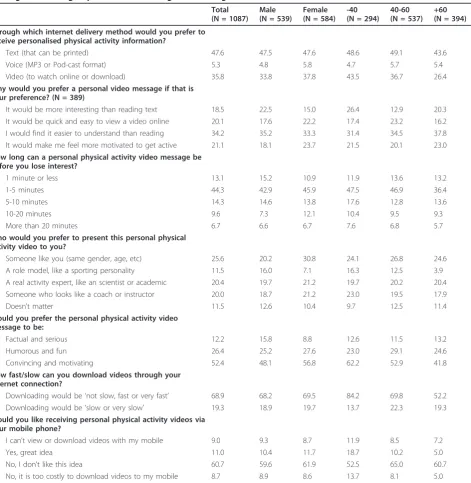
A set of new questions, based on focus group outcomes reported in this manuscript and dedicated to the concept of a video-tailored physical activity intervention, was developed specifically for this study and then added to the larger annual Queensland Social Survey (other topics in this survey were: demographics, internet use, nutrition, physical activity, smoking, physical and mental health and social capital). As such this study was able to benefit from the trained CATI interviewers and the well-established and reliable protocols of a state-wide study that has been conducted for nearly a decade. The questionnaire was pilot-tested on a total of 52 randomly selected households in South East Queensland. Interviewer comments (e.g. confusing wording, inadequate response categories, ques-tion order effect, etc.) and pre-test frequency distribuques-tions were reviewed to assist modifications to the questions. A simplified version of the multiple choice questions and answers categories can be found in Table 1. In order to make it easier for survey respondents to understand what the questions were about a brief introduction (read to par-ticipants by a CATI interviewer) was provided to explain why physical activity interventions are needed (regardless of whether or not it is applicable to them or whether or
not they would ever take part in such an intervention), but
also about how personally relevant or‘tailored’
informa-tion can be generated using the internet. Analysis
Data were cleaned and tabulated using SPSS 18.0. The data cleaning process included wild code, discrepant value, and consistency checks. The survey data were analysed using descriptive and frequency statistics. Please note that in the interest of space and to make it easier to interpret Table 1 some of the original answer-ing categories were merged or not reported when they
were less relevant (e.g. the ‘I don’t know’ and ‘No
response’ answering categories, as well as categories
with very low response numbers were not reported). As such, the reported categories are not always equal to 100%.
Results Participants
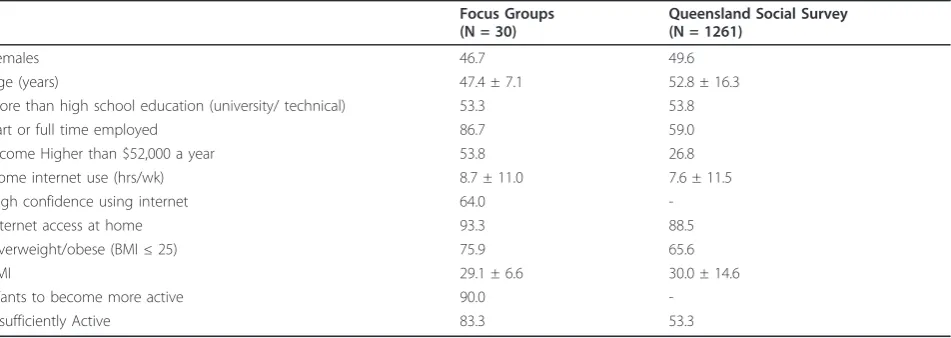
Of the 67 people initially contacted 30 participated in a total of five focus groups, which by average lasted 1 hour and 18 minutes (range: 1hr07min - 1hr39min). The num-bers of participants for each focus group ranged from 5 to 8. A total of 1261 people participated in the Queensland Social Survey, of which 1087 had access to the internet and were included in this study. The overall response rate for the survey was 35.2% and the estimated sampling error (at 95% CI) was 2.7%. Participant characteristics for both the focus groups and the survey can be found in Table 2. Comparable proportions were reported for gender (46.7% vs. 49.6% was female), educational attainment (53.3% vs. 53.8% had more than high school education), internet access at home (93.3% vs. 88.5%), home internet use (8.7 vs. 7.6 hours per week), and BMI (29.1 vs. 30) for both focus groups and survey participants respectively. How-ever, a larger proportion of focus group participant was overweight or obese (75.9%), employed (86.7%), insuffi-ciently active (83.3%) when compared to the survey parti-cipants. Average age was higher in survey participants (52.8 ± 16.3) when compared to focus group participants (47.4 ± 7.1).
Focus Group outcomes
What do you think of the concept of video-tailoring?
After explaining the concept of ‘video-tailoring’a large
majority of focus group participants (26 out of 30) agreed that the concept was good and interesting; they also indi-cated that they would be happy to receive a video-tailored
intervention themselves (’Its fantastic!’- F, age 51, FG2).
They supported the concept of a program that adapts to individual situations, that is personally relevant and which eliminates redundant information. Participants liked the anonymity of such program rather than having to interact
circumstances they would likely to be more honest about real physical activity levels. Participants saw the use of tai-lored-videos as a natural evolution of how the internet is currently evolving and pointed out that people prefer watching a video over reading text.
How long can the video-tailored messages be?
The vast majority of participants (28 out of 30) agreed that the video-messages should be short and ranging
between one and maximum five minutes (’short, sharp
and to the point’- M, age 39, F4). Many people (12 out of 30) seem to prefer a system whereby the very first tai-lored video-message would be designed to attract atten-tion and engage people into the program; and that
therefore it should be very short, ‘upbeat’ and‘snappy’.
After this initially short video longer more detailed mes-sages could be presented when participants would Table 1 Queensland Social Survey responses (%) to questions regarding computer-tailored physical activity video-messages for total group and stratified for gender and age (N = 1087)
Total (N = 1087)
Male (N = 539)
Female (N = 584)
-40 (N = 294)
40-60 (N = 537)
+60 (N = 394) Through which internet delivery method would you prefer to
receive personalised physical activity information?
Text (that can be printed) 47.6 47.5 47.6 48.6 49.1 43.6
Voice (MP3 or Pod-cast format) 5.3 4.8 5.8 4.7 5.7 5.4
Video (to watch online or download) 35.8 33.8 37.8 43.5 36.7 26.4
Why would you prefer a personal video message if that is your preference? (N = 389)
It would be more interesting than reading text 18.5 22.5 15.0 26.4 12.9 20.3
It would be quick and easy to view a video online 20.1 17.6 22.2 17.4 23.2 16.2
I would find it easier to understand than reading 34.2 35.2 33.3 31.4 34.5 37.8
It would make me feel more motivated to get active 21.1 18.1 23.7 21.5 20.1 23.0
How long can a personal physical activity video message be before you lose interest?
1 minute or less 13.1 15.2 10.9 11.9 13.6 13.2
1-5 minutes 44.3 42.9 45.9 47.5 46.9 36.4
5-10 minutes 14.3 14.6 13.8 17.6 12.8 13.6
10-20 minutes 9.6 7.3 12.1 10.4 9.5 9.3
More than 20 minutes 6.7 6.6 6.7 7.6 6.8 5.7
Who would you prefer to present this personal physical activity video to you?
Someone like you (same gender, age, etc) 25.6 20.2 30.8 24.1 26.8 24.6
A role model, like a sporting personality 11.5 16.0 7.1 16.3 12.5 3.9
A real activity expert, like an scientist or academic 20.4 19.7 21.2 19.7 20.2 20.4
Someone who looks like a coach or instructor 20.0 18.7 21.2 23.0 19.5 17.9
Doesn’t matter 11.5 12.6 10.4 9.7 12.5 11.4
Would you prefer the personal physical activity video message to be:
Factual and serious 12.2 15.8 8.8 12.6 11.5 13.2
Humorous and fun 26.4 25.2 27.6 23.0 29.1 24.6
Convincing and motivating 52.4 48.1 56.8 62.2 52.9 41.8
How fast/slow can you download videos through your internet connection?
Downloading would be‘not slow, fast or very fast’ 68.9 68.2 69.5 84.2 69.8 52.2
Downloading would be‘slow or very slow’ 19.3 18.9 19.7 13.7 22.3 19.3
Would you like receiving personal physical activity videos via your mobile phone?
I can’t view or download videos with my mobile 9.0 9.3 8.7 11.9 8.5 7.2
Yes, great idea 11.0 10.4 11.7 18.7 10.2 5.0
No, I don’t like this idea 60.7 59.6 61.9 52.5 65.0 60.7
No, it is too costly to download videos to my mobile 8.7 8.9 8.6 13.7 8.1 5.0
already be engaged with the program. How long videos can be also depends on how interested people would be in their own physical activity levels and how personally relevant the information is: the higher interest levels and relevance the longer a video can be. Videos can also be longer if participants know in advance how long it will take to watch it.
How many video-tailored messages can there be?
Participants had difficulties outlining the number of
video-tailored messages that would be acceptable (’three
perhaps, mounting up to a total of 15min of video’- F, age 55, FG1). Some participants (5 out of 30) pointed out
it would be good if they could‘tailor’how many videos
one gets, based on feedback they provide about this. A large majority of participants (25 out of 30) think it would be a good idea not to provide all videos at once, but rather one per week. In this way one could cope with more videos and information. According to the partici-pants providing all videos at once might also cause peo-ple not to return to the website if they had a look at everything already. Participants also indicated that there should be a follow-up video a while after the program
has finished(’a booster to get people back on track’- F,
age 50, FG3).
Who should be in the video tailored messages?
Participants were ambivalent about who should be in the videos to present the physical activity information to the viewer, often with opposing opinions. However, the main underlying idea supported by most participants (22 out of 30) was that whoever presents the video needs to be
credible and convincing (’someone that is very fit would
not be credible for everybody’-M, age 35, FG2). There-fore people that can talk from experience about the topic would be much liked. Many suggested (11 out of 30) that the option of self-selecting the video presenter would be
a feasible approach (’pick your presenter’- M, age 44,
FG1). Many also liked the idea of having several different
presenters in the video according to the topic (’a GP for
medical topics or a coach for getting more active’-M, age 53, FG5). Some participants would like to see role
mod-els, celebrities, famous people, sports stars; others don’t
and would be just happy with anybody as long as they
would be‘real’, passionate and motivating. Some
partici-pants would like to see similar ages, sexes, ethnicities and
weight, whilst others don’t care about it or would even
prefer the opposite. Most (27 out of 30) agree that an
overweight presenter wouldn’t be very convincing. A
sur-prisingly high number of participants (9 out of 30) liked the idea of using cartoons or animations, reporting them
as‘neutral’presenters. The participants didn’t like the
idea of professional actors (’they get paid to fake it’- M,
age 54, FG3). A researcher or professor would be cred-ible, but needs to avoid being condescending.
To what level of detail and to which variables should the video messages be tailored?
Initially participants struggled to give specific answers to this question, but agreed that some tailoring is better
than no tailoring at all. (’The more tailoring, the more
interesting! One size fits all is no good!’- M, age 40, FG4). Answering about 20 questions would be the limit in order to receive personally relevant feedback. Several par-ticipants suggested that one should be offered the option to choose: the approach (e.g. factual vs. humours), who presents, number of questions needed to answer in order to receive feedback, and at what interval new messages should be delivered. Messages should also be tailored according to personal background, age, attitudes, barriers to be active, and motivation to become more active. Which mode of delivery do you prefer for the video messages: website or mobile?
The majority of focus group participants (24 out of 30) would prefer receiving the tailored video-messages via
the internet and not via their mobile phone (’that is for
young people’-M, age 39, FG1). However, participants Table 2 Population characteristics (% or Mean ± SD), for focus group and survey participants
Focus Groups (N = 30)
Queensland Social Survey (N = 1261)
Females 46.7 49.6
Age (years) 47.4 ± 7.1 52.8 ± 16.3
More than high school education (university/ technical) 53.3 53.8
Part or full time employed 86.7 59.0
Income Higher than $52,000 a year 53.8 26.8
Home internet use (hrs/wk) 8.7 ± 11.0 7.6 ± 11.5
High confidence using internet 64.0
-Internet access at home 93.3 88.5
Overweight/obese (BMI≤25) 75.9 65.6
BMI 29.1 ± 6.6 30.0 ± 14.6
Wants to become more active 90.0
were supportive of receiving very short video-messages on their mobile phone (e.g. 20 seconds) as a reminder or to give a tip on being active. In line with this, most participants (21 out of 30) would also not mind receiv-ing reminders (SMS or e-mail) via their phone when a new tailored video-message would be available on the website. Reasons mentioned for not being supportive of phone delivery were: associated download cost of receiv-ing videos via a mobile phone, receivreceiv-ing messages when
not being in the‘right’environment making it hard to
pay the attention that these messages disserve, the phone screen is too small and the quality of the videos would have to be low to allow downloading them. How professional should the video messages be?
Most participants (19 out of 30) agreed that the level of
professionalism doesn’t have to be the highest achievable
level; however they also agreed that the video messages will need to look professional in order to be credible and engaging. It would be more important to work with a professional production team behind the camera (light, sound, camera), than who is in front of the camera. Use of a studio would be recommended, but not exclusively
supported (’also shoot at everyday locations used by‘real’
people’- F, age 60, FG3).
What approach should the video messages have?
Participants found it difficult indicating what approach
the video-messages should have (‘ideally it is individually
tailored, if that would be possible’- M, age 43, FG5). However, they indicated that the messages should be positive, friendly, encouraging, motivating, passionate, caring, engaging and inspiring; but at the same time not
be too‘preachy’,‘pushy’, confronting or‘hard’(‘it will
cre-ate resistance to the message’- F, age 51, FG2). A light hearted or humorous approach would be appreciated by many participants, but participants acknowledge that this would be difficult to achieve as everybody has a different
idea of what is‘funny’. The‘tempo’of the videos should
be ‘upbeat’ (‘keep it moving’ - M, age 49, FG1), it
shouldn’t be neither too fast nor too slow and depending
on the topic tempo variations are encouraged (‘to prevent
people from phasing out’- F, age 47, FG4). A‘negative
medical approach’(‘scare techniques’-F, age 43, FG1)
would not be recommended (‘although some topics
require you to be more serious than others’- M, age 39, FG4).
What kind of graphs and animations should be used in the video-tailored messages?
The majority of participants (24 out of 30) were suppor-tive of using graphs, animations and occasionally text into the video messages; they claim it would be more interesting, motivating and engaging to watch videos
that incorporate features like that (‘it would take longer
to get bored and switch off’- F, age 53, FG2). However, the graphs would need to be simple, basic, and easy to
understand; and there shouldn’t be too many of them
and they should be well explained.
How would you like the video messages to be stored? Most focus group participants (22 out of 30) would like their personal video messages to be saved onto a perso-nal section of the website so that they would be able to
view them again later (‘the website needs to be secure
though’- F, age 44, FG3). In addition, most people (19 out of 30) would also like to have the ability to store the newly generated video on their personal computer hard drive, so that they would not have to download it again if they want to watch it again. This would also make it easier to share it with friends or family via e-mail or social networking sites. Most participants (24 out of 30) preferred the option whereby they would be able to receive the personalised videos an unlimited amount of times, to see whether they would have progressed over time, or just to see what would happen if you answer some questions differently.
Will your internet connection cause problems for downloading the video-tailored messages?
Most of the focus group participants (20 out of 30) indi-cated to have a broadband connection, but nonetheless indicated that slow download times should be avoided if
possible (‘nobody likes to wait and you might lose people
if it takes too long’- M, age 43, FG5). Watching videos would not be an option with a dial-up connection, and in this respect low size videos were encouraged by parti-cipants. Participants strongly indicated that they would prefer to wait a little longer whilst the video downloads over having to watch a video that is stopping and start-ing all the time; in this respect they also mentioned that
an accurate progress bar (‘that shows how much longer
it will take for the download to complete’ - F, age 56,
FG2) would be needed, and‘something’to keep one
dis-tracted whilst waiting would also be a must. The level of patience to wait for a video to download appeared to
vary from ‘no patience at all’, to ’I don’t mind waiting
for 2 minutes while it loads’.
Queensland Social Survey outcomes
message was that it would be‘easier to understand over
reading’(34.2%); and this was especially the case in the
oldest age group (37.8%). For the total group, equally
important was that it would be more ‘interesting’
(18.5%), ‘quick’ (20.1%) and‘motivating’ (21.1%) when
compared to a personal text-based message. For females (15%) and participants between 40 and 60 years of age
(12.9%) the videos being ‘more interesting over reading
text’was less important when compared to males and
older age groups.
When asked who should present the personal physical activity advice most people preferred someone similar to themselves (25.6%), but this was closely followed by a
physical activity expert (20.4%) or a‘coach’ (20%). For
females (30.8%) ‘someone like you’ was a lot more
important than for males (20.2%); however males (16%)
preferred a‘role model’a lot more than females (7.1%).
Especially‘role models’were less preferred as participant
age increased (only 3.9% for those aged over 60 years). Across groups about 10% to 12% indicated not to care about who is presenting the video messages.
A large majority of participants would prefer the
videos to be ‘convincing’ (52.4%), over ‘humorous’
(26.4%) and ‘factual’ (12.2%). Especially participants
under the age of 40 (62.2%) would like the videos to be
‘convincing’, when compared to the two older age
groups (52.9% and 41.8% respectively). Especially men (15.8%) would like the videos to be factual when com-pared to women (8.8%).
For the majority of people the video-messages should be no longer than five minutes (57.4%); and of those 13.1% indicated that they should be shorter than one minute. Only 30.6% of participants indicated that the video-messages can be longer than 5 minutes. An over-whelming majority of participants indicated that they can download videos from the internet quickly (68.9%); this was especially the case when comparing younger participants (84.2%) with older participants (69.8% and 52.2% respectively).
Only about 10% of the sample indicated that they would also like to receive personal physical activity videos via their mobile phone (although this is nearly double in the younger respondents (18.7%); whereas the
majority of participants (60.7%) didn’t like this idea.
About 10% of the sample indicated that their mobile phone would not be suitable for viewing videos. Asso-ciated cost with downloading videos was mainly a con-cern in younger respondents (13.7%) when compared to older groups (8.1% and 5% respectively).
Discussion
The results clearly indicate that a video-tailored physical activity intervention is acceptable for potential users, and that developing such intervention is feasible.
Furthermore, a lot of useful information was obtained to inform the future development of this type of interven-tions. It has often been suggested that internet-delivered interventions that are highly interactive and appealing in use will result in higher participant engagement and retention, and might also result in higher and longer term effectiveness [7,31,32]. Whilst to date there is no direct evidence to support that computer-tailored inter-ventions are capable of increasing engagement and retention [43], they have previously shown to be suc-cessful in changing behaviour [11,12] and incorporating
this ‘next generation’ video enhancement (which
increases their appeal), is anticipated to further increase their effectiveness. The detailed information presented in this study is entirely focussed on providing assistance with the development of these innovative interventions.
Nearly all the focus group participants supported the concept of a video-tailored intervention, whereas a much lower proportion of survey participants indicated using video would be their preferred method of delivery. This is likely due to the extensive introduction and illus-tration on this topic received by focus group
partici-pants, resulting in higher understanding and
appreciation of the concept of video-tailoring when compared to survey participants who only received a brief explanation over the phone. Social desirability might also have contributed to focus group participants showing greater support for video-tailored interventions. However, when compared to an online survey, con-ducted by Marshall et al., the current support for video delivery of physical activity advice has risen to a level three times higher than what it was in 2003 [44]. The survey, by Marshall et al., identified the preferred sources of advice on how to become more physically active and only 12% of internet users preferred receiving advice using video. As such, only 7 years later, the
con-tinued ‘internet revolution’ has rapidly changed user
preferences, with now more than 35% of participants indicating that they would prefer video-based advice. The preference of text over video delivery by survey par-ticipants is likely a case of people being unfamiliar with a new and unknown type of intervention (video), and preferring what they know best (text). As internet speed, number of broadband connections and new websites rapidly keep evolving in a direction that is more suitable for video-delivery of content, the number of people that prefer video over text delivery will undoubtedly continue to grow. This is also reflected by having a higher pro-portion of participants less than 40 years of age who preferred to receive video-tailored advice (43.5%), as younger people are often setting new internet trends which are later adopted by the broader population.
a broadband connection [24]. This is in line with the current study with regards to those who are younger, however in this study more females (37.8%) indicated to prefer video-tailored messages when compared to men (33.8%). This might be due to the health related nature of the video messages, as males typically show less inter-est in their health when compared to females [45,46]. In this study it was also found that participants with a slow internet connection more often preferred to receive text-based advice (54.7%) compared to participants with a fast internet connection (49.6%). Similarly, those with a fast internet connection more often preferred to receive a video-based advice (40.3%) compared to those
with a slow internet connection (31.9%) (Chi2 = 632;
P < 0.001; not reported in results section). In relation to this, a study conducted in 2005 showed that bandwidth
constrains of ‘video-rich’ health behaviour change
websites were too large to allow satisfactory use with dial-up modems [32]. It is therefore encouraging that broadband connections are overtaking the marked at an astonishing rate, with currently only 10% of Australians continuing to use a dial-up connection [25]. The survey results of this study were in line with this, indicating that for less than 20% of the sample downloading videos
would be‘slow’or‘very slow’.
From these results it thus seems that many internet users are ready to receive a video-tailored physical activ-ity intervention, and that current internet infrastructure is able to support it. However, the results from this study also indicate that it is too soon to go yet another step further and use mobile phone technology to
imple-ment this type of intervention. Even though ‘smart
phone’use is on the rise (according to market research,
conducted in June 2010, 36% of Australians owns a smart phone and this is likely to increase to 50% within one year), the majority of both focus group and survey participants did not like the idea of using their mobile phones to receive this kind of intervention. Only 10% of survey respondents were in favour of this idea; although this number was nearly double for those under 40 years of age. The reason for the low support might result from the fact that the average age of participants in both the focus groups and the survey was relatively high (47.4 and 52.8 respectively). An American study, con-ducted in 2010, showed that the number of people that have watched a video on their mobile phone sharply drops with increasing age: 40% have done so in those aged 20 to 30 years, 20% in those aged 30 to 50 years, and only 6% in those aged 50 to 65 years [47]. Thus, although it is too early to implement a video-tailored intervention though mobile phones to date, it is likely that this will change in the future.
The results from both focus groups and survey high-light a number of challenges that health promotion
professionals will face when designing video-tailored interventions. Content presented by means of video is very information rich, and as such there are a lot more
‘variables’that one can tailor to in order the make the
advice more interesting or appealing, when compared to information that is presented in plain text format. On many occasions during the focus groups participants expressed very diverse preferences with regards to, for example, who presents the information in the videos, what approach the videos should have, at what interval new video-messages should be delivered and more. This is in line with the results from the survey which did not identify a clear preference as to whom should present the video-messages. Several focus group participants
suggested that one should be offered the choice (‘pick
your presenter’). Whilst technically feasible,
accommo-dating such preferences would be a huge logistical chal-lenge, as each time a participant is offered such a choice it would double, triple or quadruple (depending on how many choices are offered) the entire database of video-messages that support the program. Unlike writing text, producing videos is difficult (focus group participants indicated that a professional production is required to be engaging and credible), time consuming and expen-sive. Due to a lack of evidence it is unclear whether
accommodating such ‘personalisation’ of preferences
would result in higher intervention effectiveness [48]. However, two studies did examine this and their out-comes suggest that efforts should be made to persona-lise and tailor feedback on as much variables as feasibly possible. A HIV prevention study provided participants with the option to choose one of four virtual characters to guide them through the intervention, consistent with the focus group outcomes of the present study, prefer-ences for the virtual presenters were very diverse (they were all selected by large proportions of participants) and participants responded very positive towards the intervention [37]. Further, a study by Dijkstra et al.
eval-uated the effects of ‘feedback, ‘personalisation’ and
‘adaptation’ in an attempt to uncover the working
mechanisms of computer-tailoring, and concluded that
both ‘feedback’ and ‘personalisation’(but not ‘
adapta-tion’) were effective to increase intervention
effective-ness [49].
that this will be enough to change behaviour. Although not much is known about the actual exposure partici-pants have to intervention materials, it is obvious from previous website-delivered physical activity interventions that higher exposure (often measured through number of logins into intervention website) leads to higher inter-vention effectiveness [7,50]. A potential way of dealing with this challenge might be to develop multiple video messages that are reasonably short. As such, participants would be able to view the different videos available on a website at their own pace, or alternatively they could be provided with new videos at intervals set by health pro-fessionals. The focus groups revealed that participants are open to the idea receiving multiple messages at a set interval, which would allow them to receive more advice without causing an information overload.
A major strength of this study is that it combines quali-tative focus group data with quantiquali-tative survey data, and as such overcomes some of the limitations that are prone to each of these research methods when used separately. For example, focus group participants were a conveni-ence sample and selection bias might have occurred as those approached participated on a voluntary basis. Furthermore, social desirability bias may have emerged by discussing issues in a group, even though participants were encouraged to express their opinion even if it was different from others. However, representativeness issues were overcome by adding and comparing data on the same topic from a large state-wide survey which aimed to reflect the characteristics of the population taken from the most recent Australian Census. In turn, detailed and in depth information about a specific topic cannot be gathered using a large scale survey methods, this is where the focus groups show their added value, with their abil-ity to discover hidden opinions and attitudes through dis-cussions with peers, and their ability to gather extensive information in a relatively short period of time. Finally, one specific limitation with regards to the survey out-comes should be mentioned: a large proportion (up to 20%) of older survey respondents (over 60 years of age) did not answer the questions in relation to personalised video-tailored physical activity messages (not reported in Table 1), whereas this was minimal (generally less than 2%) in younger participants (less than 40 years of age). This is likely an indication that the oldest group of survey participants has not yet fully caught up with new aspects of internet technology, or have more difficulties under-standing the concepts in the questions asked. As such, survey outcomes of the oldest group of respondents should be interpreted with caution.
Conclusions
The results from this research provide valuable informa-tion to guide the development of a new and innovative
video-tailored physical activity intervention. The results also support the feasibility of such intervention, both in terms of users being ready to participate in it, as well as from a technical point of view whereby the infrastruc-ture available to the majority of internet users is able to cope with the demands of downloading videos. Though promising, a number of specific challenges in the devel-opment of these interventions were identified (e.g. the videos need to be short, made professionally, and tailor to a larger number of variables). Hence, the next step will be to examine whether or not these challenges can be overcome, through the development and subsequent evaluation of this new type of physical activity interven-tion. Finally, the results indicated that it is too soon to implement such intervention though mobile phones.
Acknowledgements
The focus group component of this study was funded through an internal Central Queensland University (CQU) grant (RDIM1004). The survey component of this study was funded by the Institute of Health and Social Science Research at CQU, through the Population Research Grant Scheme (PGRS). The Population Research Laboratory (PRL), managed by Ms Christine Hanley, was responsible for participant recruitment and organisation of the focus groups. The PRL was also responsible for conducting the Queensland Social Survey, which is an annual omnibus survey funded by the Institute for Health and Social Science Research. Vandelanotte was supported by a National Health and Medical Research Council of Australia (#519778) and National Heart Foundation of Australia (#PH 07B 3303) post-doctoral research fellowship.
Author details
1
Centre for Physical Activity Studies, Institute for Health and Social Science Research, Central Queensland University, Building 18, Bruce Highway, Rockhampton, Queensland, Australia.2Faculty of Physical Education and Recreation, University of Alberta, W1-34 Van Vliet Centre, Edmonton, Alberta, Canada.
Authors’contributions
CV was involved in conceptualization, study coordination, data collection, analyses and manuscript development; WKM was involved in
conceptualization, data collection and analyses. All authors read and approved the final manuscript.
Competing interests
The authors declare that they have no competing interests.
Received: 2 December 2010 Accepted: 1 July 2011 Published: 1 July 2011
References
1. Blair SN, Morris JN:Healthy Hearts-and the Universal Benefits of Being Physically Active: Physical Activity and Health.Ann Epidemiol2009, 19:253-256.
2. Vandelanotte C, Duncan MJ, Caperchione C, Hanley C, Mummery WK: Physical activity trends in Queensland (2002 to 2008): Are women becoming more active than men?Aust N Z J Public Health2010, 34:248-254.
3. Bruce MJ, Katzmarzyk PT:Canadian population trends in leisure-time physical activity levels, 1981-1998.Can J Appl Physiol2002,27:681-690. 4. DuBose KD, Kirtland KA, Hooker SP, Fields RM:Physical activity trends in
South Carolina, 1994-2000.South Med J2004,97:806-810.
6. Department of Health and Aged Care (DHAC):National Physical Activity Guidelines for Australians.Commonwealth Department of Health and AgeingCanberra: Department of Health and Ageing; 1999. 7. Vandelanotte C, Spathonis KM, Eakin EG, Owen N:Website-Delivered
Physical Activity Interventions. A Review of the Literature.Am J Prev Med 2007,33:54-64.
8. Eakin E, Reeves M, Lawler S, Graves N, Oldenburg B, Del Mar C, Wilke K, Winkler E, Barnett A:Telephone Counseling for Physical Activity and Diet in Primary Care Patients.Am J Prev Med2009,36:142-149.
9. Kahn EB, Ramsey LT, Brownson RC, Heath GW, Howze EH, Powell KE, Stone EJ, Rajab MW, Corso P, Briss PA:The effectiveness of interventions to increase physical activity - A systematic review.Am J Prev Med2002, 22:73-108.
10. Noar SM, Benac CN, Harris MS:Does Tailoring Matter? Meta-Analytic Review of Tailored Print Health Behavior Change Interventions.Psychol Bull2007,133:673-693.
11. Krebs P, Prochaska JO, Rossi JS:A meta-analysis of computer-tailored interventions for health behavior change.Prev Med2010,51:214-221. 12. Kroeze W, Werkman A, Brug J:A systematic review of randomized trials
on the effectiveness of computer-tailored education on physical activity and dietary behaviours.Ann Behav Med2006,31:205-223.
13. Kreuter MW, Farrell D, Olevitch L, Brennan LK: InTailoring Health Messages: Customizing Communication with computer Technology.Edited by: Mahwah NJ. Laurence Erlbaum Associates, Inc; 2000:.
14. de Vries H, Brug J:Computer-tailored interventions motivating people to adopt health promoting behaviours: Introduction to a new approach. Patient Educ Couns1999,36:99-105.
15. Brug J, Oenema A, Campbell M:Past, present, and future of computer-tailored nutrition education.Am J Clin Nutr2003,77:1028S-1034S. 16. Vandelanotte C, De Bourdeaudhuij I:Acceptability and feasibility of a
computer-tailored physical activity intervention using stages of change: project FAITH.Health Educ Res2003,18:304-317.
17. Brug J, Oenema A, Kroeze W, Raat H:The internet and nutrition education: challenges and opportunities.Eur J Clin Nutr2005,59: S130-S137.
18. Vandelanotte C, De Bourdeaudhuij I, Sallis JF, Spittaels H, Brug J:Efficacy of sequential or simultaneous interactive computer-tailored interventions for increasing physical activity and decreasing fat intake.Ann Behav Med 2005,29:138-146.
19. Spittaels H, De Bourdeaudhuij I, Vandelanotte C:Evaluation of a website-delivered computer-tailored intervention for increasing physical activity in the general population.Prev Med2007,44:209-217.
20. Marcus BH, Bock BC, Pinto BM, Forsyth LH, Roberts MB, Traficante RM: Efficacy of an individualized, motivationally-tailored physical activity intervention.Ann Behav Med1998,20:174-180.
21. Spittaels H, De Bourdeaudhuij I, Brug J, Vandelanotte C:Effectiveness of an online computer-tailored physical activity intervention in a real-life setting.Health Educ Res2007,22:385-396.
22. Skinner CS, Campbell MK, Rimer BK, Curry S, Prochaska JO:How effective is tailored print communication?Ann Behav Med1999,21:290-298. 23. O’Reilly T:Web 2.0: Stuck on a name or hooked on value?Dr Dobb’s
Journal2006,31:10.
24. Purcell K:The state of online video.Washington PEW Research Center; 2010.
25. ABS:Houshold use of Information Technology, 2008-2009.Canberra: Australian Bureau of Statistics2009.
26. Neville LM, O’Hara B, Milat A:Computer-tailored physical activity behavior change interventions targeting adults: A systematic review.Int J Behav Nutr Phys Activ2009,6.
27. Norman GJ, Zabinski MF, Adams MA, Rosenberg DE, Yaroch AL, Atienza AA: A Review of eHealth Interventions for Physical Activity and Dietary Behavior Change.Am J Prev Med2007,33:336-345.
28. O’Keefe I, Dade V:Personalised web experiences: Seamless adaptivity across web service composition and web content.Lecture Notes Comp Sci 5535:480-485.
29. Liu Z:Reading behavior in the digital environment: Changes in reading behavior over the past ten years.J Documentation2005,61:700-712. 30. Vandelanotte C, De Bourdeaudhuij I, Brug J:Two-year follow-up of
sequential and simultaneous interactive computer-tailored interventions for increasing physical activity and decreasing fat intake.Ann Behav Med 2007,33:213-219.
31. Leslie E, Marshall AL, Owen N, Bauman A:Engagement and retention of participants in a physical activity website.Prev Med2005,40:54-59. 32. Danaher BG, Jazdzewski SA, McKay HG, Hudson CR:Bandwidth Constraints
to using video and other rich media in Behaviour change websites.J Med Internet Res2005,7:e49.
33. Frenn M, Malin S, Brown RL, Greer Y, Fox J, Greer J, Smyczek S:Changing the tide: an Internet/video exercise and low-fat diet intervention with middle-school students.Appl Nurs Res2005,18:13-21.
34. Swartz LH, Noell JW, Schroeder SW, Ary DV:A randomised control study of a fully automated internet based smoking cessation programme.Tob Control2006,15:7-12.
35. Alexander GL, McClure JB, Calvi JH, Divine GW, Stopponi MA, Rolnick SJ, Heimendinger J, Tolsma DD, Resnicow K, Strecher VJ, Johnson CC:A Randomized Clinical Trial Evaluating Online Interventions to Improve Fruit and Vegetable Consumption.Am J Public Health2010,100:319-326. 36. Campbell MK, Carbone E, Honess-Morreale L, Heisler-Mackinnon J,
Demissie S, Farrell D:Randomized Trial of a Tailored Nutrition Education CD-ROM Program for Women Receiving Food Assistance.J Nutr Educ Behav2004,36:58-66.
37. Kok G, Harterink P, Vriens P, de Zwart O, Hospers HJ:The Gay Cruise: Developing a Theory- and Evidence-Based Internet HIV-Prevention Intervention.Sex Res Soc Policy2006,3:52-67.
38. Irvine AB, Ary DV, Grove AD, Gilfillan-Morton L:The effectiveness of an interactive multimedia program to influence eating habits.Health Educ Res2004,19:290-305.
39. Willis K, Green J, Daly J, Williamson L, Bandyopadhyaya M:Perils and posibilities: Achieving best evidence from focus groups in public health research.Aust N Z J Public Health2009,33:131-136.
40. Blair SN, Horton E, Leon AS, Lee IM, Drinkwater BL, Dishman RK, Mackey M, Kienholz ML:Physical activity, nutrition, and chronic disease.Med Sci Sports Exerc1996,28:335-349.
41. Guest G, Johnson BA:How many interviews are enough? An experiment with data saturation and variability.Field Methods2006,18:59-82. 42. Miles MB, Huberman AM:Qualitative Data Analysis: An Expanded Sourcebook
London: Sage; 1994.
43. Brouwer W, Kroeze W, Crutzen R, Nooijer J, de Vries NK, Brug J, Oenema A: Which Intervention Characteristics are Related to More Exposure to Internet-Delivered Healthy Lifestyle Promotion Interventions? A Systematic Review.J Med Internet Res2011,13:e2.
44. Marshall AL, Eakin E, Leslie E, Owen N:Exploring the feasibility and acceptability of using Internet technology to promote physical activity within a defined community.Health Promot J Aust2005,16:82-84. 45. Verdonk P, Seesing H, de Rijk A:Doing masculinity, not doing health? A
qualitative study among Dutch male employees about health beliefs and workplace physical activity.BMC Public Health2010,10:712, 35. 46. Courtenay WH:Constructions of masculinity and their influence on men’s well-being: A theory of gender and health.Soc Sci Med2000, 50:1385-1401.
47. Smith A:Mobile access 2010.Washington: PEW Research Center; 2010. 48. Hawkins RP, Kreuter M, Resnicow K, Fishbein M:Understanding tailoring in
communicating about health.Health Educ Res2008,23:454-466. 49. Dijkstra A:Working mechanisms of computer-tailored health education:
evidence from smoking cessation.Health Educ Res2005,5:527-539. 50. McKay HG, King D, Eakin EG, Seeley JR, Glasgow RE:The diabetes network
Internet-based physical activity intervention - A randomized pilot study. Diabetes Care2001,24:1328-1334.
doi:10.1186/1479-5868-8-70
Cite this article as:Vandelanotte and Mummery:Qualitative and
quantitative research into the development and feasibility of a video-tailored physical activity intervention.International Journal of Behavioral