Office Spirometry in Primary Care Pediatrics: A Pilot Study
Stefania Zanconato, MD, PhD*; Giorgio Meneghelli, MD‡; Raffaele Braga§; Franco Zacchello, MD*; and Eugenio Baraldi, MD*, on behalf of the Working Group
ABSTRACT. Objective. The aim of this study was to investigate the validity of office spirometry in primary care pediatric practices.
Methods. Ten primary care pediatricians undertook a spirometry training program that was led by 2 pediatric pulmonologists from the Pediatric Department of the University of Padova. After the pediatricians’ training, children with asthma or persistent cough underwent a spirometric test in the pediatrician’s office and at a pul-monary function (PF) laboratory, in the same day in random order. Both spirometric tests were performed with a portable turbine flow sensor spirometer. We as-sessed the quality of the spirometric tests and compared a range of PF parameters obtained in the pediatricians’ offices and in the PF laboratory according to the Bland and Altman method.
Results. A total of 109 children (mean age: 10.4 years; range: 6 –15) were included in the study. Eighty-five (78%) of the spirometric tests that were performed in the pediatricians’ offices met all of the acceptability and reproducibility criteria. The 24 unacceptable test results were attributable largely to a slow start and failure to satisfy end-of-test criteria. Only the 85 acceptable spiro-metric tests were considered for analysis. The agreement between the spirometric tests that were performed in the pediatrician’s office and in the PF laboratory was good for the key parameters (forced vital capacity, forced ex-piratory volume in 1 second, and forced exex-piratory flow between 25% and 75%). The repeatability coefficient was 0.26 L for forced expiratory volume in 1 second (83 of 85 values fall within this range), 0.30 L for forced vital capacity (81 values fall within this range), and 0.58 L/s for forced expiratory flow between 25% and 75% (82 values fall within this range). In 79% of cases, the primary care pediatricians interpreted the spirometric tests correctly.
Conclusions. It seems justifiable to perform spirom-etry in pediatric primary care, but an integrated approach involving both the primary care pediatrician and certi-fied pediatric respiratory medicine centers is recom-mended because effective training and quality assurance are vital prerequisites for successful spirometry. Pediat-rics 2005;116:e792–e797. URL: www.pediatrics.org/cgi/ doi/10.1542/peds.2005-0487; office spirometry, primary care pediatrics, asthma, children.
ABBREVIATIONS. PF, pulmonary function; FEV1, forced expira-tory volume in 1 second; ATS, American Thoracic Society; FVC, forced vital capacity; FET, forced expiratory time; FEF25–75, forced expiratory flow between 25% and 75% of expired FVC; ICC, intraclass correlation coefficient; GP, general practitioner.
P
ulmonary function (PF) tests are useful in both the diagnosis and the monitoring of lung dis-ease. The international guidelines for asthma management have endorsed the use of objective lung function measures for assigning a severity rating to patients with asthma and guide asthma therapy.1Although children’s and their parents’ reporting of asthma symptoms is important in staging and man-aging pediatric asthma, many children and parents do not perceive asthma symptoms adequately, and children with long-standing airway obstruction are less likely to report dyspnea than children with acute-onset airway obstruction.2–4In addition,
phys-ical findings seem to be inadequate for assessing obstruction that may be present despite a normal physical examination.5
Despite a large body of evidence showing that airway obstruction in children with asthma is asso-ciated with ongoing respiratory morbidity6,7 and a
reduced forced expiratory volume in 1 second (FEV1)
in adulthood,8–10 spirometry is not routinely
per-formed by physicians who treat children with asthma as an objective measure of airway obstruc-tion. According to the Asthma Insights and Reality Europe Study (a survey that assesses the current level of asthma control in Western Europe), a large proportion of children with asthma are treated with-out lung function measurements, and physicians base their treatment decisions on symptom reports and auscultation.11
Ideally, spirometry should be available on-site in primary care practices. However, despite the increas-ing use of spirometric tests in primary health care, little is known about their validity.12–17Spirometry is
often regarded as a simple, noninvasive screening test, but careful consideration clearly needs to be given to a number of aspects, including optimal test performance, adherence to standard acceptability and repeatability criteria, and accurate, well-in-formed interpretation of the results.
Portable, lightweight spirometry instruments that can be wired into a computer are now available, making spirometry technically feasible at the pri-mary care level. Advantages of the newly proposed category of office spirometers include lower instru-From the *Department of Pediatrics, University of Padova, Padova, Italy;
‡Primary Care Pediatrics, Federazione Italiana Medici Pediatri, Italy; and §Valeas SpA, Milano, Italy.
Accepted for publication Jun 24, 2005. doi:10.1542/peds.2005-0487
No conflict of interest declared.
Address correspondence to Stefania Zanconato, MD, PhD, Department of Pediatrics, University of Padova, Via Giustiniani 3, 35128 Padova, Italy. E-mail: [email protected]
ment cost, small size, and an improved quality-as-surance program.16,18
No previous studies have formally assessed spi-rometry performance in primary care pediatric prac-tice. We aimed to determine the quality of the spiro-metric tests that are performed in primary care pediatric practice after formal training for the pedi-atrician was provided. For this purpose, spirometric tests that were performed by primary care pediatri-cians were assessed for acceptability and reproduc-ibility, and the resulting spirometric data were com-pared with those obtained at a PF laboratory using the same portable spirometer. The primary care pe-diatrician’s interpretation of the spirometric data were also assessed. Finally, to validate the portable spirometer, the data that it produced in the labora-tory were compared with those that were obtained with a gold-standard laboratory-based volume spi-rometer.
METHODS
The study was a repeated, cross-sectional, within-subject com-parison of spirometric tests in a PF laboratory and in primary care pediatricians’ offices. The study involved 10 primary care pedia-tricians from northeast Italy and 2 pediatric pulmonologists at the Pediatric Allergy and Pulmonology Unit of the University of Padova, which is a certified European Respiratory Society center19 for pediatric respiratory medicine training.
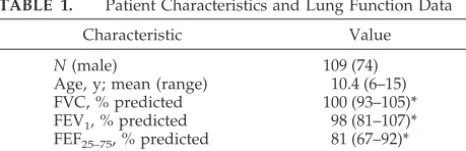
Children who had a diagnosis of asthma1or cough persisting for⬎15 days and were aged 6 to 15 years were selected for the study (Table 1). They were recruited during routine visits to the pediatricians’ offices. All parents gave their written informed consent.
Training
A spirometry training program that consisted of two 5-hour sessions separated by an interval of 12 weeks was arranged for the primary care pediatricians.15,20During each session, 2 pediatric pulmonologists (S.Z. and E.B.) reviewed respiratory system phys-iology, general aspects of asthma, indications for spirometry, basic spirometry test performance issues and the interpretation of spi-rometric indices, and flow-volume and volume-time curves. The practical part included a demonstration of the Microloop turbine flow sensor spirometer (Micro Medical Limited, Rochester, UK) and Spida 5 software (Micro Medical Limited) that was to be used for the study, individual practice with spirometry testing, and interpretation. During the 12-week interval between the first and second sessions, the participants were required to perform at least 30 spirometric tests and could share their experience and prob-lems encountered using spirometry in their practice with the 2 pediatric pulmonologists. In addition, they were assisted in their offices for technical problems. During the first training session, participants were given a manual on the theoretical and practical aspects of spirometry, paying particular attention to acceptability and reproducibility criteria and test interpretation.
Spirometry Tests
Data collection started after the second training session and lasted for 1 month. The pediatricians’ offices and laboratory all were equipped with the same portable spirometer (Microloop) and spirometry computer software (Spida 5). The spirometer uses a turbine flow sensor. The unit is provided with built-in quality assurance features, based on American Thoracic Society (ATS) criteria.21The spirometry software displays real-time flow-volume and volume-time curves and produces built-in quality assurance prompts, which are displayed after each unacceptable blow (eg, slow start, abrupt end, short blow) and to indicate the variability between the 2 highest FEV1and forced vital capacity (FVC) values. Spirometers were checked for reading errors by a technician be-fore the study began, using a certified 3-L syringe. All spirometers had a deviation of⬍3% in the volume reading.
Patients were instructed to abstain from short-acting broncho-dilators for 8 hours and long-acting bronchobroncho-dilators for 12 hours before taking the test. Each patient underwent 2 spirometric tests (forced expiratory maneuvers) in random order in the same day. One test was performed at the pediatrician’s office; the other was performed at the PF laboratory by 1 of the pulmonologists. Both the pediatricians and the pulmonologists were unaware of the results of the other spirometric test. All spirometric tests were conducted with the patient standing and wearing a nose clip. Patients were instructed to inhale completely before inserting the mouthpiece while holding their breath, then exhale forcefully into the spirometer for as long as they could. At least 3 acceptable and 2 reproducible forced expiratory maneuvers were required for each test. Table 2 shows the acceptability and reproducibility criteria. According to ATS recommendations, a forced expiratory time (FET) of ⬍6 seconds is acceptable in children,21 and we considered a FET ⱖ2 seconds as acceptable.22 The expiratory spirometric indices (including FEV1and FVC) of the maneuver with the highest sum of FEV1⫹FVC were saved and used for analysis. Flow-volume and volume-time curves and spirometric parameters results were printed.
To validate the portable spirometer against a gold-standard spirometer, a group of 55 patients with asthma (38 boys; mean age: 10.2 years) performed 1 spirometric test in the PF laboratory with a 10-L bell spirometer (Biomedin, Padova, Italy) and 1 with the portable Microloop turbine spirometer. The order in which the devices were used was varied systematically. The results of the 2 tests were compared.
Outcomes and Statistical Analysis Acceptability Criteria
Individual spirograms were judged to be “acceptable” when all of the following requirements were met: good start (as defined by a back extrapolated volume⬍5% of FVC), satisfactory exhalation forⱖ2 seconds, no abrupt end, and no cough during the maneu-ver (Table 2).
Reproducibility Criteria
After 3 acceptable spirograms had been identified, the test was judged to be reproducible when the two highest FVC and FEV1 values were within 5% of each other.
Comparison Between Pediatricians’ Offices and Laboratory Spirometric Tests With the Portable Spirometer
One of the primary outcomes was the within-subject difference between laboratory and primary care office spirometric test
re-TABLE 1. Patient Characteristics and Lung Function Data
Characteristic Value
N(male) 109 (74)
Age, y; mean (range) 10.4 (6–15)
FVC, % predicted 100 (93–105)*
FEV1, % predicted 98 (81–107)*
FEF25–75, % predicted 81 (67–92)*
FEV1/FVC, % 84 (79–88)*
* Data are expressed as median and interquartile range (IQR) of the spirometric results. The 85 acceptable spirometric tests that were performed in primary care pediatric offices were considered for analysis.
TABLE 2. Acceptability and Reproducibility Criteria
Acceptability Criteria
Back-extrapolated volume⬍5% of the FVC No abrupt ending
Duration of exhalationⱖ2 s No cough in the first second Reproducibility criteria
Current FEV1and previous highest FEV1from an acceptable effort must differ by no more than 5%
sults in terms of⌬FEV1, ⌬FVC, and forced expiratory flow be-tween 25% and 75% of expired FVC (⌬FEF25–75).
Interpretation
For each spirometric test result, the primary practice pediatri-cian was asked to record an interpretation, choosing from the following options: normal, mild obstruction, moderate obstruc-tion, moderate to severe obstrucobstruc-tion, severe obstrucobstruc-tion, and re-striction.23These records then were reviewed by the 2 pediatric pulmonologists, who marked the primary care pediatrician’s in-terpretations as “correct” or “incorrect.”
Statistical Analysis
For the statistical analysis, we performed a power calculation that showed that we needed 85 patients per spirometry group to have 80.3% power to detect a 7% or greater difference in spiro-metric parameters between spirometry performed in the pediatric office and in the PF laboratory (with␣set at 5%). FVC, FEV1, and FEF25–75values are expressed as median and interquartile range. FVC, FEV1, and FEF25–75of the spirometry tests that were per-formed with the portable spirometers in the pediatricians’ offices and the PF laboratory were compared using an intraclass correla-tion coefficient (ICC). In addicorrela-tion, for assessing the agreement between the 2 spirometric test results, crude mean⌬FVC,⌬FEV1, and⌬FEF25–75were calculated by subtracting a patient’s labora-tory value from the pediatric practice value. Mean values for these parameters with 95% confidence interval were calculated, and difference versus mean plots and accompanying limits of agree-ment (⫾1.96 times the SD of the differences) were produced to express the variability between laboratory and pediatric practice measurements according to the Bland and Altman method.24The Bland and Altman method was used to assess the agreement between the spirometric parameters that were obtained in the PF laboratory with the portable and the laboratory-based volume spirometers.
RESULTS
A total of 109 patients (74 boys) were included in the study (Table 1). Their mean age was 10.4 years (range: 6 –15 years). Thirty-four (31%) patients had never had a spirometric test before. Ninety-eight children had bronchial asthma, 11 had cough persist-ing for⬎15 days. In 75 cases, the diagnosis of asthma was made on the basis of recurrent wheeze and reversible airflow limitation, as measured by spirom-etry; in 23 cases, the diagnosis of asthma was made on the history of recurrent wheeze. Fifty-two chil-dren were randomly assigned to have the first spi-rometry at the primary care office and the second at the PF laboratory; 57 had the tests in reverse order.
Each pediatrician performed at least 9 spirometric tests.
Spirometric Test Quality
All of the spirometric test results were checked by the 2 pediatric pulmonologists. The analysis of the tests that were performed by the pediatricians in primary care practice revealed that 85 (78%) of 109 tests met all of the acceptability and reproducibility criteria (at least 3 acceptable and 2 reproducible curves). Most of the unacceptable blows were so judged on the grounds of an inadequate duration of exhalation or slow start (Table 3). In 6 cases, the spirometric test results were not reproducible. Twelve of the 24 unacceptable spirometry tests had been performed by children who were ⱕ8 years of age. In 11 of 24 cases, the children were performing their first spirometry.
Comparison of Tests That Were Performed With the Portable Spirometer in Pediatric Practices and at the PF Laboratory
Only acceptable spirometric tests were compared. Matched pairs of laboratory and pediatricians’ office tests were available for 85 patients. The agreement of the FEV1, FVC, and FEF25–75measurements that were
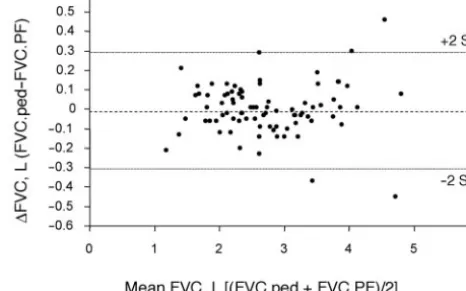
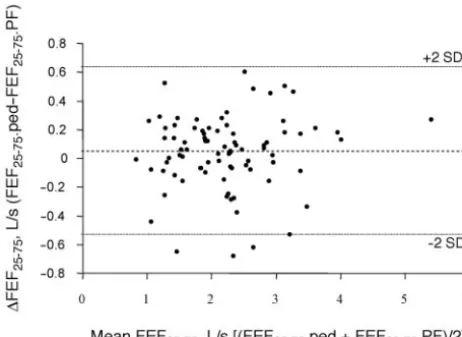
obtained from each patient in the pediatric practice and in the laboratory was expressed using ICC, which is an estimate of the correlation between 2 measurements from 1 patient. We found very high values of ICC for the spirometric parameters that were measured in the pediatric practice and in the laboratory (Table 4). Figures 1, 2, and 3 show a curve-by-curve comparison of the differences be-tween the 2 locations versus the mean for each of the key parameters (FVC, FEV1, and FEF25–75) according
to the Bland and Altman method. There was a good agreement between the pediatrician’s office and the laboratory’s spirometric tests for all 3 parameters. The repeatability coefficient was 0.26 L for FEV1
(with 83 of 85 values falling within this range), 0.30 L for FVC (with 81 values falling within this range), and 0.58 L/s for FEF25–75 (with 82 values falling within this range). The scatter of the ⌬FEV1,⌬FVC,
Fig 1. Differences in FEV1between pediatrician’s office (ped) and PF laboratory spirometry plotted against mean FEV1values. The dashed horizontal lines indicate the limits of agreement (mean difference⫾1.96 times the SD of the differences).
TABLE 3. Spirometry Quality Assurance Data
No. of tests (total) 109
Acceptable tests 85
Unacceptable tests 24
Slow start 8
Expiratory time⬍2 s 7
Abrupt end 3
Tests not reproducible 6
TABLE 4. FVC, FEV1, and FEF25–75Values (Median and IQR) Measured in the Pediatric Practices and in the Laboratory and ICCs Calculated Between the Two Measurements
Spirometric Parameter
Pediatrician’s Office PF Laboratory ICC
and ⌬FEF25–75 values did not vary systematically
over the range of measurements.
Interpretation of the Spirometric Test Results
The pediatrician’s interpretation was judged to be incorrect in 23 (21%) of 109 patients’ tests. The inter-pretation errors are given in Table 5. In 15 cases, the test result was interpreted as normal, when it actu-ally revealed mild obstruction in 11 cases and vol-ume restriction in 4. In another 3 patients, the ob-struction was underestimated, and in the last 5 cases, the obstruction was overestimated.
Comparison Between the Spirometric Tests That Were Performed at the PF Laboratory With the Portable and the Laboratory-Based Volume Spirometers
Matched pairs of spirometric tests that were per-formed in the PF laboratory with the portable and the laboratory-based volume spirometers were avail-able for 55 patients. There was good agreement be-tween the 2 spirometers for all 3 main spirometric parameters (FVC, FEV1, and FEF25–75). The
repeat-ability coefficient was 0.14 L for FEV1(with 53 of 55
values falling within this range), 0.18 L for FVC (with 52 values falling within this range), and 0.55 L/s for FEF25–75(with 54 values falling within this range).
DISCUSSION
This is the first study to address formally the qual-ity of spirometry that is performed in primary care pediatricians’ offices after a training program. The results of this study indicate that, on average, the quality of spirometric tests in primary care pediatric practice is satisfactory by comparison with a spiro-metric test performed in a PF laboratory, but 22% of the tests that were performed by the former were unacceptable, and 21% of them were misinterpreted. Laboratory-based spirometry is the “gold stan-dard” for assessing lung function in children with asthma, but the costs of the technician and equip-ment led to peak flowmeters’ often being used in-stead for office and home monitoring of lung func-tion in children. Although peak expiratory flow monitoring and asthma diaries are useful tools in selected patients, there are major limitations to their widespread use in children with asthma.25,26
Porta-ble spirometers are now availaPorta-ble with the capability for collecting a wide range of PF parameters that are clinically and epidemiologically more useful than peak expiratory flow, because they are more sensi-tive to functional status changes in asthma.16,18
The validity of spirometric tests is a prerequisite for their use as a tool for the diagnosis, monitoring, and management of respiratory diseases. Little is known about the validity of spirometric tests in adult patients in the primary care setting, however, and it has been reported that at least one third of the tests that are performed by the general practitioner (GP) fail to meet the quality criteria that are applicable to PF laboratories.20,27
The validity of spirometric tests that are per-formed in general practice was investigated recently by Schermer et al15by comparing them with the tests
that are performed in patients with chronic obstruc-tive pulmonary disease using the same spirometer at a PF laboratory. After a spirometry training pro-gram, the authors found the validity and the quality of the spirometric tests that were conducted by the GPs satisfactory, but the consistency between the laboratory’s and the GP’s measurements seemed to be limited. No studies have hitherto formally ad-dressed spirometry performance in primary care pe-diatric practice.
Fig 2. Differences in FVC between pediatrician’s office (ped) and PF laboratory spirometry plotted against mean FVC values. The dashed horizontal lines indicate the limits of agreement (mean difference⫾1.96 times the SD of the differences).
Fig 3. Differences in FEF25–75between pediatrician’s office (ped) and PF laboratory spirometry plotted against mean FEF25–75 val-ues. The dashed horizontal lines indicate the limits of agreement (mean difference⫾1.96 times the SD of the differences).
TABLE 5. Spirometry Interpretation Errors
Cases,
n
Pediatricians’ Interpretation Correct Interpretation
11 Normal Mild obstruction
4 Normal Restrictive
2 Mild obstruction Moderate obstruction 1 Moderate obstruction Moderate to severe
obstruction 2 Moderate obstruction Mild obstruction
2 Mild obstruction Normal
1 Moderate to severe obstruction
Although seemingly straightforward, spirometry is an effort-dependent test that requires a coopera-tive patient and a trained operator to administer the test. We used a spirometer with built-in quality as-surance prompts on the assumption that this would improve the quality of the spirometry, but 22% of the tests nonetheless failed to meet the acceptability and reproducibility criteria. Most of the errors were at-tributable to slow start or short blow.
In our study, the children were instructed to ex-hale for as long as they could, and a FETⱖ2 seconds was considered valid. The ATS standards recom-mend an expiratory time of ⱖ6 seconds in adult patients,21 but, recognizing that children have
diffi-culty in meeting such end-of-test criteria, they say that shorter exhalation times are acceptable in chil-dren. Assuming that the flow-volume curve shows no abrupt termination of expiratory flow and that the volume/time curve shows a plateau, it has been suggested that the minimum FET should be reduced to 2 seconds for children who areⱖ8 years and to 1 second for children who are younger than 8 years.22
Other researchers suggested taking 3 seconds28 or 4
seconds29as the target exhalation times.
A previous study in adult patients with chronic obstructive pulmonary disease demonstrated a slight but significant difference between the spirometric indexes that were measured by the GP’s staff and those that were measured at a PF laboratory, sug-gesting that an interchangeable use of these measure-ments should be avoided.15We found no difference
in FVC, FEV1, and FEF25–75 between the
pediatri-cian’s and the PF laboratory’s results of tests that were performed with the portable spirometer. In ad-dition, we demonstrated that the portable spirometer that we used provides an accurate and reliable mea-sure of PF when compared with a gold-standard laboratory-based device, as shown by the consis-tency that emerged between the 2 spirometers across the key spirometric parameters.
Although we primarily addressed the quality of the test’s performance, the pediatricians’ interpreta-tion of the results was incorrect in 21% of the cases reviewed. In many cases, this misinterpretation in-volved the failure to detect or an underestimation of airway obstruction, so any clinical decisions that are based on these results would compound, rather than reduce, the underdiagnosis and undertreatment of asthma. Accurate interpretation relies not only on a well-performed procedure but also on an apprecia-tion of physiology and a thorough clinical knowl-edge of the patient. Of course, longer, more intensive training might have produced better results in terms of the interpretation of the findings.
Proper training for the technician/physician who performs the test is perhaps the most important fac-tor in ensuring good-quality spirometric testing.20,30
As stated in 1991 by the ATS,23 the largest single
source of within-subject variability is improper per-formance of spirometry; therefore, effective training and quality assurance are vital prerequisites for suc-cessful spirometry. After adequate training, it is also important to have continual competence assessments and to review the test results carefully. It has been
demonstrated that, even in a dedicated research set-ting paying meticulous attention to quality, a techni-cian’s performance declines over time, but the qual-ity of spirometry can improve dramatically and be maintained by routinely monitoring test session quality and prompting individual feedback.31,32
In both the United States and Europe, there are accredited training centers for pediatric respiratory medicine with modules on PF testing. Because effec-tive training and quality assurance are vital prereq-uisites for successful spirometry, we believe that only approved training centers for pediatric respira-tory medicine should certify that a primary care pe-diatrician has acquired the competence for perform-ing and interpretperform-ing a spirometric test.
In conclusion, with sufficient training for the phy-sicians and their staff, it seems justifiable to perform spirometry in the pediatric primary care setting. This could improve asthma monitoring in children, as recommended by the international guidelines.1 If
spirometry is to be promoted as a screening tool in primary care practice, however, then it is important to pay careful attention to ensuring that quality stan-dards are met. To achieve this goal, an integrated approach is recommended, involving both the pri-mary care pediatrician and the certified pediatric respiratory medicine centers.
ACKNOWLEDGMENTS
This study was supported in part by Valeas SpA, Milano, Italy. Members of the Working Group: Franco Balliana, MD‡; Euge-nio Baraldi, MD*; Gianfranco Battaglini, MD‡; Raffaele Braga§; Armando Cirillo, MD‡; Annamaria De Marchi, MD‡; Mattia Doria, MD‡; Mario Fama, MD‡; Giorgio Meneghelli, MD‡; Angela Pasinato, MD‡; Andrea Passarella, MD‡; Flavio Semenzato, MD‡; and Stefania Zanconato, MD, PhD*.
We thank Dr Silvia Carraro for valued help with statistical analysis.
REFERENCES
1. Global Initiative for Asthma.Global Strategy for Asthma Management and Prevention. Bethesda, MD: National Institutes of Health, National Heart, Lung, and Blood Institute; 2002 [Publication No. NIH-NHLI 02–3659] 2. Horak E, Grassi G, Skadal D, Ulmer H. Lung function and symptom
perception in children with asthma and their parents.Pediatr Pulmonol.
2003;35:23–28
3. Baker RR, Mishoe SC, Zaitoun FH, et al. Poor perception of airway obstruction in children with asthma.J Asthma.2000;37:613– 624 4. Rietveld S, Everaerd W. Perception of asthma by adolescents at home.
Chest.2000;117:434 – 439
5. Shim CS, Williams MH Jr. Evaluation of the severity of asthma: patients versus physicians.Am J Med.1980;68:11–13
6. Fuhlbrigge AL, Kitch BT, Paltiel AD, et al. FEV1is associated with risk of asthma attacks in a pediatric population.J Allergy Clin Immunol.
2001;107:61– 67
7. Kitch BT, Paltiel AD, Kuntz KM, et al. A single measure of FEV1is associated with risk of asthma attacks in long-term follow-up.Chest.
2004;126:1875–1882
8. Brand PLP, Roorda RJ. Usefulness of monitoring lung function in asthma.Arch Dis Child.2003;88:1021–1025
9. Ulrik CS, Backer V. Nonreversible airflow obstruction in life-long non-smokers with moderate to severe asthma.Eur Respir J.1999;14:892– 896 10. Roorda RJ, Gerritsen J, van Aalderen WM, et al. Follow-up of asthma from childhood to adulthood: influence of potential childhood risk factors on the outcome of pulmonary function and bronchial respon-siveness in adulthood.J Allergy Clin Immunol.1994;93:575–584 11. Rabe KF, Vermeire PA, Soriano JB, Maier WC. Clinical management of
12. Ferguson GT, Enright PL, Buist AS, Higgins MW. Office spirometry for lung health assessment in adults. A consensus statement from the National Lung Health Education Program.Chest.2000;117:1146 –1161 13. Van den Boom G, van Schayck CP, van Molken MP, et al. Active
detection of chronic obstructive pulmonary disease and asthma in the general population. Results and economic consequences of the DIMCA program.Am J Respir Crit Care Med.1998;158:1730 –1738
14. Pinnock H, Carley-Smith J, Kalideen D. Spirometry in primary care: an analysis of the first 100 patients referred in one general practice.Asthma Gen Pract.1999;7:23–24
15. Schermer TR, Jacobs JE, Chavannes NH, et al. Validity of spirometric testing in a general practice population of patients with chronic obstruc-tive pulmonary disease (COPD).Thorax.2003;58:861– 866
16. Mortimer KM, Fallot A, Balmes JR, Tager IB. Evaluating the use of a portable spirometer in a study of pediatric asthma.Chest.2003;123: 1899 –1907
17. Buffels J, Degryse J, Heyrman J, Decramer M. Office spirometry signif-icantly improves early detection of COPD in general practice. The DIDASCO Study.Chest.2004;125:1394 –1399
18. Wensley DC, Silverman M. The quality of home spirometry in school children with asthma.Thorax.2001;56:183–185
19. Zach MS. Long Range Planning Committee, Paediatric Assembly of the European Respiratory Society, Committee on Paediatric Respiratory Training in Europe, European Board of Paediatrics. Paediatric respira-tory training in Europe: syllabus and centres.Eur Respir J. 2002;20: 1587–1593
20. Eaton T, Withy S, Garrett JE, et al. Spirometry in primary care practice. The importance of quality assurance and the impact of spirometry workshops.Chest.1999;116:416 – 423
21. American Thoracic Society. Standardization of spirometry. 1994 Up-date.Am J Crit Care Med.1995;152:1107–1136
22. Arets HGM, Brackel HJL, Van der Ent CK. Forced expiratory manoeu-vres in children: do they meet ATS and ERS criteria for spirometry?Eur Respir J.2001;18:655– 660
23. American Thoracic Society. Lung function testing: selection of reference values and intepretative strategies. Am Rev Respir Dis. 1991;144: 1202–1218
24. Bland JM, Altman DG. Statistical methods for assessing agreement between two methods of clinical measurement.Lancet.1986;1:307–310 25. Eid N, Yandell B, Howell L, et al. Can peak expiratory flow predict
airflow obstruction in children with asthma? Pediatrics. 2000;105: 354 –358
26. Kamps AW, Roorda RJ, Brand PL. Peak flow diaries in childhood asthma are unreliable.Thorax.2001;56:180 –182
27. Ponsioen BP, Bohnen AM, Martha I, et al. Measurement of FEV1and FVC with a hand held spirometer by GPs: feasibility and validity.
Primary Care Respir J.2000;11:68 – 69
28. Desmond KJ, Allen PD, Demizio DL, et al. Redefining end of test (EOT) criteria for pulmonary function testing in children.Am J Respir Crit Care Med.1997;156:542–545
29. Enright PL, Linn WS, Avol EL, et al. Quality of spirometry test perfor-mance in children and adolescents. Experience in a large field study.
Chest.2000;118:665– 671
30. Wanger J, Irvin CG. Office spirometry: equipment selection and training of staff in the private practice setting.J Asthma.1997;34:93–104 31. Enright PL, Johnson LJ, Connett JE, et al. Spirometry in the Lung Health
Study: 1. Methods and quality control.Am Rev Respir Dis.1991;143: 1215–1223
DOI: 10.1542/peds.2005-0487
2005;116;e792
Pediatrics
Eugenio Baraldi
Stefania Zanconato, Giorgio Meneghelli, Raffaele Braga, Franco Zacchello and
Office Spirometry in Primary Care Pediatrics: A Pilot Study
Services
Updated Information &
http://pediatrics.aappublications.org/content/116/6/e792
including high resolution figures, can be found at:
References
http://pediatrics.aappublications.org/content/116/6/e792#BIBL
This article cites 31 articles, 9 of which you can access for free at:
Subspecialty Collections
http://www.aappublications.org/cgi/collection/pulmonology_sub
Pulmonology
g_-_development_sub
http://www.aappublications.org/cgi/collection/practice-based_learnin
Practice-Based Learning & Development
ub
http://www.aappublications.org/cgi/collection/career_development_s
Career Development following collection(s):
This article, along with others on similar topics, appears in the
Permissions & Licensing
http://www.aappublications.org/site/misc/Permissions.xhtml
in its entirety can be found online at:
Information about reproducing this article in parts (figures, tables) or
Reprints
http://www.aappublications.org/site/misc/reprints.xhtml
DOI: 10.1542/peds.2005-0487
2005;116;e792
Pediatrics
Eugenio Baraldi
Stefania Zanconato, Giorgio Meneghelli, Raffaele Braga, Franco Zacchello and
Office Spirometry in Primary Care Pediatrics: A Pilot Study
http://pediatrics.aappublications.org/content/116/6/e792
located on the World Wide Web at:
The online version of this article, along with updated information and services, is
by the American Academy of Pediatrics. All rights reserved. Print ISSN: 1073-0397.