221 COMPUTERIZATION OF LIBRARY SERVICES IN ANAMBRA STATE: CHALLENGES AND
PROSPECTS
OBIADAZIE, REGINA EYIUCHE Chukwuemeka Odumegwu Ojukwu University.
Anambra State, Nigeria. +2347037452622
Email: [email protected],
&
NWANKWO, NDIDI GRACE CLN Chukwuemeka Odumegwu Ojukwu University
Anambra State, Nigeria. +2348061586058 Email: [email protected],
&
ANENE, IFEANYI ADINDU University of Nigeria Nsukka,
Enugu State, Nigeria. +23470521514143
Email: [email protected]
Abstract
This research investigated the extent to which libraries in Anambra State computerize their services and the challenges hindering the computerization of library services in the State. They population is made up of 208 librarians (49 males and 159 females) in the 16 libraries in Anambra State. There was no sampling. Two research questions and two null hypotheses guided the study. A questionnaire titled “Challenges in the Computerization of Library Services in Anambra State (CCLSAS)”was developed by the researcher, validated by experts and used for data collection. The reliability of the instrument was determined using test re-test method. Data collected were analyzed using mean and standard deviation while the null hypotheses were tested at 0.05 level of significance. The findings revealed among others that there were WWW and internet services in the libraries for users. It also revealed the challenges hindering computerization of library services to include lack of reliable source of power supply in the library; no air-conditioned rooms for ICT facilities; librarians have little knowledge and skill of ICT, etc. It was recommended among others that government should provide ICT infrastructures such as reliable LAN and WAN in schools and librarians should be properly trained.
222 Introduction
One of the basic needs of man is to communicate ideas, knowledge, facts and feelings. This resulted in pictographic writing, drawing and invention of languages to facilitate storage, transfer, communication and publication of information and human knowledge across boundaries. The innate ability of man to communicate, store, and use knowledge has made him distinct from other creatures. More so, their research findings are cumulative in nature; they can be utilized to manage problems from one generation to another through storage in the library.
Library is an organization that accommodate both simple and sophisticated information infrastructure that yields all forms of information across the globe for education and entertainment. It consists of written, printed and graphic materials including films, slides, and photographic records and tapes etc. housed in organized order and interpreted to meet broad and varying needs of users such as information, knowledge, recreation and aesthetic enjoyment etc. (Ezekwe & Muokebe, 2012). Hence, the library and information centers took up the responsibility of identifying, securing, storing, interpreting and disseminating information contained in diverse materials for maximum use. However, any part of the school where educational resources (like books, periodicals, magazines, newspapers, films, videotapes, slides, computers, study kits, etc.) are housed for use by teachers and students for research, learning, recreational activities, personal interest and interpersonal relationship of children in the school is called the school library. Library attached to tertiary institutions such as universities, polytechnics, and colleges of education, agriculture, technology and also research institutions is sometimes called academic library (Akporhonor, 2005). Generally, libraries contain an organized carefully selected collection of books and non-book materials managed by librarians who interpret the content of the materials in the process of use. These ranges of information resources are necessary to enable the school library fulfill its functions which include systematic provision of information resources required for different educational programmes and assistance in improving and increasing research, reading skills and learning habits of students (Ezekwe & Muokebe, 2012).
The best legacy that any society can have is library stocked with library resources. Again, any educational institution without an academic library does not worth its salt because it is one of the important facility which must be put in place before programmes are accredited in educational institutions. Preservation and access to knowledge and information is the main aim of the library together with support for teaching and learning mission of the institutions (Singh & Kaur, 2009). Academic libraries are at the forefront of providing information services to their respective communities (which is comprised of students, lecturers and researchers) in order to support their teaching, learning and research needs. Many a time, academic library also known as school library are referred to as the heart or nerve center of the institutions of higher learning (Abubakar, 2011) because a well-organized library system have a good choice of library services that recognize: the needs of the society, their stages of development, and a better means of making research findings, knowledge and information nearer to the people.
223 in form of activities that create awareness of certain products and services and ensure their maximum use by library users to meet their information needs (Chiparausha & Josiline, 2019).
Computerization of library services is one major way of bringing library and information resources to the doorstep of teachers, students and researchers anytime, anywhere. The emergence of information and communication technology (ICT) in education has transformed teaching and learning including library services into a more viable interactive activity (Iloeje, 2002). Teaching and learning process have been changed from being teacher centered to learner centered with more interactive non-linear approaches like projectors, slides, computer animation, simulation, hypertext, hypermedia/multimedia, optical disc, satellite cable, online information and material resources and other computer-based learning approaches (Kolo, 2008). ICT is helping in making information to be in a relatively computerized format which is the standard for all electronic resources (like online journals, magazines, textbooks, databases, optical disc, CD-ROM, etc.) in this age of globalization. ICT helps in: making small portion of the information resources to be on paper while others are paperless; providing unlimited access to electronic information resources in a menu driven interactive mode that is cost effective as well as providing equal access to national and international library resources all over the world 24/7 using digital technology.
Nevertheless, Adekanye (2011) noted that library needs a system beyond the card catalogue that would provide multiple access to textbooks, pamphlets, microforms, reprints, periodical articles, chapters in books, annual reports and other publications. A system that would ensure fast and more reliable acquisition, cataloguing, serial control; circulation and access to information from various offices in the school, more efficient pre-order checking; record keeping of correspondences, speedy and reliable serial tracking and control process; consistent organization of library materials through controlled description, fast production of shelf lists and appropriate collection guides; adequate, easy and fast access to the library resources; current awareness services including selective dissemination of information, and circulation operations.
Furthermore, Okon (2005) revealed that the rapid pace of development in the field of information technology and the advent of networked information services have prompted a comprehensive review of the library and information science profession. The global trend is a fundamental shift from traditional information environment to e-environment with emphasis on the acquisition of e-resources such as e-books, e-journals as well as online databases, although, Abubakar (2011) advised that traditional library and information services with their functions are still relevant. Again, Kumar (2009) noted that academic libraries are changing dramatically by adopting new means of technology in all their activities, replacing different manual methods with computerized systems and providing opportunities for online access. Libraries are now improving in providing users with different ICT for retrieving information from databases, creating library co-operation as well as consortium initiatives (Okiy, 2005). Moreover, some libraries offer their library services using a software package in a modular system (e.g. ALICE) designed by database experts and professional librarians (also conformed to international cataloguing standard) with unique features for corporate and special libraries as well as academic/school libraries. This type of services are affordable, scalable and usable on a standalone machine or over a WAN. However, all library staff must be trained on their usage to ensure effective implementation of the computerization process.
224 retrospective conversion of bibliographic records in a way that allows access to bibliographic records of books through the Web OPAC. It requires the database of books available in the library to be updated on daily bases with details of recently acquired books. The editing and updating activities must be in progress regularly. For instance, the library should have an in-house bibliographic computerized databases on different areas such as database on forestry literature, horticulture, agriculture and forestry research information; database on MSc and PhD thesis, books, and serial holdings, etc.
However, some of the services of a computerized library system includes: provision of several kinds of information on the library homepages such as information about the library, catalogue, electronic resources, online information services and related links etc.; provision of catalogue module for entering all catalogue data; provision of CD-ROMs, internet and World Wide Web services; provision of electronic publications; inter-library loan services; audiovisual and multimedia reading rooms as well as electronic reading rooms with computers to access the resources. These will provide students with opportunities to work with word processing or use internet related services (e.g. e-mail) on the computers. Some other gains of computerized library services according to Ayofe and Lawal (2010) include: no physical boundary; round the clock availability of resources; multiple access to a particular book; structured approach to information search; quick information retrieval; preservation and conservation; unlimited space; networking with other institutions at reduced cost of usage, etc. The library as the key factor in building an informed society will equip learners with appropriate skills and techniques necessary for effective and efficient utilization of different library resources for societal change and national transformation.
However, different libraries in Nigeria are trying their best to catch up with their counterpart in the developed world. Computerization of library services in Nigeria have been in pipeline since 1970’s although concerted efforts began in late 1990s. Major efforts initially made were challenged with lack of fund and expertise. More so, the Federal Government of Nigeria through the National University Commission (NUC) that supervises all the universities in Nigeria introduced projects that aimed at computerizing university services across the country including their library services. They initiated Management Information System (MIS) and started the Nigerian Universities Network (NUNET) project. NUNET was aimed at developing a viable Local Area Network (LAN) and Wide Area Network (WAN) in each institution. This was followed by National Virtual Library project also aimed at providing equal, cost effective, and enhanced access to national and international library and information resources to users all over the world. Moreover, Nok (2006) noted that the Federal Government few years ago came up with a policy on computerization of academic libraries. The policy made provision for university libraries to be linked with other renowned academic libraries across the globe to provide unlimited access to print and electronic materials. According to Nok (2006), no much efforts were made towards making the computerization process a reality in Nigerian Universities including their library services. Reasons for the delay were again lack of fund and trained manpower such as librarians with knowledge and skill of ICT.
225 trained. More so, inquisitive users with IT skills cause serious dissatisfaction to the library staff (Bii and Wangama, 2001). Frequent power outages constitute a serious bottle neck to automation. There are lots of spoilt and obsolete equipment due to no technical expert, lack of fund and poor maintenance culture in Nigerian education system. Many academic libraries in Nigeria have not initiated viable income generating strategies to supplement government funding. Staff training and re-training have not also been given proper attention in Nigeria resulting in setback in the computerization process. For libraries in Anambra State to fully computerize their library services, they must overcome these challenges and have a system with fast data entry, retrieval and inquiry of the databases. Nok (2006) advised that proper and regular in-house IT training is a necessity to gain the benefits of computerization. Ogunsola (2004) suggested that government and agencies should provide the needed financial support. Abubakar (2011) added improvement in ICT such as internet, intranet, hardware and software including internet bandwidth; and training of librarians.
Statement of the Problem
Libraries in Anambra State are making efforts (such as providing ICT gadgets, internet services, etc.) towards computerizing their library services. This computerization process require resources such as librarians with knowledge and skill of ICT, reliable source of power supply; adequate number of ICT gadgets; reliable LAN and WAN; regular training of librarians; skilled technicians for repair and maintenance of ICT gadgets; software engineers to develop the needed software; fund for library management and maintenance, etc. However, these libraries in the course of this computerization process encounter a lot of challenges but the extent to which the encounter these challenges have not been determined. It is against this background that this research sought to determine the extent to which libraries in Anambra State computerize their services and the challenges hindering computerization of library services in Anambra State.
Research questions
1. To what extent do libraries in Anambra State computerize their services?
2. What are the challenges hindering computerization of library services in Anambra State?
Testing of Hypothesis
The following hypothesis is tested at 0.05 level of significance
Ho1: There is no significant difference between the mean and standard deviation responses of male and
female librarians with regard to the extent to which libraries in Anambra State computerize their services.
Ho2: There is no significant difference between the mean and standard deviation responses of male and
female librarians with regards to the challenges hindering computerization of library services in Anambra State.
Methodology
226 type scale of strongly agree (SA), agree (A), disagree (D) and strongly disagree (SD). The responses were weighted as follows; SA = 4, A = 3, D = 2, SD = 1. The validity of the instrument was established by three experts: one in Measurement and Evaluation; two in library information science, all in Chukwuemeka Odumegwu Ojukwu University, Anambra State. Their suggestions were incorporated in the final draft of the questionnaire. The reliability of the instrument was determined using test re-test method. The first and second scores generated were correlated using Pearson-product moment correlation co-efficient to obtain a value of 0.78. The researcher appointed and trained three research assistants who helped to administer the instrument on the respondents and collected same from them. Data collected were analyzed using mean and standard deviation. Any score from 2.50 and above was adjudged to be acceptable while scores below 2.50 were regarded as non- acceptable. The two null hypothesis were tested at 0.05 level of significance using t-test statistics.
Result
Research question one
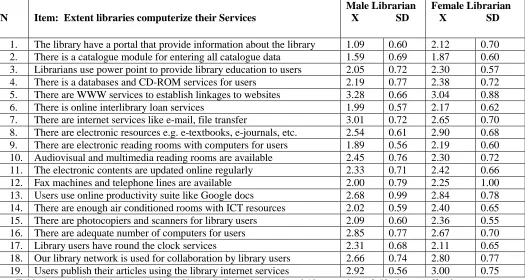
To what extent do libraries in Anambra State computerize their services?
Table 1: Mean and Standard Deviation of Respondents on the extent to which Libraries in Anambra State Computerize their Services
S/N Item: Extent libraries computerize their Services
Male Librarian X SD
Female Librarian X SD
1. The library have a portal that provide information about the library 1.09 0.60 2.12 0.70 2. There is a catalogue module for entering all catalogue data 1.59 0.69 1.87 0.60 3. Librarians use power point to provide library education to users 2.05 0.72 2.30 0.57 4. There is a databases and CD-ROM services for users 2.19 0.77 2.38 0.72 5. There are WWW services to establish linkages to websites 3.28 0.66 3.04 0.88 6. There is online interlibrary loan services 1.99 0.57 2.17 0.62 7. There are internet services like e-mail, file transfer 3.01 0.72 2.65 0.70 8. There are electronic resources e.g. e-textbooks, e-journals, etc. 2.54 0.61 2.90 0.68 9. There are electronic reading rooms with computers for users 1.89 0.56 2.19 0.60 10. Audiovisual and multimedia reading rooms are available 2.45 0.76 2.30 0.72 11. The electronic contents are updated online regularly 2.33 0.71 2.42 0.66 12. Fax machines and telephone lines are available 2.00 0.79 2.25 1.00 13. Users use online productivity suite like Google docs 2.68 0.99 2.84 0.78 14. There are enough air conditioned rooms with ICT resources 2.02 0.59 2.40 0.65 15. There are photocopiers and scanners for library users 2.09 0.60 2.36 0.55 16. There are adequate number of computers for users 2.85 0.77 2.67 0.70 17. Library users have round the clock services 2.31 0.68 2.11 0.65 18. Our library network is used for collaboration by library users 2.66 0.74 2.80 0.77 19. Users publish their articles using the library internet services 2.92 0.56 3.00 0.75
227 Research question two
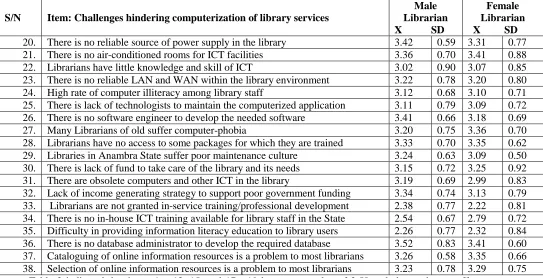
What are the challenges hindering computerization of library services in Anambra State?
Table 2: Mean and Standard Deviation of Respondents on the Challenges hindering Computerization of Library Services in Anambra State
S/N Item: Challenges hindering computerization of library services
Male Librarian X SD
Female Librarian X SD 20. There is no reliable source of power supply in the library 3.42 0.59 3.31 0.77 21. There is no air-conditioned rooms for ICT facilities 3.36 0.70 3.41 0.88 22. Librarians have little knowledge and skill of ICT 3.02 0.90 3.07 0.85 23. There is no reliable LAN and WAN within the library environment 3.22 0.78 3.20 0.80 24. High rate of computer illiteracy among library staff 3.12 0.68 3.10 0.71 25. There is lack of technologists to maintain the computerized application 3.11 0.79 3.09 0.72 26. There is no software engineer to develop the needed software 3.41 0.66 3.18 0.69 27. Many Librarians of old suffer computer-phobia 3.20 0.75 3.36 0.70 28. Librarians have no access to some packages for which they are trained 3.33 0.70 3.35 0.62 29. Libraries in Anambra State suffer poor maintenance culture 3.24 0.63 3.09 0.50 30. There is lack of fund to take care of the library and its needs 3.15 0.72 3.25 0.92 31. There are obsolete computers and other ICT in the library 3.19 0.69 2.99 0.83 32. Lack of income generating strategy to support poor government funding 3.34 0.74 3.13 0.79 33. Librarians are not granted in-service training/professional development 2.38 0.77 2.22 0.81 34. There is no in-house ICT training available for library staff in the State 2.54 0.67 2.79 0.72 35. Difficulty in providing information literacy education to library users 2.26 0.77 2.32 0.84 36. There is no database administrator to develop the required database 3.52 0.83 3.41 0.60 37. Cataloguing of online information resources is a problem to most librarians 3.26 0.58 3.35 0.66 38. Selection of online information resources is a problem to most librarians 3.23 0.78 3.29 0.75
Table 2 indicated that items 1 – 13, 15, and 17 - 19 have mean value of 2.50 and above, the cut-off score. Therefore, they are acceptable by the respondents as the challenges hindering computerization of library services in Anambra State. However, items 14 and 16 have mean score below the interion of 2.50. They are not acceptable by the respondents as the challenges hindering computerization of library services in Anambra State.
Table 3: t-test Statistic on the Mean and Standard Deviation scores of Male and Female Librarians with regards to the extent to which Libraries in Anambra State computerize their services
Variables N X SD DF t-cal t-crit Decision
Male Librarians 49 2.31 0.69
206 1.5915 1.960 HO1 is accepted
Female Librarians 159 2.46 0.70
228 Table 4: t-test Statistic on the Mean and Standard Deviation scores of Male and Female Librarians with regards to the challenges hindering computerization of library services in Anambra State
Variables N X SD DF t-cal t-crit Decision
Male Librarians 49 3.12 0.72
206 0.1685 1.960 HO1 is accepted
Female Librarians 159 3.10 0.75
The t-test presented in table 4 revealed that the t-calculated value for the mean scores of male and female librarians on the challenges hindering computerization of library services is 0.1685. At 206 degree of freedom, the table value is 1.960. Since the t-cal is less than the t-crit, the null hypothesis is therefore accepted. This indicates that there is no significant difference between the mean and standard deviation scores of male and female librarians with regards to the challenges hindering computerization of library services in Anambra State.
Discussion of Findings
Table 1 revealed the extent to which libraries in Anambra State computerize their services to include that there were WWW and internet services in the library e.gs e-mail, file transfer; electronic resources e.g. e-textbooks, e-journals, etc.; users use online productivity suite like Google docs; there are adequate number of computers and its accessories for users; they library network can be used for collaboration; and users can publish their articles using the library internet services. It also revealed that libraries in Anambra State do not have a portal that provide information about the library, catalogue module for entering all catalogue data as well as database and CD-ROM services for users. The librarians do not use power point to provide library education to users. There is no online interlibrary loan services; no electronic reading rooms with computers to access the resources; no audiovisual and multimedia reading rooms; electronic contents are not updated online regularly; Fax machines and telephone lines are not available; there are inadequate number of air conditioned rooms with ICT resources, photocopiers and scanners for library users; and users do not have round the clock services. This affirmed the findings of Adekanye (2011) who stated that libraries in the state have not succeeded in its effort to join the league of automated libraries in the country, only little has been done in the computerization of library services in various States and community libraries. More so, researches such as Wombob and Abba, (2008), Fatoki (2005), and Etim (2006) reported that recent efforts made by academic libraries in adopting ICT such as internet and WWW for improved library services have not yielded much fruits due to some challenges like epileptic power supply, poor network backbone, etc; however, very little success has been achieved, but a lot still needs to be done. They system still need to fully integrate OPAC, catalogue, circulation, acquisition, serial tracking and records so that they can be searched at the same time.
229 observed challenges like lack of fund, information resources, reliable LAN in the universities, poor acquisition, selection, and cataloguing of online information resources, inability to develop the required databases. Nok also observed that many staff of the university libraries are not computer literate as such they find it difficult to cope with the requirements of the electronic age. However, Nok (2006) found providing information literacy education to library users as a challenge but this study did not see it as a challenge in the computerization of library services in Anambra state. Ogunsola (2004) also found challenges such as shortage of manpower, lack of fund, spare parts, constant computer breakdown and low level of electricity supply in universities. Abubakar (2011) added that most university library in Nigeria are constrained by poor internet services, lack of hardware and software; and non- availability of ICTs in the library.
Recommendations
It was recommended based on the findings that:
1. Governments should assist in the provision of ICT infrastructures such as reliable LAN and WAN, internet services, etc. needed in the computerization process.
2. Libraries should devise alternative means of getting fund and sensitize the citizens on the gains of computerized system to motivate them into directing funds to the library
3. Librarians should avail themselves for in-service training and professional development programmes especially in the use of ICT.
4. Library users such as teachers, students and researchers should be trained on the skills needed to successfully access information in a computerized library.
5. Government should employ skilled technologists and software engineers to help in the construction, maintenance, and upgrading of the needed databases.
Conclusions
230 REFERENCES
Abubakar, B.M. (2011). Academic Libraries in Nigeria in the 21st Century. Library Philosophy and Practice
2011. ISSN 1522 – 0222. Retrieved on 18/02/2015 from http://www.webpages.uidaho.edu/|mbolin/abubakar.htm
Adekanye, E. A. (2011). Computerization of FatiuAdwmolaAkesode Library, Lagos State University.Library, Philosophy and Practice 2011. Retrieved on 18/02/2015 from http://www.webpages.uidaho.edu/|mbolin/adekanye.htm
Ayofe, A. N. &Lawal, W. O. (2010). Towards a secured Digitalized Library: Challenges, Solution and Implementation. Asian Journal of Information Technology, 9(6), 266 – 291.
Akporhonor, B. A. (2005). Library Funding in Nigeria: Past, Present and Future. The Bottom Line: Managing Library Finances, 18(2), 68 – 70.
Arua, U. (2011). Use of Library Resources by Staff and Students of Secondary Schools in Umuahia North Local Government Area of Abia State.Library Philosophy and Practice Retrieved on 9/03/2014 from http://www.readperiodicals.com/201102/2296746261.htm
Bii, H. K. &Wanyama, P. (2001).Automation and its Impact on the Job Satisfaction among the staff of the Margaret Thatcher Library.Moi University - Library Management, 22(6/7), 303 – 310.
Ezekwe, F. A. &Muokebe, B. O. (2012).Introductory Studies in the Use of the Library and Information Technology. Enugu: RhyceKerex Publishers.
Iloeje, M. U. (2002). The Challenges, Innovation in Technology Pose to Libraries and Librarians. Paper Delivered at the plenary Session of the NLA 39th National Conference and AGM Newsletter: A
Biannual Publication NLA, 13(1)
Chiparausha, B. & Josiline, P. C. (2019). Promoting library services in a digital environment in Zimbabwe. In P. Ngulube (ed.) Handbook of Research on Advocacy, Promotion, and Public Programming for Memory Institutions, 284 – 296, accessed 21st March, 2019. DOI: 10.4018/078-1-5225-7429=3.ch015
Kolo, M.(2008). The Role of women librarians in information and communication technology and National development.Journal of Women in Colleges of Education (JOWICE). 2(2), 92 – 94
Kumar, M.(2009). Academic Libraries in Electronic Environment paradigm shift. A Paper Presented at the International Conference on Academic Libraries (ICAL) held at the University, Delhi, India, 105 Nok, G. (2006). The Challenges of Computerizing a University Library in Nigeria: The Case of Kashim Ibrahim
Library Ahmadu Bello University Zaria. Library Philosophy and Practice,8(2). Retrieved on 9/11/2014 from http://www.webpages.uidaho.edu/|mbolin/nok.htm
Okiy, R. B. (2005). Funding Nigerian Libraries in the 21st Century: will funding from alternative source suffice?
The Bottom Line: Managing Library Finances, 18(2), 71 – 77.
Okon, H. I. (2005). Effective Communication and smooth Administration of Academic Libraries in the 21st
Century: A new Paradigm in Nigeria. Library Philosophy and Practice, 8(1).
Ogunsola, L. A. (2004). Nigerian University Libraries and the Challenges of Globalization: the Way Forward. Electronic Journal of Academic and Special Librarianship, 5(2-3). Retrieved on 18/02/2015 from http://southernlibrarianship.icaap.org/content/vo5no2/ogunsola-101.htm.
Singh, J. &Kaur, T. (2009). Future of Academic Libraries in India: Challenges and Opportunities. A Paper Presented at the International Conference on Academic Libraries (ICAL) held at the University, Delhi, India.