RESEARCH
The development of an herbal material
quality control strategy considering the effects
of manufacturing processes
Jingjing Pan
1†, Siyuan He
1†, Jiayao Zheng
1, Jingyuan Shao
1, Ning Li
2, Yunqi Gong
2and Xingchu Gong
1*Abstract
Background: Quality by design (QbD) is an advanced drug quality control concept that has been gradually imple-mented in the optimization of manufacturing processes of Chinese medicines. However, the variation of Chinese medicinal material quality has rarely been considered in published works. Because manufacturing processes may lower the variation introduced through different batches of materials, a material quality control strategy should be developed considering the influences of manufacturing processes.
Methods: In this work, the processes of extraction, concentration, water precipitation, and chromatography for notoginseng total saponin (NTS) production were investigated while considering Panax notoginseng quality variation as a sample. Ten process parameters were studied simultaneously using a definitive screening design. After the pro-cess critical quality attributes (CQAs) were determined, critical propro-cess parameters (CPPs) and critical material attrib-utes (CMAs) were identified simultaneously. Then, models utilizing the CMAs, CPPs, and process CQAs were devel-oped. The design space was then calculated using a Monte Carlo simulation method with an acceptable probability of 0.90. A material quality control strategy considering the influences of manufacturing processes was proposed. Results: The ginsenoside Rd purity and total saponin purity in the eluate were identified as process CQAs. The etha-nol solution concentration used for extraction, the ethaetha-nol solution concentration used for elution, and elution time were identified as CPPs. The extractable dry matter content of Panax notoginseng was one of the CMAs. The extract-able contents of notoginsenoside R1, ginsenoside Rg1, ginsenoside Rb1, and ginsenoside Rd were the other CMAs.
The inequalities implemented to discriminate the high quality and low quality of Panax notoginseng were developed according to the NTS standard of the Xuesaitong injection. Low quality Panax notoginseng should not be released for NTS production. High quality Panax notoginseng can be treated with feasible manufacturing processing parameters. Verification experiments were carried out successfully for 2 batches of high quality Panax notoginseng.
Conclusions: In this work, a quality control strategy for herbal materials was developed considering the matching of process characteristics and material quality attributes. This strategy is promising for application to other Chinese medicines.
Keywords: Quality by design, Definitive screening design, Panax notoginseng, Quality control strategy
© The Author(s) 2019. This article is distributed under the terms of the Creative Commons Attribution 4.0 International License (http://creativecommons.org/licenses/by/4.0/), which permits unrestricted use, distribution, and reproduction in any medium, provided you give appropriate credit to the original author(s) and the source, provide a link to the Creative Commons license, and indicate if changes were made. The Creative Commons Public Domain Dedication waiver (http://creativecommons.org/ publicdomain/zero/1.0/) applies to the data made available in this article, unless otherwise stated.
Open Access
*Correspondence: [email protected]
Background
Quality by design (QbD) is an advanced drug quality con-trol concept systematically described in Dr. Yu’s work [1]. Knowledge-based management and risk-based manage-ment are required in the application of the QbD concept [2]. Recently, the QbD concept was successfully imple-mented in the optimization of manufacturing processes of Chinese medicines [3] such as extraction [4], precipita-tion [5], chromatography [6], decoloration [7], drying [8, 9], granulation [10], and so on.
In these works, critical process parameters (CPPs) were identified by risk analysis or statistical analysis [11]. The relationships among CPPs, critical material attributes (CMAs), and process critical quality attributes (CQAs) were investigated using response surface designs [12], such as central composite design or Box-Behnken design. After data collection, quadratic models were usually built [13]. The design space was then calculated with the over-lapping method or methods considering the probability to meet all process CQA limits [14]. A control strategy for process parameters was developed, such as the rec-ommendation of normal operation ranges of CPPs [15] and the feedforward control of CPPs [16]. However, the control strategy of material was rarely considered.
The variation of material attributes was considered to be the main source of drug quality variance for Chi-nese medicines [17]. A set of proper manufacturing pro-cesses of Chinese medicines may reduce the variations introduced by materials. Therefore, the development of a material quality control strategy should consider the influences of manufacturing processes.
Wang et al. used central composite circumscribed design to simultaneously study the influences of materi-als and process parameters [18]. However, the variety of raw materials was very limited. Ye et al. used fixed pro-cess parameters to treat different batches of Salvia milti-orrhiza to obtain the disodium salt of Salvianolic acid B [19]. The quality standards of water extracts, which were the upstream intermediate, were set to ensure high purity Salvianolic acid B salt preparation [19]. However, the standards of Salvia miltiorrhiza were not developed. Therefore, a new method to develop a material control strategy that considers the effects of manufacturing pro-cesses is still highly required.
Notoginseng total saponins (NTS), the material in the Xuesaitong injection, is a kind of herbal extract made from Panax notoginseng [20–22]. It is prepared with extraction, concentration, water precipitation, chroma-tography, decoloration, and drying [23, 24]. In this work, extractable saponin content and extractable dry matter content were considered as potential CMAs of Panax notoginseng. Definitive screening design was used to investigate the four processes of extraction, concentration,
water precipitation, and chromatography simultaneously. Different materials were used in the experiments. After process CQAs were determined, CPPs and CMAs were identified simultaneously. Then, models implementing CMAs, CPPs, and process CQAs were developed. The design space was then calculated. A material control strat-egy considering the matching of manufacturing processes and materials was proposed. High quality and low quality
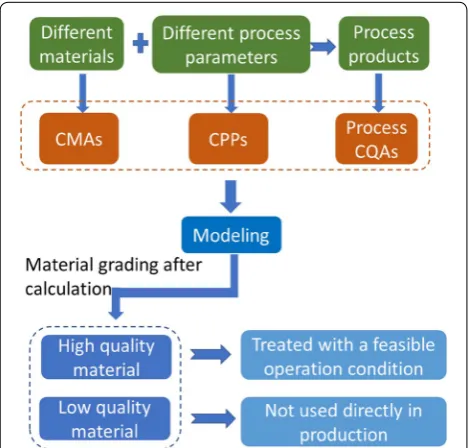
Panax notoginseng can be discriminated by inequalities and can thus be processed differently. Verification experi-ments were carried out for high quality Panax notogin-seng. Figure 1 is a schematic diagram of the development of the material control strategy.
Methods
Materials and chemicals
Twenty batches of Panax notoginseng were collected from Yunnan Province of China. HPD-100 resin was purchased from Cangzhou Bon Adsorber Technology Co., Ltd. (Cangzhou, China). Reference substances of notoginsenoside R1, ginsenoside Rg1, ginsenoside Re, gin-senoside Rb1, and ginsenoside Rd were purchased from Shanghai Winherb Medical Technology Co., Ltd. (Shang-hai, China). Acetonitrile (HPLC grade) was purchased from Merck (Darmstadt, Germany). Deionized water was prepared by an academic water purification system (Milli-Q, Milford, MA, USA). Ethanol (analytical grade) was purchased from Shanghai Lingfeng Chemical Rea-gent Co., Ltd. (Shanghai, China), and Sinophram Chemi-cal Reagent Co., Ltd. (Shanghai, China).
Procedures
Quality characterization of Panax notoginseng
To characterize the material attributes, 100 g of Panax notoginseng was pulverized and reflux-extracted with 600 mL of an 80% (v/v) ethanol solution twice. The extraction time of each extraction was 6 h. The two extracts were obtained by filtration and then combined. Then, the concentrations of saponins and dry matter in the combined extract were analyzed. The extractable dry matter content (EDMPN) of Panax notoginseng was defined as Eq. 1.
where M and DM refer to the mass and dry matter con-centration, respectively; the subscripts EX and PN refer to the combined extracts and Panax notoginseng, respec-tively. The extractable saponin content (ESPN) of Panax
notoginseng was defined as Eq. 2.
where SC refers to the saponin content; the subscript i where i is an integer value from 1 to 5 represents notogin-senoside R1, ginsenoside Rg1, ginsenoside Re, ginsenoside Rb1, and ginsenoside Rd, respectively. The extractable dry matter content and extractable saponin content were considered as potential CMAs of Panax notoginseng in this work.
Extraction, concentration, and water precipitation processes
Panax notoginseng (100 g) was pulverized and reflux-extracted with an ethanol solution twice. After extraction, the extracts were filtered and combined. The extracts were then concentrated under reduced pressure. The vol-ume of concentrated extracts was controlled. Then, water
(1)
EDMPN = MEX×DMEX
MPN
(2) ESPN,i=
MEX×SCEX,i
MPN
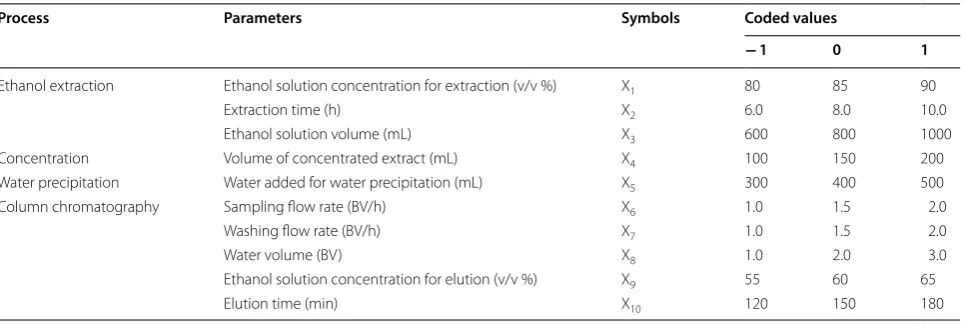
was added to the concentrated extracts under magnetic stirring (85-1, Hangzhou Instrument Motor Co. Ltd., China). The mixtures were settled at room temperature for 1 h after stirring for 10 min. The supernatants of the water precipitation samples were collected by vacuum filtration. The five parameters of the ethanol solution concentration used for extraction, extraction time, etha-nol solution volume, volume of concentrated extract, and water addition amount for water precipitation were investigated. Their coded and uncoded levels in the experiments are listed in Table 1.
Column chromatography process
A chromatography column was filled with 720 mL of HPD-100 microporous resin. The inner diameter of the column was 6 cm. Supernatants collected after water precipitation were passed through the column. A defined volume of water was then used to wash the col-umn. After that, a volume of ethanol solution was used to elute the saponins. The elution flow rate was fixed at 1.0 BV/h. The eluate was collected for 30 min during elu-tion in all experiments. The resin was regenerated with a 90% (v/v) ethanol solution at a flowrate of 1.5 BV/h for 80 min and then with water at 2 BV/h for 1.5 h. In the chromatography process, the five parameters of the sam-pling flow rate, washing flow rate, water volume, ethanol solution concentration used for elution, and elution time were investigated. Their coded and uncoded levels in the experiments can be seen in Table 1.
Experimental design
In this work, a total of 10 parameters belonging to the 4 different processes of reflux extraction, concentra-tion, water precipitaconcentra-tion, and column chromatography were investigated simultaneously. To reduce the num-ber of experiments, definitive screening design was
Table 1 Coded and uncoded values of parameters
Process Parameters Symbols Coded values
− 1 0 1
Ethanol extraction Ethanol solution concentration for extraction (v/v %) X1 80 85 90
Extraction time (h) X2 6.0 8.0 10.0
Ethanol solution volume (mL) X3 600 800 1000
Concentration Volume of concentrated extract (mL) X4 100 150 200
Water precipitation Water added for water precipitation (mL) X5 300 400 500
Column chromatography Sampling flow rate (BV/h) X6 1.0 1.5 2.0
Washing flow rate (BV/h) X7 1.0 1.5 2.0
Water volume (BV) X8 1.0 2.0 3.0
Ethanol solution concentration for elution (v/v %) X9 55 60 65
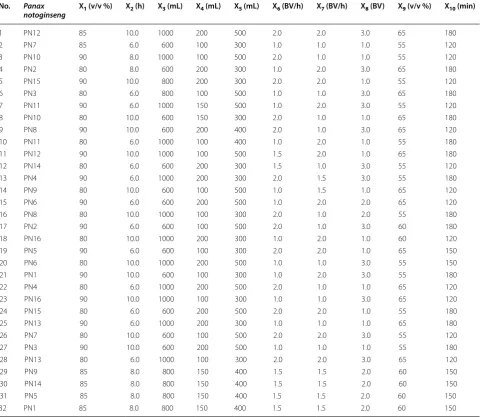
used to investigate the influences of these manufactur-ing process parameters. Quadratic models can also be developed based on the definitive screening designed experiment results [25]. Many process parameters can also be studied in a very small number of experiments [25]. The experimental conditions are listed in Table 2. To study the effects of raw materials, different batches of Panax notoginseng were used in these experiments, as shown in Table 2.
Analytical methods
Dry matter content was measured using a precision electronic balance (AB204-N, Mettler Toledo Shanghai Co., Ltd). The samples were dried at 105 °C in an oven (DZF-6050, Shanghai Jing Hong Laboratory Instrument
Co., Ltd.) for 3 h and then kept in a desiccator for 0.5 h. The quantitative analysis method for the determination of the saponin concentrations was reported in previ-ous work [26]. The method was performed on a Waters Acquity UPLC system (Waters, Milford, MA, USA) using a Waters CSH C18 column (50 mm × 2.1 mm i.d., 1.7 μm) at 40 °C. The mobile phase consisted of 0.01% formic acid–water (A) and 0.01% formic acid–acetoni-trile (B) using the following gradient program: 0–6 min, 18–20% B; 6–6.8 min, 20–30% B; 6.8–11 min, 30–35% B; 11–17 min, 35–90% B; and 17–25 min, 90% B. The flowrate was 0.35 mL/min, and the volume of the sample injection was 5 μL. The detector wavelength was set to 203 nm.
Table 2 Conditions of definitive screening designed experiments
No. Panax
notoginseng X1 (v/v %) X2 (h) X3 (mL) X4 (mL) X5 (mL) X6 (BV/h) X7 (BV/h) X8 (BV) X9 (v/v %) X10 (min)
1 PN12 85 10.0 1000 200 500 2.0 2.0 3.0 65 180
2 PN7 85 6.0 600 100 300 1.0 1.0 1.0 55 120
3 PN10 90 8.0 1000 100 500 2.0 1.0 1.0 55 120
4 PN2 80 8.0 600 200 300 1.0 2.0 3.0 65 180
5 PN15 90 10.0 800 200 300 2.0 2.0 1.0 55 120
6 PN3 80 6.0 800 100 500 1.0 1.0 3.0 65 180
7 PN11 90 6.0 1000 150 500 1.0 2.0 3.0 55 120
8 PN10 80 10.0 600 150 300 2.0 1.0 1.0 65 180
9 PN8 90 10.0 600 200 400 2.0 1.0 3.0 65 120
10 PN11 80 6.0 1000 100 400 1.0 2.0 1.0 55 180
11 PN12 90 10.0 1000 100 500 1.5 2.0 1.0 65 180
12 PN14 80 6.0 600 200 300 1.5 1.0 3.0 55 120
13 PN4 90 6.0 1000 200 300 2.0 1.5 3.0 55 180
14 PN9 80 10.0 600 100 500 1.0 1.5 1.0 65 120
15 PN6 90 6.0 600 200 500 1.0 2.0 2.0 65 120
16 PN8 80 10.0 1000 100 300 2.0 1.0 2.0 55 180
17 PN2 90 6.0 600 100 500 2.0 1.0 3.0 60 180
18 PN16 80 10.0 1000 200 300 1.0 2.0 1.0 60 120
19 PN5 90 6.0 600 100 300 2.0 2.0 1.0 65 150
20 PN6 80 10.0 1000 200 500 1.0 1.0 3.0 55 150
21 PN1 90 10.0 600 100 300 1.0 2.0 3.0 55 180
22 PN4 80 6.0 1000 200 500 2.0 1.0 1.0 65 120
23 PN16 90 10.0 1000 100 300 1.0 1.0 3.0 65 120
24 PN15 80 6.0 600 200 500 2.0 2.0 1.0 55 180
25 PN13 90 6.0 1000 200 300 1.0 1.0 1.0 65 180
26 PN7 80 10.0 600 100 500 2.0 2.0 3.0 55 120
27 PN3 90 10.0 600 200 500 1.0 1.0 1.0 55 180
28 PN13 80 6.0 1000 100 300 2.0 2.0 3.0 65 120
29 PN9 85 8.0 800 150 400 1.5 1.5 2.0 60 150
30 PN14 85 8.0 800 150 400 1.5 1.5 2.0 60 150
31 PN5 85 8.0 800 150 400 1.5 1.5 2.0 60 150
Data processing
The total saponin concentration (TSC) value in the extract or eluate was calculated with Eq. 3.
The total saponin yield (TSY) was defined as Eq. (4).
where the subscript EL refers to the eluate.
Dry matter yield (DMY) was calculated with Eq. (5).
Saponin purity (SP) values were calculated using Eq. 6.
The total saponin purity (TSP) value in the eluate was calculated with Eq. 7.
Design expert V8.0.6.1 (State-Ease Inc. MN) was used to analyze the results of the definitive screening designed experiments. To identify CPPs and CMAs, Eq. (8) was used to model process parameters, quality attributes of
Panax notoginseng, and process CQAs.
where Y is a process CQA, Xi (i = 1–10) represents a pro-cess parameter, Zk (k = 1–6) represents a material attrib-ute, a0 is a constant, and bi (i = 1–10) and ck (k = 1–6) are regression coefficients. Stepwise regression was used to simplify the models. Insignificant variables were removed by stepwise regression. The significance levels for add-ing terms and removadd-ing terms were both set to 0.05. Any term remaining in the model was considered to represent a CPP or a CMA.
Then, CPPs’ interactive sand square terms were added to establish predictive models for process CQAs, as seen in Eq. (9).
(3)
TSC=
5
i=1
SCi
(4)
TSY = MEL×TSCEL
MPN
(5)
DMY = MEL×DMCEL
MPN
(6)
SPi= CEL,i DMEL ×100% (7) TSP= 5 i=1 SPi (8) Y =a0+
11
i=1
biXi+
7
k=1
ckZk
(9)
Y=a0+
n
i=1 biXi+
n
i=1 biiXi2+
n−1
i=1
n
j=i+1 bijXiXj+
m
k=1 ckZk
where n is the number of CPPs and m is the number of CMAs. Stepwise regression was also performed as men-tioned above.
A Monte Carlo method simulating the random error of experimental values was performed to calculate the design space. The detailed calculation processes are described in previous work [27]. A brief description is given as follows: the experimental results were assumed to be normally distributed. The mean value of the normal distribution was assumed to be the measured response value. The relative standard deviation (RSD) of the nor-mal distribution was fixed at 0.04. Random values rep-resenting experimental values were then created by the Monte Carlo simulation according to the normal dis-tribution. These random values were modeled by Eq. 9. After each simulation, a new equation for a process CQA was obtained. The new equations developed from the Monte Carlo simulation values were used to calculate the predicted results. The probability of meeting all pro-cess CQA goals was then calculated based on the model prediction results. The design space was defined with a probability higher than 0.90. The simulation was per-formed 1000 times to obtain a probability-based design space. All calculations were carried out using MATLAB (R2016a, Version 9.0, The Math Works Inc., USA).
Results
Material attributes
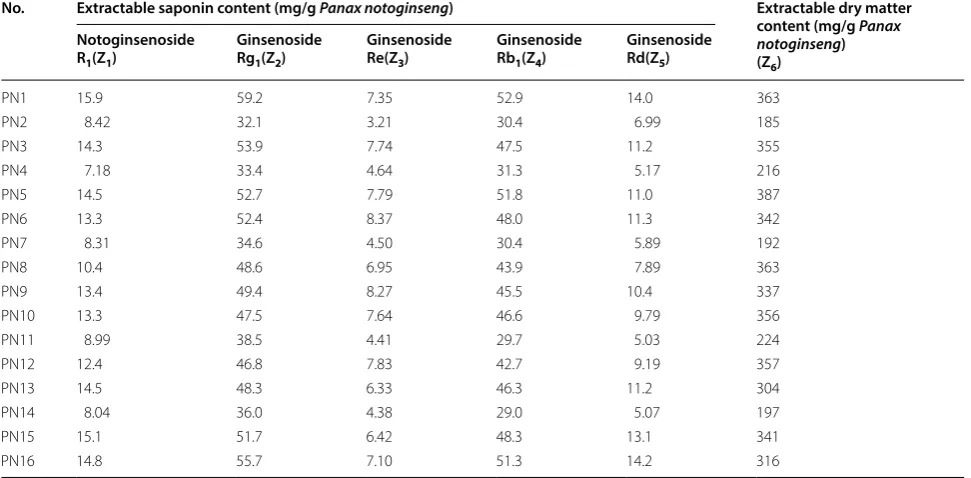
The quality attributes of different Panax notoginseng
batches are shown in Table 3. For the extractable saponin contents, the ginsenoside Rg1 content was the highest, and the ginsenoside Re content was the lowest. For most materials, more than 100 mg/g Panax notoginseng of sap-onins can be extracted. The extractable dry matter con-tents were between 185 and 387 mg/g Panax notoginseng.
Process CQA identification
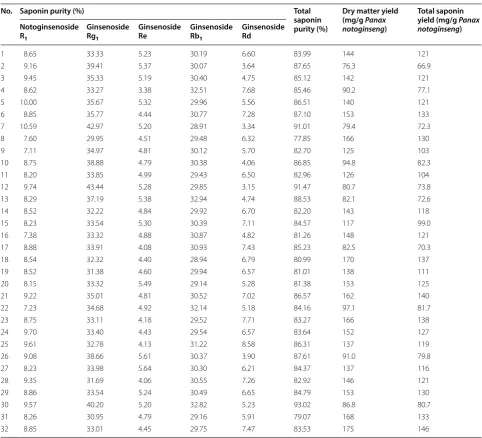
After analyzing the eluates collected after column chro-matography, the process quality attributes were calcu-lated and were determined to be saponin purities, total saponin yield, and dry matter yield in the eluates. As shown in Table 4, the total saponin yield in the eluate was between 66.9 and 146 mg/g Panax notoginseng. Due to the removal of impurities, the dry matter yield was between 76.3 and 175 mg/g Panax notoginseng, which was significantly lower than the extractable dry matter of corresponding materials. Total saponin purity increased significantly to between 77.85 and 91.02%. The purity of ginsenoside Rd was between 3.15 and 8.58%.
composition of the process product. Therefore, saponin purity was considered a potential process for CQAs.
In the quality standards of the Xuesaitong injection, the purity of notoginsenoside R1, ginsenoside Rg1, ginsenoside Re, and ginsenoside Rb1 in the NTS should not be lower than 6%, 28%, 2.5%, and 26%, respectively. In Table 4, the minimum purities of the above four saponins were 7.11%, 29.95%, 3.38%, and 28.91%, respectively. This means that these four process quality attributes easily attained their standards. Therefore, they were not considered as process CQAs. However, the minimum obtained Rd purity and total saponin purity were lower than that of their standards and were 3.5% and 85%, respectively. Therefore, Rd purity and total saponin purity were used as process CQAs.
The identification of CMAs and CPPs
The linear regression results of Eq. 8 and the correspond-ing ANOVA results are shown in Table 5. The P value of each model was lower than 0.0001, indicating that the models were significant. The determination coefficients (R2) of all the models were higher than 0.70, which indi-cated that most of the data variances can be explained. It also indicated that the major influencing factors were probably included in the models. According to the P val-ues, the ethanol solution concentration used for extrac-tion, the ethanol solution concentration used for eluextrac-tion, and elution time were selected as CPPs. The extractable contents of notoginsenoside R1, ginsenoside Rg1, gin-senoside Rb1, and ginsenoside Rd of Panax notoginseng
were CMAs. The extractable dry matter content of Panax notoginseng was also a CMA.
The effects of CMAs and CPPs
Compared with Eq. 8, the nonlinear effects and interac-tion effects of CPPs were considered in Eq. 9, which was evaluated in this work. However, after stepwise regres-sion, the terms representing nonlinear effects and inter-action effects were all taken out of the models. This result indicated that only linear effects of CPPs were significant.
According to the regression coefficient values in Table 5, higher ethanol concentrations in the extrac-tion process resulted in higher ginsenoside Rd purity and total saponin purity. As the ethanol solution concentration used for elution and the elution time increased, the ginsenoside Rd purity increased. For CMAs, higher ginsenoside Rd and lower extractable dry matter content both led to a higher ginsenoside Rd purity in the eluate. Higher notoginsenoside R1, higher ginsenoside Rg1, and lower ginsenoside Rb1 purities all resulted in a higher purity of total saponins.
Design space development
The lower limits of Rd purity and total saponin purity were set according to the NTS standards of the Xue-saitong injection, which were 3.5% and 85%, respec-tively. Then, the design space was calculated, as shown
Table 3 Quality attributes of different batches of Panax notoginseng
No. Extractable saponin content (mg/g Panax notoginseng) Extractable dry matter content (mg/g Panax
notoginseng)
(Z6)
Notoginsenoside R1(Z1)
Ginsenoside Rg1(Z2)
Ginsenoside Re(Z3)
Ginsenoside Rb1(Z4)
Ginsenoside Rd(Z5)
PN1 15.9 59.2 7.35 52.9 14.0 363
PN2 8.42 32.1 3.21 30.4 6.99 185
PN3 14.3 53.9 7.74 47.5 11.2 355
PN4 7.18 33.4 4.64 31.3 5.17 216
PN5 14.5 52.7 7.79 51.8 11.0 387
PN6 13.3 52.4 8.37 48.0 11.3 342
PN7 8.31 34.6 4.50 30.4 5.89 192
PN8 10.4 48.6 6.95 43.9 7.89 363
PN9 13.4 49.4 8.27 45.5 10.4 337
PN10 13.3 47.5 7.64 46.6 9.79 356
PN11 8.99 38.5 4.41 29.7 5.03 224
PN12 12.4 46.8 7.83 42.7 9.19 357
PN13 14.5 48.3 6.33 46.3 11.2 304
PN14 8.04 36.0 4.38 29.0 5.07 197
PN15 15.1 51.7 6.42 48.3 13.1 341
in Fig. 2a and Additional file 1: Table S1. The design space was an irregular region.
Control strategy of Panax notoginseng
To prepare satisfactory eluates, Inequalities 1 should be satisfied for Rd purity and total saponin purity.
where superscript 1 and 2 refer to Rd purity and total saponin purity, respectively. The values of regression coefficients in Inequalities 1 can be found in Table 5. In
(1)
b11X1+b9X91 +b110X10+c15Z5+c16Z6+a10≥3.5%
b21X1+c 2 1Z1+c
2 2Z2+c
2 4Z4+a
2
0≥85.0%
principle, different batches of Panax notoginseng can be divided into two grades according to Inequalities 1. If the CMAs of a batch of Panax notoginseng meet Inequali-ties 1, the batch of Panax notoginseng is considered to be acceptable material if the process parameters can be varied within the investigated ranges. In contrast, if Ine-qualities 1 is unattainable, the batch of Panax notoginseng
is considered to be unacceptable and cannot be released for NTS production. For a batch of acceptable Panax notoginseng, feasible process parameters can be cho-sen after calculation or selected from Additional file 1: Table S1.
Table 4 The quality attributes of the manufacturing processes
No. Saponin purity (%) Total
saponin purity (%)
Dry matter yield (mg/g Panax
notoginseng)
Total saponin yield (mg/g Panax
notoginseng)
Notoginsenoside R1
Ginsenoside Rg1
Ginsenoside
Re GinsenosideRb1
Ginsenoside Rd
1 8.65 33.33 5.23 30.19 6.60 83.99 144 121
2 9.16 39.41 5.37 30.07 3.64 87.65 76.3 66.9
3 9.45 35.33 5.19 30.40 4.75 85.12 142 121
4 8.62 33.27 3.38 32.51 7.68 85.46 90.2 77.1
5 10.00 35.67 5.32 29.96 5.56 86.51 140 121
6 8.85 35.77 4.44 30.77 7.28 87.10 153 133
7 10.59 42.97 5.20 28.91 3.34 91.01 79.4 72.3
8 7.60 29.95 4.51 29.48 6.32 77.85 166 130
9 7.11 34.97 4.81 30.12 5.70 82.70 125 103
10 8.75 38.88 4.79 30.38 4.06 86.85 94.8 82.3
11 8.20 33.85 4.99 29.43 6.50 82.96 126 104
12 9.74 43.44 5.28 29.85 3.15 91.47 80.7 73.8
13 8.29 37.19 5.38 32.94 4.74 88.53 82.1 72.6
14 8.52 32.22 4.84 29.92 6.70 82.20 143 118
15 8.23 33.54 5.30 30.39 7.11 84.57 117 99.0
16 7.38 33.32 4.88 30.87 4.82 81.26 148 121
17 8.88 33.91 4.08 30.93 7.43 85.23 82.5 70.3
18 8.54 32.32 4.40 28.94 6.79 80.99 170 137
19 8.52 31.38 4.60 29.94 6.57 81.01 138 111
20 8.15 33.32 5.49 29.14 5.28 81.38 153 125
21 9.22 35.01 4.81 30.52 7.02 86.57 162 140
22 7.23 34.68 4.92 32.14 5.18 84.16 97.1 81.7
23 8.75 33.11 4.18 29.52 7.71 83.27 166 138
24 9.70 33.40 4.43 29.54 6.57 83.64 152 127
25 9.61 32.78 4.13 31.22 8.58 86.31 137 119
26 9.08 38.66 5.61 30.37 3.90 87.61 91.0 79.8
27 8.23 33.98 5.64 30.30 6.21 84.37 137 116
28 9.35 31.69 4.06 30.55 7.26 82.92 146 121
29 8.86 33.54 5.24 30.49 6.65 84.79 153 130
30 9.57 40.20 5.20 32.82 5.23 93.02 86.8 80.7
31 8.26 30.95 4.79 29.16 5.91 79.07 168 133
However, in the current traditional Chinese medicine TCM industry, raw materials are usually treated with a set of fixed manufacturing process parameters because of the limitation of regulations. In this case, the quality control of raw material should be stricter.
For example, the manufacturing process parameters were fixed as follows: the ethanol solution concentration for extraction was 88%, the extraction time was 6 h, the etha-nol solution addition was 6.72 mL/g Panax notoginseng, the volume of concentrated extract was 1.31 mL/g Panax notoginseng, and the water addition for water precipitation was 3.73 mL/g Panax notoginseng. The sampling flow rate was 1.7 BV/h, the washing sampling flow rate was 1.8 BV/h, the washing volume was 2.0 BV, the ethanol solution con-centration for elution was 56%, and the elution time was 133 min.
Inequalities 1 can then be simplified to Inequalities 2.
Then, Inequalities 2 can be used to divide different batches of Panax notoginseng into two grades. A batch of Panax notoginseng with CMAs meeting Inequalities 2, this batch of Panax notoginseng is considered to be high quality material for the current parameter fixing process. If a batch of Panax notoginseng with CMAs does not meet Inequalities 2, it is considered a low-quality mate-rial and should not be released for NTS production.
(2)
397
Z5−8.61Z6+730≥0
10.3Z1+5.291Z2−11.1Z4+108.3≥0
Table 5 Regression coefficients, R2 values and ANOVA results for the multiple linear regression models
* p < 0.05 ** p < 0.01
Process
parameters Y1(Rd purity) Ypurity)2(Total saponin Coefficient p value Coefficient p value
Constant − 0.12 0.76
X1 3.382 × 10⁻⁴ 0.0394* 2.203 × 10−3 0.0056** X9 1.824 × 10⁻³ < 0.0001**
X10 1.869 × 10⁻⁴ < 0.0001**
Z1 0.0103 0.0143*
Z2 5.291 × 10⁻³ 0.0023**
Z4 − 0.0111 < 0.0001**
Z5 3.971 × 10⁻³ < 0.0001** Z6 − 8.607 × 10⁻⁵ < 0.0001**
Model p value < 0.0001 < 0.0001
R2 0.9348 0.7460
R2adj 0.9223 0.7083
Examples of material quality control and verification experiments
The CMAs of 4 batches of Panax notoginseng were meas-ured and are shown in Table 6. According to Inequalities (1), Panax notoginseng of PN17 and PN19 were low qual-ity Panax notoginseng, and they should not be directly used in production. However, PN17 and PN19 were probably qualified materials because their saponin con-tents met the standards in Chinese Pharmacopeia (1st Section, 2015 Edition). If they were qualified materials, they can also be used in the existing manufacturing pro-cesses after proper mixing with other qualified batches of
Panax notoginseng to form a new batch.
PN18 and PN20 were high quality Panax notoginseng
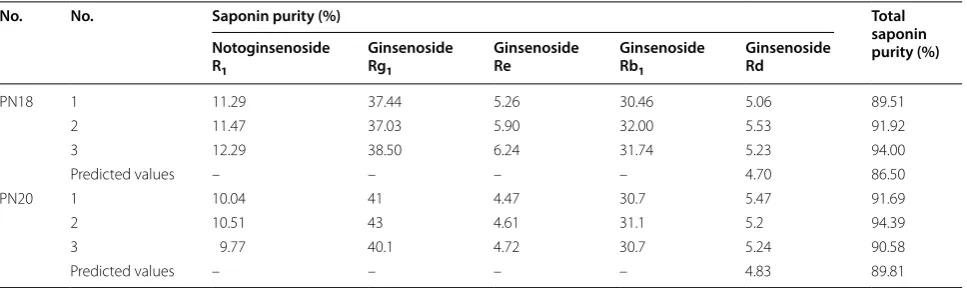
batches. The verification experiment conditions were as follows: for PN18, the fixed process parameters men-tioned in “Control strategy of Panax notoginseng” section were used. For PN 20, the ethanol concentration was 90% (v/v), the extraction time was 10 h, the ethanol solution addition was 6.0 mL/g Panax notoginseng, the volume of the concentrate was 1.5 mL/g Panax notoginseng, the water addition for water precipitation was 3 mL/g Panax notoginseng, the sampling flow rate was 1.0 BV/h, the water volume was 1 BV, the ethanol solution concentra-tion for eluconcentra-tion was 60% (v/v), and the eluconcentra-tion time was 120 min. The results are listed in Table 7. All the indices met the standards of NTS of the Xuesaitong injection.
The prediction results were close to the experimental results, indicating that the models were accurate.
Discussion
The selection of potential CMAs
Potential CMAs can be physical, chemical, and biologi-cal features of Panax notoginseng. Considering that NTS is mainly composed of five saponins, their contents in Panax notoginseng should be potential CMAs. The method to analyze saponin contents in Panax notogin-seng can be found in Chinese Pharmacopeia (1st Section, 2015 Edition) and other publications [28–30]. Panax notoginseng needs to be pulverized into a powder and extracted with methanol or a methanol solution in these works. However, Panax notoginseng will not be pulver-ized as finely in industry processes. The extraction sol-vent is an ethanol solution instead of a methanol solution. This means that the saponins extracted in an industrial process may be less than that in an analytical laboratory for the same material. Therefore, extractable saponin content was used in this work as a potential CMA.
In addition to the abovementioned five saponins, there are many other components in Panax notoginseng. How-ever, only the components that can be extracted by the ethanol solution may affect the composition of NTS. Therefore, extractable dry matter was used as another potential CMA in this work. The usage of extractable dry
Table 6 Material attributes of Panax notoginseng
Notoginsenoside R1(Z1)
Ginsenoside Rg1(Z2)
Ginsenoside Rb1(Z4)
Ginsenoside Rd(Z5)
PN17 6.55 37.1 35.9 7.19 242 Low quality
PN18 8.05 38.7 34.0 7.41 241 High quality
PN19 8.67 51.6 46.8 7.42 312 Low quality
PN20 9.09 38.7 32.3 6.43 227 High quality
Table 7 Results of verification experiments
No. No. Saponin purity (%) Total
saponin purity (%) Notoginsenoside
R1
Ginsenoside Rg1
Ginsenoside
Re GinsenosideRb1
Ginsenoside Rd
PN18 1 11.29 37.44 5.26 30.46 5.06 89.51
2 11.47 37.03 5.90 32.00 5.53 91.92
3 12.29 38.50 6.24 31.74 5.23 94.00
Predicted values – – – – 4.70 86.50
PN20 1 10.04 41 4.47 30.7 5.47 91.69
2 10.51 43 4.61 31.1 5.2 94.39
3 9.77 40.1 4.72 30.7 5.24 90.58
matter also avoided the difficulties in measuring low con-tent components in Panax notoginseng. Extractable dry matter and extractable saponin content were measured after extraction experiments with conditions similar to industrial conditions.
The reduction of CPP number
In this work, three CPPs were identified for four pro-cesses: the ethanol solution concentration used for extraction, the ethanol solution concentration used for elution, and the elution time. If these processes were studied separately, as in previous works [6, 13, 31, 32], there were more than 10 CPPs. These results indicated that CPP number can be reduced if several processes are studied simultaneously. A lower CPP number means that the design of the process control strategy can be simpli-fied. There is no CPP in water precipitation and concen-tration, which means that these processes are not critical processes. This conclusion also agreed well with Zhong et al.’s work [33] and He’s work [34].
The relationship of material control strategy and regulations
In the current industry, manufacturing process param-eters are fixed despite the variation of herbal material quality on most occasions. However, in principle, process parameters can vary within their ranges declared by drug regulatory authorities. However, if the declared ranges of manufacturing process parameters are very narrow, the variation of process parameters will be difficult. Although the application for changing a manufacturing process is an option, the cost for Type II and Type III change is usually not economically feasible. Therefore, strict con-trol of the quality of medicinal materials becomes the better option. An example of determining material qual-ity standards for the parameter fixing process is given in “Control strategy of Panax notoginseng” section.
The disadvantages of the present method
Equation 9 was used to model CMAs, CPPs, and pro-cess CQAs [35]. However, the interaction between CMAs and CPPs was not considered. The nonlinear effects of CMAs were also ignored. After stepwise regression, the interaction between CPPs was not found. A main reason is that the experimental number was not large enough after using the current experi-mental design.
Extractable dry matter content and five extract-able saponin contents were considered potential CMAs. However, some CMAs may be missing. Although dif-ferent batches of Panax notoginseng were used, the
representativeness of material quality may still be insufficient.
Conclusion
In this work, the manufacturing processes of extraction, concentration, water precipitation, and chromatography for NTS production were studied with the considera-tion of Panax notoginseng quality variation. A definitive screening design was used for the study of 10 process parameters. Different materials were used in the experi-ments. Extractable saponin contents and extractable dry matter content were considered potential CMAs. The purity of ginsenoside Rd and the purity of total saponins were selected as process CQAs. The ethanol solution concentration used for extraction, the ethanol solution concentration used for elution, and elution time were selected as CPPs. Extractable dry matter content and extractable contents of notoginsenoside R1, ginsenoside Rg1, ginsenoside Rb1, and ginsenoside Rd were CMAs. Quantitative models of CPPs, CMAs, and process CQAs were obtained. The design space was then calculated using a Monte Carlo simulation method with an accept-able probability of 0.90. High quality and low quality
Panax notoginseng can be discriminated with Inequalities 1. Low quality Panax notoginseng should not be directly used in production. High-quality Panax notoginseng can be treated with feasible process parameters. Verifica-tion experiments were carried out for high quality Panax notoginseng. The prediction results agreed well with the experimental results, indicating that the models were accurate. In this work, a quality control strategy of raw
Panax notoginseng material was developed considering the matching of manufacturing process characteristics and material quality attributes. A similar strategy can also be applied to other Chinese medicines.
Supplementary information
Supplementary information accompanies this paper at https ://doi. org/10.1186/s1302 0-019-0262-9.
Additional file 1: Table S1. Design space and calculated probability.
Abbreviations
NTS: Notoginseng total saponins; CMAs: critical material attributes; CQAs: critical quality attributes; CPPs: critical process parameters; QbD: quality by design; DSD: definitive screening design; EDM: extractable dry matter content; ES: extractable saponin content; M: mass; DM: dry matter concentration; SC: saponin content; TSC: total saponin concentration; TSY: total saponin yield; DMY: dry matter yield; SP: saponin purity; TSP: total saponin purity.
Superscript
Acknowledgements Not applicable.
Authors’ contributions
Data curation, SH, JZ, JS and JP; methodology, XG and NL; software, JP, SH, and XG; formal analysis, JP and XG; resources, XG, NL, and YG; writing—original draft preparation, JP and SH; writing—review and editing, JP, YG, XG; supervi-sion, XG. All authors read and approved the final manuscript.
Funding
The authors would like to acknowledge the support of the National Project for Standardization of Chinese Materia Medica (ZYBZH-C-YN-58) and the Standardization Program of the Ministry of Science and Technology of Yunnan Province, China (2017ZF001).
Availability of data and materials
All data generated or analyzed during this study are included in this published article and its supplementary information files.
Ethics approval and consent to participate Not applicable.
Consent for publication Not applicable.
Competing interests
The authors declare that they have no competing interests.
Author details
1 Pharmaceutical Informatics Institute. College of Pharmaceutical Sciences, Zhejiang University, Hangzhou 310058, China. 2 Kunming Pharmaceutical Group Co., Ltd., Kunming 650100, Yunnan, China.
Received: 9 July 2019 Accepted: 19 September 2019
References
1. Yu LX. Pharmaceutical quality by design: product and process develop-ment, understanding, and control. Pharm Res-Dordr. 2008;25(4):781–91. 2. Yu LX, Amidon G, Khan MA, Hoag SW, Polli J, Raju GK, et al. Understanding
pharmaceutical quality by design. AAPS J. 2014;16(4):771–83. 3. Dai S, Xu B, Shi X, Zhang Z, Zhang Y, Wang Y, et al. Chinese Medicine
Quality derived from design methods and application for: pruduct and process design. World Chin Med. 2018;13(3):550–5.
4. Gong XC, Li Y, Chen HL, Qu HB. Design space development for the extraction process of Danhong injection using a monte carlo simulation method. PLoS ONE. 2015;10:5.
5. Zhang L, Yan BJ, Gong XC, Yu LX, Qu HB. Application of quality by design to the process development of botanical drug products: a case study. AAPS PharmSciTech. 2013;14(1):277–86.
6. Chen T, Gong XC, Zhang Y, Chen HL, Qu HB. Optimization of a chromatographic process for the purification of saponins in Panax notoginseng extract using a design space approach. Sep Purif Technol. 2015;154:309–19.
7. Chen T, Gong XC, Chen HL, Qu HB. Process development for the decol-oration of Panax notoginseng extracts: a design space approach. J Sep Sci. 2015;38(2):346–55.
8. Lv S, Gong M, Luo X, Wei H, Chen X, Wu D, et al. Optimization of spray dry-ing parameters for cyclocaryapaliurus compound extract usdry-ing a quality by design approach. Chin J New Drugs. 2018;27(12):1410–6.
9. Zhang J, He Y, Xu Y, Zhang A, Yang Q, Rao X, et al. Study on spray drying technology of Fengke Granule based on QbD concept. Chin Trad Herbal Drugs. 2017;48(10):2061–6.
10. Cui X, Xu B, Zhang Y, Zhang N, Shi X, Qiao Y. Application of quality by design in granulation process for ginkgo leaf tablet (I): comprehensive characterization of granule propertiesl. China J Chin Materia Med. 2017;42(6):1037–42.
11. Gong XC, Zhang Y, Pan JY, Qu HB. Optimization of the ethanol recycling reflux extraction process for saponins using a design space approach. PLoS ONE. 2014;9(12):e0114300.
12. Gong XC, Li Y, Guo ZT, Qu HB. Control the effects caused by noise param-eter fluctuations to improve pharmaceutical process robustness: a case study of design space development for an ethanol precipitation process. Sep Purif Technol. 2014;132:126–37.
13. Gong XC, Chen HL, Pan JY, Qu HB. Optimization of Panax notoginseng extraction process using a design space approach. Sep Purif Technol. 2015;141:197–206.
14. Peterson JJ. A Bayesian approach to the ICH Q8 definition of design space. J Biopharm Stat. 2008;18(5):959–75.
15. Peterson JJ, Lief K. The ICH Q8 definition of design space: a comparison of the overlapping means and the bayesian predictive approaches. Stat Biopharm Res. 2010;2(2):249–59.
16. Wang X, Li W, Qu H. Research progress on feedforward control strategy and its application prospect in quality control of Chinese materia medica. Chin Trad Herbal Drugs. 2017;48(21):4560–4.
17. Zhong W, Chen S, Zhang J, Wang Y-S, Liu A. Which one is more important, raw materials or productive technology?—a case study for quality con-sistency control of Gegen Qinlian decoction. China J Chin Materia Med. 2016;41(6):1027–32 (in Chinese).
18. Wang XY, Li WL, Qu HB. Application of feedforward control strategy based on spectra of raw materials to optimize alcohol extraction process of Panax notoginseng. China J Chin Materia Med. 2018;43(15):3127–34 (in Chinese).
19. Ye T, Qu H, Gong X. Preparation of salvianolic acid B disodium salt consid-ering the water extract quality standard. Molecules (Basel, Switzerland). 2019;24(7):1269.
20. Li YQ, Cao HT, Liu MZ, Zhang BY, Zhang XL, Shi DL, et al. Different modula-tion of Panax notoginseng on the absorpmodula-tion profiling of triptolide and tripterine from Tripterygium wilfordii in rat intestine. Chinese Medicine. 2018;13(1):1.
21. Toh DF, Patel DN, Chan EC, Teo A, Neo SY, Koh HL. Anti-proliferative effects of raw and steamed extracts of Panax notoginseng and its ginsenoside constituents on human liver cancer cells. Chin Med. 2011;6(1):4. 22. Wang N, Wan JB, Chan SW, Deng YH, Yu N, Zhang QW, et al.
Compara-tive study on saponin fractions from Panax notoginseng inhibiting inflammation-induced endothelial adhesion molecule expression and monocyte adhesion. Chin Med. 2011;6(1):37.
23. Yao H, Shi PY, Shao Q, Fan XH. Chemical fingerprinting and quantitative analysis of a Panax notoginseng preparation using UV and HPLC-MS. Chin Med. 2011;6(1):9.
24. Chen W, Dang YJ, Zhu CY. Simultaneous determination of three major bioactive saponins of Panax notoginseng using liquid chromatography-tandem mass spectrometry and a pharmacokinetic study. Chin Med. 2010;5(1):12.
25. Jones B, Nachtsheim CJ. A class of three-level designs for definitive screening in the presence of second-order effects. J Qual Technol. 2011;43(1):1–15.
26. Gong XC, Zhang Y, Chen HL, Chen T, Pan JY, Wang XY, et al. Develop-ment of an analytical method by defining a design space: a case study of saponin determination for Panax notoginseng extracts. Anal Methods. 2016;8(10):2282–9.
27. Shao J, Qu H, Gong X. Comparison of two algorithms for development of design space-overlapping method and probability-based method. China J Chin Materia Med. 2018;43(10):2074–80.
28. Jia XH, Wang CQ, Liu JH, Li XW, Wang X, Shang MY, et al. Compara-tive studies of saponins in 1–3-year-old main roots, fibrous roots, and rhizomes of Panax notoginseng, and identification of different parts and growth-year samples. J Nat Med. 2013;67(2):339–49.
29. Yang ZH, Zhu JQ, Zhang H, Fan XH. Investigating chemical features of Panax notoginseng based on integrating HPLC fingerprinting and deter-mination of multiconstituents by single reference standard. J. Ginseng Res. 2018;42(3):334–42.
•fast, convenient online submission
•
thorough peer review by experienced researchers in your field
• rapid publication on acceptance
• support for research data, including large and complex data types
•
gold Open Access which fosters wider collaboration and increased citations maximum visibility for your research: over 100M website views per year
•
At BMC, research is always in progress.
Learn more biomedcentral.com/submissions
Ready to submit your research? Choose BMC and benefit from: 31. Gong XC, Chen HL, Chen T, Qu HB. Unit operation optimization for the
manufacturing of botanical injections using a design space approach: a case study of water precipitation. PLoS ONE. 2014;9(8):e104493. 32. Chen T, Gong XC, Chen HL, Zhang Y, Qu HB. Chromatographic elution
process design space development for the purification of saponins in Panax notoginseng extract using a probability-based approach. J Sep Sci. 2016;39(2):306–15.
33. Zhong Y, Zhu J, Yang Z, Shao Q, Fan X, Cheng Y. Q-marker based Strategy for CMC research of Chinese Medicine: a case study of panax notogin-seng saponins. Phytomedicine. 2018;44:129–37.
34. He SY. Critical processes identification for preparation of panax notogin-seng total saponins based on biological activity. Bachelor’s thesis. Zhejiang University, 2018.
35. Jorgensen K, Naes T. A design and analysis strategy for situations with uncontrolled raw material variation. J Chemom. 2004;18(2):45–52.
Publisher’s Note