TOPAS Advanced Polymers manufactures and markets TOPAS® COC (cyclic olefi n copolymer) for advanced packaging, medical, optical and other applications worldwide. The company is a joint venture of Daicel Corporation, and Polyplastics Co., Ltd. Headquartered in Frankfurt,
Germany, it operates a U.S. subsidiary in Florence, Kentucky, USA, and a 30,000 metric ton per year plant, the world’s largest, in Oberhausen, Germany. TOPAS Advanced Polymers was launched January 1, 2006 following the purchase of the TOPAS business from Ticona, a subsidiary of Celanese Corporation.
1. Introduction 4 2. Product portfolio 6 3. Product performance 6 3.1 3.1.1 3.1.2 3.1.3 3.1.4 3.1.5 3.1.6 3.1.7 3.2 3.3 3.4 Physical properties
Mechanical properties of blends Thermal properties Rheology Optical properties Barrier properties Deadfold Coefficient of friction Chemical resistance Regulatory Recycling 6 8 8 9 10 10 11 11 12 13 13 4. Processing 14 4.1 4.2 4.3 4.4 4.5 4.6 4.7 4.8 Drying
Cast film extrusion of TOPAS/PE blends Cast film extrusion of discrete TOPAS layers Blown fi lm extrusion
Extrusion coating Additves
Purge and shutdown Troubleshooting 14 14 15 16 16 16 17 5. Secondary operations 18 5.1 5.1.1 5.1.2 5.2 5.3 5.4 5.5 5.6 5.7
Thermoforming films and sheet Multilayer fi lms
Monolayer blends
Orientation and shrinkage Sealing Sterilization Vacuum metallizing Printing Electrical properties 18 18 19 19 20 20 21 22 22 6. TOPAS applications 22 6.1 6.2 6.3 Food Healthcare Consumer 23 24 25 Introduction 1 Product portfolio 2 Product performance 3 Processing 4 Secondary operations 5 TOPAS applications 6
CH2 CH2 CH CH
Y X
} High transparency and gloss
} Excellent moisture and aroma barrier
} Variable glass transition temperatures from 65°C up to 178°C
} High stiffness and strength
} Easy to extrude and thermoform
} Compatibility with polyolefins
} Excellent biocompatibility and inertness
} Resists hydrolysis, polar organics, acids and alkalis TOPAS COC (cyclic olefin copolymer)
TOPAS is an amorphous, copolymer based on the polymerization of ethylene and nor-bornene using metallocene catalysts. Its property profile can be varied over a wide range by adjusting the chemical structure during polymerization. These new materials exhibit a unique combination of properties whose performance benefits include:
Table 1: TOPAS packaging applications
Forming webs } improved forming window and uniformity
Soft shrink fi lm } tough, stiff, soft shrink, halogen-free, polyolefi n
Shrink sleeves and labels } high shrinkage and stiffness with low shrink force
Slip additive } non-migrating for reduced ambient and hot COF in polyolefi n fi lm
Sealant fi lms } additional stiffness, improved seal strengthand hot tack
Twist wrap } high end clarity and gloss, excellent deadfold
Bags/pouches } increased stiffness at room temperature and under
hot-fi ll conditions, easy tear, retort performance
Medical trays } high moisture barrier, deep draw, clarity
Paperboard coating } increased moisture barrier, reduced curl
Zipper closures } reduced warping and camber, increased opening force
Blister packs } high moisture barrier, deep draw, halogen-free
These characteristics have made TOPAS a widely accepted packaging material that enhances packaging performance over a broad range of applications. TOPAS opens new opportunities by adding a new
tool in the packaging engineer’s toolbox. It is used as a blending component for other polyolefins to enhance performance and as a discrete layer in coextruded multilayer films.
Broad use in packaging 1
2
3
4
5
TOPAS is a high purity, amorphous polymer often processed by extrusion. TOPAS F-series grades give optimum performance in extruded sheet, cast film and blown film (Table 2). TOPAS grades differ primarily in their glass transition (Tg) and the related
heat deflection temperature (HDT/B), i.e., those with higher norbornene content have higher heat resis-tance. Flow characteristics may be adjusted indepen-dently of heat resistance with molecular weight.
3. Product performance
Table 2: Standard TOPAS film gradesTOPAS 9506F-04
A low glass transition temperature (Tg) extrusion grade for use in food and medical packaging as a discrete layer in multilayer film. It has a low glass transition temperature, and provides excellent clarity, stiffness, water vapor barrier and good thermoformability. TOPAS 9506F-04 is especially recommended for use in blown films due to its higher molecular weight and increased melt strength for better bubble stability.
TOPAS 8007F-04
Similar to grade 9506F-04, this grade is a typical high clarity extrusion grade for use in food, medical and pharmaceutical packaging. It is also a standard grade for use in coextruded cast films such as blister film. Glass transition temperature (Tg) and heat resistance are slightly higher than 9506F-04, while the grades also offers excellent clarity, stiffness, water vapor barrier and thermoformability.
TOPAS 9506F-500
A standard extrusion grade with improved processability versus grade 9506F-04. Fundamental properties such as glass transition temperature and viscosity are on a par with
9506F-04, whereas clarity is inferior and the haze value becomes high in films depending on the extrusion parameters. Use is recommended with high compression ratio olefin screws and in blends with PE.
TOPAS 8007F-600
A standard extrusion grade with improved processability versus grade 8007F-04. Glass transition temperature (Tg) and viscosity are on a par with grade 8007F-04, while as is the case with grade 9506F-500, clarity is inferior and the haze value becomes high in films depending on the extrusion parameters. Use is recommended with high compression ratio olefin screws and in blends with PE.
TOPAS 5013F-04
A high clarity extrusion grade having high temperature resistance for pharmaceutical, medical and food packaging. It has a high glass transition temperature (Tg) and provides excellent clarity, stiffness, water vapor barrier and thermoformability. Increasing viscosity accompanying a high glass transition temperature is suppressed, a similar viscosity to standard extrusion grade PE is exhibited when processed at the same temperature as conventional PE, and close attention is paid to film forming properties.
TOPAS 6013F-04
A high clarity extrusion grade having high temperature resistance for pharmaceutical, medical and food packaging. It has a high glass transition temperature (Tg) and provides excellent clarity, stiffness, water vapor barrier and thermoformability. It can be used in coextruded films as a discrete layer.
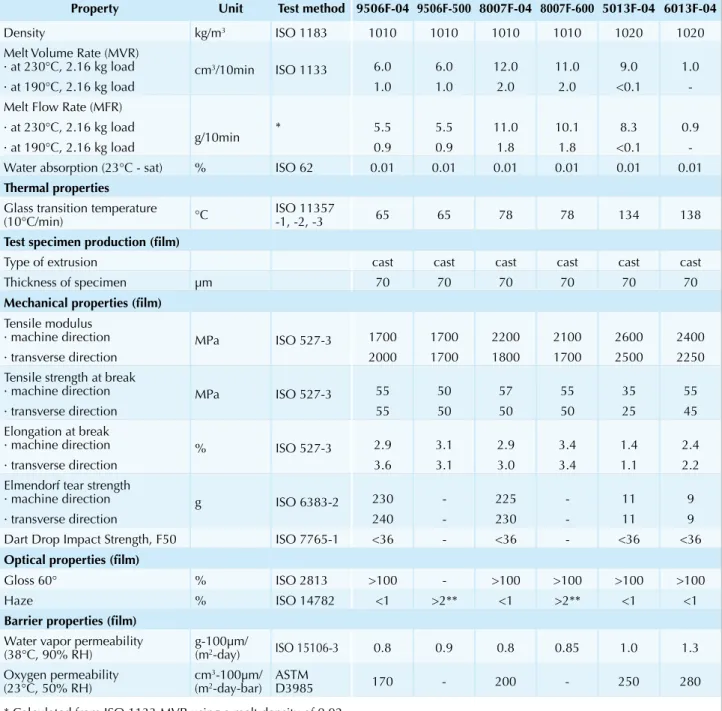
maintains high modulus at temperatures approaching its Tg. Film grades of TOPAS have Tg’s ranging from 65 to 138°C. TOPAS is the only polyolefin having heat deflection temperatures (HDT) as high as 170°C (338ºF) at 0.45 MPa (66 psi).
For all TOPAS grades, HDT is about 5-8°C lower than Tg values. Other properties associated with the various grades of TOPAS are given in Table 3.
Table 3: Physical properties of TOPAS
Property Unit Test method 9506F-04 9506F-500 8007F-04 8007F-600 5013F-04 6013F-04
Density kg/m3 ISO 1183 1010 1010 1010 1010 1020 1020
Melt Volume Rate (MVR)
· at 230°C, 2.16 kg load cm3/10min ISO 1133 6.0 6.0 12.0 11.0 9.0 1.0
· at 190°C, 2.16 kg load 1.0 1.0 2.0 2.0 <0.1
-Melt Flow Rate (MFR)
* · at 230°C, 2.16 kg load
g/10min 5.5 5.5 11.0 10.1 8.3 0.9
· at 190°C, 2.16 kg load 0.9 0.9 1.8 1.8 <0.1
-Water absorption (23°C - sat) % ISO 62 0.01 0.01 0.01 0.01 0.01 0.01
Thermal properties
Glass transition temperature
(10°C/min) °C ISO 11357 -1, -2, -3 65 65 78 78 134 138
Test specimen production (film)
Type of extrusion cast cast cast cast cast cast
Thickness of specimen μm 70 70 70 70 70 70
Mechanical properties (film)
Tensile modulus
· machine direction MPa ISO 527-3 1700 1700 2200 2100 2600 2400
· transverse direction 2000 1700 1800 1700 2500 2250
Tensile strength at break
· machine direction MPa ISO 527-3 55 50 57 55 35 55
· transverse direction 55 50 50 50 25 45
Elongation at break
· machine direction % ISO 527-3 2.9 3.1 2.9 3.4 1.4 2.4
· transverse direction 3.6 3.1 3.0 3.4 1.1 2.2
Elmendorf tear strength
· machine direction g ISO 6383-2 230 - 225 - 11 9
· transverse direction 240 - 230 - 11 9
Dart Drop Impact Strength, F50 ISO 7765-1 <36 - <36 - <36 <36
Optical properties (film)
Gloss 60° % ISO 2813 >100 - >100 >100 >100 >100
Haze % ISO 14782 <1 >2** <1 >2** <1 <1
Barrier properties (film)
Water vapor permeability
(38°C, 90% RH) g-100μm/ (m2-day) ISO 15106-3 0.8 0.9 0.8 0.85 1.0 1.3 Oxygen permeability
(23°C, 50% RH) cm
3-100μm/
(m2-day-bar) ASTM D3985 170 - 200 - 250 280
* Calculated from ISO 1133 MVR using a melt density of 0.92. ** Haze level will depend on processing conditions.
The above values are representative values and not guaranteed values for quality or design purposes.
1 2 3 4 5 6
3.1.1 Mechanical properties of blends
TOPAS is a stiff (high modulus) amorphous polymer with a density of 1.01-1.02 g/cc. It is available in a wide range of glass transition temperatures and molecular weights. Like other glassy amorphous polymers, it has low elongation to break. For this reason, it is not usu ally used as a monolayer 100% TOPAS structure unless exceptional optics are needed. TOPAS grades have an average tensile modulus in the range of 2000 MPa (300 kpsi). They significantlyenhance the stiffness of polyolefin film when used as a blend component, which greatly improves the performance of PE bags, pouches and other packaging. This occurs even at low addition levels as illustrated in Figure 1. For example, a 10% blend of TOPAS with polyethylene raises film stiffness more than 100% while preserving a low haze level. The added stiffness
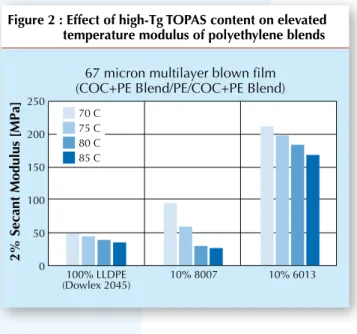
allows downgauging to thinner and less costly film structures. When high-Tg grades are utilized, these modulus improvements are maintained up to temperatures approaching the Tg of the TOPAS, improving hot-fill performance and elevated temperature capability as shown in Figure 2.
Adding TOPAS to PE films also boosts thermal resistance and significantly decreases Elmendorf tear values, enabling the design of “Easy Tear” and “Linear Tear” products. Ad-justing the TOPAS level in PE films can yield a desired tear resistance while increasing puncture resistance in monolayer PE films. For instance, the force needed to puncture 150 or 300 micron (6 or 12 mil) monolayer octene LLDPE film containing a LLDPE/TOPAS blend increases almost linearly as TOPAS increases from 0 to 30%. As a discrete layer in multilayer extruded and laminated films, TOPAS offers high clarity, stiffness and moisture barrier.
3.1.2 Thermal properties
Norbornene content is the key to controlling the ther-mal properties of TOPAS. The norbornene molecule is much bulkier than ethylene, and has a rigid ring structure. Norbornene is incorporated randomly on the main chain which prevents crystallization and makes the TOPAS structure amorphous. TOPAS does not exhibit a crystalline melting point. Norbornene also stiffens and strengthens the polymer and increases its Tg in proportion to its presence in the chain.
Figure 2 : Effect of high-Tg TOPAS content on elevated temperature modulus of polyethylene blends
250 200 150 100 50 0
2% Secant Modulus [MPa]
70 C 75 C 80 C 85 C 100% LLDPE 10% 8007 10% 6013 (Dowlex 2045)
67 micron multilayer blown film (COC+PE Blend/PE/COC+PE Blend)
Figure 1 : Effect of TOPAS content on room temperature modulus of polyethylene blends
800 600 400 200 0 0 5 10 15 20 25 Weight % TOPAS 8007F-04 Modulus [MPa] LLDPE m-LLDPE Plastomer (VLDPE)
The advanced metallocene process for producing TOPAS is flexible and allows for various norbornene/ ethylene ratios. The higher this ratio, the higher the Tg and HDT. Commercial TOPAS grades have Tg’s from 65
to 178°C and HDT’s from 60 to 170°C
respectively. Although modulus is slightly higher for the higher Tg grades, the application-dependent use temperature is typically the major determining factor in grade selection.
3.1.3 Rheology
The melt viscosity of TOPAS is a function of molecular weight and Tg at any given measurement temperature. The relationship between viscosity and shear
rate is illustrated in Figure 4.
TOPAS is often utilized as a blend component or coextruded with conventional polyolefins for which melt index (MI) is commonly utilized to match flow characteristics. Several grades of TOPAS have MI values in the range most often utilized in extrusion grades of polyethylene. Due to its amorphous
structure the temperature de-pendence of MI is higher for TOPAS than for typical semicrystalline polyolefins, a fact which needs to be considered when choosing materials and process temperatures.
Figure 3: TOPAS glass transition temperature (Tg) as a function of norbornene content
250 200 150 100 50 0 0 20 40 60 80 Norbornene [mole%] Tg [°C] Current TOPAS Products
Figure 5: Melt Index (g/10 min) of TOPAS at standard polyolefi n measurement conditions
9506F-04 8007F-04 8007F-600 6013-F04
Melt Index [g/10 min]
Temperature [°C] 0.9 1.9 1.8 0.1 5.5 11.0 10.1 0.9 11 18 28 28 45 40 35 30 25 20 15 10 5 0 260 230 190 Figure 4: Viscosity as a function of shear rate for various
TOPAS grades
0.1 1 10 100 1000
Viscosity [Poise]
Shear Rate [1/sec] at 230°C
6013F-04 9506F-04 8007F-04 8007F-600 1.00E+05 1.00E+04 1.00E+03 1 2 3
3.1.4 Optical properties
TOPAS forms clear, colorless films which are finding utility in optical films for a variety of uses such as retardation, polarization, and brightness enhancement Except for Grade 9506F-500 and 8007F-600. Their light transmittance as shown in Figure 6 extends through the visible spectrum into the near UV and exceeds that of polystyrene (PS), polycarbonate (PC), and nearly equals that of polymethyl methacrylate (PMMA). TOPAS films have low birefringence and very low haze.
3.1.5 Barrier properties
TOPAS is being increasingly utilized as a barrier material in packaging. Packaging must preserve the taste, flavor and composition of packaged foods and the composition of non-food items such as fragrances. It must prevent excessive amounts of oxygen, water, solvents, flavors, aromas and other gases or liquids from leaving or entering a package. This has become
more important as food packaging has moved away from heavy, inflexible glass and metal containers to those made of plastic. Such packaging often involves sophisticated, multilayer structures containing highbarrier polymers like EVOH and PVdC. These structures can be costly, require adhesive polymers, advanced and expensive processing equipment, and reduce the potential for recycling.
TOPAS has one of the highest moisture barriers of any polymeric material. While not considered a high barrier to oxygen or other gases, it is a significantly better barrier than polyethylene and can be used in blends to modify oxygen, carbon dioxide and other gas transmission rates to target specific values such as those required by fruits and vegetables.
TOPAS has four to five times better barrier than LDPE over a broad range of permeants and does not require an adhesive in combinations with polyethylenes. Blends with polyethylene having more than 70% TOPAS typically provide over 90% of the barrier of pure TOPAS. This can dramatically improve the
Figure 6: Light transmission of TOPAS 8007F-04
Figure 7: TOPAS is one of the best polymeric water vapor barriers 200 400 600 800 1000 1200 1400 1600 1800 2000 100 80 60 40 20 0 Transmission [%] Wavelength [nm]
Sources: Permeability Properties of Plastics and Elastomers, Massey, 2nd Edition; various datasheets; internal data
LDPE HDPE BOPP TOPAS® COC EVA12PC PS PVC hard PET PEN PCTFE 10,000 1,000 100 10 1 0.1 0.01 0.01 0.1 1 10 100 1,000 10,000 PAN MXD PA 6 Starch Cellulose EVOH PVdC LCP PP PVC plasticized PCL Cellulose Acetate Water Permeability [g/m2·d] Oxyg en Perm eab ility [c m 3/c m 2·d· bar ]
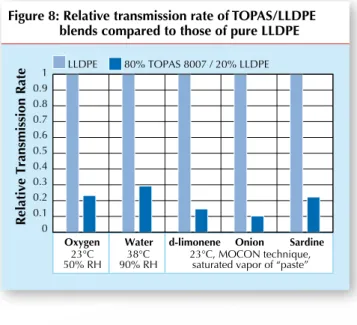
performance of a packaging film in preserving the original characteristics of a package’s contents or moderating the transfer or loss of aromas and odors as illustrated in Figure 8. TOPAS barrier layers can compensate for the poor water vapor transmission performance of commonly used oxygen barrier materials such as nylon and EVOH.
3.1.6 Deadfold
TOPAS has a high modulus which can be utilized to produce a film with the deadfold characteristics required by twist-wrapped candy. These applications often require an expensive cellophane film. A film having thin outer TOPAS layers (20 to 40% of total thickness) and a PE core has excellent deadfold, clarity, recyclability and a high gloss surface with good metallizability. These TOPAS-based twist films have proven to be processable on commercial highspeed wrapping lines designed for cellophane where conventional polyolefin films fail.
3.1.7 Coeffi cient of friction
TOPAS can reduce the coefficient of friction (COF) to commercially acceptable levels in cast PE films. Blending in ~10% TOPAS by weight can produce medium-slip films useful for vertical form-fill-seal operations (a COF of 0.2 to 0.4). A process melt temperature of no more than about 180°C is needed for blends containing low Tg TOPAS grades, while a higher process melt temperature of up to 240°C can be used for blends with high Tg material. TOPAS resins are thus viable alternatives as non-migratory, non-contaminating slip additives when processed at relatively low temperatures. Lower temperature processing may affect haze, but does not affect printability or sealing properties.
Figure 8: Relative transmission rate of TOPAS/LLDPE blends compared to those of pure LLDPE
1 0.9 0.8 0.7 0.6 0.5 0.4 0.3 0.2 0.1 0
Relative Transmission Rate
LLDPE 80% TOPAS 8007 / 20% LLDPE
Oxygen Water d-limonene Onion Sardine
23°C
50% RH 90% RH38°C 23°C, MOCON technique,saturated vapor of “paste”
Figure 9: COF reduction in LDPE using TOPAS
51 37
17
52 48
28
(1st Column = Static 2nd Column = Dynamic)
0.8 0.7 0.6 0.5 0.4 0.3 0.2 0.1 0 160 180 200 240 250 260 COF
Process Melt Temperature [°C] TOPAS 8007F-04 at 10% TOPAS 6013F-04 at 10% Haze Haze 51 37 17 52 48 28 1 2 3
3.2 Chemical resistance
TOPAS is very pure because the metallocene catalyst used in its production is filtered from most grades af-ter polymerization. It also is extremely low in extract-ables, e.g. hexane extractables are 0.3% or less and ash is nearly zero. It easily passes the European Pharmacopoeia Section 3.1.3 extractable test for polyolefins. It has excellent organoleptic properties. Tests with various food components have yielded
lower extractables and similar scalping levels to those of standard PE resins.
As a non-polar material, TOPAS is highly resistant to polar compounds such as water, alcohol and acetone. Like most polyolefins, it is less resistant to nonpolar materials. TOPAS should be tested against specific compounds when chemical resistance is critical in an application.
Table 4: Chemical resistance of TOPAS pH < 7 (acidic/aqueous) hydrochloric acid 36%
+
sulfuric acid 40%+
nitric acid 65%+
acetic acid > 94%+
pH = 7 (neutral/aqueous) water+
aqueous solution of soap
+
saline solution
+
pH > 7
(basic/aqueous)
sodium hydroxide 50%
+
ammonia (aq. sol.) 35%
+
Polar organic solvents ethanol, methanol, butanol, isopropanol (short chain alcohols)
+
acetone, butanone (short chain ketones)
+
(※)(※)Grades 9506 and 8007 are not resistant.
Aromatic solvents benzaldehyde
toluene
–
benzene
–
chlorinated solvents
–
Non-polar organic solvents
pentane, hexane, heptane etc. (alkanes)
–
gasoline (petrol ether)
–
norbornene
–
Other oleic acid
–
+
–
resistant
increase of weight < 3% or loss of weight < 0.5%
elongation at break not substantially altered
limited resistance
increase of weight 3 to 8% or loss of weight 0.5 to 5%
elongation at break reduced by < 50%
not resistant
increase of weight > 8% or loss of weight > 5%
elongation at break reduced by > 50%
3.3 Regulatory
Many TOPAS grades comply with industry certifica-tions and national and international regulacertifica-tions for food, drug, and for use in medical devices. For details in the individual grades please contact our technical representatives.
TOPAS uses no ingredients (heavy metals) regulated by CONEG and uses no ingredients listed on Califor-nia Proposition 65. It also uses no ingredients listed on the following EU Directives: WEEE – EU-Directive 2002/96/EC; RoHS – EU-Directive 2002/95/EC and EU-Directive 2003/11/EC.
Food packaging
Most TOPAS grades comply with all major regula-tory food contact requirements. In the US, it complies with FDA regulation 21 Code of Federal Regulations (CFR) 177.1520 “Olefin Polymers” (3.9). TOPAS can be used in films, sheets and other articles made there from that come in direct contact with food under the U.S. FDA FCN #75. This applies to all types of food and all conditions of use. It also complies with FDA FCN #405 for food contact, which covers all appli-cations, including bottles. These notifications allow TOPAS to be used in single-use and repeat-use ap-plications. Its conditions of use span categories A to H in Table 2 of 21 CFR 176.170(c). The Tg of some TOPAS grades produces a practical use temperature limitation.
TOPAS is also suitable for food-contact applications in Europe, where the monomers used in its manufac-ture are listed in the EU Plastics Directive 2002/72/ EC1/2 (6 August 2002) and the German "Bedarfsge-genständeverordnung" (23 December 1972). Manufac-turers who use TOPAS should check any restrictions and migration rate limits on the finished article.
Pharmaceutical and medical packaging
TOPAS has undergone testing for use in medical and pharmaceutical applications. A U.S. FDA Drug Master File (DMF #12132) and a FDA Device Master File
(MAF #1043) have been established for most TOPAS grades. In addition, several TOPAS grades have passed United States Pharmacopoeia (USP) Class VI biocompatibility protocols, including acute systemic, intracutaneous and implantation tests. Some grades have passed other biocompatibility tests as de-fined in ISO 10993, including those for sensitization, physicochemical effects, cytotoxicity and hemolysis. Certain grades have passed similar tests in accord with EU and Japanese protocols.
In the pharmaceutical sector, a structure containing TOPAS 8007F-04 has been used in and been in con-tact with a CDER-approved solid oral dose. TOPAS is widely used in medical devices and in medical device packaging.
3.4 Recycling
Most TOPAS packaging applications involve mixed structures with other polymers. Processors can blend TOPAS-containing scrap into their products at vari-ous rates. In general, this approach is most successful when TOPAS is blended with olefin-based polymers. Post-consumer recycling depends on the polymers with which TOPAS is combined. Although many blends and multilayered structures should be coded "7" under the SPI system, certain PE combinations may use the code of the majority PE component. For instance, a LDPE structure having a minor amount of TOPAS may retain a SPI recycle code of "4".
If it is not practical to recycle a TOPAS-containing product, TOPAS may safely be incinerated in munic-ipal waste disposal systems. It contains only carbon and hydrogen (no chlorine or other halogens are present). When combusted completely, it yields carbon dioxide and water and releases well over 23,000 kJ/kg (10,000 BTU/lb).
3.2 Chemical resistance
TOPAS is very pure because the metallocene catalyst used in its production is filtered from most grades af-ter polymerization. It also is extremely low in extract-ables, e.g. hexane extractables are 0.3% or less and ash is nearly zero. It easily passes the European Pharmacopoeia Section 3.1.3 extractable test for polyolefins. It has excellent organoleptic properties. Tests with various food components have yielded
lower extractables and similar scalping levels to those of standard PE resins.
As a non-polar material, TOPAS is highly resistant to polar compounds such as water, alcohol and acetone. Like most polyolefins, it is less resistant to nonpolar materials. TOPAS should be tested against specific compounds when chemical resistance is critical in an application.
Table 4: Chemical resistance of TOPAS pH < 7 (acidic/aqueous) hydrochloric acid 36%
+
sulfuric acid 40%+
nitric acid 65%+
acetic acid > 94%+
pH = 7 (neutral/aqueous) water+
aqueous solution of soap
+
saline solution
+
pH > 7
(basic/aqueous)
sodium hydroxide 50%
+
ammonia (aq. sol.) 35%
+
Polar organic solvents ethanol, methanol, butanol, isopropanol (short chain alcohols)
+
acetone, butanone (short chain ketones)
+
(※)(※)Grades 9506 and 8007 are not resistant.
Aromatic solvents benzaldehyde
toluene
–
benzene
–
chlorinated solvents
–
Non-polar organic solvents
pentane, hexane, heptane etc. (alkanes)
–
gasoline (petrol ether)
–
norbornene
–
Other oleic acid
–
+
–
resistant
increase of weight < 3% or loss of weight < 0.5%
elongation at break not substantially altered
limited resistance
increase of weight 3 to 8% or loss of weight 0.5 to 5%
elongation at break reduced by < 50%
not resistant
increase of weight > 8% or loss of weight > 5%
elongation at break reduced by > 50%
3.3 Regulatory
Many TOPAS grades comply with industry certifica-tions and national and international regulacertifica-tions for food, drug, and for use in medical devices. For details in the individual grades please contact our technical representatives.
TOPAS uses no ingredients (heavy metals) regulated by CONEG and uses no ingredients listed on Califor-nia Proposition 65. It also uses no ingredients listed on the following EU Directives: WEEE – EU-Directive 2002/96/EC; RoHS – EU-Directive 2002/95/EC and EU-Directive 2003/11/EC.
Food packaging
Most TOPAS grades comply with all major regula-tory food contact requirements. In the US, it complies with FDA regulation 21 Code of Federal Regulations (CFR) 177.1520 “Olefin Polymers” (3.9). TOPAS can be used in films, sheets and other articles made there from that come in direct contact with food under the U.S. FDA FCN #75. This applies to all types of food and all conditions of use. It also complies with FDA FCN #405 for food contact, which covers all appli-cations, including bottles. These notifications allow TOPAS to be used in single-use and repeat-use ap-plications. Its conditions of use span categories A to H in Table 2 of 21 CFR 176.170(c). The Tg of some TOPAS grades produces a practical use temperature limitation.
TOPAS is also suitable for food-contact applications in Europe, where the monomers used in its manufac-ture are listed in the EU Plastics Directive 2002/72/ EC1/2 (6 August 2002) and the German "Bedarfsge-genständeverordnung" (23 December 1972). Manufac-turers who use TOPAS should check any restrictions and migration rate limits on the finished article.
Pharmaceutical and medical packaging
TOPAS has undergone testing for use in medical and pharmaceutical applications. A U.S. FDA Drug Master File (DMF #12132) and a FDA Device Master File
(MAF #1043) have been established for most TOPAS grades. In addition, several TOPAS grades have passed United States Pharmacopoeia (USP) Class VI biocompatibility protocols, including acute systemic, intracutaneous and implantation tests. Some grades have passed other biocompatibility tests as de-fined in ISO 10993, including those for sensitization, physicochemical effects, cytotoxicity and hemolysis. Certain grades have passed similar tests in accord with EU and Japanese protocols.
In the pharmaceutical sector, a structure containing TOPAS 8007F-04 has been used in and been in con-tact with a CDER-approved solid oral dose. TOPAS is widely used in medical devices and in medical device packaging.
3.4 Recycling
Most TOPAS packaging applications involve mixed structures with other polymers. Processors can blend TOPAS-containing scrap into their products at vari-ous rates. In general, this approach is most successful when TOPAS is blended with olefin-based polymers. Post-consumer recycling depends on the polymers with which TOPAS is combined. Although many blends and multilayered structures should be coded "7" under the SPI system, certain PE combinations may use the code of the majority PE component. For instance, a LDPE structure having a minor amount of TOPAS may retain a SPI recycle code of "4".
If it is not practical to recycle a TOPAS-containing product, TOPAS may safely be incinerated in munic-ipal waste disposal systems. It contains only carbon and hydrogen (no chlorine or other halogens are present). When combusted completely, it yields carbon dioxide and water and releases well over 23,000 kJ/kg (10,000 BTU/lb).
1 2
4.1 Drying
TOPAS requires no drying. It should not be stored in an extremely high temperature environment, as pellet sticking may result.
Extrusion of discrete layers of high Tg grades (TOPAS 6013F-04) may call for degassing to remove oxygen that can cause bubbles in the melt. This is best done by heating the polymer in a vacuum dryer or a nitro-gen-purged dryer for 4 hours at 20 to 30°C below the HDT of the TOPAS grade. Alternately, use the same drying conditions with a desiccant dryer.
4.2 Cast film extrusion of TOPAS/PE blends Each of the TOPAS grades suitable for cast film blends has its own process requirements. It is best to choose a grade based on process viscosity and the end-use properties needed. Most polyethylenes have excellent compatibility with TOPAS in blends. Good results have been demonstrated using PEs having melt indi-ces of 1.0 to 6.0 g/10 min at 190°C and densities of 0.895 to 0.965 g/cc.
The start-up conditions in Table 5 are recommended when processing TOPAS blends as cast film at film thicknesses of 25 to 250 microns (1 to 10 mil). When extruding PE-rich blends, it is important that the extruder temperatures in the first few zones of the extruder are no lower than recommended in the table below. This will ensure thorough melting of the TOPAS pellets. Higher temperatures may be used if desired for overall processing, as TOPAS is thermally stable and has been processed at up to 320°C on extrusion coating lines. Higher melt and casting roll temperatures are recommended for best clarity with higher-Tg TOPAS grades.
Barrier mixing screws work best, where the advanc- ing melt pool is separated from unmelted pellets. Maddock mixing sections have proven effective.
Use a screw L/D ratio of 24:1 or above and a low compression ratio for optimum melt homogeneity.
Use typical coathanger dies.
Use a draw down ratio (DDR) of 2:1 to 20:1, depending on fi nal thickness.
Casting roll temperatures of 40 to 50°C work well for TOPAS/PE blends.
Table 5: Cast fi lm temperature profi les for polyethylene-rich blends (5-25% TOPAS)
TOPAS Grade 5-25%
Tg
[°C] [g/10 min] at Melt Index Rear Temp. [°C] Temp. [°C]Center Front Temp. [°C] Adapter Temp. [°C] Die Temp. [°C]
190°C 230°C
9506 65 0.9 5.5 190-200 200-210 200-210 200-210 200-210
8007 78 1.9 11.0 200-210 220-230 220-230 220-230 220-230
6013 138 0.1 0.9 200-210 250-260 250-260 250-260 250-260
4.3 Cast fi lm extrusion of discrete TOPAS layers As an amorphous thermoplastic, TOPAS lacks crys-tallinity and a defined melting point. It softens as temperature rises over a range depending on Tg. For discrete TOPAS layers or TOPAS-rich blends, process
120°C or more above the Tg of the grade used. Best solids conveying occurs at relatively high rear zone temperatures. Higher melt and casting roll tempera-tures generally give the best clarity.
Several TOPAS grades are suitable for extruding as
Table 6: Cast fi lm temperature profi les for discrete TOPAS layers
TOPAS
Grade [°C]Tg [g/10 min] at Melt Index Rear Temp. [°C] Temp. [°C]Center Front Temp. [°C] Adapter Temp. [°C] Die Temp. [°C]
190°C 230°C
9506 65 0.9 5.5 210-220 230-240 230-240 230-240 230-240
8007 78 1.9 11.0 210-220 230-240 230-240 230-240 230-240
6013 138 0.1 0.9 210-220 260-270 260-270 260-270 260-270
tween film layers. TOPAS 8007F-600 is a specially formulated grade for easy processing in discrete layers over a broader range of extruder types and conditions. For other grades a low molecular weight amide wax powder lubricant dusted on pellet surfaces at 0.1 to 0.2% aids lubricity in the feed section of the extruder and can result in improved film quality. Lubricants usually are not needed in blends containing over
20% polyethylene. Other process aids can be used. Equipment recommendations are the same as for TOPAS/PE blends. Recommended start-up conditions for discrete TOPAS layers or high TOPAS content blends (> 65% TOPAS) as cast film for film thickness-es of 25 to 250 microns (1 to 10 mil) are given in Table 6.
4.4 Blown fi lm extrusion
TOPAS also performs well in blown film extrusion systems. General processing recommendations given for cast film and the cast film starting temperature profiles given in Table 5 (PE-rich blends) and Table 6 (Discrete TOPAS layers) can also be used for blown film. The key new variables are bubble stability and bubble collapsing. TOPAS has lower melt strength than LDPE and the melt strength of other polymers in the film structure will strongly influence bubble stabil-ity. Increased melt temperatures generally give the best clarity with higher Tg grades. Bubble stability will determine the maximum possible melt temperature. Structures containing high levels of TOPAS or discrete layers of TOPAS can be stiff and cause challenges in achieving wrinkle-free layflat. In general, keep-ing the film warmer in the collapskeep-ing area helps the collapsing process. Collapsing equipment designed to handle stiff films such as nylons and HDPE will
structures. Additional equipment recommendations are as follows:
Barrier mixing screws work best, where the advanc-ing melt pool is separated from unmelted pellets. Maddock mixing sections have proven effective.
A preferred screw has a screw L/D ratio (screw length to diameter) of 24:1 or above and a low compression ratio for optimum melt homogeneity. A standard blown fi lm tower can be used.
Grooved feed extruders are not preferred but may be used with improved processibility grades such as 8007F-600. Heated feed zones are sometimes required for good processability in grooved feed extruders.
Use typical spiral dies and die gaps of 1.5 to 2.25 mm (60 to 90 mils).
Recommended blow-up ratio (BUR) is 2:1, but good results have been achieved at 1.5:1 to 3.5:1.
4.1 Drying
TOPAS requires no drying. It should not be stored in an extremely high temperature environment, as pellet sticking may result.
Extrusion of discrete layers of high Tg grades (TOPAS 6013F-04) may call for degassing to remove oxygen that can cause bubbles in the melt. This is best done by heating the polymer in a vacuum dryer or a nitro-gen-purged dryer for 4 hours at 20 to 30°C below the HDT of the TOPAS grade. Alternately, use the same drying conditions with a desiccant dryer.
4.2 Cast film extrusion of TOPAS/PE blends Each of the TOPAS grades suitable for cast film blends has its own process requirements. It is best to choose a grade based on process viscosity and the end-use properties needed. Most polyethylenes have excellent compatibility with TOPAS in blends. Good results have been demonstrated using PEs having melt indi-ces of 1.0 to 6.0 g/10 min at 190°C and densities of 0.895 to 0.965 g/cc.
The start-up conditions in Table 5 are recommended when processing TOPAS blends as cast film at film thicknesses of 25 to 250 microns (1 to 10 mil). When extruding PE-rich blends, it is important that the extruder temperatures in the first few zones of the extruder are no lower than recommended in the table below. This will ensure thorough melting of the TOPAS pellets. Higher temperatures may be used if desired for overall processing, as TOPAS is thermally stable and has been processed at up to 320°C on extrusion coating lines. Higher melt and casting roll temperatures are recommended for best clarity with higher-Tg TOPAS grades.
Barrier mixing screws work best, where the advanc- ing melt pool is separated from unmelted pellets. Maddock mixing sections have proven effective.
Use a screw L/D ratio of 24:1 or above and a low compression ratio for optimum melt homogeneity.
Use typical coathanger dies.
Use a draw down ratio (DDR) of 2:1 to 20:1, depending on fi nal thickness.
Casting roll temperatures of 40 to 50°C work well for TOPAS/PE blends.
Table 5: Cast fi lm temperature profi les for polyethylene-rich blends (5-25% TOPAS)
TOPAS Grade 5-25%
Tg
[°C] [g/10 min] at Melt Index Rear Temp. [°C] Temp. [°C]Center Front Temp. [°C] Adapter Temp. [°C] Die Temp. [°C]
190°C 230°C
9506 65 0.9 5.5 190-200 200-210 200-210 200-210 200-210
8007 78 1.9 11.0 200-210 220-230 220-230 220-230 220-230
6013 138 0.1 0.9 200-210 250-260 250-260 250-260 250-260
4.3 Cast fi lm extrusion of discrete TOPAS layers As an amorphous thermoplastic, TOPAS lacks crys-tallinity and a defined melting point. It softens as temperature rises over a range depending on Tg. For discrete TOPAS layers or TOPAS-rich blends, process temperatures usually depend primarily on the Tg of the TOPAS grade. The minimum processing temper-ature for extrusion processing TOPAS is generally
120°C or more above the Tg of the grade used. Best solids conveying occurs at relatively high rear zone temperatures. Higher melt and casting roll tempera-tures generally give the best clarity.
Several TOPAS grades are suitable for extruding as discrete layers in multilayer films. Choose the grade having a viscosity curve most comparable to the other polymers in a structure to minimize instabilities
be-Table 6: Cast fi lm temperature profi les for discrete TOPAS layers
TOPAS
Grade [°C]Tg [g/10 min] at Melt Index Rear Temp. [°C] Temp. [°C]Center Front Temp. [°C] Adapter Temp. [°C] Die Temp. [°C]
190°C 230°C
9506 65 0.9 5.5 210-220 230-240 230-240 230-240 230-240
8007 78 1.9 11.0 210-220 230-240 230-240 230-240 230-240
6013 138 0.1 0.9 210-220 260-270 260-270 260-270 260-270
tween film layers. TOPAS 8007F-600 is a specially formulated grade for easy processing in discrete layers over a broader range of extruder types and conditions. For other grades a low molecular weight amide wax powder lubricant dusted on pellet surfaces at 0.1 to 0.2% aids lubricity in the feed section of the extruder and can result in improved film quality. Lubricants usually are not needed in blends containing over
20% polyethylene. Other process aids can be used. Equipment recommendations are the same as for TOPAS/PE blends. Recommended start-up conditions for discrete TOPAS layers or high TOPAS content blends (> 65% TOPAS) as cast film for film thickness-es of 25 to 250 microns (1 to 10 mil) are given in Table 6.
4.4 Blown fi lm extrusion
TOPAS also performs well in blown film extrusion systems. General processing recommendations given for cast film and the cast film starting temperature profiles given in Table 5 (PE-rich blends) and Table 6 (Discrete TOPAS layers) can also be used for blown film. The key new variables are bubble stability and bubble collapsing. TOPAS has lower melt strength than LDPE and the melt strength of other polymers in the film structure will strongly influence bubble stabil-ity. Increased melt temperatures generally give the best clarity with higher Tg grades. Bubble stability will determine the maximum possible melt temperature. Structures containing high levels of TOPAS or discrete layers of TOPAS can be stiff and cause challenges in achieving wrinkle-free layflat. In general, keep-ing the film warmer in the collapskeep-ing area helps the collapsing process. Collapsing equipment designed to handle stiff films such as nylons and HDPE will generally produce better results with stiff TOPAS
structures. Additional equipment recommendations are as follows:
Barrier mixing screws work best, where the advanc-ing melt pool is separated from unmelted pellets. Maddock mixing sections have proven effective.
A preferred screw has a screw L/D ratio (screw length to diameter) of 24:1 or above and a low compression ratio for optimum melt homogeneity. A standard blown fi lm tower can be used.
Grooved feed extruders are not preferred but may be used with improved processibility grades such as 8007F-600. Heated feed zones are sometimes required for good processability in grooved feed extruders.
Use typical spiral dies and die gaps of 1.5 to 2.25 mm (60 to 90 mils).
Recommended blow-up ratio (BUR) is 2:1, but good results have been achieved at 1.5:1 to 3.5:1.
1 2 3 4 5 6
4.5 Extrusion coating
TOPAS 8007F-600 is recommended for extrusion coating applications because of its relatively low wa-ter vapor transmission rate (WVTR), stiffness and curl control. It has four times the water vapor barrier of LDPE, the most common extrusion coating material. When used as a discrete layer (100% TOPAS or 80% or more TOPAS blended with LDPE), it significantly reduces WVTR at a low coating weight.
TOPAS as a stiff, low shrinkage, amorphous mate-rial can help reduce the shrinkage of semicrystalline polyolefins when added as a blend component. This is advantageous when coating is done on lightweight papers, which are subject to curling. Adding 10 to 20% TOPAS can make the difference between a high-curl product and a product that lays flat.
TOPAS can be processed at normal polyethylene processing conditions but lacks the melt strength of a LDPE or HDPE, so it is typically not used as a mono-layer extrusion coating. In a LDPE/TOPAS/LDPE co-extruded structure, the LDPE adds melt strength and the TOPAS adds water barrier. This structure does not alter the adhesion characteristics of the coating to the substrate.
Direct bonding of TOPAS to paper requires a strong pretreatment with flame, corona, ozone, or a combi-nation of these. Blends containing at up to 40% TOPAS 8007F-600 in extrusion coating grades of LDPE (MI of 5 to 10) have good melt strength (low neck-in and good edge stability) and can be pro-cessed at the same conditions as LDPE alone but may have reduced adhesion strength.
4.6 Additives
TOPAS can be modified with additives to fit specific requirements. Its coefficient of friction and blocking properties can be modified with many of the same
slips and antiblocks used in polyethylene. Specialty additives such as processing aids, antioxidants, anti-stats, and impact modifiers have been utilized with TOPAS and should be considered on an application dependent basis.
4.7 Purge and shutdown
TOPAS is a very stable resin, and is highly resistant to formation of "gels" as often seen in extrusion of PE and certain other resins. However, it may be desir-able to purge TOPAS from extrusion equipment for transitions or shutdown. To purge equipment after running TOPAS, one may use a purge blend contain-ing 50% 1 MI LLDPE and 50% of a typical PE purge compound. For a shutdown blend, one may use 50% 0.25 MI, LDPE and 50% of a standard PE antioxidant masterbatch. Follow these procedures for purge and shutdown:
Step 1 Reduce rear zone temperature to 205°C (400°F) and introduce the purge blend. Retain existing temperatures on the rest of the extruder and die. Purge for about 20 to 30 minutes.
Step 2 Reduce all temperatures to 177°C (350°F) and introduce the shutdown blend. Continue to run until the extrudate is clear and machine temperature is below 190°C (380°F).
Step 3 Shut down. Do not run the equipment dry.
Step 4 For equipment start-up, heat the extruder
and other equipment to 180°C (360°F) and heat soak for the required time. Start the extruder with the shutdown blend and raise it to the desired tem-perature. Follow the shutdown blend with an LDPE (preferably one with a melt index between 2 and 3), run for about 15 to 20 minutes and then introduce TOPAS.
4.8 Troubleshooting
TOPAS is an easy-to-run material. If problems arise during processing, take the steps described below to
resolve them. If problems persist, please contact a TOPAS technical representative.
Table 7: TOPAS fi lm and sheet: troubleshooting guide
Issue Potential solution Explanation
Particles
(unmelt, or ‘gels’) in extrudate
Raise extruder temperatures Adjust MI of PE in PE-rich blends
Temperatures in the early zones (1, 2, 3) are critical in soften-ing the resin. Unmelts fl ush out readily once proper condi-tions are found.
Raise extrusion pressure
(“back pressure”) For lines without a melt pump, a change to fi ner screens at the screen pack can increase pressure. Increase screw speed. Preheat TOPAS pellets A resin dryer can be used to give the resin a boost toward its Tg.
Haze/Optics Lower extrusion temperatures,
decrease cooling roll temperature Can be effective at low TOPAS percentages (< 20%) in blends with PE and discrete layers of 8007F-600. Dry resin Rare issue that can occur with high-Tg grades. TOPAS is
non-hygroscopic and in this case drying is actually de-oxygenation. Increase extrusion temperatures Higher melt temperatures typically give the lowest haze with
grades other than 8007F-600 and 9506F-500
Purging TOPAS
after run Most PE and PP resins work well LDPE with antioxidant concentrate can be used for shut-downs.
Degradation/Gels Rarely encountered due to stability “Gels” are usually unmelts (see above for solutions).
Moisture in resin TOPAS is very moisture-resistant If pellets themselves are wet, drying is suggested.
Surging of extruder/Pressure variation
Raise extruder temperatures Temperatures in the early zones (1, 2, 3) are critical in soften-ing the TOPAS resin to stabilize meltsoften-ing behavior. A high qual-ity, uniform temperature melt will produce a more uniform output.
Lower extruder temperatures
(early zones) If using a resin blend, the non-TOPAS material may start to bridge in the feed throat or plug the screw fl ights in the feed zone. This can often be diagnosed through visual observation. Raise extrusion pressure
(“back pressure”) For lines without a melt pump, a change to fi ner screens at the screen pack can increase pressure. Usually, 10.4 MPa (1500 psi) is suffi cient.
Check fi lters for plugging A coarser mesh screen may be needed in this case. Preheat TOPAS pellets A resin dryer can be used to give melting a head start.
Brittleness Use lower Tg TOPAS Higher Tg resins are stiffer, and hence more brittle.
Curl Use TOPAS on both sides
of structure The amorphous TOPAS resin reduces shrinkage of the structure.
Low interlayer adhesion in coex structures
Change PE type or use a tie layer Adhesion of TOPAS to LLDPE is higher than to LDPE and HDPE. Conventional PE tie layers can also be used.
re-4.5 Extrusion coating
TOPAS 8007F-600 is recommended for extrusion coating applications because of its relatively low wa-ter vapor transmission rate (WVTR), stiffness and curl control. It has four times the water vapor barrier of LDPE, the most common extrusion coating material. When used as a discrete layer (100% TOPAS or 80% or more TOPAS blended with LDPE), it significantly reduces WVTR at a low coating weight.
TOPAS as a stiff, low shrinkage, amorphous mate-rial can help reduce the shrinkage of semicrystalline polyolefins when added as a blend component. This is advantageous when coating is done on lightweight papers, which are subject to curling. Adding 10 to 20% TOPAS can make the difference between a high-curl product and a product that lays flat.
TOPAS can be processed at normal polyethylene processing conditions but lacks the melt strength of a LDPE or HDPE, so it is typically not used as a mono-layer extrusion coating. In a LDPE/TOPAS/LDPE co-extruded structure, the LDPE adds melt strength and the TOPAS adds water barrier. This structure does not alter the adhesion characteristics of the coating to the substrate.
Direct bonding of TOPAS to paper requires a strong pretreatment with flame, corona, ozone, or a combi-nation of these. Blends containing at up to 40% TOPAS 8007F-600 in extrusion coating grades of LDPE (MI of 5 to 10) have good melt strength (low neck-in and good edge stability) and can be pro-cessed at the same conditions as LDPE alone but may have reduced adhesion strength.
4.6 Additives
TOPAS can be modified with additives to fit specific requirements. Its coefficient of friction and blocking properties can be modified with many of the same
slips and antiblocks used in polyethylene. Specialty additives such as processing aids, antioxidants, anti-stats, and impact modifiers have been utilized with TOPAS and should be considered on an application dependent basis.
4.7 Purge and shutdown
TOPAS is a very stable resin, and is highly resistant to formation of "gels" as often seen in extrusion of PE and certain other resins. However, it may be desir-able to purge TOPAS from extrusion equipment for transitions or shutdown. To purge equipment after running TOPAS, one may use a purge blend contain-ing 50% 1 MI LLDPE and 50% of a typical PE purge compound. For a shutdown blend, one may use 50% 0.25 MI, LDPE and 50% of a standard PE antioxidant masterbatch. Follow these procedures for purge and shutdown:
Step 1 Reduce rear zone temperature to 205°C (400°F) and introduce the purge blend. Retain existing temperatures on the rest of the extruder and die. Purge for about 20 to 30 minutes.
Step 2 Reduce all temperatures to 177°C (350°F) and introduce the shutdown blend. Continue to run until the extrudate is clear and machine temperature is below 190°C (380°F).
Step 3 Shut down. Do not run the equipment dry.
Step 4 For equipment start-up, heat the extruder
and other equipment to 180°C (360°F) and heat soak for the required time. Start the extruder with the shutdown blend and raise it to the desired tem-perature. Follow the shutdown blend with an LDPE (preferably one with a melt index between 2 and 3), run for about 15 to 20 minutes and then introduce TOPAS.
4.8 Troubleshooting
TOPAS is an easy-to-run material. If problems arise during processing, take the steps described below to
resolve them. If problems persist, please contact a TOPAS technical representative.
Table 7: TOPAS fi lm and sheet: troubleshooting guide
Issue Potential solution Explanation
Particles
(unmelt, or ‘gels’) in extrudate
Raise extruder temperatures Adjust MI of PE in PE-rich blends
Temperatures in the early zones (1, 2, 3) are critical in soften-ing the resin. Unmelts fl ush out readily once proper condi-tions are found.
Raise extrusion pressure
(“back pressure”) For lines without a melt pump, a change to fi ner screens at the screen pack can increase pressure. Increase screw speed. Preheat TOPAS pellets A resin dryer can be used to give the resin a boost toward its Tg.
Haze/Optics Lower extrusion temperatures,
decrease cooling roll temperature Can be effective at low TOPAS percentages (< 20%) in blends with PE and discrete layers of 8007F-600. Dry resin Rare issue that can occur with high-Tg grades. TOPAS is
non-hygroscopic and in this case drying is actually de-oxygenation. Increase extrusion temperatures Higher melt temperatures typically give the lowest haze with
grades other than 8007F-600 and 9506F-500
Purging TOPAS
after run Most PE and PP resins work well LDPE with antioxidant concentrate can be used for shut-downs.
Degradation/Gels Rarely encountered due to stability “Gels” are usually unmelts (see above for solutions).
Moisture in resin TOPAS is very moisture-resistant If pellets themselves are wet, drying is suggested.
Surging of extruder/Pressure variation
Raise extruder temperatures Temperatures in the early zones (1, 2, 3) are critical in soften-ing the TOPAS resin to stabilize meltsoften-ing behavior. A high qual-ity, uniform temperature melt will produce a more uniform output.
Lower extruder temperatures
(early zones) If using a resin blend, the non-TOPAS material may start to bridge in the feed throat or plug the screw fl ights in the feed zone. This can often be diagnosed through visual observation. Raise extrusion pressure
(“back pressure”) For lines without a melt pump, a change to fi ner screens at the screen pack can increase pressure. Usually, 10.4 MPa (1500 psi) is suffi cient.
Check fi lters for plugging A coarser mesh screen may be needed in this case. Preheat TOPAS pellets A resin dryer can be used to give melting a head start.
Brittleness Use lower Tg TOPAS Higher Tg resins are stiffer, and hence more brittle.
Curl Use TOPAS on both sides
of structure The amorphous TOPAS resin reduces shrinkage of the structure.
Low interlayer adhesion in coex structures
Change PE type or use a tie layer Adhesion of TOPAS to LLDPE is higher than to LDPE and HDPE. Conventional PE tie layers can also be used.
Die deposits Dry resin and extrude
under nitrogen
Rare issue, seen with high-Tg grades. Drying works by re-moving absorbed oxygen from the polymer. Fluoropolymer process aids can produce improvement. Vacuum venting can also reduce deposits.
1 2 3 4 5 6
Figure 10: TOPAS improves stiffness, appearance and part uniformity at lower gauge
5.1 Thermoforming films and sheet
TOPAS offers many thermoforming advantages. As an amorphous polymer, its broad softening and melting range enable a wide thermal window prior to form-ing, unlike the narrow range typical of semicrystalline materials like HDPE, PP and PE. Its wide processing window enables good formability and less gauge var-iation in the formed cavity.
TOPAS thermoforming grades vary in molecular weight and have a Tg range of 65 to 138°C. TOPAS films and sheeting can be thermoformed from about 85 to 200°C, so it can be used in low- and high-tem-perature processes, which is markedly different than crystalline polyolefins.
5.1.1 Multilayer fi lms
Monolayer TOPAS films and sheeting create clear and stiff packaging having exceptional moisture, alcohol and aroma barrier. These benefits can be captured in multilayer structures having one or more TOPAS lay-ers. TOPAS can be coextruded without tie adhesive layers and adheres to LLDPE, LDPE, EVA, HDPE and SBC. Adhesion issues with these materials can usually be corrected by adjusting processing conditions and flow properties. If this does not resolve the issue, any adhesive commonly used with PE will work with TOPAS. Tie layers may be needed when it is coex-truded with polypropylene homopolymer (it adheres well to polypropylene random copolymer) and when draw depth and area draw ratio is aggressive.
Formed Corner Puncture kg [lb]
Formed Cavity Puncture kg [lb]
Formed Cavity Gauge Variation [%]
Retained Volume [%]
TD Tensile Strength MPa [kpsi]
MD Tensile Strength MPa [kpsi]
TD Modulus MPa [kpsi]
MD Modulus MPa [kpsi] Gloss [60°] Haze [%] Gauge micron [mil] Cost $/m2 [$/MSI]
EVA/Ionomer/EVA
b-LLDPE/EVA/COC/EVA/b-LLDPE
With polypropylene homopolymer, LLDPE with a MI of 4 or above is an effective tie layer, although com-mercial anhydride-grafted tie resins are also used. TOPAS and PET (including PETG and APET) can be bonded with ethylene-methyl acrylate (EMA) polymers having 25% or more methyl acrylate and a melt index of 5 or above. Tie resins recommended for PE-PETG interfaces have also proven successful. For adhesion to other polymers, consult suppliers of tie layer materials and ask for tie recommendations between the polymer of interest and polyethylene.
Many multilayer structures can be made with TOPAS, which enhances formability and reduces gauge varia-tion. Discrete TOPAS layers often improve appearance by lowering haze and increasing gloss. Such layers may enhance the stiffness of the overall structure, de-pending on the location of the TOPAS layer(s), which allows for downgauging and significant cost savings. 5.1.2 Monolayer blends
TOPAS is compatible with most polyolefins, so lower cost polymers not often found in thermoforming ap-plications may be used. TOPAS can be melt blended in any ratio with LDPE, EVA, LLDPE, PP and HDPE. TOPAS-rich monolayer blend films and sheeting are usually tougher than TOPAS alone, yet retain much of the TOPAS barrier, stiffness and forming properties. PE-rich monolayer films and sheeting have excellent forming properties. Thermoformed parts from mono-layer LLDPE-TOPAS films having as little as 15% TOPAS have low gauge variation, added stiffness, and high dimensional stability with little or no snap back. Such improved performance can be expected from all grades of LLDPE, regardless of comonomer or catalyst. 5.2 Orientation and shrinkage
TOPAS orients readily at appropriate temperatures above its Tg. Its broad grade range (Tg from 65 to 138°C) allows orientation and shrink temperatures to
be tailored to a process and a product. Shrink tem-perature curve steepness can be controlled precisely by blending TOPAS grades, as illustrated in Figure 11. Shrinkage rates can also be influenced by blending TOPAS with other polymers.
TOPAS 8007F-04 and 9506F-04 have been monoaxi-ally and biaximonoaxi-ally oriented in flat (tenter, and machine direction stretcher) and tubular (double bubble) pro-cesses. Orientation increases ductility, while adding some stiffness. As a monolayer in biaxial processing, TOPAS orients best at about a 4x4 ratio. Higher orien-tation ratios are attainable when TOPAS is a layer or component of a multicomponent structure, e.g., skin layers of TOPAS can be oriented at a 5x10 ratio in OPP tentering and other processes.
TOPAS has high shrink recovery. In monoaxially ori-ented labels, shrinkage of over 80% is possible. Its shrink stress can be less than half that of competing materials, provided it is not oriented at too low a tem-perature. Inherent high dimensional stability is useful in shrink applications by reducing film shrinkage be-low its Tg, e.g., in warm storage conditions.
Figure 11: Shrinkage performance of oriented fi lm can be adjusted with blends of TOPAS grades
90 80 70 60 50 40 30 20 10 0 50 70 90 110 130 150 Temperature [°C] Shrink [%] TOPAS 8007 TOPAS Blend 8007/PE TOPAS Blend 8007/6013 TOPAS 6013
Figure 10: TOPAS improves stiffness, appearance and part uniformity at lower gauge
5.1 Thermoforming films and sheet
TOPAS offers many thermoforming advantages. As an amorphous polymer, its broad softening and melting range enable a wide thermal window prior to form-ing, unlike the narrow range typical of semicrystalline materials like HDPE, PP and PE. Its wide processing window enables good formability and less gauge var-iation in the formed cavity.
TOPAS thermoforming grades vary in molecular weight and have a Tg range of 65 to 138°C. TOPAS films and sheeting can be thermoformed from about 85 to 200°C, so it can be used in low- and high-tem-perature processes, which is markedly different than crystalline polyolefins.
5.1.1 Multilayer fi lms
Monolayer TOPAS films and sheeting create clear and stiff packaging having exceptional moisture, alcohol and aroma barrier. These benefits can be captured in multilayer structures having one or more TOPAS lay-ers. TOPAS can be coextruded without tie adhesive layers and adheres to LLDPE, LDPE, EVA, HDPE and SBC. Adhesion issues with these materials can usually be corrected by adjusting processing conditions and flow properties. If this does not resolve the issue, any adhesive commonly used with PE will work with TOPAS. Tie layers may be needed when it is coex-truded with polypropylene homopolymer (it adheres well to polypropylene random copolymer) and when draw depth and area draw ratio is aggressive.
Formed Corner Puncture kg [lb]
Formed Cavity Puncture kg [lb]
Formed Cavity Gauge Variation [%]
Retained Volume [%]
TD Tensile Strength MPa [kpsi]
MD Tensile Strength MPa [kpsi]
TD Modulus MPa [kpsi]
MD Modulus MPa [kpsi] Gloss [60°] Haze [%] Gauge micron [mil] Cost $/m2 [$/MSI]
EVA/Ionomer/EVA
b-LLDPE/EVA/COC/EVA/b-LLDPE
With polypropylene homopolymer, LLDPE with a MI of 4 or above is an effective tie layer, although com-mercial anhydride-grafted tie resins are also used. TOPAS and PET (including PETG and APET) can be bonded with ethylene-methyl acrylate (EMA) polymers having 25% or more methyl acrylate and a melt index of 5 or above. Tie resins recommended for PE-PETG interfaces have also proven successful. For adhesion to other polymers, consult suppliers of tie layer materials and ask for tie recommendations between the polymer of interest and polyethylene.
Many multilayer structures can be made with TOPAS, which enhances formability and reduces gauge varia-tion. Discrete TOPAS layers often improve appearance by lowering haze and increasing gloss. Such layers may enhance the stiffness of the overall structure, de-pending on the location of the TOPAS layer(s), which allows for downgauging and significant cost savings. 5.1.2 Monolayer blends
TOPAS is compatible with most polyolefins, so lower cost polymers not often found in thermoforming ap-plications may be used. TOPAS can be melt blended in any ratio with LDPE, EVA, LLDPE, PP and HDPE. TOPAS-rich monolayer blend films and sheeting are usually tougher than TOPAS alone, yet retain much of the TOPAS barrier, stiffness and forming properties. PE-rich monolayer films and sheeting have excellent forming properties. Thermoformed parts from mono-layer LLDPE-TOPAS films having as little as 15% TOPAS have low gauge variation, added stiffness, and high dimensional stability with little or no snap back. Such improved performance can be expected from all grades of LLDPE, regardless of comonomer or catalyst. 5.2 Orientation and shrinkage
TOPAS orients readily at appropriate temperatures above its Tg. Its broad grade range (Tg from 65 to 138°C) allows orientation and shrink temperatures to
be tailored to a process and a product. Shrink tem-perature curve steepness can be controlled precisely by blending TOPAS grades, as illustrated in Figure 11. Shrinkage rates can also be influenced by blending TOPAS with other polymers.
TOPAS 8007F-04 and 9506F-04 have been monoaxi-ally and biaximonoaxi-ally oriented in flat (tenter, and machine direction stretcher) and tubular (double bubble) pro-cesses. Orientation increases ductility, while adding some stiffness. As a monolayer in biaxial processing, TOPAS orients best at about a 4x4 ratio. Higher orien-tation ratios are attainable when TOPAS is a layer or component of a multicomponent structure, e.g., skin layers of TOPAS can be oriented at a 5x10 ratio in OPP tentering and other processes.
TOPAS has high shrink recovery. In monoaxially ori-ented labels, shrinkage of over 80% is possible. Its shrink stress can be less than half that of competing materials, provided it is not oriented at too low a tem-perature. Inherent high dimensional stability is useful in shrink applications by reducing film shrinkage be-low its Tg, e.g., in warm storage conditions.
Figure 11: Shrinkage performance of oriented fi lm can be adjusted with blends of TOPAS grades
90 80 70 60 50 40 30 20 10 0 50 70 90 110 130 150 Temperature [°C] Shrink [%] TOPAS 8007 TOPAS Blend 8007/PE TOPAS Blend 8007/6013 TOPAS 6013 1 2 3 4 5 6
5.3 Sealing
Heat-sealing capability is usually specified by seal strength, hot tack strength and seal initiation tempera-ture. As it cools, TOPAS transitions from a rubbery to a glassy state to create a high-modulus material at 65°C (TOPAS 9506) to 78°C (TOPAS 8007). This adds signif-icant seal strength at temperatures where PE has low strength and modulus.
When blended with PE, TOPAS broadens the seal tem-perature range of many polyethylenes. Figure 12 shows a typical case where the seal range for pure LLDPE is extended and the seal strength is also noticeably higher. TOPAS often improves hot tack performance (strength of the hot seal after cooling for 0.1 sec.) as much as 100%. Hot tack strength is important in vertical form, fill and seal equipment where contents are dropped into bags while the seal is still hot. The more robust sealing performance with TOPAS is valuable in a wide range of "real-world" packaging situations.
When an all-TOPAS surface layer is used in a packag-ing film, the film can be sealed to itself much like a PE
film. For example, TOPAS 8007F-04 seals to itself at a seal initiation temperature of 105°C (defined as seal temperature where 8.8 N seal strength is achieved). The seal strength of the TOPAS-TOPAS seal is similar to that of LDPE and LLDPE. It also has good hot-tack strength. The high modulus of TOPAS means the seal may not be as tough as that of other materials, although the seal will be hermetic.
Figure 12: Addition of TOPAS improves seal properties
35 30 25 20 15 10 5 0 90 100 110 120 130 140 150 160 170
Seal Strength [Newtons]
Sealing Temperature [°C]
0% TOPAS 8007 15% TOPAS 8007 25% TOPAS 8007
PE Resin = LLDPE Dwell Time = 250 ms Seal Pressure = 63 psi
cast film
Table 8: Sterilization of TOPAS
TOPAS Hot steam ETO High-energy radiation
121°C 134°C 143°C Gamma Electrons
8007 - - - + + +
6013 + - - + + +
5.4 Sterilization
TOPAS can be sterilized by all common methods, in-cluding gamma radiation, e-beam or beta irradiation, ethylene oxide and steam as shown in Table 10. It is relatively stable to gamma irradiation at a dosage to 5 Mrad. Its tensile strength, Izod impact strength and other mechanical properties show little change after
exposure and after 12 months aging. It does yellow slightly immediately after exposure, but this fades over several days to nearly the initial color.
TOPAS 6013 can be steam sterilized, typically at 121°C for 20 minutes. The procedure for sterilizing TOPAS calls for venting the steam with dry air above 120°C. Drying should last about 60 minutes,
depend-ing on size and thickness, to gain the desired clarity before cooling to room temperature. For thermal sterili-zation, air pressure in the autoclave should match the steam pressure.
E-beam or beta irradiation causes TOPAS to yellow slightly. The color fades to the original color in about 10 days. The intensity of the color shift is proportional to dosage. TOPAS is unaffected by ethylene oxide sterilization and the temperatures this involves (above 60°C in some cases).
5.5 Vacuum metallizing
TOPAS-based film usually outperforms other polyole-fins in decorating, printing and other secondary opera-tions. It delivers a clean, hard surface, high stiffness, and thermal stability.
Attractive metallic coatings, usually aluminum, may be applied to TOPAS. Vacuum aluminum metallization of
TOPAS has been performed without surface treatments such as flame or corona and when corona is used its ef-fects last significantly longer than on polyethylene. The economic advantage of direct metallization without pretreatment, plus exceptionally low shrinkage over a wide range of HDTs, sets TOPAS apart from other polyolefins.
TOPAS film is ideal for aesthetic uses calling for high clarity, gloss and reflection. In twist-wrapped candies, for example, it produces a sleek, shiny, metallized surface and the excellent deadfold needed for clear twist closures.
When metallized, cast or blown films with TOPAS skins yield barriers equal or superior to metallized OPP applications for dry foods with low fat content, making TOPAS-containing film a cost-effective candidate for packaging dry foods such as crackers, rice, coffee, cereal, pet food, snacks and dry mixes.
Figure 13: Gas and moisture barrier of metallized TOPAS
OTR at 25°C and 50% r.h. [cm3/(m2 · 24h · bar)] MVTR at 25°C and 100% r.h. [g/(m 2 · 24h)] 10 1 0.1 0.01 0.01 0.1 1 10 100 1000
dry, low fat
dry, high fat
AL foil
met oPET met oPP
met COC
*
Colored areas represent typical ranges
optical density of 1.6

![Figure 7: TOPAS is one of the best polymeric water vapor barriers 200 400 600 800 1000 1200 1400 1600 1800 2000100806040200Transmission [%] Wavelength [nm]](https://thumb-us.123doks.com/thumbv2/123dok_us/10095648.2909938/10.892.65.421.517.788/figure-topas-polymeric-water-vapor-barriers-transmission-wavelength.webp)