EFFICIENT MESSAGE DISSEMINATION FRAMEWORK FOR DIVERSE WIRELESS NETWORKS
A Dissertation
Submitted to the Graduate Faculty of the
North Dakota State University of Agriculture and Applied Science
By Osman Khalid
In Partial Fulfillment for the Degree of DOCTOR OF PHILOSOPHY
Major Department:
Electrical and Computer Engineering
April 2014
North Dakota State University
Graduate School
Title
EFFICIENT MESSAGE DISSEMINATION FRAMEWORK FOR DIVERSE WIRELESS NETWORKS
By OSMAN KHALID
The Supervisory Committee certifies that this disquisition complies with North Dakota State University’s regulations and meets the accepted standards for the degree of
DOCTOR OF PHILOSOPHY SUPERVISORY COMMITTEE: Dr. Samee U. Khan Chair Dr. Ying Huang Dr. Sudarshan Srinivasan Dr. Jacob Glower Approved:
June 4, 2014 Dr. Scott C. Smith
ABSTRACT
Wireless networks exhibit diversity, ranging from mostly disconnected delay tolerant networks and partially connected mobile ad hoc networks, to mostly connected cellular
networks. Besides having useful applications, including, vehicular communications, emergency response networks, battlefield networks, and wildlife monitoring, wireless networks face numerous challenges, such as unreliable connectivity, bandwidth restrictions, interference, frequent disruptions and delays, power outages, message loss, and malicious attacks. Moreover, when nodes are mobile, communication may be disrupted frequently for longer time periods. Designing protocols to tolerate such disruptions is challenging because of the extreme uncertainty in mobile wireless environments. Most of the existing approaches either require exact knowledge about future connectivity schedules, or perform message flooding in an attempt to improve message delivery rate. However, message flooding results in an increased overhead and loss of messages in resource constrained environments. Moreover, it is almost impossible to acquire precise future contact schedules in real-life scenarios.
The goal of this dissertation is to architect robust protocols that overcome disruptions and enable applications in diverse wireless networks. We propose a suite of protocols for wireless environments where nodes transfer messages during opportunistic contacts. To conserve resources, the protocols control flooding by autonomously adapting to the changing network conditions, to find optimal temporal routes between source and destination nodes. Moreover, the dissertation presents novel approaches that utilize time-series forecasting on nodes’ contact patterns. Such routing schemes learn from nodes’ temporal contacts and mobility patterns, and forecasts the future contact opportunities among the nodes. By making precise predictions about
likelihood. Simulation results proved that the proposed routing framework can be efficiently utilized in many real-life applications to disseminate delay tolerant data, such as electronic newspapers, weather forecasts, movie trailers, emergency information, and travel routes information in various parts of a city. The dissertation also proposes a novel application for mobile social networks that generates real-time recommendation of venues for a group of mobile users. The proposed framework utilizes Ant colony algorithm, social filtering, and hub and authority scores on the users’ contextual information to produce optimal recommendations.
ACKNOWLEDGMENTS
I am grateful to acknowledge and thank all those who assisted me in my graduate
program at North Dakota State University. I would like to express my deepest appreciation and a bundle of thanks to my academic advisor Dr. Samee U. Khan. His guidance, support, and
patience throughout my years as a graduate student are truly appreciated. Special thanks to my other graduate committee members, Dr. Ying Huang, Dr. Sudarshan Srinivasan, and Dr. Jacob Glower. I would also like to express my gratitude to COMSATS Institute of Information Technology, Pakistan for their financial support.
Last but not the least, I would like to thank all my colleagues at NDSU for their kind help and support during my PhD.
DEDICATION
TABLE OF CONTENTS
ABSTRACT ... iii
ACKNOWLEDGMENTS ... v
DEDICATION ... vi
LIST OF TABLES ... xiii
LIST OF FIGURES ... xiv
LIST OF ALGORITHMS ... xvi
1. INTRODUCTION ... 1
1.1. Overview ... 1
1.2. Motivation ... 2
1.3. Contributions... 3
1.4. Network Types Considered ... 4
1.5. List of Publications ... 6
1.5.1. Published ... 6
1.5.2. Submitted ... 7
1.6. Dissertation Outline ... 8
1.7. References ... 8
2. BACKGROUND AND RELATED WORK ... 12
2.1. Background ... 12
2.2. Message Dissemination Schemes for MANETs ... 14
2.3. Message Dissemination Schemes for DTNs ... 17
3. BENCHMARKING AND MODELING OF ROUTING PROTOCOLS FOR
DELAY TOLERANT NETWORKS ... 23
3.1. Overview ... 23
3.1.1. Motivation ... 24
3.1.2. Contributions... 25
3.2. DTN Routing Insights ... 27
3.2.1. Forwarding versus Replication ... 28
3.2.2. Metadata Exchange ... 28 3.2.3. Buffer Management ... 29 3.3. DTN Routing Protocols ... 30 3.3.1. Direct Transmission ... 31 3.3.2. First Contact ... 31 3.3.3. Epidemic ... 32 3.3.4. Life ... 32 3.3.5. Wave ... 33
3.3.6. Spray and Wait ... 33
3.3.7. Spray and Focus ... 34
3.3.8. PRoPHET ... 34
3.3.9. MaxProp ... 35
3.3.10. Rapid ... 35
3.4. Empirical Setups, Results, and Discussion ... 36
3.4.1. Performance Metrics ... 36
3.4.2. Mobility Scenarios ... 37
3.4.4. Comparative Analysis ... 39
3.4.5. Summary of Results and Discussions ... 49
3.5. Proposed Routing Models ... 52
3.5.1. Enhanced Epidemic Scheme ... 53
3.5.2. Adaptive Multi-Copy Spray (AMS) ... 54
3.5.3. Adaptive Source Token Multi-Copy Spray (ASTMS) ... 57
3.6. References ... 60
4. FORECAST AND RELAY: A MESSAGE ROUTING SCHEME FOR OPPORTUNISTIC MOBILE NETWORKS ... 63
4.1. Overview ... 63
4.1.1. Motivation ... 63
4.1.2. Contributions... 64
4.2. Network Model and Assumptions ... 65
4.3. FAR Protocol Design ... 67
4.4. Simulation and Results ... 68
4.5. References ... 72
5. A CHECKPOINT BASED MESSAGE FORWARDING SCHEME FOR OPPORTUNISTIC COMMUNICATION... 74 5.1. Contributions... 74 5.2. Checkpoint Architecture ... 75 5.2.1. CP Nodes ... 75 5.2.2. Mobile Nodes ... 76 5.2.3. Buses Nodes ... 77
5.5. Simulation ... 79
5.5.1. Scenario... 79
5.5.2. Simulation Parameters ... 80
5.6. Results ... 81
5.6.1. Effect of CP Deployment on Average Delay and Message Delivery Ratio ... 82
5.6.2. Effects of the Number of CPs on Message Delivery Ratio and Average Delay ... 83
5.6.3. CP Model Evaluation with Human Mobility Pattern ... 84
5.6.4. CP Model Evaluation with RWP Mobility Pattern ... 85
5.7. References ... 86
6. OPPORTUNISTIC DATABANK: A CONTEXT AWARE ON-THE-FLY DATA CENTER FOR MOBILE NETWORKS ... 88
6.1. Contributions... 88
6.2. Network Model ... 89
6.3. Hybrid Scheme for Message Replication (HSM) for DTN Environments ... 91
6.4. Empirical Setups and Results... 94
6.4.1. Performance Metrics ... 95
6.4.2. Related DTN Replication Schemes ... 96
6.4.3. Simulation Results ... 96
6.5. References ... 98
7. APS: AN ADAPTIVE PROGNOSTIC MESSAGE ROUTING SCHEME FOR DELAY TOLERANT NETWORKS ... 100
7.1. Overview ... 100
7.1.1. Motivation ... 100
7.2. Network Model and Assumptions ... 102
7.3. APS Protocol Design ... 102
7.3.1. Data Stationarity Tests ... 104
7.3.2. Computing p, d, and q ... 105
7.3.3. Forecasting ... 105
7.4. Simulation Results and Discussions ... 106
7.5. References ... 110
8. OMNISUGGEST: A UBIQUITOUS CLOUD BASED CONTEXT AWARE RECOMMENDATION SYSTEM FOR MOBILE SOCIAL NETWORKS... 112
8.1. Overview ... 112 8.1.1. Motivation ... 112 8.1.2. Research Problem ... 113 8.1.3. Contributions... 115 8.2. System Architecture ... 117 8.2.1. Major Components... 117
8.2.2. Cloud Services Mapping ... 120
8.3. Proposed Recommendation Framework ... 121
8.3.1. Offline Preprocessing... 122
8.3.2. Online Recommendation for Single User ... 124
8.3.3. Group Recommendation ... 133
8.3.4. Time Complexity ... 138
8.4. Performance Evaluation ... 139
8.4.3. Results ... 141
8.5. References ... 148
9. CONCLUSION AND FUTURE WORK ... 152
9.1. Summary of Contributions ... 152
LIST OF TABLES
Table Page
3.1. Commonly used simulation parameters. ... 38
3.2. Protocol specific parameters. ... 38
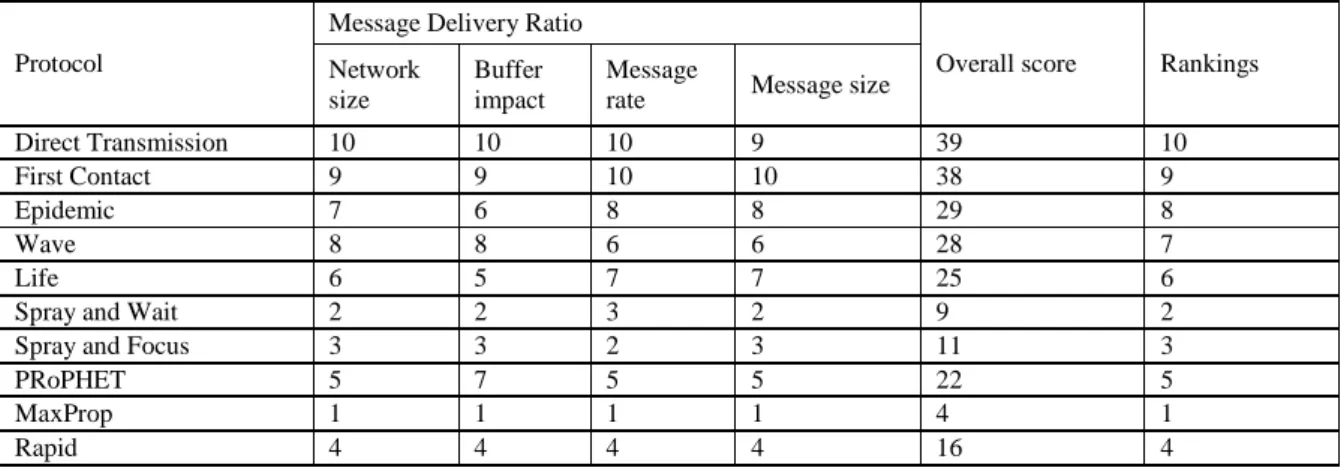
3.3. Protocols ranking based on message delivery ratio. The protocol with lowest score is given top ranking. ... 52
3.4. Overview of results. ... 52
4.1. Notations and their definitions. ... 66
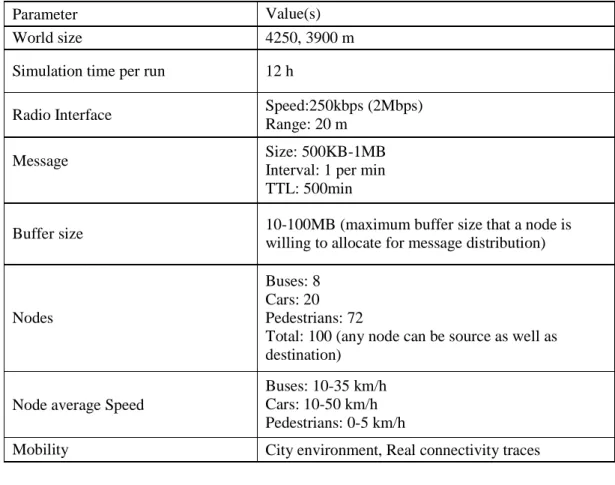
4.2. Simulation parameters. ... 69
5.1. Database fields for a Checkpointi. ... 76
5.2. Database fields for a MobileNodei. ... 77
5.3. Simulation parameters used in ONE. ... 81
5.4. Performance of DTN protocols for human mobility... 84
5.5. Performance of DTN protocols for RWP mobility. ... 85
6.1. Notations and their meanings... 90
7.1. Simulation Settings. ... 107
8.1. Number of times required venues are visited by each hub user and total check-ins at the venues. ... 132
LIST OF FIGURES
Figure Page
1.1. Top level hierarchy of wireless networks. ... 1
2.1. Replication example in MANETs: (a) network division and data access, and (b) effective data replication for continued data access. ... 12
2.2. Replication example in DTNs. Data is replicated from node to node during opportunistic contacts at time slots T1, T2, and T3, without any global knowledge of network topology. ... 13
3.1. Examples of DTNs where devices have intermittent connectivity. ... 23
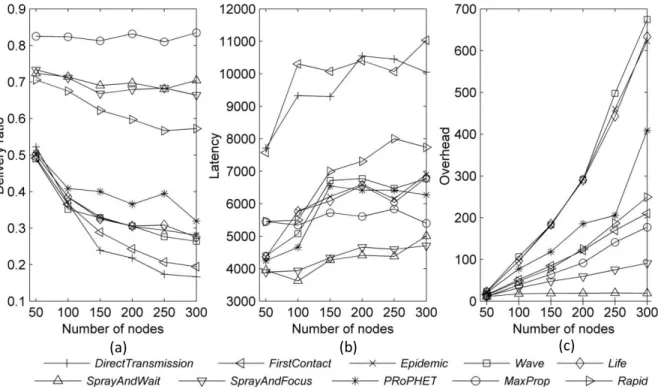
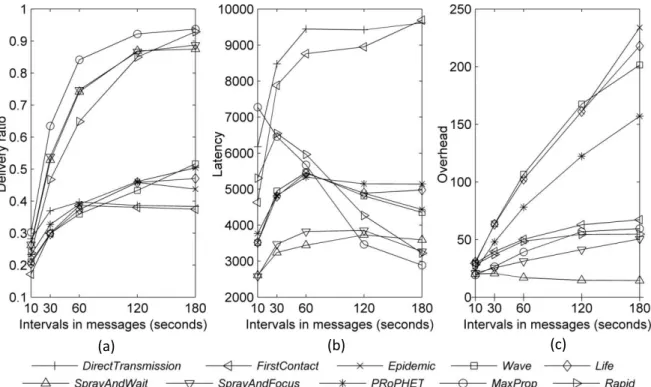
3.2. Effect of increasing number of nodes on a protocol’s (a) delivery ratio (b), latency, and (c) overhead. ... 41
3.3. Effect of decreasing the message creation rate on a protocol’s (a) delivery ratio, (b) latency, and (c) overhead. ... 43
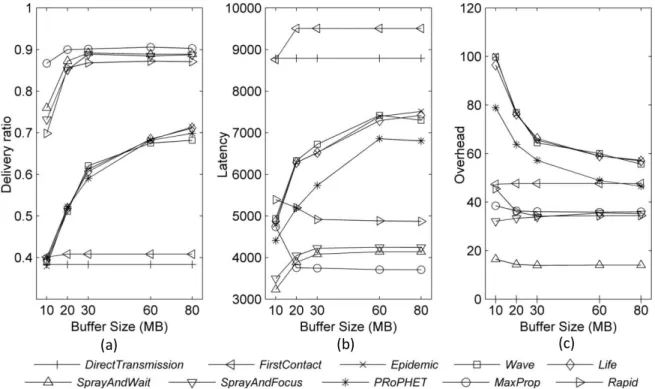
3.4. Effect of increasing buffer size on (a) delivery ratio, (b) latency, and (c) overhead. ... 45
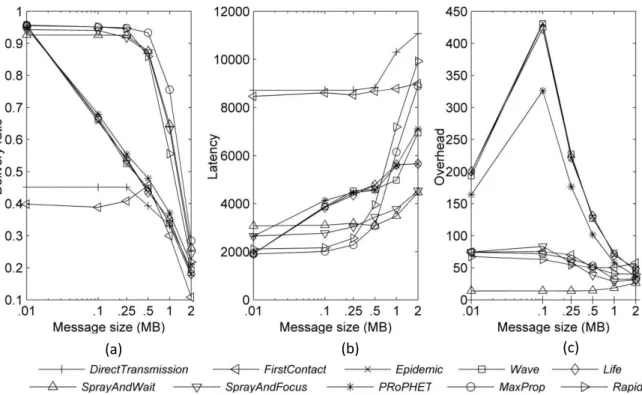
3.5. Effect of changing message size on a protocol’s (a) delivery ratio, (b) latency, and (c) overhead. ... 46
3.6. Performance comparison with real connectivity traces for (a) delivery ratio, (b) latency, and (c) overhead. ... 48
3.7. Performance comparison between Epidemic and E-Epidemic protocol. ... 55
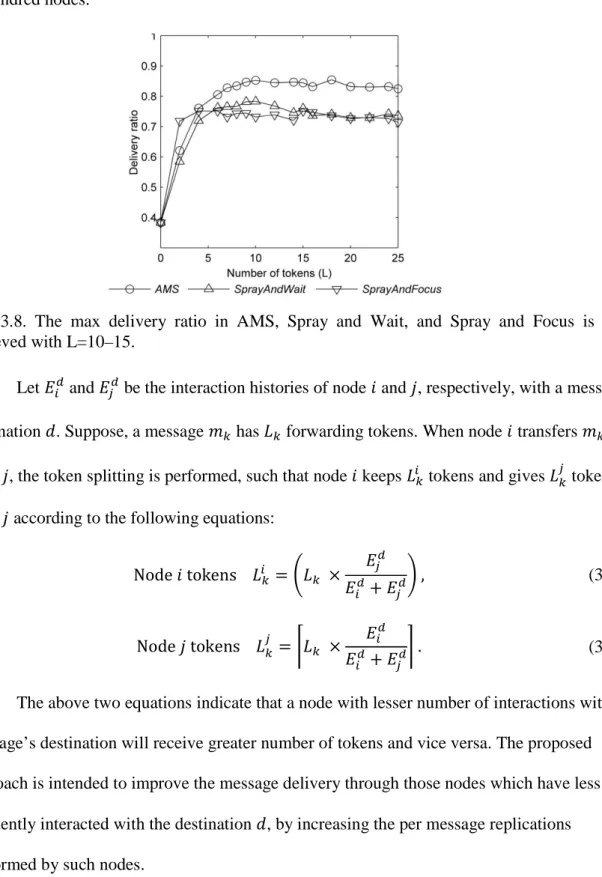
3.8. The max delivery ratio in AMS, Spray and Wait, and Spray and Focus is achieved with L=10–15. ... 56
3.9. Performance comparison of AMS with Spray and Wait, and Spray and Focus. ... 57
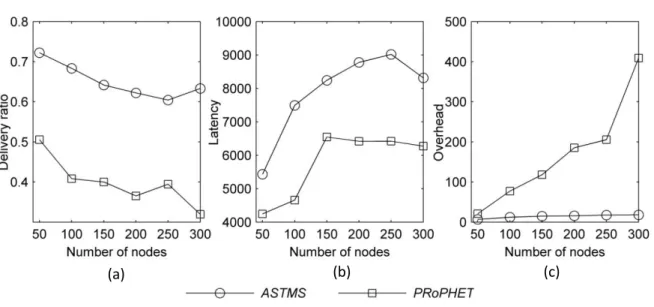
3.10. Performance comparison of ASTMS with the PRoPHET protocol. ... 59
4.1. Mobile carries are exchanging messages on making opportunistic contacts. ... 66
4.2. Performance comparisons with synthetic mobility (a)–(f) and real connectivity trace (g)–(i). ... 71
5.1. CP architecture with CPs connected through bus nodes. ... 78
5.2. Checkpoint based simulation model in ONE, with circles representing the deployed CPs. ... 80
5.3. Effect of CP deployment on message delivery ratio. ... 82
5.4. Effect of CPs on (a) message delivery ratio and (b) packet latency. ... 83
5.5. CP6 is located near center of map where nodes mobility is maximum. ... 86
6.1. An example of heterogeneous DTN network. ... 90
6.2. Flowchart of proposed replication scheme. ... 94
6.3. Performance comparison results with synthetic mobility (a)–(c) and real mobility trace (d)–(f). The schemes compared are: 1. HSM, 2. PRoPHET, 3. Epidemic, 4. Random, and 5. Wave. ... 97
7.1. Mobile carries are exchanging messages on making opportunistic contacts. ... 105
7.2. ACF and PCF plots of nodes’ contact durations. ... 106
7.3. Performance comparison results with scenario-1, (a)–(c) and scenario-2, (d)–(f). The protocols compared are: 1. APS, 2. PRoPHET, 3. Epidemic, 4. Random, and 5. Wave. ... 109
7.4. Average hop count for: 1. APS, 2. PRoPHET, 3. Epidemic, 4. Random, and 5. Wave. ... 109
8.1. Venues are linked with various categories at multiple levels. The lower half indicates users who have performed check-ins at venues. A venue may be linked with multiple categories. ... 118
8.2. A top level architecture of the Cloud-based OmniSuggest framework. ... 119
8.3. OmniSuggest framework’s cloud services mapping. ... 121
8.4. (a) Hubs similarity graph retrieved from database, and (b) connectivity of active user with hub similarity graph. ... 131
8.5. A step-wise procedure for group recommendations. ... 136
8.6. Performance evaluation results: (a) precision, (b) recall, (c) F-measure, (d) group consensus effects, (e) group size effects, and (f) effect of recurrent recommendations on global satisfaction. ... 146
LIST OF ALGORITHMS
Algorithm Page
3.1. Pseudo-code for ASTMS scheme ... 59 8.1. Ant Colony based Venue Selection ... 126 8.2. Group Recommendation ... 135
1. INTRODUCTION
1.1. Overview
The computer networks in today’s era exhibit significant diversity in underlying communication mechanisms. A top level categorization of such mechanisms includes wired networks (such as local area networks) and wireless networks (such as cellular networks). Though wired networks have achieved significant advancement in technology, numerous challenges, such as long distance cabling costs, maintenance, and security issues limit the large-scale deployment of wired networks. For many years wireless networks have seen significant evolution in the communication technologies because of being economical, flexible, and
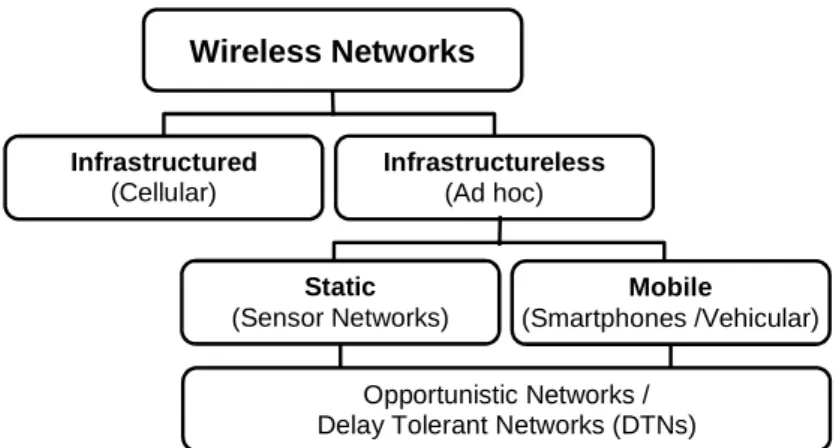
ubiquitous in nature. Unlike wired networks, wireless networks do not require cables and can be easily deployed in an ad hoc manner enabling these networks to have a number of applications. A hierarchy and examples of wireless networks is presented in Fig.1.1.
Recent years have seen a prolific increase in network-enabled mobile devices. According to a market research report [1.1], in year 2009 alone a total of 144 million mobile phones were
Wireless Networks Infrastructured (Cellular) Infrastructureless (Ad hoc) Mobile (Smartphones /Vehicular) Static (Sensor Networks) Opportunistic Networks / Delay Tolerant Networks (DTNs)
shipped with Wi-Fi capability and it is further estimated that such smart-phones may reach 66% of the total shipments till 2015 [1.2]. Multiple communication technologies in smart phones have enabled the users to easily communicate with or without the support of infrastructure [1.3]. In some environments, it may not be possible to deploy infrastructure-based networks (such as cellular or access points) because of the high deployment costs, security issues, and difficult terrains. Therefore, mobile devices may be required to communicate directly with each other without using the infrastructure, and together form on-the-fly networks, also known as Mobile Ad hoc NETworks (MANETs) [1.4] and Opportunistic Mobile Networks [1.5].
1.2. Motivation
The standard TCP/IP Internet is based on the assumption that a continuous bidirectional connection is available between source and destination to support end-to-end communication [1.6], [1.7]. The nodes in the Internet are connected most of the time, so the Internet protocols can easily estimate the links’ costs between any two nodes, and packets are routed on least cost path. In case, the least cost path is disrupted, the alternate path is selected for message routing. However, designing protocols that can overcome disruptions in mobile environments is
challenging because of the following reasons: (a) uncertain network conditions and (b) diversity in networks [1.3], [1.8].
Uncertainty in network conditions occurs mainly due to mobility of nodes, fluctuating channel conditions, short battery life, and bandwidth restrictions that may result in frequent topology changes/disconnections, unreliable connectivity, and transmission delays. Therefore, protocols for mobile environments need to make routing decisions based on partial knowledge about the network.
Mobile users require network access in diverse environments that range from fully disconnected to partially connected, and fully connected networks. Interconnecting these diverse
networks poses several challenges due to heterogeneity of nodes and communication
technologies. Designers need to first uncover the challenges specific to the network, and then design protocols that can address the challenges.
Due to the above mentioned issues, the traditional routing protocols (such as TCP/IP) designed for Internet are inapplicable for mobile environments, as end-to-end communication paths cannot be maintained among nodes. Although there exist a few routing protocols, such as AODV and DSDV [1.6] that create routing paths in dynamic environments, such protocols fail to work when the network is sparse and have frequent disconnections due to nodes’ mobility. To improve the routing performance, several proposals, such as [1.9]-[1.17] have been presented that mainly addressed the routing/forwarding mechanisms for frequently disrupting mobile wireless networks. However, there is no consensus on which approach best suits a given scenario or application [1.3]. A few routing schemes perform message flooding in the network [1.11], [1.14], [1.15], [1.17]. Flooding increases the message delivery probability, but at the expense of network resources. On the contrary, the routing schemes that minimize the flooding, such as [1.10], [1.12], [1.13], [1.16], consume less resources, but at the expense of longer delays and decrease in message delivery probability.
In the light of above discussion, there is still a pressing need to develop resource conserving routing solutions for the mobile environments that must exhibit better message delivery rates with reduced network overhead. This dissertation addresses the critical area of resource efficiency in mobile routing, and exploits the nodes’ mobility patterns to control message replicas within the network.
Specifically, we address the issues and challenges pertaining to seamless message delivery in mobile networks that are prone to intermittent connectivity. We design a suite of protocols that allow the mobile users to opportunistically interconnect with or without the support of
infrastructure to enable various real-life applications, such as dissemination of electronic newspapers, weather forecasts, movie trailers, emergency information, and travel routes
information in various parts of a city with the help of mobile nodes. Mobility of nodes results in time evolving topology and frequent variation in network conditions. Therefore, the proposed routing protocols are designed to easily adapt to the changing network conditions, making the protocols resilient to network uncertainties.
Several of the previous studies reveal that humans follow repetitive schedule of meetings at similar places and times, and that the human mobility is predictable and follows a power-law distribution [1.18]. The aforementioned fact is further endorsed by Song et al. that the human mobility is 93% predictable [1.19]. To obtain benefits of repetitive mobility, we utilize time-series forecasting on nodes’ contact patterns [1.20]. Therefore, our proposed protocols learn from the nodes’ temporal contacts and mobility patterns, and forecast the future contact opportunities among the nodes. In this way, the protocols also control message flooding by forwarding the messages to only those nodes that increase the message delivery likelihood.
1.4. Network Types Considered
The types of networks considered in this dissertation are: (a) mostly disconnected, (b) intermittently connected, and (c) mostly connected [1.3], [1.8]. The networks are categorized on the basis of time durations of nodes’ connections and disconnection in a particular network. Moreover, we define a network infrastructure as to be a cellular tower and/or access point (AP).
Most disconnected networks are also known as Delay Tolerant Networks (DTNs) [1.7], [1.21]. In such networks, infrastructure is difficult to deploy or is sparsely available, and nodes
have infrequent connectivity. Nodes make contact for brief durations, for an interval of a few seconds to a few minutes, and stay disconnected for longer time durations for about hours or even days. The DTNs were initially designed to enable inter-planetary communication. Nowadays, such networks are also deployed in numerous terrestrial applications, such as wild life tracking, military networks, disaster relief networks, and vehicular ad hoc networks. In this dissertation, at first we present an empirical benchmarking of ten popular routing protocols for DTNs. As a next step, we propose three new protocols for DTNs based on the enhancements in the existing routing schemes. Our simulation results showed improved performance of the proposed techniques.
Intermittently connected networks have smaller durations of disconnections as compared
to DTNs [1.3]. For instance, a mobile node making a connection with an AP installed at a bus station, the node will be disconnected when it moves out of range of the AP, and may be connected again after a while with an AP installed at a coffee shop. Though the disconnection durations are shorter than DTNs, the network is still not well connected. As a contribution in this dissertation, we proposed three routing schemes for intermittently connected networks. We utilize time-series forecasting on nodes’ contact pattern to predict future contacts of nodes. Our results with real connection traces [1.22] as well as synthetic mobility indicated the better performance of the proposed schemes.
Mostly connected networks are assumed to have contemporaneous end-to-end
communication paths among source and destination nodes. An example of such networks is the cellular networks and WiMAX, where mobile users stay connected to at least one cellular tower in range. One of the popular application areas of fully connected networks is mobile social
and ties among mobile users. A novel application area of mobile social networks is the
recommender systems. Such systems track the user activities, mobility patterns, and utilize the
user’s contextual information to provide recommendations on a variety of items. In this
dissertation, we build a novel cloud-based framework to perform real-time recommendations of venues to the mobile subscribers. The proposed framework recommends new venues to a user based on the contextual information and similarities of interest with the friends in the user’s social network.
1.5. List of Publications
Some of the contributions presented in this dissertation have appeared in the following publications:
1.5.1. Published
1. O. Khalid, M. U. S. Khan, S. U. Khan, A. Y. Zomaya, “OmniSuggest: A Ubiquitous Cloud
based Context Aware Recommendation System for Mobile Social Networks”, IEEE
Transactions on Services Computing, 10.1109/TSC.2013.53, December, 2013.
2. O. Khalid, S. U. Khan, S. A. Madani, K. Hayat, M. I. Khan, N. Min-Allah, J. Kolodziej, L.
Wang, S. Zeadally, and D. Chen, “Comparative Study of Trust and Reputation Systems for Wireless Sensor Networks,” Security and Communication Networks, vol. 6, no. 6, pp. 669-688, 2013.
3. K. Bilal, S. U. R. Malik, O. Khalid, A. Hameed, E. Alvarez, V. Wijaysekara, R. Irfan, S. Shrestha, D. Dwivedy, M. Ali, U. S. Khan, A. Abbas, N. Jalil, and S. U. Khan, “A Taxonomy and Survey on Green Data Center Networks,” Future Generation Computer Systems, http://dx.doi.org/10.1016/j.future.2013.07.006
4. O. Khalid, S. U. Khan, J. Kolodziej, L. Zhang, J. Li, K. Hayat, S. A. Madani, L. Wang, and
Communication,” in 26th European Conference on Modeling and Simulation (ECMS), Koblenz, Germany, May 2012, pp. 512-518.
5. O. Khalid, S. U. Khan, S. A. Madani, K. Hayat, L. Wang, D. Chan, and R. Ranjan,
“Opportunistic Databank: A Context-aware on-the-fly Data Center for Mobile Networks,” in Handbook on Data Centers, S. U. Khan and A. Y. Zomaya, Eds., Springer-Verlag, New York, USA. (Forthcoming.)
6. O. Khalid, K. Bilal, and S. U. Khan, “Green Computing,” IEEE Technical Committee on
Scalable Computing Blog, April 16, 2012
1.5.2. Submitted
1. O. Khalid, M. Sualeh, R. N. B. Rais, K. Hayat, S. A. Madani, J. Kolodziej, F. Zhang, R.
Ranjan, N. Ghani, D. Chen, L. Wang, S. U. Khan, and A. Y. Zomaya, “Benchmarking and Modeling of Routing Protocols for Delay Tolerant Networks,” Submitted to future
generation of computer systems, January, 2014.
2. O. Khalid, R. N. B. Rais, N. Ghani, and S. U. Khan, “Forecast and Relay: A Message
Routing Scheme for Opportunistic Mobile Networks,” Submitted to IEEE communication
letters, March, 2014.
3. O. Khalid, N. Ghani, and S. U. Khan, “APS: An Adaptive Prognostic Message Routing
Scheme for Delay Tolerant Networks,” Submitted to IEEE communication letters, March, 2014.
4. S. Khan, O. Khalid, M. I. Khan, S. U. Khan, M. Azeem, M. N. Saqib, and S. Tanveer, “Trust-based Secure and Optimized Link State Routing Protocol,” Submitted to IET
5. R. Irfan, O. Khalid, M. U. S. Khan, C. Chira, R. Ranjan, F. Zhang, S. U. Khan, B.
Veeravalli, K. Li, and A. Y. Zomaya, “A Context-aware Recommendation Framework based on Bi-objective Optimization Techniques for Mobile Social Networks,” Submitted to IEEE
transactions on services computing, 2014.
6. K. Bilal, O. Khalid, S. U. R. Malik, M. U. S. Khan, S. U. Khan, and A. Zomaya, “Fault Tolerance in the Cloud,” Submitted to Encyclopedia on Cloud Computing, Wiley 2014
1.6. Dissertation Outline
The dissertation is organized as follows. In Chapter 2, we present the background and related literature. Chapter 3 presents an empirical benchmarking of ten DTN routing protocols. Moreover, we propose three new routing schemes for DTNs in Chapter 3. A routing scheme based on time-series forecasting is proposed for intermittently connected opportunistic mobile networks in Chapter 4. In Chapter 5, we propose a checkpoint-based message routing approach for DTNs. Chapter 6 presents a data replication scheme for mobile networks. A routing protocol based on time-series forecasting for DTNs is proposed in Chapter 7. In Chapter 8, we present a venue recommendation system for mobile social networks, and conclusions with future research directions are presented in Chapter 9.
1.7. References
[1.1] X A. Ionut, “Wi-fi enabled mobile phone handsets in the US, 2010-2015,” Technical
report. Market research analysis, Coda Research Consultancy, 2010.
[1.2] A. Ionut, “Wi-fi capable handsets: Residential and enterprise markets for wi-fi and dual-mode handsets,” Technical report, ABI Research, 2009.
[1.3] M. Conti and M. Kumar, “Opportunities in Opportunistic Computing,” IEEE Computer,
[1.4] S. U. Khan, “Mosaic-Net: A Game Theoretical Method for Selection and Allocation of Replicas in Ad Hoc Networks,” Journal of Supercomputing, vol. 55, no. 3, pp. 321-366, 2011.
[1.5] J. Whitbeck, Y. Lopeza, J. Leguaya, V. Conana, and M. D. Amorim, “Push-and-track: Saving infrastructure bandwidth through opportunistic forwarding,” Pervasive and
Mobile Computing, vol. 8, no. 5, pp. 682–697, 2012.
[1.6] C. P. Mayer, “Hybrid Routing in Delay Tolerant Networks,” KIT Scientific Publishing, 2012.
[1.7] Delay-Tolerant Networking Research Group (DTNRG), http://www.dtnrg.org, accessed March, 2014.
[1.8] A. Balasubramanian, “Architecting protocols to enable mobile applications in diverse wireless networks,” Ph.D. dissertation, Dept. Comp. Sci., University of Massachusetts Amherst, 2011.
[1.9] S. M. Bilal, A. R. Khan, S. U. Khan, S. A. Madani, B. Nazir, M. Othman, “Road Oriented Traffic Information System for Vehicular Ad hoc Networks,” Wireless Personal
Communications. DOI: 10.1007/s11277-014-1651-0.
[1.10] J. Kolodziej, S. U. Khan, L. Wang, N. Min-Allah, S. A. Madani, N. Ghani, and H. Li, “An Application of Markov Jump Process Model for Activity-Based Indoor Mobility Prediction in Wireless Networks,” in 9th IEEE International Conference on Frontiers of
Information Technology (FIT), Islamabad, Pakistan, 2011, pp. 51-56.
[1.11] A. Balasubramanian, B. Levine, and A. Venkataramani, “Replication Routing in DTNs: A Resource Allocation Approach” IEEE/ACM Transactions on Networking, vol. 18, no.
[1.12] P. Cheng, K. C. Lee, M. Gerla, and J. Härri, “GeoDTN+Nav: Geographic DTN Routing with Navigator Prediction for Urban Vehicular Environments,” Mobile Networks and
Applications, vol. 15, no.1, pp. 61-82, 2010.
[1.13] P. Hui, J. Crowcroft, and E. Yoneki “BUBBLE Rap: Social-Based Forwarding in Delay Tolerant Networks,” IEEE Transactions on Mobile Computing, vol.10, no.11, pp. 1576-1589, 2011.
[1.14] S. C. Nelson, M. Bakht, and R. Kravets, “Encounter-Based Routing in DTNs,” IEEE
Infocom, 2009, pp. 846-854.
[1.15] A. Lindgren, A. Doria, E. Davies, and S. Grasic, “Probabilistic Routing Protocol for Intermittently Connected Networks,” http://tools.ietf.org/html/rfc6693, 2012, accessed on Feb 2014.
[1.16] Z. Guo, B. Wang, and J. Cui, “Generic prediction assisted single-copy routing in underwater delay tolerant sensor networks,” Ad Hoc Networks, vol. 11, no. 3, pp. 1136– 1149, 2013.
[1.17] J. Ott, A. Keränen, and E. Hyytiä, “BeachNet: Propagation-based Info-Sharing in Mostly Static Networks,” In Proceedings of ExtremeCom., 2011.
[1.18] I. Rhee, M. Shin, S. Hong, K. Lee, S. J. Kim, and S. Chong, “On the Levy-Walk Nature of Human Mobility,” IEEE/ACM Transactions on Networking, vol. 19, no. 3, pp. 630-643, 2011.
[1.19] C. Song, Z. Qu, N. Blumm, and A. Barabási, “Limits of Predictability in Human Mobility,” Science Magazine, vol. 327, no. 5968, pp. 1018-1021, 2010.
[1.21] M. J. Khabbaz, C. M. Assi, and W. F. Fawaz, “Disruption-Tolerant Networking: A Comprehensive Survey on Recent Developments and Persisting Challenges,” IEEE
Communications Surveys and Tutorials, vol. 14, no. 2, pp. 607-640, 2012.
[1.22] Infocom06 connectivity traces on “CRAWDAD website,” http://crawdad.cs.
dartmouth.edu, accessed on 05 March, 2014.
[1.23] N. Vastardis and K. Yang, “Mobile Social Networks: Architectures, Social Properties, and Key Research Challenges,” IEEE communications surveys and tutorials, vol. 15, no. 3, pp. 1355-1371, 2013.
2. BACKGROUND AND RELATED WORK
This chapter presents the background as well as the literature survey on recent works related to the topics investigated throughout this dissertation. We perform categorization of the existing message dissemination schemes proposed for various types of mobile networks.
2.1. Background
Wireless radio range variations, limited energy resources, sparsity of mobile nodes, continuous mobility, and noise, to name a few, are the reasons due to which mobile networks suffer from frequent disconnections. This phenomenon is undesirable when mobile hosts are accessing data from each other. As it is not possible to control randomly occurring network disconnections, an alternative solution to this problem is to replicate multiple copies of data onto various mobile hosts so that when disconnections/disruptions occur, mobile hosts can still access data [2.1], [2.2]. Replication process distributes additional copies of primary data items into the network in order to increase accessibility and decrease communication costs. In the past few years, data replication has been studied extensively for both the MANETs and DTNs environments [2.1], [2.3], [2.4]–[2.10]. Fig. 2.1(a) and Fig. 2.1(b) illustrate the replication scenario in MANETs. B A C D E F M1 M2 B A C D E F M1 M2 Link failure M2’ M 1’ (a) (b)
Fig. 2.1. Replication example in MANETs: (a) network division and data access, and (b) effective data replication for continued data access.
If the central link between nodes C and E fails, then the set of mobile hosts E, F, and D will not be able to access the data item M1. Similarly, the data item M2 will be inaccessible by the nodes A, B, and C. To cope with the problem of data inaccessibility due to network division, one possible solution is to create replicas of original messages M1 and M2, and place these replicas at the opposite sides of the ad hoc network. In this way, every mobile host can access both data items even after the network division, as indicated in Fig. 2.1(b). Due to the existence of end-to-end communication paths, the aforementioned mechanism of proactively placing replicas on nodes before the link failures is possible only in the case of MANETs. However, replica placement exhibits more complexity when the network is sparse with no end-to-end communication paths among nodes, as in the case of DTNs.
Fig. 2.2 illustrates an example scenario of replica allocation in DTNs. For the sake of simplicity, we consider allocation of a single message M1 from node A to node D. At a reference time T1, node A is not in the communication range of node D. On making contact with nodes B and C, suppose the node A is not sure which of the two nodes B and C will make contact with node D in future. Therefore, node A places a replica of M1 on both the mobile nodes B and C.
B A C D F B A C D F B A C D F M 1 M 1’ M 1’ M1’ M 1’ M 1’ M1’ M 1 M1 T 1 T2 T3
Fig. 2.2. Replication example in DTNs. Data is replicated from node to node during opportunistic contacts at time slots T1, T2, and T3, without any global knowledge of network topology.
M
1’
During time T2, only the node C makes contact with another node, and replicates M1 on node F. Finally, node F transfers replica on node D on making contact at time slot T3.
It is evident from the given example that replica placement in DTNs is dependent on the occurrence of opportunistic contacts among mobile nodes. Therefore, the main difference in data replication between MANETs and DTNs is the absence of any centralized mechanism and/or global knowledge of network for DTNs. Moreover, in any of MANET/DTN network, the decision of where to place replica must trade off the cost of accessing data that is reduced by additional copies with the cost of storing and updating the replicas [2.1], [2.4]. These costs have severe implications in ad hoc network environments because mobile hosts have limited resources (energy, storage, and processing power). Therefore, efficient and effective replication schemes strongly depend on how many replicas to be placed in the system, and to what nodes [2.1].
2.2. Message Dissemination Schemes for MANETs
Khan et al. in their celebrated work have rigorously addressed message dissemination problem in distributed systems [2.1]–[2.3], [2.11], [2.12]. Specifically, in [2.1], [2.12] Khan et al pioneered in applying game theory to ad hoc network replica allocation problem (ADRP). In [2.1], the authors proposed a novel scheme that seeks to strategically balance energy, bandwidth, and storage space through a cooperative game-theory approach for replication in a mobile environment. In the presented work [2.1], the authors: (a) derived a mathematical problem formulation for ADRP, (b) proposed an optimization technique that allocates replicas so as to minimize the network traffic under storage constraints with “read from the nearest” and “push based update through the primary mobile server” policies, and (c) used a strict consistency model as opposed to an opportunistic consistency model. The authors addressed selfish behavior of mobile servers in the proposed solution. In ad hoc networks, resources may belong to different self-interested servers. These servers may manipulate the resource (replica) allocation
mechanism for their own benefit by misrepresenting their preferences, which may result in severe performance degradation. The proposed technique involved players (mobile hosts) that compete through bids in a non-cooperative environment to replicate data objects that are beneficial to themselves and the system as a whole. It is always possible that in order to satisfy local queries, the players replicate data objects that are not beneficial to the system as a whole in terms of saving communication cost (although it may be productive from the players’ point of view). To counter such negative notions, a referring body was introduced (termed as the mechanism). The aim of the mechanism was to direct the competition in such a fashion that a global optimal was achieved even though the agents are competing against one another. Moreover, the basic objective of the proposed work was to make the system robust against incorrect dissemination of information by the players. To cater for the possibility of collusive behavior of the players, the scheme used the Vickrey payment protocol that leaves the players with no option other than to bid in such a fashion that is beneficial to the system as a whole. The goal of a player is to maximize its profit, which is payment minus cost. The goal of the
mechanism is to minimize the total data item transfer cost in the network due to the read and update accesses. In Mosaic-Net [2.1], the authors used side payments to encourage players to tell the truth. The authors [2.1] proved that the ADRP problem in general is NP-complete and also identified some useful properties of the proposed scheme and the necessary conditions of optimality.
Hirsch et al. [2.4] proposed a game-theory based model for ADRP, where all nodes were assumed to be cooperative. The authors applied ideas from Volunteer’s dilemma [2.13] in area of game theory. Under the Volunteer’s dilemma approach, a node volunteers to store replicas that
nodes’ selection for replica assignment in such a manner that a global utility function defining the network cost is optimized. In the proposed algorithm, named as Cooperative Altruistic Data Replication (CADR), the net global benefit (NGB) is calculated for each node on the return path of requested replica, where NGB depends on two parameters: (a) global savings (GS) and (b) global cost (GC). The GS is the global network savings when the node makes a local replica of data item to minimize traffic through read requests. The GC is the cost incurred when data item is updated, or displaced from primary node to other node when primary node is low on resources. The CADR algorithm proceeds as illustrated in the following. On return path of a requested replica , each node calculates NGB as , and stores into a matrix appended in the header of response replica. When replica is received by the requesting node , the node computes . Then, if , ∀ , then the node stores a copy of data item in its buffer. Otherwise, replica is placed on a node on the request/response path, such that
, ∀ .
It is important to observe from the above described techniques addressing ADRP that most of the approaches utilize a common assumption of availability of global network
knowledge. Such global network knowledge constitutes the following information: (a) number of replicas of original data items, (b) the identifiers of nodes having original and copies of data items, (c) frequency of access of each replica, and (d) frequency of contacts among various nodes. However, it is formally proved by Khan et al. [2.1] that despite the availability of global information, the varying dynamics of network topology in MANETs make replica allocation problem NP hard. The things get further complicated in DTNs, due to lack of global network state information, as well as scarcity of end-to-end communication paths. In the following
section we address the replica allocation challenges in DTNs and propose our solution to the problem.
2.3. Message Dissemination Schemes for DTNs
DTNs are resource-constrained networks in terms of transfer bandwidth, energy, and storage. Recently, several works, such as [2.5], [2.8], [2.9], [2.14], [2.15] have been presented on the routing/forwarding mechanisms for the OMNs. However, there is no consensus on which approach best suits a given scenario or application. Among all the routing strategies, the single-copy forwarding schemes are considered to be the most resource conservative, as such approaches are designed to forward only a single copy of the message within the network [2.15]. However, such approaches suffer from delay and reduced message delivery, as single message copy may have to wait longer. In some cases, the message may never reach the destination. The flooding-based approaches spread multiple replicas of a message within the network [2.5], [2.8], [2.10]. A higher number of message replicas improves the message delivery probability, but at an increased expense of network resources. The authors in [2.16] set a limit on the number of replicas per message that lowered the overhead, but increased the message delay. Lindgren et al. [2.9] proposed a probabilistic message replication approach, named as the PRoPHET, where a node replicates a message to a neighbouring node, if and only if, the neighbouring node has more frequently encountered with the destination. However, the PRoPHET protocol is not mobility-cognizant and sets no limit on the number of message replicas. To address network overhead, the techniques proposed in [2.8] and [2.14] restrict a message replica from entering a node’s buffer for a certain period of time. However, such a restriction results in increased delay as messages are restrained from quickly spreading within the network.
Different methods have been applied to collect the human mobility traces. For example Rhee et
al. [2.17] studied the urban human mobility through GPS traces. Cacciapuoti et al. [2.18] used the signaling information in cell phones through the AirSage (www.airsage.com) technology to gather the mobility traces. All the previous studies reveal that humans tend to follow a repetitive schedule of meetings at same places and times, and the human mobility is predictable following a power law distribution. The aforementioned fact is further endorsed by Song et al. [2.19] that human mobility is 93% predictable. Therefore, CP based approach presented in Chapter 5 is inspired by the same fact that humans tend to follow schedule of meetings with higher interaction probabilities at commonly visited places such as bus stops/stations and shopping malls where the CPs may be deployed.
2.4. Mobile Social Networks
In this section, we discuss some of the recently proposed (2009-2013) techniques for venue recommendation systems in mobile social networks. The existing approaches can be categorized as [2.20]: (a) trajectory based, (b) explicit rating based, and (c) check-in based approaches. Trajectory based approaches utilize information about a user’s visit sequence to various locations, the paths selected, and the duration of stays. Doytsher et al. [2.21] proposed a trajectory-based graphical model that keeps track of frequently traveled routes by users and recommend best route to a new user. The authors in [2.22] mine GPS trajectories data to extract most popular locations based on users’ travel sequences. Although the aforementioned
approaches suggests locations based on users’ past trajectories, they are unable to distinguish the places in terms of their categories, which we performed in our proposed OmniSuggest framework in Chapter 8. Moreover, such approaches suffer from data sparseness problems, as usually a person does not frequently visit on multiple places.
Many online social services, such as Yelp (yelp.com) and Yellow pages
(yellowpages.com) allow users to rate the visited locations. Rating-based recommendation systems utilize the existing ratings’ data to recommend people with most popular venues or travel routes in a city. The authors in [2.23] proposed models based on collaborative filtering that take into account users’ existing ratings to generate personalized venue recommendations. The aforementioned approaches may closely capture users’ preferences, but are not scalable enough to simultaneously process huge volumes of real-time data. Moreover, they also suffer from data sparseness issues due to limited number of entries within the user-rating matrix.
Most of the above mentioned approaches have designs built on (memory based) CF models, which enables these approaches to depict a user’s future preferences based on his/her past entries. However, these approaches suffer from scalability issues due to large number of similarity computations on user-venue matrix during online recommendation process. Moreover, such approaches also suffer from data sparseness and cold start problems, as there are very few users who have visited large number of venues. Furthermore, these approaches do not provide a solution to the group recommendation problem as well as do not take into account the effect of real-word time-varying conditions on recommendations. To address these limitations, our proposed cloud based recommendation framework, OmniSuggest, presents a solution for
scalability, data sparseness, and group recommendation challenges. The proposed approach also takes into account the real-world conditions while generating recommendations that results in a set of venues that satisfies all of the group members.
2.5. References
[2.2] S. U. Khan and I. Ahmad, “A Pure Nash Equilibrium based Game Theoretical Method for Data Replication across Multiple Servers,” IEEE Transactions on Knowledge and
Data Engineering, vol. 21, no. 4, pp. 537-553, 2009.
[2.3] S. U. Khan and C. Ardil, “A Competitive Replica Placement Methodology for Ad Hoc Networks,” in International Conference on Parallel and Distributed Computing
Systems (ICPDCS), Oslo, Norway, July 2009, pp. 128-133.
[2.4] D. Hirsch and S. Madria, “Data Replication in Cooperative Mobile Ad-Hoc Networks,”
Mobile Networks and Applications, vol. 18, no. 2, pp. 237-252, 2013.
[2.5] A. Balasubramanian, B. Levine, and A. Venkataramani, “Replication Routing in DTNs: A Resource Allocation Approach,” IEEE/ACM Transactions on Networking, vol.18, no.2, pp.596-609, 2010.
[2.6] M. J. Khabbaz, C. M. Assi, and W. F. Fawaz, “Disruption-tolerant networking: A comprehensive survey on recent development and persisting challenges,” IEEE
Communications Surveys Tutorials, vol. 14, no. 2, pp. 607–640, Second Quarter, 2012.
[2.7] O. Khalid, S. U. Khan, J. Kolodziej, L. Zhang, J. Li, K. Hayat, S. A. Madani, L. Wang, and D. Chen, “A checkpoint based message forwarding approach for opportunistic communication,” European Conference of Modeling and Simulation, 2012.
[2.8] J. Ott, A. Keränen, and E. Hyytiä, “BeachNet: Propagation-based Information Sharing in Mostly Static Networks,” in Proc. of ACM ExtremeCom, 2011.
[2.9] A. Lindgren, A. Doria, A. Davies, and S. Grasic, “Probabilistic Routing Protocol for Intermittently Connected Networks,” http://tools.ietf.org/html/rfc6693, 2012, accessed on March 2014.
[2.10] A. Vahdat and D. Becker, “Epidemic routing for partially connected ad hoc networks,”
Technical Report CS-200006, Duke University.
[2.11] S. U. Khan, “On a Game Theoretical Methodology for Data Replication in Ad Hoc Networks,” in International Conference on Parallel and Distributed Processing
Techniques and Applications (PDPTA), Las Vegas, NV, USA, July 2009, pp. 232-238.
[2.12] S. U. Khan, A. A. Maciejewski, H. J. Siegel, and I. Ahmad, “A Game Theoretical Data Replication Technique for Mobile Ad Hoc Networks,” in 22nd IEEE International
Parallel and Distributed Processing Symposium (IPDPS), Miami, FL, USA, April
2008.
[2.13] S. Lee, D. Levin, V. Gopalakrishnan, B. Bhattacharjee, “Backbone construction in selfish wireless networks.” In ACM SIGMETRICS, New York, 2007, pp. 121–132. [2.14] C. P. Mayer, “Hybrid Routing in Delay Tolerant Networks,” KIT Scientific Publishing,
2012.
[2.15] Z. Guo, B. Wang, and J. Cui, “Generic prediction assisted single-copy routing in underwater delay tolerant sensor networks,” Ad Hoc Networks, vol. 11, no. 3, pp. 1136– 1149, 2013.
[2.16] T. Spyropoulos, T. Turletti, and K. Obraczka, “Routing in Delay-Tolerant Networks Comprising Heterogeneous Node Populations,” IEEE transactions on mobile
computing, vol. 8, no. 8, pp. 1132-1147, 2009.
[2.17] I. Rhee, M. Shin, S. Hong, K. Lee, S. J. Kim, and S. Chong, “On the Levy-Walk Nature of Human Mobility Networking,” IEEE/ACM Trans on Networking, vol. 19, no. 3, pp.
[2.18] A. S. Cacciapuoti, F. Calabrese, M. Caleffi, G. Di Lorenzo, and L. Paura, “Human mobility-enabled wireless networks for emergency communications during special events,” Pervasive and Mobile Computing, vol. 9, no. 4, pp. 472–483, 2013. [2.19] C. Song, Z. Qu, N. Blumm, and A. Barabási, “Limits of Predictability in Human
Mobility,” Sci. Mag, vol. 327, no. 5968, pp.1018-1021.
[2.20] J. Bao, Y. Zheng, M.F. Mokbel, “Location-based and preference-aware
recommendation using sparse geo-social networking data,” In Proc. 20th International
Conference on Advances in Geographic Information Systems, ACM New York,
pp.199-208, 2012.
[2.21] Y. Doytsher, B. Galon, and Y. Kanza, “Storing routes in socio-spatial networks and supporting social-based route recommendation,” In Proc. 3rd ACM SIGSPATIAL
International Workshop on Location-Based Social Networks, ACM, pp. 49-56, 2011.
[2.22] Y. Zheng, L. Zhang, X. Xie, and W.Y. Ma, “Mining interesting locations and travel sequences from GPS trajectories,” In Proceedings of the 18th international conference
on World wide web, ACM, pp. 791-800, 2009.
[2.23] L. Wei, Y. Zheng, and W. Peng, “Constructing popular routes from uncertain trajectories,” In Proceedings of the 18th ACM SIGKDD international conference on
3. BENCHMARKING AND MODELING OF ROUTING PROTOCOLS FOR DELAY TOLERANT NETWORKS
This paper is submitted to the journal: Future Generation Computer Systems (FGCS). The authors of this paper are Osman Khalid, Muhammad Sualeh, Rao Naveed Bin Rais, Khizar Hayat, Sajjad A. Madani, Joanna Kolodziej, Fan Zhang, Rajiv Ranjan, Nasir Ghani, Dan Chen, Lizhe Wang, Samee U. Khan, and Albert Y. Zomaya.
3.1. Overview
Delay Tolerant Networks (DTNs) are characterized by their intermittent connectivity, frequent partitioning, long message delays, and lack of end-to-end communication paths. In the year 2002, the Internet Research Task Force (IRTF) documented a DTN architecture
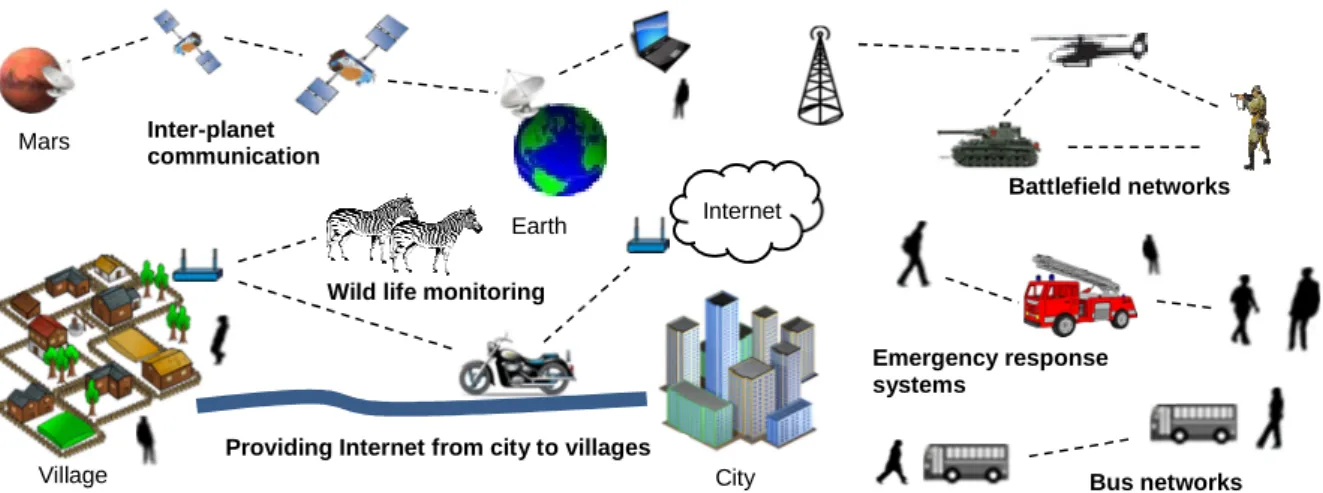
specification for interplanetary communication [3.1], [3.2]. Later on, in addition to the space communication, the focus of DTN research also shifted towards establishing communications in the challenging terrestrial network environments, such as sparsely distributed mobile ad-hoc networks and wireless sensor networks. Fig. 3.1 presents a few application areas of DTNs.
Village City Internet Mars Earth Inter-planet communication
Providing Internet from city to villages
Battlefield networks
Emergency response systems
Bus networks Wild life monitoring
3.1.1. Motivation
Wireless radio range variations, limited energy resources, sparsity of mobile nodes, and noise, to name a few, are the reasons due to which such networks suffer from frequent disruption and delay in the process of message transfer. The traditional mobile ad hoc network (MANET) routing protocols, such as OLSR [3.24], AODV [3.25] and DSR [3.26] are not suitable for network environments with frequent disruptions, as such protocols require the existence of end-to-end communication paths among sources and destination nodes. The inherent uncertainty about network conditions makes message routing in DTNs a daunting task. In the absence of end-to-end routing paths, nodes have to rely on opportunistic contacts to exchange messages. There is no guarantee that a message eventually reaches the destination, as the message may be dropped due to network congestion, or life time expiry, yielding a best effort delivery service. Therefore, it is quite difficult for a DTN routing protocol to achieve a 100% message delivery.
The typical performance metrics for DTN routing are: (a) message delivery ratio, (b) message latency, and (c) message overhead. Delivery ratio is the percentage of messages
delivered successfully. A message’s latency is the total time spent between message creation and delivery to the destination. Overhead indicates the number of extra transmissions for each
delivered message. Primary objective of a DTN protocol is to improve message delivery ratio with minimum latency and overhead, in a network with limited resources. Therefore, DTN protocols adopt various strategies and heuristics to improve the routing performance, and are generally categorized as [3.3]: (a) deterministic, (b) enforced, and (c) opportunistic. Among the aforementioned categories, opportunistic routing is the most challenging, as it is applied to networks where nodes’ mobility information is not known beforehand, and nodes have to rely on random contacts for message transfer. Moreover, to transfer data to potential intermediate relay nodes, opportunistic routing utilizes various heuristics to find the suitability and fitness of a
relay, such as (a) relay affiliation with community, (b) contact duration, (c) available bandwidth,
(d) available storage at relay nodes, (e) message expiration time, and (f) message priority [3.3],
[3.4]. An ever increasing number of protocols addressing “opportunistic” DTN scenarios have been proposed in the past. However, still it is not much clear how existing solutions can be applied to a variety of DTN applications, given their requirements and underlying network characteristics. Moreover, to this date, there is no specific study that performs large scale comparison of different routing schemes and gives a solid argument against or in favor of a specific protocol in a particular scenario and underlying network characteristics.
3.1.2. Contributions
In recent years, numerous comparative studies have been conducted for DTN protocols, under various parameters, simulation platforms, and mobility scenarios [3.3], [3.5]–[3.7]. All such studies to some extent presented useful comparisons for DTN protocols. However, most of the evaluations were limited in terms of: (a) number of protocols compared, (b) simulation parameters, and (c) DTN scenarios. We address this very problem in this chapter by presenting a thorough empirical comparison of ten carefully chosen “opportunistic” routing protocols. These ten protocols were selected because they seemed to be most appropriate in addressing the routing challenges for diverse DTN environments [3.8], [3.9]. Moreover, the protocols cover a broad range of routing scenarios, such as, single-copy forwarding, replication/flooding, probabilistic routing, greedy, and nature inspired content dissemination techniques. The protocols are evaluated with Opportunistic Network Environment simulator (ONE) [3.10] by using both real-world traces [3.11] and synthetic mobility scenarios. Moreover, evaluations are done for performance metrics, such as (a) delivery ratio, (b) latency, and (c) overhead, so as to fully
knowledge, this is the first study that presents an extensive benchmarking of DTN protocols under diverse network conditions and parameters.
In addition to the benchmarking, we go one step further by proposing three DTN routing protocols, namely, Enhanced Epidemic Scheme (EES), Adaptive Multi-Copy Spray (AMS), and Adaptive Source Token Multi-Copy Spray (ASTMS), by improving the models of the existing routing schemes. The presented techniques efficiently utilize the available network information to control message replication frequency, by autonomously adapting to the varying network conditions, and find optimal spatiotemporal routes for messages. The controlled distribution of message copies helps the efficient utilization of network resources, resulting in the improved delivery ratio and overhead performance. In summary, our contributions in this chapter are as follows:
(1) We present the basic building blocks of DTN routing and discuss the various critical components that must be considered in designing of an efficient DTN protocol.
(2) We perform the empirical benchmarking of ten carefully-selected DTN routing schemes to evaluate their performance under the similar platform and scenarios. This provides a good and useful comparative study of routing protocols in terms of their strengths and weaknesses.
(3) The routing protocols are evaluated by varying different parameters, such as: (a) number of nodes, (b) message creation rate, (c) buffer size, (d) message size, and (e) bandwidth. The evaluation results are generated by using both the synthetic mobility models and the real mobility traces.
(4) We propose three new DTN routing protocols by enhancing the models of the existing schemes. By introducing adaptability features in the proposed schemes, the protocols are able to control message replication frequency by autonomously adapting to the time
varying network conditions. Our results indicate significant improvement in performance of the proposed schemes in terms of delivery ratio and overhead.
The rest of the chapter is organized as follows. Section 3.2 demonstrates DTN routing problem and discusses the important factors that must be carefully considered in modeling of a DTN protocol. In Section 3.3, we present a comparative analysis of the ten selected DTN routing protocols with an emphasis on the strengths and weaknesses of each the protocol. The simulation and benchmarking of the protocols under real-world traces and synthetic mobility is performed in Section 3.4. In Section 3.5, we present the models of the three new routing schemes and analyze their performance in comparison with existing schemes.
3.2. DTN Routing Insights
The routing problem in DTNs can be expressed as: “Which messages to transfer during
an opportunistic contact, such that, they contribute to overall improvement of network performance parameters, such as communication overhead, delivery ratio, and delay?” It is
quite challenging to find a precise answer to this question as the routing performance is affected by many factors, such as: (a) message size, (b) message rate, (c) message life-time, (d) buffer size, (e) bandwidth, (f) transmission range, (g) interference, (h) node speed, (i) node energy, (j) mobility pattern, (k) node’s sleep intervals, and (l) network size. The numerous combinations and values of the aforementioned factors constitute the different DTN scenarios. The
applicability of a DTN protocol for various scenarios depends on the number of aforementioned factors considered while designing a protocol. In the following subsections, we define the basic building blocks of DTN routing and discuss various critical factors that affect the performance of a DTN protocol.
3.2.1. Forwarding versus Replication
Message transfer in DTN routing is achieved through either forwarding or replication [3.12]. When a message is forwarded to a neighbor, the sending node deletes the local copy of message from the buffer. This way, only a single copy of message stays in the network [3.12]. Alternatively, when the message is replicated, both the sending and receiving nodes carry a separate copy of the same message. Forwarding yields minimum overhead and consumes less buffer space as there are lesser number of messages in the network. However, the decrease in message replicas also decreases the probability that a message will be delivered to the
destination. Therefore, forwarding is mostly applicable for deterministic DTN environments, where nodes’ mobility patterns are known beforehand or can be precisely predicted. Message replication frequency may be controlled [3.13] or uncontrolled [3.14]. The controlled replication scheme replicates a message only when a certain condition is satisfied. For example, the
neighbor node is more likely to encounter with the destination node as compared to the node carrying the message. The uncontrolled replication is a flooding based technique in which maximum copies of the same message are floated unconditionally in the network. Increase in message copies also increases probability of a message reaching the destination, but at the cost of higher overhead and buffer consumption. Therefore, increased replication rate may also increase the message drop due to buffer overflows, which may reduce the overall delivery ratio.
3.2.2. Metadata Exchange
The routing protocols differ in the way they utilize the amount of information or
metadata to perform message transfer decisions [3.3]. In many protocols, nodes maintain a
record of their contacts with other nodes in the form of a list , , , having parameters:
(a) node identification , (b) contact time , contact duration , and (c) bytes transferred , respectively [3.6], [3.15]. Based on the metadata, a node computes optimal routes for each
message. The uncontrolled replication-based routing schemes do not utilize metadata [3.12], [3.14] as compared to the controlled replication-based routing schemes [3.6], [3.15], which utilize metadata to improve performance at the cost of increased complexity and computational requirements. When two nodes make a contact, the nodes share and update their respective metadata. This enables the information symmetry throughout the network.
3.2.3. Buffer Management
Routing schemes also differ in the way they employ buffer management policies. The buffer management typically includes: (a) message queue sorting and (b) message deletion. Message queue sorting is performed by assigning priorities to the messages, and a message of least priority may be deleted. One factor that influences the buffer management is available
contact time window, which is the time duration between initialization and termination of
connection between any two nodes. Suppose, a node is at location and has a transmission range . The node needs to transfer messages of size X bytes to the neighbor node which is at the location is and have the transmission range . Let the bandwidth available for this
communication be Y bytes/s. Then, the total time required for the transfer of X bytes messages equals / . When the two nodes communicate, they are in each other’s effective range, which is mathematically represented as:
| | ! " #$ , % . (3.1)
Let ')))*( and ')))*+ be velocities of both nodes, respectively. The contact duration window between the two nodes can be calculated as follows:
, 2 . " # / , 0 . 123 4 |'(
where 4 is the angle between the relative velocity |'))))* '( ))))*+| and the straight line (distance vector) between the two nodes. Let " and # be the number of messages that both the nodes and need to transfer, respectively, then there must be sufficient time available for transfers, specified by:
5 6 78 9 5 : 78 ; , < . (3.3)
In above equation, the parameter < is scaling factor that depends on time spent in metadata exchange (control signaling) and link delays. An important question arises here, and can be stated as, “Given a limited contact duration, which messages should be given priority
over others?” In [3.7] the messages are prioritized on the basis of their size, such that the
messages that can fit in the real-time contact window are transferred first, whereas in [3.15] messages with low hop counts are given priority for quicker dissemination in the network. Lindgren et al. [3.13] gives priority to those messages whose destinations are most encountered by the neighboring relay node, whereas authors in [3.6] assign priorities to messages whose
utility contributes to improvement of routing performance. In the next section, we briefly define
the ten selected routing protocols and discuss the merits and demerits of each.
3.3. DTN Routing Protocols
For evaluation, we selected the following ten routing protocols: (a) Direct Transmission [3.16], (b) First Contact [3.12], (c) Epidemic [3.14], (d) Wave [3.17], (e) Life [3.17], (f) Spray
and Wait [3.18], (g) Spray and Focus [3.19], (h) PRoPHET [3.13], (i) MaxProp [3.15], and (j) Rapid [3.6]. The aforementioned protocols cover a broad range of scenarios and DTN
applications. For instance, the MaxProp [3.15] and Rapid [3.6] protocols were designed specifically to target a bus-based DTN scenario, where nodes as buses follow mobility at fixed schedules. The protocols, such as Epidemic [3.14], Wave [3.17], Life [3.17], Spray and Wait [3.18], and Spray and Focus [3.19] in general address the scenarios where nodes mostly follow
random mobility patterns. Alternatively, the Direct Transmission [3.16], First Contact [3.12], and PRoPHET [3.13] protocols are designed to target the scenarios where the meeting schedules of nodes can be predicted. Because of diverse properties, the selected set of protocols provide a thorough investigation of the various insights about DTN routing schemes. We begin with the simplest routing protocol of the abovementioned list, and gradually proceed towards more complex models. The discussion gives us an insight into how an increase in complexity of protocols improves the performance for one metric at the cost of another.
3.3.1. Direct Transmission
Spyropoulos et al. [3.16] presented the simplest of DTN routing protocols. As the name suggests, the source node directly transmits the message to the destination node without any intermediate relaying. Therefore, at any time, only a single copy of message is present in the network. The benefit of Direct Transmission scheme is that it causes minimum overhead due to reduction in messages’ copies. However, the source nodes may have to wait for longer periods or indefinitely to make direct contacts with the messages’ destinations. Therefore, Direct
Transmission may experience maximum latency as well as the minimum message delivery ratio.
The Direct Transmission scheme may be useful for DTN scenarios where nodes’ mobility pattern can be precisely predicted. One such application can be bus networks where buses followed fixed schedules for various routes.
3.3.2. First Contact
The First Contact scheme [3.12] allows a node to forward a message towards a randomly selected neighbor. After the message is successfully forwarded, the sender node deletes local copy of message. The message may be relayed through several hops before reaching the