Interactive Machine Learning for End-User Innovation
Francisco Bernardo, Michael Zbyszy ´nski, Rebecca Fiebrink and Mick Grierson
Goldsmiths University of London Department of Computing
London, UK
Abstract
User interaction with intelligent systems need not be lim-ited to interaction where pre-trained software has intelligence “baked in.” End-user training, including interactive machine learning (IML) approaches, can enable users to create and customise systems themselves. We propose that the user ex-perience of these users is worth considering. Furthermore, the user experience of system developers—people who may train and configure both learning algorithms and their user interfaces—also deserves attention. We additionally propose that IML can improve user experiences by supporting user-centred design processes, and that there is a further role for user-centred design in improving interactive and classical ma-chine learning systems. We are developing this approach and embodying it through the design of a new User Innovation Toolkit, in the context of the European Commission-funded project RAPID-MIX.
Introduction
When considering the user experience of machine learn-ing systems, it is important to consider the experiences of users designing, training, evaluating, and refining such sys-tems. One relevant group of users is the “end users” of software tools in which machine learning facilitates per-sonalisation or adaptation. Tools that afford customisation or adaptation—for instance by learning on user-provided training examples—are useful in domains including the cre-ation of new control interfaces for people with disabilities, data monitoring applications for “quantified self” or smart homes, new interactive interfaces for music and art, and the creation of diverse sensor-driven interactions by hackers and makers.
Interactive machine learning (IML) approaches can en-able such users to create and customise machine learning applications. Fails and Olsen 2003 define IML as a new machine-learning paradigm with a workflow that features rapid, iterative cycles of the user training a model, evalu-ating its performance, and modifying the model to improve its performance. In the simplest case, users can interact with the machine learning process by iteratively providing new training examples (e.g., examples of a human action or ac-tivity, alongside the label that a classifier should apply to
Copyright c2017, Association for the Advancement of Artificial Intelligence (www.aaai.org). All rights reserved.
that action/activity). In this paper, we describe how IML can support new types of end-user customisation, which can be understood in terms of end-user development (Lieberman et al. 2006) or of user innovation (von Hippel 2005). We de-scribe considerations and challenges for supporting user ex-perience in this context. We also discuss a similar context, that of system developers employing machine learning to create intelligent systems for use by others. These develop-ers are also “usdevelop-ers” of machine learning tools, and the tools they use influence the type of systems that can be built and the types of experiences that are possible for their end users. We also describe how IML and user-centred design pro-cesses may inform one another. User-centred design (UCD) (Norman and Draper 1986) is an approach to design based upon the understanding of users, their tasks, and environ-ments; it involves the user at an early stage of project de-velopment and throughout the project lifetime. In UCD, the design is driven and refined through an iterative cycle of de-velopment and user-centred evaluation. IML provides a set of mechanisms to support UCD, by making it possible to translate users’ demonstrations or observations of user ac-tions into training examples that are used to build or refine a new technology. At the same time, UCD can and should play a role in the design of interactive and classical machine learning systems, whether aimed at developers or end users. We frame our work in the context of innovation studies, where we introduce the concept of User Innovation Toolkits (von Hippel 2001) and explain how we are appropriating it to create IML tools to support end-user innovation.
The final section of our paper describes RAPID-MIX, a design project that places next-generation machine learning tools in the hands of end users in the form of a User Innova-tion Toolkit (von Hippel 2001). We describe the aims of this project and the methodologies employed to understand and improve the user experiences of both end users and profes-sional developers using machine learning to build new inter-active systems.
Claims
Interactive machine learning can enable end-user
customisation
As described above, IML can make it possible for end users to create customised systems. Typically, IML users
itera-tively adjust training data or learning parameters to “steer” a machine-learned model toward a desired behaviour. A user interface for IML may enable users who have domain ex-pertise (but possibly no machine learning exex-pertise) to steer models by providing new training examples (Fiebrink 2011; Fails and Olsen Jr 2003), adjusting misclassification costs (Kapoor et al. 2010), adjusting weightings of component classifiers in an ensemble system (Talbot et al. 2009), or taking other actions. This approach can be used to create simple computer vision classifiers (Fails and Olsen Jr 2003), new sensor-based interactions (Hartmann et al. 2007), cus-tomised gestural controllers including new musical instru-ments (Fiebrink 2011), customised alerts (Amershi et al. 2011), and potentially many other bespoke systems.
Amershi et al. (2014) describe the IML workflow as more rapid, focused and incremental than classic machine learn-ing (CML), which can be laborious and sometimes ineffi-cient. IML can also offer users without machine learning or programming expertise an effective way to customise sys-tems. For instance, systems that learn to recognise human gestures or mimic human decision-making can be trained on users’ own demonstrations of gestures or decisions. When systems make mistakes, users can often fix them providing corrective demonstrations to the system rather than chang-ing the machine learnchang-ing algorithm or program code. For in-stance, a user can provide additional examples of an action that was misclassified by a trained model, along with the cor-rect label for this action, and reasonably hope that the next model trained on the augmented training set will improve its performance on that type of action. IML can thus be under-stood as a tool for end-user programming, as well as a way to “democratise” machine learning, making the benefits of learning algorithms realisable by a wider range of people.
Based on work by Fiebrink and collaborators (Fiebrink, Cook, and Trueman 2011; Fiebrink et al. 2010; Fiebrink 2011), we argue that using IML for end-user programming and customisation can provide the following advantages: • IML can be used by people without programming or
ma-chine learning expertise.
• IML can facilitate rapid prototyping and iterative refine-ment activities which are known to be important to design of new systems.
• Providing training examples can be a direct and effective way for a user to communicate the desired behaviour of a system, particularly when designing a system to recognise or respond to human actions. Even expert programmers may have difficulty coding how an embodied activity is to be analysed, but may be able to easily demonstrate an example of the activity.
At the same time, supporting end-user customisation with IML presents several challenges:
• It may be hard for users to reason about how well a sys-tem will work in the future. Fiebrink et al. (2011) show that conventional metrics of quality computed from the training data (e.g., cross-validation) are inappropriate for IML systems in which the user employs training data to steer the model behaviour. It may not be clear how to as-sess whether a model is trustworthy, how to identify likely
model mistakes, or how to do these efficiently (i.e., with-out experimentally feeding the model new data and ob-serving its response).
• It may be difficult for users to select or construct appro-priate features. Many real-world applications cannot be built easily from raw data, but rather require some pro-cessing of the data in order for learning to be possible. For instance, building new interactions with sensors may require smoothing, segmentation, or analysis of statistics over time windows. Such feature engineering can be diffi-cult even for users with programming and signal process-ing expertise.
• It may be difficult to collect appropriate training data and understand this data, especially when the user’s goal is to build a system that generalises well to new users or environments whose data he/she cannot easily replicate for training or testing.
• It may be difficult for end users to connect machine learn-ing tools to other tools of interest (e.g., existlearn-ing systems for home automation, music, activity sensors, etc.) Exist-ing sensors, hardware, and software may not use interop-erable or open communication protocols.
• Not all designs a user might imagine will be learnable with the available algorithms, features, and data. Users may struggle to understand what is learnable and what is not.
IML can also be useful for developers and
designers
Even when the end user interacts with a pre-trained intelli-gent system, the user experience of the developer or designer deserves consideration. Both the set of supported learning algorithms and user interfaces for employing those algo-rithms affect the developer experience. Just as with end-user development, IML can allow developers to build new sys-tems by demonstration, resulting in a faster development process. When the goal is to build a system that responds to complex phenomena the developer cannot easily describe in code (e.g., high-dimensional or noisy sensor data, or em-bodied interactions), IML can also result in systems that are more accurate in their labeling or response to new data.
The speed, directness, and iterative nature of interaction involved in IML makes it a good fit for supporting rapid pro-totyping for interaction design. IML-based propro-totyping tools like Wekinator (Fiebrink, Cook, and Trueman 2011) and Ex-emplar (Hartmann et al. 2007) can yield a smaller gulf of execution (Norman and Draper 1986) than other techniques for building functional interactive systems. Furthermore, re-ducing the time needed to instantiate and modify prototypes facilitates exploration of the design space.
Improving the interfaces used by developers can make the process of training machine learning systems more efficient and effective (e.g., Patel et al. 2010, Amershi et al. 2015). Yet developers still face many challenges in applying ma-chine learning effectively, and not all these have obvious so-lutions. In addition to the challenges facing end users, de-scribed above, developers and designers must translate their
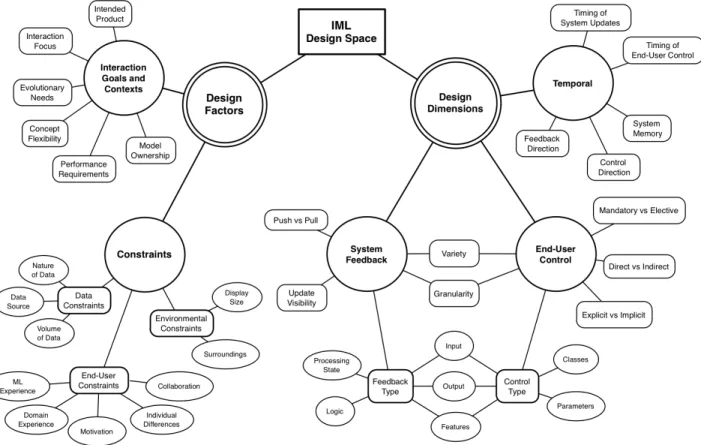
Figure 1: Design space for end-user interaction with machine learning, abstracted from Amershi’s (2012) textual description of design factors and dimensions.
design ideas into choices about machine learning configu-rations. For instance, developers may may have to choose among the many potentially useful learning algorithms. A developer of a gestural control system may choose between classification, regression, and temporal modelling methods such as hidden Markov models. Variants of these algorithms have also been designed specifically to support interactive training or new types of user interaction (e.g., hierarchi-cal HMMs enable gesture segmentation and tracking within segments (Franc¸oise et al. 2014)). Each algorithm may af-ford a different type of interaction by end users, as well as different trade-offs in accuracy, training time, the number of training examples needed, and so on. Developers may also struggle with feature engineering, despite having more sig-nal processing and programming expertise than end users. They may also encounter substantial challenges in under-standing and cleaning training datasets collected from target users.
Another significant challenge is that designers of systems that allow end-user customisation must choose which inter-actions to expose and how to expose them in a user interface. Amershi (2012) argues that there are a lack of established principles and proven techniques for designing interaction with machine learning, and that knowledge should advance from ad-hoc solutions into generalized understanding about the IML process.
IML can support user-centred design
UCD typically involves iterative cycles of working with users to identify design directions, implementing prototype designs, and getting feedback from users. IML can acceler-ate this iteration for the design of systems that respond to hu-man gestures or actions, or to other events that can be easily simulated or demonstrated by end users. IML can be used to collect training examples directly from user demonstra-tions and to instantiate new prototype designs on the spot, which is useful to elicit feedback from users. Or, design-ers or developdesign-ers can translate observations of usdesign-ers in UCD activities into training examples for the system being devel-oped. We have previously used both approaches to develop new gestural musical instruments for people with disabilities (Katan, Grierson, and Fiebrink 2015).
UCD should be applied to IML & CML
UCD can and should be applied to understanding and im-proving usability of interactive and classical machine learn-ing, by both end users and developers. Talbot et al. (2009) observe that “a critical human-computer interaction chal-lenge is to provide adequate tools to allow non-experts to wield [machine learning] techniques effectively. In order to design these tools, we must start at current best practices in applied machine learning and identify tasks that can be sup-ported or augmented by an effective combination of human
intuition and input with machine processing” (p. 1283). This challenge and the previously enumerated ones in the sections above cannot be met by algorithmic or technical innovation alone. Rather, meeting these challenges requires understand-ing of users’ practices and goals.
Amershi (2012) highlights the importance of studying users of interactive machine learning applications based on the tighter link that is established between learning systems and their users. She found that users’ goals have a significant impact on the success of system design; for instance, design requirements can be influenced by whether end users want to train an accurate or a reusable model; or, whether they are interacting directly with machine learning or using it in the background. These factors can lead to interface designs that differ, for instance, in terms of provisions for alternative mechanisms for end user control and system feedback, and varying degrees of guidance about the quality of the model. These are just a few examples of many factors that impact and constrain how people interact with machine learning systems, which Amershi has distilled into a description of the design space for interactive machine learning (Figure 1). Prior work contains a number of examples of how UCD processes can improve the user experiences of developers and end-users applying machine learning. For instance, Pa-tel et al. (2010) worked with software developers to create improved development environments for applying conven-tional machine learning. Fiebrink et al. (2010) used partici-patory design processes with composers both to design more usable interfaces for applying interactive machine learning to musical instrument design, and to better understand the utility of machine learning in this application domain.
The goals of understanding and improving user experi-ences with machine learning should also apply when the “in-terface” employed by the user is a software API. This is the case for many developers who currently use a variety of ma-chine learning libraries to create new software. Some exist-ing research considers the user experience of programmexist-ing languages, IDEs, and APIs (e.g., (Ko and Riche 2011)), but very little research has considered the challenges that are unique to developers working with machine learning. Un-derstanding the needs of developers building real-time sen-sor applications and using that understanding to build better APIs are current goals of the RAPID-MIX project.
An innovation studies perspective on IML
Fagerberg (2013) defines innovation studies as “the study of how innovations emerge and diffuse, what factors influence these processes..., and what the social and economic conse-quences are.” (Fagerberg 2013)One branch of research within innovation studies consid-ers end usconsid-ers’ involvement in innovation activities (Von Hip-pel 1986; Flowers et al. 2010). This work provides a com-plementary perspective to human-computer interaction re-search on end-user programming, development, and cus-tomisation. Whereas HCI research tends to focus on under-standing and supporting end-user engagement, innovation studies research is more concerned with the economic and social contexts that motivate end-user development or
cus-tomisation, as well as the factors that contribute to the suc-cess of end-user innovation.
For instance, von Hippel (1986) notes that in markets with highly heterogeneous consumer needs, certain end users— “lead users”—are highly motivated to develop products for their own needs, and well-positioned to anticipate general demand and identify specific market needs for new products. In many of these cases, both end users and product develop-ers can benefit from the existence of user-innovation toolk-its (UITs), which von Hippel (2001) defines as “integrated sets of product-design, prototyping, and design-testing tools intended for use by end users” (p. 163). The fundamental principle behind UITs is to repartition product development tasks by shifting design activities to end users, enabling them to design high-quality custom products, or to customize es-sential parts of products, and meet their needs in a more ac-curate and complete way. Integrated circuits (ICs) are the seminal early example a UIT that efficiently and flexibly en-abled end-user innovation (von Hippel 2001). Other exam-ples include game level editors such as Final Alert 2 (Jeppe-sen and Molin 2003) and music synthesis environments such as Propellerhead’s Reason (Jeppesen and Frederiksen 2006). Von Hippel (2001) identified the conditions in which user-innovation toolkits are able to provide the highest value:
i) for types of products and services in which users require high degrees of customisation;
ii) when users have “sticky” information, i.e., need-related, context-of-use or product usage information that is costly to acquire, transfer and apply, and which might grow outdated quickly;
iii) when users “must engage in learning by doing to clarify what they want” (p. 22).
IML offers a set of techniques for addressing these needs in many contexts: As we have discussed earlier in this paper, IML can support efficient customisation and prototyping. General-purpose machine learning algorithms enable learn-ing of diverse concepts, maklearn-ing them suitable for heteroge-neous user needs. IML provides users with natural ways to embed specialist or changing knowledge about the intended design into a new system.
Work in innovation studies can therefore inform the cre-ation of IML tools that aim to support end-user innovcre-ation, and it can also suggest new uses of IML in creating or im-proving UITs across a variety of application domains. For instance, Von Hippel (2001) discusses the importance of UITs that enable user learning and problem solving through trial-and-error. This suggests that IML tools for innovation should gracefully accommodate user mistakes and back-tracking (e.g., by supporting multiple levels of “undo”-ing, such as rolling back user changes to the training examples). Von Hippel also notes the importance of UITs facilitating the translation of users’ designs into production. This suggests it may be beneficial to provide IML users with easy ways to use trained models outside of prototyping environments, for instance embedding them into users’ own software or hard-ware projects.
RAPID-MIX
We are currently participating in a research project involv-ing the application of UCD methodologies to improve tools for applying machine learning and, by extension, the in-teractive systems built with these tools.Real-time Adaptive Prototyping for Industrial Design of Multimodal, Interac-tive and eXpressive technologies(RAPID-MIX) is an Inno-vation Action funded by the European Commission under the Horizon 2020 program. The RAPID-MIX consortium aims to accelerate the production of the next generation of multimodal, interactive, and expressive technologies, such as gesturally-controlled musical instruments and games and immersive audiovisual experiences. Specifically, we aim to accelerate this production by creating hardware and software tools for rapid prototyping and product development, and placing these tools in the hands of developers and designers in the form of a UIT (von Hippel 2001).
The members of the RAPID-MIX consortium, which include three European research labs and five small and medium—sized creative technology enterprises, have estab-lished research portfolios in the design and evaluation of em-bodied and wearable human-computer interfaces for creative and music technology. We have also developed and accumu-lated a significant portfolio of technologies for multimodal and expressive interaction, including music information re-trieval and digital signal processing libraries, cloud-based repositories for storing and visualizing audiovisual and mul-timodal data, and the following tools for applying IML: • Wekinator (Fiebrink, Cook, and Trueman 2011): a
general-purpose, standalone application for applying ma-chine learning. It provides a high-level interface to super-vised learning algorithms and their parameters, and it en-ables users to rapidly create and edit datasets, train and run models in real time.
• XMM (Franc¸oise, Schnell, and Bevilacqua 2013): li-braries for using Hierarchical Hidden Markov Models for classification and regression to model gesture and sound parameters, and for creating mappings between gesture and sound in interactive music systems.
• Gesture Variation Follower (Caramiaux et al. 2015): a library for real-time gesture recognition and analysis that employs a template-based method using Sequential Monte Carlo inference.
We are integrating these technologies into a UIT for ap-plying IML to sensors, audio, and other realtime data. This UIT includes developer-facing libraries with a modu-lar and multi-layered architecture for device and cross-platform deployment. The UIT aims to make IML efficient and accessible to developers who are new to machine learn-ing by providlearn-ing high-level APIs with default settlearn-ings—such as the choice of learning algorithm and its parameters—that are appropriate for many interaction prototyping applica-tions. For instance, developers prototyping interactions will often provide very small datasets, because they are creating training data by demonstrating interactions at the moment of design rather than curating large datasets in advance. Learn-ing algorithms such as nearest-neighbour may be more
ap-propriate in this context than in more conventional machine learning applications.
Our UIT also includes access to lower-level parameters of the learning algorithms and data processing pipeline, along with numerous examples, to help intermediate and expert users engage in more complex projects. Our UIT also in-cludes mechanisms for exporting trained models and data processing chains from rapid prototyping environments, and running them in production environments (e.g., within other C++ or JavaScript applications).
To facilitate the design of these tools, we have developed a UCD framework that provides a set of guidelines for UCD research actions, which will be used to answer and refine key research questions within the RAPID-MIX project. We are performing multiple UCD actions, including co-design workshops with project partners, hack-a-thons, public work-shops, and interviews with professional developers as well as students and hobbyist developers. These actions con-tribute to define the design space of the UIT based on in-sights that were obtained from:
i) Assessing and aligning the consortium partners’ think-ing through ideation, identification of scenarios and de-sign challenges.
ii) Deploying technology probes based on early and back-ground technologies.
iii) Prototyping the integration of component technologies into new products.
iv) Defining an initial set of target users and contexts of use, and evolving gradually to a more scoped definition based on user engagement.
v) Gathering of direct insights from the future users of the toolkit.
vi) Evaluating early products from industry partners, and their integration of the alpha version of the UIT. Early UCD actions focused on refining and understanding the primary users of the UIT. These include web develop-ers, mobile developdevelop-ers, game developdevelop-ers, creative coddevelop-ers, in-teraction designers, data analysts/scientists, hackers/makers, researchers and students, teachers, professional audio devel-opers, music creators, and composers.
Deployment of technology probes and testing of early prototypes and UID implementations has led to some better understanding of challenges that exist for these users. For instance, we have found that many participants in our UCD actions struggle to grasp fundamental concepts of machine learning (e.g. classifier, labels, numerical data comes in and labels come out), even when users are professional devel-opers when they are provided with documentation. This has informed our approach to documenting our UIT, which goes beyond code documentation to include interactive code ex-amples as well as video tutorials of machine learning funda-mentals.
The effort of intertwining several rounds of rapid pro-totyping with user engagement uncovered design problems and specific technical challenges for the RAPID-MIX con-sortium. For instance, some of the IML technologies such as XMM were favoured over classifiers of current market
products for classifying dynamic body gestures, but seen as more difficult to use; Wekinator has been perceived as very user-friendly for beginners and designers with few program-ming skills and was used to build, but for a few participants it was appointed as limited for temporal data and recognition of continuous gestures.
We also observed in a hack-a-thon how different teams of developers were able to successfully integrate our library with their projects for basic machine learning features. Some of the feedback demonstrated that our API design approach could be facilitating understanding with respect to how ma-chine learning can aid design - for example, one participant commented that “(I) could have programmed it in a more traditional manner but I realised how ML makes it easier. You worry about it in some specific ways, here’s a couple of things, get to it and it seems to work! What RAPID-MIX brought to me is that, it’s just quite usable”. Another participant mentioned that it was “great to have a toolkit just ready to use and to plug in”. We also uncovered how, for instance, API design decisions regarding data types and containing data structures could have an impact on the con-ceptual model of professional developers and mislead which machine learning tasks to use in slightly more sophisticated projects.
Reports on our UCD methodologies and our de-sign guidelines can be found on our website at: http://rapidmix.goldsmithsdigital.com/downloads/
Conclusion
IML can enable end users and developers to customize in-teractive systems and can support UCD. Furthermore, UCD can and should be applied to the process of creating ma-chine learning applications of all kinds. These positions are informed by, and inform the RAPID-MIX project, which is ongoing. By engaging with members of the user experience design, service design, HCI, HRI and AI communities at this symposium, we hope to connect with complementary perspectives and potential users of our toolkit and use that feedback in our next cycle of design and prototyping.
Acknowledgements
The work reported here was supported in part by RAPID-MIX, an EU Horizon 2020 Innovation Action: H2020-ICT-2014-1 Project ID: 644862.
References
Amershi, S.; Lee, B.; Kapoor, A.; Mahajan, R.; and Chris-tian, B. 2011. Cuet: human-guided fast and accurate network alarm triage. InProceedings of the SIGCHI Conference on Human Factors in Computing Systems, 157–166. ACM. Amershi, S.; Cakmak, M.; Knox, W. B.; and Kulesza, T. 2014. Power to the people: The role of humans in interactive machine learning.AI Magazine35(4):105–120.
Amershi, S.; Chickering, M.; Drucker, S. M.; Lee, B.; Simard, P.; and Suh, J. 2015. ModelTracker: Redesigning performance analysis tools for machine learning. In Pro-ceedings of the 33rd Annual ACM Conference on Human Factors in Computing Systems, 337–346.
Amershi, S. 2012. Designing for Effective End-User Inter-action with Machine Learning. Ph.D. Dissertation, Univer-sity of Washington.
Caramiaux, B.; Montecchio, N.; Tanaka, A.; and Bevilac-qua, F. 2015. Adaptive gesture recognition with variation estimation for interactive systems. ACM Transactions on Interactive Intelligent Systems (TiiS)4(4):18.
Fagerberg, J. 2013. Innovation a New Guide.
Fails, J. A., and Olsen Jr, D. R. 2003. Interactive machine learning. InProceedings of the 8th international conference on Intelligent user interfaces, 39–45.
Fiebrink, R.; Trueman, D.; Britt, C.; Nagai, M.; Kaczmarek, K.; Early, M.; Daniel, M.; Hege, A.; and Cook, P. 2010. To-ward understanding human-computer interaction in compos-ing the instrument. InProc. of the International Computer Music Conference.
Fiebrink, R.; Cook, P. R.; and Trueman, D. 2011. Human model evaluation in interactive supervised learning. In Pro-ceedings of the SIGCHI Conference on Human Factors in Computing Systems, 147–156.
Fiebrink, R. 2011. Real-time human interaction with super-vised learning algorithms for music composition and perfor-mance. Ph.D. Dissertation, Princeton University.
Flowers, S.; von Hippel, E.; de Jong, J.; and Sinozic, T. 2010. Measuring user innovation in the uk: The importance of product creation by users.
Franc¸oise, J.; Schnell, N.; Borghesi, R.; and Bevilacqua, F. 2014. Probabilistic models for designing motion and sound relationships. InProceedings of the 2014 International Con-ference on New Interfaces for Musical Expression, 287–292. Franc¸oise, J.; Schnell, N.; and Bevilacqua, F. 2013. A multimodal probabilistic model for gesture–based control of sound synthesis. InProceedings of the 21st ACM interna-tional conference on Multimedia, 705–708. ACM.
Hartmann, B.; Abdulla, L.; Mittal, M.; and Klemmer, S. R. 2007. Authoring sensor-based interactions by demonstra-tion with direct manipulademonstra-tion and pattern recognidemonstra-tion. In Proceedings of the SIGCHI conference on Human factors in computing systems, 145–154.
Jeppesen, L. B., and Frederiksen, L. 2006. Why do users contribute to firm-hosted user communities? the case of computer-controlled music instruments. Organization sci-ence17(1):45–63.
Jeppesen, L. B., and Molin, M. J. 2003. Consumers as co-developers: Learning and innovation outside the firm. Tech-nology Analysis & Strategic Management15(3):363–383. Kapoor, A.; Lee, B.; Tan, D.; and Horvitz, E. 2010. Inter-active optimization for steering machine classification. In Proceedings of the SIGCHI Conference on Human Factors in Computing Systems, 1343–1352.
Katan, S.; Grierson, M.; and Fiebrink, R. 2015. Using in-teractive machine learning to support interface development through workshops with disabled people. In Proceedings of the 33rd Annual ACM Conference on Human Factors in Computing Systems, 251–254.
Ko, A. J., and Riche, Y. 2011. The role of conceptual knowl-edge in API usability. InVL/HCC, 173–176.
Lieberman, H.; Patern`o, F.; Klann, M.; and Wulf, V. 2006. End-user development: An emerging paradigm. InEnd user development. Springer. 1–8.
Norman, D. A., and Draper, S. W. 1986. User centered design.New Perspectives on Human-Computer Interaction. Patel, K.; Bancroft, N.; Drucker, S. M.; Fogarty, J.; Ko, A. J.; and Landay, J. 2010. Gestalt: Integrated support for imple-mentation and analysis in machine learning. InProceedings of the 23nd annual ACM symposium on User interface soft-ware and technology, 37–46.
Talbot, J.; Lee, B.; Kapoor, A.; and Tan, D. S. 2009. En-sembleMatrix: interactive visualization to support machine learning with multiple classifiers. In Proceedings of the SIGCHI Conference on Human Factors in Computing Sys-tems, 1283–1292.
Von Hippel, E. 1986. Lead users: A source of novel product concepts.Management science32(7):791–805.
von Hippel, E. 2001. User toolkits for innovation. Journal of product innovation management18(4):247–257.
von Hippel, E. 2005. Democratizing innovation: The evolv-ing phenomenon of user innovation. Journal f¨ur Betrieb-swirtschaft55(1):63–78.