EPOS, XVIII (2002), págs. 309-323
BODY PART METONYMIES IN ACTION AND
PERCEPTION FRAMES: A COGNITIVE ANALYSIS
O L G A ISABEL D Í E Z VELASCO
Universidad de La Rioja
ABSTRACT
In Cognitive Linguistics studies on metonymy have been mainly c o n c e r n e d with its c o n c e p t u a l n a t u r e w h e r e a s its i m p a c t on g r a m m a r has generally not recei-ved m u c h a t t e n t i o n . H o w e v e r , in the last few y e a r s some a u t h o r s have s t a r t e d to pay a t t e n t i o n to t h e k i n d of c o n s t r a i n t s t h a t metonymy imposes on g r a m m a r . In this p a p e r we d e s c r i b e metonymies a p p e a r i n g within t h e action a n d p e r c e p t i o n frame focusing on t h e i r motivation a n d realisation p a t t e r n s . W i t h i n t h e action fra-me o u r study c e n t r e s on t h e A C T I O N F O R P R O C E S S m a p p i n g ; a n d within t h e p e r c e p t i o n frame we posit the existence of the P E R C E P T I O N F O R E X P E R I E N -T I A L E V E N -T m e t o n y m y . Finally, t h e analysis reveáis t h a t b o t h metonym.es a r e significant b o t h at a c o n c e p t u a l a n d at a g r a m m a t i c a l level.
1. INTRODUCTION
Cognitive linguists consider both metaphor and metonymy conceptual mechanisms for reasoning and understanding. Within this trend, metaphor and metonymy are described as mappings or sets of correspondences between
con-3 1 0 OLGA ISABEL DÍEZ VELASCO
ceptual domains (Lakoff and Johnson, 1980; Lakoff, 1987). The difference be-tween them lies in the nature of the domains involved: in metaphor there are two sepárate domains whereas in metonymy we find a domain-subdomain re-lationship. Although both phenomena were regarded as equally importan!, ini-tially most of the work was devoted to metaphor. However, in the nineties some scholars tumed their attention to metonymy (Dirven, 1993, 1999; Panther and Thomburg, 1996,1999; Ruiz de Mendoza, 1996, 1997, 1999) so that a great deal of research was carried out (c.f. the collection of articles compiled in Panther and Radden, 1999; Barcelona, 2000 and the references therein).
One of the most interesting topics in metonymy theory has been brought up by Kovecses and Radden (1998) and Radden and Kovecses (1999) who have posited the existence of some high-level principies which account for every metonymic mapping. Thus, Panther and Thomburg (1999, 2000) have offered detailed analyses of some of these high-level metonymies such as the POTEN-TIALITY FOR ACTUALITY or the EFFECT FOR CAUSE mappings. More-over, Ruiz de Mendoza and Pérez (2001) have contended that high-level metonymies (e.g. ACTION FOR PROCESS) may place constraints on grammar. According to them, one of the phenomena where this interaction between metonymy and grammar is better observed is grammatical metonymy, which is defined as a metonymic mapping which carries syntactic consequences. Ruiz de Mendoza and Pérez offer a classification of grammatical metonymy which is based on a fundamental distinction: the scope of the grammatical transformation; that is to say, whether the change is just syntactic or whether it also affects the intemal characterisation of the source domain of the metonymy. The former case, which is the main concern of our analysis, works mainly at predícate level (e.g. ACTIVITY FOR THE EVENT WHICH IS CAUSEO BY IT) whereas the latter case occurs whenever a recategorization process takes place as a consequence of the metonymic mapping (AGENT FOR ACTION). Besides, we have noted that grammatical metonymy at predícate level affects the sentence differently de-pending on the type of ICM ' in which it is included (namely, the Action and Per-ception ICMs); for this reason, our analysis will attend to this distinction and we shall describe those metonymies appearing within the action and the perception frame, paying special attention to their motivation and realization pattems.
Becau.se of space reasons we will limit our analysis to those metonymic types which contain a body part in their instantiation. Our choice is motivated by the productivity of body parts in deriving metonymic meanings (c.f. Kovecses and
' The notion of ICM was introduced by LAKOFF (1987) and can be defined as a domain of knowledge that results from the activity of a structuring principie.
Body part metonymies in action and perception frames: a cognitive analysis 311
Szabo, 1996; Niemeier, 2000). Thus, body parts inherently play a role in our un-derstanding of the world. We can only interact with the outer world by means of our bodies just as we perceive stimuli from the world through them. Therefore, they are likely to have a crucial role within the action and perception frames.
2. T H E ACTION FRAME
Action ICMs include a number of participants which interact and are some-how related to the action. Thus, an action typically includes an agent, a goal (or affected entity since the action is directed at it), a beneficiary and an instrument. Most of these participants are optional (i.e. they need not appear in all cases). However, one of them is compulsory for the definition of this ICM: the agent. The reason is that the agent is the only participant that can be in control of an ac-tion and acac-tions are, by definiac-tion, controlled states of affairs (or SoAs). Accord-ingly, every action must have an agent as the following example illustrates:
(1) Nick tightened his fingers with a menacing precisión.
Example (1) represents a prototypical action where Nick is the agent and
fin-gers the goal. Note that Nick is in control of the SoA since he can decide whether
it will take place or not (i.e. he can choose whether to tighten his fingers or not). But what if the elements in an action frame combine while excluding the agent?
(2) Nick's fingers tightened with a menacing precisión.
3 12 OLGA ISABEL DÍEZ VELASCO
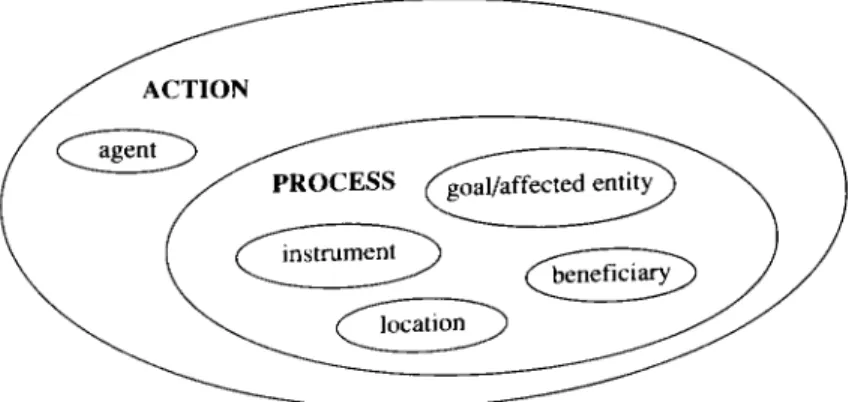
Obviously, the result can never be an action since in (2) the fingers are not in control of the SoA; it is a process according to Dik's (1989) labelling (i.e. a [-control] [+dynamic] SoA). The relationship between events and actions is better observad in the foUowing figure where the domain-subdomain relation that holds between them is evident:
At first sight, the fact that (2) is a process does not necessarily mean that it includes any metonymic mapping. However, a closer look at this sentence shows that this is not the case and that it is a grammatical metonymy.
To begin with, according to Dik's (1989) typology ^, (2) represents a process (that is to say, a non-controlled and dynamic SoA) whereas (1) is an action (i.e. a controlled and dynamic SoA). This means that control is the only distinguishing feature between them. However, (2) is not completely non-con-trolled: we understand that someone controls the SoA although this is not ex-plicitly stated (e.g. there is no doubt that Nick is the agent in (2)). Thus, in these sentences we are using an action metonymically to refer to a process. Ruiz de Mendoza and Pérez (2001) have called this high-level metonymy ACTION FOR PROCESS. As a result of this mapping, the controller entity loses its prominence and fingers achieves a much more relevant role since the whole process is focused on them.
Once we have shown the existence of this metonymic mapping, we will study the way it takes place and the syntactic consequences it has for the orga-nization of the clause. Consider the following examples:
(3)
(a) His lips brushed against her cheek. (b) He brushed his lips against her cheek.
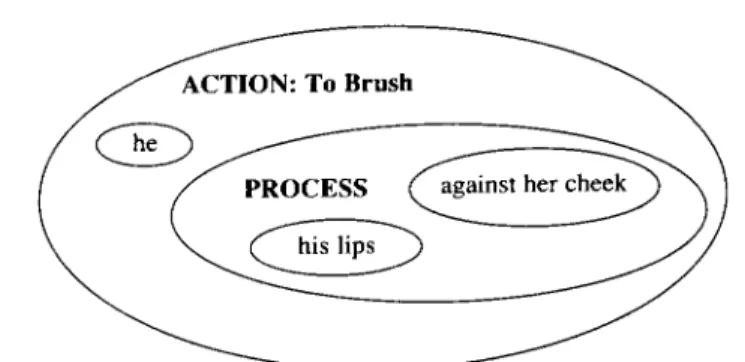
(3a) is another example of an ACTION FOR PROCESS metonymy and (3b) is its non-metonymic counterpart. When comparing both of them the first thing we observe is that the position of the agent is occupied by the affected entity in (3a). This is a consequence of the transformation of an ac-tion into a process (see figure 2). Since a process lacks control, it cannot assign the semantic function «agent». Thus, the first argument position is left vacant. But English sentences must have a subject so that the affected entity, which occupies the second argument position in (3b), is raised to the first argument position. Secondly, this metonymy prompts a valency
re-- DlK (1989) puts forward a classification of SoAs in which he distinguishes four main types (i.e. actions, proccsses, positions and stares) which are defined according to the parameter.s of [±control] and [±dynamic.]
Body part metonymies in action and perception frames: a cognitive analysis 313
Figure 2. His lips brushed against her cheek.
duction ^ of the predícate so that the verb to hrush, which is typically tran-sitive, behaves intransitively in example (3a).
We have contended that thanks to this metonymic mapping the affected entity (lips) acquires a greater degree of prominence. Let us explain the way it occurs. As a consequence of the valency reduction, lips, which is the only ar-gument position of the predícate, is raised to the subject position. This position is considered the most privileged one within the clause by numerous authors (c.f. Dik, 1989; Langacker, 1991; the latter explains transitive sentences by means of the fígure/ground segregation where the subject corresponds to the figure (the prominent part) and the direct object to the ground). Henee, by means of the metonymic mapping the affected entity acquires the most promi-nent place in the clause; in other words, the metonymy serves to upgrade a non-first argument to the most privileged position in the clause (i.e. the subject po-sition). Therefore, this metonymic mapping is a device for perspectivising a situation the same way the passive voice is.
Besides, this metonymic mapping is also motivated by economy princi-pies as can be easily observed when comparing (3a) and (3b). The latter ex-ample introduces one further argument to the representation of the SoA. Thus, in (3b) two arguments are compulsorily needed, whereas (3a) is a one-place predícate because the reduction of one of the arguments of the predícate is made possible by the metonymic link. This is what makes (2) and (3a) cases of grammatical metonymies, i.e. that the metonymy has syntactic consequences for the sentences in which it appears.
' D.K (1989) defines valency reduction as a procedure to form derived predicates which takes place when one argument position is removed from a predícate.
3 1 4 OLGA ISABEL DÍEZ VELASCO
This type of grammatical metonymy is a very valuable resource for con-verting transitive sentences into intransitive ones. Moreover, it lays bare the motivation of a phenomenon which has been analyzed by several authors (Dik, 1989; Levin, 1993). These authors, however, have just offered a more or less detailed description of it in terms of valency reduction (Dik, 1989) or in terms of the causative-inchoative altemation (Levin, 1993) but they have failed to un-derstand the metonymic motivation that underlies this process.
Nevertheless, it is important to note that we are not postulating that for every case of valency reduction there exists a metonymy which motivates the reduction of an argument position. This only holds true for the shift from a [+control] SoA to a [-control] SoA. Further analyses are needed to find out whether there is a metonymic motivation for every pattem of valency reduction.
A variation of this tyf)e of metonymy is found in (4): (4) Her arm rose and fell back on the bedclothes.
As in the previous cases, arm has not the semantic function 'agent', not being in control of the SoA (it is the person who is in control of it). However, there is a basic difference between this predicate and the one in (3a); namely, while in (3a) the metonymy has caused the reduction of one of the argument positions of the predicate, in (4) to rise is a one-place predicate so that there is no valency reduction at all. It could be wrongly argued that the metonymy in (4) is only conceptual since there is no valency reduction, and therefore, it brings about no syntactic consequences for the rest of the clause. But the com-parison of (4) and (5) throws some new light and shows that this is not the case:
(5) Arthur raised an arm in greeting
Thus, to raise and to rise represent the same SoA from different per-spectives and work in complementary distribution, the former accounting for the transitive uses and the latter for the intransitive ones. This suggests that a literal versión of (4) should employ to raise instead of to rise (e.g. She raised her arm). Henee, the metonymy causes the reduction of one argument of the predicate; but, the existence of the verb to rise makes impossible the use of the verb to raise intransitively. As a consequence, the change of verb becomes compulsory in order to avoid ungrammaticality (i.e. *Her arm raised). Therefore, we are dealing again with a grammatical metonymy: the metonymic mapping causes the shift from the verb to raise in the literal ver-sión to the verb to rise in the one containing the metonymy. On the whole, the change of verb motivated by a metonymic mapping is an uncommon
Body pan metonymies in acüon and perception frames: a cognitive analysis 315 phenomenon simply because these alternations (e.g. to raiselto rise) are rare
in English.
In all the previous examples, there was an SoA standing for another SoA. However, this is not the only pattem available within the action frame, as evi-denced in (6) and (7):
(6) His other hand retrieved the rose (7) His thumb touched her cheek gently
In (6) and (7) we find instantiations of the INSTRUMENT FOR AGENT mapping. Thus, the actions of retrieving and touching are not performed by hand and thumb, respectively, but by a person; that is to say, the instrument, which in these sentences coincides with the body part more closely connected to the action, occupies the function assigned to the agent.
This metonymic type differs from the other cases of metonymy studied so far in the fact that the metonymic sentences are transitive. Henee, (6) and (7) have the same number of argument positions as their non-metonymic counter-parts below. This means that the INSTRUMENT FOR AGENT metonymy cannot motivate a valency reduction of the predícate:
(8) He retrieved the rose with his other hand (9) He touched her cheek gently with his thumb
Once more, it could be argued that these mappings are not cases of gram-matical metonymy since there seems to be no syntactic consequence for the or-ganisation of the clause. However, a closer look at these four sentences reveáis some interesting aspects of this metonymic type. Firstly, the comparison shows that (8) and (9) include both the agent and the instrument, and that if the latter were removed, important meaning would be lost. Secondly, the metonymy al-lows the shift of the instrument from its canonical position to the place left by the agent. Thus, the metonymic mapping provokes the disappearance of one el-ement of sentence structure (i.e. the agent).
The INSTRUMENT FOR AGENT metonymy emphasises the role of the instrument of the action by placing it higher than the second argument of the predícate. Thus, by means of this metonymy, the instrument is promoted to the most privileged position of the clause, and therefore, becomes an argument (the first argument). Once more, this grammatical metonymy is a tool English speakers have to represent a SoA from a different perspective.
We suggest that tíie motivation for the high frequency of this metonymic type in English is related to our folk-model understanding of the person as a
com-316 OLGA ISABEL DIEZ VELASCO posite of different functional parts. Thus, we tend to conceive each part of the p)er-son as in charge of certain activities for which its function is specially relevant. However, this instrumental function does not canonically occupy a privileged ¡x)-sition in the clause, which is evidenced by the fact that it is not given argument status by some authors (e.g. Dik, 1989). In consequence, the metonymy is only a way to increase its prominence by promoting the instrument to a subject p)osition.
3. THE PERCEPTION FRAME
Perceptions are concemed with our experiences about the world. Their relevance in everyday life has been postulated by author such as Kóvecses and Radden (1998) and Langacker (1987). These scholars have argued in favour of their distinct nature from actions, although they admit that percep-tions may resemble acpercep-tions in some respects. The main participants of a per-ception frame are the experiencer and the phenomenon. The former, as its ñame suggests, is the sentient being that senses or experiences while the lat-ter is the object of the perception (i.e. what is sensed). Clearly, there exist more participants in the frame but they are not compulsorily needed in every case. More interestingly, this frame also includes an ajfected entity, which is the entity most closely connected to the perception. The affected entity may have different roles in the clause. For instance, in Suddenly, I felt a sharp pain in my chest, «the chest» is the affected entity since the perception is pri-marily concemed with it, in I felt my stomach queasy, «my stomach» is the affected entity and in I feel tired the experiencer (i.e. «I») coincides with the affected entity.
Body parí me tony mies in action and perception frames: a cognitive analysis 317 Whenever the experiencer and the affected entity are sepárate, there exists
the possibility that the participants of a perception rearrange while leaving the experiencer apart:
(10) My legs feel heavy
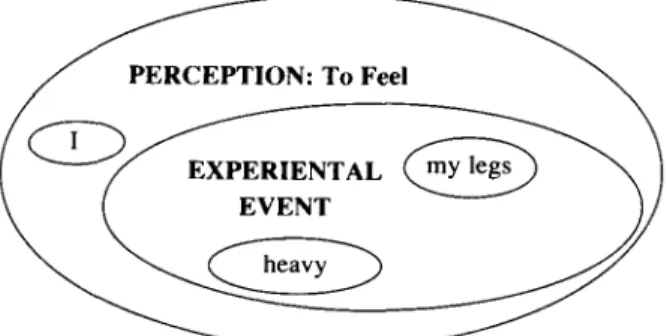
This situation parallels the ACTION FOR PROCESS metonymy as evi-denced in the following diagram:
As was the case within the action frame, a compulsory element (i.e. the experiencer) is excluded from the frame so that it is no longer a perception; what we have is an experiendal event, which stands for the perception. Note that in (10) it is clear that the experiencer is / as the non-metonymic versión of the sentence shows:
(11) I feel my legs heavy.
Therefore, we can postúlate the existence of the PERCEPTION FOR EX-PERIENTIAL EVENT metonymy. It takes place whenever (a) the experiencer and the affected entity do not coincide and (b) the experiencer of a perception is left apart while its place is occupied by the affected entity. Three different pat-tems of PERCEPTION FOR EXPERIENTIAL EVENT mappings can be distin-guished regarding the role of the affected entity. The rest of this section will be devoted to analysing in depth the different ways this metonymy works, its im-plications and motivations. The first one is illustrated in the following example:
(12) When her lungs felt as if they would burst, Mary finally reached double gates.
In (12) the lungs are presented as living entities capable of feeling and having perceptions since they are the experiencer, occupying the subject posi-tion. However, example (12) portrays a very different situation, namely, Mary is so tired that she feels that her lungs are going to burst. Henee, the experi-encer is not the lungs, but the person. Besides, lungs, and by extensión any body part, can never be the experiencer because they are not endowed with the faculty of having perception; only living creatures are. What we find in this ex-ample is an instantiation of the PERCEPTION FOR EXPERIENTIAL EVENT metonymic mapping. The way this metonymy works is better observed when We compare example (12) with the following example:
3 1 8 OLGA ISABEL DÍEZ VELASCO
Example (12) and (13) can be said to offer the szime situation as far as the subordínate clause (in bold tyjjeface) is concemed. The only difference between them is that (13) is a perception, whereas in (12) the experiencer is not overtly stat-ed and the affectstat-ed entity (i.e. the lungs) occupies its place. Henee, a metonymic mapping is needed for the correct interpretation of the sentence as a perception (i.e. in the real world lungs do not feel). In short, in (13) the SoA is presented as a perception where no part is given prominence over the rest while in (12) a metonymic mapping takes place in order to highlight the role of the lungs.
As far as the grammar is concemed, the comparison of these two sentences is also useful. Firstly, as a result of this metonymic mapping the affected entity which works as the subject of an embedded clause (lungs) is promoted to the sub-ject position of the main clause; i.e. it achieves a more prominent position in the clause. In this respect, the PERCEPTION FOR EXPERIENTIAL EVENT metonymy is not different from the ACTION FOR PROCESS mapping.
Secondly, it is interesting to note that in the non-metonymic versión both the exjjeriencer and the affected entity (the person and the lungs) are included as was the case with the examples studied within the action ICM. However, a closer look reveáis an important difference between the metonymic mapping in (12) £ind those of the previous section; namely, example (12) makes reference to the concept of lung twice: one in the subject position of the main clause and the oth-er as a pronominal form in its canonical place (the subject of the subordinated clause). TTiis means that the metonymic mapping does not cali for the deletion of the subject position of the subordínate clause. Furthermore, this deletion of the pronoun would result in an ungrammatical sentence (e.g. *Her lungs felt as if they would hurst). There are two possible reasons for this. The former is that this position cannot be left vacant because English sentences must always have a sub-ject. Therefore, although lungs is promoted to the main clause, its place in the embedded clause is occupied by a pronoun with which lungs is correferential. The latter is that in contrast to previous cases where we were dealing with sim-ple clauses, now she and lungs are placed in different clauses in the literal ver-sión. As a result, the distance between them is greater so that the metonymic mapping cannot motívate the elimination of one element which is in a different clause and only provokes its transformation into a pronominal form (i.e. they) in order to avoid redundancy. Thus, a metonymic mapping cannot cause valency re-duction beyond the limits of the clause. We believe that this latter hypothesis is the correct one. This is substantiated by the analysis of other cases where the af-fected entity occupies a non-subject position in the embedded clause and remains as a pronominal form, as will become clear when we study it.
Finally, just to note that her lungs would hurst is a metaphoric way of ex-pressing exhaustion. First, the lung is conceived as a machine. When a machine
Body part metonymies in action and perceptionframes: a cognitive analysis 319 works beyond its possibilities it ends up bursting or exploding. Second, our
knowledge about machines interacts with our knowledge about the stereotypi-cal symptoms of exhaustion": one of the physiologistereotypi-cal effects of ninning or making strenuous physical effort is that we breathe quicker.
The second pattem found can be observed in the following example: (14) Her chest felt as if frantic hands were hammering it.
This is a very interesting example which shows the pervasiness of the metonymic and metaphoric phenomena in everyday language as it contains three metonymic mappings and a metaphoric one. First, we shall deal with the metonymy relevant for our present discussion: the PERCEPTION POR EX-PERIENTIAL EVENT mapping; and then we shall sketch out briefly the oth-er ones. As in the previous case, the chest as a body part is not a propoth-er expe-riencer so the metonymic mapping is needed in order to make sense of this sentence. At first sight it may seem that this metonymy is identical to the pre-vious one; but, this is not the case as evidenced by the rewriting of (14) where the metonymy is avoided:
(15) She felt as if frantic hands were hammering her chest.
The comparison between (14) and (15) shows that the original place for «chest» is the direct object position of the embedded clause. Thus, although both in (12) and (14) the metonymy allows the movement of the affected enti-ty (the body part) from the embedded clause to the main one, the position of the affected entity in the embedded clause is different: the subject in (12) and the direct object in (14).
When dealing with the previous metonymic pattem where the affected en-tity was the subject of the embedded clause, we noted that the main difference between this metonymy and those studied within the action frame was related to the way the grammar of the sentence was affected by the metonymic map-Ping; namely, in the latter the result of the metonymic mapping was the reduc-tion of the second argument of the predícate or of one of its satellites whereas in the former the metonymic mapping does not trigger the deletion of any ele-ment of the sentence but its conversión into a pronoun. Furthermore, we of-fered two possible answers to account for this difference and supported the
sec-' On the way physiological phenomena help us in conceptualising emotions, see Kovecses (1990).
3 2 0 OLGA ISABEL DÍEZ VELASCO
ond one (i.e. a metonymy cannot produce the deletion of an element beyond the boundaries of the clause). This metonymy helps to confirm our hypothesis. Let US explain the reasons why.
Firstly, we have pointed out that by means of the PERCEPTION POR EXPERIENTIAL EVENT metonymy the direct object of an embedded clause is raised to the subject position of the main clause. Secondly, we have seen that in similar grammatical metonymies (e.g. the ACTION POR PROCESS mapping) where we dealt with simple clauses (c.f. example (2)) the metonymy may cause the reduction of an argument position (i.e. the di-rect object). Then, it is obvious that the deletion of the didi-rect object of a tran-sitive sentence is possible in English. Thus, the only difference between (2) and (14) is that the distance between the experiencer and the affected entity is greater in the latter because they are in different clauses as put forward in the second hypothesis.
It may be argued that they also differ in the fact that one metonymy takes place within an action and the other within a perception, but in the discussion of the last pattem, we shall see that this is not a relevant parameter.
The other metonymies of (14) are found infrantic hands and to ham-mer. Hand is the source domain of a grammatical metonymy (INSTRU-MENT POR AGENT) as it is not a hand but a person that carries out the ac-tion with his hands. In hammer, we find another grammatical metonymy where the instrument employed in the performance of an action metonymi-cally stands for the whole action. In this case the metonymy involves a word form conversión since a category change (from noun to verb) follows the metonymic mapping.
Regarding the metaphor, the situation is similar to the one found in (12) where two metaphors interact. Pirst, the chest is conceived as an object that someone is hitting repeatedly. And this is used to describe a frightened person because one of the physiological effects of fear is that the heart beats stronger or faster and it seems to hit against the chest (c.f. footnote 4).
Pinally, the last metonymic type of this group is illustrated in the follow-ing example:
(16) Juliet's throat felt dry.
There is no doubt that in (16) the throat cannot experience anything be-cause it is Juliet that has a feeling conceming her throat. Example (16) contains another instantiation of the PERCEPTION POR EXPERIENTIAL EVENT metonymic mapping where the throat (the affected entity) is not the experi-encer as its non-metonymic versión evidences:
Bodypart metonymies in action and perceptionframes: a cognitive analysis 321 (17) Juliet felt her throat dry
FoUowing Dik (1989: 165-169), in example (17) throat is an argument of an adjectival predícate. Thus, by means of this metonymy the argument of an adjec-tival predícate is prometed to the first argument position of the verbal predícate (c.f. 16). In addition, the comparison of (16) and (17) reveáis an important feaUíre of this metonymy: the metonymic mapping allows the deletion of the affected en-tity from its original place (i.e. the argument of the adjective). Furthermore, its repetition or transformation into a pronoun would result in an ungrammaücal sen-tence (e.g. *Juliet's throat felt her throatlit dry). Since this last example differs from the previous PERCEPTION FOR EXPERIENTIAL EVENT metonymies studied in being a simple sentence, it proves that the perception frame does not pose any restriction on the deletion of a clausal element as a result of a grammat-ical metonymy: in (16) the metonymy occurs within a perception frame and the deletion is compulsory. Therefore, this pattem further substantiates the hypothe-sis that the scope of action of a grammatical metonymy is the clause.
To sum up, all the metonymic pattems distinguished within the perception frame coincide in being motivated by a search for prominence; to be more pre-cise, by means of these metonymic mappings the affected entities which are placed in a non-privileged positions are raised to the more promment place in the sentence (i.e. the subject position of the main clause).
4. CONCLUSIÓN
In this paper we have studied some high-level metonymies by paying special attention to the frame within which they take place. The analysis has revealed that all the high-level metonymies found in our research are signifi-cant both at a conceptual and at a grammatical level; that is to say, the metonymy has consequences for the general organization of the clausal struc-ture. This has shown the relevance that a phenomenon such a metonymy may have for the adequate understanding of some grammatical issues such as va-' va-' " M : l t r " b y making a parallel with the ACTION ^ R P R O C E S S m ^ Ping we have posited the existence of the PERCEPTION FOR ™ R I E N T T A L EVENT metonymy, which accounts for those cases in ^h^c^ ^^^^^^f^^^^^JJ^ a perception is not overtly expressed. We have also obsei^ed that t h - metonymy can be realized according to three different pattems. Besides, the «mdy of t h e ^ three pattems has provided us with enough evidence to P°^.^"»^^^. " f " P ' of action of a grammatical metonymy is within the boundanes of the clause.
3 2 2 OLGA ISABEL DIEZ VELASCO
Finally, we conclude that the basic motivation underlying the metonymies found in our analysis is highlighting the role of the body part. Thus, all the metonymic mappings coincide in locating the body part in a more privileged position than it originally had in the non-metonymic versión.
5. REFERENCES
BARCELONA, A (ed.) (2000): Metaphor and Metonymy at the Crossroads, Berlín/ New York: Mouton de Gruyter.
DlK, S. C. (1989): The Theory of Functional Grammar, Vol.l: the Structure of the
Clause. Dordrecht: Foris.
DiRVEN, R. (1993): «Metonymy and metaphor: different mental strategies of concep-tualisation». Leuvense Bijdragen 82: 1-25.
DiRVEN, R. (1999): «Conversión as a conceptual metonymy of event schemata».
PANTHER, K . and RADDEN, G . (eds.) Metonymy in Lxinguage and Thought.
Am-sterdam/Philadelphia: John Benjamins. 275-288.
HALLIDAY, M . A . K . (1994): An Introduction to Functional Grammar. London: Ed-ward Amold. 2nd. de.
KOVECSES, Z . and SZABÓ, P . (1996): «Idioms: A view from Cognitive Semantics».
Applied Linguistics, Vol. 17-3: 326-355.
KOVECSES, Z . and RADDEN, G . (1998): «Metonymy: developing a cognitive linguis-tic view». Cognitive Linguislinguis-tics 9-1: 37-77.
KOVECSES, Z . (1990): Emotion Concepts, New York: Springer-Verlog.
LAKOFF, G . and JOHNSON, M . (1980): Metaphors We Uve By. Chicago: The
Univer-sity of Chicago Press.
LAKOFF, G . (1987): Women, Fire, and Dangerous Things: What Categories Reveal
ahout the Mind. Chicago: The University of Chicago Press.
LANGACKER, R. W . (1987): Foundations of Cognitive Grammar. Vol. 1: Theoretical
Prerequisites. Stanford: Stanford University Press.
LANGACKER, R . W . (1991): Foundations of Cognitive Grammar. Vol 2: Descriptive
Application. Stanford: Stanford University Press.
LEVIN, B . (1993): English Verh Classes and Alternation: a Preliminary ¡nvestigation. Chicago & London: The University of Chicago Press.
NIEMEIER, S. (2000): «Straight from the heart - Metonymic and metaphorical explo-rations». Barcelona, A (ed.). Metaphor and Metonymy at the Crossroads, Berlin/ New York: Mouton de Gruyter. 195-214.
PANTHER, K . and RADDEN, G . (eds.) (1999): Metonymy in Language and Thought. Amsterdam/ Philadelphia: John Benjamins.
PANTHER, K . and THORNBURG, L . (1996): «Metonymic and indexical inferencing in
Body part metonymies in action and perception frames: a cognitive analysis 323
PANTHER, K . and THORNBURG, L . (1998): «A cognitive approach to inferencing in conversation», Journal of Pragmatics 30, 755-769.
PANTHER, K . and THORNBURG, L . (1999): «The Potential for Actuality metonymy in English and Hungarian». PANTHER, K. and RADDEN, G . (eds.): Metonymy in
Lan-guage and Thought. Amsterdam/ Philadelphia: John Benjamins. 333-359.
PANTHER, K . and THORNBURG, L . (20(X)): «The EFFECT FOR CAUSE metonymy in
Eng-lish grammar». Barcelona, A (ed.). Metaphor and Metonymy at the Crossroads, Berlin/ New York: Mouton de Gruyter. 215: 232.
RADDEN, G . and KOVECSES, Z . (1999): «Towards a theory of metonymy». PANTHER,
K. and RADDEN, G . (eds.) Metonymy in Language and Thought. Amsterdam/ Philadelphia: John Benjamins. 17-60.
Ruiz DE MENDOZA IBÁÑEZ, F . J. (1996): «Understanding through metonymy: the role of metonymy in communication and cognition». PENAS, B . (ed.) The
Pragmat-ics of Understanding and Misunderstanding. University of Zaragoza, Servicio
de Publicaciones. 197-208.
RUIZ DE MENDOZA IBÁÑEZ, F . J. (1997): «Metaphor, metonymy and conceptual
in-teraction». Atlantis Vol.l9, / , 281-295.
RUIZ DE MENDOZA IBÁÑEZ, F . J . (1999): «From semantic underdetermination via
metaphor and metonymy to conceptual interaction» Essen: LAÚD N-.492.
RUIZ DE MENDOZA IBÁÑEZ, F . J. and PÉREZ HERNÁNDEZ, L . (2001): «Metonymy and
the grammar: motivation, constraints and interaction». Language &