1
The changing nature of academic development:
Exploring student perceptions and experiences of a
learning skills programme in higher education
Karen Petrenko
Supervisor: Ms. Rahmat Omar
A Research Report submitted in partial fulfilment of the requirements for the
degree of Magister Education in the Faculty of Education,
University of the Western Cape
October 2011
2
The changing nature of academic development: Exploring
student perceptions and experiences of a learning skills
programme in higher education
Karen Petrenko
A.
Keywords
academic development,
embedded learning,
academic literacy,
third generation academic literacy,
employability skills,
generic skills,
school-leavers,
mature learners
3
B.
Abstract
The changing nature of academic development: Exploring student perceptions and experiences of a learning skills programme in higher education
In this paper, I focus on the issue of student perceptions and experiences of a 3rd generation academic development programme in higher education. I set out to explore the issue from two perspectives: firstly from the perspective of the higher education institution’s approach to academic development, namely, a learning skills programme and a first year sociology course, and secondly from the perspective of students’ intentions, expectations and experiences of such a programme. The research questions focused on the learning priorities embedded in the curriculum of a learning skills programme at Monash University, South Africa and the learning experiences of students in this programme.
The methodology used in this study includes a case study which focused on the responses of six participants from a number of African countries completing their BA degrees. Semi-structured interviews held and the content analysis method was used to analyse the data. The study concludes: that the main priority of the learning skills programme is to prepare students for their university learning rather than to prepare students for the world of work i.e. it falls within Street’s (2004) academic socialization model and that the Learning Skills programme can be seen as an example of Boughey’s (2007) 3rd
generation academic development programmes.
The study also suggests that there is a need to explore Volbrecht’s (2003) argument on the limitations of discipline-based models of academic development, the need to examine how academic literacy is constructed and how identity and power relations intersect in this construction. It further highlights the importance of the idea of multi-literacies as put forward by Street (2004) and suggests that as practitioners we should include a consideration of these literacies in academic development programmes to improve the quality of students’ learning and meaning making.
4
C.
Acronyms
CPD
Continuous Professional development
HE
Higher Education
HEI
Higher Education Institutions
HEQC
Higher Education Quality Committee
LS
Learning Skills
LSA
Learning Skills Advisor
MSA
Monash South Africa
MU
Monash University
NGO
Non Governmental Organization
NPO
Non Profit Organization
OECD
Organisation for Economic Co-operation and
Development
SA
South Africa
TQM
Total Quality Management
WB
World Bank
5
D.
Declaration
I declare that
The changing nature of academic development: Exploring student perceptions and
experiences of a learning skills programme in higher education is my own work, that it has not been submitted for any degree or examination in any other university, and that all the sources I have used or quoted have been indicated and acknowledged by complete references.
.
Full name: ...Karen Teresa Petrenko...………...
Date: ... October 2011...… ……….. Signed: …...…………... Karen T. Petrenko
6
E.
Acknowledgements
I would like to thank the students and the sociology lecturer and tutor at Monash University, South Africa and the staff at Monash Library.
I am especially grateful and appreciative of my supervisor, Rahmat Omar for her guidance, insights and patience.
Lastly I would like to thank my husband, Vasily and children Marchel, Anton and Boris, for affording me the time, patience and support to undertake and complete this project.
7
Table of Contents
A. Keywords ... 2 B. Abstract ... 3 C. Acronyms ... 4 D. Declaration ... 5 E. Acknowledgements ... 6 1. Introduction ... 9 2. Literature Review ... 132.1 Education and the Knowledge Economy ... 14
2.2 Employability and employability skills ... 16
2.3 The Link between Employability Skills and Generic Skills in Higher Education ... 18
2.4 Diversity in higher education – Promoting the move towards inclusivity ... 21
2.5 Academic Development as Practice ... 24
2.6 Academic literacy and the New Academic Studies perspective ... 26
Conceptual Framework ... 33
2.7 The Academic Literacies Framework and the 3rd Generation Academic development .. 33
3. Research Methodology ... 35
4. Presentation of Data ... 43
4.1 Document Analysis ... 43
4.2 Student experiences of the LS programme ... 53
5. Findings ... 65
5.1 LS programme objectives and students’ intentions, expectations and experiences ... 66
5.2 Lecturer Involvement ... 71
5.3 Learning Skills and the World of Work ... 73
5.4 Overall perception of the LS programme ... 77
6. Conclusion ... 80
8
7. References ... 85
8. Appendices ... 88
Appendix 1: Schedule of Interviews ... 88
Appendix 2: Participant Profile ... 89
Appendix 3: Critical Crossfield Outcomes ... 90
Appendix 4: Interview Questions and Themes for the Document Analysis ... 91
Appendix 5: Developing Employability Skills ... 93
Appendix 6: Learning Skills Embedded in the Sociology 1365 Course ... 94
LIST OF TABLES
Table 1: Students enrolled for a Bachelor of Arts Degree at MSA in 2011………..…………..21Table 2: Academic literacies and the ‘new orders’……….……….……..27
LIST OF FIGURES
Figure 1: The Academic Socialization Model ... 46
9
Chapter 1
1.
Introduction
One of the fundamental reasons why higher education institutions are reassessing their approach to the students’ holistic learning experience at university, is that they are responding to the changes in the global economy, to produce the best possible graduates to participate in that economy. Universities are under tremendous pressure to compete for funding and other resources and there is also the need to produce students who are well rounded and who can adapt relatively easily to the world of work. This paradigm shift is focused primarily on integrating the students’ learning experience into interactive and collaborative learning experiences at university and to have a more utilitarian approach to learning (Duderstadt, 2005). It is no longer enough to have the content knowledge as taught in a traditional sense at university, but it becomes imperative to link this knowledge and learning experience to skills required for the workplace.
The learning skills programme was developed, because of the need by universities, to respond to these changes in the economy and to accommodate the learning needs of vast numbers of students from diverse cultural, economic and social backgrounds. Institutions are also regarded as inclusive of students who can no longer be regarded as traditional students, but come into the systems with diverse abilities and competencies. On the one hand the learning skills programme tries to address the inequities that students come into the university system with and on the other hand it tries to engage the entire student cohort with discipline specific academic writing skills including mature students who re-enter the system after a long absence from studying. This academic literacies programme reframes the teaching process “not as a deficit for students who are [English second language speakers], but something that all students encounter as they shift from secondary school into postsecondary education” (Lea and Street, 2006, p. 369).
10
This study looks at the course offerings of the learning skills programme set out by Monash South Africa (MSA) as a response to the needs of students and turning the spotlight on some of the perceptions and experiences of student attending these programmes. This could be used as the beginning of an enquiry into the experiences of academic development programmes from the perspectives of the students themselves. It also tries to illuminate the viewpoints of students and what they see as necessary considerations when these programmes are restructured and reviewed.
Background and Context
Academic development programmes, formerly known as academic support programmes were developed to cater for the academic literacy needs of students entering higher education. The historical development of the academic development programmes can be categorised into three phases: The first phase, academic support can be traced back to the 1980s. In the second phase the focus shifted from students to the HE institutions in response to the political changes in the country, the third phase, which include institutional development results from the need for universities to respond to global economic changes (Boughey, 2007, p. 2). In the earlier stages of these programmes there seemed to be a major focus on equity, but recent shifts in the literature seems to focus strongly on issues of quality. This phase of academic development is what Boughey (2007) referred to as third generation of academic development. She argues that this development in higher education (HE) globally, and South Africa (SA) specifically is a direct response to the demands of globalization and a more neo-liberal agenda at policy level. It is in this context that I will explore the experiences and perceptions of students participating in an academic development programme at an institution of higher learning.
My interest in this research area from a practitioner’s perspective is based on how these programmes are received by students and what contribution they make to student learning in a SA academic context and as preparation for the world of work.
11 What is the Learning Skills (3rd generation academic) programme and why was it developed?
The learning skills programme is perhaps a good example of how institutions of higher learning are responding to global changes and the need to prepare university students for their lives as global citizens and who may take up positions in the global job market (Allan, 2005). Global citizenship embodies the values, skills, knowledge and attitudes that students would develop to address global issues such as sustainable development, trans-national responsibility, respect for cultural and ethnic diversity and social justice both locally and globally. How will HE institutions ensure that graduates have the appropriate skills and knowledge to live and work within a global society? The notion of global citizenship will be explored further in the literature review.
The academic development programme at Monash University South Africa’s aim is to respond to the needs of underprepared students coming into the university and to incorporate graduate attributes such as problem-solving, time management, teamwork, reading strategies and critical thinking in discipline-specific courses. The intended outcome is to improve students’ academic performance and to prepare them for the world of work linked to global citizenship.
The question is which one of these two sets of needs is the programme responding to. Is it responding to the need to develop academic literacy skills, or is it responding to the need to develop graduates’ employability skills or both, and if so how is it doing this? Is there a tension or balance between the two sets of needs?
Research Purpose
This study investigated the contribution made by a learning skills (3rd generation academic development) programme, implemented in the Sociology Department at MSA in
12
Johannesburg between 2009 and 2010, to the academic needs of underprepared students and development of their employability skills.
This research addressed four main questions: Firstly, what learning priorities are embedded in the curriculum of this learning skills programme? Secondly, what are the intentions of students entering this programme? Thirdly, what kinds of learning do students experience in this programme? Fourthly, to what extent is there a match or mismatch between the programme design and students’ expectations and experiences?
To try and answer these questions I set out to explore a number of issues which I felt was relevant to the debate around student learning from a discipline-specific perspective, and the current discourses that prevail within the context of academic development in higher education. In chapter 2, the literature review aims to explore questions relating to academic development, and employability skills from both an international and a South African perspective and identifies Street’s academic literacies framework as a useful framework for discussing these issues. Chapter 3 describes the research process, the methods used to collect the data and how the date was analysed. Chapter 4 presents the data gathered through document analysis and semi-structured interviews with students. In Chapter 5 I discuss the data in the context of the literature review, and chapter 6 presents the concluding arguments.
13
Chapter 2:
2.
Literature Review
The shift in the field of academic development is profound in the sense that it has moved from focusing on academic support to that of academic development in response to changes in education policy and other developments within the broader SA context after 1994. Boughey (2007) contends that “Academic Development [should be about] a concern for equity [intertwined] with a concern for efficiency within an overall regard for quality. The debates, centred around academic literacy, takes place in the context of major shifts in how academic development is constructed and its potential instrumental role in the changing nature of HE institutions in response to socio-economic changes” (p.1).
There are two perspectives that will be focused on in this literature review, one being the debate around employability and employability skills and two, the significance of these two dimensions on the development of 3rd generation academic development programmes. There is the view that that this approach to academic development would inculcate within students values and skills that would prepare them for their roles in the workplace, and global citizenship which is epitomised by an acceptance of cultural diversity and difference, and being equipped to take up positions in global organizations, or in cultural and economic environments beyond their national borders. A major focus of this research study tries to establish whether the learning skills programme, at a HE institution like Monash University, emphasizes elements in the curriculum which promotes employability skills and the attributes university graduates need to participate in the world of work, or whether this programme is more focused on developing the students’ academic learning skills.
Some of the issues raised in the literature review will be that of education and the knowledge economy which centres around the debate on education’s response to the rapid
14
changes in the global economy; a discussion of the current discourses on employability and employability skills; then diversity in higher education and finally the development of academic literacies and academic literacy in practice
2.1 Education and the Knowledge Economy
There is tremendous pressure on higher education (HE) institutions to produce graduates with the necessary skills needed for the rapidly changing and demanding work environment.
Institutions such as the World Bank (WB) and the Organisation for Economic Co-operation and Development (OECD) placed less emphasis on the traditional relationships between education, learning and work, and more of a focus on the need for a new coalition between industry and education. Universities are traditionally centred around activities such as teaching and scholarship, but more recently universities are seen within society as a major contributor to economic growth (Duderstadt 2005). According to Peter and Humes (2003), education will play a prominent role in “determin[ing] the future of work, the organisation of knowledge institutions and the shape of society in the years to come” (p.5). This view is consistent with Leadbeater (cited in Naidoo, 2003) who claims that there seems to be a drive by nation states, through their skills development strategies, to increase the production of knowledge workers, who are highly educated through post-secondary school education, who will take up positions which will contribute significantly to the knowledge economy. Knowledge workers include those workers involved in technical, scientific and managerial work. In this new dispensation there is a stronger link between higher education which will produce the ‘knowledge workers’ and developments in the economy which will then create a demand for the knowledge workers.
15
Graduates are viewed as knowledge workers who should be well-rounded in terms of their academic qualifications, their employability skills and their graduate attributes. Another interesting point raised by Hager (2006) is that “[education] policies which promote and reward employability skills, generic skills and learning to learn skills have become common concepts at all levels of education systems” (p.17). This means that individuals will have to be equipped with the employability skills that will make them the preferred candidate for positions in the job market. This prerequisite is what is referred to as employability and employability skills. From the perspective of HE, it is argued that universities should play a far greater role in forming partnerships with industry and preparing graduates for the labour market. The issue, about what measures universities should take to introduce teaching and learning strategies to prepare graduates for the demands of the labour market, is at the centre of the debates in HE (Winberg et al, 2006)
A more recent emphasis in university programmes is that of including knowledge and skills relevant to the workplace. The knowledge would include academic knowledge and technical knowledge which is a necessary part of the student’s qualification and the practical knowledge which could be regarded as the graduate attributes that students developed along the way (Hager, 2006). This is a bid to make universities more utilitarian rather than academic, and responsive to societal and economic changes. Kraak (2003) argues that there is a radical transformation of the intellectual culture in higher education, and universities in particular, away from the traditional university system towards a more utilitarian university system (also referred to as a mode 2 university system). This means that a more open, responsive and inclusive system of teaching and learning is emerging that caters for a diverse student population (Kraak, 2003) and that universities are responding to economic pressures and quality imperatives by trying to maintain student throughput, postgraduate numbers and research outputs (Naidoo, 2003).
As a consequence, tensions have emerged in the field of academic development between the imperatives of quality verses redress and the notion of creating an inclusive university
16
environment. In the South African university context inclusivity refers to the social inclusion of those students who were previously disadvantaged by an unequal education system and an unequal society, which included students from diverse social and economic backgrounds and those mature students who have decided to return to university. This aspect will be discussed in more depth later in the literature review.
This tension played itself out in a recent SA parliamentary discussion report on transformation in HE (Parliamentary Monitoring Group, February 2010). Some members of suggested that the quality of the students coming into universities needed to be assessed, and it was proposed that underperforming institutions should to be closed and their funding rechanneled to better performing institutions. Brown et al, (2003, p.121) argue that “Where market competition is based on quality rather than price it is important to be seen to be the best” and suggest that because of the decrease in government funding to tertiary institutions, they should compete for this resource, a model which is consistent with neoliberal principles. Other members felt that a major challenge was not only about quality, but also about equity, which supports the process of social transformation. The view here was that rather than closing these ‘underperforming universities, they should be afforded more support to meet the demands of the changes in the social and economic environment. It is in the context of these developments that the issue of the employability and employability skills of graduates take centre stage.
2.2 Employability and employability skills
Hillage and Pollard (as cited in Brown et al, 2003) suggest that ‘employability is about having the capability to gain employment, maintain employment and obtain new employment if required’ (p.110). This definition, according to Brown et al (2003) is geared towards satisfying the needs of the labour market and seems to ignore the needs of the individual.
17
Brown et al (2003) argue that most policy statements fail to recognize the ‘duality of employability’ which include an absolute dimension and a relative dimension (p.110). This absolute dimension of employability focuses on the individual’s capabilities, as being knowledgeable, having the skills and the commitment to carry out the job in an efficient, creative and productive way. The other dimension is that of relative employability. Here the emphasis is on the notion of supply and demand within the job market. This alludes to the fact that there are much fewer jobs than the number of candidates applying for these jobs which suggests that candidates have to compete for positions.
Brown et al (2003) suggest that there is significant pressure on HE institutions to produce employable graduates due to high public investment in them and the need to prepare them for the demands of the knowledge-driven economy. According to Hager, Holland and Beckett (2002) there is a growing body of evidence that suggests that there is a demand from business and employer organizations for graduates to possess employability skills. This is part of a bigger debate about the purpose of HIM and how it should produce “[graduates that are both employable and capable of contributing to civil society” (p.4). There is also the concern that employment cannot be guaranteed in a highly competitive global economic environment because the labour market is affected by the principle of supply and demand. This implies that there will always be more candidates than jobs available in the job market (Naidoo, 2003; Brown et al, 2003), and herein lie a number of contradictions, which will be highlighted below.
This human capital perspective has played an important role in transforming education systems to produce the kind of knowledge and intellectual capital that individuals would need to adapt to the rapidly changing work conditions and to equip them with the intellectual capacity to develop new skills and new knowledge as these opportunities present themselves in the workplace. There is the concern that the labour market may not be able to accommodate a highly qualified labour force, because the number of prospective positions are far fewer than the candidates that apply for them. Winberg et al (2003) states
18
that neither skills nor experience are sufficient in securing a job, but that it is dependent on what the economy has to offer in terms of job opportunities and patterns of discrimination in the labour market.This challenge has presented itself in the South African labour market context in recent years and formed part of a major discussion in the Joint Initiative on Priority Skills Acquisition (JIPSA) report.
The JIPSA Report (2006) found that 200 000 graduates, with a mix of diplomas, certificates and degrees, were unemployed. Unemployment amongst Black graduates was particularly high and the reasons cited in this report were that there seemed to be an oversupply of graduates with qualifications that were not in demand in the labour market on the one hand, and on the other hand, those who had the relevant qualifications lacked industry experience and the generic skills that would have distinguished them from other applicants for positions. This trend is exacerbated by factors such as race, field of study, and employer perceptions of the graduates’ quality and employability.
However, these policies pay little attention to broader debates about the purpose of higher education in producing graduates who are both employable and capable of contributing to civil society as suggested by Hager, Holland and Beckett (2002).
2.3 The Link between Employability Skills and Generic Skills in Higher Education
The terms generic skills, employability skills and graduate attributes seem to be used interchangeably when referring to preparing students for the workplace, although there may be subtle differences. According to Poole and Zahn (1993), employability skills refer to the personal characteristics and attributes preferred by employers. These skills would include personal responsibility, seeking and securing a job, reasoning and problem-solving, health and safety and personal attributes. They also note that “studies that have been conducted with the purpose of defining the employability skills needed for job success typically identify similar types of characteristics but often use different words and systems of
19
organization to define them” (p. 58). Poole and Zahn (1993) also recognize that it does not matter which route or system an educational institution takes, but that some organizational system be used to integrate employability skills into the curriculum. They believe that it is imperative that institutions of higher learning embed these employability skills into their curricula to prepare students for a volatile work environment.
Hager, Holland and Becket (2002) however, use the term generic skills to refer the qualities and capacities that are needed in higher education. They identify a range of skills that make up generic skills, for example, critical thinking skills concerned with "logical and analytical reasoning, problem solving and intellectual enquiry; effective communication skills; teamwork skills and capacities to identify, access and manage knowledge and information; personal attributes will include skills such as imagination, creativity and intellectual rigour; and values such as ethical practice, persistence, integrity and tolerance” (p.3). It can be argued that higher education have included generic skills such as those listed above embedded in discipline-specific knowledge. Business considers these generic skills to be inadequate for the education of graduates, if they cannot utilize them in a workplace context. The Enterprise in Higher Education Initiative (EHEI) in Britain identified transferrable skills which they suggest are becoming increasingly valued by employers. These include problem-solving, communication skills and working effectively with others which are required to allow knowledge and understanding to be used appropriately and effectively at work and in collaboration with others (Entwistle, no-date).
Jansen (2010) takes the debate about the importance of developing generic skills in HE a step further and talks about generic competencies specifically geared towards the Arts degree, which he dissects into “critical thinking skills, appreciation of literature, understanding of cultures, the uses of power, the mysteries of the mind the organization of societies the complexities of leadership and the problem of change” (p. 8). He implies that a BA degree forms a solid basis for workplace training because he contends that students should learn to learn in an academic environment and become educated first and foremost.
20
He also contends that what South African universities fail to do, is to educate young adults broadly on issues of ethics, values, reasoning, problem-solving, argumentation and logic. He emphasizes that complex social and human problems cannot be solved except through inter-disciplinary thinking that spans across disciplinary boundaries. Therefore one can conclude that a tension exists between the EHEI and Jansen’s view about where the focus of developing generic skills should be. Hager et al (2002) suggest that the debate about generic skills is really centred around what the purpose of university education is and should be, and how to develop graduates who will be able to participate in the workforce, as well as having the capability to participate in other social engagement activities in broader society.
What is also revealed in the literature is that there is no real explanation for how generic skills and graduate attributes can be transferred to the workplace context. It can be deduced that employability skills can only be tested once the graduate engages in work activities with other workers. Another question which remains unanswered is, are these skills generic and transferrable, and can they be applied in any context, whether it be the workplace or otherwise, or are these skills generic and transferrable in the sense that they lay a foundation upon which students can build, and are able to engage in a range of other intellectual activities on the foundation that has been laid.
Apart from the pressure applied from business and industry, another factor that presents considerable challenges for HEIs is the changing nature of the students entering
universities. What Walters and Koetsier (cited in Winberg et al, 2003) alludes to, from their experiences at the University of the Western Cape, is that “new students require new
structures and new concepts to support their learning” (p. viii). This can be viewed through the lens of issues of diversity and inclusivity in the student population at universities in South Africa and further afield.
21
2.4 Diversity in higher education – Promoting the move towards inclusivity
Higher education institutions are moving towards the process of inclusivity in education which attracts diverse groups of students to higher education. This diversity in the student population encompasses the following characteristics: age, culture, background, sexuality, work experience, different learning styles, physical ability and disability (Tennant et al, 2009).
In recent years there has been a strong focus on the internationalisation of higher education. From the Australian HE perspective it meant that student mobility from Asian countries like China, Malaysia and Japan became more prominent in Australian universities in recent years and with this came the need to accommodate these students from diverse cultural, social and economic backgrounds (Tennant, McMullen and Kaczynski, 2009). Inclusivity, in a SA context, tries to address two major challenges, firstly, the issue of equity and social justice: to create an inclusive environment for Black, Coloured and Indian students who were previously disadvantaged, and were restricted from getting a university degree from historically white universities, and for the SA government to redress past inequalities, and secondly, to prepare students for the global labour market by exposing them to, and to create an appreciation for diverse cultures.
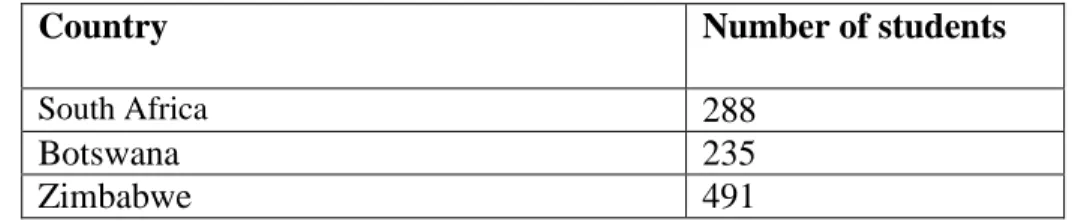
From a MSA perspective it is really about the inclusivity of a diverse population of students mainly from other parts of Africa. Table 1 indicates the student population at MSA from a multi-cultural perspective and shows the diversity in the student population in the faculty of Arts in 2011.
Table 1: Students enrolled for a Bachelor of Arts at Monash South Africa in 2011
Country Number of students
South Africa 288 Botswana 235 Zimbabwe 491
22
Other African Countries 143
Europe and UK 10
Asia 2
Australian Antarctic Territory 2
The proportion of SA students only constitutes approximately 25 percent whereas the majority of students in this faculty come from other parts of Africa where English is spoken as a second or third language. The assumption can also be made that they come from diverse cultural, ethnic and educational backgrounds.
The internationalization of education and the focus on global citizenship have created two opportunities for universities in terms of rethinking their curricula and adding an international dimension to their course offerings. Firstly for universities to restructure their policies and curricula in anticipation of the influx of international students to major universities around the world, and secondly, to expose all student to issues of cultural diversity and to better prepare them for the global labour market and for their future roles as global citizens (Tennant et al, 2009).
There is a significant effort by HE institutions to create inclusive environments, given that the intake of international students has increased over the last few years. There is also an increasing view that this new development in higher education, the issue of the diversity in students’ learning preparation, should be viewed as a unique opportunity to embrace diversity rather than to see it in terms of a deficit which requires remediation. This has led institutions of higher learning to revisit their approach to academic development and academic literacies.
In a SA context the issues of inclusivity in HE meant that institutions of higher learning had to align their policies with that of the new political order which means that instead of focusing on academic support, as they did in the past, they now have to revise their
23
curricula and teaching methodologies to meet the needs of the anticipated social, economic and cultural diversity of students entering HE in the form of new academic development practices.
Academic development practices have been subject to different stages of transformation, as it adapted to the changing landscape of HE, especially in a South African context. Boughey (2007) contends that earlier endeavours of academic literacy within HEIs, provided underprepared students with direct academic support. Underprepared is a term used to refer to students, especially in a SA context, who are underprepared by their schooling for university studies. The schooling system, during apartheid, had an authoritarian and rigid approach to teaching and learning which required learners to regurgitate knowledge without questioning and critiquing it. Students who were underprepared for university tended to reproduce information verbatim, had an inability to present an argument, not being able to critically analyse a text and had a tendency to write from a highly subjective point of view (Slonimsky and Shalem, no-date).
Another view is that most universities in SA use English as a medium of instruction, although most of the students entering universities have English as a second or third language, which means that students come into the university environment with a significant ‘deficit’ (Pauw et al, 2006). Students must be able to grasp the academic language and conventions needed to advance in their university learning, and universities have had to put mechanisms in place to address these challenges. These mechanisms came in the form of academic development programmes with the objective of bringing underprepared students up to the level where they could cope and excel in their academic learning. These programmes were initially referred to as academic support programmes.
It should be noted that words like ‘deficit’ and ‘at risk’ has negative connotations and reinforces the language of exclusion and remediation (Rose, 1998). The academic literacy perspective does not approach academic learning in this context as a problem of deficit, but it explores a set of issues about how students learn the academic skills to become part of
24
the academic community. ‘At risk’ is a term still used by learning skills practitioners and lecturers at MU and MSA to identify students who are finding their academic studies challenging, and who are not coping with their academic learning. This term is however also used in the MU Learning Skills Policy guidelines (Learning Skill Policy document). I have reservations about using this term because it holds negative connotations especially for the students who are classified in this way and may categorise or label these students as needing constant academic support and intervention (remediation).
2.5 Academic Development as Practice
A plethora of literature have emerged on academic development and student learning (Zamel and Spack, 1998), but very little has been written in the area of 3rd generation academic development or differentiated learning (Boughey, 2007).
The aim of the academic development movement post-1994 in South Africa had the responsibility to make a contribution to the transformation of HEIs. Although these programmes were crucial in addressing the education disparities between White and Black students, they were by and large a gesture of goodwill since these programmes lacked substantial funding to remain sustainable. It is ironic that while the academic development movement had taken root, the issue of funding was still a major factor in determining the success or failure of the programmes.
The debates at HE institutions were about where to position these programmes and about what the function of academic development should be. The debates shifted from addressing education disparities towards the need to assure the quality of programmes presented by institutions. Universities are not only held accountable by their funding agencies, but also by HE quality agencies, which conduct annual audits to ensure that quality standards are maintained. Academic development programmes are monitored by the HEQC, to ensure that equity issues are addressed, that the quality of their course provisions is maintained and that these programmes are sustainable.
25
The repositioning of the academic development movement has occurred as a consequence of the changing relationship between HE and the needs of the economy and society in general. The nature of the debates centred around exactly what role these academic development programmes will play in SA universities. By and large this practice drew much of its theoretical underpinnings from literature abroad. The approach that featured most prominently in the discourses on academic development is that of the deep versus the surface approaches to learning. There was an urgent need for academic development practitioners to engage students in text-based activities and to provide an opportunity for them to become actively involved in their own learning. This was indeed a paradigm shift for HE in that the students that came into the university system came from a schooling system that taught them to rote learn texts and to memorize concepts without them understanding these in context and the relevance of the information they were learning. With this shift in focus, came what is known as ‘differentiated kinds of learning’ (Boughey, 2007, p.8).
The differentiated learning approach would mean that academic literacies would be embedded in the courses and disciplines of the students and that practitioners would go beyond teaching generic skills but skills that would fulfill the specific requirements of a particular discipline or course. This means that academic development would have to be contextualized at programme level (Boughey, 2007). This is the main thrust of the 3rd generation academic development and a major dimension of the learning skills programme, carried out by the learning skills practitioner, in partnership with the academic staff at MSA. The implication of this approach is that the academic fraternity would have to play an active role facilitating the process to embed these skills into the course content and should adopt a student-centred approach to learning, which would include aspects of what students need to learn and to develop effective strategies to teach these capabilities.
26
Academic disciplines constitute the norms and conventions which are often treated by academics, seasoned in the discipline, as common sense and are often not explicitly addressed, so they remain elusive to many students. It should be noted that what constitutes a discipline and its ways of thinking and knowing are actually embedded in that discipline’s writing, its norms and conventions. Volbrecht (2003) however contests this compartmentalization of using discipline specific language literacy programmes, emphasizing that its disciplinary content and conventions are a hindrance to creative and independent thinking because students, especially first year students, would be confined to using the language of that particular discipline.
Volbrecht (2003) presents another argument in his review of Rouse and Katz’s book, Unexpected Voices: Theory, Practice and Identity in the Writing Classroom, by stating that the issue of power and identity is becoming a major concern in the field of literacy studies. Rouse and Katz contends that this presents a very pertinent question that all educators should try to address, ‘What sort of individual should we help bring into being?’ (cited in Volbrecht, 2003, p.106). The fundamental concern here is that the issues of knowledge acquisition and transmission is rooted in power relations. Volbrecht (2003) also emphasizes the fact that educators need to be critically aware of how they “reproduce, perpetuate or subvert [power relations]” (p.107). This line of thinking has direct bearing on the academic literacies model presented in Street’s Academic Literacies Framework.
2.6 Academic literacy and the New Academic Studies perspective
As discussed above, the arrival of students from diverse backgrounds or what was also termed ‘non-traditional’ students in HE, has led to a paradigm shift for universities and the role of writing in it. There are two contexts which will be featured as integral to the debate about writing in HE. It locates writing within a broader framework that takes into account more than simply study skills and academic socialization which are featured as the dominant approaches in academic development, to include New Literacy Studies which
27
was the latest development in academic literacy according to Street (2004). This new approach sees reading and writing as social, contextual and ideological practices within the field of academic literacy. The broader context within which these new developments occur within academic literacy is what Street (2004) termed the ‘new orders’. He focuses on the limitations of viewing academic literacy as a set of skills or as academic socialization. His research calls for a policy shift from focusing on remediation and skills support to a concern with Continuous Professional Development (CPD) for academics as well as teachers, and practitioners in the academic development services.
Academic literacies in the broader context: The ‘new orders’
The new literacy studies identify three broad areas within the new orders: the new work order, the new communicative order and the new epistemological order and it calls for a new approach to how literacy should be defined (or conceptualized) within the context of work.
Street (2004) contends that this paradigm shift is as necessary for academics and researchers as it is for activists and practitioners. The former have to accommodate the needs of practical knowledge and the latter are being called upon to take account of theoretical knowledge. These academic literacies are linked to the broader changes taking place in the work environment. He identifies three different models in his study that would highlight changes in the way students’ writing in higher education can be viewed: study skills, academic socialization and academic literacies, as indicated in Table 2.
Table 2: Academic literacies and the ‘new orders’.
New Work order New epistemological
order
New communicative order Study skills >writing as surface language correctness Hierarchy and discipline Atomized units of knowledge transmitted and tested; Quality control, performativity
Include as units non-linguistic skills and modes – visual, gestural, etc.
Regulation of body, policing
28 Academic socialization >Writing as conduit Multiple discourses in multi-disciplinary teams; privilege exchange value
Learn new knowledge in old ways – elitist
institutions – or in new marketized ways – wider access, knowledge in use
Learn new modes e.g. ‘rhetoric of science
classroom’; new policing of modes Academic literacies >writing as contested Flattened hierarchy teamwork new Language skills; privilege use value
Critical reflexivity on language and knowledge as process/resources;
academics as practical epistemologists’
Critical reflexivity on uses of language and non-linguistic modes in representing knowledge; knowing as processes/resources
Street (2004, p.14)
I will begin by paying closer attention to the framework devised by Street (2004) and will attempt to give a brief explanation of the headings that constitute the academic literacies models and the new orders
Academic literacies
The study skills approach, very briefly, characterizes academic literacy as a set of skills which students learn and can be transferred to different contexts. This can be defined as a remedial and instrumental approach and incorporates surface level learning, incorporating grammar, referencing, and spelling. This approach has been reviewed and began to include issues related to social context.
In academic socialization the students are socialized into the academic culture. The main thrust of this approach is to induct students into the academy and for them to be able to interpret their learning activities. Although this approach includes aspects of student-centred learning and the cultural aspects to learning, this approach has been criticized for focusing on the academy as one culture.
29
The third approach, namely academic literacies sees literacies as social practices. This approach engages students at the level of ‘epistemology and identities’ (Street, 2004, p.15) rather than study skills and socialization. The main thrust of this approach is for the student to use his/her body of knowledge including different genres, disciplines and courses which would be relevant to different settings. These models as illustrated by Street (2004) will form part of the guide to the analysis of the learning skills program in this research, to ascertain where, in these three models, the learning skills programme at Monash SA is located.
Institutions are viewed as sites of discourse and power and influences how the academic literacy practice is carried out within that context. Black (no-date) concurs that “rather than focusing on the extent to which individual possess a particular set of literacy skills, [he] focus on what literacy actually means to these people”. Here he refers to how literacy is used and valued by people in different social contexts. Literacy cannot be seen as something that is prescribed to address learning or writing problems as is the case in the study skills model. Street makes the distinction between an autonomous model which focuses on standardized skills to literacy practices and the ideological model which focuses on literacy practices in a range of social contexts.
The academic literacies described above may operate in different contexts, described by Street (2004) as a new work order, a new epistemological order and a new communicative order – as outlined below.
The New Work Order
Gee et al and Holland et al (cited in Street, 2004), characterizes the new work order within the globalization of production and distribution. They contend that these changes has implications for the what language will be used in work and educational contexts.
30
Street (2004) agrees that the language and terminology have changed to express the changing nature of work contexts. There is also a distinct emphasis on change in the organizational behaviour, an organisation that can adapt to the rapidly changing global economic environment.
This means that an organization, operating within the global economic environment should be able to demonstrate flexibility and adaptability. Another important feature of an organization is that of total quality management (TQM) and that organisations should conform to certain standards. This includes educational organizations as they too have to conform to quality control measures to ensure the quality of their outputs and products. There is also a distinct emphasis on change in the organizational behavior, one that can adapt to the rapidly changing global economic environment.
The flatter organisational structure which encourages team work projects and interaction within these teams between managers and workers has implications for worker interaction and the skills needed to function in this new work environment. Teamwork and collaboration is emphasized, with members having differentiated skills and different levels of competence and analysing problems from different disciplinary discourses.
Another essential requirement for employees to have would be ‘discursive skills’, according to Street (2004), and the ability to collaborate and negotiate within these environments. He contends that these new work environments seem to be strongly linked to some of the principles of democracy: that it is participative; that there is devolution of power in the workplace; that there is a partnership between managers and workers and that workers are empowered (Street, 2004). However, Street (2004) together with other authors, like Gee (cited in Street, 2004) believes that these shifts in the terminology should be handled with great skepticism.
31
The New Communicative Order
This area of the new orders is of particular concern for the New Literacy Studies approach. It draws attention to how literacy is defined within the new communicative order and suggests that “reading and writing forms one part of what people will have to learn to in order to be ‘literate’ in future” (Street, 2004, p.11). The other forms of communicative practices would be that of teamwork literacies and the use of icons in many communicative practices. However Street advises that literacy should refer to language use and that it is always accompanied by other visual and oral semiotic practices which should be referred to as channels but in essence these also represent other literacies. He suggests that this distinction has advantages for both research and practice:
1) It enables us to see the relationship between reading and writing and other channels, whereas incorporating them into one term ‘literacy’ hides internal variations.
2) It recognizes the social importance of reading and writing
3) It provides a tried and tested language of description that provides detailed accounts of literacy practices
4) It offers a model from the new literacy studies that might then be applied to other channels (Street, 2004, p.12)
Language and writing is but one aspect of the broader range of literacies which include “semiotic systems’ which cut across reading, writing and speech” (Street, 2004. P.11). Grammar is viewed in a holistic way one that brings meaning to how people, places and images are depicted in a particular context. The different dimensions of grammar go beyond just being a set of language rules and conventions, but are also a set of possibilities, and emphasizes that each participant engages and derives their own meaning from it. The communicative order relates to the next order under discussion the new epistemological order which questions the basis on which we define and learn knowledge.
32
The New epistemological Order
The new epistemological order centres around the debate on the relevance of traditional knowledge within a changing work environment. This alludes to the discussion about knowledge economies and the marketization of knowledge in the global economic context. This also challenges the view that universities are the leading sites where knowledge is produced and that this new knowledge can also be produced in non-academic settings such as business environments. Barnett (cited in Street, 2004) suggests that the new role of researchers should be that of ‘practical epistemologist’ those that would engage with practical knowledge in real world projects and not only with theoretical knowledge. Universities should become sites for debate about the basis of knowledge, an opportunity that is not readily provided by business. The practical epistemologist engages with knowledge in use and not simply with propositional knowledge.
What Street is trying to achieve with this matrix, is to set up a framework for academic development practitioners and academics, to think about study skills, academic socialization and academic literacies respectively, within the context of the new work order, the new epistemological order and the new communicative order. It can be identified as a heuristic device which may help academic development practitioners locate their programmes within the framework. It can help the practitioners, academics and HE curriculum developers to think about academic literacies and how it links to the workplace. This aspect of the matrix clearly links with the discussion on employability and employability skills and how academic literacies can be linked to skills required for the workplace. The epistemological order relates to how knowledge is viewed in higher education as distinct from the business environment.
What has become clear is that there is a need in academic development to reframe the learning process. Below is a comment on how Street’s framework and Boughey’s concept of 3rd generation academic development has been used in this research.
33
Conceptual Framework
2.7 The Academic Literacies Framework and the 3rd Generation Academic
development
I have used Street’s framework and the concept of 3rd generation academic development as a way to analyse the learning skills policy, the learning skills programmes and the Sociology 101 documents in this study. A set of criteria was drawn from Street’s matrix. The documents were analysed using these criteria to establish whether the curriculum, the policy and the programme actually lean towards a study skills approach, an academic socialization approach and an academic literacies approach. This means that I explored the extent to which the curriculum, programme and policy leans towards surface language correctness and fits into the study skills model. Next, the aim was to ascertain which model the sociology curriculum, the LS programme and the LS policy fits into. In order to understand whether the academic literacies model is used, means that one would be trying to establish whether the policies, programme and curriculum aim to highlight the fact that there is a debate currently about what constitutes literacies and to familiarize students with these debates and at the same time enable them to understand which of these literacies are being practiced and recognized by Monash University and inside the Sociology curriculum. These would include institutional policies and requirements, for example the policy regarding plagiarism or the feedback system.
It should be noted that the 3rd generation academic development phase, discussed by Boughey (2007), is similar to the Academic Socialization model illustrated by Street (2004). It addresses the embedding of differentiate kinds of learning in discipline-specific courses. If it is established that the LS programme would fall in the category of 3rd generation academic development then the likelihood that it is located in Street’s academic socialization model would be high.
34
However it should be noted that I will not be evaluating the efficacy of these approaches but will be exploring student responses to a LS programme which has been designed as embedded within a particular discipline, i.e. 3rd generation academic development.
35
Chapter 3:
3.
Research Methodology
This study investigates the contribution made by a learning skills (3rd generation academic development) programme to the academic needs of underprepared students, and to the development of their employability skills.
The study was focused on the learning skills programme implemented in the Sociology Department at Monash University in Johannesburg between 2009 and 2010. It was driven by an interest in understanding how students made sense of their university learning experiences in relation to the learning skills programme and the Sociology 1365 course.
This research has utilised a qualitative research design which placed great emphasis on words rather than on quantifying data collection and analysis (Bryman, 2008). In terms of ontology the qualitative researcher discards the notion of an external, objective reality in favour of a reality that tries to discover meanings that people in a specific setting attach to it. From a constructivist perspective, social phenomena and their meaning are in a continuous state of reconstruction. In terms of epistemology, the qualitative researcher is subjective because he/she interacts with the participants and tries to capture reality from their perspectives. The role of the researcher requires the identification of personal values, assumptions and biases.
My perceptions of HE have been shaped by my personal experiences of the context within which I work. I have been involved with academic development for the past six years and served on a number of projects related to university learning, and student workplace preparation programmes. Because of these experiences I have an understanding and sensitivity to the learning context of the participants. As the researcher I tried by all means
36
to be mindful of the fact that I have a predisposition to the students and the learning skills programme. I may not always be impartial during the data collection and analysis processes. As a researcher I have had to reflect on the biases I bring to the study. I would have to give an account of how the findings are shaped by my experiences and background such as gender, culture and socio-economic origin and history.
Research Design
The case study as a format for design was characterised by the focus on a phenomenon which has identifiable boundaries. This is what Henning (2004) describes as a “bounded system” (p.32). The aim is not to simply describe the case but to establish the patterns, relationships and the dynamic that prompted the inquiry. Merrian (cited in Henning, 2004, p.41) points out that “the process is more important than the outcome”. Here she means that the how, where, when and why things happen, are noted and form an essential part of the study. The context is more than part of the case. The interaction between context and action is usually the unit of analysis.
The case study was used because it tried to illuminate student experiences and perceptions in a particular context, namely Monash South Africa, and the findings of the research will contribute to broader discussions on student perceptions and experiences of the learning skills programmes with Monash Malaysia and Monash Australia.
Document analysis
Key documents that were analysed are:
Monash Learning Skills Service Policy document,
Sociology 1365 Curriculum and course outlines.
37
I chose to use these documents for the purpose of this study for the following reasons: 1) The Monash Learning Skills Service Policy document outlines the vision, mission and rationale for introducing the Learning Skills Programme at Monash University (MU), the practical implications of the programme and the different levels of services the programme has to offer to MU students and teaching staff. 2) The Sociology 1365 Curriculum and course outlines were used to show how the learning skills can be embedded into the content of the course material used in this study.
In analyzing these documents, I used the qualitative content analysis. This process searched out the underlying themes in the material being analysed, and I linked their relevance to the research questions and the themes arising from the literature as indicated in Appendix 4.
Interviews
Interviews are one of the most effective sources of case study information, but for the sake of this project semi-structured interviews were used to capture the meanings of those being researched and to understand their worldview. The enquiry took take place in the natural setting viz the university, to collect substantial situational information.
For the most part, face-to-face semi-structured interviews were conducted, around eight themes arising from the literature. These included:
- Learning priorities embedded in the curriculum - curriculum e.g. employability or academic literacies - a set of skills or a means to academic socialization.
- shift from addressing education disparities towards quality assurance of programmes
- preparing workers for the global market, global citizenship. - intentions of students entering this programme
38
- kinds of learning students experience in this programme
- Match or mismatch between the programme design, students’ expectations and
experiences?
Interviews were an ideal method for collecting data of student experiences and an interview guide was used to cover all the categories and themes that were covered in the literature review. Through these interviews I have explored the views of students, allowing for discussion to flow.
This involved having an informal conversation with the participants and maintained a friendly chat while staying close to the interview guide. It was interesting to note that the participants were fairly nervous at the onset of the interview but as the conversation progressed some became more relaxed. I also found that most of the respondents were English Second and Third language speakers and at times were unable to express themselves clearly. Another observation was that the more mature students were far more engaging than the younger students, who at times had to be coaxed along to elicit the kinds of responses that would be relevant to the research questions and themes. I have recorded the information by audio taping and writing notes. The audiotaped data were transcribed and will be kept in storage for about six months. These will be made available when requested. The data analysis process was ongoing which involved reflection on the data, asking analytical questions and writing memos throughout the study.
The sample
All 2nd and 3rd year sociology students were invited to participate in the research project. These were students that have attended the learning skills workshops arranged jointly by the sociology lecturer, and the learning skills practitioner. Based on the responses by students I selected six students using the following criteria:
39 2nd and 3rd year Sociology students because they have had experience of the Learning skills programme at different levels, namely in one-on-one consultations, generic workshops and as an integrated workshop with their discipline-specific courses. These students have participated in the learning skills programme for at least one year, to be able to give an informed account of what they have experienced with the programme. They have accessed a combination of services offered by the learning skills unit – personal consultations and generic and course-specific workshops
A combination of young and mature students were recruited to ascertain whether their approach to making use of a programme such as the learning skills programme differed between young and mature students and, if so, why?
The next step was to invite them to a preliminary interview where I discussed how the interview will be conducted and the ethical issues involved in participating in such a study. Once the student agreed to participate, I presented him/her with the consent form and arranged the interview date.
For the sake of this study and because of time constraints, interviews were the best method in accumulating the data. If more time were available it would have been beneficial to the study to observe the students and lecturer in their natural setting to strengthen the reliability of the study.
It was agreed that their names would not be disclosed in the research paper and complete anonymity would be maintained throughout the research process and in future use of the data. The information that they provided will be discussed below. Names and identifying information have been removed to maintain anonymity.