A comparison of 0
⫹
5 versus 5
⫹
2 applicants to
vascular surgery training programs
Mohamed A. Zayed, MD, PhD, Ronald L. Dalman, MD,andJason T. Lee, MD,Stanford, Calif
Objective:The new integrated 0ⴙ5 vascular surgery (VS) training paradigm introduced in 2007 required program directors and faculty to reconsider recruiting methods and exposure of medical students to VS. As a means to identify variables important for recruitment of 0ⴙ5 VS applicants, we sought to analyze national 0ⴙ5 VS residency application trends and to compare medical school demographics of applicants to both our 0ⴙ5 residency and 5ⴙ2 fellowship programs.
Methods:Electronic Residency Application Service and National Resident Matching Program online public databases were queried to evaluate nationwide trends in the number of applicants to integrated VS residency programs between 2007 and 2010. Demographic data from Electronic Residency Application Service applications submitted to our institution’s 0ⴙ 5 and 5ⴙ2 VS training programs during the same time period were reviewed.
Results:From 2008 to 2011, there were 190 applicants to our 0ⴙ5 VS residency program and 161 applicants to our 5ⴙ2 fellowship program, with 127 (66.8%) and 122 (75.8%) being United States medical graduates, respectively. Annual application volume to our programs over these years remained stable for both training pathways (range, 39-49 for 0ⴙ5 integrated; range, 39-43 for 5ⴙ2 traditional). Nationally, applications to 0ⴙ5 programs increased sixfold over the same time period (52 in 2007 to 340 applicants in 2010;P<.001), far exceeding the available training positions. Compared with applicants to the 5ⴙ2 VS fellowships, medical students applying to the 0ⴙ5 programs are more likely to be female, be slightly older, have additional postgraduate degrees and publications, have higher United States Medical Licensure Examination test scores, and are more likely to be in the top quartile of their medical school class.
Conclusions:Nationwide interest in the 0ⴙ5 vascular surgery residency training paradigm continues to significantly increase. Significant differences exist between the cohorts of 0ⴙ5 residency and 5ⴙ2 fellowship program applicants at the completion of medical school, suggesting that 0ⴙ5 VS residency programs are attracting a different medical student population to the VS specialty. VS program directors should continue to foster interest in this new applicant pool through early exposure, mentorship, and extracurricular research activities. ( J Vasc Surg 2012;56:1448-52.)
Vascular surgery (VS) training has undergone substan-tial evolution over the past 2 decades.1-3Since the incep-tion of formalized fellowship training in the 1970s by the Accreditation Council for Graduate Medical Education, the scope of VS practice and techniques has also changed considerably.3With the aging population, increased inci-dence of vascular disease, rising interest in and demand for catheter-based endovascular procedures, and a resultant increase in case volume, more qualified vascular surgeons are needed in the workforce.2,4
Due to waning interest in the fellowship match in 2004 when 21% of the available positions were unfilled, VS
program directors realized there were potential challenges to successful recruitment of the most qualified surgical trainees. Reasons cited in various surveys of general surgery (GS) residents and medical students included prolonged time of training, lack of academic development/research time, popularity of other fellowships after GS, and declin-ing interest in cardeclin-ing for the complex vascular patient.2,5-7 This potential VS trainee shortage prompted the Associa-tion of Program Directors in Vascular Surgery to develop and implement new strategies for recruitment, consider new training paradigms, and provide qualified and inter-ested medical student candidates a more effective and effi-cient means of VS training.2
As a result, in 2006, the Accreditation Council for Graduate Medical Education approved several novel and distinct training pathways for VS certification, with the integrated 0⫹5 VS residency gathering the most initial momentum and interest. Since its inception, the number of 0⫹5 residency programs as well as the number of medical student applicants has increased annually.3,8Medical stu-dent interest measured by number of applicants has sur-passed expectations, with the demand far exceeding the supply of available residency positions.3This culminated in From the Division of Vascular Surgery, Stanford University Medical Center.
Author conflict of interest: none.
Presented at the Twenty-sixth Annual Meeting of the Western Vascular Society, Lihue, Hawaii, September 17-20, 2011.
Reprint requests: Jason T. Lee, MD, 300 Pasteur Dr, Ste H3600, Stanford, CA 94305 (e-mail:[email protected]).
The editors and reviewers of this article have no relevant financial relation-ships to disclose per the JVS policy that requires reviewers to decline review of any manuscript for which they may have a conflict of interest. 0741-5214/$36.00
Copyright © 2012 by the Society for Vascular Surgery.
http://dx.doi.org/10.1016/j.jvs.2012.05.083 1448
2011 with the integrated 0⫹ 5 VS residency being the most competitive residency match participating in the Na-tional Resident Matching Program (NRMP) as defined by percent of available positions per applicant.
As one of the early adopters of the 0⫹5 paradigm at our institution, we have had three match cycles from 2008 to 2011 while maintaining our traditional 5⫹2 fellowship program. Supporting one position per year in each of the training paradigms has provided us with historical data to understand differences between the two trainee cohorts, particularly performance in medical school, which both cohorts have experienced. Supporting both training para-digms has provided insight into the qualities and demo-graphics of each of the training programs’ applicant pools at the completion of their medical school careers. As a means to identify variables important for recruitment of 0⫹5 VS applicants, we sought to analyze national 0 ⫹5 VS resi-dency application trends and to compare the medical school demographics and academic proficiency of appli-cants with both our 0⫹5 residency and 5⫹2 fellowship programs.
METHODS
Online public databases from 2007 to 2010 (most recently available information) from the Electronic Resi-dency Application Service (ERAS) and NRMP Web sites were queried.9,10The number of applicants according to surgical subspecialty and medical school type was obtained from the ERAS database. The number of available pro-grams, as well as the number of match participants accord-ing to surgical subspecialty, was obtained from the NRMP online publications.
All applications received from ERAS from 2008 to 2011 to Stanford University Medical Center’s integrated 0 ⫹ 5 residency and 5 ⫹ 2 fellowship programs were retrospectively collected, deidentified, and reviewed. There was no overlap between the applicant pools of the two training pathways. Applicants applying more than once to either program were included only once in the analysis. Due to differences in medical school educational paradigms between United States (U.S.) medical schools and foreign medical schools, subset analysis was also performed for medical student graduates of each. Comparisons between concurrent 0⫹5 VS residency and GS residency applicants to our institution were not performed due to lack of access to those applications.
Applicant demographics at the completion of medical school were collected from the ERAS program, which included the applicants’ gender and age. Metrics of aca-demic proficiency were collected, including core surgery clerkship grades, Alpha Omega Alpha (AOA) membership, class rank on the Dean’s letter, and mean United States Medical Licensure Examination (USMLE) scores. Re-search productivity during medical school was also evalu-ated by candidates’ self-reported participation in research programs/projects during medical school, number of pub-lications that were completed during medical school, and
whether an additional postgraduate degree was earned (PhD, MPH, MS, MBA, or JD).
Applicant demographics and characteristics at the com-pletion of medical school were compared between groups. Fisher exact test was used for categorical variables, and the Studentt-test was used for continuous variables. Statistical significance was predetermined at an alpha of 0.05 (P⫽
.05, two-tailed), with a Bonferroni correction to account for multiple comparisons. All statistical analysis was per-formed using SPSS Statistics 17.0 (SPSS Inc, Chicago, Ill). RESULTS
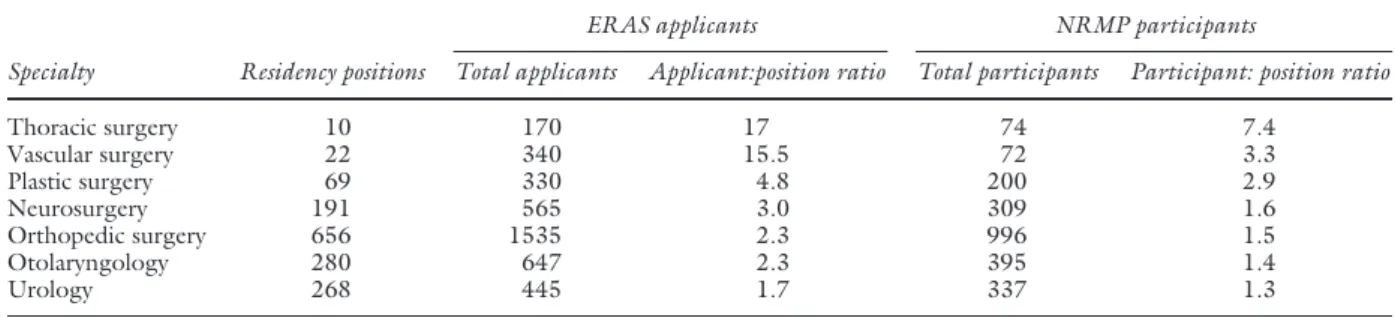
Since 2007, the number of available 0⫹5 residency positions has increased more than fivefold. During the same time period, the number of applicants participating in the match and ranking a 0⫹5 residency position has increased eightfold, and the number of total applicants has increased significantly (Fig). When analyzing the 2010 match cycle, the number of total applicants submitting VS applica-tions was similar to the number of the applicants apply-ing to integrated plastic surgery residencies, which has significantly more positions and programs in the match (Table I). The ratio of total VS applicants to available residency positions was 15.5; the second highest among surgical subspecialties for the 2010 match. Of those applicants who ultimately proceed to rank a VS program and presumably were offered at least one residency inter-view, the applicant-to-position ratio was 3.3. This was considerably higher when compared to other highly competitive residencies, including plastic surgery, neu-rosurgery, orthopedic surgery, otolaryngology, and urology (Table I).
We next analyzed the medical school background of the 190 graduating medical students to Stanford’s 0⫹5 program and 161 GS residents to our 5⫹2 program from 2008-2009 to 2010-2011 match years. U.S. medical school graduates constituted 67% of 0⫹5 residency and 75% of 5⫹2 fellowship applicant cohorts. Over the study period, the total number of applicants and proportion of
Fig. There has been a dramatic increase in the total number of 0⫹ 5 vascular surgery applicants as well as those offered interviews. This demand outweighs the available residency positions in each year from 2007 to 2011.
U.S. medical school applicants did not vary annually for the 5⫹2 fellowship. In the 0⫹5 program, the number of U.S. applicants did increase by 25% during the most recent 2010-2011 match cycle (Table II).
Demographic analysis revealed that at the completion of medical school, 0 ⫹5 program applicants were older (mean, 28.8 years; range, 24-43 years) than applicants who pursued GS residency and later ultimately applied for our 5⫹2 vascular fellowship (mean, 27.9 years; range, 23-26 years;P⬍.001 compared with 0⫹5 applicants). Female applicants comprised 26% of our total cohort of VS appli-cants and 31% of U.S. medical graduates. There was a slightly higher proportion of female applicants to the 0⫹5 program (27.9%) compared with the 5 ⫹ 2 program (23.0%). This difference was further accentuated when comparing only U.S. medical school graduates (36% vs 25%;P⫽.07;Table III).
Differences in metrics for academic achievement be-tween the two applicant cohorts at the completion of medical school are highlighted inTable III. Mean USMLE scores were higher among 0⫹5 applicants compared with applicants who ultimately pursued the 5⫹2 program (226 vs 219;P⫽.005). Forty-eight percent of 0⫹5 applicants received honors on their surgery clerkship and 27% had AOA membership, compared with 40% and 20% for 5⫹2 applicants (P ⫽.25 and 0.3, respectively). Applicants to 0 ⫹ 5 programs were also more likely to be in the top quartile of their graduating class compared with 5 ⫹ 2 program applicants (40.3% vs 27.9%;P⫽.06). Publications during medical school were different between the two
programs, with 72% of 0⫹5 applicants having at least one publication, compared with 48% of 5⫹2 applicants (P⬍
.001). On average, medical school applicants to the 0⫹5 program produced 4.4 publications, compared with 1.2 publications during their medical school years for the 5⫹2 applicant (P⬍.001). Of note, among U.S. medical grad-uates, 30% who applied for the 0⫹5 program also attained another degree of postgraduate education, compared with only 18% in the 5⫹2 program applicant pool (P⫽.038; Table III).
DISCUSSION
Prior to the creation of a primary certificate in VS and the development of the 0⫹5 integrated VS residency, the number and quality of VS candidates was limited annually by the number of graduating GS residents.2,5This provided a perceived bottleneck effect, especially since, over the course of the past 15 years, there has been an increasing number of available fellowship positions to choose from but a stable number of GS graduates.1,2Newer subspecial-ties after GS training such as critical care, minimally invasive surgery, hepatobiliary, and surgical oncology also created competition for VS programs to recruit the most competi-tive GS residents. This mismatch in supply and demand for VS fellowships was unlikely sustainable and prompted the Table I. Results of 2010 residency match into the most competitive surgical subspecialties based on applicant:position ratios
Specialty Residency positions
ERAS applicants NRMP participants
Total applicants Applicant:position ratio Total participants Participant: position ratio
Thoracic surgery 10 170 17 74 7.4 Vascular surgery 22 340 15.5 72 3.3 Plastic surgery 69 330 4.8 200 2.9 Neurosurgery 191 565 3.0 309 1.6 Orthopedic surgery 656 1535 2.3 996 1.5 Otolaryngology 280 647 2.3 395 1.4 Urology 268 445 1.7 337 1.3
ERAS,Electronic Residency Application Service;NRMP,National Resident Matching Program.
Table II. USMG and FMG applicants to Stanford integrated 0⫹5 and traditional 5⫹2 vascular surgery programs from 2008 to 2011
Match year
0⫹5 5⫹2
USMG FMG Total USMG FMG Total
2008-09 39 26 65 39 14 53 2009-10 39 20 59 40 13 53 2010-11 49 17 66 43 12 55 Total 127 63 190 122 39 161
FMG,Foreign medical graduates;USMG,United States medical graduates.
Table III. Comparison of medical school performance between candidates applying to Stanford integrated 0⫹5 and traditional 5⫹2 vascular surgery programs from 2008-2011 0⫹5 program 5⫹2 program P value Female 36.2% 25.4% .07 Age 28.8 26.9 ⬍.001 Additional postgraduate degrees 29.9% 18.0% .038 AOA membership 26.8% 20.5% .29 Honors on surgery clerkship 48.0% 40.2% .25 % top quartile of medical school class 40.3% 27.9% .06 Average number of publications 3.6 1.3 ⬍.001 Mean USMLE step 1/2/3 score 226 219 .004
AOA,Alpha Omega Alpha; USMLE,United States Medical Licensure Examination.
Association of Program Directors in Vascular Surgery to re-examine its recruitment and training paradigms, “to support the development of pathways to VS training that do not depend on GS certification.”2The resultant inte-grated 0⫹5 VS residency training paradigm has garnered increasing support and interest in just a few years as the number of applicants and programs has continued to grow.3,8
In this study, we demonstrated that there continues to be a rising and significant interest among competitive med-ical student applicants to 0⫹5 programs. We also identi-fied some key demographic differences at the completion of medical school between 0 ⫹ 5 residency applicants and candidates that later pursued 5⫹2 fellowship programs. Access to the medical student cohort via recruitment into a 0⫹5 program allows VS as a specialty to attract previously unattainable students that we have demonstrated to be more experienced and academically accomplished. Com-pared to medical students pursuing GS training that subse-quently applied for 5 ⫹ 2 VS training, 0 ⫹ 5 medical student applicants to our program were more likely to be female, were slightly older, performed better on standard-ized examinations, had additional postgraduate training, and had more scholarly publications. These findings sug-gest that 0⫹5 VS residency programs are providing the VS program directors new access to a highly qualified medical student applicant cohort. The robust and rapidly increasing number of qualified 0 ⫹5 VS residency applicants may serve as further encouragement to program directors con-templating adding additional 0⫹5 VS programs sites.
This current analysis corroborates our previous findings demonstrating that qualified 0⫹5 VS residency applicants, when compared with top students applying to GS residency in the same year, were more likely to be female, have higher USMLE step scores, and have more scholarly publica-tions.8Moreover, 0⫹5 VS residency program applicants were also found to be similarly older. As concluded previ-ously, the slightly older age of the 0⫹5 applicant may be a reflection of the additional time engaged in extracurricular activities and research pursuits. Therefore, 0⫹5 candidates with focused research interests or prior formalized research degrees might find a more efficient and shorter training pathway to be more appealing.8 Similar trends are also reported in other highly competitive early surgical special-ization tracts, which typically attract top quality applicants with extended research and professional backgrounds.11,12 For this reason, VS mentorship and research programs in the early preclinical years can help sustain interest in this highly qualified group of applicants.13
Our analysis also found a higher proportion of female candidates applying to 0⫹5 VS residency programs com-pared with those who ultimately pursue 5⫹2 fellowship programs. This was expected, as the female candidate re-cruitment pool for 0⫹5 VS residency programs is larger since half of U.S. medical school graduates are female compared with only 25% among GS residents. Second, gender discrepancies in surgical subspecialty choices have been previously described.14,15Some argue that fewer
fe-male candidates are interested in pursuing surgical subspe-cialization due to the length and rigor of training, which may have a negative impact for some female surgeons choosing long training pathways with plans to raise a fam-ily.2Thus, with increased efficiency and potentially shorter duration of training, 0⫹5 VS programs may appear to be more appealing to pursue compared with 5⫹2 programs. In our 0⫹5 program, we have observed a 56% increase in female applicants over the past 3 years. Of the most quali-fied applicants we invited to interview, the proportion of females has increased by 60%. Overall, this suggests that highly qualified female medical student applicants that may have never been in the pool to apply for 5⫹2 fellowship are now actively pursuing 0⫹5 VS residency.16
Program directors use various measures of academic performance, including USMLE scores, surgical core clerk-ship grades, AOA status, and class rank, in selecting appli-cants for interviews and formulating their rank list.17-20A direct correlation between USMLE scores and successful match outcomes exists for surgical residency appli-cants.12,17,18,21The number of interview invitations that applicants receive also correlates with applicant class rank, AOA status, and USMLE scores.20,21While these measures can be debated whether they predict a successful future vascular surgeon, we found in our cohorts that the medical school academic achievement for the 0⫹5 VS residency versus the 5⫹2 fellowship applicants was notably superior among 0⫹5 candidates. It is anticipated that continued recruitment of this new pool of highly qualified medical student applicants will be the greatest contributor of suc-cess of integrated 0⫹5 VS residency programs.
There are several limitations to our study, namely the retrospective design of the study and the aggregate assess-ment of applicants from only one institution. Various geo-graphic biases do not necessarily make our findings repre-sentative of the entire national applicant pool, although a report from a different institution from a different geo-graphic region provides similar findings to ours.3Given the relative youth of 0⫹5 residencies, early analyses such as this and curricular modifications will be necessary to ensure continued success of these residency programs and sustain growth of VS trainee pools. Another limitation is that we compared variables from different time periods at the com-pletion of medical school for 0⫹5 and 5⫹2 applicants, which may give rise to confounding variables and cohort effects. There could have been variation within the medical student cohorts that were analyzed over the 5-year period. The overall competitiveness of VS programs and medical student quality may also have varied as a function of some other influence. For this reason, we limited our analysis to objective categorical variables that maintain relevance be-tween the two time periods, and which we had previously reported between applicants to GS and 0 ⫹ 5 vascular residency programs in the same year.8We also acknowledge that several of the variables we chose to analyze as a surro-gate for quality, including medical school academic perfor-mance and USMLE scores, might be less important or desired in the evaluation and selection of qualified 5⫹2
fellowship applicants. There are certainly personal and an-ecdotal incidences of many average-performing students in medical school that blossom during GS residency and go on to become superbly competitive and successful vascular fellowship applicants.
In summary, we found in this analysis of nationwide application trends that interest in 0 ⫹ 5 VS residencies continues to be at an all-time high and extremely compet-itive. The 0⫹5 VS residency programs are attracting a new pool of highly qualified medical student applicants with a unique set of demographics slightly different when com-pared with medical students who ultimately pursue 5⫹2 fellowships. Although the overall trainee pool in VS re-mains competitive, 0 ⫹ 5 VS residency applicants are slightly older, more likely to be female, have higher USMLE test scores, are more likely to be in the top quartile of their medical school class, and had additional postgrad-uate education and publications. Early subspecialty expo-sure, mentorship programs, and extracurricular research activity in VS should be used to continue to cultivate interest among qualified medical students.
AUTHOR CONTRIBUTIONS Conception and design: MZ, RD, JL Analysis and interpretation: MZ, JL Data collection: MZ, JL
Writing the article: MZ, JL
Critical revision of the article: MZ, JL, RD Final approval of the article: RD, JL Statistical analysis: MZ, JL
Obtained funding: Not applicable Overall responsibility: JL
REFERENCES
1. Cronenwett JL. Changes in board certification could improve vascular surgery training. J Vasc Surg 2004;39:913-5.
2. Eidt JF, Chaikof E, Sidawy AN, Issues Committee of the Association of Program Directors in Vascular Surgery. Characteristics of the applicant pool to vascular surgery residency programs. J Vasc Surg 2005;42:519-23.
3. Schanzer A, Nahmias J, Korenda K, Eslami M, Arous E, Messina L. An increasing demand for integrated vascular residency training far out-weighs the limited supply of positions. J Vasc Surg 2009;50:1513-8. 4. Schanzer A, Steppacher R, Eslami M, Arous E, Messina L, Belkin M.
Vascular surgery training trends from 2001-2007: A substantial increase in total procedure volume is driven by escalating endovascular
proce-dure volume and stable open proceproce-dure volume. J Vasc Surg 2009;49:1339-44.
5. Berguer R. Problems facing vascular surgery in 2004. Vascular 2004; 12:39-41.
6. Calligaro KD, Dougherty MJ, Sidawy AN, Cronenwett JL. Choice of vascular surgery as a specialty: survey of vascular surgery residents, general surgery chief residents, and medical students at hospitals with vascular surgery training programs. J Vasc Surg 2004;40:978-84. 7. Green RM. What changes are needed to keep vascular surgery alive and
vigorous? Vascular 2004;12:15-9.
8. Lee JT, Teshome M, de Virgilio C, Ishaque B, Qiu M, Dalman RL. A survey of demographics, motivations, and backgrounds among appli-cants to the integrated 0⫹5 vascular surgery residency. J Vasc Surg 2010;51:496-502.
9. Results and data 2010 main residency match. Available at:http:// www.nrmp.org/data/resultsanddata2010.pdf. Accessed September 15, 2011.
10. Electronic Residency Application Service (ERAS) Data; 2010. Available at: https://www.aamc.org/data/facts/erasmdphd/. Accessed Sep-tember 15, 2011.
11. Chung KC, Lau FH, Kotsis SV, Kim HM. Factors influencing residents’ decisions to pursue a career in hand surgery: a national survey. J Hand Surg Am 2004;29:738-47.
12. Rogers CR, Gutowski KA, Munoz-Del Rio A, Larson DL, Edwards M, Hansen JE, et al. Integrated plastic surgery residency applicant survey: characteristics of successful applicants and feedback about the interview process. Plast Reconstr Surg 2009;123:1607-17.
13. Lee JT, Son JH, Chandra V, Lilo E, Dalman RL. Long-term impact of a preclinical endovascular skills course on medical student career choices. J Vasc Surg 2011;54:1193-200.
14. Debas HT, Bass BL, Brennan MF, Flynn TC, Folse JR, Freischlag JA, et al. American Surgical Association Blue Ribbon committee report on surgical education. Ann Surg 2004;2005:1-8.
15. Harris LM, Chaikof EL, Eidt JF. Altering the career choice: Can we attract more women to vascular surgery? J Vasc Surg 2007;45:846-8. 16. Ellis MC, Dhungel B, Weerasinghe R, Vetto JT, Deveney K. Trends in
research time, fellowship training, and practice patterns among general surgery graduates. J Surg Educ 2011;68:309-12.
17. Bernstein AD, Jazrawi LM, Elbeshbeshy B, Della Valle CJ, Zuckerman JD. Orthopaedic resident-selection criteria. J Bone Joint Surg Am 2002;84-A:2090-6.
18. LaGrasso JR, Kennedy DA, Hoehn JG, Ashruf S, Przybyla AM. Selec-tion criteria for the integrated model of plastic surgery residency. Plast Reconstr Surg 2008;121:121e-5e.
19. Wagoner NE, Suriano JR. Program directors’ responses to a survey on variables used to select residents in a time of change. Acad Med 1999;74:51-8.
20. Wood JS, David LR. Outcome analysis of factors impacting the plastic surgery match. Ann Plast Surg 2010;64:770-4.
21. Andriole DA, Yan Y, Jeffe DB. Does US medical licensing examination step l score really matter in surgical residency match outcomes (and should it)? J Am Coll Surg 2008;206:533-9.