by
Per Oscarson
Linköping Studies in Arts and Science No. 412 Linköping Studies in Information Science, Dissertation No. 18 Linköping University, Department of Management and Engineering
SE-581 83 Linköping, Sweden Linköping 2007
doctoral studies are carried out within broad problem areas. Research is organised in interdisciplinary research environments and doctoral studies mainly in graduate schools. Jointly, they publish the series Linköping Studies in Arts and Science. This thesis comes from Information Systems Development at the Department of Management and Engineering.
Distributed by:
Department of Management and Engineering Linköping University
SE-581 83 Linköping, Sweden
Per Oscarson
Actual and Perceived Information Systems Security Edition 1:1
ISBN: 978-91-85895-47-2 ISSN: 0282-9800
© Per Oscarson
Department of Management and Engineering 2007 Cover design by Olah Örtengren, Annonsmakaren AB Printed by Liu-Tryck 2007
reaching a certain level of actual IS security is vital for most businesses, this level must also be perceived as acceptable by stakeholders. Businesses have to maintain a certain level of security and be able to assess the level of other actors’ security. IS security is abstract and complex, however, and difficult to estimate and measure. This thesis uses epistemic and ontological frameworks to study the conceptual nature of IS security and separate the concepts of actual and perceived IS security. A well-known event is used to illustrate the conceptual discussion: the Sasser worm that was spread around the world in 2004. This study also includes a smaller case study from the City of Stockholm, where about 4,000 computers were infected by Sasser.
The outcome of the study is that actual IS security should be treated as a dynamic condition that is influenced by three different objects: information assets, threat objects and security mechanisms. Incidents are processes that are ruled by the conditions of these three objects and affect the states of confidentiality, integrity and availability of information assets. The concepts of threat, risk and trust remain at epistemic level, i.e. perceptions. Perceptions of IS security can differ depending on their social establishment and are classified as subjective judgements, inter-subjective judgements or institutional facts. While actual IS security conditions can influence actors’ perceptions of IS security, perceived IS security can also influence actual IS security.
This thesis has been financed by Bergslagen Research Centre, KK-stiftelsen, Örebro University, Transcendent Group Sverige AB and the Swedish Emergency Management Agency (SEMA).
discipline studying human work with developing and changing computer-based information systems in organisational settings. It includes theories, strategies, models, methods, co-working principles and tools concerning information systems development. Different development/change situations can be studied as planning, analysis, specification, design, implementation, deployment, evaluation, maintenance and redesign of information systems and its interplay with other forms of business development. The discipline also includes the study of prerequisites for and results from information systems development, as e.g. studies of usage and consequences of information systems.
This work,Actual and Perceived Information Systems Security, is written by Per Oscarson at Swedish Emergency Management Agency; earlier at Örebro University. He is also a member of the research group VITS. He presents this work as his Ph D dissertation in Information Systems Development, Department of Management & Engineering, Linköping University.
Linköping, October 2007 Göran Goldkuhl
2. Stefan Cronholm (1998) Metodverktyg och användbarhet - en studie av datorstödd metodbaserad systemutveckling
3. Anders Avdic (1999) Användare och utvecklare - om anveckling med kalkylprogram
4. Owen Eriksson (2000) Kommunikationskvalitet hos informationssystem och affärsprocesser
5. Mikael Lind (2001) Från system till process – kriterier för processbestämning vid verksamhetsanalys
6. Ulf Melin (2002) Koordination och informationssystem i företag och nätverk 7. Pär J. Ågerfalk (2003) Information Systems Actability: Understanding
Information Technology as a Tool for Business Action and Communication 8. Ulf Seigerroth (2003) Att förstå och förändra systemutvecklingsverksamheter
– en taxonomi för metautveckling
9. Karin Hedström (2004) Spår av datoriseringens värden – effekter av IT i äldreomsorg
10. Ewa Braf (2004) Knowledge Demanded for Action - Studies of Knowledge Mediation in Organisations
11. Fredrik Karlsson (2005) Method Configuration - method and computerized tool support
12. Malin Nordström (2005) Styrbar systemförvaltning - Att organisera system-förvaltningsverksamhet med hjälp av effektiva förvaltningsobjekt
13. Stefan Holgersson (2005) Yrke: Polis – yrkeskunskaper, motivation, IT-system och andra förutsättningar för polisarbete
14. Marie-Therese Christiansson & Benneth Christiansson (2006) Mötet mellan process och komponent – mot ett ramverk för en verksamhetsnära
kravspecifikation vid anskaffning av komponentbaserade informationssystem 15. Britt-Marie Johansson (2007) Kundkommunikation vid distanshandel. En
studie om kommunikationsmediers möjligheter och hinder
16. Göran Hultgren (2007) eTjänster som social interaktion via användning av IT-system – en praktisk teori
17. Björn Johansson (2007) Deciding on Sourcing Option for Hosting of Software Applications in Organisations
utvärdering baserat på ett verksamhetsinriktat och samskapande synsätt 2. Karin Pettersson (1994) Informationssystemstrukturering, ansvarsfördelning
och användarinflytande - en komparativ studie med utgångspunkt i två informationssystem-strategier
3. Stefan Cronholm (1994) Varför CASE-verktyg i systemutveckling? - En motiv- och konsekvensstudie avseende arbetssätt och arbetsformer
4. Anders Avdic (1995) Arbetsintegrerad systemutveckling med kalkylprogram 5. Dan Fristedt (1995) Metoder i användning - mot förbättring av
systemutveckling genom situationell metodkunskap och metodanalys 6. Malin Bergvall (1995) Systemförvaltning i praktiken - en kvalitativ studie
avseende centrala begrepp, aktiviteter och ansvarsroller
7. Mikael Lind (1996) Affärsprocessinriktad förändringsanalys - utveckling och tillämpning av synsätt och metod
8. Carita Åbom (1997) Videomötesteknik i olika affärssituationer - möjligheter och hinder
9. Tommy Wedlund (1997) Att skapa en företagsanpassad
systemutvecklingsmodell - genom rekonstruktion, värdering och vidareutveckling i T50-bolag inom ABB
10. Boris Karlsson (1997) Metodanalys för förståelse och utveckling av system-utvecklingsverksamhet - analys och värdering av systemutvecklingsmodeller och dess användning
11. Ulf Melin (1998) Informationssystem vid ökad affärs- och processorientering - egenskaper, strategier och utveckling
12. Marie-Therese Christiansson (1998) Inter-organisatorisk
verksamhetsutveckling - metoder som stöd vid utveckling av partnerskap och informationssystem
13. Fredrik Öberg (1998) Object-oriented frameworks - a new strategy for CASE tool development
14. Ulf Seigerroth (1998) Integration av förändringsmetoder - en modell för välgrundad metodintegration
15. Bengt EW Andersson (1999) Samverkande informationssystem mellan aktörer i offentliga åtaganden - en teori om aktörsarenor i samverkan om utbyte av information
16. Pär J. Ågerfalk (1999) Pragmatization of information systems - a theoretical and methodological outline
informationssystem
19. Ewa Braf (2000) Organisationers kunskapsverksamheter - en kritisk studie av "knowledge management"
20. Henrik Lindberg (2000) Webbaserade affärsprocesser - möjligheter och begränsningar
21. Benneth Christiansson (2000) Att komponentbasera informationssystem -Vad säger teori och praktik?
22. Per-Arne Segerkvist (2001) Webbaserade imaginära organisationers
samverkansformer – Informationssystemarkitektur och aktörssamverkan som förutsättningar för affärsprocesser
23. Stefan Holgersson (2001) IT-system och filtrering av verksamhetskunskap – kvalitetsproblem vid analyser och beslutsfattande som bygger på uppgifter hämtade från polisens IT-system
24. Per Oscarson (2001) Informationssäkerhet i verksamheter - begrepp och modeller som stöd för förståelse av informationssäkerhet och dess hantering i verksamheter
25. Johan Petersson (2002) Lokala elektroniska marknadsplatser – informationssystem för platsbundna affärer
26. Fredrik Karlsson (2002) Meta-method for Method Configuration – A Rational Unified Process Case
27. Lennart Ljung (2003) Utveckling av en projektivitetsmodell – om organisationers förmåga att tillämpa projektarbetsformen
28. Britt-Marie Johansson (2003) Kundkommunikation på distans – en studie om kommunikationsmediets betydelse i affärstransaktioner
29. Fredrik Ericsson (2003) Information Technology for Learning and Acquiring Work Knowledge among Production Workers
30. Emma Eliasson (2003) Effektanalys av IT-systems handlingsutrymme 31. Anders Hjalmarsson (2004) Att etablera och vidmakthålla
förbättringsverksamhet. Behovet av koordination och interaktion vid förändring av systemutvecklingsverksamheter
32. Björn Johansson (2004) Deciding on Using Application Service Provision in SMEs
33. Ulf Larsson (2004) Designarbete i dialog – karaktärisering av interaktionen mellan användare och utvecklare i en systemutvecklingsprocess
informationssystemprojekt
36. Jan Olausson (2005) Att modellera uppdrag – grunder för förståelse av processinriktade informationssystem i transaktionsintensiva verksamheter 37. Amra Halilovic (2006) Ett praktikperspektiv på hantering av
mjukvarukomponenter
38. Hanna Broberg (2006) Verksamhetsanpassade IT-stöd - designteori och metod
has involved a great deal of learning, travel and collaboration with others. This process would not have been possible without the encouragement and support I received from other people - academics and practitioners alike. Because of the time aspect and four different workplaces, I cannot thank everyone individually but I will try and mention the most important contributors (and hope that I don’t forget anybody…).
Firstly, I would like to thank my supervisor Karin Axelsson, who patiently has guided me through the process with a lot of engagement and encouragement. My co-supervisor Göran Goldkuhl gave me important insights into my own work, especially the philosophical aspects. I am deeply indebted to both of you.
I would like to extend a special thanks to the administrative staff at the Department of Management and Engineering, Department of Computer and Information Science, and LiuTryck – you were always willing to help and kept smiling. This also applies to Ruth McNaughton, Tracks Translations and Olah Örtengren, Annonsmakaren, for your great work with the language and the cover. Thank you!
I would also like to thank information security professionals Anders Bessier, Per Hellqvist, Anders Kylesten, Kent Larsson and Lars Sundström for your empirical input and fruitful discussions. A special thanks to my mentors and discussion partners Anders Bessier and Kent Larsson for your important contributions to information security issues in general.
The VITS research network provides an open and creative atmosphere for academic discussion, and inspired me to continue. Thanks again to Göran Goldkuhl and everyone in the network who together created a fruitful and pleasant research environment. A special thank you to everyone who responded to my work during seminars: Bengt E W Andersson, Anders Avdic, Stefan Cronholm, Emma Eliason, Owen Eriksson, Amra Halilovic, Sandra Haraldson, Karin Hedström, Stefan Holgersson, Britt-Marie Johansson, Fredrik Karlsson, Ella Kolkowska, Jenny Lagsten, Mikael Lind, Ulf Melin, Malin Nordström, Johan Petersson, Ulf Seigerroth and Kai Wistrand.
I would especially like to thank Anders Avdic who lured me into academia in the first place and continued to encourage me throughout the process. Thank you, Anders!
security professionals over the past five years: present and former colleagues, customers, students and others. You have all contributed! I would especially like to mention Yngve Sunnanbo, Fredrik Björck, Wilhelm Arndt and Arvid Kjell, who really believe in the practical use of academic work and thinking, and did not hesitate before welcoming an academic into the world of information security practice.
I would also like to thank my present employer, the Swedish Emergency Management Agency (SEMA) and my manager Ingvar Hellquist for your support, as well as my previous employers; Örebro University, Technology Nexus Security AB and Transcendent Group Sweden AB.
Last but not least, I would like to thank my friends and family for your unconditional patience and understanding over the past five years.
Stockholm, October 2007 Per Oscarson
PART I: RESEARCH SCOPE AND APPROACH...1
1.
INTRODUCTION...31.1 Security in the Information Age...3
1.1.1 Information Systems Security at a Glance ...4
1.2 The Business Significance of IS Security...5
1.2.1 Example: The Companies Alpha and Beta ...6
1.3 The Abstractness of IS Security ...8
1.4 Problem Area ...9
1.5 Research Questions ...10
1.6 Aim and Contributions ...11
1.6.1 Target Groups ... 11
1.6.2 Delimitations ...12
1.7 Outline of the Thesis...13
1.7.1 Part I: Research Scope and Approach ... 13
1.7.2 Part II: Theoretical and Empirical Bases... 14
1.7.3 Part III: Analysis ... 15
1.7.4 Part IV: Conclusion ... 16
2.
RESEARCHAPPROACH...172.1 Scientific and Practical Perspective...17
2.1.1 Qualitative and Interpretive Research... 19
2.1.2 View of Empirical Sources ... 19
2.1.3 Personal Background ... 20
2.2 Research Strategy...23
2.3 Applied Research Methods...25
2.3.1 Literature Studies... 25
2.3.2 Empirical Studies... 27
2.3.3 The City of Stockholm and the Sasser Worm ... 30
2.3.4 Conceptual Modelling... 31
2.4 On the Quality of the Study ...32
2.4.1 The Relevance of the Study ...32
2.4.2 The Rigour of the Study... 34
PART II: THEORETICAL AND EMPIRICAL BASES...37
3.
THEMEANING OFACTUAL ANDPERCEIVED...393.1 A Philosophical Presupposition ...39
3.2 External Realism ...41
3.2.1 Relations between ER and Representations of ER... 45
3.2.2 Epistemology versus Ontology ... 47
3.2.3 Conceptual Relativity ... 51
3.4.2 The Ontological Level: The Immaterial World... 57
3.4.3 The Epistemic Level: Institutional Facts... 58
3.4.4 The Epistemic Level: Inter-subjective Judgements ...59
3.4.5 The Epistemic Level: Subjective Judgements... 60
3.5 An Analysis Model for Actual and Perceived IS Security...60
3.5.1 Applications of the Analysis Model... 61
4.
ANINFORMATIONSYSTEMSSECURITYPERSPECTIVE... 654.1 Information Systems Research ...65
4.1.1 The Scandinavian School...67
4.2 Information Systems Security Research ...69
4.2.1 The Need of Contextual IS Security Research ...71
4.2.2 The Contribution of The Scandinavian School ... 74
4.3 The Information Systems Security Concept...75
4.3.1 Computer Security and IT Security ... 76
4.3.2 Information Security and Information Systems Security ... 77
4.4 IS Security Community and Practice...81
4.4.1 IS Security Community ... 81
4.4.2 The Theory of Practice ... 83
4.4.3 Overview of the IS Security Practice Model... 85
4.4.4 Prerequisites for the IS Security Practice... 86
4.4.5 Activities in IS Security Practice ... 89
4.4.6 Results and Consequences ... 92
4.4.7 The IS Security Practice and External Relationships... 93
5.
FUNDAMENTALIS SECURITYCONCEPTS...955.1 Information Assets...95
5.1.1 Information ... 96
5.1.2 Information Management Resources ...97
5.2 Information Systems Security – the CIA Triad ...98
5.3 Threats and Threat Objects...101
5.4 Incidents and Damage...103
5.5 Security Mechanisms...105
5.5.1 Vulnerability... 107
5.6 Relations between the Concepts ...107
5.6.1 Graphical Conceptualisation ...108
5.6.2 Concepts Matrix...109
5.7 Risk...110
5.7.1 The Risk Concept in the IS Security Area ...111
5.7.2 The Paradigm of Objectivism ...114
5.7.3 The Paradigm of Constructivism ...116
5.8 Trust ...117
5.8.1 Social Trust...119
6.3 Sasser and the City of Stockholm ...125
6.3.1 Underlying Causes ...126
6.3.2 Measures and Lessons Learned... 127
PART III: ANALYSIS...131
7.
ANALYSIS OFFUNDAMENTALIS SECURITYCONCEPTS...1337.1 Actual and Perceived Information Assets ...133
7.1.1 The Ontological Status of Information Assets ...134
7.1.2 Values of Information Assets... 137
7.1.3 Known, Unknown and Delusional Information Assets... 138
7.1.4 Information Assets and the Sasser Worm ...139
7.2 Actual and Perceived CIA Triad ...140
7.2.1 The Ontological Status of the CIA triad ...140
7.2.2 The CIA Triad and Values...141
7.2.3 Actual and Perceived CIA Triad ...143
7.2.4 The CIA Triad and Time ...145
7.2.5 The CIA Triad and the Sasser Worm ...147
7.3 Actual and Perceived Incidents...147
7.3.1 The Ontological Status of Incidents...147
7.3.2 The Dimension of Undesirability...149
7.3.3 Known, Unknown and Delusional Incidents...151
7.3.4 Incidents and the Dimension of Time ...153
7.3.5 Incidents and the Sasser Worm... 155
7.4 Actual and Perceived Damage...156
7.4.1 The Ontological Status of Damage ...156
7.4.2 Values of Damage... 157
7.4.3 Damage and the Dimension of Time ...157
7.4.4 Incidents and Damage... 158
7.4.5 Damage and the Sasser Worm ...160
7.5 Actual and Perceived Threat Objects...161
7.5.1 The Ontological Status of Threat Objects ...161
7.5.2 The Threatening Dimension ...162
7.5.3 Known, Unknown and Delusional Threat Objects... 163
7.5.4 Threat Objects and the Sasser Worm ...163
7.6 Actual and Perceived Threats ...164
7.6.1 Threat Objects and Incidents ... 164
7.6.2 The Ontological Status of Threat ...168
7.6.3 Threats and the Sasser Worm ...169
7.7 Actual and Perceived Security Mechanisms...170
7.7.1 The Ontological Status of Security Mechanisms ...170
7.8 Summary of Chapter 7...181
8.
ACTUALIS SECURITY...1838.1 Constitutions of Actual IS Security...183
8.1.1 Actual IS Security Concepts ...183
8.1.2 What is Actual IS Security? ...185
8.1.3 Influences of Actual IS Security ...186
8.2 Actual Constitutions of Risk ...187
8.2.1 The Likelihood Factor ... 188
8.2.2 The Potential Damage Factor... 190
8.2.3 Summary of Actual Constitutions of Risk ...191
8.3 Actual Influences on IS Security...191
8.3.1 Information Assets’ Actual Influence ...191
8.3.2 Threat Objects’ Actual Influence ...192
8.3.3 Security Mechanisms’ Actual Influence ...193
8.3.4 Influences on Actual IS Security – a Composed Picture...195
8.3.5 Actual Influences by the IS Security Practice... 196
8.4 Actual IS Security and the Sasser Worm ...197
9.
PERCEIVEDIS SECURITY...1999.1 Constitutions of Perceived IS security...199
9.1.1 Actual Matters to be Perceived ... 199
9.1.2 Types of Perceptions...202
9.1.3 Perceptions of Present IS Security ...203
9.1.4 Perceptions of Historical IS Security ...204
9.1.5 Perceptions of Future IS Security ... 205
9.2 Perceptions of Risks and Threats ...206
9.2.1 Perceived Threats... 208
9.3 Perceptions and Roles ...209
9.3.1 Roles related to the Core Business ...209
9.3.2 Roles related to the IS Security Practice ...211
9.4 Origins and Establishments of Perceptions ...213
9.4.1 Access to IS Security Conditions...213
9.4.2 Spreading and Establishments of Perceptions... 216
9.5 Perceived IS Security and Trust ...218
9.6 Perceived IS Security and the Sasser Worm...221
10.
RELATIONS BETWEENACTUAL ANDPERCEIVEDIS SECURITY...22510.1 Actual IS Security’s Influence on Perceived IS Security ...225
10.1.1 Assessments of IS security...226
10.1.2 Correspondence and Measurability... 229
10.2 Perceived IS Security’s Influence on Actual IS Security ...232
10.2.1 Actors’ Perceptions that Lead to Intervention...232
10.2.2 External Perceptions that Lead to Intervention ... 233
10.3.4 Temporal Instability between Actual and Perceived IS Security ...242
10.4 Relations between Actual and Perceived IS Security and the Sasser Worm...242
PART IV: CONCLUSION ...247
11.
CONTRIBUTIONS, REFLECTIONS ANDFURTHERRESEARCH...24911.1 Primary Contributions ...249
11.1.1 Actual IS Security...250
11.1.2 Perceived IS Security ... 251
11.1.3 Relations between Actual and Perceived IS Security...254
11.1.4 IS Security Concepts... 255
11.1.5 The Analysis Model for Actual and Perceived IS Security... 256
11.2 Secondary Contributions... 257
11.2.1 The IS Security Perspective ... 257
11.2.2 The Sasser Worm...257
11.2.3 General Security and Risk Contributions...257
11.3 Retrospective and Prospective Discussions ...258
11.3.1 Reflections on the Research... 258
11.3.2 Further Research ... 259
REFERENCES ...261
APPENDIX A: INTERVIEW GUIDES ...275
1. Conceptual Issues...275
2. Organisational Issues...276
P
ART
I
R
ESEARCH
S
COPE
Introduction
1.1 Security in the Information Age
We are living in an era known as theInformation SocietyorInformation Age. For almost half a century, the importance of computers for citizens, organisations, governments and society as a whole has been growing. At the same time, the importance of intellectual asset flows, such as information and knowledge, has been growing at the expense of material asset flows (Sveiby, 1997). During the 1990s, something happened that made us redefine our society or economy; the spreading of Internet usage. The main reason for this was the invention and spreading of the World Wide Web (WWW), which made the Internet more accessible to people who were not technically-minded or experts. This made the Internet interesting as a professional channel, and terms like thedigital economy(e.g. Tapscott, 1996),electronic commerce (e-business) and electronic government (e-government) were soon coined (Turban et al, 2002). Until the mid 1990s, businesses mainly used private networks but around that time, information flows began to dislocate to the Internet. Today, in this new millennium, almost every function in society uses or is planning to use the Internet as its major communication infrastructure, including healthcare, the taxation authorities, educational institutions, businesses, associations and citizens.
This chapter gives an introduction to information systems security and the direction of this thesis. Initially, the ‘information age’ and the information systems security area are described briefly in Section 1.1. The business significance of information systems security and its abstractness are focused in Section 1.2 and 1.3, which end up in the problem area in Section 1.4. Research questions are listed in Section 1.5 while aim and contributions, including target groups and delimitations, are stated in Section 1.6. The chapter concludes with an outline of the thesis in Section 1.7.
This dislocation from private and isolated networks to one single public and open network had major consequences. One of the most important consequences is security, which concerns everyone who wants to participate in this ‘e-society’. Security is one of the most crucial issues for the Information Age and has moved to centre stage since the Internet emerged (e.g. CSI/FBI, 2006). The main reason for this is that the Internet is a public network that was originally designed for openness and flexibility, not for security. For these new infrastructure and information systems to succeed, the Internet must have an acceptable level of security. In almost every level and arena of society, the Internet is becoming the major infrastructure for inter-organisational communication. Thus, at almost every level and arena of society, security is an important and crucial issue. For organisations, security related to Internet and information management is an increasingly important factor, as recent extensive surveys show, for example CSI/FBI (2006), Deloitte (2006) and Ernst & Young (2006):
“Overall, our 2006 Global Information Security Survey confirms that information security has never been more important” (Ernst & Young, 2006, p 3)
This thesis deals with security in a time when society is heavily dependent upon information and how it is handled, and where information technology (IT) plays a major role. This applies for nearly everyone; businesses, public administration, associations and households are all dependent upon information systems for confidential, correct and available information.
1.1.1 Information Systems Security at a Glance
This section contains a brief description of information systems security (IS security) and gives the reader a basic understanding of the topic. A more detailed description and discussion of IS security is presented in chapters 4 and 5. IS security concerns the security of information assets, i.e. information and resources that are used to manage information, such as IT and other tools, administrative procedures and human abilities. Traditionally, IS security has three main aspects: confidentiality, integrity and availability, also known as the CIA triad. In technical-oriented IS security (i.e. IT or computer security), the CIA triad concerns computer systems and/or data, while the three aspects in the wider IS security area apply for information assets, i.e. information and information handling resources in any form. IS security is a broad field and embraces a number of areas. One way to describe this is to use the content of one of the most established framework s in the area; the standard ISO/IEC
27002:2005 (ISO, 2005a)1. Besides formal statements, the standard is organised around the following areas:
x Risk Assessment and Treatment
x Security Policy
x Organisation of Information Security
x Asset Management
x Human Resources Security
x Physical and Environmental Security
x Communications and Operations Management
x Access Control
x Information Systems Acquisition, Development and Maintenance
x Information Security Incident Management
x Business Continuity Management
x Compliance
The array of areas in the standard indicate the broad spectrum of IS security. Each of the sections in the standard contains a number of more specific topics, such as computer viruses, encryption, firewalls and security awareness.
1.2 The Business Significance of IS Security
The significance of proper IS security for an organisation is proportional to the organisation’s dependence on information. The characteristics of the organisation determine the prioritisation of the three IS security aspects in the CIA triad described above; the more sensitive information an organisation handles, the more important is the confidentiality aspect and so on. Internally, the CIA triad of information assets is critical for most business processes; production, sales, business administration, etc. Deficiencies in IS security can cause direct negative consequences for business processes due to incorrectness, delays and information leakage and in the end, can affect the business as a whole. In just a few decades, the use of IT has formalised information management and streamlined the administration of organisations. On the other hand, this development has entailed a substantial dependence on IT services where few business processes can be handled manually when IT services are out of order.
1
The standard ISO/IEC 27002:2005Information Technology – Security Techniques – Code of Practice for Information Security Management is part of the ‘ISO/IEC 27000 family’ (ISO, 2005a; ISO, 2005b; ISO 27000, 2007).
Additionally, the progress of e-business and e-government for businesses and public administration means that organisations are dependent upon information systems that are suspended on the Internet. When organisations use the Internet as an infrastructure for business communication, IS security is no longer an internal issue for organisations, but proper IS security is a prerequisite and enabler for these inter-organisational relationships (e.g. Keen et al, 2000). Organisations share the infrastructure as well as information systems, information resources and security solutions. An organisation’s IS security affects not only the organisation itself, but also its external parties (von Solms, 1999). Not only do shared information systems and infrastructures require an accepted level of security, but also the organisations themselves must be considered secure enough to act in these ‘e-arenas’. An analogy is traffic safety; it is not enough to build safe roads, we must also have shared traffic rules and safe cars (von Solms, 1999).
1.2.1 Example: The Companies Alpha and Beta
This section presents an example to illustrate IS security issues for an organisation and its business partners. The example is a scenario built partly upon the results in Oscarson (2001).
Consider the following serious IS security incident in the fictitious manufacturing company Alpha: a database management system (DBMS) that manages the order database of Alpha has a serious breakdown caused by hardware failure. Major parts of the ordering information system have been damaged and cannot be used – the database with the customer orders simply cannot be accessed by the DBMS. The organisation’s IT staff make daily backups of the order information stored in the database. The backup media is DAT tapes that are stored in a small room in the same building. The tapes are labelled with the system name and date of backup and then sorted in chronological order. Each backup copy is stored for seven days, so there are seven ‘daily copies’ at any given time (copies are also stored weekly and monthly). There is also a CD ROM copy of the DBMS software that can be useful in case of software failures. However, there are no backups of the hardware that it runs on. The personnel at Alpha’s IT department are trying to recover the order information in the DAT tapes, but there is no functioning system for the copied information and no other application at Alpha can read the data format stored on the tapes. Furthermore, there are no parallel manual procedures for handling customer information, and no action plans for switching over to manual procedures in the event of order system breakdowns.
Some of the production staff are idle because the order information is inaccessible. The order department is trying to manage incoming orders manually, which takes a lot of time. The inaccessible order information affects the customer service negatively; deliveries are both delayed and incorrect. Some orders in the database are unknown to the staff (some have been known but are forgotten) and are not handled or delivered before the system is recovered. Some customers complain, so that their orders can be handled manually. The delivery problems continue for several days after the system is recovered because of delays in production and administration processes. Due to the lack of manual procedures, a large amount of the manually handled orders are delivered late and/or incorrectly.
The fictitious retailer Beta is one of Alpha’s valued customers. Beta is waiting for a large delivery from Alpha, some of which has already been sold to end consumers. During a monthly meeting with a retailing organisation that Beta belongs to, one of the top managers at Beta heard about the serious computer incident at Alpha. The manager thinks: “The IS security management at Alpha is deficient… I’m glad we don’t have any e-commerce relationships!” Back at the shop, the top manager heard from the staff that a number of waiting customers have complained about undelivered products from Alpha. The delivery problems continued for a few weeks; angry customers called the shop constantly and asked for their products, confused salesmen at Alpha also contacted Beta to ask whether products had been ordered. The top manager’s trust in Alpha deteriorated, and finally he cancelled all orders from Alpha and ordered the same products from one of Alpha’s competitors.
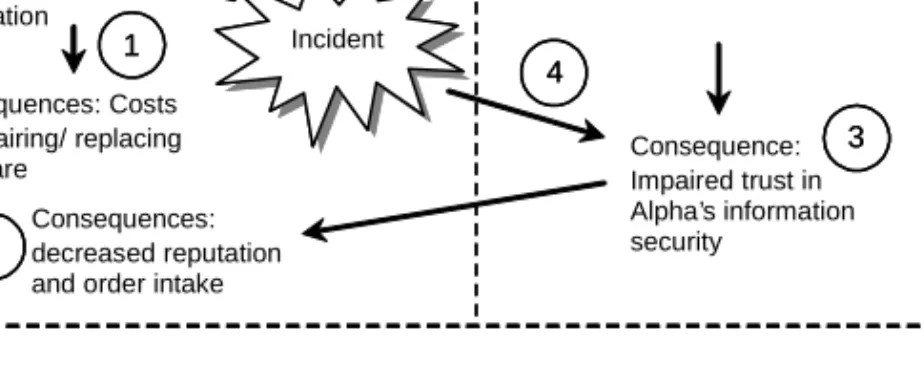
This example shows how the internal incident at Alpha had consequences at several different levels. The incident caused Alpha two types of direct damage; the server hardware was damaged and had to be repaired or replaced, and the order information was temporarily inaccessible (see (1) inFigure 1). The information could not be accessed by the DBMS as the hardware that was stored in the database had crashed. Both types of damage impaired the availability aspect of IS security. Repairing or replacing hardware costs money and requires re-installation of software. In addition to these direct consequences, the incident had several indirect consequences, which were probably far more serious for Alpha.
Beta Alpha Incident Consequence: Impaired service Damage: hardware failure and inaccessible information Consequence: Impaired trust in Alpha’s information security Consequences: decreased reputation and order intake Consequences: Costs for repairing/ replacing hardware 2 3 1 4 5 Beta Alpha Incident Consequence: Impaired service Damage: hardware failure and inaccessible information Consequence: Impaired trust in Alpha’s information security Consequences: decreased reputation and order intake Consequences: Costs for repairing/ replacing hardware Beta Alpha Incident Incident Consequence: Impaired service Damage: hardware failure and inaccessible information Consequence: Impaired trust in Alpha’s information security Consequences: decreased reputation and order intake Consequences: Costs for repairing/ replacing hardware 2 2 3 3 1 1 4 4 5 5
Figure 1:Damage and consequences at Alpha and Beta.
The inaccessible order information impairs customer service because orders can be forgotten or deliveries can be delayed, incorrect or unaccomplished (2). Beta’s trust in Alpha can be affected (3), not only because of impaired service, but also because of the incident itself (4). Even if causes of the incident do not lead to direct impairments for Beta, the occurrence of an incident in a crucial information system can indicate that the IS security status of Alpha is unsatisfactory or even unacceptable. The top manager’s knowledge of the incident affected his trust in Alpha. The rumour that there was a serious incident at Alpha may have been false, but the top manager at Alpha would still lose trust in Alpha’s IS security management. In this example, Beta cancelled the order from Alpha and ordered similar products from a competitor, which is obviously a negative consequence for Alpha. But decreased trust also affected Alpha. If Beta’s trust in Alpha’s IS security falls for any reason, Alpha’s trustworthiness is impaired (5).
This simple example shows how an internal incident can spread and lead to a number of different consequences for an organisation. Not only do the actual IS security conditions matter, but also how they are perceived. This leads us to one of the major problems with IS security – abstractness.
1.3 The Abstractness of IS Security
For several reasons, IS security is an abstract concept and field. Firstly, the nature of security makes it difficult to measure and estimate; it concerns phenomena that may not happen now but could happen in the future. In contrast to other quality characteristics such as capacity, security can hardly be measured or judged objectively (Jonsson, 1995). Only in isolated
environments, where technical aspects alone are considered, are measurements applicable (ibid). As described earlier in this chapter, IS security deals with aspects other than technology; humans that work with administrative processes in organisations. Moreover, natural objects and processes can affect IS security as well, and are always difficult to predict. Some attempts have been made to develop frameworks for assessments and measurements of IS security, both by practitioners (e.g. Veriscan, 2006) and academics (e.g. Johansson, 2005; Ravenel, 2006). These attempts seem, however, to be limited to technical aspects of IS security (i.e IT security) such as vulnerabilities and incidents within computer networks, or the efficiency of IS security management systems and processes. Thus, attempts to measure IS security normally neglect other factors that affect IS security, such as the value of information assets (i.e. potential consequences) and threats (especially threats that are not IT-based). Covering these ‘softer’ parts of IS security is of course difficult and a hard challenge, which also advocates for measurements and metrics admit (e.g. Payne, 2006).
Another reason for abstractness is technological complexity. Information technology becomes increasingly advanced and complex, and security topics are no exception. Encryption technologies, firewalls and virtual private networks (VPN) are all examples of complex technologies and applications that are difficult for non-experts to understand. Assessing their ability to secure information systems and resources is even more difficult. The indirect consequences of IS security incidents that are discussed above also contribute to abstractness because they are so difficult to survey. A specific incident can lead to concrete damage, but its further spreading is difficult or impossible to foresee, not least because of the fuzzy interfaces between information systems and organisations. Consequently, it is difficult for an organisation to estimate the actual level of IS security for its various information systems, infrastructures and organisations, not least its business partners.
1.4 Problem Area
Thus, IS security is an important issue for organisations and an abstract area that is difficult to grasp and estimate. The significance of IS security for organisations and for society as a whole motivates research and practical developments in this area from a number of perspectives; technological as well as organisational and behavioural. The abstractness of IS security however, seems to indicate that the IS security area calls for conceptual and philosophical approaches when analysing the theoretical fundamentals of IS security. Compared to for example the (general) concept of risk, the concepts of IS security and IS security risk have rarely been problemised in a
theoretical and conceptual manner, but are often taken for granted (see e.g. Baskerville, 2005; Willison and Siponen, 2007). The fundamentals of the risk concept, such as whether objective risks exist, have been the subject of lively debate in social sciences over the past few decades (e.g. in Renn, 1992; Shrader-Frechette, 1990 and Thompson, 1990).
During the late 1990s and early years of this decade, a lot of research was conducted into issues related to trust and the Internet and electronic commerce and its relation to IS security (e.g. Camp, 2000; Chellappa and Pavlou, 2002; Keen et al, 2000). The trust concept and its role in the digital environment was conceptually illuminated, while the IS security issues of this work were limited to technical solutions such as encryption algorithms and systems rather than conceptual discussions. As shown in the Alpha example above, trust and trustworthiness are closely related to IS security; perceived low IS security in an organisation can lower the organisation’s trustworthiness. As such, levels of trust can be affected by IS security. But what is IS security? The number of incidents? The bit-length of the encryption keys, or perhaps the IS security standard that is followed? Is IS security as good as anyone judges it to be, or are there elements that manifest some kind of actual IS security? Does anyone know, and if so, why is this so difficult to measure and assess?
Oscarson (2001) focused on generic work with IS security in organisations. One conclusion was that not only should organisations achieve an acceptable level of IS security, but also that the level of their IS security should be perceived as acceptable. The terms ‘actual’ and ‘perceived’ IS security were coined during this work, and after years of thinking, studying, teaching and consulting in the IS security area, I am puzzled: does actual IS security really exist, and how can we understand and separate it from perceived IS security? Due to the lack of conceptual work in this area, I believe that this question is worth asking because of the significance and abstractness of IS security in the Information Age.
1.5 Research Questions
The description of the problem area above is summarised into a comprehensive research question for this thesis:
How can we understand actual and perceived information systems security and their significance for organisations ?
This comprehensive research question comprises the understanding of actual and perceived IS security as a whole. The first part is conceptual while the second – its significance for organisations – is more practical. The question
might also be interesting from a philosophical point of view, but as emphasised earlier, it also has practical relevance for society. The comprehensive research question is divided into eight sub-questions:
1. How can the concepts of ‘actual’ and ‘perceived’ be defined and understood?
2. What fundamental concepts in the IS security area can be treated as actual?
3. How can actual IS security be defined? 4. How can perceived IS security be defined?
5. What categories of actors could be interested, and thus have perceptions of IS security?
6. How are perceptions of IS security created and established? 7. What significance do perceptions of IS security have?
8. How can actual and perceived IS security influence each other? These questions are mainly sequential; the investigation of perceived IS security takes place after actual IS security is defined.
1.6 Aim and Contributions
The aim of this thesis is:
To introduce a conceptual framework for understanding the nature and significance of actual and perceived IS security.
The understanding described above aims in turn to increase the understanding of what IS security really is and consists of, in a conceptual manner. It will also contribute to an understanding of the mechanisms and consequences that are involved when different actors judge the IS security of information systems and organisations. The theoretical framework will illustrate the business significance of IS security in and between organisations. The knowledge should be treated as a proposition rather than a hypothesis, because the theoretical contribution of this thesis cannot be measured. This is in accordance with Whetten (1989); research results that consist of a conceptual framework should be treated as a proposition while hypotheses require measures that can be tested.
1.6.1 Target Groups
The target group of the thesis is both academics and practitioners. The first group includes researchers, lecturers and students who are primarily
interested in IS security, but also IT, security and risk in general and the philosophical aspect of actual and perceived realities. Practitioners in the target group include primarily IS security professionals who need or are interested in the conceptual and philosophical aspects of the field. IS security professionals include IS security officers/managers and consultants. Even more technical oriented (IT-) security professionals are included in the target group in order to expand their knowledge of IS security. The relevance of this study for the target groups is discussed in Section 2.4.1.
1.6.2 Delimitations
IS security is a broad area, and in order to maintain a manageable scope when analysing actual and perceived IS security, some limitations have been made.
Firstly, the notion of IS security is limited to the three classical aspects of confidentiality, integrity and availability (the CIA triad). Other concepts that sometimes represent aspects of IS security, such as traceability, authenticity, authorisation and non-repudiation are ignored. The limitation has been chosen because of the traditional domination of the CIA triad, but also because of their conceptual characteristics; the concept of traceability for example is argued to be limited to a control function for the CIA triad (arguments and discussions on other concepts can be found in Section 5.2)
Secondly, this thesis is written from a perspective that is limited to an organisational context. An IS security perspective is introduced in Chapter 4, where IS security practice, as a supporting practice to a core business, plays a major role. IS security practice is part of a broader IS security community consisting of IS security practitioners, researchers, students, etc. The IS security community manifests some fundamental values, such as that viruses, worms and trojan horses are malicious code, i.e. negative things that must be counteracted. Accordingly, the IS security community plays a role when defining actual and perceived IS security because security is dependent upon these types of fundamental values. Thus, the thesis is written from an organisational view where societal aspects, primarily the IS security community, play an important role.
1.7 Outline of the Thesis
The thesis consists of four parts, comprising eleven chapters. The four parts and included chapters are described below and illustrated inFigure 2.
Part IV: Conclusion Part I: Research Scope and Approach Part II: Theoretical and Empirical Bases 3. The Meaning of Actual and Perceived Part III: Analysis 1. Introduction 2. Research Approach 4. An IS Security Perspective 5. Fundamental IS Security Concepts 6. The Sasser Worm 7. Analyses of Fundamental IS Security Concepts 8. Actual IS Security 9. Perceived IS Security 10. Relations between Actual and Perceived IS Security 11. Contributions, Reflections and Further Research Part IV: Conclusion Part I: Research Scope and Approach Part II: Theoretical and Empirical Bases 3. The Meaning of Actual and Perceived Part III: Analysis 1. Introduction 2. Research Approach 4. An IS Security Perspective 5. Fundamental IS Security Concepts 6. The Sasser Worm 7. Analyses of Fundamental IS Security Concepts 8. Actual IS Security 9. Perceived IS Security 10. Relations between Actual and Perceived IS Security
11. Contributions, Reflections and Further Research
Figure 2:Graphical illustration of the thesis’ disposition.
1.7.1 Part I: Research Scope and Approach
Part I defines the thesis research scope and the chosen research approach. Chapter 1gives an introduction to IS security and the direction of this thesis. Initially, the ‘Information Age’ and the IS security area are briefly described as well as the business significance of IS security and its abstractness. These discussions end up in the problem area that forms the basis for the thesis research questions and its aim and contributions, including target groups and delimitations. Chapter 1 ends with this outline of the thesis.
Chapter 2 aims to describe how the research questions and aim are handled. My scientific and practical perspective is introduced in order to explain the decisions made concerning the thesis research strategy. This
includes a description of my personal background as an academic and an IS security professional. Specific research methods are described – literature studies, empirical studies and conceptual modelling – based upon the research strategy. Finally, the quality of the study is discussed in terms of relevance and rigour.
1.7.2 Part II: Theoretical and Empirical Bases
This part introduces theoretical perspectives and models that are used in the analysis part of the thesis (Part III).
Chapter 3 deals with ontological and epistemological topics and concludes with an analysis model that is used when analysing actual and perceived IS security in Part III. When discussing and analysing actual and perceived IS security, it is important to present the philosophical point of view from which those concepts derive. It must be clear for the reader what I mean by ‘actual’ and ‘perceived’ in a generic sense before applying those concepts into the IS security area. Discussing actual and perceived realities is a classical philosophical issue. During history, different philosophical currents and scientific paradigms have expressed a number of viewpoints of the world and how we understand it; is there an objective, actual world, or is it all in our minds or socially constructed? In this chapter, I present and argue for a – in my opinion – balanced philosophical worldview.
Chapter 4presents an IS security perspective that illuminates this study. IS security is a sub-part of the information systems (IS) discipline, and the presentation of the IS security perspective thus starts with a general IS perspective that stresses some distinctive characteristics of IS research in Scandinavia – ‘The Scandinavian School’. The IS security perspective is characterised by a contextual and holistic viewpoint where technical as well as human and organisational aspects are covered. Concepts express underlying perspectives, and the IS security concept and related concepts (e.g. IT security) are discussed accordingly in this chapter. Finally, IS security practice, as part of the broader IS security community, is introduced. In this thesis, the IS security practice model works as a framework for understanding IS security as a supporting practice to a core business.
Chapter 5introduces a number of IS security concepts: information asset, confidentiality, integrity, availability, threat object, threat, incident, damage, security mechanism, vulnerability, risk and trust. These concepts can be seen as fundamental in the IS security field. Each concept is introduced, discussed and defined, then related to the other concepts in order to reach a conceptual entirety. This is carried out with graphical representations and a conceptual matrix where relationships are expressed. This conceptual framework will
serve as a basis for the analysis part of the thesis, especially in Chapter 7 where each concept is examined from an actual-perceived perspective.
Chapter 6 presents the Sasser worm case that was spread around the world in spring 2004. In order to reach a practical understanding of the theoretical analysis in the forthcoming chapters, the Sasser worm is used as a practical application. This chapter presents the Sasser worm; its functionality, origin and impact, how it affected the City of Stockholm, the measures that were taken and the lessons learned.
1.7.3 Part III: Analysis
Part II consists of four chapters that all analyse IS security from an actual-perceived perspective.
consists of analyses of the fundamental IS security concepts that are introduced and discussed in Chapter 5 by using the analysis model developed in Chapter 3. The concepts of risk and trust are analysed in Chapters 8 and 9 respectively, because they express a more comprehensive and holistic view than other concepts. Another important input to this analysis is interviews with IS security professionals. Implicitly, the IS security perspective presented in Chapter 4 influences the analysis part as well, not least because the IS security community has fundamental values and assumptions. The concepts in this chapter are basically analysed in isolation, but some relationships between the concepts are also examined. The conceptual analysis of each concept begins with an ontological analysis that aims to elucidate the ontological status of the concept (human, nature, artefact, etc) and the basic characteristics of those (e.g. objects, processes and states). The analysis of each concept concludes with a practical application using the Sasser worm case that is described in Chapter 6. This application is twofold; to provide a more practical understanding of the theoretical discussions, and to examine these discussions with the Sasser case in order to test the concepts’ practical relevance.
Chapter 8aims to elucidate the ontological features that constitute actual IS security. In contrast to Chapter 7, the discussion objects are groups of concepts, the core concept actual IS security, and the broader concept of risk. This chapter begins with a discussion on the nature of actual IS security, which in previous sections has been treated as equal to the CIA triad. Thereafter, actual aspects of the risk concept are extracted in order to illuminate the IS security concept from another angle; the likelihood of incidents and potential damage. Three objects are found to influence actual IS security; information assets, threat objects and security mechanisms. How these objects influence actual IS security is analysed, as well as a composed
picture of actual IS security and how it is influenced. Finally, the Sasser case is used as a practical application of the findings in the chapter.
Chapter 9 examines the other side of the coin; perceptions of actual IS security. Initially, constitutions of perceived IS security are analysed, i.e. the matters that are perceived, including the concepts of risk and threat. Thereafter, actors and roles that can have IS security perceptions are identified using the IS security practice model. The origins and establishment of IS security perceptions are mapped to these roles, as well as their effects and consequences. The chapter is concluded by applying the Sasser case.
Chapter 10 completes the analysis part by illuminating the relationship between actual and perceived IS security. This relationship has also been considered in previous chapters of the analysis part, but in order to deepen the understanding and pick up some missing parts, this chapter aims to further emphasise the relation between both concepts. The analysis focuses on how actual IS security influences perceived IS security and vice versa, and on their relationship in terms of the time dimension. This chapter is also concluded by applying the Sasser case.
1.7.4 Part IV: Conclusion
This part consists of one single chapter:Chapter 11 presents the contributions of the thesis, and contains reflections on the study and suggestions for further research. Contributions are divided into primary contributions that directly correspond to the research questions, and secondary contributions that constitute the basis for the primary findings, such as frameworks and perspectives.
Research Approach
2.1 Scientific and Practical Perspective
Any scientific work is based upon certain scientific underpinnings (Walsham, 1995). Before introducing the research strategy for this study, it is important to introduce the scientific perspective that the study is based upon. Furthermore, this is a qualitative and interpretive study (see Section 2.1.1), and a quality criterion is that the researcher declares his or her underlying scientific perspective because it influences the interpretation (Lincoln and Guba, 1985).2 I believe that such a scientific perspective is rarely the fruit of an instrumental choice by an individual researcher, but rather its roots lie in the scientific discipline or community to which the researcher belongs. I perceive myself as belonging to a certain branch of the scientific community labelled information systems (IS), which has certain scientific characteristics, underpinnings and ideals (cf. Keen, 1991). The certain direction of IS research that I belong to has its focus in security issues, i.e. information systems security (IS security), and focuses on both social and technological issues (the communities of IS and IS security are described more exhaustedly in Chapter 4).
2
See section 2.4 in this chapter: On the quality of the study
While Chapter 1 describes the research questions and their motivation, this chapter aims to describe how the research questions are handled. In Section 2.1, my scientific and practical perspective is introduced in order to explain the decisions that were made concerning the thesis research strategy in Section 2.2. Section 2.3 describes and motivates specific research methods based upon the research strategy. The research methods are divided into literature studies, empirical studies and conceptual modelling. Finally, the quality of the study is discussed in section 2.4.
Having such a holistic view of IS and IS security means that more knowledge objectives are attained than by focusing on technological issues alone. Human communications, intentions, thoughts and beliefs are examples of knowledge that can be categorised as social issues. Selecting the field of study and formulating research questions and aims thus depends upon the scientific underpinnings; the knowledge objectives depend upon the researcher’s scientific perspective. The scientific perspective also influences the research strategy. This reasoning means that the scientific perspective influences the knowledge objectives, i.e.whatissues to study, as well as the research strategy, i.e. how to reach these knowledge objectives. Thus, the underlying scientific perspective influences knowledge objectives as well as the research strategy that aims to reach that knowledge (seeFigure 3).
Scientific perspective Research strategy Knowledge objectives Scientific perspective Scientific perspective Research strategy Research strategy Knowledge objectives Knowledge objectives
Figure 3:The scientific perspective influences the knowledge objectives and the research strategy that influence each other.
Consequently, although the scientific perspective permeates the whole thesis implicitly, there are also parts of this study that deal with perspectives at different levels more explicitly. Due to the nature of this study, i.e. to understand actual and perceived IS security, a philosophical worldview of actual and perceived realities is introduced in Chapter 3. The philosophical underpinnings behind this thesis are thus also introduced in Chapter 3, because the ontological and epistemological matters that in some sense permeate the scientific perspective are discussed. The same applies for the IS security research perspective that is presented in Chapter 4.
2.1.1 Qualitative and Interpretive Research
The hermeneutic scientific ideal with its qualitative and interpretive characteristics is often treated as a contrast, or a challenger, to ‘traditional’ positivistic research ideal (e.g. Merriam, 1998). Hermeneutics is a scientific ideal with roots in humanistic scientific traditions (e.g. Føllesdal, 1990). This thesis is written in the information systems (IS) discipline, and is permeated by a Scandinavian IS research perspective. This means that the field of study consists of human work with information technology in organisational contexts (e.g. Goldkuhl, 1996; Walsham, 1995). To a great extent, attaining this knowledge implies interpreting and understanding rather than explaining. This thesis aims to increase the understanding of IS security at a conceptual level. The elements that are studied are often difficult to grasp from a positivistic approach. The concepts and ideas examined in this work can rarely be explained or measured in quantitative terms, but must rather be understood based on reasoning, interpretation and philosophical viewpoints. The interpretations in this work mainly concern fundamental IS security concepts that are filtered through a theoretical analysis model. The concepts originate from literature as well as empirical sources and are modelled throughout the thesis. This means that the interpretative process concerns all three research activities used in this work; literature studies, empirical studies and conceptual modelling (see descriptions in Section 2.3). A theoretical or conceptual framework of an area consists of factors (variables, constructs, concepts) as well as their relations that together form a ‘conceptual landscape’ (Whetten, 1989). The interpretation and understanding are thus not limited to the meanings of concept in isolated ways, but comprise their relationships in order to reach a conceptual and theoretical whole in the form of ‘boxes and arrows’ (ibid). Relationships between concepts in an interpretative study like this cannot be compared with universal and ‘hard’ causality as the notion of positivists, but rather a ‘soft’ causality (e.g. Føllesdal, 1990). Without meddling in rationality and logic, relationships are dependent upon the definitions of the involved concepts, which are based upon interpretations that can rarely be treated as objective or universal.
2.1.2 View of Empirical Sources
The researcher’s scientific view also has consequences for how the empirical material is viewed, and how people who serve the researcher with information are regarded and treated. In traditional positivistic research, the studied group of people are often treated as passive objects, labelled as ‘material’ or ‘respondents’ (Holmer and Starrin, 1993). The research material
or respondents are limited to following specific instructions or answering more or less structured questions formulated by the researcher (ibid). The terminformant expresses a person that has a more active co-operation, and who can inform the researcher his or her insights, experiences and intentions. In these cases, the relation between the researcher and the informant is more equal, and the communication is often in the form of a dialog, where both parties formulate questions with their own terms as well as answering questions (ibid). The interview methods are described in Section 2.3.2.
Because the knowledge objectives in this work take the form of understanding, I prefer interpretative research, and believe in research that correlates to practitioners’ demands and perspectives, and treat people in empirical environments as informants rather than passive respondents. Additionally, I believe that this attitude in itself helps grasp practical needs and relevance, as it does not pre-determine topics of concern.
2.1.3 Personal Background
In conformance with the interpretive nature of this research, it is important to disclose my background in IS security research and practice. The interpretations and decisions made in this study will be more understandable if the reader is familiar with my background; the transparency of the study will increase, which is also a quality criterion for qualitative research (see section 2.4.2). I believe this is particularly important because I not only have a background as an academic but also as an IS security professional.
In the research network VITS (Work practice development, IT usage, co-operation and coordination) and in the discipline of informatics at Örebro University, I have been part of the information systems community. The information systems perspective is further described in Chapter 4. In these contexts, I have written a number of research papers; individually and in collaboration with fellow academic.Table 1shows the scholarly works that directly or indirectly have contributed to this thesis.
Table 1: Scholarly works related to the thesis.
1. Oscarson P (2004) A Scandinavian Information Systems Perspective on Security, Accepted toThe 3rdSecurity Conference
, April 13–14 2004, Las Vegas, USA. 2. Oscarson P (2004) Focusing on Human Aspects in IS Security Research – A
Scandinavian Information Systems Perspective on Security. In Promote IT, Proceedings of the 4thConference for the Promotion of Research in IT at New Universities and University Colleges in Sweden, May 5–7 2004, Karlstad, Sweden, (Eds. Bubenkoet al), The Knowledge Foundation, Karlstad University, Karlstad, Sweden, pp. 268–277.
3. Kolkowska E, Aderud J and Oscarson P (2003) Conflicts between Usability and Information Security – A Literature Review. In Electronic Proceedings of the 26th Information System Research Seminar in Scandinavia (IRIS 26)
, August 9–12, 2003, Haikko Manor, Finland, (Eds. Laukkanen S and Sarpola S), Department of Information Systems Science, Helsinki School of Economics, Helsinki, Finland.
4. Oscarson P (2003) Information Security Fundamentals – Graphical Conceptualisations for Understanding, In Security Education and Critical Infrastructures, Proceedings of the Third Annual World Conference on Information Security Education (WISE 3), June 26–28 2003, Monterey, CA, USA (Eds. Irvine C and Armstrong H), pp. 95–107.
5. Oscarson P (2001) Informationssäkerhet i verksamheter – begrepp och modeller som stöd för förståelse av informationssäkerhet och dess hantering i verksamheter (in Swedish). Licentiate Thesis, Department of Computer and Information Science, Linköping University, Sweden.
6. Ågerfalk P J, Oscarson P and Petersson J (2000) The Ability to Act Secure: A Key Success Factor for Local Internet-based Marketplaces, InDoing IT together, Proceedings of the 23rdInformation System Research Seminar in Scandinavia (IRIS 23), August 12–15 2000, Lingatan, Sweden, Vol. 2, (Eds. Svensson L et al), Uddevalla, Sweden: University of Trollhättan Uddevalla, pp. 869–881. 7. Oscarson P (2000) Managing Information Security in a Small IT-service
Company: A Case Study, InChallenges of Information Technology Management in the 21stCentury, Proceedings of the 2000 Information Resources Management Association (IRMA) International Conference, May 21–24 2000, Anchorage, Alaska, USA, (Ed. Khosrowpour M) Hershey, PA: IDEA Group Publishing, pp 760–761.
The main contribution to this work is the licentiate thesis (number 5). The major contribution of that work is the development of an IS security practice model and a revision of the (Swedish) conceptual framework in IS security.
Both of these parts, after some adjustments, have been adopted in Chapters 4 and 5 respectively. The licentiate thesis thus constitutes important input into this work (also pointed out in Section 2.2). The scholarly works number 1, 2, 3 and 7, deal with IS security perspectives and are inputs to the IS security perspective introduced in Chapter 4. Number 4 includes some fundamental concepts and is partly a refinement of the conceptual work in the licentiate thesis. That work has provided input to the presentation of the fundamental concepts in Chapter 5. The same applies for paper number 6, which contains some sections that deal with IS security an d trust.
Between 1996 and 2004, I taught in the field of information systems at Örebro University. Some of this teaching concerned IS security: a basic distance course, separate IS security lectures in different courses, and supervision of bachelor’s and master’s theses concerning IS security.
From September 2004 until December 2006, I have been a full-time consultant in IS security management at Technology Nexus Security and Transcendent Group (both in Stockholm). The most important consultant assignments during this time are listed inTable 2.
Table 2: A selection of performed consultant assignments .
1. Development of a method for analysis and raising information security awareness and behaviour – ‘Secure Behaviour’
2. Project manager at Stockholm County Council: Analysing information security awareness and behaviour at two hospitals (using the method ‘Secure Behaviour”)
3. Project manager at a multinational company: Planning information security awareness and educational measures during the assignment to achieve compliance with the Sarbanes-Oxley Act of 2002 (SOX)
4. Competency process analyst at a global IT company: Development and implementation of IT security processes for an outsourcing account (Scandinavian bank)
5. Audit of a PKI (Public Key Infrastructure) solution for an online gaming company
6. Director and teacher at the ‘Information Security School’ arranged by Dataföreningen Kompetens
7. Restructure of the ‘Information Security School’ into three freestanding courses (Strategic, Operational and Technical Information Security)
This has involved daily work together with a large number of colleagues and clients, where both groups consisted of experienced IS security professionals. Being part of this environment has increased my own understanding of IS security and the practical demands of IS security research. My assignments have predominantly concerned the human factors of IS security: awareness, behaviour, education, etc. Teaching at the Information Security School has provided good opportunities for testing some of the conceptual findings in this work for approximately 50 IS security professionals.
In January 2007, I left IS security consultancy to take up a position at the Swedish Emergency Management Agency (SEMA). This involved a shift from IS security at organisational level to national level, and my main assignment in this new position is to develop a national roadmap for information security in Sweden, an assignment that is currently ongoing.
2.2 Research Strategy
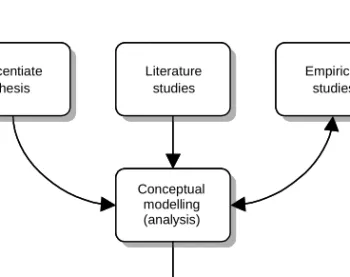
Based on the scientific perspective and knowledge objectives, the research strategy is described in this section. The research questions in this thesis are conceptual; the objectives are how we can understand certain phenomena. According to Patton (2002) and Walsham (1995) for example, this knowledge needs an interpretive research approach. The phenomena also need to be modelled in a conceptual way, i.e. ‘What are they, really?’, ‘What do they really mean?’, ‘How are they related to other concepts’? etc. This conceptual modelling constitutes the analysis parts of the thesis. In my opinion, a conceptual work like this needs empirical inputs as a supplement to theoretical inputs. In order to reach practical relevance, the conceptual development must have a pragmatic sense in practice, and not only be rooted semantically.
The theoretical input to the conceptual modelling (analysis) has taken the form of 1) my previous work (mainly the licentiate thesis as described in Section 2.1.3 above) and 2) literature studies. However, the empirical sources in Oscarson (2001) – a local government – have been used indirectly because they contribute to a general understanding, which constitutes the conclusions of that work.
In the empirical studies, interviews have been the main method for obtaining information. Because the empirical studies aimed to contribute to conceptual understanding, it has been important to access practitioners’ thoughts about the nature of IS security and its fundamental concepts. According to Patton (1990), this would have been impossible through observation: