GRADUATE CURRICULUM AUTHORIZATION FORM
Check As Appropriate:X _Level I New Program or Program Revision
Level II Degree Program Revision or New/Revised COR
Level III Minor Program Revision Application for COR Renewal
Deletion Course or Track or Minor or Program Variability in Program Delivery
Program Reactivation
New Course Enter CIP Code (Contact Registrar‟s Office): Major Course Revision
Minor Course Revision Dual-Level or Cross Listing Distance Education
Description of Proposal: Doctor of Philosophy in Safety Sciences
Department: Safety Sciences
Author or Contact Person: Dr. Lon Ferguson ([email protected]) Dr. Christopher Janicak
(name and email address)
SIGNATURES OF APPROVAL
Academic Integrity Resource ImplicationsEmail Address Date
Department Curriculum Committee Chair: Department Chair: TECC Chair: College Curriculum Committee Chair: College Dean: Graduate Dean: Provost:
Graduate Com. Chair:
Safety Sciences PhD Proposal 9/29/2010
Doctor of Philosophy in Safety Sciences
Indiana University of Pennsylvania
College of Health and Human Services
Department of Safety Sciences
Dr. Lon Ferguson, Department Chairperson
Dr. Christopher Janicak, Graduate Program Coordinator
Submitted February 20, 2008
Last Revised: November 14, 2008
Proposed Implementation Date June 2010
Table of Contents
1. Introduction... 5
1.a. Description, Scope and Purpose of the Program... 5
1.b. Alignment with PASSHE Mission... 7
1.c. Appropriateness to IUP Mission and Strategic Plan ... 7
2. Need and Impact ... 8
2.a. Student Demand and Career Enhancement ... 8
2.b. Intellectual Impact ... 11
3. Academic Integrity... 11
3.a. Program Structure and Administration ... 11
3.b. Program Pedagogical Goals ... 12
3.c. Curriculum Overview... 14
3.d. Course Offerings ... 17
3.e. Learning Experiences ... 18
3.f. Leadership and Faculty Qualifications ... 18
3.g. Student Qualifications, Support and Advisement ... 19
4. Program Assessment... 23
4.a. Collecting and Evaluating Student Learning Outcomes Data... 23
4.b. Use of Student-Learning Outcomes Data to Improve the Program ... 26
5. Coordination/Cooperation/ Partnerships ... 26
5. a. Coordination with Related Programs at Other Institutions ... 26
5. b. Coordination with Other Departments on Campus... 28
5. c. Coordination with Outside Agencies, Corporations ... 29
6. Resource Sufficiency ... 29
6.a. Faculty Workload ... 29
6.b. Detail the Need for and Availability of Necessary Resources... 32
6.c. Five-Year Budget Projection... 39
7. Impact on Educational Opportunity ... 41
7.a. Effect on Diverse Group of Students ... 41
7.b. Effect on Faculty, Advisors, etc... 41
7.c. Effect on Employers... 41
8. Bibliography ... 41
9. Executive Summary ... 43
10. Catalog Description of Program ... 45
Appendix A: Permission to Plan a PhD in Safety Sciences ... 49
Appendix B: Department meeting minutes showing faculty approval of the proposed degree ... 53
Appendix C: Letters of Support from ASSE and NIOSH ... 59
Appendix D: Student Voice Survey Results ... 63
Appendix E: Advisory Group Meeting Minutes ... 68
Appendix F: Faculty Summary Sheets and Curriculum Vitae ... 75
Appendix G: Letters of Notification... 92 Appendix H: University Doctoral Degree Program in Occupational Safety and
Safety Sciences PhD Proposal 9/29/2010
Appendix J: Industrial Hygiene and Ergonomics Lab Equipment 000000000000000000000000 128 Appendix K: Interactive Safety Management Lab Holdings 0000000000000000000000000000000000 136
1. Introduction
1.a. Description, Scope and Purpose of the Program
The faculty of the Department of Safety Sciences is seeking approval of a doctoral degree (Ph.D.) in safety sciences. In the Safety Sciences profession, there is an urgent need for safety professionals holding doctoral degrees to teach at the university level and conduct the research necessary to keep the profession moving forward. This proposed Doctor of Philosophy degree in Safety Sciences would be the only one of its kind in the
Pennsylvania State System of Higher Education and the state of Pennsylvania. While there are a handful of doctoral degrees in the United States that have some safety science coursework included, most of these programs are industrial engineering degree programs with an emphasis of providing engineers with some background in safety. This proposed doctoral degree would be unique in that it focuses primarily on safety sciences
coursework.
An abstract from the Pennsylvania State System of Higher Education demonstrating the permission to plan this degree is attached (See Appendix A). This degree is fully supported by the faculty of the safety sciences department (See Appendix B).
Today, the IUP Safety Sciences Department offers a Bachelor of Science degree in Safety Sciences and a Master of Science degree in Safety Sciences. The Safety Sciences
Department was formed in 1969 in the School of Health Services to administer a three- year grant issued by the National Institute for Occupational Safety and Health (NIOSH). The purpose of the grant was to establish a baccalaureate program in Safety Management for academic preparation of students to be safety professionals in industry, government and institutional settings. The first faculty member was hired in 1971 as the NIOSH grant administrator and department chairperson. The first course was offered in the fall, 1971. In the spring, 1972, additional courses were offered and one additional faculty member was retained on a temporary, part-time basis.
The program was originally accredited by the American Society of Safety Engineers. In 1993, ASSE no longer accredited safety degree programs and accreditation of safety and safety-related degree programs was performed through the Accreditation Board for Engineering and Technology (ABET). The IUP Safety Sciences undergraduate degree program has since then pursued and obtained accreditation through ABET, (the pre- eminent accrediting body for the safety and engineering fields).
Safety sciences (or more broadly known and regarded as safety, health and environmental sciences, SH&E) is by its very nature an interdisciplinary field. Students and
practitioners of safety need competence in a wide variety of academic disciplines
Safety Sciences PhD Proposal 9/29/2010
- Page 6 of 145 -
been widely available for over 30 years, there have been relatively few attempts to build a formal doctorate program in safety. To date, there are merely a handful of programs nationwide that even obliquely address traditional safety pedagogy at the doctoral level. Perhaps the best known program is the doctoral program at the West Virginia University (WVU). The WVU program operates out of the WVU School of engineering, and as such, the curriculum is more closely related to engineering than to the traditional foci found in safety curricula.
Another regional university program is the safety emphasis offered through the Penn State University doctoral degree in Petroleum and Mining Engineering. As indicated, the safety sciences area is available in this doctoral program as an emphasis area, but not as major. This has the effect of greatly diluting the core safety content and application within both the available coursework, and also the dissertations.
While there are doctoral degree programs that include some coursework in safety sciences as part of the their overall degree requirements, the proposed program will be unique in that it will focus entirely on safety science coursework and research methods applied to the field. As structured, the IUP safety doctorate will emphasize all traditional safety pedagogies and will be able to facilitate dissertations that have safety and safety- related concerns as their major focus. As such, there are no other programs like it in Pennsylvania or the Pennsylvania State System of Higher Education.
Therefore, as a response to the lack of doctoral programs specifically focused on SH&E, the IUP Safety Sciences department proposes the development of the nation‟s first dedicated doctoral degree (PhD) in safety sciences. As structured, the IUP safety doctorate will emphasize all traditional safety pedagogies and will be able to facilitate dissertations that have safety and safety-related concerns as their major focus. As such, there are no other programs like it in either the Pennsylvania State System or beyond. The program would be expected to begin in the summer term, 2009 with a cohort of 18 students. The program is designed for a cohort cycle of 11 semesters with the first seven semesters devoted to coursework and the last four semesters devoted to dissertation, see
Table 10 “Expected Progression through the Degree”. The doctorate in safety sciences
includes a 54-credit curriculum, a comprehensive exam following completion of all required coursework, development of a dissertation proposal and subsequent defense and a completed dissertation and defense.
With the exception of appropriate and qualified elective courses, the Safety Sciences department will teach all required courses and perform all advising and dissertation consultation. However, it is foreseeable that on occasion, safety, health or environmental experts outside of IUP may be asked to serve on dissertation committees.
There are significant and influential professional associations and government agencies interested in having specifically IUP develop and implement a doctorate in safety.
Namely, the American Society of Safety Engineers (ASSE) and the National Institutes of Occupational Safety and Health (NIOSH) have each indicated their support of such a program and their letters can be viewed in Appendix C.
1.b. Alignment with PASSHE Mission
The Ph.D. Program advances the missions of both IUP and the Pennsylvania State System of Higher Education (PASSHE). The fifth objective within the Mission of the State System of Higher Education states the following: “To provide continuing education and community and public service in accord with the needs and aspirations of citizens and the social, cultural, economic, and technical needs of the commonwealth.” The Ph.D. Program is also consistent with the IUP mission statement which states “An
institution of higher and continuing learning committed to the teacher-scholar model and the learning-centered environment, and a university where masters and doctoral
education is targeted to the education of competent practitioners.”
The primary area of knowledge in which the department assists the university is the preservation of life, property and the environment, i.e., the safety sciences. There
remains a need both in the nation as well as the world for trained occupational safety and health professionals. Over the past thirty years, the IUP Safety Sciences Department has been meeting this demand for professionals in safety. To date, the department has graduated 2,000 students of which 350 are graduate students. Data from IUP Alumni surveys indicate that over 90% of these students have been placed in safety and health- related positions.
1.c. Appropriateness to IUP Mission and Strategic Plan
The mission of the IUP Safety Sciences Department is to prepare individuals for careers in the safety sciences, which encompass occupational safety, occupational health, environmental safety, fire protection, ergonomics, disaster response, systems safety, and safety management. The department currently has three programs to support this
mission, a certificate of recognition program, a baccalaureate degree program, and a Master of Science degree program. The doctoral degree program will enhance the
undergraduate and master‟s degree programs by exposing both faculty and students to the safety research conducted by the students and most advanced safety techniques in the field. The department also expects a number of students currently pursuing a master‟s in safety sciences degree and alumni from the program to continue their education and pursue the doctorate.
The goal of the Doctor of Philosophy degree program in Safety Sciences is to prepare graduates for their role as teachers in higher education, researchers, and top-level professionals in the field of Safety Sciences. Building upon the national reputation that the Bachelor‟s and Master‟s degrees already have, the doctoral program would be the only one in the United States of its kind. While there are doctoral degree programs with a component that includes industrial safety, these degree programs are typically
engineering based with primary emphases on engineering design. There are still other doctoral degree programs that focus on a specific sub-specialty area of safety sciences such as ergonomics, industrial hygiene, and occupational health. While these specialized degrees meet needs in the practicing profession, the emphasis of the proposed Ph.D. in
Safety Sciences PhD Proposal 9/29/2010
- Page 8 of 145 -
possess applied research skills. In this way, the PhD in safety is expected to materially meet the burgeoning need for new safety faculty in the U.S.
It is anticipated that the majority of the students seeking this degree will move into teaching positions at the university level of which there is a significant and increasing shortage of degreed candidates to fill these positions. In addition, we expect people possessing a doctoral degree in safety sciences will also be highly sought by private industry and government agencies that have research and data analysis applications in the areas of industrial safety.
2. Need and Impact
2.a. Student Demand and Career Enhancement
Research demonstrates the need for safety and health professionals holding doctoral degrees on a national level. Without formalized succession planning and without a cadre of doctoral programs in safety nationwide, replacement of professors of safety is
problematic. In this sense, the safety profession is in need of more doctoral degree programs in the field and more people willing to enter higher education to teach in the programs. The safety profession has three major concerns related to the academic preparation of future safety professionals. They are a major loss of current post- secondary educators to retirements over the next decade, the increased competition for safety professionals available to teach in higher education, and a lack of doctoral degree programs in safety available to develop the future safety educators.
There is expected to be a large number of educators moving out of higher education over the next decade due to retirements. The aging of college and university faculties mirrors general demographic trends in the United States (Dorfman, 2005). Many of today‟s university and college professors hired during the great expansion of academe in the 1960s and 70s are now reaching retirement (Fogg, 2005). The proportion of professors age 50 or over has significantly increased over the decade. At some institutions almost 40 percent of the faculty members are 55 or older (Fogg, 2005).
The safety profession should be even more concerned about the need for more faculty with doctorates in the field because employment demands outside of academia are further reducing the number of candidates available to teach in higher education. The
employment prospects for safety professionals outside of academia are also expected to extremely bright. The Bureau of Labor Statistics has identified an employment demand for safety engineers and safety technicians to increase by as much as 10-20 percent between 2002 and 2012 (Bureau of Labor Statistics, 2005). This demand for personnel further adds to the demand placed upon the pool of available candidates in safety for faculty positions in higher education.
In 2000, “Safe Work in the 21st Century” was published by the Institute of Medicine which was the results of a study conducted by the Institute of Medicine at the request of
the National Institute of Occupational Safety and Health. The purpose of the study was to assess the supply of, demand for, and knowledge, skills, and abilities of occupational safety and health professionals. Additionally, the study was to identify the personnel needs, skills and curricula needed for the coming decades (Institute of Medicine, 2000). One key finding of the committee charged with conducting this study is that “Doctoral- level safety educators are needed to teach and train injury prevention and safety
professionals or their numbers will decrease” (Institute of Medicine, 2000).
While we can interpolate the need for doctoral degree safety professionals in higher education from retirement trends, employment demands, and previous studies, one of the best ways to gain insight as to the need for doctoral level safety professionals and
doctoral degree programs is to survey post secondary institutions. To answer these questions a study was conducted in 2005 by Dr. Christopher Janicak to identify the current minimum requirements for employment as a faculty member in a safety or safety- related degree programs in post-secondary institutions in the United States with regards to terminal degrees, professional practice, research and certifications. This study has identified the need for properly qualified individuals in higher education.
A survey of 51 safety and safety-related degree programs offered at institutions throughout the United States was conducted in the Janicak study. The institutions included public two-year institutions, public four-year institutions, and private four-year institutions with enrollments at the institutions ranging from 4,200 students to 45,000. The degrees offered at these institutions ranged from an emphases in safety to doctorates in safety or safety-related fields with the majority of the degrees offered being Bachelor of Science degrees. There was one Ph.D. degree identified with the title Ph.D. in Occupational Safety and Health which is in West Virginia University‟s College of Engineering and Mineral Resources. To gain admission to this doctoral degree, applicants are expected to have an undergraduate and graduate degree in engineering. Three doctorates with safety coursework were found in other engineering schools. As would be expected, the majority of the degrees awarded over the previous five years were bachelor degrees followed by master degrees in safety. Of the doctorates awarded, 22 were in a safety-related field. However, none were specifically awarded in
Occupational or Industrial Safety. The majority of the doctoral degrees awarded were in industrial engineering with limited coursework in safety.
The respondents were asked if they were currently conducting a search or intended to conduct one within the next five years. Approximately 21 percent of the schools
surveyed stated they are currently conducting a search for faculty positions in a safety or safety-related program while approximately 77 percent of the programs indicated they saw a need to conduct a faculty search in the next five years. Results indicate a projected need for approximately 71 positions to be filled over the next five years. The number of positions that will need to be filled ranges from one position to as many as seven
Safety Sciences PhD Proposal 9/29/2010
- Page 10 of 145 -
Programs were asked to project the number of faculty expected to retire over the next ten years to 2013. Approximately 85 percent of the programs surveyed expected to have one or more faculty members retire. Approximately 62 positions would become available over the next 10 years due to these retirements. The number of faculty retiring in a program ranged from one faculty member to as many as six faculty members. Of the programs surveyed, approximately 63 percent see a need for doctoral degree programs in safety and safety-related fields. This need would help in alleviating one of the biggest hurdles in hiring qualified individuals to teach in safety and safety-related degree programs. With regards to hiring criteria, approximately 17 percent of the programs surveyed required a master's degree in safety or a safety-related field as their terminal degree. Approximately 83 percent required a doctorate in safety or a safety- related field. Depending upon the institution, many allowed a bachelor's degree or a master's degree to teach at the instructor level or adjunct level while almost every institution required a doctorate to reach the rank of full professor.
The most frequently identified difficulty for institutions in finding qualified candidates for faculty positions, is the lack of a doctorate in safety or a safety-related field (60.7%) followed by having to compete with salaries in industry (53.6%).
A survey was conducted by the Department of Safety Sciences to ascertain the need for a Ph.D. degree program in Safety Sciences. Alumni and current students from Master of Science degree programs at Indiana University of Pennsylvania, Murray State University, Oakland University, and East Carolina University as well as internship site supervisors and employers participated in the survey. A summary of the survey results can be found
in Appendix D. One hundred five respondents participated in the survey out of
approximately 424 possible respondents. Approximately 93 percent of the respondents have master‟s degrees in the safety sciences field.
Interest in pursuing a doctorate in safety sciences was extremely high with approximately 61 percent of the respondents indicating they were either interested or very interested in pursuing a doctoral degree in safety sciences within the next five years.
The perceived need for people with a doctoral degree in safety sciences ranged from approximately 54 percent of the respondents indicating a need for someone with a doctorate in safety sciences as important or very important over the next 2 years to approximately 70 percent indicating a need for someone with a doctorate in safety sciences in organizations as important or very important beyond 5 years.
Respondents were also asked about the delivery methods for the degree program. Approximately 86 percent of the respondents indicated they approved or strongly approved of online delivery for some of the degree program courses. Approximately 78 percent indicated they approved or strongly approved of one week summer courses. On April 14, 2006, the Advisory Group to the IUP Department of Safety Sciences met and discussed the proposed Ph.D. in Safety Sciences. Input was solicited from the Advisory Group members as to the demand for the degree in industry and government, the best format to deliver the degree. Advisory group members indicated a Ph.D. in Safety Sciences would be helpful for someone in research areas, policy development positions, government agencies and for ES&H professionals called upon to give expert testimony. A copy of the advisory group meeting minutes appears in Appendix E.
2.b. Intellectual Impact
Persons possessing a doctoral degree in safety are also needed in industry and
government. As was indicated in the survey of universities and colleges, many of their potential employment candidates possessing doctoral degrees, opted for employment in industry and government. The proposed Doctoral Degree in Safety Sciences would also prepare researchers and safety professionals for employment in these areas.
In conclusion, the safety profession needs to take action now to ensure the future demands of the profession are met. A loss of faculty available to teach in safety degree programs, added to a shortage of doctoral level safety professionals available to teach at the college level, added to a large demand for safety professionals in industries across the board could result in problems for the profession in years to come.
3. Academic Integrity
3.a. Program Structure and Administration
IUP‟s undergraduate degree program in safety sciences is the nation‟s oldest accredited safety program. As such, it understands the concepts of degree and content integrity quite well. Since there is only one doctoral program in safety, ABET does not have accreditation criteria designed for the Safety Sciences faculty to respond to, or upon which to pattern the PhD program. However, the Safety Sciences faculty are willing and able to bring their considerable experience from their accredited undergraduate and masters degree, as well as their collective expertise (many are safety program
evaluators for ABET) to bear on the structure, flow and content of the proposed doctorate.
The proposed Doctor of Philosophy in Safety Sciences will prepare safety professionals with advanced skills in the anticipation, recognition, evaluation, control, and prevention
Safety Sciences PhD Proposal 9/29/2010
- Page 12 of 145 -
federal policy that involves SH&E issues, be knowledgeable of and involved in
appropriate professional associations and graduates will be able to teach SH&E content to adult audiences (industry or collegiate).
With regards to accreditation, the Accreditation Board for Engineering and Technology‟s (ABET) Applied Science Accreditation Council (ASAC) accredits safety science degree programs. However, they do not accredit programs at the doctoral level. Typically with engineering and engineering related programs under ABET, it is the undergraduate program which is most often the accredited program.
3.b. Program Pedagogical Goals
We expect our doctoral graduates to be national leaders in safety sciences. To meet the above goal, objectives have been developed for the Ph.D. Program in Safety Sciences. After completing the Ph.D. Program in Safety Sciences the student will be able to:
1. Identify, recognize, evaluate and control complex safety, health and environmental hazards in the workplace.
2. Conduct and publish independent research in the safety, health and environmental field.
3. Apply appropriate quantitative and qualitative research methods to safety, health and environmental problems, management systems, policy and law.
4. Demonstrate an advanced knowledge level of safety, health, and environmental management techniques.
5. Effectively develop, implement, and evaluate a safety education curriculum. The proposed Ph.D. in Safety Sciences is substantially different from any other degree program offered at IUP. There are no other doctoral level degree programs at the University that prepares students in the field at the doctoral level. This Doctoral Degree program will consist of both distance education courses and classroom based courses. Over the past six years, the Department of Safety Sciences has been heavily involved in distance education and one of the leading departments at the University in this area. The Department currently offers 12 distance education courses and received approval to provide over 50% of its Master of Science degree via distance education in 2005. Six of the seven total faculty members in the Department of Safety Sciences have taught at least one distance education course with some teaching as many as four different online courses in the Department. Approximately three distance education courses are offered each semester by the Department. It is the intent of the Department of Safety Sciences to meet a growing demand of the profession while maintaining a quality degree program.
Through their experience teaching distance education courses and formal education (three Department faculty members have Doctorates in Education and one member has a Ph.D. with a minor area in adult education) the Safety Sciences faculty members are aware of the limitations of distance education as well as the benefits and understand that distance education is not the same as classroom instruction. It is not the intent of the Department to offer courses as distance education courses if it does not believe the same level of quality met in the classroom can be met in a distance education course. The faculty in the Department determine, as a group, which courses are appropriate for distance education and which are not; which is one of the reasons three of the courses will be taught as lecture based one week workshops. The Department relies upon the integrity of its faculty members and input from existing IUP expertise in distance education to ensure a quality distance education course is offered much the same way it does when the course is being offered in the classroom. Specifically, our first four distance education courses were developed by Dr. Kay Wijekumer who at the time was the Director of Distance Education at IUP. More recently, faculty have relied on the expertise provided by Dr. Glen Himes and the IDC staff as well as Dr. Mike Powers with the IUP Intelligence E- learning Project. We are sure anyone of these faculty can attest to the quality of our distance education courses. To further ensure the integrity of this cohort, the Department will implement evaluation measures it uses on existing courses and program to ensure a quality program is maintained. These evaluation measures are discussed in the Outcomes Assessment section of this report.
The Department of Safety Sciences faculty members are abreast of numerous guidelines and best practices for the development and delivery of distance learning programs. Examples of resources the Department has consulted when developing this program include Middle States Commission o n Higher Edu cati on‟s Dist ance Lea rning P ro gr ams Interregional Guidelines for Electronically Offered Degree and Certificate Programs and the Best Practices for Electronically Offered Degree and Certificate Programs. A reference list for distance education course and program development and delivery is
attached to this document.
It is because faculty members are aware of the limitations of distance education that the Department is not requesting the entire degree program be offered online. Of the 14 courses required to complete the doctoral degree, eight courses were identified as not lending themselves well to distance education. The rationale for requiring these courses as classroom based courses is that the objectives of the courses can not be met through distance education.
Offering a portion of the doctoral degree in this proposed format will not diminish the quality of degree. Some controls the Department already has in place involves a rigorous acceptance policy in which the students will be required to have a strong background in the safety profession with the appropriate undergraduate degree preparation in the field. All students entering the program must meet minimum competencies in occupational
Safety Sciences PhD Proposal 9/29/2010
- Page 14 of 145 -
complete deficiency coursework as is the case with any other student entering the
program. Students with deficiencies would have to complete their deficiency coursework outside of the cohort model.
It is anticipated that the majority of the students admitted to this cohort will be safety professionals that are working in the field. These non-traditional students will benefit most from a cohort model as proposed due to the fact that they will be adult students. Adult learners are better at self directed learning, they are self-motivated, and they want to learn so they can apply it to their everyday lives. A distance education component to the Doctoral Degree will take advantage of these characteristics. Therefore, the
Department believes an academic rationale for this cohort model is that the model best fits the learning strategies of adult learners they intend to attract to the Doctor of Philosophy degree program.
3.c. Curriculum Overview
The proposed admission criteria and plan of study follow.
Admission Criteria
It is expected that students entering the Ph.D. program in safety sciences will already have completed a master's degree in safety sciences, occupational safety, industrial hygiene or other closely related discipline. A highly qualified applicant may enter the doctoral track with a baccalaureate degree. These students must meet the Master of Science in Safety Sciences degree program admission requirements and complete the Master of Science in Safety Sciences degree requirements en route to the Ph.D. Students with a master‟s degree in safety or a closely related field seeking admission to the Doctor of Philosophy in Safety Sciences degree program must meet the following criteria:
Have earned a master‟s degree from a regionally accredited college or university
Have a minimum graduate grade-point average of 3.0 (on a 4.0 scale)
Additionally, the doctoral coordinator, after consulting with the department screening committee, will submit a recommendation regarding applicants to the Graduate School and Research. The following criteria are reviewed:
1. All official college transcripts. 2. Three letters of recommendation. 3. Statement of goals.
4. Resume.
5. Official GRE scores (general test).
International students must also meet Graduate Admissions requirements for international students. These requirements include:
Submission of Test of English as a Foreign Language (TOEFL) scores for applicants from countries people whose native language is not English. The minimum TOEFL score for admission to the program is 530.
Submit a Foreign Student Financial Statement. International students must document their ability to assume full responsibility for the cost of graduate education per Graduate School requirements.
Plan of Study
The Ph.D. program in safety sciences is designed to be completed in approximately three calendar years of study beyond the master's degree. The curriculum requires a minimum of 54-semester hours of acceptable graduate credit beyond the Master‟s degree (24 credits will be distance education – DE - courses). As described below, each student must complete the following 1) all required and elective course work, 2) comprehensive examinations, 3) dissertation proposal and defense, 4) and the dissertation and its defense.
I. Required Course Work (Italics indicate a DE course).
1. Core Courses (33 semester hours):
SAFE 800 Pedagogical Practices in Safety Education 3 cr
SAFE 801 Current Legislation and Consensus Standards 3 cr
in Safety Sciences
SAFE 802 Advanced Qualitative Methods 3 cr
SAFE 803 Quantitative Strategies for Analysis in Safety Sciences 3 cr
SAFE 804 Legal Aspects of Safety Sciences 3 cr
SAFE 805 Strategies in Risk Control 3 cr
SAFE 806 Current Issues in Safety Sciences 3 cr
SAFE 807 Doctoral Colloquium in Safety Sciences 3 cr
SAFE 808 Curriculum Evaluation in Safety Education 3 cr
SAFE 813 Practicum in Safety Education 3 cr
SAFE 874 Fire Safety in Building Design 3 cr
2. Advanced Applied Research (9 semester hours):
SAFE 810 Applied Research I: Experimental Design 3 cr
SAFE 811 Applied Research II: Correlation and Regression 3 cr
SAFE 812 Applied Research III: Tests and Measurements 3 cr
3. Dissertation (12 semester hours):
Safety Sciences PhD Proposal 9/29/2010
- Page 16 of 145 -
II. Comprehensive Examination
Upon completion of their coursework, doctoral students will be required to arrange a written comprehensive exam with their major advisor. This pass/fail examination will encompass all coursework completed to tha t point in the degree and focus on subject areas expected to be explored by the student during his/her dissertation research. Upon successful passing of the comprehensive
examination, a student may proceed toward fulfillment of remaining degree requirements, beginning with the completion and defense of the dissertation proposal (typically the introduction and proposed methodology of the
dissertation). If a student does not pass their comprehensive examination, they are allowed to retake the examination on ce.
III. Proposal Development and Defense
Students will be required to successfully complete an oral defense of their dissertation proposal before their dissertation committee. Although some aspects of format and the main content of the dissertation proposal will be specific to each student, it is expected that each dissertation proposal will consist of at least of the following sections: an introduction, literature review, purpose and rationale, hypotheses and proposed
methodology/ analysis plan (see next section). The completed dissertation will likely add results, discussion and conclusion sections. Upon successful completion of the
proposal defense, a student may proceed toward fulfillment of the dissertation requirements.
IV. Dissertation Process and Defense
SAFE 995 will be the dissertation course. SAFE 995 can be taken in 3 credit increments and all students will need to have taken at least 12 credits of SAFE 995 prior to
graduation. Students will be allowed to progress to the “next” level only upon successful completion of the previous segment. The intention of each 3 credit segment is to make consistent and incremental progress on one‟s dissertation in order to enhance and facilitate the timely completion of one‟s dissertation.
For example, for the first 3 credits of SAFE 995, students would be expected to complete an introduction and problem statement for their dissertation. For the second 3 credits of SAFE 995 the student would be expected to complete the review of literature for their dissertation. Although one semester may not appear to be enough time it is important to keep in mind that student will already have started their review of literature as part of the core course SAFE 807. For the third 3 credits of SAFE 995 the students will be expected to complete the research design. It is during these three credits the students will complete their proposal defense. For the last 3 credits of SAFE 995 the students will be expected to collect the data, analyze the data and develop conclusions and recommendations for their study.
The dissertation defense. Upon the completion of the written dissertation, students must successfully complete an oral defense of their dissertation. The defense shall be
Chairperson and committee members. The membership and procedures of the
dissertation committee shall follow the requirements of the School of Graduate Studies and Research.
In accordance with university guidelines, in order to confer the doctoral degree, successful completion of a doctoral dissertation (12 semester hours of SAFE 995 in three credit segments) and dissertation defense is required.
All other IUP School of Graduate Studies and Research procedures apply.
3.d. Course Offerings
The proposed Ph.D. in Safety Sciences requires 14 new graduate level courses plus the dissertation (SAFE 995) course. The new courses are:
SAFE 800 Pedagogical Practices in Safety Education 3 cr
SAFE 801 Current Legislation and Consensus Standards 3 cr
in Safety Sciences
SAFE 802 Advanced Qualitative Methods 3 cr SAFE 803 Quantitative Strategies for Analysis in Safety Sciences 3 cr SAFE 804 Legal Aspects of Safety Sciences 3 cr SAFE 805 Strategies in Risk Control 3 cr SAFE 806 Current Issues in Safety Sciences 3 cr SAFE 807 Doctoral Colloquium in Safety Sciences 3 cr SAFE 808 Curriculum Evaluation in Safety Education 3 cr SAFE 810 Applied Research I: Experimental Design 3 cr SAFE 811 Applied Research II: Correlation and Regression 3 cr SAFE 812 Applied Research III: Tests and Measurements 3 cr SAFE 813 Practicum in Safety Education 3 cr SAFE 995 Dissertation 1-12 cr
Safety Sciences PhD Proposal 9/29/2010
- Page 18 of 145 -
The following course will require renumbering to 800 level numbers. There will be no change in course content.
SAFE 674 to SAFE 774/874 Fire Safety in Building Design 3 cr
Students who have completed SAFE 774/874 as part of their Master‟s degree may transfer in the 3 hours toward their Ph.D. program of study.
3.e. Learning Experiences Distance Education
It is anticipated that most students seeking a doctoral degree in this program will be working, full-time, safety professionals from around the United States. To make the program available to a larger number of students and to facilitate optimal allocation of faculty resources, 24 hours of the 54 hours in the degree program will be offered through distance education. Two courses will be offered as one week courses during the summers on the IUP campus.
3.f. Leadership and Faculty Qualifications
Once current and new faculty members are granted graduate faculty status at the doctoral level, the Department will have seven professors capable of teaching at the doctoral level. The following Safety Sciences faculty members currently are Graduate Faculty with Doctoral level status and will be involved in the delivery of courses:
Dr. Tracey Cekada Dr. John Engler Dr. Lon Ferguson Dr. Christopher Janicak
The following Safety Sciences faculty members have Graduate Faculty status at the Master‟s level and will be requesting Doctoral level status:
Dr. Jan Wachter Dr. Laura Rhodes
The following new Safety Sciences faculty member will be requesting Graduate Faculty status at the Master‟s and Doctoral level:
Dr. Bachel Han
Dr. Christopher Janicak will serve as the Doctoral Degree Coordinator. He has over 16 years of experience teaching safety sciences at the university level and over 22 years of experience overall in the safety profession. His research and publication record is extensive with four books, two book chapters, over 20 peer reviewed research journal articles, and numerous professional presentations. He currently serves as the Master of Science degree program coordinator for the department.
Two additional faculty members have been requested for the delivery of the Ph.D. program. All faculty members will be involved in teaching courses, advising students, and serving on dissertation committees. Copies of the Faculty Summary Sheets appear in
Appendix F.
Two teaching associates and two graduate assistants will be requested as part of the Ph.D. in Safety Sciences program. The teaching associates will be used to teach undergraduate courses and the graduate assistants will assist faculty with research.
To the best of our knowledge, the Ph.D. in Safety Sciences degree program is in compliance with the current Collective Bargaining Agreement (CBA).
3.g. Student Qualifications, Support and Advisement
Requirements for Admission, Degree Candidacy, and Graduation
It is expected that students entering the Ph.D. program in safety sciences will already have completed a master's degree in safety sciences, occupational safety, industrial hygiene or other closely related discipline. A highly qualified applicant may enter the doctoral degree with a baccalaureate degree. These students must complete the Master of Science in Safety Sciences degree requirements en route to the Ph.D.
Applicants must meet all Graduate School and Research admission requirements. Additionally, the doctoral coordinator, after consulting with the department screening committee, will submit a recommendation regarding applicants to the Graduate School and Research. The following criteria are reviewed:
1. all official college transcripts 2. three letters of recommendation 3. statement of goals
4. example of written work, ex., thesis, articles, reports, etc.
5. personal interview, if requested by department screening committee or by the applicant
Upon completion of their coursework, doctoral students will be required to arrange a written comprehensive exam with their major advisor. This pass/fail examination will encompass all coursework completed to that point in the degree and focus on subject areas expected to be explored by the student during his/her dissertation research. Successfu l completion of the comprehensive written examination will result in d egree candidacy.
Safety Sciences PhD Proposal 9/29/2010
coursework in the program of study, pass the written comprehensive examination and achieve candidacy, write a dissertation, and successfully defend the dissertation.
Progression through the Degree
Most students entering this degree program can be expected to be full time working professionals seeking to advance their education and in many cas es, change their careers paths to higher education, thus the Department of Safety Sciences will admit a limited number of students in a cohort model. As mentioned earlier, the program is designed for a cohort cycle of 11 semesters with the first seven semesters devoted to coursework and the last four semesters devoted to dissertation, see Table 10 “Expected Progression through the Degree”. The twelve hours of dissertation credits will be offered in three hour segments for four semesters.
Safety Sciences PhD Proposal 9/29/2010
Table 10: Expected Progression through the Degree
Progression through the Degree
The following table depicts the typical progression through the degree for a cohort model student.
Summer 2009 Fall 2009 Spring 2010 Summer 2010 Fall 2010 Spring 2011 Summer 2011 Fall 2011 Spring 2012 Summer 2012 Fall 2012 SAFE 810 SAFE 803 SAFE 805 (DE) SAFE 804 (DE) SAFE 806 (DE) SAFE 802 (DE) SAFE 811 SAFE 812 Safety 800 (DE) SAFE 874 (DE) SAFE 801 (DE) SAFE 808 (DE) SAFE 807 SAFE 813
Dissertation Dissertation Dissertation Dissertation
6 hours 6 hours 6 hours 6 hours 6 hours 6 hours 6 hours 3 hours 3 hours 3 hours 3 hours
4. Program Assessment
4.a. Collecting and Evaluating Student Learning Outcomes Data
The Ph.D. in Safety Sciences degree program has the following student learning outcomes:
Students will be able to:
1. Anticipate, recognize, evaluate, control, and prevent complex safety, health and environmental hazards in the workplace.
2. Conduct independent research in the safety, health and environmental field. 3. Apply appropriate quantitative and qualitative research methods to safety, health
and environmental problems.
4. Demonstrate advanced knowledge level of safety, health, and environmental management techniques.
5. Effectively develop, implement, and evaluate a safety education curriculum. The Department of Safety Sciences utilizes a variety of methodologies to determine if student learning has been achieved. Courses have been carefully selected and developed for the Ph.D. program to ensure adequate coverage of material to meet the stated student outcomes. Each course has Course Specific Student Learning Outcomes that are written in terms of what the student will be able to do at the end of the course. These course outcomes reflect the knowledge and skills that the student will be held accountable for. A variety of outcome indicators will be used to determine if each student outcome has been met in a particular course. For each course, the instructor has identified a series of outcome indicators that are indicative of each student outcome covered by that particular course. Based upon how the students perform on the outcome indicators, the faculty member will be able to determine if the student learning outcomes have been met.
Faculty teaching the course will determine if the student successfully met the anticipated student outcome while the Doctoral Program Coordinator will coordinate the assessment activities for the program.
In addition to the course measures for student outcomes, global measures of student outcomes will be obtained through the use of portfolios, alumni surveys, employer surveys, certification examinations, Safety Sciences Advisory Board review of program and student outcomes materials, student exit interviews, and job placement data. As with the bachelor‟s and master‟s degree programs, the Advisory Committee will review the program requirements and course content areas. They suggest areas of improvement to the faculty on the program and individual courses.
Safety Sciences PhD Proposal 9/29/2010
Summaries of the student outcomes and their respective outcome indicator by course are provided in Table 11.
Safety Sciences PhD Proposal 9/29/2010
Table 11: Summary of Student Outcomes and Outcome Indicator by Course
Required Courses Student Outcome Outcome Indicators
SAFE 800: Pedagogical Practices in Safety Education 1, 4, 5 Course projects, homework assignments
SAFE 801: Current Legislation and Consensus Standards in Safety Sciences
1, 4 Course project, examinations
SAFE 802: Advanced Qualitative Methods 3, 4 Research proposal, research project, class
assignments
SAFE 803: Quantitative Strategies 3, 4 Research project, examinations, case studies
SAFE 804: Legal Aspects of Safety 1, 4 Trial review, research project, quizzes
SAFE 805: Strategies in Risk Control 1, 4 Course projects, homework assignments
SAFE 806: Current Issues in Safety Sciences 1, 4 Course projects, homework assignments
SAFE 807: Doctoral Colloquium in Safety Sciences 2, 3 Research project, assignments, presentations
SAFE 808: Curriculum Evaluation in Safety Education 1, 4, 5 Course projects, homework assignments
SAFE 810: Applied Research I 3, 4 Research project, assignments
SAFE 811: Applied Research II 3, 4 Research project, assignments
SAFE 812: Applied Research III 3, 4 Research project, assignments
SAFE 813: Practicum in Safety Education 1, 4, 5 Course projects, homework assignments,
presentations
SAFE 874: Fire Safety in Building Design 1, 4, 5 Course projects, homework assignments, case
studies
Safety Sciences PhD Proposal 9/29/2010
4.b. Use of Student-Learning Outcomes Data to Improve the Program
As with the outcomes assessments for the Bachelors and Masters degree programs, the Safety Sciences plans to utilize a continuous improvement process to ensure the student educational objectives are being met. This process involves the collection and evaluation of the outcomes indicator data on an annual basis.
Faculty will collect and interpret the date from the course outcomes indicators and report back to the department through the annual assessment retreat held by the department. As in the past with the other degree programs, the faculty member responsible for the course will develop interventions necessary to ensure students are adequately meeting the outcomes for their particular course.
Students completing the doctoral degree will be required to develop a portfolio of work completed during their program of study. The portfolio work will be analyzed by the Doctoral Program Coordinator, Department Chair, and the Safety Sciences Advisory Committee. Recommendations based upon the portfolio reviews will be presented to the faculty for consideration. Faculty members can use the information to further improve their courses to ensure outcomes are being met.
Employer surveys, student exit surveys, and alumni surveys (which include employment data and certification data) are administered through the department for the bachelor‟s and master‟s degrees. These activities will also be conducted for the doctoral degree program. Data from these surveys are collected and compiled by the Department Chairperson. Results are then distributed to faculty members and the Safety Sciences Advisory Board. As part of the annual outcomes assessment retreat, the results of the surveys are discussed and appropriate improvement actions are decided whether they be at the program level or course level. The Safety Sciences Advisory Board dedicates one meeting per year to outcomes assessment. The input from the advisory board is then provided to the faculty members.
5. Coordination/Cooperation/ Partnerships
5. a. Coordination with Related Programs at Other Institutions
This proposed program will not duplicate unnecessarily existing programs at other PASSHE or area universities. Indiana University of Pennsylvania will be the only SSHE institution that offers a Ph.D. in Safety Sciences, therefore, the proposed degree will not duplicate any other existing SSHE program. The following three programs represent comparisons of regional programs.
Penn State University and the University of Pittsburgh – Neither Penn State
nor the University of Pittsburgh offer a doctoral degree in industrial safety or closely related field. Whereas Pitt has no program or options, Penn State will
soon offer a doctoral emphasis through a combination of coursework in 3 distinct academic programs. Penn State University will be offering a Ph.D. degree in the safety and health field but it will be very different from the IUP model. It will be done in a manner similar to the way other traditional engineering disciplines offer focused areas within their bigger, overall program. The health and safety
component will be one of three possible options that students can declare (mining engineering, petroleum and natural gas engineering or industrial health and safety). The degree is a health and safety degree in classroom and research content, with additional focus on engineering economics and petroleum engineering principles. While students can focus their studies and research on any area of interest within the health and safety field, the degree is a pure research degree in a department build around the natural resource extractive industries. While much of the research funding currently comes from the extractive industries, the Penn State program is also receiving safety and health related research funding from the National Institute of Occupational Safety and Health.
West Virginia University – WVU offers a Ph.D. in Occupational Safety and
Health through their College of Engineering and Mineral Resources and as such, this degree provides a materially different emphasis in coursework and outcomes. Copies of these degree programs appear in Appendix H.
In addition to programs or options in traditional university settings, the National Institutes of Occupational Safety and Health (NIOSH) manages the Education and Research
Centers (ERC) as apart of NIOSH‟s Congressional mandate to provide an adequate supply of appropriately educate occupational safety and health professionals. NIOSH currently funds 16 ERCs at universities around the country. Each ERC provides training and research in the 4 core areas of occupational safety and health: occupational medicine, occupational health nursing, industrial hygiene and safety.
Of the 16 ERCs, the following offer doctoral programs in safety or occupational safety:
Michigan Center for Occupational Health and Safety Engineering (PhD
Occupational Safety): The Occupational Safety Engineering and Ergonomics program
at the University of Michigan is offered by the College of Engineering's Department of Industrial and Operations Engineering. It is intended for engineers and science majors who wish to acquire an M.S. or Ph.D. degree. Courses and research activities emphasize accident and injury prevention through engineering control of workplace hazards. A copy of the degree program requirements appears in Appendix H.
University of Cincinnati (PhD Occupational Safety): The University of Cincinnati
offers a PH.D. Degree in Environmental and Occupational Hygiene or Occupational Safety/Ergonomics through their Department of Environmental Health. These degree programs at the doctorate level are narrowly focused in either industrial hygiene or ergonomics. A copy of the degree program requirements appears in Appendix H.
Safety Sciences PhD Proposal 9/29/2010
- Page 28 of 145 -
Deep South ERC (Auburn & University Alabama Birmingham, PhD Occupational
Safety and Ergonomics, School of Industrial Engineering): The safety curriculum at
Auburn resides in the Industrial and Systems Engineering (ISE) program. The Aburn ISE program offers a PhD in occupational safety and ergonomics. The Auburn ISE degree is heavily oriented toward the industrial engineering discipline and therefore differs
markedly from the proposed doctoral program.
For example, as can be seen below, safety-related courses appear in the ISE core. However, safety is not offered as a distinct degree. According to the Auburn ISE website: “All ISE graduate degrees require a set of six core courses:
INSY 6010 Safety Engineering INSY 6010 Safety Engineering I
INSY 6600 Manufacturing/Production Economics
INSY 7030 Manufacturing System Design and Operation INSY 7060 Ergonomics I
INSY 7240 Production and Inventory Control Systems INSY 7300 Advanced Engineering Statistics I
INSY 7400 Simulation Modeling and Analysis
INSY 7420 Linear Programming and Network Flows” A copy of the degree program requirements appears in Appendix H.
Rocky Mountain Center for Occupational and Environmental Health (University of
Utah, PhD Safety & Ergonomics): The University of Utah offers a Doctor of
Philosophy degree in Mechanical Engineering with an emphasis in safety and
ergonomics. In this program, the degree is an engineering degree with an emphasis area in safety and ergonomics. A copy of the degree program requirements appears in
Appendix H.
The number of ERC supported students actually graduating with doctorates from ERCs in safety from these 4 ERCs is unknown; however, it is known that the majority of ERC graduates are not in safety.
5. b. Coordination with Other Departments on Campus
The Department of Safety Sciences does not believe other departments could be potentially affected by the Ph.D. degree in Safety Sciences. As a courtesy, letters of notification and proposals were sent to the following departments and colleges: Department of Sociology
Department of Psychology
College of Education and Education Technology
Copies of the letters of notification appear in Appendix G. There were no responses received from the departments.
5. c. Coordination with Outside Agencies, Corporations
The Department of Safety Sciences has strong ties to area businesses and governmental agencies. Examples of these ties with area businesses and governmental agencies include:
1. Safety professionals serving on the Department Advisory Committee 2. Providing donated equipment for use in courses and laboratories 3. Governmental agencies such as the Occupational Safety and Health
Administration providing speakers for student groups and classes 4. Donating money for various department initiatives including equipment
purchases, summer scholars programs, sponsoring forums, student meetings
5. Holding joint student/safety professional meetings with professional organizations such as the American Society of Safety Engineers.
6. Resource Sufficiency 6.a. Faculty Workload
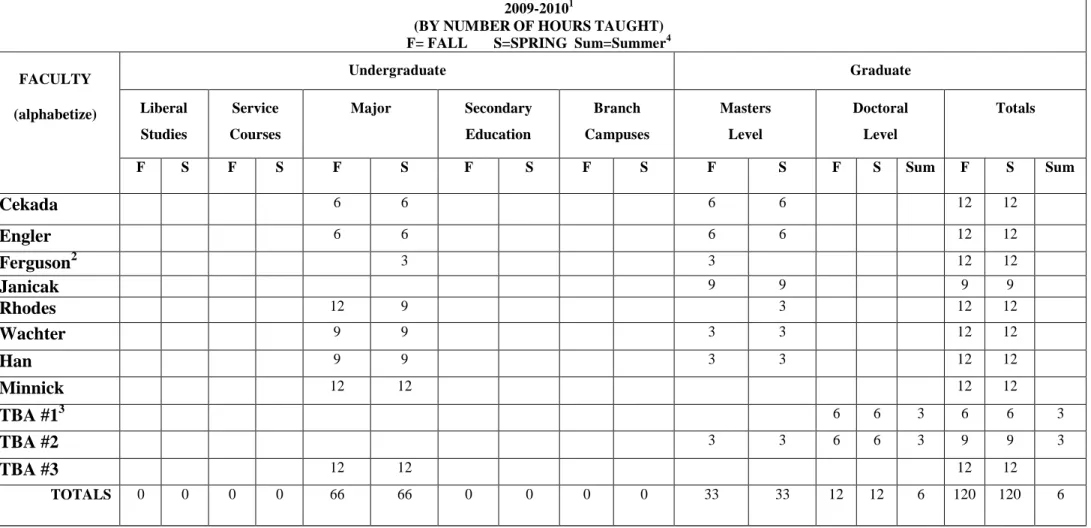
The proposed Ph.D. in Safety Sciences will require two new doctoral level degree courses to be offered each semester. To adequately staff the new doctoral program, two new full-time faculty positions will be required. These positions will provide the Department the ability to offer courses in the Bachelor of Science degree, Master of Science degree, Certificate of Recognition and the new doctoral degree program and to assist in the coordination of doctoral students, advising and research. Two faculty positions will be needed to start the doctoral program. Because new cohorts of 18 students will be admitted every third summer, dissertation advisement for the first cohort and more doctoral student supervision is required with the new cohort beginning in the third year. Faculty Workload Tables are provided that depict current and projected workloads (See Tables 12 and 13).
Safety Sciences PhD Proposal 9/29/2010
- Page 30 of 145 -
Table 12: SAFETY SCIENCES DEPARTMENT FACULTY ALLOCATION HISTORY (By number of hour taught) -- U= Undergraduate D= Dual Level G= Graduate T= Total
Faculty (alphabetize)
Past Experience Projected
2007-20081 2008-20092 2009-20103 2010-200114 2011-20125 U D G T U D G T U D G T U D G T U D G T Cekada 24 24 24 24 24 24 12 12 24 12 12 24 Engler 3 24A 3 24A 3 24A 12 12 24 12 12 24 Ferguson (chair) 6 3 27 6 3 27 6 24 6 24 6 24 Janicak 20 3 26 20 3 26 18 6 24 18 18 18 18 Ramsay 12 12 24 24 Rhodes 21 3 24 21 3 24 21 3 24 21 3 24 21 3 24 Rivers 18 6 24 18 6 24 Soule 20 6 26 20 6 26 18 6 24 Wachter 18 6 24 18 6 24 18 6 24 Han 18 6 24 18 6 24 Minnick 24 24 24 24 TBA #1 12B 12 12B 12 TBA #2 12 12 TBA #3 24 24 1
- two years prior to program implementation; 2 - one year prior to program implementation; 3 – year of program implementation; 4 – one year after program implementation; 5 – two years after program implementation. A12 credits OSHA Program Director (Fall) 9 credits Program Director (Spring); B6 credits as Doctorate Coordinator.
Table 13: SAFETY SCIENCES DEPARTMENT FACULTY ALLOCATION 2009-20101
(BY NUMBER OF HOURS TAUGHT)
F= FALL S=SPRING Sum=Summer4
FACULTY (alphabetize) Undergraduate Graduate Liberal Studies Service Courses Major Secondary Education Branch Campuses Masters Level Doctoral Level Totals F S F S F S F S F S F S F S Sum F S Sum Cekada 6 6 6 6 12 12 Engler 6 6 6 6 12 12 Ferguson2 3 3 12 12 Janicak 9 9 9 9 Rhodes 12 9 3 12 12 Wachter 9 9 3 3 12 12 Han 9 9 3 3 12 12 Minnick 12 12 12 12 TBA #13 6 6 3 6 6 3 TBA #2 3 3 6 6 3 9 9 3 TBA #3 12 12 12 12 TOTALS 0 0 0 0 66 66 0 0 0 0 33 33 12 12 6 120 120 6
1Academic year of program implementation (Use footnotes to explain deviations from 24- hour load per year of 18- hour load per year for full-time graduate teaching); 2Department Chairperson (9 hours release); 3Doctoral Coordinator; 4Doctoral Degree Cohort begins in Summer 2009
Safety Sciences PhD Proposal 9/29/2010
- Page 32 of 145 -
6.b. Detail the Need for and Availability of Necessary Resources Doctoral Program Education Fee
All doctoral students will be charge a one-time program education fee of $1,500.00 on entry to the program. This fee will be necessary to provide sufficient allocation of instructional
resources to maximize the doctoral educational experience. Examples of resources supported by these fees are:
1. guest speaker honorariums
2. enhancement of technology resources used for instruction (examples my include computer programs and hardware)
3. student research support funds
4. travel and presenter expenses for students and/or faculty to present at regional and national conferences
5. support the purchase of items to enhance classroom/facilities environment This is a non-refundable fee. The fee will be assessed by the Department for deposit in an account specifically designated as the IUP Safety Sciences Doctoral Program Education Account. The doctoral coordinator will manage the account.
Library Resources
The IUP Libraries consists of the Stapleton/Stabley main Library, Cogswell Music Library, and regional campus libraries at Northpointe and Punxsutawney. Collectively, IUP Libraries contains over 722,259 book volumes; 141,104 bound periodicals; 2,391,488 items on microforms; 1,784 current periodical subscriptions; 14,344 electronic serial titles; and over 110,598 media items. There are over 1,200 study spaces and several group study rooms throughout the main Library, which is open 102 hours per week during the fall and spring semesters. The Library recently extended operating hours until 2:00am Sunday-Thursday. Over 118 computers for student/faculty use are available on every floor of the building and wireless laptops are available for circulation within the building. There is a wireless network available in all public areas of both buildings of the Library. A wide range of resources and services are available to support teaching and research. The University Library is a select US and State Government Depository, a member of PALINET, PALCI (Pennsylvania Academic Library Consortium, Inc.), Access Pennsylvania, and the Laurel Highlands Health Sciences Library Consortium.
Online searching services are available to faculty and students. Currently over a hundred
databases covering a wide variety of subjects are accessible both locally and remotely. Many of the databases provide fulltext access to the documents they index. The Library is constantly adding new databases, many purchased with student technology fee monies. These and other services can be accessed through the Library‟s home page (www.lib.iup.edu/). In addition to general subject indexes such as EBSCOhost‟s Academic Search Premier, Gale‟s InfoTrac
OneFile, and Wilson‟s OmniFile Fulltext, databases of particular interest to the Safety Sciences program include Academic Universe, Acess Science, ACS Web, Applied Science & Technology, Business & Company Index, Business Source Premier, Congressional Universe, Environmental Issues & Policy Index, GeoBase, Marcive WebDocs, Medline, and Toxline. The Library
subscribes to Digital Dissertations which allows searching of all dissertations since 1861 and provides fulltext access to dissertations since 1997. The Library also provides access to
WorldCat, a database that lists library holdings worldwide. The Library maintains a large print, microform, and electronic periodical collection. Students and faculty can acquire articles in magazines and journals not owned by or accessible through IUP by requesting them from InterLibrary Loan. ILLIAD, the new ILL software, has decreased the waiting time for requests and now makes it possible to receive articles electronically as attachments to email, oftentimes within a week of request.
The IUP Libraries has established a liaison program where each subject department is assigned a bibliographer who serves as the department‟s link to information about and assistance with using the Library. Since 1999 IUP Libraries has used an approval plan through Yankee Book Peddlers to facilitate book selection and ordering. Based on a profile developed by the Collection
Development Librarian and the department liaison, books and slips arrive on a regular basis for review by the subject department faculty and library bibliographers. Faculty can also submit their own requests for books. Through GOBI 2 (Global Online Bibliographic Information Service), Yankee‟s online ordering system, both liaisons and bibliographers can access the titles of books and slips sent, order books, and review departmental profiles. Workshops on how to use GOBI 2 are periodically offered by the Library. The Collection Development Librarian has developed an allocation formula, based on a number of factors, to determine the amount each department will have to spend each fiscal year. For the fiscal year 2005-2006 the Safety Sciences program has been allocated $5,064.47. In 2006, the Safety Sciences Department will receive $5,940.76 in performance fund money. The performance fund money will be used to purchase new books for the department and to fill in gaps in the Library's collection for the safety sciences area.
Periodic reviews, during which department liaisons and bibliographers have an opportunity to give input, are conducted to ensure that the profile is meeting the needs of the department. The Collection Development Librarian maintains a Liaison Listserv for general announcements and to facilitate communication between bibliographers and liaisons. Periodic „Liaison Lunches‟ are sponsored by the Library to distribute information and serve as a forum for questions and discussion among bibliographers and departmental liaisons. In addition to books found in the circulating collection, the Reference collection contains a number of books specific to the safety sciences including the Encyclopedia of Occupational Safety and Health, Best’s Safety Directory,
HazMat data: for First Response, Transport, Storage, and Security, Sax’s Dangerous Properties
of Industrial Materials, the NFPA National Fire Codes, and a variety of ANSI Standards. The IUP Libraries‟ book collection is augmented electronically with a subscription to NetLibrary. Books not owned by IUP can be borrowed directly by students and faculty from any PALCI member library by using the link on the Library‟s web page. Books will be sent to the patron through the Circulation Department and can be checked out and returned like a book owned by