Low Complexity Joint Sub-Carrier Pairing,
Allocation and Relay Selection in Cooperative
Wireless Networks
Muhammad Abrar
1, 2, Xiang Gui
1, Amal Punchihewa
31
School of Engineering and Advanced Technology, Massey University, New Zealand 2
Department of Electrical Engineering, UCE&T, BZ University, Pakistan 3
Asia-Pacific Broadcasting Union, Kuala Lumpur, Malaysia [email protected]
Abstract: Multi-carrier cooperative relay-based wireless
communication is of particular interest in future wireless networks. In this paper we present resource allocation algorithm in which sub-carrier pairing is of particular interest along with fairness constraint in multi-user networks. An optimization of sub-carrier pair selection is formulated through capacity maximization problem. Sub-carrier pairing is applied in both two-hop Amplify & Forward (AF) and Decode & Forward (DF) cooperative multi-user networks. We develop a less complex centralized scheme for joint sub-carrier pairing and allocation along with relay selection. The computational complexity of the proposed algorithms has been analyzed and performance is compared with Exhaustive Search Algorithm.
Keywords: Relay Networks, OFDM, Resource Block,
Sub-carrier Pairing, Relay Protocols, Relay Network.
1.
Introduction
Relay-based cooperative communication has been proposed in the cellular networks to improve reliability, enhance capacity, reduce total power consumption and extend coverage area [1-5]. The deployment of relay terminal in Orthogonal Frequency Division Multiplexing (OFDM)-based wireless cellular networks is a promising design to meet high data rates and extended coverage demands in future wireless networks. However, the presence of relay terminals makes the issue of resource allocation more challenging and considerable.
Relay based cooperative wireless communication is a hot research topic now a day. Recently, several results on resource allocation in cooperative relaying networks have been reported in the literature [6-8].
The sub-carriers are the most important resources in the OFDM-based transmission and the allocation of these to different users according to channel conditions has already been proven to provide significant gain in system efficiency under fading wireless environment [3]. In most of the literature, it is assumed that the same sub-carrier is used in both the first and the second hops of transmission [9, 10]. But due to independent channel fading on the same sub-carrier over the two hops, the system performance may not be optimal. The system performance can be enhanced further by sub-carrier pairing in the two hops according to their
channel conditions [11]. In [11], sub-carrier pairing based resource allocation for cooperative multi-relay networks is addressed for Amplify & Forward (AF) protocol. In [12], the concept of sub-carrier pairing in relay networks was introduced in the three-node network using the Decode & Forward (DF) protocol. In [13], resource allocation with sub-carrier paring is investigated under a joint sum-power constraint for both AF and DF systems. Symbol Error Performance (SEP) analysis with sub-carrier pairing in OFDM relaying systems is presented in [14]. In all of these papers, the network of interest is a single source-destination pair with either single relay or multiple relays. But in practical scenarios, interference due to multiple users also plays a critical role in system performance degradation [15].
Figure 1. LTE Downlink Physical Resource [16]
In [17] and [18], Sub-carrier pairing based resource allocation has been addressed in Two-Way Relaying (TWR) networks with AF protocol only. In in this paper we propose a new Low Complexity Iterative RB-Pairing and Allocation (LIRBPA) algorithm in multiuser multi-relay One-way Relaying (OWR) networks with proportional fairness among users.
(∆f) is 15 kHz. Each resource block has a total size of 180 kHz in the frequency domain and 0.5ms in the time domain. Each user is allocated a number of resource blocks in the time–frequency grid. The allocation of resource blocks to users depends on the scheduling mechanisms in the frequency and time dimensions [16].
The rest of the paper is divided into five additional sections. Section 2 describes the system model and basic assumptions. The problem formulation and description is presented in Section 3 while low complexity RB-pairing and allocation algorithm is presented in Section 4. Furthermore, numerical results with simulation are illustrated in Section 5. Finally, conclusion is provided in Section 6.
2.
System Model
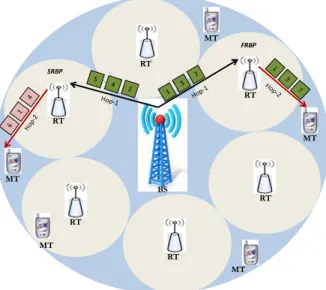
In this paper we consider a two-hop multi-user multi-relay-assisted cooperative wireless network that consists of M mobile terminals (MTs), R relay terminals (RTs) and a base station (BS) as shown in Fig. 2. A downlink transmission is considered where MTs receive information from the BS through the RTs. Each RT operates in a time-division half-duplex mode using AF protocol.
Figure 2. Multi-Users Multi-Relay Cooperative
Network
By considering multi-carrier transmission, it is assumed that K RBs are available. In the rest of the paper, the term RB is used instead of a sub-carrier. The frequency selective fading channels are assumed where each RB experiences independent channel environment while all sub-carriers in a single RB experience the same channel environment. It is also assumed that there is no intra-cell interference due to orthogonal sub-carriers and perfect synchronization in OFDM based cooperative wireless system. However, in case of imperfect synchronization, the multi-user interference may occur due to the different carrier frequency offsets
between different MTs. This multi-user interference can easily be mitigated using some cancellation techniques such as the one proposed in [20].
3.
Problem Formulation and Description
Let the signal received at RT on the RB index
k
is forwarded to MT over the RB indexk
'
. Here, the RB index'
k
may not be the same ask
and they form a RB-pair (k
,'
k
). The total achieved network throughput (Rs) can be expressed aslog (1 )
2
1 , , '
, ' , , ' , 2
1 1 1 ' 1
k k m r k k m r k k M m K k K k R r s
R = ∑ +δ α γ
= ∑ = ∑ = ∑
= (1)
Here
γ
rk,,mk' is the signal-to-noise ratio (SNR) for AF or DF protocol, as given in [1], while binary variables δk,k'and' , ,k k m r
α
are RB-pairing index and RB-allocation index, respectively, and are given as: = Otherwise 0 ' RB with paired is RB If 1 '
,k k k
k δ (2) = Otherwise 0 RT at MT to allocated is ) ' ( pair RB If 1 ' , , r m k,k k k m r
α
Considering joint RB and power allocation with RB-pairing, an optimization problem is formulated in this sub-section. The main goal of this optimization problem is to maximize the overall system throughput given in (1):
) 1 ( log 2 1
Maximize 2 , ' ,, ' ,,, '
1 1 1 ' 1
k k m r k k m r k k M m K k K k R
r +δ α γ
∑
= ∑= ∑= ∑= (3)
Subject to:
k K kk k
k k k K k ∀ = ∀ = ∑ = ∑
= 1 ' and 1
' , 1 ' ' ,
1δ δ
(4) ' , } 1 , 0 { ,
1 ,, ' ' , , 1 k k k k m r k k m r M
m ≤ ∈ ∀ ∀
∑
=α α (5)
' , } 1 , 0 { ,
1 ,, ' ' , , 1 k k k k m r k k m r R r ∀ ∀ ∈ ≤ ∑
= α α (6)
kk rkmk rrkmk m m
K k K k R r ∀ ≥ ∑ = ∑ = ∑
= δ α τ
' , , ' , , ' ,
1 ' 1
1
(7)
one MT and RT. The relay selection is also achieved with (6), while (7) guarantees the minimum rate requirement for all MTs. Here τm in (5) is the MRR for each mth MT. The RB-pairing and allocation can be investigated by doing exhaustive search on all possible combinations of RB-pairs on all RTs for each user. The computational complexity of Exhaustive Search Algorithm (ESA) as proposed in [21] with multi-relay network can roughly be approximated to
) (M R KK
O × × . With increasing number of MTs, RTs and RBs the complexity becomes too high which need to be avoided in practical applications. Therefore in the next section we will propose a new low complexity algorithm.
4.
The Low-complexity Iterative RB-Pairing
and Allocation (LIRBPA) Algoritm
To reduce the complexity of ESA we solve RB-pairing problem by using a one-to-one optimization solver known as Hungarian Algorithm (HA). The HA [22] is a one-to-one optimization solver for assignment problems with polynomial complexity. It has already been used in different resource allocation algorithms in non-relaying networks [23, 24] . Let us first we define a demand metric (Drk,,mk') for mth MT on RB-pair (
k
,k
'
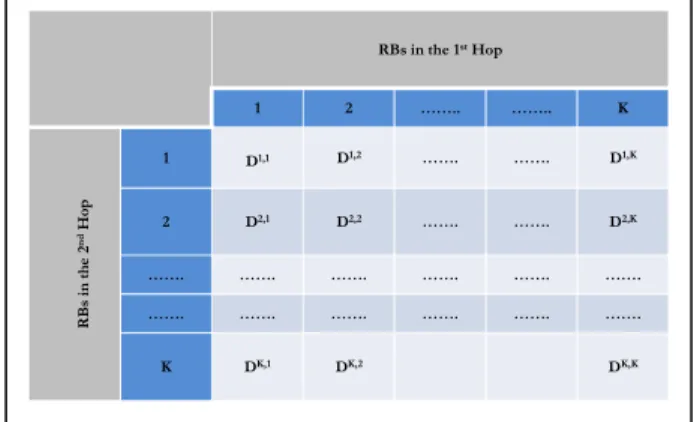
) as the achievable rate using rth RT.The following sub-steps are involved in LIRBPA. 1. The K×Kmatrix as shown in Fig.3 is established
in such a way that the demand metric on each RB-pair is calculated as the maximum of R×M links.
Dk,k'=max{rrk,m,k'} (8) Here
r
rk,m,k' indicates the rate achieved by mth MT on RB-pair(k,k').2. By applying HA on each K×K matrix as shown in Fig. 3 the best RB-pairing is achieved here. 3. The allocation of these RB-pairs is made iteratively
to MTs by implementing the constraint given in (7).
4. The rows and the columns with assigned RB-pairs are eliminated.
5. The MTs satisfying MRR are removed temporarily. 6. 1-5 are repeated until all RBs are assigned or all
MTs achieved MRR.
7. If RBs are still available the step 1-2 is repeated once to assign all remaining RBs to the best users to maximize the system throughput.
The Computational Complexity has been reduced significantly as compared to ESA. The total complexity of step 1 is O(R×M×K)while the polynomial complexity of one iteration of HA is
O
(
K
n3)
[25], where K is the nnumber of unassigned RBs. We need maximum of K iterations to implement RB pairing and fairness in terms of data rate among all MTs, therefore the maximum complexity of step 1 is O(R×M×K2)and applying HA with ensuring fairness is
O
(
K
4)
. If step 7 exits then the complexity of this step isO
(
K
3)
. The complexity of the whole LIRBPA algorithm is loosely upper-bounded as) (R M K6 K3
O × × + . Considering practical scenario where
R
K>> andK>>M, there is a significant reduction in the computational complexity with same outputs as comparing with the ESA algorithm.
Figure 3. Snapshot of HA-Matrix for RB-Pairing
It is interesting to note that there is no scarification or trade off in throughput performance for low complexity by implementing LIRBPA algorithm. The proposed algorithm provides same throughput performance as with ESA with much less computational complexity, which is the main contribution in this paper.
5.
Performance Evaluation
In this section we evaluate the performance of the proposed resource allocation algorithm with some simulation results.
5.1 Simulation Models and Parameters
In these simulations we assume random distribution of all RTs and MTs. We consider that all channels remain constant for one complete transmission while all noise variances are identical. To establish centralized resource allocation techniques it is assumed that CSI is known to the BS which is already commonly used assumption.
The Line- of-Sight (LOS) path loss model is used for BS-RT link as we assume that relays are in LOS of BS which has directional antennas for transmission. The Non Line-of-Sight (NLOS) path loss model is used for RT-MT links. Both path loss models follow those defined for the Urban Micro (UMi) environment for the evaluation of 4G mobile wireless systems [26] . Other simulation parameters are given in Table 1.
RBs in the 1stHop
1 2 …….. …….. K
1 D1,1 D1,2 ……. ……. D1,K
2 D2,1 D2,2 ……. ……. D2,K
……. ……. ……. ……. ……. ……. ……. ……. ……. ……. ……. …….
K DK,1 DK,2 DK,K
R
B
s
in
t
h
e
2
n
dH
o
Table 1. Simulation Parameters
Parameter Value
Cell Radius 1 Km
Carrier Frequency 2 GHz
OFDM Sub-carrier Bandwidth 15 KHz Number of Sub-carrier per RB 12
Nominal Average SNR 20 dB
5.2 Simulation Results and Discussions
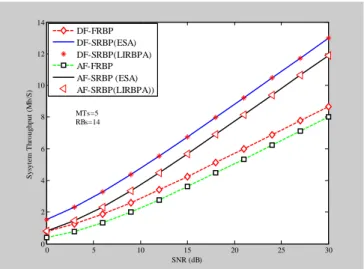
In the simulation results, we use the notations selective order RB-pairing (SRBP) for RB-pairing and Fixed order RB-pairing (FRBP) for No-RB-pairing, respectively.
Figure 4. Achieved System Throughput versus SNR
The SRBP provides significant gain in system throughput over FRBP in both AF and DF systems. It can also be observed that the difference between two curves increases with an increase in SNR.
The performance of system throughput against average received SNR is depicted in Fig. 4. We simulate both ESA and LIRBPA for RB-pairing and allocation against different SNR values. It produces same result but with different computation complexity as described in previous section. The result presented in Fig. 4 clearly confirms that RB-pairing provides significant gain in system throughput as compared to the system throughput when there is no RB-pairing used and data is transmitted on the same order RB in the 1st and 2nd hop, respectively. The figures shows the performance of system throughput at different nominal average SNR=PTk,k'/σ2 values.
Fig. 5 shows the total achieved throughput for AF and DF systems with SRBP and FRBP against increasing number of available RBs. In both AF and DF systems MRR constraint is implemented. The better performance in term of throughput is achieved with SRBP than FRBP RB-pairing. It is also noticeable that the gain in performance with RB-pairing increases as the number of available RBs increases. Because the more RBs, the more flexibility that the system has in exploiting the channel diversity gains.
Figure 5. System Throughput versus Number of RBs
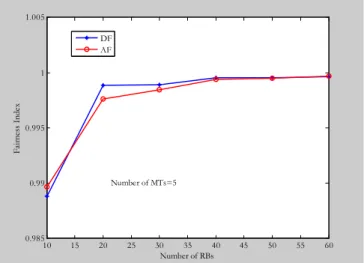
We also employ Jains fairness index [27] to assess the performance of our proposed algorithms. Jain’s fairness index has already been widely used to determine the proportional fairness among users [25, 28]. It is given by
∑ = ∑ =
= M
i i M
i i
r M
r f
1 2 2
1 (9)
where r is the normalized rate for the ii th user. The value of this index ranges from 0 (worst case) to 1 (best case). It is clear in Fig. 6 and Fig 7 that fairness index remains around 1 in both cases with different number of available RBs having fixed number of MTs and with different number of MTs having fixed number of RBS, respectively , which means that we are achieving maximum fairness among users in both cases. The only difference arises which is obvious, is that fairness index is increasing towards unity when we have fixed number of MTs and increasing number of RBs while it decrease from to away from unity in the other case.
0 5 10 15 20 25 30
0 2 4 6 8 10 12 14
SNR (dB)
S
y
sy
te
m
T
h
ro
u
g
h
p
u
t
(M
b
/S
)
DF-FRBP DF-SRBP(ESA) DF-SRBP(LIRBPA) AF-FRBP AF-SRBP (ESA) AF-SRBP(LIRBPA))
MTs=5 RBs=14
10 20 30 40 50 60
0 5 10 15 20 25 30 35 40
Number of RBs
Sy
st
em
T
h
ro
u
gh
p
ut
(
M
b
/
S)
DF-FRBP DF-SRBP AF-FRBP AF-SRBP
Figure 6. Variations of the Fairness Index against the
Number of RBs
Figure 7. Variations of the Fairness Index against the
Number MTs
Fig. 8 and Fig. 9 show the bar graphs of RBs which are assigned to different MTs using SRBP and FRBP in AF and DF protocols respectively. Each bar position shows that how different RBs are paired in 1st and 2nd hops in different schemes. The SRBP is clearly shown in Fig. 8(a) and Fig. 9(a), in which 1st hop RBs are, paired with different order RBS in 2nd hop, while Fig. 8(b) and Fig. 9(b) indicate that RB in 1st hop is paired with the same order RB in 2nd hop. The different color of bars indicates the different MTs.
6.
Conclusions
In this paper we focus on sub-carrier pairing in dual-hop relay networks. We presented resource allocation algorithm in which sub-carrier pairing and allocation is jointly proposed with relay selection and fairness constraint in multi-user relay networks. We observe that the computational complexity of conventional Exhaustive Search Algorithm is too high and is not applicable in practical applications. Therefore we propose Hungarian
Algorithm based new low complexity iterative RB-pairing and allocation scheme which has much less computational complexity with same output performance.
Simulation results demonstrate that RB-pairing proposed provides significant gain in system throughput. The proposed algorithm is also capable to provide maximum fairness in terms of data rate among all users. The simple model and low computational complexity make the proposed algorithm suitable for solving such optimization problem in relay networks.
References
[1] J. N. Laneman, D. N. C. Tse, and G. W. Wornell, "Cooperative diversity in wireless networks: Efficient protocols and outage behavior," IEEE Transactions on Information Theory, vol. 50, pp. 3062-3080, 2004. [2] A. Nosratinia, T. E. Hunter, and A. Hedayat,
"Cooperative communication in wireless networks," IEEE Communications Magazine, vol. 42, pp. 74-80, 2004.
[3] K. J. R. Liu and A.K.Sadek, Cooperative Communications and Networking: Cambridge University Press, 2009.
[4] Y. W. Hong, W. J. Huang, F. H. Chiu, and C. C. J. Kuo, "Cooperative Communications in Resource-Constrained Wireless Networks," IEEE Signal Processing Magazine, vol. 24, pp. 47-57, 2007.
[5] M. Salem, A. Adinoyi, M. Rahman, H. Yanikomeroglu, D. Falconer, K. Young-Doo, K. Eungsun, and C. Yoon-Chae, "An Overview of Radio Resource Management in Relay-Enhanced OFDMA-Based Networks," IEEE Communications Surveys & Tutorials, vol. 12, pp. 422-438, 2010.
[6] T. Wang, Y. Fang, and L. Vandendorpe, "Power Minimization for OFDM Transmission with Subcarrier-Pair Based Opportunistic DF Relaying," IEEE Communications Letters, vol. 17, pp. 471-474, 2013. [7] M. Zhou, Q. Cui, R. Jantti, and X. Tao,
"Energy-Efficient Relay Selection and Power Allocation for Two-Way Relay Channel with Analog Network Coding," IEEE Communications Letters, vol. 16, pp. 816-819, 2012.
[8] M. Abrar, X. Gui, and A. Punchihewa, "Sub-carrier allocation for downlink multi-user OFDM cooperative cellular networks," 6th International Conference on Broadband and Biomedical Communications (IB2Com), Melbourne, Australia, pp. 63-67, 2011. [9] K. Sung, Y. W. P. Hong, and C. Chao, "Resource
Allocation and Partner Selection for Cooperative Multicarrier Systems," IEEE Transactions on Vehicular Technology, vol. 60, pp. 3228-3240, 2011.
[10] A. Agustin, J. Vidal, and O. Munoz, "Protocols and Resource Allocation for the Two-Way Relay Channel with Half-Duplex Terminals," in IEEE International Conference on Communications (ICC), Dresden, 10 15 20 25 30 35 40 45 50 55 60
0.985 0.99 0.995 1 1.005
Number of RBs
F
ai
rn
es
s
In
d
ex
DF AF
Number of MTs=5
5 10 15 20 25 30
0.998 0.998 0.999 1 1.0005
Number of MTs DF
AF
Germany, pp. 1-5,2009.
[11] W. Dang, M. Tao, H. Mu, and J. Huang, "Subcarrier-pair based resource allocation for cooperative multi-relay OFDM systems," IEEE Transactions on Wireless Communications, vol. 9, pp. 1640-1649, 2010.
[12] W. Ying, Q. Xin-chun, W. Tong, and L. Bao-ling, "Power Allocation and Subcarrier Pairing Algorithm for Regenerative OFDM Relay System," in 65th IEEE Vehicular Technology Conference (VTC-Spring), Dublin, Ireland, pp. 2727-2731, 2007.
[13] Y. Li, W. Wang, J. Kong, and M. Peng, "Subcarrier pairing for amplify-and-forward and decode-and-forward OFDM relay links," IEEE Communications Letters, vol. 13, pp. 209-211, 2009.
[14] S. Chen, F. Liu, X. Zhang, C. Xiong, and D. Yang, "Symbol Error Performance Analysis of OFDM Relaying System with Subcarrier Mapping Scheme," IEEE Communications Letters, vol. 14, pp. 638-640, 2010.
[15] S. Vakil and L. Ben, "Cooperative Diversity in Interference Limited Wireless Networks," Wireless Communications, IEEE Transactions on, vol. 7, pp. 3185-3195, 2008.
[16] E. Dahlaman, S. Parkvall, J. Skold , and P. Beming, 3G Evolution: HSPA and LTE for Mobile Broadband, 2 ed.: Academic Press, Oxford, UK, 2008.
[17] G. Sidhu, F. Gao, W. Chen, and A. Nallanathan, "A Joint Resource Allocation Scheme for Multiuser Two-Way Relay Networks," IEEE Transactions on Communications, vol. 59, pp. 2970-2975, 2011. [18] H. Zhang, Y. Liu, and M. Tao, "Resource Allocation
with Subcarrier Pairing in OFDMA Two-Way Relay Networks," IEEE Wireless Communications Letters, vol. 1, pp. 61-64, 2012.
[19] G. Berardinelli, L. A. Ruiz de Temino, S. Frattasi, M. I. Rahman, and P. Mogensen, "OFDMA vs. SC-FDMA: performance comparison in local area imt-a scenarios," Wireless Communications, IEEE, vol. 15, pp. 64-72, 2008.
[20] S. Manohar, D. Sreedhar, V. Tikiya, and A. Chockalingam, "Cancellation of Multiuser Interference Due to Carrier Frequency Offsets in Uplink OFDMA," IEEE Transactions on Wireless Communications, vol. 6, pp. 2560-2571, 2007.
[21] M. Abrar, G. Xiang, and A. Punchihewa, "Radio Resource Allocation in Multi-User Cooperative Relaying Networks with Resource Block Pairing and Fairness Constraints," International Journal of Wireless Information Networks, vol. 20, pp. 346-354, 2013. [22] H. W. Kuhn, "The Hungarian method for the
assignment problem " Naval Research Logistic Quarterly, vol. 2 pp. 83-97, 1955.
[23] D. Niyato and E. Hossain, "Adaptive Fair Subcarrier/Rate Allocation in Multirate OFDMA Networks: Radio Link Level Queuing Performance Analysis," IEEE Transactions on Vehicular
Technology, vol. 55, pp. 1897-1907, 2006.
[24] M. Rahman and H. Yanikomeroglu, "Interference Avoidance through Dynamic Downlink OFDMA Subchannel Allocation using Intercell Coordination," in IEEE Vehicular Technology Conference (VTC Spring), Marina Bay, Singapore, pp. 1630-1635, 2008.
[25] M. Salem, A. Adinoyi, M. Rahman, H. Yanikomeroglu, D. Falconer, and Y. Kim, "Fairness-aware radio resource management in downlink OFDMA cellular relay networks," IEEE Transactions on Wireless Communications, vol. 9, pp. 1628-1639, 2010.
[26] K. Loa, C. Wu, S. Sheu, Y. Yuan, M. Chion, D. Huo, and L. Xu, "IMT-advanced relay standards [WiMAX/LTE Update]," IEEE Communications Magazine, vol. 48, pp. 40-48, 2010.
[27] R. Jain, The Art of Computer Systems Performance Analysis: Techniques for Experi-mental Design, Measurement, Simulation and Modeling. New York: Willey, 1991.
(a) (b)
Figure 8. Snapshot of Simulated RB-Pairing for AF (a) SRBP (b) FRBP
(a) (b)
Figure 9. Snapshot of Simulated RB-Pairing for DF (a) SRBP (b) FRB
1 2 3 4
5 6 7 8
9 1011 12
1314
12
34
56
7
89
10
1112
1314
0 0.2 0.4 0.6 0.8 1
RBs in the First Hop RBs in the Second Hop
A
v
er
ag
e
T
h
ro
u
gh
p
u
t
o
v
er
R
B
-P
ai
r
1 2 3 4
5 6 7 8
9 1011 12
1314 1
2 3
4 5
6 7
8 9
10 11
1213
14 0
0.2 0.4 0.6 0.8 1
RBs in the First Hop RBs in the Second Hop
A
v
er
ag
e
T
h
ro
u
gh
p
u
t
o
v
er
R
B
-P
ai
r
1 2 3 4
5 6 7 8
9 101112
13 14
12
34
56
78
910
11
1213
14 0
0.2 0.4 0.6 0.8 1
RBs in the First Hop RBs in the Second Hop
A
v
er
ag
e
T
h
ro
u
gh
p
u
t
o
v
er
R
B
-P
ai
r
1 2 3 4
5 6 7 8
9 1011 12
13 14
12
34
56
78
910
11
1213
14 0
0.2 0.4 0.6 0.8 1
RBs in the First Hop RBs in the Second Hop
A
v
er
ag
e
T
h
ro
u
gh
p
u
t
o
v
er
R
B
-P
ai
![Figure 1. LTE Downlink Physical Resource [16]](https://thumb-us.123doks.com/thumbv2/123dok_us/8126004.2155123/1.892.491.819.607.782/figure-lte-downlink-physical-resource.webp)