The implications of the SANE space environment model for higher education.
Andrew Harrison, DEGW, Porters North, 8 Crinan St, London, N1 9SQ, United KingdomTel:+44 (0)20 7239 7777; Fax: +44 (0)20 7278 3613; Email: [email protected]
Abstract.Sustainable Accommodation for the New Economy1 (SANE) is a two year EC-funded research programme considering the combined impact of the new economy on people, process, place and technology to identify new ways of accommodating work. Its focus is on the creation of
sustainable, collaborative workplaces for knowledge workers across Europe, encompassing both virtual and physical spaces. This paper outlines major trends in the use of the physical estate in Higher Education. The initial Space Environment Model developed by DEGW as part of the SANE project is then presented and its implications for the Corporate Workplace
discussed. The increasing implementation of distributed workplace models in the Corporate sector will provide major opportunities for academic
institutions to capitalise on their existing estates, earn additional revenue and enhance the quality of the student and staff experience. Examples of a number of these opportunities are described.
.
1. Introduction
The 1990s has seen a revolution in the way that space and time are used in many types of organisations. Academic institutions have had to adjust to changing student numbers and curriculum preferences, funding structures and the impact of information technology on both teaching and learning. Commercial organisations in many sectors have introduced ‘New Ways of working’ that have allowed them to integrate the physical work environment into the business process, to increase density of occupation within office buildings while at the same time creating effective work environments that encourage interaction and communications.
The current decade will see even greater challenges: both at the level of the individual trying to use the scarce resource of time more effectively and at the level of the organisation trying to manage a dispersed workforce while creating the spirit and teamwork necessary for organisations to continue to generate new ideas and thrive. Increasingly organisations will move outside of the physical container of their own buildings into larger organisational networks across cities, countries, the region or the world.
Once again information technology has played an essential role in the transformation, allowing forward thinking organisations to integrate a wider range of urban work settings into their corporate workspace. The need for building or space ownership becomes less significant as space is
purchased on demand, on an hourly, daily, or monthly basis or as non owned spaces such as hotels, airport lounges and clubs become a standard part of the working week. The city is the office.
2 Changing environments for learning
The fundamental changes that are occurring in the corporate workplace are being matched by similar changes in higher education. Changes in teaching methods, the nature of the curriculum, the size and composition of the student population and the impact of information technology across every facet of university life are all challenging the historic models of what a university is and how it sits within the fabric of the city or community within which it is located.
1
SANE (Sustainable Accommodation for the New Economy) project funded by the European Commission, under Framework V („New Ways of Working“, contract nr. IST-2000-25257) with partners from DEGW (London), Ove Arup (London’), RHUL (London), Telenor (Oslo), IAT (Stuttgart), Institut Cerda (Barcelona) und FAW (Ulm).
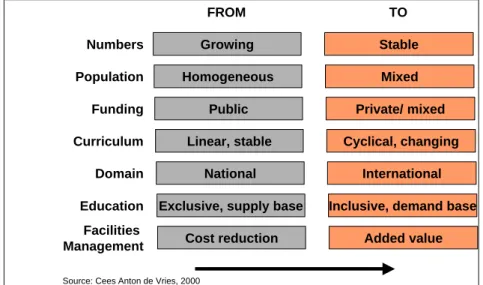
Numbers Population Funding Curriculum Domain Education Facilities Management FROM Growing Homogeneous Public Linear, stable National Exclusive, supply base
Cost reduction TO Stable Mixed Private/ mixed Cyclical, changing International Inclusive, demand base
Added value
Source: Cees Anton de Vries, 2000
FIGURE 1. THE CHANGING CONTEXT OF HIGHER EDUCATION.
FIGURE 2. CHANGING MODES OF TEACHING. SOURCE: S. DUGDALE/ DBB 1997
Despite the increasing role of distance learning and IT-based learning in many institutions the role of the physical buildings will remain paramount since the real value of education lies in the
discourse generated by face-to-face interaction. However the role that buildings play in the life of the university and the way the buildings are procured and managed will change profoundly. These changes to the role of the physical estate can be considered in terms of identity and brand, user needs, space requirements and estate opportunities.
Identity and branding. Universities have traditionally concentrated on teaching and learning, with research becoming increasingly important in recent years. In the United Kingdom the government is striving to add an additional focus on business enterprise. No longer self-contained entities, universities are increasingly entering into partnership with private or local government organisations to provide business, living or leisure facilities that build upon the activities of the university.
Brand is becoming more important as universities increasingly seek to provide academic programmes that focus on human values and face-to-face interaction.This learning environment lifestyle emphasises choice, convenience, discourse and membership to academic networks and communities.
User needs. After several years of growth, student numbers are now stabilising in many countries. However the diversity making up these numbers is still increasing. With information readily and freely available through the internet, individuals increasingly chart their own progress through their chosen programmes. The authority and role of the teacher is based less on knowledge and more on interpersonal skills and facilitation of learning. Lectures are becoming more about theatrical events pulling large communities together than the primary means of knowledge transfer. Tutorials and small seminar groups are as much about social interaction as about sharing learning experiences. The key feature of this new learning environment is quality face-to-face interaction, with campuses and cities providing an increasingly vital backdrop in supporting and promoting this shift in focus.
Space requirements. Traditional understanding of facilities provision within campuses has generally focused on clear categories of space - departmental allocation, shared teaching facilities (the bookable pool), centralised functions (library, ICT, student union services, catering), residential and sports. Space utilisation studies tend to concentrate on teaching space, paying little attention to how library, ICT centres and social spaces are used. Yet the steady increase in these types of space reflects growing acknowledgement that the true value of education lies in discourse and that much of this discourse takes place informally. New building types are emerging, designed primarily around patterns of human interaction rather than specific needs. Traditional categories of space are being abandoned as space becomes less specialised, boundaries blur and operating hours extend from core day towards 24hr/7day access. New space models are being developed which place a primary focus on providing spaces that enhance quality of life as much as on supporting the learning experience.
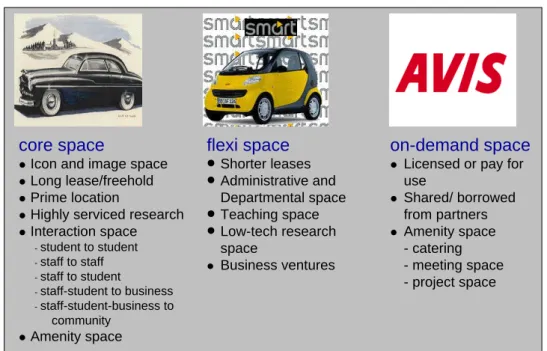
Estate opportunities. As universities become less self-contained, and develop into networked organisations, new concepts of procuring and managing space are developing. To enhance flexibility, university portfolios are now more likely to consist of a variety of different types of tenure, as well as making use of publicly available facilities within the local vicinity. With public funds becoming increasingly scarce, universities are looking to the private sector for funding through partnerships, and the focus for estate management is shifting from cost reduction to income generator. Estates are being rationalised according to needs, maintenance costs/feasibility and a desire to maximise assets. New property models are being sought to enable universities to become increasingly innovative in the selection, procurement and management of their facilities and sites. DEGW are developing the concept of ‘core’, ‘flexi’ and ‘on-demand’ space as a way of categorizing elements of the university estate.
The goal of the overall physical estate should be to:
• Provide a high quality, rich and innovative back-drop for academic discourse by allowing people to come together with ease
• Be readily responsive and adaptable to ongoing programme changes and shifting priorities
• Realise its full potential as a key asset of the University in terms of both efficiency and effectiveness
core space
l Icon and image space
l Long lease/freehold
l Prime location
l Highly serviced research
l Interaction space -student to student -staff to staff -staff to student -staff-student to business -staff-student-business to community l Amenity space
flexi space
•
Shorter leases•
Administrative and Departmental space•
Teaching space•
Low-tech research space l Business ventureson-demand space
l Licensed or pay for use l Shared/ borrowed from partners l Amenity space - catering - meeting space - project space
FIGURE 3. HIGHER EDUCATION SPACE TYPES. SOURCE: DEGW 2001.
Core space is primarily interaction space for all constituencies of the academic community and it is the space that defines the image or brand of the university. Core space defines the ‘place’ that is at the heart of the student experience – the reason for attending the physical university when,
perhaps, more and more of the actually knowledge transfer takes place electronically away from the campus. Core space may also include specialist facilities that are not adaptable for other functions or too expensive to be procured through the usual commercial processes.
Flexi space is more generic, adaptable space that can be used for a wide range of activities including Departmental administration, research, teaching and business. The requirements for this type of space may vary considerably over time as student numbers and the level of research funding rise and fall. Thus shorter or more flexible leases for this type of space will allow the institution to shed or acquire additional space with less concern about long term space surpluses in the future. The institution may also chose to act as provider of work or research space for outside organisations and use the management of these short term tenancies both as a means of income generation and as a way of maximising the utilization of the available space.
On-demand space is purchased by the institution on an ‘as needed’ basis and may involve informal or formal partnerships with other city institutions or private commercial organizations for the use of conference centres, auditoria, serviced office, catering or other types of amenity or support spaces.
3. Sustainable Accommodation for the New Economy (SANE)
The implication of the distributed workplace will be explored in detail during the next eighteen months in the SANE project. SANE is a two year EC- funded research programme considering the combined impact of the new economy on people, process, place and technology to identify new ways of accommodating work. Its focus is on the creation of sustainable, collaborative workplaces for knowledge workers across Europe, encompassing both virtual and physical spaces. Its findings will be relevant to a wider global audience and will impact the built environment at all scales - from home, to office, to city. SANE will accelerate the transition from a location centric to a location independent approach to work. It will harness the potential to free workers from the traditional spatial, temporal and organisational constraints that can impede creativity, productivity, agility, learning and co- operation.
The overall goal of SANE is to contribute to sustainable European economic development, while at the same time increasing productivity in the workplace and improving the quality of life for European citizens. Work in the new economy involves more challenges and possibilities than ever before: new technologies enable greater mobility; divisions between work and home life are shifting; business is undergoing fundamental change in delivery and production methods. Together these factors are creating new possibilities for the way we work and fresh opportunities for those creating working environments.
4. SANE Space Environment Model: a new distributed workplace model
The distributed workplace model developed by DEGW assumes radical changes in both the supply and demand sides of the building procurement model. At the supply side of the equation developers will increasingly realise that increased profits will result from thinking of buildings more in terms of the opportunity to deliver high value added services on a global basis to a customer base rather than as a simple passive investment vehicle.
From the users’ perspective there is increasing interest in the provision of global solutions that provide flexibility and break down the old barriers between real estate provisions, building operation and the provision of business services. For global organisations it is also becoming more important to reduce the number of providers of work environments to maximise the economies of scale they can achieve.
The role that buildings are playing in many organisations is also changing. Historically buildings have often provided a way of demonstrating organisational wealth, power and stability. The solid 19th century bank and insurance headquarters buildings in the UK and the 20th century drive for taller and taller office buildings, often in the absence of a sound financial or real estate case for them, are both demonstrations of this.
With distributed workforces only accessing buildings periodically the role of buildings is shifting dramatically. Work can take place anywhere so why should some-one come to the office? The office is seen as an opportunity to express the culture and reinforce the values and beliefs of an organisation. The physical work environment and the opportunities it provides for interaction and collaboration aids knowledge transfer and communication and will form the infrastructure for learning organisations.
The distributed workplace model developed by DEGW also tries to incorporate the increasing congruence between physical and virtual work environments, acknowledging the impact that information and communications technologies have had on the work process of most individuals and organisations.
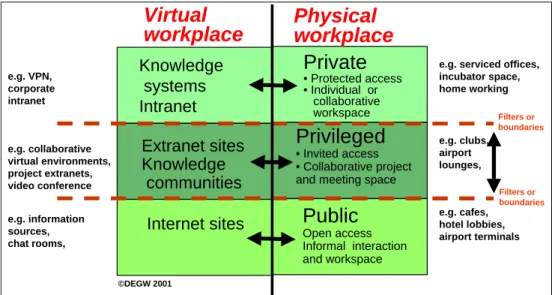
The model also examines the continuum between public and private space and produce novel solutions to their integration into work places. The workplace is divided into three conceptual categories according to the degree of privacy and accessibility they offer. The three categories of place used in the model are “public”, “privileged” and “private”.
Each of these ‘places’ is composed of a number of different types of work settings, the relative proportion of each forming the character of the space. Publicspace is predominately suited for informal interaction and touchdown working for relatively short periods of time. Privileged space
supports collaborative project team and meeting spaces as well as providing space for concentrated individual work. Private space also contains both individual and collaborative work settings but with a greater emphasis on privacy and confidentiality, with defined space boundaries and security.
Internet sites
Private
• Protected access • Individual or collaborative workspaceVirtual
workplace
Physical
workplace
Privileged
• Invited access • Collaborative project and meeting space
Public
Open access Informal interaction and workspaceKnowledge
systems
Intranet
Extranet sites
Knowledge
communities
Filters or boundaries e.g. cafes, hotel lobbies, airport terminals e.g. clubs, airport lounges,e.g. serviced offices, incubator space, home working e.g. information sources, chat rooms, e.g. VPN, corporate intranet e.g. collaborative virtual environments, project extranets, video conference Filters or boundaries ©DEGW 2001
FIGURE 4: SANE SPACE ENVIRONMENT MODEL. SOURCE: DEGW 2001
Each of the physical work environments has a parallel virtual environment that shares some of the same characteristics. The virtual equivalent of the public workplace is the internet where access is open to all and behaviour is relatively ‘unmanaged’. The equivalents of the privileged workplace are
extranets where communities of interest use the internet to communicate and as an information resource membership.
There are restrictions to entry into a knowledge community (such as registration or membership by invitation only) and membership has obligations and responsibilities attached, perhaps in terms of contributing material or communicating with other members. The virtual equivalents of the private workplace are intranets, the private knowledge systems belonging to an individual organisation that contain the organisation’s intellectual property. Access to the Intranet is restricted to members of the organisation and the value of the organisation is related to the contents of this virtual space – the customer databases, the descriptions of processes and project histories.
When designing accommodation strategies organisations will increasingly need to consider how the virtual work environments will be able to support distributed physical environments and how the virtual environments can contribute to the development of organisational culture and a sense of community when the staff spend little or no time in ‘owned’ facilities.
An organisation could choose to locate the Public, Privileged and Private workplaces within a single building and location. In many ways the rich mix of work settings provided in New Ways of Working implementations could be said to already do this. In the diagram below this type of combined work environment is referred to as ‘‘Office is the City’. All workspace is owned by the organisation and is occupied solely by them. Zoning within the building is often used to reinforce culture and community and urban metaphors such as ‘neighbourhood’, ‘village’ and ‘street’ may be used to describe these zones.
Dispersed organization
Figurehead organization
‘City is the office’
‘Owned’ and public spaces
•
Owned spaces for core activities
•
Use of city spaces and facilities for
Multiple locations
‘Owned’ spaces
Owned spaces for all activities
Use of city locations to reinforce culture and community
‘Office is the city’
Private
Privileged
Public
©DEGW 2001Private
Privileged
Public
Shared space Owned spacePrivate
Privileged
Public
Private
Privileged
Public
Increased use of distributed,shared workplaces Move from fixed to variable costs
Multiple locations, shared spaces Single location, owned space Multiple locations, owned space Multiple locations, owned & shared spaces
FIGURE 5: PROPERTY STRATEGIES FOR DISPERSED ORGANISATIONS. SOURCE: DEGW 2001
As the level of remote working increases in an organisation it may not be desirable to house all types of workplace in the same location. Distributing workplaces around the city may allow staff to reduce the amount of commuting they need to do and allow the organisation to start using the attributes of the city to reinforce organisational culture and community. For example an organisation that wants to be thought of as innovative and trendy could choose to locate drop-in work centres in downtown retail/ leisure area such as Soho in London or Chelsea in New York while the bulk of their workplace could be in more traditional business locations. In the diagram above this property strategy is described as ‘dispersed.’
As discussed previously organisations are increasingly incorporating semi-public spaces such as hotels, serviced office centres, airport lounges and cafes into their work environments. It is possible that this trend will continue to the point where the only spaces actually owned by the organisation are the Private Workplaces including such things as Headquarters Buildings, Training and IT Centres. All other space could be provided by outside organisations on a flexible, ‘as used’ basis as well as many of the business support services. This type of real-estate strategy is described as ‘figurehead’ in the property strategy diagram above.
If this move away from owned organisational space is taken to its extreme it is possible to envisage an organisation where virtual work environments are used to house the organisation’s knowledge and information resources and all physical work takes place in either individually owned space (for example, staff working at home) or in shared work environments booked on an ‘as-needed’ basis. In the diagram above this is described as ‘City is the Office.’ If this strategy is adopted by an organisation issues relatively to training and knowledge transfer, use of ICT to support the work process, management of distributed work teams and informal interaction and team building will need to be carefully thought through.
6 Implications of the Space Environment Model
The introduction of a distributed workplace strategy potentially has both efficiency and effectiveness benefits that can work at the level of the individual, the organisation and the City. The Space Environment Model suggests that workspace in the future will be broken down into smaller units distributed across the city, including both suburban (close to home) and urban (close to clients) space.
Smaller units of space can more easily be incorporated into the existing city fabric and, when combined with new methods of delivering both voice and data communications, these smaller units may be accommodated within old or previously obsolete buildings in downtown areas. Opportunities are therefore provided for regenerating existing city districts to provide homes for New Economy companies. An example of this is the re-use of obsolete office buildings in Wall Street, New York (Silicon Alley) that have been wired up for high bandwidth communications and now act as incubator space for dot com companies who occupy the space on a ‘space for equity’ basis. The re-use of buildings contributes to sustainability in terms of avoiding the construction of new buildings (materials and energy) and in the maintenance and support of existing communities. Remote working, whether at home or at neighbourhood work centres (café/ club type space) aids sustainability by improving the quality of life for individuals (reduced commuting time) and by the reduction of energy consumption.
The increased use of shared space has economic implications for the organisations concerned. Buying space on an ‘as needed’ basis rather than by committing to long term leases allows organisations to move from a fixed cost structure to a more variable, freeing up capital to be invested in developing the business rather than just housing the existing business.
As well as providing re-use and regeneration opportunities across the whole city a distributed work strategy also offers opportunities to specific cultural and historic facilities and areas that can attract organisations who want to use these cultural facilities to reinforce their organisational culture in the absence of their own buildings. Museums, historic castles, art galleries, universities and even Department Stores could all earn extra revenue from providing café or club type services office centres.
At the level of the individual, distributed working allows more control over the use of time, with reduced commuting and an ability to match the work environment to the tasks required: to use visits to the office to meet with colleagues and work with project teams and use a range of other locations for concentrated individual work, away from interruptions and distractions.
Sharing workspace with other organisations also provides opportunities for interaction with people from other professions which may lead to the development of new business ideas or projects as well as opportunities for career development and networking.
The implementation of a distributed working strategy will require careful planning involving all areas of the business. Critical issues to be considered include:
• Costs and benefits
• Risks to business delivery
• HR policies on remote working
• Provision of training
• Corporate branding
• Maintenance of community and culture
• Knowledge management
• Management ofteams andindividuals
• Confidentiality
• Client perceptions
• Provision of business services
The widespread adoption of distributed working strategies is likely to result in a fundamental shake-up of the property procurement chain and major new players are likely to emerge who are able to merge expertise in workplace design, hotel management and service provision and IT delivery.
7 The implications of the SANE Space Environment Model for higher education
The core of the SANE space environment model, as described above, consists of the following three predictions:
• Workplaces will become increasingly dispersed to meet both organizational and employee requirements
• There will be increased use of city spaces and facilities for informal work locations and project spaces
• Shared work locations will be provided by third parties or there will a growing number of ‘workplace club’ joint ventures by compatible organizations wanting to maximize the effective use of their physical workplaces
The rise of the distributed workplace offers major opportunities for academic institutions to capitalize on their existing estates, earn additional revenue and enhance the quality of the student and staff experience.
Creation of mixed academic and business campuses
The distributed workplace model suggests that organizations will increasing look to external institutions or cultural artifacts to reinforce their own organizational culture and values. In effect, commercial organizations will seek to ‘trade’ on the brand values of these institutions or cultural artifacts to enhance their own brand. The Tate Modern in London, for example, has rapidly become a cultural icon and is acting as a focus for regeneration in the area as small arts and media
organizations move in to associate themselves with the values of the Tate (leading edge, cool, innovative etc). Many organizations now see innovation, learning and knowledge creation as being essential for survival in the New Economy. Association with an academic institution is an effective way of signaling these values to employees, clients and the business community in general.
Proximity to the university may also provide better access to potential recruits and the knowledge of the academic staff.
Mixed-use academic and business campuses will allow these organizations to achieve their objectives and potentially provide a significant revenue stream for the institution concerned. The management of the shorter-tenure shared spaces may also provide a mechanism for institutions to short term research or administrative space.
Creation of dispersed branded physical ‘places’ to support distance learning as well as corporate trainingrequirements.
Many academic institutions are either investigating ‘e-learning’ or have implemented pilot
programmes already. The use of IT-based teaching is both a way of increasing student catchment area and overall income for the institution. While electronic delivery of course work etc is feasible it does not provide the students with a comparable university ‘experience’ to being physically present at the campus.
It is likely that academic institutions with major e-learning programmes will differentiate themselves by providing high quality physical places at international or regional centres where students can meet for seminars, gain access to specialist resources or advice and interact socially. These centres may not be needed continuously so there will be opportunities for partnerships with corporate training providers for shared facilities or utilization could be improved by a number of institutions sharing a centre.
Partnerships with workplace providers to develop University clubs/ business lounges for alumni and other users in business locations
The SANE space environment model suggest that the distributed workplace is likely to include shared Neighbourhood Work Centres in suburban or out of town locations and larger shared
Corporate centres in downtown business locations. There are opportunities for academic institutions with either suburban or urban campuses to partner with a workplace provider to develop branded work centres. These centres could also serve as an amenity or club for alumni which allows them to continue the experience of being ‘at university’ into their working careers, generating income and opportunities for alumni fundraising initiatives.
The future this paper is describing is dependent on a fundamental re-evaluation of the way that academic institutions function. The increasing importance of social and interaction and social spaces rather than traditional teaching and Departmental spaces, the sharing of buildings and facilities with other organizations, the fluidity of occupation over an extended teaching day and the increasing use of ‘on demand’ facilities not under the control of the institution are all challenging traditional academic practice.
If an institution is considering the implementation of new ways of teaching or learning or an even more fundamental change to how the institution operates it is vital that a comprehensive change management process occurs along side the physical or management changes if the implementation is to succeed.
Summary.
Learning will become more diverse in the future with the students, the ‘customers’ having much wider choice about how, when and where they study. Academic institutions will only thrive if they respond to this changing demand and offer a range of physical and virtual learning experiences. The physical university will only continue to have relevance to the academic experience if it maintains and increases its role as a social hub for all members of the academic community, students and academics alike, that anchors the experience of being ‘at university’ for both communities.
The experience of being at university can also be further enriched by integrating the university more closely into the fabric of the city, of blending the boundaries between the university and the
surrounding community, and by providing opportunities for a range of mixed use facilities that will allow commercial organizations to participate in the activities of the university in a mutually beneficial way and will also provide effective bases for business initiatives of the universities. The Strategic Plan and the Estates Strategy are important opportunities to consider the relevance of distributed workplace and new ways of learning for a university. The plans for the future should be based on a detailed understanding of the physical estate, the surrounding urban and business context and the short and long term academic and business objectives of the university.
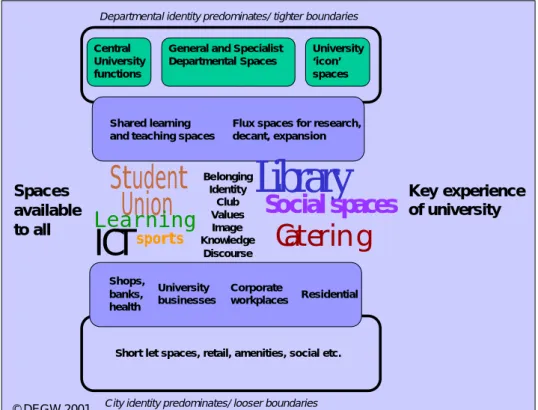
FIGURE 6. INTEGRATED SPACE MODEL FOR HIGHER EDUCATION. Central
University functions
General and Specialist Departmental Spaces
University ‘icon’ spaces
Shared learning and teaching spaces
Flux spaces for research, decant, expansion
Departmental identity predominates/ tighter boundaries
Belonging Identity Club Values Image Knowledge Discourse
Student
Union
ICT
Learning
Library
Social spaces
Caterin g
Spaces
available
to all
Key experience
of university
Shops, banks, health Corporate workplaces University businesses Residentialsports
Short let spaces, retail, amenities, social etc.
City identity predominates/ looser boundaries