National Louis University
Digital Commons@NLU
Dissertations6-2016
A Quantitative Comparison of the Reading
Achievement of English Learners in Dual Language
and Transitional Bilingual Programs
Shajaira P. Lopez National Louis University
Follow this and additional works at:https://digitalcommons.nl.edu/diss
Part of theBilingual, Multilingual, and Multicultural Education Commons, and theEducational Leadership Commons
This Dissertation - Public Access is brought to you for free and open access by Digital Commons@NLU. It has been accepted for inclusion in Dissertations by an authorized administrator of Digital Commons@NLU. For more information, please [email protected].
Recommended Citation
Lopez, Shajaira P., "A Quantitative Comparison of the Reading Achievement of English Learners in Dual Language and Transitional Bilingual Programs" (2016).Dissertations. 166.
A QUANTITATIVE COMPARISON OF THE READING ACHIEVEMENT OF ENGLISH LEARNERS IN DUAL LANGUAGE AND TRANSITIONAL
BILINGUAL PROGRAMS
Shajaira P. López
Educational Leadership Doctoral Program
Submitted in partial fulfillment of the requirements of
Doctor of Education
in the Foster G. McGaw Graduate School
National College of Education National Louis University
A QUANTITATIVE COMPARISON OF THE READING ACHIEVEMENT OF ENGLISH LEARNERS IN DUAL LANGUAGE AND TRANSITIONAL
BILINGUAL PROGRAMS
Submitted in partial fulfillment of the requirements of
Doctor of Education
in the Foster G. McGaw Graduate School
Shajaira P. López
Educational Leadership Doctoral Program
Approved:
____________________________ ______________________________
Chair, Dissertation Committee Program Director
____________________________ ______________________________
Member, Dissertation Committee Director, Doctoral Programs
____________________________ ______________________________
Member, Dissertation Committee Dean, National College of Education
____________________________ ______________________________
Copyright by Shajaira P. López, 2016 All rights reserved
iii DEDICATION
This dissertation is dedicated to my supportive parents, Ernesto and Sarah Larrier. Dad, I am grateful for the encouragement you provided me with throughout my educational journey. Mom, memories of you were the main
inspiration to complete this dissertation. This dissertation is also dedicated to my loving husband, Mauricio Lopez. Gracias por apoyarme emocional y
financieramente para lograr que mis sueños se hagan realidad. I am forever thankful to the three of you.
iv ABSTRACT
One of the goals of bilingual education research is to identify programs that have shown to be effective in increasing the English proficiency of English learners (ELs). The purpose of this archival comparative study was to conduct a
quantitative comparison of the English reading achievement of third grade ELs enrolled in dual language education (DLE) programs to those enrolled in transitional bilingual education (TBE) programs in order to determine which program is more effective in improving the reading proficiency of third grade ELs in the Chicago Public Schools. The data analyzed in this study were the 2010-2014 reading scores on the Illinois Standards Achievement Test (ISAT) and reading proficiency levels on the Assessing Comprehension and Communication in English State-to-State for English Language Learners (ACCESS for ELLs). Independent sample t-tests were used to compare the data, from two DLE programs and two TBE programs, in order to test hypotheses that predicted that ELs in DLE programs would score significantly higher than those in TBE
programs. The findings did not support the hypotheses. Overall, there was not a statistically significant difference between the ISAT reading scores of the two groups; however, ELs in the TBE programs obtained significantly higher reading proficiency levels on the ACCESS for ELLs. The findings of this study are
significant because they provide the CPS with information that can be used to evaluate programming options and make decisions for the success of ELs, but most importantly, the findings provide support for the need of long-term analysis of the impact of language acquisition programs.
v
ACKNOWLEDGEMENTS
I am appreciative of the individuals who selflessly assisted me during my doctoral dissertation pursuit, and it is with the sincerest gratitude that I
acknowledge them for their active part in this process. I want to give a heartfelt thanks to my dissertation chair, Dr. Vicki Gunther, for her unwavering
commitment to see that this dissertation was completed, and to the members of my dissertation committee: Dr. Jason Stegemoller, Dr. Carlos Azcoitia, and Dr. Madi Phillips. The recommendations they made strengthened this work.
I would like to thank two individuals who took time out of their workday to assist me: Dr. Diego Giraldo for helping me narrow my research topic, and Dr. Sonia Soltero for providing me with feedback on my topic.
I would like to thank Dr. Maria Josefina Vargas for providing me with suggestions on how to collect the data for this study, and thanks to the Chicago Public Schools’ Office of Language and Cultural Education Deputy Chief Jorge Macias for sharing with me some information about the language acquisition programs in this study.
I would also like to thank the men and women who kindly served me coffee at the Romeoville Starbucks where I spent countless hours drafting this dissertation. Thanks to my friend and former colleague, Edmee Cappas Velez, for letting me use her new laptop when mine stopped working. Finally, a heartfelt thanks to my husband, Mauricio Lopez, for pretending that he was legitimately interested in every aspect of this study.
vi TABLE OF CONTENTS Page ABSTRACT……….. iv ACKNOWLEDGEMENTS.………. v List of Tables……….... ix List of Figures…….…...……….. x
CHAPTER ONE: INTRODUCTION……….. 1
Rationale for the Study: A Vignette……… 4
Background of the Problem...……… 6
Statement of the Problem……….. 10
Purpose of the Study……….. 11
Research Questions……… 12
Research Design………. 14
Definition of Terms……….. 15
Summary………... 17
CHAPTER TWO: LITERATURE REVIEW...……… 18
Introduction………... 18
The Condition of Education for English Learners……….. 20
Achievement Gap……… 21
Policies and Practices……… 23
Language Acquisition….……… 27
Literacy Development….……… 32
vii
Dual Language Education Program Models ………. 38
Transitional Bilingual Education……… 42
Research on Dual Language and Transitional Bilingual Programs………. 48
Summary………... 55
CHAPTER THREE: METHODOLOGY……… 57
Introduction………... 57
Research Design ………...………. 57
Setting and Participants………. 61
Instrumentation……… 63
ISAT…...……… 63
ACCESS for ELLs...……… 65
Procedure………. 68
Data Analysis………... 69
Limitations and Delimitations………. 70
Summary……….. 71
CHAPTER FOUR: ANALYSIS OF DATA……… 73
Introduction………... 73
Description of the Sample………. 74
DLE1 and TBE1………..………. 74
DLE2 and TBE2………....………. 76
Statement of the Results…..…....………. 77
viii
Research Question 2: Comparison of ACCESS for ELLs Reading
Proficiency Levels…..………..……… 80
Additional Research Questions………...…..………… 83
Summary………....………. 86
CHAPTER FIVE: DISCUSSIONS AND RECOMMENDATIONS……..………….. 87
Introduction………..………... 87
Summary of the Study.………..……….………... 87
Discussion.………... 88
Research Question 1: Comparison of ISAT Reading Scores…..………… 89
Research Question 2: Comparison of ACCESS for ELLs Reading Proficiency Levels…..………..……… 94
Limitations………... 97
Implications………... 99
Recommendations for Future Research………... 101
Conclusions.……..………... 102
REFERENCES…….………... 105
ix
LIST OF TABLES
Table Page
1 Chicago Public Schools used in the study……….………... 62
2 ACCESS for ELLs Reading 3-5 Reliability………... 68
3 School characteristics of DLE1 and TBE1………... 75
4 School characteristics of DLE2 and TBE2………... 77
5 ISAT difference between DLE and TBE programs…………..….. 79
6 ACCESS for ELLs difference between DLE and TBE programs……….………... 82
7 ISAT difference between DLE1and DLE2……… 84
8 ISAT difference between TBE1 and TBE2………... 84
9 ACCESS for ELLs difference between DLE1 and DLE2………... 85
x
LIST OF FIGURES
Figure Page
1 Fourth and eighth grade reading achievement gap between
English learners and English-proficient students in Chicago
Public Schools……...… 22
2 Features of successful dual language education programs……. 37
3 Dual language Education Program Models………. 41
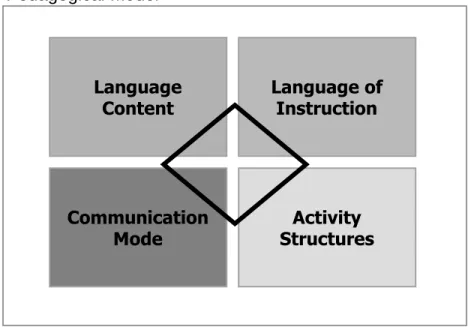
4 The four dimensions of the Transitional Bilingual Pedagogical
1
CHAPTER ONE: INTRODUCTION
Making sure we offer all our kids, regardless of race, a world-class education is more than a moral obligation, it’s an economic imperative if we want America to succeed in the 21st century. But it’s not something that can fall to the Department of Education alone. It’s going to take all of us; public and private sector, teachers and principals, parents getting involved in their kids’ education, and students giving their best; because the farther they go in school, the farther they’ll go in life (The White House, 2010).
President Barack Obama’s words reflect the focus of the U.S. Department of Education since 2010 in its quest to once again make the United States the nation with the largest number of college-educated people. This is an immense undertaking for the federal government given the percentage of college educated people across the nation—in 2014 only 46% of 25 to 34 year-olds obtained a college degree—which places the United States in seventh place among the 34 nations that are members of the Organization for Economic Cooperation and
Development (OECD, 2015). Also, only 38% of 12th graders in 2013 were
considered proficient in reading, an essential skill for success at the college level (Kena et al., 2015). With percentages like those, it is imperative for federal and state governments to work towards creating promising education policies that are based on evidence and best practices—not just on inclination.
Education critics believe that the reason why our nation cannot outperform other countries in educational attainment can be attributed to its inability to
provide an adequate education to individuals in low-income households (Nichols, 2011). If the federal government wants the United States to have the highest
2
proportion of college graduates in the world, then it must develop visual acuity on the obstacles that our students face due to their socioeconomic status (Nichols, 2011). However, educating our nation’s bottom half of the income distribution has been at the center of education policy reforms for well over a decade. Thanks to provisions under the No Child Left Behind [NCLB] Act of 2001 (2002),
policymakers have, at the very least, ensured that school districts across the nation become more transparent about the progress of at-risk students based on zip code, race, disability, learning need, family income, and English proficiency (Brenchley, 2015). This, in turn, revealed ongoing issues, such as a 30-year 40% achievement gap in reading and mathematics between fourth and eighth grade English learners (ELs) and their English-proficient peers (Leos & Saavedra, n.d.; National Assessment of Educational Progress, 2015).
The achievement gaps between ELs and English-proficient students are a deeply rooted challenge for states, school districts, and individual schools, but NCLB (2002) created a starting-point to focus on this problem that was upheld by its replacement—the Every Student Succeeds Act (ESSA) of 2015. The
traditional approach to respond to the English language acquisition needs of ELs has been to ignore what the research on best instructional practices
recommends and assume that with time ELs will somehow learn as easily as their English-proficient peers (National Education Association, 1966). This practice has been the biggest contributing factor to the discrepancy in
3
hope is for schools to continue to be purposeful in their attempts to address the glaring disparities. For example, schools have to follow the states’ established English language proficiency standards that provide a path for educators as they navigate the English-acquisition instructional journey; every EL must participate in the statewide assessment system that measures their progress towards becoming proficient in reading, writing, listening, and speaking in English; and every EL that has attended a public school for at least one year must participate in the state-specified standardized achievement test (ESSA, 2015). The most impactful change proposed by the ESSA (2015) was to mandate the inclusion of ELs in states’ accountability systems. This means that schools should be held fully accountable for the academic and English-language proficiency growth of all of their ELs.
Even with the ESSA (2015) requirements for the instruction, assessment, and accountability of ELs, the question of what is the best approach to close the achievement gap remains unresolved in most our schools’ practices and district policies. Properly addressing the educational needs of ELs who have come to school with varying degrees of proficiency in English has proven to be a
challenge for public schools across the nation (Collier & Thomas, 2009). In the case of the Chicago Public Schools (CPS), this school district seeks to ensure that ELs develop two languages at high levels of proficiency by offering dual language education (DLE) programs in 15 of its schools (Chicago Public Schools, 2016). With the rising popularity of DLE programs across the nation
4
(Garcia, 2015), these 15 CPS DLE programs draw positive attention from parents, educators, and researchers who are committed to bilingual education. Nevertheless, the question of whether or not ELs enrolled in these CPS DLE programs are performing at higher levels than their peers in transitional bilingual education (TBE) programs has not been addressed by empirical research. Therefore, the goal of this quantitative study was to compare the achievement of ELs enrolled in dual language education programs to that of ELs enrolled in transitional bilingual education programs in order to determine which program is more effective in improving the reading proficiency of ELs in the Chicago Public Schools.
Rationale for the Study: A Vignette
In 2006, a seventh grade teacher of a dual language education program in the Chicago Public Schools (CPS) had only 14 students in her homeroom. Surrounding those 14 students sitting in 14 desks, were posters on the parts of speech, word walls, skillfully decorated bulletin boards, colorful curtains,
classroom rules, all the little things that make a classroom look alive—things that would fool the inexperienced eye into believing that great instruction took place in that classroom every day. Yet no one saw that every day that seventh grade teacher went home frustrated, searching for answers, feeling incompetent, and at times she cried tears of embarrassment that only she knew about. Every tear she shed enveloped the thought of each of her students. And so she cried 14 tears, each of which carried the realization that as a first year teacher she was
5
not equipped to meet the disparate needs of her students. One of those tears, however, was bigger than the others. It was the tear she cried for her one and only English learner student, because she did not have the skills or pedagogical understanding to help him. Truth was, even though she worked in a dual
language school, she had never attended a bilingual education teacher preparation course.
That is how my story began. I was that first year teacher in desperate need of a better understanding of pedagogy and language acquisition theory. Had it not been for my veteran colleagues who took me under their wings,
perhaps that English learner would not have made it through seventh and eighth grade. Every time I think about this student, I not only regret the disservice I provided him with, but I also think about the disservice that many other schools could be providing to their own English learners (ELs) by placing them in the classroom of unskilled teachers or by not providing their ELs with a quality language acquisition program.
I immediately went on to obtain my bilingual teacher certification, but even after that I always questioned what many of my professors and colleagues
claimed to be true about bilingual education programs: that dual language education (DLE) programs were the best, transitional bilingual education (TBE) programs were okay, and that stand-alone English as a second language (ESL) programs were not ideal but better than nothing. I questioned their comments, not only because of the inconsistencies that I witness while working at a DLE
6
program in the CPS, but mostly because I am a product of a stand-alone ESL program where with just one year of ESL instruction in third grade, my
confidence and proficiency in the English language grew exponentially. In no way do I think that a stand-alone ESL program is a better alternative than bilingual education programs; however, my personal experience as an English learner made me think about the English learner I had as a student during my first year teaching, and it made me wonder if DLE programs in the CPS are truly doing what is best for their English learners.
Background of the Problem
The National Education Association (2015) expects that by 2025 English learners (ELs) will comprise one-fourth of the student population in the nation. The growing number of ELs, along with the increased expectations for their academic achievement, has considerable impact on schools as they work to meet the challenges of ensuring ELs are college and career ready. Schools must develop a path to achievement gap closure as well as provide high quality
education for ELs that respects and incorporates their native language in order to ensure that they acquire the English language (Adams & Jones, 2005).
To better understand the type of education that ELs need, researchers recommend that the social and language acquisition theories such as those proposed by Vygotsky (1982, cited in Daniels, 1996), Krashen (1982), and Cummins (1976 & 2000) be taken into account because they provide a
7
perspective needed to understand the process of academic learning and language acquisition.
Vygotsky proposed that students posses what’s known as a Zone of Proximal Development (ZPD)—a difference between what students know and can do on their own, and what they cannot—and that it is important for teachers to provide instruction and the social interaction students need to move from what they know to what they do not yet know (Daniels, 1996). Whereas, Krashen’s (1982) Acquisition/Learning Hypothesis states that language can be acquired
and learned, and his Input Hypothesis goes on to explain that in order for
acquisition to occur through the formal instruction of language, the input needs to be comprehensible and must become slightly more complicated with time.
Cummins (1976) proposed the Threshold Hypothesis in which he states that there are threshold levels of language ability that a second language learner must attain in order to avoid cognitive drawbacks and, instead, allow the
beneficial aspects of bilingualism. Cummins (2000) also proposed the
Developmental Interdependence Hypothesis which states that proficiency in the second language is dependent on the proficiency level students achieve in their first language; and the Common Underlying Proficiency (CUP) Model, which in essence states that knowledge of either language should encourage the
proficiency level underlying both languages, given proper motivation and exposure to both languages.
8
Together, these theorists offer a perspective that provide researchers and education practitioners with background knowledge to understand the language acquisition process, which in turn allows them to determine which programs may be better suited for ELs.
Nevertheless, understanding the theoretical frameworks of language acquisition and academic learning is not enough. In order to help determine which specific language acquisition programs are better fitted for ELs, Collier and Thomas (2004) believe that it is important to analyze the achievement gaps of ELs and their English-proficient peers to identify how students are doing and to determine whether or not the language acquisition programs are effective. In their analysis of the progress of three bilingual education programs from grades 1-6, Collier and Thomas (2004) reported that all of the programs closed the achievement gap for their ELs; however, the variation in the rate in which each program closed the gap depended on how each program was structured. Although transitional bilingual education (TBE) programs provided important support for ELs during the 1-4 years of program participation, Collier and Thomas (2004) concluded that four years was insufficient time to completely close the gap. The key contribution this analysis made to bilingual education research is the identification of programs that were in fact closing the achievement gap between ELs and their English-proficient peers—dual language education programs.
9
In the United States, dual language education (DLE) programs are a form of bilingual education that uses two languages—English and the partner
language—to teach ELs and English-proficient students literacy and content. DLE programs are viewed as an additive approach to instruction because, rather than ignoring the student’s native language, it is used in classroom instruction in order to develop the second language and further expand the student’s mother tongue with the ultimate goal of bilingualism, biliteracy, multiculturalism, and high levels of academic achievement (Ovando, Collier, & Combs, 2003; Howard et al., 2007). This additive language acquisition program is linked to higher student outcomes thanks to the instructional approaches used. Alanis and Rodriguez (2008) concluded that the power of DLE is in the teaching philosophy of its teachers. Teachers have to see DLE as an enrichment program instead of a remediation program and not emphasize language development over academic achievement—the two are equally important (Alanis & Rodriguez, 2008;
Christian, Howard, & Loeb, 2000).
On the other hand, the most widely used approach to bilingual education in the U.S. is the transitional bilingual education (TBE) program. TBE programs provide ELs with instruction in their native language, but they are considered a subtractive form of bilingual education because even though the EL’s native language is used, the ultimate goal is solely second language proficiency (Ovando et al., 2003). Thomas and Collier (1997) believe that TBE programs tend to be “remedial in nature” (p.18); while Crawford (2004) contends that
10
bilingual education programs that use the native language to develop the second language and utilize a gradual transition to English have often proven superior in promoting long-term achievement among at risk students.
Statement of the Problem
The education of English learners (ELs) is gaining more attention due to the rapid growth of this population and the indisputable academic achievement gap that exists between ELs and English-proficient students (Valencia et al., 2004; Batalova, Fix, & Murray, 2007). In Illinois, the reading achievement gap between ELs and their English proficient peers is reflective of the national achievement gap—on average, there is a 40% achievement gap in Illinois between ELs and non-ELs across grades 3 through 8 (Illinois State Board of Education, 2014). The same reading achievement gap can be seen since 2012 in Illinois’ largest school district: Chicago Public Schools (CPS) (Illinois State Board of Education, 2014). The problem of the achievement gap between ELs and non-ELs calls for ongoing studies.
A closer look at dual language education (DLE) and transitional bilingual education (TBE) research studies suggest that DLE programs are an effective way to address the linguistic and academic needs of ELs (Lindholm-Leary, 2001; Thomas & Collier, 2002; Howard, Christian, & Genesee, 2004; Nascimento, 2011). However, there are also documented achievements of ELs in TBE programs at the elementary level (Baker, 2006; Gomez, Freeman & Freeman, 2005; Thomas & Collier, 2002); and other studies that have not found significant
11
differences between the achievement of ELs in DLE and TBE programs (Fralick,2007; Trejo, 2005; Montes, 2005; Jonathan, Kim & Franking, 2012).
Given that researchers have provided contrasting answers about the effectiveness of DLE and TBE programs, it is crucial for bilingual education researchers to continue to add to the body of research utilizing varied student samples; especially in large urban school districts—like the CPS—that will be impacted by the predicted influx of ELs. For this reason, this study addresses which of two programs is more effective in countering the problem of the
underperformance of ELs in CPS by comparing the reading achievement of ELs enrolled in DLE programs to those in TBE programs.
Purpose of the Study
The purpose of this archival quantitative study was to compare the reading achievement of third grade English learners (ELs) enrolled in dual language education (DLE) programs with those enrolled in transitional bilingual education (TBE) programs in order to determine which program is more effective in
improving the English reading proficiency of third grade ELs in the Chicago Public Schools (CPS). This information is critical for district and school administrators to have in order to determine which programs benefit their
students and how they can interpret their students’ third grade achievement data. It could also serve as a foundation for future research that compares the
achievement of ELs of in these two programs at various grade levels. Ultimately, this study provides the CPS with information that can be used to fulfill the
12
demands of the Every Student Succeeds Act (ESSA) of 2015 that expects school districts to create a plan to meet the learning needs of their students.
A comparative design was used in order to analyze archival third grade student reading test data. This grade level was selected for the following reasons: (1) Illinois state-wide accountability testing begins at the third grade level; (2) this was the grade level with the largest EL sample size in CPS; (3) there is a shortage of research comparing DLE and TBE programs at the third grade level; and (4) this is the grade level where most ELs begin to acquire English proficiency. Reading proficiency was selected as the focus because it is an area of focus in second language acquisition research and ELs’ reading scores were consistently the lowest among the academic subjects reported in several studies (Collier & Thomas, 2004; Howard et al., 2004).
This study compared the English reading proficiency of third grade DLE students to third grade TBE students, in order to test hypotheses that were developed from the results of a recent bilingual education study performed by Nascimento (2011), who found that ELs in grades K-3 who attended a DLE program scored significantly higher than K-3 ELs who attended a TBE program.
Research Questions
In order to help provide a clearer picture of what types of language acquisition education programs work well to increase the reading proficiency of third grade students in the Chicago Public Schools system, the following
13
Research Question 1: Is there a significant difference in the reading scores of English learners on the Illinois Standards Achievement Test between those enrolled in third grade dual language education programs and those enrolled in third grade transitional bilingual education programs?
Research Question 2: Is there a significant difference in the reading proficiency levels of English learners on the ACCESS for ELLs between those enrolled in third grade dual language education programs and those enrolled in third grade transitional bilingual education programs?
Once the data was collected and analyzed, the following additional research questions were developed:
Research Question 3: Is there a significant difference in the Illinois Standards Achievement Test reading scores of third grade English learners enrolled in different dual language education programs?
Research Question 4: Is there a significant difference in the Illinois Standards Achievement Test reading scores of third grade English learners enrolled in different transitional bilingual education programs?
Research Question 5: Is there a significant difference in the ACCESS for ELLs reading proficiency levels of third grade English learners enrolled in different dual language education programs?
Research Question 6: Is there a significant difference in the ACCESS for ELLs reading proficiency levels of third grade English learners enrolled in different transitional bilingual education programs?
14
Research Design
This archival quantitative study used a comparative design to gain insight on two language acquisition programs—dual language education (DLE) and transitional bilingual education (TBE). The data utilized in this study were from students enrolled in the Chicago Public Schools (CPS) between 2010-2014 and include the following:
1. Individual reading scale scores for third grade English learners and English-proficient students on the Illinois Standards Achievement Test (ISAT)
2. Individual reading proficiency levels for third grade English learners on Assessing Comprehension and Communication in English State-to-State for English Language Learners (ACCESS for ELLs)
The independent variable in this study was the type of instructional programs, DLE or TBE. The dependent variables were the students’ scores on ISAT and ACCESS for ELLs. Independent sample t-tests were used to compare the data in order to determine if there is a statistically significant difference between two groups (DLE v. TBE) in each of the dependent variables.
Additional analyses were conducted utilizing independent sample t-tests. Two analyses compared the performance of the two DLE programs, to each other, in each of the dependent variables; and the other two analyses compared the performance of the two TBE programs, to each other, in each of the
15
Definition of Terms
It is without question that variables can have different definitions among various studies. For this reason, it is important for a researcher to be clear on how variables are defined in a particular study by developing definitions for every variable, what Creswell (2015) refers to as operational definitions.
The operational definitions for this study are:
Dual language education (DLE): A type of bilingual education program that provide students with instruction in the core content areas, in two languages. The goal is for all students to achieve high levels of bilingualism and biliteracy, at- or above-grade level performance in all academic areas, and to ensure students develop positive “cross-cultural attitudes and behaviors” (Chicago Public Schools, 2016).
English learners (ELs): Students who come from diverse linguistic and cultural backgrounds whose English language proficiency levels require that they receive language support in order to properly access grade-level work in English (WIDA, 2012).
English-proficient students: Students who are competent in reading, speaking, listening, and writing in the English language (WIDA, 2012). English-proficiency in the Chicago Public Schools is solely determined by students’ performance on the Assessing Comprehension and Communication in English State-to-State for English Language Learners (ACCESS for ELLs) language proficiency assessment. In 2014, ACCESS for ELLs stipulated that for an English
16
learner to be classified as English-proficient, he or she had to achieve a score of at least 5.0 on the composite proficiency level and at least 4.2 on the literacy proficiency level (Illinois State Board of Education, 2013). However, different cut scores were used between 2010-2013: at least 4.8 on the composite proficiency level and at least 4.2 on the literacy proficiency level. The composite proficiency level is a compilation of the scores ELs’ obtained on the four language domains, but it is accounted for in the following way: 15% listening score, 15% speaking score, 35% reading score, and 35% writing score. The literacy proficiency level only takes into account 50% reading score and 50% writing score (Illinois State Board of Education, 2009).
Reading proficiency: A student’s competence in processing language through reading (WIDA, 2012). On the ACCESS for ELLs, reading proficiency is based on the levels of the WIDA English Language Development Standards: 1-entering, 2-emerging, 3-developing, 4-expanding, 5-bridging, 6-reaching (WIDA, 2012). On the Illinois Standards Achievement Test (ISAT), reading proficiency is measured by the Illinois Learning Standards, and qualified by the following performance levels: academic warning, below standards, meet standards, and exceeds standards (Illinois State Board of Education, 2014b)
Transitional bilingual education (TBE): A type of bilingual program that provides instruction through the use of the students' native language (home language) in order to support his or her acquisition of the English language (Chicago Public Schools, 2002). The Chicago Public Schools only provides TBE
17
programs in schools that have 20 or more ELs who speak the same home language (Illinois Administrative Code 228.25(a)).
Summary
The growing number of English learners impact the way schools work to meet their needs, and the problem of the underperformance of English
learners—as seen by the continued 40% achievement gap across the U.S. and in Illinois—support the need for additional research in order to determine which programs work better for this population of students (Leos & Saavedra, n.d.; Illinois State Board of Education, 2014; National Assessment of Educational Progress, 2015). Even though researchers agree that transitional bilingual education programs can ensure academic growth, most believe that when compared to dual language education programs, transitional bilingual education programs are not deemed nearly as successful (Baker, 2006; Hofstetter, 2004; Thomas & Collier, 2002). On the other hand, recent studies have not found significant differences in the achievement of English learners in either program. For this reason, this archival quantitative study will compare the reading
achievement of third grade English learners enrolled in dual language education programs with those enrolled in transitional bilingual education programs in order to determine which program is more effective in improving the reading proficiency of third grade English learners in the Chicago Public Schools.
18
CHAPTER TWO: LITERATURE REVIEW Introduction
Throughout the years, numerous terms have been utilized to refer to the growing population of students who enter school speaking a language other than English, such as: English as a second language (ESL) student, second language learners, limited English proficiency (LEP) student, and language minority
students (Gersten et al., 2007). These terms have changed with time as well as with fluctuating political interests. Currently, English learner (EL) students and English learners (ELs) are terms used to describe this population because they emphasize learning, “rather than suggesting that non-native English-speaking students are deficient” (National Council of Teachers of English, 2008, p. 2), and they acknowledge that these students are learning more than just language— they are also learning the culture and values of a society whose main language is English. These changes are evidence of the extensive history of educating ELs, some of whom have been educated through the use of inconsistent or
controversial approaches (Gil & Bardack, 2010).
Unfortunately, the question of what is the best approach to teach English to ELs remains unresolved as evidenced by state policies and school practices. Regardless of the availability of research evidence to support various approaches to teach ELs, “the lack of clarity on research-based instructional methodology, coupled with many preconceived notions, contributes to confusion about appropriate policies, goals, strategies, and outcomes for ELs” (Gil & Bardack,
19
2010, p. 1). Often times, even researchers who want to be a part of the solution experience issues making comparisons among states with respect to ELs’ learning progress, because each state may have different policies and
approaches to determine which students are classified as ELs (Batalova, et al. 2007). There are also methodological issues in bilingual education research such as the differences in results based on the grade levels of the students involved, the length of time enrolled in a bilingual program, and the varying amount of time that is spent in a particular language of instruction (Hinkel, 2011).
Although there is a scarcity of large scale, quantitative research on the effects of bilingual education programs, it is useful to consider the results of the studies and bilingual program evaluations available. The goal is not to find a one-size fits all solution, but to be informed of the various language acquisition
programs, to comprehend their philosophies and practices, and to base pedagogical decisions on informed viewpoints (Jin & Cortazzi, 2011).
This review of literature will report the current state of ELs across the U.S. and the Chicago Public Schools district in order to uncover the urgency in
understanding and meeting their education needs. Also, an explanation of various language acquisition theories, language acquisition programs—dual language education (DLE) programs and transitional bilingual education (TBE) programs—and highlights of related quantitative research that have been conducted for the two programs will serve to clarify any misconceptions or misunderstandings about their effectiveness.
20
The Condition of Education for English Learners
Students who are identified as needing instructional support in order to access grade-level content due to their proficiency level in the English language are referred to as English learners (ELs) (WIDA, 2012). In the school year 2012-2013 ELs made up 9.2% of K-12th graders enrolled in American public schools (Kena et al., 2015). Although the same reports showed that ELs are located in every state, the highest numbers of ELs are concentrated in the Western portion of the country. Illinois, a Midwestern state, is placed eighth on the list of states with the largest population of ELs (Soto, Ariel, Hooker, & Batalova, 2015). Of the 211,619 ELs enrolled in Illinois during the 2014-2015 school year, an astounding 33% were enrolled in the Chicago Public Schools (CPS) alone. It is predicted that by 2025, ELs will become 25% of the U.S. student population (Lyons, 2014), a trend that can also be expected in the states that have the largest population of ELs.
The growing number of ELs, heavily concentrated in specific school districts, impact the way schools work to meet their needs; however, in order to create a clear picture of the condition of public school education for ELs, it is important to not look at their performance in isolation, but to analyze the achievement gaps between them and their English-proficient peers (Collier & Thomas, 2004). Collier and Thomas (2004) believe that gap-closure research can help educators determine how ELs are doing and whether or not a specific language acquisition program is effective.
21
Achievement Gap
Since 1998, the National Assessment of Educational Progress has collected student achievement data nationwide (Kena et al., 2015). Its 2013 report showed that the national reading achievement gaps between ELs and
English-proficient students in 4th and 8th grade were not significantly different
from the gaps in either 2011 or 1998 (Kena et al., 2015). According to the Illinois
State Board of Education (2014), the 2014 reading achievement gap between 4th
grade ELs and English-proficient students in Illinois was 49 points, and the
reading achievement gap between 8th grade ELs and English-proficient students
in Illinois was 54 points. The 2010-2014 reading achievement gaps of 4th and 8th
grade ELs and non-ELs in the Chicago Public Schools (CPS), shown in Figure 1, on the following page, are comparable to that of Illinois.
Given the discrepancy in reading achievement between ELs and their English-proficient peers, schools must place a high importance in the reading attainment of ELs to guarantee reading proficiency. By reading proficiently, students are able to become lifelong learners and participate in a progressively more literacy-based society. Unfortunately, learning to read in a second language is challenging for ELs (Snow et al., 1998). Although there are ELs who attain speaking and listening proficiency in English after only two years in a language acquisition program, attaining proficiency in reading takes considerably longer (Snow et al., 1998), and it is up to states and school districts to be mindful of these realities and create policies and programs that will help close the academic
22
achievement gap between ELs and their English-proficient peers (Genesee et al., 2006).
Figure 1. Fourth and eighth grade reading achievement gap between English learners and English-proficient students in the Chicago Public Schools
English learners were the students identified as requiring language support to achieve grade-level content due to their English language proficiency levels. Non-English learners were students who were English-proficient making them competent in reading, speaking, listening, and writing in the English language. Source: Illinois Report Card, 2015
2010 2011 2012 2013 2014 English-Proficient Students 77% 78% 80% 64% 60% English Learners 36% 34% 39% 14% 11% 0% 10% 20% 30% 40% 50% 60% 70% 80% 90% % M EET S & EX CEED S F O URT H GR AD E 2010 2011 2012 2013 2014 English-Proficient Students 86% 87% 88% 62% 59% English Learners 39% 44% 49% 9% 5% 0% 10% 20% 30% 40% 50% 60% 70% 80% 90% 100% % M EET S & EX CEED S EIGH T H GR AD E
23
Policies and Practices
Variants such as the grade levels in which ELs enter a district can affect a student’s English language-proficiency level, as well as the language-acquisition approach taken by districts. If ELs enter at the elementary level, they have the advantage of more time to learn English and grade level content, compared to ELs who enter at the secondary level. That leads to a serious problem discussed by Collier and Thomas (2004): the idea (based not on research, but on
convenience) that ELs should achieve grade-level proficiency in English in just three years. Hence, many language-acquisition programs are created with the goal of eliminating language support for ELs after they have been in the program for three years; however, the student achievement data does not support this practice.
The Illinois State Board of Education (ISBE) requires that ELs enrolled in schools where 20 or more students speak their native language be provided with an opportunity to participate in bilingual education programs for a minimum of three years, or until the student achieves a level of English language proficiency that will allow him or her to participate in classrooms where instruction is
provided in English only (Illinois Administrative Code 228.25(a)). The ISBE’s bilingual education policy also states that ELs may remain in the bilingual program for a period longer than three years at the discretion of the school district and with parental consent. However, the CPS’ bilingual education policy does not make a provision for the possibility of students remaining in the bilingual
24
education program longer than four years, if deemed necessary (Chicago Public Schools, 2002). ELs in Chicago public schools can be simply exited from the bilingual education program (i.e. transitional bilingual education program) after three years (Vargas, 2006), and based on the district’s bilingual education policy, that has been in effect since 2002, the only provision made—the Framework for Success—states that a fourth year of bilingual education services will be
provided “to students who complete their third year but… are found to require additional bilingual services” (Chicago Public Schools, 2002, p. 2). Yet nothing is stated about students that may require five or more years of language acquisition services.
In Illinois, ELs are exited from a language acquisition program after attaining the score in English-language proficiency (ELP) required by a test called Assessing Comprehension and Communication in English State-to-State for English Language Learners (ACCESS for ELLs) (Illinois State Board of Education, 2015). In 2013, only 22% of ELs obtained the required ELP score on the ACCESS for ELLs; meaning that 78% of them did not achieve an ELP score that would allow them to leave the program (Illinois State Board of Education, 2015). The percentage of students attaining the required ELP score was, however, greater for ELs who had been in language acquisition programs for more than three years (57%) than for ELs who had been in the program for only two to three years (30.72%) (Illinois State Board of Education, 2015). These findings are consistent with the studies conducted by Collier & Thomas (2004)—
25
they concluded that it takes ELs six to eight years to reach grade-level English proficiency, and that those results are achieved only through very good one-way and two-way dual language programs.
Although school districts such as the CPS can stipulate a maximum amount of years that bilingual education programs are provided, researchers strongly oppose this practice (Collier & Thomas, 2004; Lindholm-Leary, 2005; Vargas, 2006). To make matters worse, the majority of ELs in U.S. public schools are enrolled in programs that are not of good quality; instead, these programs simply focus on the speed at which students exit them (Gandara, 2015), or they are simply poorly implemented programs (Baker, 2006). Fortunately, this
disservice being done to ELs has not gone unnoticed by the federal government. Access to quality education has been a source of concern for the federal government; as a result, they have been involved in various initiatives to ensure students access to an equitable education. For example, the Office of Civil Rights and the Department of Justice identified areas that frequently involve
non-compliance by school districts while attempting to meet their federal obligations to ELs (U.S. Department of Education, 2015). These issues were communicated by the U.S. Department of Education (2015) in a Dear Colleague letter to
educators that offers guidance such as:
● Provide EL students with a language assistance program that is educationally sound and proven successful;
26
● Meet the needs of EL students that opt out of language assistance programs to ensure their progress with respect to acquiring English proficiency and grade level core content;
● Evaluate the effectiveness of district’s language assistance program(s) to ensure that EL students in each program acquire English proficiency and that each program was reasonably
calculated to allow EL students to attain parity of participation in the standard instructional program within a reasonable time. (p. 8-9).
Provisions like these are necessary if the federal government wants to ensure that the educational needs of ELs are met, and the same happens at the state level. The Illinois State Board of Education (ISBE) periodically visits schools to determine if they are providing ELs with the instruction required by the federal government and appropriately spending funds intended to help them. When the ISBE visited the Chicago Public Schools (CPS) between January 26, 2015 and February 11, 2015, they found that the district had “failed to adequately teach thousands of students who speak limited English” (Mitchell, 2015, para. 3). Catalyst Chicago, the watchdogs of school improvement in Chicago, reported that, overall, the CPS had fully implemented only about a fourth of the 45 required components of English-learner services (Belsha, 2015). Among the problems that the Illinois State Board of Education (2015) found were:
● 1,143 out of 58,188 ELs did not take the annual assessment for English language proficiency in 2014.
● In some cases, students are exited from the TBE/TPI program services prior to achieving English language proficiency. ● There are inconsistent procedures across attendance centers
regarding monitoring progress of students who have exited the TBE/TPI program for two years after they transition into the general education program.
27
● In some of the attendance centers in the district, students are placed into part-time TBE programs before their English language proficiency assessment results and other characteristics indicate that they have sufficient proficiency in English to benefit from a part-time program.
● In some of the attendance centers that offer part-time TBE program services, no services are available for students in certain grade levels.
● Some of the attendance centers in the district do not provide instruction in ESL and other language support services to the ELs eligible for a transitional program of instruction.
● Some attendance centers do not have adequate or sufficient native language and ESL instructional materials to meet the needs of English learners.
● Not all the attendance centers provide program options for parents who refused or waived services of a TBE/TPI program.
● Not all of the attendance centers ensure that parents of English learners are provided with information about school events and school activities in their home languages, so that their children have the opportunity to participate fully in extracurricular activities.
● Not all of the attendance centers that offer summer school programs provide TBE/TPI services for ELs.
After receiving the result of the ISBE’s report, the CPS Office of Language and Cultural Education, the department that oversees language acquisition programs, expressed that their plan is to “establish a firm baseline and work towards better supporting schools” (Belsha, 2015, para. 4).
Language Acquisition
In order to understand what it takes to service English learners (ELs), it is important to take into account several theories on language development and language acquisition. The theoretical perspectives described below explain the process ELs go through in order to acquire a second language.
28
Vygotsky (1982, cited in Daniels, 1996) proposed the social theory—Zone of Proximal Development (ZPD)—which stipulates that there is a difference between what students can do on their own and what they can do with the support of others. In the case of language education, the teacher’s support and students’ collaborative efforts are pivotal for second language development. The ZPD asserts that the teacher’s most essential role is to deliver instruction and allow for the social interaction students need to move from what they know to what they need to know. This social interaction that produces “authentic
discourse in the target language is imperative for learners to use and acquire the language” (Briceño, 2013, p. 16). In other words, the ZPD uses “social
interactions with more knowledgeable others to move development forward” (Blake & Pope, 2008, p. 62). These interactions can be with the teacher or peers, but ultimately teachers interact with students in order to collaboratively construct knowledge by challenging and broadening their current level of development and providing support so that students are able to move to the next stage within their ZPD.
Vygotsky’s ZPD has been often related to an idea proposed by Krashen— the Input Hypothesis (Dunn & Lantolf, 1998). Krashen’s Input Hypothesis states that “humans acquire language in only one way—by understanding messages, or by receiving comprehensible input…that contains structures at our next stage— structures that are a bit beyond our current level of competence” (Krashen, 1985, p. 2). In order words, in order for language acquisition to occur through formal
29
instruction, the input needs to be comprehensible and must become slightly more complicated in order for a student to grow in the acquisition of the language. Krashen called this level of input i+1, where “i” is the learner’s level of
competence, and “+1” is the next stage of language acquisition. Even though Krashen’s Input Hypothesis has often been related to the ZPD, Dunn and Lantolf (1998) caution against attempting to find connection between i+1 and ZPD because the theoretical frameworks underlying both constructs are themselves incommensurable since they suggest different conceptualizations of how people communicate and think. Krashen’s Input Hypothesis does not consider the role to social interaction in the language acquisition process—he believed that speaking does not play a role in language acquisition (Krashen, 1985). Dunn and Lantlof (1998) believe that in researchers’ eagerness to make a connection between i+1 and ZPD, they have read too deep into Krashen’s hypothesis and not deep enough in Vygotsky’s hypothesis which can serve to explain good instruction in general, not just language instruction.
Krashen argued that language acquisition occurs when learners receive input that they can understand, but he makes no mention of output; however, Swain (1985) argued that language learners need the opportunity to produce language—output. Swain noticed that students in French immersion classes did not achieve high levels of proficiency in French. These students were in classes where teachers did the vast majority of the talking, and they had limited
30
second language acquisition depends on output as well as input. Nevertheless, Freeman and Freeman (2011) caution against requiring second language learners in early stages of English acquisition to produce language too soon because it can have negative consequences, such as too much emphasis placed on correct pronunciation rather than comprehension. If effective language
acquisition is to occur, learners need opportunities for both comprehensible input and output at levels students are prepared to produce (Freeman & Freeman, 2011).
Krashen (1982) also proposed the Acquisition/Learning Hypothesis, where he claimed that language can be both acquired or learned. Krashen (1982)
believed that students acquire a new language subconsciously as they receive messages they understand. For instance, when a student is in an ESL classroom that has word walls with pictures that describe the words the teacher is using in the lesson; students acquire the second language in the process of trying to comprehend what the teacher is saying. The student is not focused on the language itself, instead, they are using it for a real purpose. Krashen (1982) contrasts acquisition with learning, where learning is what students do consciously as they focus on different aspects of the language. It is what happens in the classroom when teachers break the language down into parts, present each part to students one at a time, and provide the students with feedback to indicate how well they have mastered the different parts of the language. When language is acquired, there is meaningful interaction that
31
mimics natural communication; whereas when language is learned, there is formal instruction on the language is provided.
Another theorist, Cummins (1976), proposed the Threshold Hypothesis claiming that a threshold level of language proficiency must be reached in order for students to reap the cognitive benefits of bilingualism. This threshold may be different depending on the cognitive stage of the student; which led Cummins (1976) to conclude that there are two threshold levels, and not just one. If a student reaches the lower threshold level of bilingual competence (high level in only one language) bilingualism will not bring about any cognitive effect, but when students read the higher threshold level of bilingual competence (high levels in both languages, or balanced bilingualism) bilingualism will have positive cognitive effects. However, if the student only reaches a low level of competence in both languages they will have negative cognitive effects (Cummins, 1976).
Cummins (2000) proposed the Developmental Interdependence
Hypothesis, where he claimed that second language proficiency is dependent on the level of proficiency students achieve in their first language. The more the learners develop their first language, the greater their possibilities to develop their second language. Cummins (2000) also proposed the Common Underlying Proficiency (CUP) Model, which in essence states that experience with either language can encourage the development of the proficiency underlying the two languages, given the proper stimulus and interaction with both languages. Cummins (2000) developed the CUP model after seeing various studies that
32
showed that within a bilingual program, teachers can focus on developing a students’ first language literacy skills without detriment on the development of second language literacy skills. It also suggests that successfully developing the literacy skills of ELs’ first language can provide a foundation for long-term growth in their second language literacy skills (Cummins, 2000). Together the
Developmental Interdependence Hypothesis and the CUP model support an important claim: If the development of one language is directly correlated to the development of the other language, and together, both languages are the path for cognitive development and knowledge acquisition, then, there is a positive correlation between the level of bilingualism and the level of cognitive
development (Cummins, 2000).
Literacy Development
Theories regarding the acquisition of literacy in a second language have changed with evolving views on language development and related instructional practices. Goodman and Goodman (1990) argue that although “second-language learning is facilitated by the ‘advanced knowledge’ of the first language” (p. 230), the process of learning the native language and a second language are similar. Over a decade later, Genesee et al. (2006) used a similar principle and
determined that literacy in the native language “contributes to and supports” the development of literacy in the second language (p. 81); and the research
33
Laija-Rodríguez, Ochoa, and Parker (2006) conducted a quantitative study of second and third grade English learners (ELs) in transitional bilingual
education (TBE) programs and found that the best predictor of reading growth in the second language was development of the EL’s first language. Meaning that when ELs develop their first language they are able to transfer their native language skills and increase their chances of learning to read in their second language; which is consistent with Goodman and Goodman (1990) and Genesee et al. (2006). This is one of the strategies Goldenberg (2008) recommended to improve the English reading skills of ELs; however, Goldenberg (2008) and Cummins (2007) cautioned that this transfer of skills may not occur
spontaneously. Teachers need to purposely teach ELs that the reading skills they have in their first language can also be applied to their second language.
However, Escamilla (1993) contends that not all elements of literacy are easily transferable, such as background knowledge. She suggests that ELs learning to read in a second language must also develop knowledge of cultural ideas and of forms of communication, in order to fully comprehend what they are reading, make connections, and relate to the text. The ability to connect with text goes beyond ELs’ ability to read, meaning that when ELs read in a second language they must have sufficient prior cultural knowledge to understand
culture-specific nuances in the text (Soltero, 2004). For this reason, it is important for the literacy development of ELs to include more than just decoding, phonics,
34
and phonemic awareness; it is also necessary for teachers of ELs to focus on building students’ background knowledge.
In addition to having background knowledge on specific cultural subject matter, an EL’s self-perception also contributes to literacy development. Cummins (2000) explains that an EL’s self-perception and attitudes about their literacy skills contribute to their literacy development. Meaning that ELs that consider themselves literate in their first language will tackle the challenges of second language literacy with confidence—transferring the literacy strategies they acquired in their first language (Soltero, 2004).
Dual Language Education
Similarly as with numerous other complex concepts, dual language education (DLE) does not have one simple definition. Howard et al. (2007) defined it as a “program that provides literacy and content instruction to all students through two languages and that promotes bilingualism and biliteracy, grade-level academic achievement, and multicultural competence for all
students” (p. 1). An earlier definition developed by Soltero (2004) described DLE as “a long-term additive bilingual and bicultural program model that consistently uses two languages for instruction, learning, and communication… in the pursuit of bilingual, biliterate, academic, and cross-cultural competencies” (p. 2).
However, for the purpose of this study, DLE is defined based on the description and goals provided by the Chicago Public Schools. According to the Chicago Public Schools (2016), DLE programs provide students with:
35
Instruction of core content areas in both English and Spanish;
The opportunity to become biliterate, bilingual, and cross-cultural;
The opportunity to develop two languages at high levels of proficiency;
The means to achieve at or above grade level in all content areas in
two languages.
DLE programs are usually offered for a period of six to eight years (Mora, Wink, & Wink, 2001), and can be implemented to meet the specific needs of language learners. According to the National Dual Language Consortium (2011), there are four kinds of dual language programs which differ according to the population they serve:
1. Two-way immersion programs (or two-way dual-language programs). These programs enroll a balance of native (or proficient) English speakers and native speakers of the partner language. The goal is to have both groups of students interact with each other in order to develop their partner’s language skills, while growing in proficiency in their native language;
2. One-way immersion programs (or one-way dual language programs). These enroll primarily native English speakers. The goal is for the students to grow their native language and at the same time learn the partner language.
3. Heritage language programs. These enroll students who are considered
36
spoke the partner language. The goal is to provide students with
instruction in the heritage language through community-based programs and higher education; however, the goals of a heritage program are achieved through two-way dual language immersion at the K-12 level. 4. Developmental bilingual programs (sometimes called one-way dual
language programs). These enroll primarily students who are native speakers of the partner language. The goal is for the students to grow their native language and at the same time learn the partner language. DLE is viewed as an additive form of bilingual education because an EL’s native language is used in classroom instruction to support second language acquisition and to further develop the native language so that students become bilingual and biliterate (Ovando et al., 2003). The theoretical framework that supports DLE has three main components: (1) bilingualism theories, such as Cummins’ Common Underlying Proficiency Model, that highlight the importance of having solid native language literacy skills in order to learn a second language (Cummins, 2000); (2) theories, such as Vygotsky’s Zone of Proximal
Development, that see learning as a social experience in which important
communications are underlined as fundamental to the learning process (Blake & Pope, 2008); and (3) identification of effective instructional practices for language development and academic achievement (Soltero, 2004).
Based on extensive research in the field, leading dual language
37
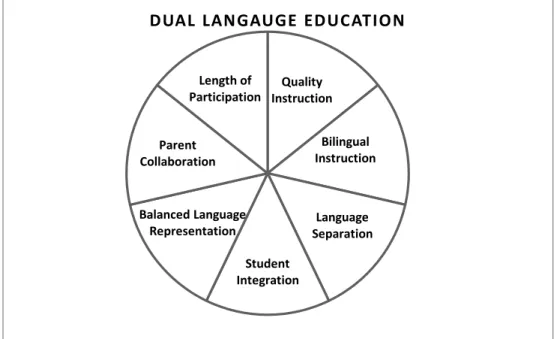
make a profoundly effective DLE program (Thomas & Collier, 1997; Lindholm-Leary, 2001; Soltero, 2004). Figure 2 presents a compilation of the seven program features identified.
Figure 2. Features of successful dual language education programs
Source: Soltero, 2004
As explained by Soltero (2004), the length of participation refers to the length of time a school carries out a DLE program. In order for DLE programs to effectively accomplish their objective, they should be implemented no less than six to eight years, and parent collaboration must be seen by the families and the schools as the most important aspect among the features of a DLE program. Parents must know and comprehend the goals and pedagogical practices of the DLE program, and must understand their role in supporting their children’s linguistic, academic, and sociocultural development (Soltero, 2004). It is also
Quality Instruction Bilingual Instruction Language Separation Student Integration Balanced Language Representation Parent Collaboration Length of Participation
38
essential to have a balance of equal, or near equal, proportions between language minority students (speakers of the partner language) and language majority students, and that these two groups are together for at least 50% of their instructional day at all grade levels (Soltero, 2004). In terms of language use, there must be an unmistakable language separation that outlines the use of each language for instruction and communication, and bilingual instruction of content and literacy must be provided for all students (Soltero, 2004). Soltero (2004) stresses that quality instruction must be provided at all times to guarantee that all students are taught at their fullest potential.
Dual Language Education Program Models
DLE programs deliver academic instruction using two languages, with the non-English language commonly being used at least 50% of the time (Christian, 2011). In addition to that requirement, experts have laid out some basic
requirements for successful DLE that determines how a program should be implemented—its model. A simple way to look at it is to determine whether the school community wants more or less of the target language; then again, the decision is actually more complex and it involves understanding the context of each school, language and educational background of the community,
expectations for language proficiency, trained personnel, and the needs of the school and its community.
39
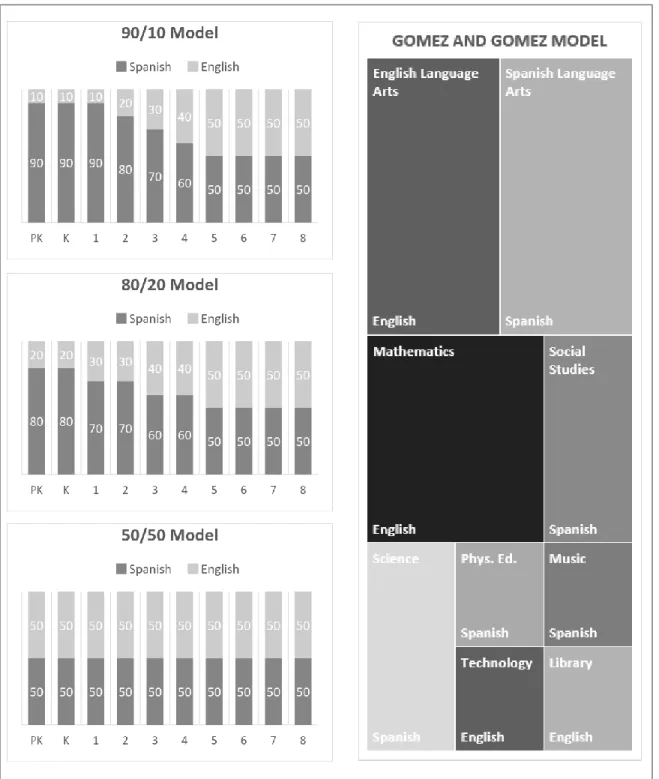
The most common DLE program models (graphically represented in Figure 3 on page 41) are:
1. The 90/10 and 80/20 Model. Instruction in these two models starts by
using the partner language (the language other than English) for the greater percentage of time and then slowly decreasing the percentage until instruction in both languages is delivered for the same amount of time (Christian, 2011). In the case of the 90/10 model, in the initial grade of the program (usually kindergarten) 90% of instructional time is provided using the partner language and 10% of the time using English. Then in first grade it changes to 80% in the partner language and 20% in English. Second grade is a 70/30 ratio, third grade is 60/40, and from fourth grade on, instructional time is 50% in the partner language and 50% in English. The 80/20 model follows the same premise, but starts with 80% in the partner language and 20% in English. The major reason for establishing an 80/20 model as opposed to a 90/10 lies in parental and administrative preference.
2. The 50/50 Model. In this model, students spend an equal amount of time in the partner language as they do in English; 50% and 50% in every grade level (Christian, 2011).
3. The Gomez and Gomez Dual Language Education Program. This model is especially well suited for areas with high numbers of ELs. It is unique in that: