The Levy Economics Institute of Bard College
Public Policy Brief
No. 101, 2009
PROMOTING GENDER EQUALITY
THROUGH STIMULUS PACKAGES AND
PUBLIC JOB CREATION
Lessons Learned from South Africa’s Expanded
Public Works Programme
The Levy Economics Institute of Bard College, founded in 1986, is an autonomous research organization. It is nonpartisan, open to the exam-ination of diverse points of view, and dedicated to public service.
The Institute is publishing this research with the conviction that it is a constructive and positive contribution to discussions and debates on rel-evant policy issues. Neither the Institute’s Board of Governors nor its advisers necessarily endorse any proposal made by the authors. The Institute believes in the potential for the study of economics to improve the human condition. Through scholarship and research it gen-erates viable, effective public policy responses to important economic problems that profoundly affect the quality of life in the United States and abroad.
The present research agenda includes such issues as financial instability, poverty, employment, gender, problems associated with the distribu-tion of income and wealth, and internadistribu-tional trade and competitiveness. In all its endeavors, the Institute places heavy emphasis on the values of personal freedom and justice.
Editor: Feridoon Koohi-Kamali Text Editor: Barbara Ross
The Public Policy Brief Series is a publication of The Levy Economics Institute of Bard College, Blithewood, PO Box 5000, Annandale-on-Hudson, NY 12504-5000. For information about the Levy Institute, call 845-758-7700 or 202-887-8464 (in Washington, D.C.), e-mail [email protected] or visit the Levy Institute website at www.levy.org.
The Public Policy Brief Series is produced by the Bard Publications Office.
Copyright © 2009 by The Levy Economics Institute. All rights reserved. No part of this publication may be reproduced or transmitted in any form or by any means, electronic or mechanical, including photocopying, recording, or any information-retrieval system, without permission in writ-ing from the publisher.
ISSN 1063-5297
ISBN 978-1-931493-91-8
3 Preface
Dimitri B. Papadimitriou
4 Promoting Gender Equality through Stimulus Packages and Public Job Creation
Rania Antonopoulos
12 About the Author
Preface
Beyond loss of income, joblessness is associated with greater poverty, marginalization, and social exclusion; the current global crisis is clearly not helping. There is, therefore, a particular urgency to engage in dialogue and pursue new policy directions. In this new Public Policy Brief, Research Scholar Rania Antonopoulos explores the impact of both joblessness and employment expansion on poverty, paying particular attention to the gender aspects of poverty and poverty-reducing public employment schemes targeting poor women. The author advocates public employment as a policy instrument that, when set up as a permanent institution, acts as an automatic stabilizer. Its main feature is that the government steps in as a guarantor to make available a job to those who fail to secure one through the market. Antonopoulos notes that such public job opportuni-ties have typically been created in the construction and maintenance of physical infrastructural assets, often bypassing equally meaningful jobs that enhance social service delivery. She argues that the latter have a bigger impact on poverty reduction, especially among women, who account for the majority of the poor in many developing countries. This is because social sector public employment converts the female burdens of unpaid work—a key feature of female poverty—into paid employment, in addition to improving their job market skills.
The author presents the results of a Levy Institute study that examines the macroeconomic consequences of scaling up South Africa’s Expanded Public Works Programme by adding to it a new sector for social service delivery in health and education. She notes that gaps in such services for households that cannot afford to pay for them are mostly filled by long hours of invisible, unpaid work performed by women and children. Her proposed employment creation program addresses several policy objectives: income and job generation, provisioning of communities’ unmet needs, skill enhancement for a new cadre of workers, and promotion of gender equality by addressing the overtaxed time of women. A budgetary allocation of 9.2 million rand creates approximately 571,000 full-time social sector jobs, the vast majority going to the unskilled poor and ultrapoor; 60 percent of these jobs are expected to be filled by women. The expenditure amounts to 1.1 percent of GDP (in 2000 prices), yet it impacts GDP growth by 1.8 percent. All ultrapoor participants in the program cross the ultrapoor poverty line, observes Antonopoulos, and all poor households with income levels previously at or just above the ultrapoor poverty line are lifted above the poverty line datum. She concludes by noting that drawing in marginalized seg-ments of the population via social sector public job creation has the strong potential to fulfill mul-tiple policy objectives.
As always, I welcome your comments.
Dimitri B. Papadimitriou, President
Introduction and Policy Context
The current global economic crisis has highlighted quite starkly some disturbing realities. Beyond any doubt,the expectation that financial liberalization would bring market efficiency has been shattered; decoupling expectations for emerging markets are gone; projections of a slowdown in both growth and trade are truly worrisome; and a crisis of joblessness is spreading worldwide. Yet, we must not lose sight of the fact that while these recent events are reversing trends in prosperity enjoyed by some, for the vast majority of the world’s population they are simply adding insult to injury: poverty and inequality have shown remarkable persistence, and reducing them has remained elusive—including in countries experiencing a healthy growth rate over the last decade or so.
These challenges, poverty and income inequality, originate in several distinct processes, and policy must be mindful of the fact that one size will not fit all: a growing earnings gap between skilled and unskilled workers; the shift in the functional distri-bution of income away from earned income and in favor of profits; the eminent threat of landlessness due to low agricul-tural productivity or the adverse effects of world market prices; international trade practices that put pressure on staple food prices; and a disappearing state social safety net. Each of these factors contributes to inequities in its own way; hence, each requires a different type of intervention and invites a distinct set of policy recommendations.
Employer of last resort (ELR) is a policy recommendation that is particularly relevant for one group of people whose economic suffering is based largely on a chronic and severe lack of employ-ment opportunities—namely, the jobless. Its main feature is that the government steps in as guarantor to make available a job to those for whom the market fails to secure one, at a minimum wage.1Beyond loss of income, and particularly troubling, jobless-ness is associated with not only poverty but also marginalization and social exclusion, susceptibility to extremist ideologies, the subjection of people to high levels of violence, and overall loss of hope. The current global crisis is clearly not helping on this front. There is, therefore, a particular urgency to engage in dialogue and
pursue new policy directions, and it is generally acknowledged that fresh ideas are needed. From our perspective, in addition to new thinking, it is bold policy action that is in high order.
In this context, ELR, which makes it the obligation of the state to provide a job to those unable to find one, is an option that warrants attention. At its core, ELR is a policy instrument that proposes an “employment benefit”—“employment insurance,” if you will—that, when set up as a permanent institution, also acts as an automatic stabilizer from a macroeconomic point of view. When markets are unable to generate sufficient numbers of job openings, public service job creation provides a work opportu-nity, at a minimum wage, to anyone willing and able to work.
The Obama administration has introduced a direct job cre-ation component in its stimulus package, as have some other gov-ernments around the world. Historically, such job opportunities have been created primarily in the construction and maintenance of physical infrastructural assets. Often bypassed are equally meaningful jobs that enhance social service delivery, a subject this policy brief is dedicated to examining. This paper presents findings that actually agree with Treasury Secretary Timothy Geithner’s statement that social service job creation delivers “more bang for the buck” than jobs programs targeting infra-structure, as shown by the experience of Japan (Fackler 2009). The results presented here originated in a Levy Institute study undertaken by myself and colleagues to examine the macroeco-nomic consequences of scaling up South Africa’s Expanded Public Works Programme (EPWP), a public job creation initiative intro-duced in 2004. The job creation we propose pertains to social service delivery in health and education, areas that are especially important when current backlogs are taken into account. Gaps in such services for households that cannot, due to lack of income, purchase them are devastating, and are mostly filled by long hours of invisible, unpaid work performed by women and children. Time-use data reveals this to be the case in many countries, result-ing in yet another form of gender inequality—and South Africa is not an exception. Our proposal therefore addresses several policy objectives: income and job generation, provisioning of commu-nities’ unmet needs, skill enhancement for a new cadre of work-ers, and promotion of gender equality by addressing the overtaxed time of women. As such, this study provides evidence that highlights how domestic labor resource mobilization through well-designed public employment programs presents an opportunity to achieve multiple developmental policy objec-tives. In the case of South Africa, we find that public job creation
Promoting Gender Equality through
Stimulus Packages and Public Job
Creation
synergistically creates jobs and income, expands tax revenue that can be used to partially offset the cost of this initiative, promotes pro-poor growth, and contributes to gender equality by substitut-ing paid for unpaid work. These results stem from an ex ante eval-uation of a policy scenario for South Africa’s EPWP. The orders of magnitude involved are indeed compelling, and we hope they are useful in motivating discussion for other countries.
Background on South Africa
While many positive developments have taken place in postapartheid South Africa, unemployment and poverty remain serious challenges. During the past decade, the coun-try’s official unemployment rate has been very high, and at the time this study was conducted it stood at 25.5 percent. The expanded unemployment rate (a measure that includes dis-couraged workers) is about 37.1 percent, reflecting the vast numbers of predominantly unskilled and low-skill workers who are without jobs (SSA 2007). These rates corresponded to 4.4 and 7.1 million persons, respectively, who were out of work. What makes joblessness even more intractable is the fact that, compared to countries of a similar socioeconomic level of development, self-employment and the size of the informal sec-tor in South Africa remain surprisingly small.
Unemployment and poverty continue to have racial, gen-der, and spatial characteristics in South Africa. Joblessness among African women and youth in ex-homelands, urban slums, and rural areas is as high as 70–80 percent in some parts of the country. In March 2007, the official unemployment rate (a measure that excludes discouraged workers) among the African population was 36.4 percent for women and 25 percent for men, while for white women it was 4.6 percent, and for white men, 4.1 percent. Poverty estimates place 50–60 percent of the population below the poverty line.2Overall, a larger number of
women live in poverty; in a population of about 44 million, 11.9 million (54.4 percent) of those living below the poverty line are female, compared to 10 million who are male (Sadan 2006).
High unemployment rates persist despite South Africa’s robust economic growth—between 3 and 4.5 percent over the past five years. Starting in 1994, the government introduced poli-cies and programs geared toward improving growth and reduc-ing poverty and inequality. Examples include the Reconstruction and Development Programme (1994), a Keynesian aggregate-demand strategy; the Growth, Employment, and Redistribution
Strategy (1996), which included a strong commitment to price stability and inflation targeting; the Child Support Grant (1998), part of a social cash-transfers programmatic commitment; and, more recently, the Accelerated and Shared Growth Initiative for South Africa (2006). Despite these policies, moderate but steady growth has not translated into substantial employment creation, partly due to the number of overall manufacturing jobs lost as a result of labor-saving technologies. Simply put, private sector demand has not been able to absorb surplus labor. Current pro-jections indicate that, even if the South African government were to adopt aggressive expansionary fiscal and monetary policies, cutting unemployment by more than half its present rate would be an impossible task in the next decade (Altman 2007; Pollin et al. 2006). Prospects look especially grim for unskilled workers.
To redress the serious problem of chronic unemployment, the Government of South Africa introduced, among other meas-ures, the Expanded Public Works Programme (EPWP) in 2004. The program provides the unemployed with a paid work enti-tlement and has set a target of creating one million job oppor-tunities within five years. The idea of government’s acting as the employer of last resort has a very long history, and over the years many countries have undertaken what have variably been known as “employment guarantee schemes,” “public employment programs,” “food for work,” and “public works programs.” Such government-led projects have been implemented as temporary emergency-relief programs during crises and phased out as conditions improve (Antonopoulos 2007). However, the case has also been made for using such measures on a permanent basis (Drèze and Sen 1989; Minsky 1986; Papadimitriou 1998; Wray 2007; Mitchell 2001) to guard against the many undesir-able socioeconomic effects of underemployment and to pro-mote the right to a job as a guaranteed entitlement. In 2005, India became the first country to introduce such a permanent entitle-ment by making the National Rural Employentitle-ment Guarantee Act, or NREGA, part of its constitution.
The main goal of EPWP is to address economic empower-ment through job creation. This is a policy that has the poten-tial to mitigate social exclusion and contribute to poverty alleviation by mobilizing an underutilized domestic resource— namely, labor. By creating short- to medium-term jobs for unskilled workers who have been unemployed (in most cases, for prolonged periods of time), this policy aims to achieve yet another goal—to build skills and provide on-the-job training and formal accreditation so as to prepare EPWP participants
for longer-term jobs.3EPWP projects and job creation are pri-marily focused on labor-intensive infrastructure, such as con-struction and maintenance of roads and bridges, with a mandate to substitute, to the largest degree possible, labor for machines. In addition, smaller budgetary allocations are designated for environmental projects and for social sector job creation.
In many respects, EPWP has set deeply transformative objectives, which are difficult to achieve within a short term and with small budgetary allocations. In the 2004–05 period, the ratio of EPWP cost to GDP was 0.3 percent, and the ratio of EPWP cost to government expenditures, a mere 0.8 percent. To give an indication of the relative magnitudes involved, out of the annual budgetary allocation of 20 billion rand (R) for fiscal year 2004–05, R15 billion was dedicated to job creation within infrastructure projects, R4 billion for employment in environ-mental projects, and R600 million to social sector job opportu-nities. Recent midterm reviews and independent research have revealed that budgetary allocations are incommensurable with the problem at hand, and that job opportunities are too few and too short in duration to have a substantial impact. Hence, fresh discussions are currently under way to scale up EPWP.
This study joins in the efforts aiming to contribute to the current policy dialogue on scaling up EPWP. We propose an expansion of job creation within the social sector and subse-quently explore the economy-wide implications of such a job creation on unemployment, growth of output, fiscal space, and poverty reduction. As distinct from other countries’ public job creation initiatives that focus exclusively on infrastructure, South Africa is the first nation to programmatically include public job creation that aims to extend social service delivery. Specifically, two focus areas have been identified: early childhood develop-ment (ECD) and home- and community-based care (HCBC). We consider this particularly important from a gender equality perspective. Across the world, especially among poor households that cannot purchase such services from the market, it is the unpaid work of women that fills public sector care gaps.
The invisibility of unpaid work has resulted in omitting unpaid work inequalities from proper consideration in eco-nomic analysis and policy recommendations. To provide a clearer picture of the nexus between poverty, paid/unpaid work, and unemployment, this research project uses a methodology that includes the construction of time-use satellite accounts that reveal the hidden economy of unpaid work, as well as a variety of useful jobs that present themselves as potential but
“hidden” vacancies waiting to become part of the monetized economy. Overall, we find that in South Africa, time spent on unpaid care work is higher for women, increasing with poverty and unemployment. In contrast to adult men, women perform 75 percent of the total unpaid work. The time burdens of unpaid work, including unpaid care work, are particularly acute among African poor women in ex-homelands and urban slum areas. As a result, these women end up having less time available for skill upgrading, political participation, and self-care, with negative implications for human development, active citizen-ship, and fully realized capabilities.
EPWP provides policy space to create job opportunities that upgrade skills for men and women, extend service delivery to underserved communities, and substitute paid for unpaid work. We consider this policy a very important feature of the program, particularly from a gender perspective. EPWP pro-grammatically recognizes that unpaid HCBC and ECD work performed primarily by women, children, and mostly unem-ployed and poor “volunteers” should become paid work. Unpaid work performed by poor women includes care for the sick and permanently ill, such as malaria and TB patients and people living with HIV/AIDS. It also consists of care provision-ing, with meagre means and under impoverished conditions, for children during their early childhood developmental stages. This work extends beyond child minding—it includes securing adequate nutrition and clean water, collecting firewood to prepare meals, accessing health services, providing mental stimulation, and creating a secure, clean, warm, and nurturing environment, which is crucial for the physical and psychological development of children. In South Africa, the two care areas of ECD and HCBC are critically interconnected. As a result of the high HIV/AIDS prevalence rates among those in the middle age ranges, older chil-dren and older women become the primary caretakers of orphans and children living in households with HIV patients.
Case Study on Scaling Up the Social Sector: EPWP
The EPWP jobs we propose below build upon and extend the present scope of the EPWP social sector.4 Evaluation docu-ments have noted that the social sector has been primarily focused on facilitating skill upgrading through learnerships.5 Given its small budgetary allocations, the social sector program offers a very short duration of employment and does not expand service delivery adequately. In contrast, the program we propose
provides full-time, year-round jobs based on service delivery targets. It is meant to create jobs while providing services that reach infants, young children, and the sick members of vulner-able households. These services will also be availvulner-able to house-holds from within which newly hired EPWP workers will be recruited, enabling women’s participation in EPWP without adding to their already heavy burdens of unpaid work. Delivery of services will entail the hiring and development of ECD and HCBC cadres that range from child care workers, school nutri-tion workers, teachers’ aids, school caretakers, and school cleri-cal workers to cooks, vegetable gardeners, and administrators for local ECD sites, as well as community health workers, nutri-tion and food security workers, TB and malaria health officers, and staff for directly observed therapy services and voluntary counselling and testing. These services will help alleviate unpaid care burdens by providing support for the raising of children and the care of the ill.
While the present study addresses the particular context of South Africa, this research project develops a methodology appli-cable to a variety of other policy experiments and, with appropri-ate modifications, can be adopted for use in other countries. The two pillars of our analysis are a gender-disaggregated social accounting matrix (SAM) and time-use satellite accounts that we developed for the South African economy. Our methodol-ogy visualizes the macroeconomy, with gender, race, income, and poverty structures highlighted. It sheds light on how unpaid work is distributed by gender, employment status, and the poverty sta-tus of households, and offers simulations and impact analysis that are disaggregated by gender and a variety of household types, revealing some salient features of the macro-micro implications of policy experiments.
The SAM model allowed us to assess the impacts of scaling up EPWP social sector job creation. The model shows the use of male and female labor (skilled and unskilled) in paid work for several stratified household types. Parallel satellite time-use accounts were constructed to shed light on the distribution of unpaid work for the same stratified household types. We also made use of models that allowed us to determine the types and numbers of new jobs needed to expand service delivery. From these estimates we calculated the corresponding budgetary allo-cations that will allow such a scale-up to take place. Lastly, during the month of October 2007, 17 interviews with government officials and EPWP beneficiaries were conducted and five proj-ect sites, in the provinces of KwaZulu-Natal and Limpopo, were
visited. These provided valuable insights and enhanced our understanding of both the importance of scaling up and the challenges facing EPWP.
We based our policy experiment on a suggested budgetary allocation of approximately R9.2 billion. The proposed full-time, year-round jobs primarily reach unskilled workers who are members of ultrapoor and poor households. Wages are stip-ulated at R500 per month, with some jobs requiring higher skill levels and paying up to double that amount. The labor supply response is presumed to be the same for all households below the poverty line. The key simulation findings are:
• The injection of R9.2 billion corresponds to the creation of 571,505 new full-time EPWP social sector jobs. Approximately 540,000 of these are allocated to unskilled members of poor and ultrapoor households, and the remaining to skilled super-visory workers.
• Almost 60 percent of these jobs are estimated to be filled by women, including 317,007 unskilled positions (55.5 per-cent) and 16,386 skilled positions (representing 2.9 percent of the total number of jobs directly created). Monthly wages received by both women and men are identical, at R500 for most workers and R1,000 for those with some level of skill. • In addition to the jobs directly created, approximately 200,000 jobs are created indirectly elsewhere in the econ-omy. The injection of roughly R9.2 billion results in extra demand generated throughout the economy from two sources: (1) new demand for intermediate inputs used by the EPWP sector in order to hire, train, and deliver the new ECD and HCBC services; and (2) new demand for consump-tion goods that is generated when the newly hired skilled and unskilled EPWP workers, as well as workers from other sec-tors, spend the income received.
• For every three job opportunities directly created through EPWP, another job becomes necessary, and is therefore indi-rectly created, elsewhere in the economy—for a total of 772,000 new work opportunities overall.
• In 2000 prices, the R9.2 billion corresponds to 3.5 percent of government expenditures, or 1.1 percent of GDP. The annual cost of this policy covers all labor payments and all other costs associated with service delivery and human capital devel-opment, such as food, other agricultural inputs for meal preparation, and supervisory costs, as well as training and cer-tification expenses.
• The total impact on GDP growth is on the order of 1.8 per-cent, or R15 billion. In 2000 prices, the GDP growth rate increases from 4.2 to 6 percent from an implied multiplier of 1.6 (15B ÷ 9.2B).
• New direct and indirect taxes are generated equal to about R3 billion, which will reduce the overall cost of the interven-tion by one third (assuming there will not be any unantici-pated leakages).
• The resultant growth is pro-poor. The overall incremental
change in income is 9.2 percent for ultrapoor households, 5.6 percent for poor households, and 1.3 percent for nonpoor households. These changes are instructive, but they do not shed light on those households from whose ranks participants of the scaled-up social sector EPWP are drawn (see below). • All EPWP-participating ultrapoor households cross the
ultrapoor poverty line datum, and depth of poverty is reduced by 60–80 percent. Poor households previously located above or around the ultrapoverty line are lifted above the poverty line datum. Our results indicate the need for careful consideration of possible targeting. It may be the case that job rationing is required in order to obtain a big-ger poverty reduction outcome.
• Overall, social sector job creation is more labor intensive than the infrastructure sectors of EPWP. Budgetary allocations in the social sector result in higher levels of job creation and greater depth-of-poverty reduction.
Fiscal Space
Financing for the above proposed EPWP social sector expansion of R9.2 billion (R13.3 billion in 2007 prices) can take place through one of three venues, or a combination thereof—an expansionary fiscal stance, higher tax rates, and increased tax rev-enues due to the resultant economic growth (Pollin et al. 2006):
• Deficit financing. The government budget surplus of R26.6 billion in fiscal year 2007–08 could fully finance the pro-posed expansion. South Africa has been running primary surpluses for several years. Given this fiscal discipline, struc-tural deficit financing of EPWP would not impose a heavy burden in the near future: it may increase the budget-deficit-to-GDP ratio from minus 1.6 to minus 2.2 percent in fiscal year 2009–10. Positive multiplier effects of the
pro-gram would increase tax revenue and thus reduce this ratio to minus 2.0 percent.
• Tax financing. Financing solely through tax revenue would be achieved by increasing the tax-revenue-to-GDP ratio from 27.8 to 28.4 percent. A 1 percent increase in the value-added tax rate (from 14 to 15 percent on nonbasic consump-tion goods and services) would raise the revenue by R12 billion. Raising the corporate income tax rate to its previous level of 29 percent (from 28 percent) would collect another R5.7 billion. These two adjustments alone may be enough to finance expansion of the EPWP social sector.
• Growth dividend. Economic growth translates into higher tax revenues: the estimated 3.7 percent growth in real GDP during the 2008–09 fiscal year alone could bring in an addi-tional R20 billion. In addition, it must also be kept in mind that the projected Keynesian multiplier effects of this spe-cific intervention program could finance up to one third of the proposed government spending on this initiative.
Beyond the Multiplier Analysis
We must emphasize that this exercise serves as a hypothetical pol-icy experiment, and its aim is to identify orders of magnitude for its economy-wide impacts should a scale-up of EPWP be imple-mented. Many of the specific assumptions can be easily changed to reflect different initial conditions, as well as diverse objectives set by beneficiary communities, policymakers, and other stake-holders at the national, provincial, and municipal levels.
Going beyond the multiplier analysis, a variety of immeas-urable implications for all participants, especially women, must be mentioned:
• Service delivery.Children of all households across the coun-try will be able to enroll in early childhood development programs that should lead to better child nutrition, health, education, and general well-being, especially for children in vulnerable households. About 20 percent of (the most vul-nerable) households living with HIV/AIDS patients will be receiving home-based care, counseling, and better nutrition. Such extended services will reduce demands placed on women’s time for unpaid care work.
MDG 1
Eradicate Extreme Hunger and Poverty
MDG 2
Universal Primary Education
MDG 3
Promote Gender Equality and Empower Women
MDG 4
Reduce Child Mortality
MDG 5
Improve Maternal Health
MDG 6
Combat HIV/AIDS, Malaria, and Other Diseases
MDG 7
Ensure Environmental Sustainability
MDG 8
Develop a Global Partnership for Development
Wage income benefit to EPWP workers (beneficiaries)
Project design in development of community gardens and common lands, and other community-based agricultural production
Reduction in need for unpaid work will result in higher enrollment of girls Training provides work/education options for adults
Beneficiaries can be also engaged in school construction/maintenance
Women beneficiaries participate in the design of EGS projects Wage income benefit combined with gender-targeting design elements Training/accreditation courses draw women into the labor force Reduction of unpaid work via better service delivery and infrastructure Water and crèche provisioning for and by beneficiaries
Early childhood development (ECD) workers and centers for infants and children ages 1–4 Home-based care workers alleviate unpaid care burdens
Wage income benefit for extension workers and community workers in ECD
ECD center beneficiaries receive training in extension health services and receive certification to operate centers
Infrastructure for clean water, latrines, and crèche is developed
Wage income benefit for extension workers in maternal health care education program Education/training certification programs
Beneficiaries can be engaged in auxiliary community care activities
Home- and community-based care worker development in education/training programs Beneficiaries are engaged in providing auxiliary community care services
Engage beneficiaries in environmental remediation, reforestation, development of ponds, traditional irrigation systems, water projects, and ecological latrines
Youth-targeting design elements
Learning from the international experiences of job creation programs by engaging with women’s groups, area experts, and global networks
• Accreditation.The range of possible work opportunities we have proposed entails on-the-job training, including attend-ing seminars and workshops that lead to formal accredita-tion. Increased levels of human capital and certification of skills will potentially lead to better job prospects in formal markets, including the government sector at the provincial or municipal level. Both ECD and HCBC are female-inten-sive sectors, increasing the likelihood of translating EPWP training in these sectors to formal employment opportuni-ties for women.
• Participants will experience a renewed sense of dignity, fulfill-ment, and self-worth.Our hypothetical policy scenario limits our capacity to directly conduct such an impact assessment study emanating from the proposed intervention. Nonetheless, existing literature on this subject, as well as visits to various EPWP sites and other public works project evalua-tions, confirms that the program brings enhanced self-esteem to its participants. Even the most critical research has shown an increase in self-esteem and fulfilment stemming from being able to work, save, afford better clothing, participate in com-munity events, and help family members financially.
• Generating self-employment. Potential savings and other asset accumulation, together with government interventions that nurture community-based development, can lead to the emergence of new small businesses. Newly earned income spent on purchases from local shops and neighbor-hoods is extremely important in this context. As households move out of poverty, the government is expected to gener-ate savings due to reduced budgetary pressures for poverty alleviation. An excellent use of such savings would be to support interventions that contribute to community-based development and revitalization.
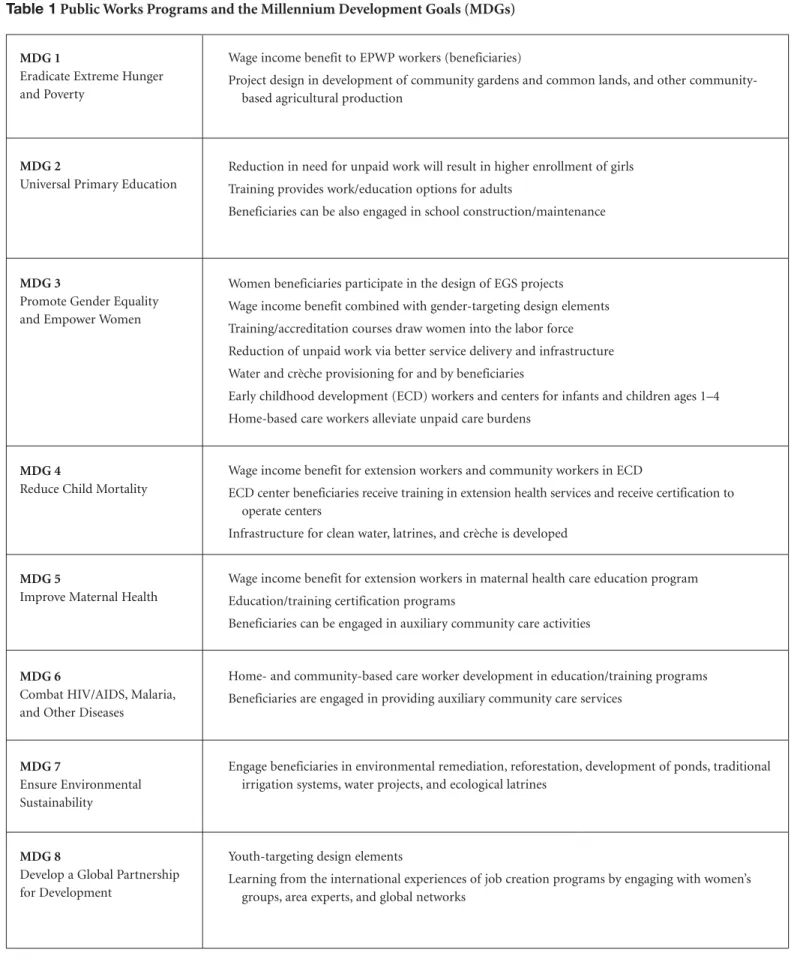
Finally, it is also worth considering the strong linkages between any public service job creation initiative, including that of EPWP, and the Millennium Development Goals (MDGs). Many costing studies have been conducted with the objective of determining the total resource requirement for achieving the MDGs. For the most part, discussion on the feasibility of the MDGs has focused on the lack of financial resources and on ways of bridging the funding gap. Yet, policy selection is equally impor-tant in this context. In this context, domestic labor resource
mobilization through a public works strategy ought to be given due consideration. There are multiple channels through which employment can speed up the achievement of MDG targets—an issue that has received some attention in recent years (see Islam 2006).6 A good place to start would be to include a public employment, and a labor-intensive mandate for all MDG-related projects (for physical and social infrastructural asset creation). Although not a panacea, a well-designed public employment guarantee strategy can go a long way toward the achievement of MDGs. The table below lists the benefits that gender-informed EPWP projects deliver.
Conclusion
This policy brief joins the efforts of others that consider public job creation to be part of the policy mix needed to address unemployment and poverty. One of the concerns in implement-ing such initiatives is that scarce resources may be wasted in meaningless types of projects. We have proposed job creation that addresses such concerns. In evaluating the desirability, fea-sibility, and sustainability of such a policy, the multidimensional benefits that can accrue must be kept in mind. Drawing in mar-ginalized segments of the population via the types of job cre-ation proposed in this analysis has the strong potential to contribute to many policy objectives, including reversing out-ward migration and crime trends, revitalizing marginalized com-munities, increasing human capital, and promoting social inclusion. Moreover, by reducing the unpaid care burdens of poor women, the specific jobs we have proposed contribute toward the goal of gender equality.
Notes
1. Examples include India, Argentina, Korea, Morocco, and Australia, among others. See Antonopoulos (2007). 2. There is no official poverty line in South Africa, although
the treasury is in the process of finalizing documentation that will establish such a threshold. Some researchers adopt R5,057 per annum, according to which the head-count ratio (defined as the proportion of the population living below the poverty line) for South Africa is 49.8 percent. The 20th percentile cutoff of adult equivalent income (R2,717 per annum) is sometimes used as the “ultrapoverty line.” About 28.2 percent of the South African population live
below this line. For this study, we have adopted compara-ble measures using 2000 prices and poverty levels. 3. The goal of skill creation and accreditation (learnerships;
see note 5 below) must be contextualized against the racist practice of apartheid that enforced a deliberately inferior system of education and deskilling on Africans. For exam-ple, the Bantu Building Workers Act of 1951 made it a criminal offense for a black African person to perform any skilled work in urban areas, except in segregated sections designated for black residence; the Bantu Education Act of 1953 established a Black Education Department in the Department of Native Affairs that compiled a curriculum suited to the “nature and requirements of the black people.” The author of this legislation, Hendrik Verwoerd (then min-ister of native affairs, later prime minmin-ister), stated explicitly that its aim was to prevent Africans from receiving an edu-cation that would lead them to aspire to positions they would not be allowed to hold in society.
4. Other types of interventions have been modeled and are available upon request from the author.
5. A learnership combines work-based experience with struc-tured learning, and results in a qualification, registered within the National Qualifications Framework by the South African Qualification Authority, that signals occupational competence and is recognized throughout the country. 6. See also the numerous publications of the United National
Development Programme’s International Poverty Centre in Brasília, available at www.undp-povertycentre.org.
References
Altman, M. 2007.Employment Scenarios to 2024.Pretoria: Human Sciences Research Council. September.
Antonopoulos, R. 2007. “The Rightto a Job, the Right Typesof Projects: Employment Guarantee Policies from a Gender Perspective.” Working Paper No. 516. Annandale-on-Hudson, N.Y.: The Levy Economics Institute. September. Drèze, J., and A. K. Sen. 1989. Hunger and Public Action.
Oxford: Oxford University Press.
Fackler, M. 2009. “Japan’s Big-works Stimulus Is Lesson for U.S.” The New York Times, February 5.
Islam, R. (ed.). 2006. Fighting Poverty: The Development-Employment Link. Boulder, Colo.–London: Lynne Rienner Publishers.
Minsky, H. P. 1986. Stabilizing an Unstable Economy. New Haven, Conn.: Yale University Press.
Mitchell, W. F. 2001. “Fiscal Policy and the Job Guarantee.” Working Paper No. 01/09. Newcastle (Australia): Center for Full Employment and Equity.
Papadimitriou, D. B. 1998. “(Full) Employment Policy: Theory and Practice.” Working Paper No. 258. Annandale-on-Hudson, N.Y.: The Levy Economics Institute. December. Pollin, R., G. Epstein, J. Heintz, and L. Ndikumana. 2006. An
Employment-targeted Economic Program for South Africa.
A Project of the Poverty Group of the Bureau for Development Policy, New York, and the International Poverty Centre in Brasília (IPC), United Nations Development Programme. Amherst, Mass.: Political Economy Research Institute.
Sadan, M. 2006. “Gendered Analysis of the Working for Water Program.” Occasional Paper. Pretoria: Southern African Regional Poverty Network.
Statistics South Africa (SSA). 2007.Labour Force Survey.
Pretoria (South Africa). March.
Wray, L. R. 2007. “The Employer of Last Resort Programme: Could It Work for Developing Countries?” Economic and Labour Market Papers, 2007/5. Geneva: International Labour Organization. August.
About the Author
Research Scholar rania antonopoulosis a visiting associate professor of economics at Bard College and a research scholar at the Levy Institute, where in 2004–05 she initiated the planning of the Gender Equality and the Economy program. She specializes in gender and economics, and international competition and globalization. She has been a consultant for the United Nations Development Programme (UNDP) and, since 2002, a principal investigator for and coordinator of the GEM-IWG Knowledge Networking Program on Engendering Macroeconomics and International Economics. In 2007, Antonopoulos oversaw the launch of an interactive website as groundwork for the knowledge-sharing initiative Economists for Full Employment; EFE seeks to link and mobilize a global community of economists, academics, public policy advocates, and nongovernmental organizations, with the principal objective of placing decent job creation at the center of development and macroeconomic strategies. She more recently headed up a team of Levy Institute researchers studying the impact of public employment guarantee schemes (EGS) on pro-poor development and gender equality. The project, supported by a grant from the UNDP, consisted of a pilot study exploring the synergies between EGS and unpaid work—including unpaid care work—in India and South Africa.