
Specification Patterns for Robotic Missions
Claudio Menghi, Christos Tsigkanos, Patrizio Pelliccione, Carlo Ghezzi, and Thorsten Berger
Abstract—Mobile and general-purpose robots increasingly support our everyday life, requiring dependable robotics control software. Creating such software mainly amounts to implementing their complex behaviors known as missions. Recognizing this need, a large number of domain-specific specification languages has been proposed. These, in addition to traditional logical languages, allow the use of formally specified missions for synthesis, verification, simulation or guiding implementation. For instance, the logical language LTL is commonly used by experts to specify missions as an input for planners, which synthesize the behavior a robot should have. Unfortunately, domain-specific languages are usually tied to specific robot models, while logical languages such as LTL are difficult to use by non-experts. We present a catalog of 22 mission specification patterns for mobile robots, together with tooling for instantiating, composing, and compiling the patterns to create mission specifications. The patterns provide solutions for recurrent specification problems, each of which detailing the usage intent, known uses, relationships to other patterns, and—most importantly—a template mission specification in temporal logic. Our tooling produces specifications expressed in the temporal logics LTL and CTL to be used by planners, simulators or model checkers. The patterns originate from 245 realistic textual mission requirements extracted from the robotics literature, and they are evaluated upon a total of 441 real-world mission requirements and 1251 mission specifications. Five of these reflect scenarios we defined with two well-known industrial partners developing human-size robots. We validated our patterns’ correctness with simulators and two different types of real robots.F
1
INTRODUCTION
M
OBILErobots are increasingly used in complex environ-ments aiming at autonomously realizing missions [9]. The rapid pace of development in robotics hardware and tech-nology demands software that can sustain this growth [10], [11], [12], [13]. Even though existing solutions are not readily usable [14], in the near future robots will be used for accom-plishing tasks of everyday life by end-users with no expertise and knowledge in computer science, robotics, mathematics or logics. Providing techniques that support robotic software development is a major software-engineering challenge [10], [15]. Indeed, as in the mobile application domain, where electrical engineers develop low level hardware components and constructing higher level software components that are executed on mobile devices is a software engineering issue, in the robotic domain robotic engineers develop robots and low level software primitives that allow controlling and managing these robots and developing and defining software that uses those low level primitives is a software engineering issue.The mission describes the high-level tasks the robotic software must accomplish [16]. Among the different ways of describing missions that were proposed in the literature [17], in this work, we consider declarative specifications [18]. These describe the final outcome the software should achieve—rather than describing how to achieve it—and are prominently used in the robotics domain [17]. Precisely specifying missions and transforming them into a form useful for automatic processing are among the main challenges in engineering robotics software [19], [20]. On the one hand, missions should be defined with a notation that is high-level and user-friendly [16], [21]. On the other hand, to enable automatic processing, the notation should be unambiguous and provide a formal and precise description of what robots should do in terms of movements and actions [22], [23], [24]. Engineering robotics software typically amounts
to expressing the robotic mission in natural language (henceforth calledmission requirement), and then translating mission requirements into more precisemission specifications. The latter are often expressed in a domain-specific language, many of which have been proposed over the last decades [17]. These languages are often integrated with development environments used to generate code that can be executed within simulators or real robots [25], [26], [27], [28]. However, these languages are typically bound to specific types of robots and support a limited number and type of missions. Other works especially from the robotics domain, advocate the use of formally specified missions in temporal logics [29], [30], [31], [32]. Unfortunately, specifying missions using temporal logic formulae can be too complex and error-prone for practitioners or engineers. As such, defining robotic missions is generally challenging, as widely recognized in the software-engineering and robotics communities [33], [34], [35], [36].
Mission requirements are often ambiguous, hindering pre-cise and unambiguous specification [36], [37], [38]. Consider the very simple mission requirement “the robot shall visit the kitchen and the office.” This can be interpreted as “visit the kitchen” and also that at some point the robot should “visit the office” without a specific order between the visit of the kitchen and the office, or as visit “the kitchen and the office in order.” Assume that the correct intended behavior requires that “the kitchen and the office are visited in order,” which is a common mission specification problem [39], [40]. When transforming this mission requirement expressed in natural language into a precise mission specification, an expert might come up with the following formula in temporal logic:
φ1=F (r in l1)∧ F(r in l2)
,
wherer in l1andr in l2signify that robotris in the kitchen and office, respectively, andFdenotesfinally. Now, recall that the actual mission requirement is that the robot reaches the kitchenbeforethe office. It is important to highlight that the logical formula still admits that the robot reaches the office
before entering the kitchen, which may be an unintended behavior. In fact, a possible interpretation might also require that a robot should visit the office after having visited the kitchen and that the robot absolutely cannot visit the office before having visited the kitchen. This alternative interpre-tation requires defining additional behavioral constraints. A correct formula, among others, is the following:
φ2=φ1∧ ¬(r in l2)
U (r in l1)
,
where U stands for until. Further interpretations are also possible. This highlights the ambiguity in natural language requirements formulation, and common mistakes may be introduced when diverse interpretations are given [24], [41], [42], [43]. The additional constraint added in the last interpretation above requires the office to not be visited before the kitchen, recalling a specification pattern for temporal logics known as the absence pattern [44]. Rather than conceiving such specifications recurrently in an ad hoc way with the risk of introducing mistakes, engineers could re-use validated solutions to existing mission requirements. Creating mission specifications that correctly capture mission requirements is hard and error-prone [33], [34], [35], [36], also evident from the examples above. The challenge of defining behavioral properties in logical languages such as LTL, has been recognized by researchers. While precise behavioral specifications in logical languages enable reason-ing about behavioral properties [45], [46], their specification is hard and error prone [47], [48]. Practitioners are often unfamiliar with the specification process as well as with the intricate syntax and semantics of logical languages [44]. Specification patterns have become a popular solution to this challenge. For instance, Dwyer et al. [44] introduced patterns for safety properties, which were later extended by Grunske [49] and Konrad et al. [50] to address real-time and probabilistic quality properties, respectively. Autili et al. [51] consolidated and organized these patterns into a comprehen-sive catalog. Bianculli et al. [52] applied specification patterns to the domain of web services. All these patterns provide template solutions that can be used to specify the respective properties. However, none of these pattern catalogs focuses on the robotic domain to solve the mission specification problem. Our contribution enriches this line of research by focusing on the new emerging domain of mobile robots, whose missions need to be expressed in precise terms by users who are not proficient in formal specifications. It follows a typical research paradigm in engineering that tries to replicate, contextualize, and extend an existing useful method to a different domain, which has its own specificities. We propose a new set of patterns focusing on robot movement as one of the major aspects considered in the robotics domain [53], [54], [55], as well as on how robots perform actions within their environment. For each pattern we provide its usage intent, known uses, relationships to other patterns, and—most importantly—a template mission specification in temporal logics. The latter relies on LTL and CTL as the most widely used formal specification languages in robotics [27], [29], [30], [32], [56], [57], [58], [59], [60], [61], [62]. The template mission specification can be defined in multiple languages that may have different expressiveness – the patterns we provide lie in the intersection of LTL and CTL. These logical formalisms are sufficiently expressive, since
missions that contain explicit time requirements are beyond the scope of this work, and subject of future investigation. Our catalog has been produced by analyzing 245 natural-language mission requirements systematically retrieved from the robotics literature. From these requirements we identified recurrent mission specification problems and conceived solu-tions organized as patterns. Our patterns provide a formally defined vocabulary that supports robotics developers in defining mission requirements. Relying on the usage of the pattern catalog as a common vocabulary allows mitigating ambiguous natural language formulations [34]. Our patterns also provide validated mission specifications for recurrent mission requirements, facilitating the creation of correct mission specifications.
We implemented the tool PsALM (Pattern bAsed Mission specifier)to further support developers in designing missions. PsALM allows (i) specifying a mission requirement through a structured English grammar, which uses patterns as basic building blocks and operators that allow composing these patterns into complex missions, and (ii) automatically generating specifications from mission requirements. PsALM is robot-agnostic and integrated with Spectra [63] (a robot development environment), a planner [30], NuSMV [64] (a model checker), and Simbad [65] (a simulator for education and research). The pattern catalog and the PsALM tool are available in an online appendix [66].
We validated the correctness of the proposed patterns. The methodology we conceived is generic and can be reused in future work that propose pattern catalogs. Specifically, we characterize all (and only) the set of behaviors that were expected to be admitted by a mission requirement by manually defining anω-regular expression. Thisω-regular expression is compared with the set of behaviors admitted by an LTL formula by using standard language inclusion procedures. To further build confidence for the absence of errors on the definition of the ω-regular expression, we additionally tested patterns correctness on a set of12
randomly generated models representing buildings where a robot is deployed. We considered ten mission requirements (each obtained by combining three patterns), converted the mission requirements into LTL mission specifications and used those to generate robots’ plans. We used the Simbad [65] simulator to verify that the plans satisfied the intended mission requirement. We subsequently generated both LTL and CTL specifications from the considered mission requirements. We verified that the same results are obtained when they are checked on the randomly generated models, confirming the correspondence among the CTL and LTL specifications.
We evaluated the benefits of using our patterns for designing missions. We collected441mission requirements in natural language:436obtained from robotic development environments used by practitioners (i.e., Spectra [63] and LTLMoP [31], [36]), and five defined in collaboration with two well-known robotics companies developing commercial, human-size service robots (BOSCH and PAL Robotics). We show that most of the mission requirements were ambiguous but expressible using the proposed patterns, and that usage of patterns reduces ambiguities. We then evaluated the coverage of mission specifications. We collected1229LTL and22CTL mission specifications from robotic development
environments used by practitioners (i.e., Spectra [63] and LTLMoP [31], [36]) and research publications (i.e., [67]) and show that almost all specifications can be obtained using the proposed patterns (1154over 1251, i.e., ≈ 92% ). We also generated specifications for five mission requirements defined in collaboration with the two robotic companies and fed them into an existing planner. The produced plans were correctly executed by real robots, namely Tiago and Turtlebot1showing the benefits of the patterns support in real scenarios. Finally, we also showed that the LTL formulation of the patterns is within the GR(1) fragment, enabling the use of existing reactive synthesis tools (e.g., [29]).
A small fragment of this work has been published as an extended abstract [68] and a tool-demo paper [69]. In these papers, we presented the initial idea and a description of our toolset for early dissemination. This paper presents our work in its full richness, explaining the methodology, presenting all patterns with their formalization, as well as our evaluation of the patterns’ correctness and benefit using real-world mission requirements and mission specifications. We proceed by presenting background information and important terminology in Section 2, and by describing our research methodology in Section 3. We present our pattern catalog in Section 4, and tool support in Section 5. We evaluate patterns’ correctness in Section 6 and their benefits in Section 7. We discuss our findings in Section 8, related work in Section 9, and conclude in Section 10.
2
BACKGROUND
In this section, we present the terminology used in the remainder and introduce the temporal logic LTL used for defining the patterns’ template solutions.
Recall that for communication and further refinement, the requirements of a software system are typically expressed in natural language or informal models. Refining these require-ments into more formal representations avoids ambiguity, allowing automated processing and analysis. Such practices also emerged in the robotics engineering domain.
•Mission Requirement: a description in a natural language or in a domain-specific language of the mission (also called “task”) the robots must perform [37].
• Mission Specification: a formulation of the mission in a logical language with a precise semantics [57] .
•Mission Specification Problem: the problem of generating a mission specification from a mission requirement.
•Mission Specification Pattern: a mapping between a recurrent mission-specification problem to a template solution and a description of the usage intent, known uses, and relationships to other patterns.
•Mission Specification Pattern Catalog: a collection of mission specification patterns organized in a hierarchy aiding at browsing and selecting patterns, in order to support decision making during mission specification.
We consider LTL (Linear Temporal Logic) [70] and CTL (Computation Tree Logic) [71], since they are commonly used to express mission specifications in robotics and are utilized extensively by the community (e.g., [32], [56], [58]). A temporal logic specification can be used for several purposes,
1. Tiago (tiago.pal-robotics.com) and Turtlebot (turtlebot.com).
Table 1
Papers (requirements) analyzed per venue and year
Robotics Venue 2017 2016 2015 2014 2013 Total
Int. Conf. Robotics & Autom. 9(14) 16 (11) 17 (18) 27 (22) 16 (15) 85 (80) Int. J. of Robotics Research 4(8) 13 (12) 12 (11) 13 (8) 17 (12) 59 (51) Trans. on Robotics 2(6) 12 (9) 5 (1) 8 (2) 4 (2) 31 (20) Int. Conf. on Int. Robots & Sys. 10(23) 55 (26) 13 (8) 20 (16) 33 (21) 131 (94)
such as (i) for producing plans through the use of planners, (ii) for analysing the mission satisfaction though the use of model checkers, and (iii) to design a robotic application.
We now briefly recall LTL’s syntax and semantics; a precise treatment can be found in specialized text books (e.g., Baier and Katoen [5]). While CTL has also been considered as a target logic to define patterns’ template solutions, it is not introduced explicitly as this paper will use LTL as a reference temporal logic. For additional details on the use of CTL in the formulation of the proposed pattern the interested reader may consult our online appendix [66]. Letπbe a set of atomic propositions; LTL’s syntax is defined as follows:
(LTL) φ::=τ| ¬φ|φ∨φ| Xφ|φ U φwhereτ ∈π. The semantics of LTL is defined over an infinite sequence of truth assignments to the propositionsπ. The formulaXφ
expresses thatφis true in the next position in a sequence, and the formulaφ1 U φ2expresses the property thatφ1is true untilφ2 holds. The eventuallyF, alwaysGand weak untilW operators can be obtained from theX andU LTL operators as usual [5].
3
METHODOLOGY
We derived our pattern catalog in three main steps: (i) collection of mission requirements, (ii) identification of mission specification problems, and (iii) pattern formulation.
Collection of Mission Requirements.We collected mis-sion requirements from scientific papers in the field of robotics. We additionally considered the software engineer-ing literature, but noted a general absence of robotic mission specifications. We chose major venues based on consultation with domain experts and by considering their impact factor. Specifically, we analyzed mission specifications published in the four major robotics venues [72] over the last five years, in line with similar studies for pattern identification [44], [49], [50]. We analyzed all papers published within a venue with two inclusion criteria (considered in order): (i) the paper title implies some notion of robotic movement-related concept, (ii) the paper contains at least one formulation of a mission requirement involving a robot that concerns movement. When the paper contained more than one mission requirement, each was considered separately.
Altogether we obtained 306 papers, through which, matching our inclusion criteria, we obtained 245 mission requirements. Table 1 shows the venues included in our analysis, together with the number of scientific publications and mission requirements obtained per year. The considered software engineering venues (ICSE, FSE, and ASE) are not present since they did not contain any paper matching the inclusion criteria.
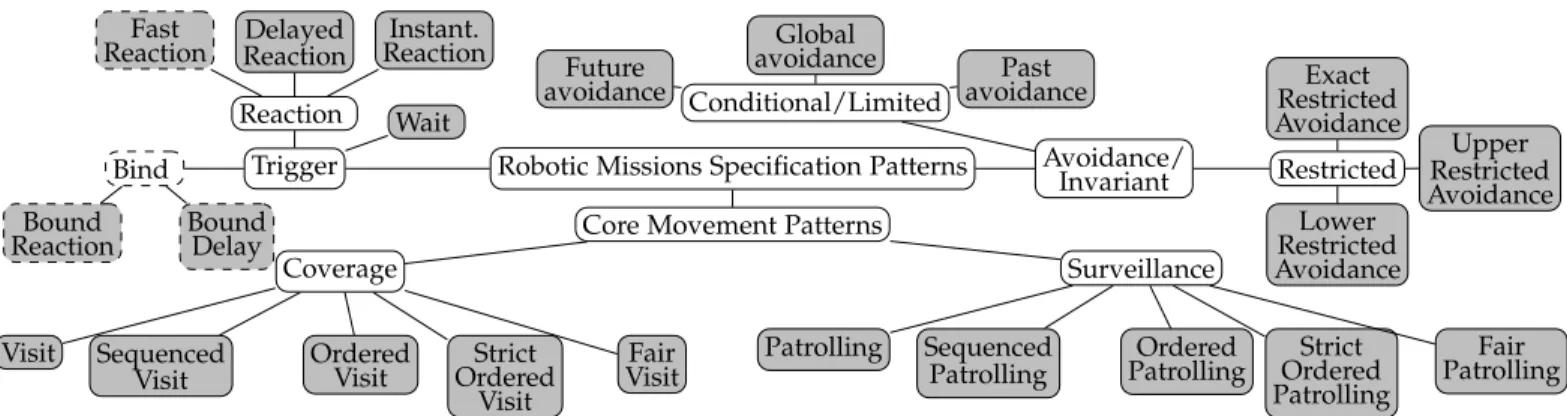
Robotic Missions Specification Patterns Avoidance/Invariant Conditional/Limited Past avoidance Global avoidance Future avoidance Restricted Lower Restricted Avoidance Exact Restricted Avoidance Upper Restricted Avoidance Trigger Wait Reaction Instant. Reaction Delayed Reaction Fast Reaction Bind Bound
Reaction BoundDelay Core Movement Patterns Coverage
Visit Sequenced
Visit OrderedVisit OrderedStrict Visit Fair Visit Surveillance Patrolling Sequenced Patrolling Ordered
Patrolling OrderedStrict Patrolling
Fair Patrolling
Figure 1. Mission specification pattern catalog. Filled nodes: patterns, non-filled nodes: categories.
Identification of Mission Specification Problems. We identified mission specification problems as follows2.
• (STEP.1) We divided the collected mission requirements among two of the authors, who labeled them with key-words that capture the mission specification problems they describe. For example, the mission requirement “The robot has to autonomously patrol the site and measure the state of valve levers and dial gauges at four checkpoints in order to decide if some machines need to be shut down” (occuring in Schillinger et al. [73]) was associated with the keywords “patrol,” since the robot has to patrol the site, and “instantaneous reaction,” since when a valve is reached its level must be checked.
• (STEP.2) We created a graph structure representing semantic relations between keywords. Each keyword is associated with a node of the graph structure. Two nodes were connected if their keywords identify two similar mission specification problems. For example, the keywords “visit” and “reach” are related since in both cases the robot has to visit/reach a location.
• (STEP.3) Since our interest was not a mere classification of actions and movements that are executed by a robots, but rather detecting mission specification problems that concern how actions and movements are executed by a robot behavior over time, nodes that contain keywords that only refer to actions are removed (e.g., balance).
• (STEP.4) Nodes that were connected through edges and contained keywords that identify to the same mission specification problem, e.g., visit and reach, were merged.
• (STEP.5) We hierarchically organized the mission speci-fication problems into a catalog represented through a tree structure that facilitates browsing among mission specification problems.
Pattern Formulation.We formulated patterns by follow-ing established practices in the literature [44], [49], [51]. A pattern is characterized by
• (i) a name;
• (ii) a statement that captures the pattern intent (i.e., the
mission requirement);
• (iii) a template instance of the mission specification in LTL and CTL;
• (iv) variations describing possible minor changes that can be applied to the pattern;
2. For technical details on this methodology see [66].
• (v) examples of known uses;
• (vi) relationships of the pattern to others and;
• (vii) occurrences of the pattern in literature.
For each LTL pattern we also designed a B ¨uchi Automa-ton (BA) that unambiguously describes the behaviors of the system allowed by the mission specification. The mission specification was designed by consulting specifications en-coding requirements already present in the papers surveyed, by crosschecking them, and consulting specification patterns already proposed in the software-engineering literature [51]. If the proposed specification was related to (or corresponded with) one of an already existing pattern, we indicated this in the relationships of the pattern to others, meaning that the pattern presented in the literature is also useful to solve the identified mission specification problem.
4
MISSION
SPECIFICATION
PATTERNS
In this section, we present our catalog of mission specification patterns3 and present one of them. Our catalog comprises
22patterns hierarchically organized into a pattern tree as illustrated in Figure 1. Leaves of the tree represent mission specification patterns. Intermediate nodes facilitate browsing within the hierarchy and aid pattern selection and decision making. Patterns identified by following the procedure described in Section 3 are graphically indicated with a solid border. Patterns represented with a dashed border represent new patterns identified during our evaluation, as explained below in Section 7.1.
We provide a high-level description of all patterns iden-tified, examples of application, and the corresponding LTL mission specifications. The interested reader may refer to our online appendix [66], which contains additional examples, occurrences of patterns in the literature, relations among the patterns, and additional CTL mission specifications.
Preliminaries.To aid comprehension of behavior and fa-cilitate precise pattern definitions, we introduce the following notation. Given a finite set of locationsL={l1, l2, . . . , ln} and robots R = {r1, r2, . . . , rn}, P L = {rx in ly | rx ∈
Randly ∈ L} is a set of location propositions, each indicating that a robotrxis in a specific locationlyof the en-vironment. Given a finite set of conditions of the environment
C={c1, c2, . . . , cm}, we indicate asP E={s1, s2, . . . , sm}
3. The pattern catalog in full, accompanied material and tool support is available on our dedicated website: www.roboticpatterns.com
Table 2
Core movement patterns. The symbol%indicates the mathematical operator modulo.
Description Example Formula (l1, l2, . . . are location
proposi-tions)
V
isit Visit a set of locations in an unspeci-fied order. lLocationsl1,l2, andl3must be visited.l1 →l4 →l3 →l1 →
4 → l2 → (l#)ωis an example trace that satisfies the mission requirement. n V i=1 F(li) Sequenced Visit
Visit a set of locations in sequence, one after the other.
Locationsl1,l2,l3must be covered following this sequence. The tracel1 →l4 → l3 →l1 →l4 →l2 → (l#\3)ωviolates the mission sincel3does not followl2. The tracel1 → l3 →l1 →
l2→l4→l3→(l#)ωsatisfies the mission requirement.
F(l1∧ F(l2∧. . .F(ln)))
Order
ed
V
isit
The sequenced visit pattern does not forbid to visit a successor location before its predecessor, but only that after the predecessor is visited the successor is also visited. Ordered visit forbids a successor to be visited before its predecessor.
Locationsl1,l2,l3must be covered following this order. The trace
l1 →l3 →l1→l2→l3 →(l#)ωdoes not satisfy the mission requirement sincel3preceedsl2. The tracel1→l4→l1→l2→
l4→l3→(l#)ωsatisfies the mission requirement.
F(l1∧ F(l2∧. . .F(ln))) n−1 V i=1 (¬li+1)Uli Strict Order ed V isit
The ordered visit pattern does not avoid a predecessor location to be visited multiple times before its suc-cessor. Strict ordered visit forbids this behavior.
Locationsl1,l2,l3must be covered following the strict orderl1,l2,
l3. The tracel1 →l4→l1→l2→l4→l3 →(l#)ωdoes not satisfy the mission requirement sincel1occurs twice beforel2. The tracel1 → l4 →l2 →l4 → l3 →(l#)ωsatisfies the mission requirement. F(l1∧ F(l2∧. . .F(ln))) n−1 V i=1 (¬li+1)Uli n−1 V i=1 (¬li)U(li∧ X(¬liU(li+1))) Fair Visit
The difference among the number of times locations within a set are visited is at most one.
Locationsl1,l2,l3must be covered in a fair way. The tracel1 →
l4 → l1 → l3 → l1 → l4 → l2 → (l#\{1,2,3})ωdoes not perform a fair visit since it visitsl1three times whilel2andl3are visited once. The tracel1→l4→l3 →l1→l4 →l2→l2 →
l4→(l#\{1,2,3})ωperforms a fair visit since it visits locationsl1,
l2, andl3twice. n V i=1 F(li) n V i=1 G(li→ X((¬li)Wl(i+1)%n)) Patr olling
Keep visiting a set of locations, but not in a particular order. The pa-trolling problem also appears in lit-erature assurveillance.
Locationsl1,l2,l3must be surveilled. The tracel1→l4→l3→
l1 → l4 → l2 → (l2 → l3 → l1)ω ensures that the mission requirement is satisfied. The tracel1 →l2 →l3 →(l1 →l3)ω represents a violation, sincel2is not surveilled.
n V i=1 G F(li) Sequenced Patr olling
Keep visiting a set of locations in sequence, one after the other.
Locationsl1,l2,l3must be patrolled in sequence. The tracel1 →
l4→l3→l1→l4→l2→(l1→l2→l3)ωsatisfies the mission requirement since globally anyl1will be followed byl2andl2byl3. The tracel1→l4→l3→l1→l4→l2→(l1→l3)ωviolates the mission requirement since after visitingl1, the robot does not visitl2. G(F(l1∧ F(l2∧. . .F(ln)))) Order ed Patr olling
Sequence patrolling does not forbid to visit a successor location before its predecessor. Ordered patrolling ensures that (after a successor is visited) the successor is not visited (again) before its predecessor.
Locationsl1,l2, andl3must be patrolled following the orderl1,l2, andl3. The tracel1→l4→l3→l1→l4→l2→(l1→l2→
l3)ωviolates the mission requirement sincel3precedesl2. The trace
l1→l1→l2→l4→l4→l3→(l1→l2→l3)ωsatisfies the mission requirement G(F(l1∧ F(l2∧. . .F(ln)))) n−1 V i=1 (¬li+1)Uli n V i=1 G(l(i+1)%n→ X((¬l(i+1)%n)Uli)) Strict Order ed Patr olling
The ordered patrolling pattern does not avoid a predecessor location to be visited multiple times before its successor. Strict Ordered Patrolling ensures that, after a predecessor is visited, it is not visited again before its successor.
Locationsl1,l2,l3must be patrolled following the strict orderl1,
l2, andl3. The tracel1→l4→l1→l2 →l4 →l3 →(l1 →
l2→l3)ωviolates the mission requirement sincel1is visited twice beforel2. The tracel1→l4→l2→l4→l3→(l1→l2→l3)ω satisfies the mission requirement.
G(F(l1∧ F(l2∧. . .F(ln)))) n−1 V i=1 (¬li+1)Uli n V i=1 G(l(i+1)%n→ X((¬l(i+1)%n)Uli)) n−1 V i=1 G((li)→ X(¬liU(l(i+1)%n))) Fair Patr olling
Keep visiting a set of locations and ensure that the difference among the number of times locations within a set are visited is at most one.
Locationsl1,l2, andl3must be fair patrolled. The tracel1→l4→
l3 → l1 → l4 → l2 → (l1 → l2 → l1 →l3)ωviolates the mission requirements since the robot patrolsl1more thanl2andl3. The tracel1 →l4 →l3→l4 →l2 →l4→(l1 →l2→l3)ω satisfies the mission requirement since locationsl1,l2, andl3are patrolled fairly. n V i=1 G(F(li)) n V i=1 G(li→ X((¬li)Wl(i+1)%n))
Table 3 Avoidance patterns.
Description Example Formula
Past avoidance
A condition has been fulfilled in the past.
If the robot enters locationl1, then it should have not visited location
l2before. The tracel3→l4→l1→l2→l4→l3→(l2→l3)ω satisfies the mission requirement since locationl2is not entered before locationl1. (¬(l1))Up, wherel1∈Landp∈M Global avoidance An avoidance condition globally holds throughout the mission.
The robot should avoid entering locationl1. Tracel3→l4→l3→
l2→l4→l3→(l3→l2→l3)ωsatisfies the mission requirement since the robot never entersl1.
G(¬(l1)), wherel1∈L
Future avoidance
After the occurrence of an event, avoidance has to be fulfilled.
If the robot entersl1, then it should avoid enteringl2in the future. The tracel3→l4→l3→l1→l4→l3→(l3→l2→l3)ωdoes not satisfy the mission requirement sincel2is entered afterl1.
G((c)→(G(¬(l1)))), wherec∈Mandl1∈P L Upper Rest. Avoidance A restriction on the maximum number of occurrences is desired.
A robot has to visitl1at most (less than)3times. The tracel1 →
l4 →l1 →l3 →l1 → l4 → l1 → (l3)ωviolates the mission requirement sincel1is visited four times. The tracel4→l3→l1→
l2→l4→(l3)ωsatisfies the mission requirement.
¬ F(l1∧ X(F(l1∧. . .X(F(l1) | {z } n/n+1 )))), where l1 ∈ L Lower Rest. Avoidance A restriction on the minimum number of occurrences is desired.
A robot should enter locationl1at least (more than)3times. The trace
l4→l3→l2→l2→l4→(l3)ωviolates the mission requirement since location1is never entered. The tracel1 →l4→l3 →l1→
l4→l1→(l3)ωsatisfies the mission requirement.
F(l1∧ X(F(l1∧. . .X(F(l1) | {z } n/n+1 )))), wherel1∈L Exact Rest. Avoidance
The number of occur-rences desired is an ex-act number.
A robot must enter locationl1exactly3times. The tracel4→l3→
l2→l2→l4→(l3)ωviolates the mission requirement. The trace
l1 →l4 →l3 → l1 → l4 → l1 →(l3)ωsatisfies the mission requirement since locationl1is entered exactly3times.
(¬(l1))U(l1∧(X((¬l1)U(l1. . .∧(X((¬l1)U(l1 | {z } n ∧(X(G(¬l1)))))))))), wherel1∈L Table 4 Trigger patterns.
Description Example Formula
Inst. Reaction The occurrence of a stimulus instanta-neously triggers a counteraction.
When locationl2 is reached the action a must be executed. The tracel1 → l3 → {l2, a} → {l2, a} → l4 →(l3)ωsatisfies the mission requirement since when locationl2is entered conditionais performed. The tracel1→l3→l2→ {l1, a} →l4→(l3)ωdoes not satisfy the mission requirement since whenl2is reachedais not executed. G(p1→p2), wherep1∈Mandp2∈P L∪P A Delayed Reaction The occurrence of a stimulus triggers a counteraction some time later
Whencoccurs the robot must start moving toward locationl1, and
l1is subsequently finally reached. The tracel1 →l3→ {l2, c} →
l1 → l4 → (l3)ω satisfies the mission requirement, since afterc occurs the robot starts moving toward locationl1, and locationl1is finally reached. The tracel1 →l1 → {l2, c} →l3→(l3)ωdoes not satisfy the mission requirement sincecoccurs when the robot is inl2, andl1is not finally reached.
G(p1 → F(p2)), wherep1∈Mandp2 ∈P L∪ P A Prompt Reaction The occurrence of a stimulus triggers a counteraction promptly, i.e. in the next time instant.
Ifcoccursl1is reached in the next time instant. The tracel1→l3→ {l2, c} →l1→l4→(l3)ωsatisfies the mission requirement, since aftercoccursl1is reached within the next time instant. The trace
l1→l3→ {l2, c} →l4→l1→(l3)ωdoes not satisfy the mission requirement. G(p1 → X(p2)), wherep1∈M andp2 ∈P L∪ P A Bound Reaction A counteraction must be performed every time and only when a specific location is en-tered.
Actiona1is bound though a delay to locationl1. The tracel1 →
l3 → {l2, c} → {l1, a1} →l4→ {l1, a1} →(l3)ωsatisfies the mission requirement. The tracel1 →l3 → {l2, c} → {l1, a1} → {l4, a1} → {l1, a1} →(l3)ωdoes not satisfy the mission require-ment sincea1is executed in locationl4.
G(p1↔p2), wherep1∈Mandp2∈P L∪P A
Bound Delay
A counteraction must be performed, in the next time instant, ev-ery time and only when a specific loca-tion is entered.
Actiona1is bound to locationl1. The tracel1→l3→ {l2, c} → {l1} → {l4,11} → {l1} → {l4, a1} →(l3)ωsatisfies the mission requirement. The tracel1→l3 → {l2, c} → {l1} → {l4,11} → {l1, a1} → {l4} →(l3)ωdoes not satisfy the mission requirement.
G(p1 ↔ X(p2)), wherep1∈M andp2 ∈P L∪
P A
Wait Inaction is desired till a stimulus occurs.
The robot remains in locationl1until conditioncis satisfied. The tracel1 →l3 → {l2, c} →l1→l4→(l3)ωviolates the mission requirement since the robot leftl1before conditioncis satisfied. The tracel1→ {l1, c} →l2→l1→l4→(l3)ωsatisfies the mission requirement.
Name:Strict Ordered Patrolling
Intent: A robot must patrol a set of locations following a strict sequence ordering. Such locations can be, e.g., areas in a building to be surveyed.
Template: The following formula encodes the mission in LTL fornlocations and a robotr(% is the modulo arithmetic operator):
n V i=1 G(F(l1∧ F(l2∧...F(ln)))) n−1 V i=1 ((¬li+1) U li) n V i=1 G(l(i+1)%n→ X((¬l(i+1)%n)U li))
Example with two locations.
G(F(l1∧ F(l2)))∧((¬l2) U l1)∧ G(l2→ X((¬l2) U l1))∧ G(l1→ X((¬l1) U l2))
wherel1andl2are expressions that indicate that a robotris in locationsl1andl2, respectively.
Variations: A developer may want to allow traces in which sequences ofconsecutivel1(l2) are allowed, that is strict ordering is applied on
sequences of non consecutivel1(l2). In this case, traces in the forml1→(→l1→l1→l3→l2)ωare admitted, while traces in the form
l1→(→l1→l3→l1→l2)ωare not admitted. This variation can be encoded using the following specification:
G(F(l1∧ F(l2)))∧((¬l2)U l1)∧ G((l2∧ X(¬l2))→ X((¬l2) U l1))∧ G((l1∧ X(¬l1))→ X((¬l1)U l2))
This specification allows for sequences of consecutivel1(l2) since the left side of the implicationl1∧ X(¬l1)(l2∧ X(¬l2)) is only triggered
whenl1(l2) is exited.
Examples and Known Uses: A common usage example of the Strict Ordered Patrolling pattern is a scenario where a robot is performing surveillance in a building during night hours. Strict Sequence Patrolling and Avoidance often go together. Avoidance patterns are used to force robots to avoid obstacles as they guard a location. Triggers can also be used in combination with the Strict Sequence Patrolling pattern to specify conditions upon which Patrolling should start or stop.
Relationships: The Strict Ordered Patrolling pattern is a specialisation of the Ordered Patrolling pattern, forcing the strict ordering. Occurrences: Smith et. al. [74] proposed a mission specification forcing a robot to not visit a location twice in a row before a target location is reached.
Figure 2. The pattern Strict Ordered Patrolling. The catalog in full can be found in the online appendix [66].
a set of environment propositions such that si ∈ P E is true if and only if conditionciholds. Given a finite set of actions A = {a1, a2, . . . , am}that the robots can perform, we indicate as P A = {rx exec ay | rx ∈ Randay ∈ A} a set of action propositions such that rx exec ay is true if and only if action ay is performed by robot rx. We define the set of propositions M of a robotic application as P L∪P E∪P A. Let Mx, My, Mz ⊆ M, a trace is an infinite sequence Mx → My → Mz. . . indicating that
Mz holds after My, andMy holds afterMx. For example,
{r1 in l1} → {r1 in l2, c1} → {c2, r2 exec a1}. . . is a trace where the element in position1of the trace indicates that the robot r1 is in location l1, then the element in position2 indicates that the robotr1 is in locationl2 and conditionc1holds (indicating, for example, that an obstacle is detected), and then the element in position 3 indicates that condition c2 holds and robot r2 is executing action
a1. In the following, with a slight abuse of notation, when a set is a singleton we will omit brackets. We use the notation (Mx → . . . → My)ω, where Mx, . . . , My ⊆ M, to indicate a sequence Mx → . . . → My that occurs infinitely. We use the notationl#to indicate any location, e.g.,
r1in l1→r1in l#→r1in l2indicates that a robotr1visits locationl1, afterwards any location, and then locationl2. We use the notationl#\K, whereK⊂M, to indicate any possi-ble location not inK, e.g.,r1in l1→r1in l#\{l3}→r1in l2 indicates thatr1visitsl1, then any location exceptl3is visited, and finallyl2.
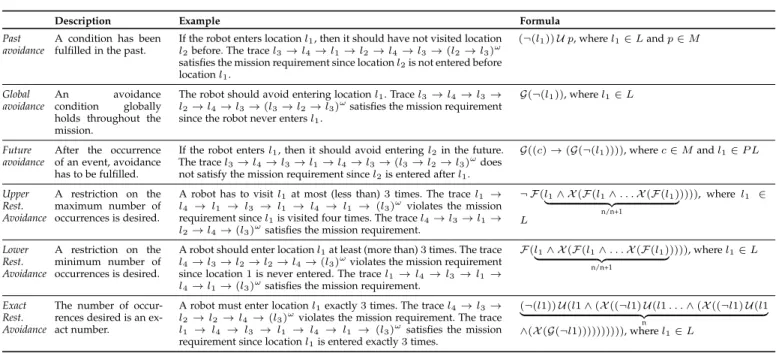
Patterns.Patterns are organized in three main groups – core movement (Table 2), triggers (Table 3), and avoidance (Table 4), explained in the following. For simplicity, in Tables 2 and 3, we assume that a single robot is considered during the mission specification and we use the notationlx as shortcut forr1in lx. The presented examples assume that the environment is made of four locations, namelyl1,l2,l3, andl4.
• Core movement patterns. How robots should move within
an environment can be divided in two major categories representing locations’ coverage and locations’ surveil-lance. Coverage patterns require a robot to reach a set of locations of the environment. Surveillance patterns require a robot tokeepreaching a set of locations of the environment.
• Avoidance patterns. Robot movements may be
con-strained in order to avoid occurrence of some behavior (Table 3). Avoidance may reflect a condition, possibly over the occurrence of some event.Conditional avoidance generally holds globally (i.e., for the entire behavior) and applies when avoidance of locations or obstacles is sought that depends on some condition. For example, a cleaning robot may avoid visiting locations that have been already cleaned. In therestricted avoidance case, avoidance does not hold globally but accounts for a number of occurrences of an avoidance case. Depending on the number of occurrences being a maximum, min-imum or exact number,upper,exactorlowerrestricted avoidance is yielded. For example, a cleaning robot may avoid cleaning a room more than three times.
• Trigger patterns.Trigger patterns express a robot reactive behaviour based on stimuli, or robot’s inaction until a stimulus occurs as described in Table 4.
As an example, the definition of the Strict Ordered Patrollingmission specification pattern is presented in Fig-ure 2. The patterns in detail are available in our online appendix [66]. Note that the logic formulation is generic on purpose to allow specifications where a robot can be simulta-neously in an area and in one of its sub-areas. An additional logical constraint can be added to disallow these behaviors. For example, the constraint G(¬((r1 in l1)∧(r2 in l2))) disallows the robotr1 to be simultaneously in locationsl1 andl2. Defining such constraints is an orthogonal concern.
5
SPECIFICATION
PATTERN
TOOL
SUPPORT
We now present PsALM [69]4, a tool that supports developers in designing mission requirements through the proposed pat-terns and the automatic generation of mission specifications. PsALM allows creating complex mission requirements by composing patterns with simple operators and transforming mission requirements (i.e., composed patterns) into mission specifications in LTL or CTL.
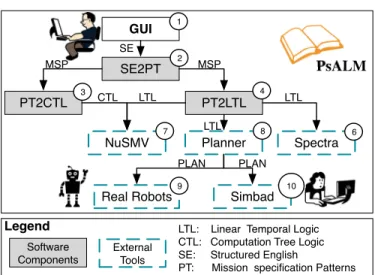
Figure 3 illustrates the components of PsALM. Its GUI
1 allows defining robotic missions requirements through a structured English grammar, which uses patterns as basic building blocks and AND and OR logic operators to compose these patterns. The structured English grammar is provided in our online appendix [66]. TheSE2PTcomponent extracts from a mission requirement the set of patterns that are composed through the AND and OR operators 2 . The PT2LTL 3 and PT2CTL 4 components automatically
generate LTL and CTL specifications from these patterns. The produced LTL specifications can be used in different ways; three possible usages are presented in Figure 3. The LTL formulae are (i) fed into an existing planner and used to generate plans that satisfy the mission specification 5 ; (ii) converted into Deterministic B ¨uchi automata used as input to the widely used Spectra [63] robotic application modeling tool 6 ; or (iii) converted into the NuSMV [64] input language to be used as input for model checking 7 . The plans produced using the planner are (i) used as inputs by Simbad [65] 10, an autonomous robot simulation package for education and research; and (ii) performed by actual real robots 9 , as also illustrated in the following sections. The produced CTL specifications are also converted to the NuSMV [64] input language to be used as input for model checking 7 .
To use our pattern-based mission specification and the PsALM prototype tool in practice (as exemplified in Figure 4), a robotics engineer follows four distinct steps:
1) The pattern catalog is consulted and behavior intents relevant to the mission at hand are selected [66]. This step is essential to establish common vocabulary, utilize the unambiguous patterns notation, and provide a precise description of what robots should do in terms of movements and actions during run-time.
2) The mission is defined using an appropriate GUI that allows using patterns as basic building blocks and composing them through a structured English grammar (Figure 4a).
3) Automatically generated CTL or LTL specifications are customized if necessary.
4) Analysis, planning or simulation facilities are invoked through interfacing with NuSMV [64], Spectra [63], Simbad [65] (Figure 4b), or sent to robots for execution (Figure 4c) through LTL planning.
A video showing how PsALM can be used in practice is also made available on a dedicated website [75].
6
CORRECTNESS OF THE PATTERNS
We now describe the procedure we used to validate the correctness of our patterns. This procedure can be considered
4. The tool is available at github.com/claudiomenghi/PsAlM
PT2CTL PsALM GUI SE2PT PT2LTL Spectra Planner NuSMV Simbad LTL LTL LTL CTL MSP SE MSP Real Robots 10 PLAN PLAN Software Components External Tools
LTL: Linear Temporal Logic CTL: Computation Tree Logic SE: Structured English
PT: Mission specification Patterns
Legend 1 2 3 4 6 7 8 9
Figure 3. Main components of the PsALM specification tool [69].
a contribution per se since it can be used in validating future patterns be proposed by the research community. The procedure has two phases: (i) testing the compliance between the English formulation and the logical specification of the patterns (Section 6.1) and (ii) testing for errors in the logical specification (Section 6.2).
6.1 Compliance Testing
We tested the compliance between the English formulation and the target mission specifications (LTL and CTL) as follows. We considered the English formulation and defined an alternative set of specifications into a language that is different from (but comparable to) the one used to express the target mission specifications. We then compared the specifications. If the alternative and the target mission specifications are not equivalent, an error must be present either in the alternative or in the target specification. If the two formulations are equivalent there is no guarantee that the specification is correct, as it might be the case that both the specifications do not represent the intended mission requirement. A further check that we performed to avoid this case is explained in Section 6.2.
For LTL specifications we proceeded as follows:
• (STEP.A1) We considered a pattern’s English description and wrote aω-regular expression [5], which encodes all (and only) the behaviors of the system that are admitted by the specification;
• (STEP.A2) We converted the LTL specification into a B ¨uchi automaton (BA), which was subsequently con-verted into aω-regular expression;
• (STEP.A3) We checked the equivalence among theω -regular expressions.
We performed those steps using SPOT [76]. The testing activity did not reveal any non-compliance between the English formulation and the logical specification of the patterns, i.e., all theω-regular expressions were equivalent.
While a similar procedure can also be applied in the case of the CTL specifications, e.g., by considering a restriction of First Order Logic, in our case this check was not necessary since the CTL mission specifications correspond with the LTL specifications where all the temporal operators are scoped
(a) Pattern-based mission specification.
(b) Mission verification and simulation.
(c) Execution on robots. Figure 4. Specification of dependable robotic missions with PsALM [69].
with the branch quantifier “for all” (∀). Since, given a CTL formula, if there exists an equivalent LTL formula, it can be obtained by dropping all the branch quantifiers [5], the CTL formulation is compliant with the LTL specification.
The steps previously described can be used to check compliance among English formulations and mission specifi-cations in future pattern catalogs proposed by the research community.
6.2 Checking for Errors through Testing
We performed a further experiment to check whether for some patterns we had formulated two equivalent speci-fications, but both of them do not represent the mission requirement. This has been performed through testing. We randomly created scenarios and assigned to a robot a mission obtained by combining a set of patterns. We synthesized a plan for the robot and observed the robot performing the plans. We checked whether the robot was executing the plans according to the mission requirement described by the patterns. This has been performed through the following steps:
• (STEP.B1) Scenarios were randomly defined over a map. Testing by exploiting a set of randomly generated models is a widespread technique to evaluate artifacts in both software [77], [78], [79] and robotic engineering communities [80], [81], [82], [83], [84].
• (STEP.B2) To test the LTL specifications, randomly gen-erated mission requirements were created by combining a core movement, a trigger, and an avoidance pattern, and by ensuring that each pattern in our catalog is used for at least one requirement. Then, (a) the corresponding LTL specification was negated; (b) the specification and the model of the scenario was encoded in a model checker; and (c) the model checker was used to check whether the models contained a path that satisfied the mission specification (i.e., violates its negation). If a path was present, a simulator was used to execute the
produced plan. Subsequently, we checked whether the plan execution was correct with respect to the intent of the mission specification patterns: when we expected a plan to not be present in the given model, the model checker was not able to compute it, and, when a plan was expected to be present, it was computed by the model checker. Finally, we simulated the generated plans by using the Simbad robot simulator and checked whether the robots achieve their mission requirements.
• (STEP.B3) To build confidence that errors do not ex-ist in the CTL specification with respect to the LTL ones, an extra testing activity was performed. The comparison among the LTL versus the CTL expressions was performed since given a CTL formulaφ, and an LTL formula ψ obtained by eliminating all the path quantifiers fromφ, either the two formula are equivalent (i.e., φ ≡ ψ) or it does not exist any LTL formula that is equivalent to φ [5]. Our testing activity aims at determining whether CTL and LTL formulation are not equivalent. The same models considered in step (STEP.B2) were used and LTL and CTL specifications were generated for the considered mission requirements. The LTL and CTL specifications, as well as the model of the scenario, were considered and a model checker was used to check whether the verification of the specifications returned the same results, i.e., if the LTL specification was satisfied, also the CTL specification was satisfied (and viceversa).
While the proposed process can be reused in future works, the random generation procedure for creating test cases is problem-specific and must be defined on a per-domain basis. In the following, we describe the results of executing the process described above.
• (STEP.B1) We generated12scenarios representing floor plan structures containing16locations, where a robot is deployed. We synthesized plans to be executed by robots from combinations of mission specification patterns
Table 5
Results of the verification procedure for checking presence of errors. For step B2 columns contain the number of times a plan is found (>) and not found (⊥). For step B3 and B30columns contain the number of times the
mission requirement is satisfied (>) and violated (⊥).
B2 B3 B30 Mission Requirement > ⊥ > ⊥ > ⊥ OrdPatrol,UpperRestAvoid,Wait 2 10 1 11 1 11 FairVisit,ExactRestAvoid∗,DelReact 5 7 0 12 4 8 StrOrdVisit,GlobalAvoid,InstReact 3 9 1 11 1 11 SeqVisit,FutAvoid,BindDel∗ 1 11 0 12 2 10 OrdVisit,PastAvoid,InstReact 3 9 1 11 1 11 Visit,LowRestAvoid,BindReact 3 9 1 11 1 11 StrictOrdPatrol,FutAvoid,Wait 1 11 1 11 1 11 Patrol,LowRestAvoid,InstReact 3 9 1 11 1 11 FairPatrol,ExactRestAvoid∗,DelReact 3 9 0 12 4 8 SeqPatrol,UpperRestAvoid,FastReact∗ 1 11 0 12 2 10
and checked whether the plan execution is correct with respect to patterns’ intent. The plan has been generated by allocating 12 traversable locations and
4 locations that cannot be crossed, on a4×4 matrix. The identifiersl0, l1, . . . , l11are randomly assigned to the traversable locations. In6 of the12scenarios, the robot can move among adjacent cells that are traversable, while it cannot move within not crossable locations. In the other6scenarios, the robot can cross adjacent cells from a cell with coordinates[i, j]to a traversable one of
[i, j+ 1 modj](and similarly to thejaxis). Conditions and actions specify whether a box is present in a location (condin the following), and the capability of the robot in changing its color (actin the following). We randomly selected4 traversable locations in whichcond is true and4locations in whichactcan be performed, that is the robot can wrap around to the other side of the grid.
• (STEP.B2) In total we generated10mission requirements (Table 5). Core movement patterns are parametrized with locations l1, l2. The patterns upper, exact, and lower restricted avoidance are parametrized by forcing the robot to visit locationl3, at most, exactly, and at least2times, respectively. The pattern global avoidance forces the robot to not visitl3, while the future and past avoidance force the robot to not visitl3after and before conditioncondis satisfied, i.e., a room that contains a box is visited. The wait pattern forces the robot to wait in locationl4if a box is not present. The other trigger patterns are parametrized with the actionactthat must be executed by the robot in relation with the occurrence of conditioncond.
To test the LTL specifications, we followed the indi-cations provided in (STEP.B2) and made use of the NuSMV [64] model checker and of Simbad [65] to simulate the robot executing the plan.
We did not find any error in the proposed LTL specifi-cations. The column labeled ExpV1 in Table 5 marked with>(respectively⊥) contains the number of cases in which a plan was (was not) present.
• (STEP.B3) We used the NuSMV [64] model checker: Table 5’s column B3 contains the number of cases in which the mission requirement was satisfied (>) and not satisfied (⊥). Mission requirements were generally not satisfied, since to be satisfied they have to hold
Table 6
Coverage of the proposed mission requirements. Lines contain the total number of mission requirements (MR), the number of not expressible
(NE) and ambiguous (A) mission requirements and the number of requirements that lead to a consensus (C) and no consensus (NC).
Columns labeled with Spectra and MP contain the number of requirements extracted from LTLMoP.
Spectra 1 2 3 4 5 6 7 8 9 10 11 MP Total MR 29 2 22 5 1 159 4 32 47 53 74 8 436 NE 3 0 0 0 0 47 0 0 7 1 8 0 66 A 3 0 2 1 0 35 0 10 12 32 7 0 102 C 13 0 11 2 1 29 4 8 11 8 20 5 112 NC 10 2 9 2 0 48 0 14 17 12 39 3 156
on all the paths of the models. The testing activity did not reveal any error as NuSMV always returned the same results for LTL and CTL specifications. Since in several cases the mission requirement was always not satisfied, and we also wanted to test cases in which the mission requirement was satisfied, we relaxed the mission requirements, by removing the patterns marked with the∗symbol in Table 5. Table 5’s column B30shows that by relaxing the mission requirements there were cases in which the mission requirements were actually satisfied. Also in these cases the testing activity did not reveal any error in the LTL and CTL specifications as NuSMV always returned the same results.
7
EVALUATION
We evaluated howeffectiveour pattern catalog is in capturing mission requirements and producing mission specifications. We investigated three questions:
• RQ1: To what extent are real-world, natural-language mission requirements expressible using our pattern catalog? (Section 7.1)
• RQ2: To what extent are real-world mission
specifica-tions expressible using our pattern catalog? (Section 7.2)
• RQ3: Does the pattern catalogue support the formula-tion of mission requirements and specificaformula-tions in a set of real-world scenarios defined in collaboration with our industrial partners? (Section 7.3)
To cover both aspects and to answer the question above, we performed three experiments.
7.1 Formulation of Mission Requirements (RQ1)
We collected mission requirements in natural language from available requirements produced from Spectra [63] and LTLMoP [31], [36]. Spectra is a tool that supports the design of robotic applications. LTLMoP is a software package assisting in the development, implementation, and testing of robot controllers. We checked how the pattern catalog may have supported developers in the definition of the mission requirements.
In the case of Spectra, we extracted 428 mission require-ments from Spectra files of 11 robotic applications. Note that these mission requirements are realistic, since they were defined for and executed with real robots. Videos are available online [85]. The number of mission requirements
Table 7
Number of occurrences of each pattern in the formulation of mission requirements.
Pattern Occ Pattern Occ Pattern Occ Pattern Occ Visit 25 SeqVisit 1 OrdVisit 1 InstReact 127 PastAvoid 60 DelReact 50 Wait 3 FutAvoid 48 StrictOrdPat 1 GlobAvoid 25 ExactRest 1
(MR) per robotic application is reported in Table 6. In the case of LTLMoP, 8 requirements were extracted from the corresponding research papers [31], [36] (Table 6 MP column). Each mission requirement was independently analyzed by two of the authors. The authors checked whether it is possible to express the mission requirement using the mission specification patterns. If one the authors stated that the requirement is not expressible, it is marked as not expressible (NE). The number of not expressible mission requirements is presented in Table 6 in the row NE. If at least one of the authors found the mission requirement is ambiguous the author marked it with the flagA. Otherwise, the mission requirement is labeled with the mission specifica-tion patterns needed to express the mission requirement. Then, the mission specification patterns used to express the mission requirement are considered. If the authors used the same mission specification patterns to express the mission requirement, a consensus is reached. The number of mission requirements that leads to consensus (respectively no consensus) is indicated in the row labeled C (respectively NC). The number of occurrences of each pattern is indicated in Table 7.
The results show that most of the mission requirements (370of436, i.e.,≈84%) were expressible using the pattern catalog, which we consider a reasonable coverage for a pattern catalog. The66mission requirements that are not covered suggested the introduction of new patterns identified in Figure 1 with a dashed border. It also shows that the pattern catalog is effective in real scenarios.
102 mission requirements were ambiguous, meaning that different interpretations can be given to the proposed mission requirement. For these requirements, alternative combinations of patterns have been proposed by the au-thors to express the mission requirement. Each of these alternatives represents a possible way of expressing it in a non-ambiguous manner. For 156 mission requirements, while the authors judged that the requirement was not ambiguous, different pattern combinations were proposed. The combinations of patterns encode possible ways of expressing the mission requirement in a non-ambiguous manner.
7.2 Formulation of Mission Specifications (RQ2)
We analyzed the mission specifications contained in the Spectra examples collected for answering RQ1 . We collected
1216distinct LTL mission specifications and we analyzed each of these specifications.5 We verified whether it is possible to obtain the mission specifications starting from the proposed patterns, by performing the following steps.
5. This number differs from the one of RQ1, since some specifications were not related with a mission requirement in natural language.
• (STEP.1) For each property we automatically checked whether it was an instance of a mission specification pattern or a simple combination of mission specification patterns through a script that matches pattern occur-rences within mission specifications. Results are shown in Table 8. Among1216mission specifications424were obtainable from the proposed patterns.
• (STEP.2) We considered the mission specifications that did not match any of the proposed patterns.127 of these mission specifications are simple statements on the initial state of the system (no temporal operator is used) and, thus, did not match any of the proposed patterns.
442mission specifications concern properties that refer to variation of the trigger patterns, that we have added to the pattern catalogue.224mission specifications still did not match any of the proposed patterns. After analysis,
155among them were expressed using past temporal op-erators6, which are not used in the mission specifications proposed in this work. In Step 3 we checked whether these specifications might be reformulated without the past operators.69of these mission specifications, while they could be rewritten using the proposed patterns, they are written as complex LTL formulae and thus they do not match any of our patterns or combination of them. As these specifications did not “directly” match any of our patterns (or combinations of them), we did not consider them as covered.
• (STEP.3) We considered the155mission specifications ex-pressed using past temporal operators and we designed mission specifications for them. We found that129of the proposed LTL formulae match one of the proposed patterns, while26are complex LTL formulae that did not match any combination of the patterns. Thus, the final coverage of the proposed pattern catalog is92%. We then analyzed 13mission specifications expressed in the form of LTL properties and 22 PCTL properties considered by Ruchkin et al. [67]. The PCTL properties wrap an LTL formula into a CTL formula which is scoped with the probabilistic operator (P). To check for the pattern presence we transform PCTL formulae into CTL by replacing the probabilistic operator (P) with the universal quantifier (∀) and by scoping temporal operators of the LTL formulae with the universal quantifier. Removing the probabilistic operator in front of the PCTL formula generated an approximation of the original formula. Scoping the LTL formulae with the universal quantifier was allowed as the analyzed formulae belong to the intersection among LTL and CTL7. Given the small number of LTL and CTL mission specifications we manually checked the presence of patterns in the formulae (Step 1 in Table 8). The results reported in the Table 8 (Columns labeled with [67]) show that 2 among these specifications did not match any pattern. The results show that the pattern system was able to generate almost all mission specifications (1154of1251, i.e.,≈92%).
6. The LTL formulae can be formulated using the future or past operators. We used future operators as commonly done and dictated by reuse of robotic components (e.g., planners), needed for the real robots of BOSCH/PAL Robotics. Formulations using past operators can be obtained using LTL formulae equivalence.
Table 8
Pattern occurrence in the formulation of mission specifications for the considered mission specifications.
LTL CTL Pattern Spectra [67] [67] Step 1 Instantaneous reaction 318 0 0 Visit 52 0 0 Patrolling 0 1 0
Strict Ordered Visit 0 9 18
Wait 0 1 2
Avoidance/Invariant 21 0 0
Visit and Instantaneous reaction 18 0 0 Strict Ordered Visit and Global Avoidance 0 0 1 Reaction chain (chain of instantaneous reactions) 15 0 0
Non matching 792 1 1 Step 2 Init 127 - -Fast reaction 379 - -Bound reaction 36 - -Bound delay 27 -
-Non matching for past 155 -
-Actual non matching 69 -
-Step
3 Fast reaction 103 -
-Bound delay 26 -
-Actual non matching 26 -
-7.3 Usage in Real-World Robotic Scenarios (RQ3)
We checked how the pattern catalog supports the formulation of mission requirements and the generation of mission specifications in real-world robotic scenarios. To this end, we defined five scenarios (Table 9) in collaboration with our industrial partners BOSCH and PAL Robotics.
The pattern catalog supported the formulation of mission requirements using the patterns listed in Table 9 for the different scenarios. In all the scenarios, PsALM allowed the automatic creation of LTL mission specifications from the mission requirements. The mission specifications were then executed by the robots by relying on existing planners (see Figure 3). In our case, we used an existing planner developed by Meng and Dimarogonas [3] as this was a requirement of the Co4Robots project [4] which was funding part of this work. However, the proposed patters are agnostic with respect to the LTL planner that is used to synthesize plans. Videos of the robots performing the described missions are available in our dedicated website [66]. The pattern catalog effectively supported the creation of mission requirements and specifications in realistic, industry-sourced scenarios.
8
REFLECTION
The pattern catalog is effective in supporting developers in defining mission requirements and in generating mission specifications. Sections 7.1 and 7.3 show that the pattern catalog effectively supports the definition of mission require-ments and that helps in reducing ambiguities in available mission requirements. Sections 7.2 and 7.3 show that the pattern catalog effectively supports the generation of mission specifications. Section 7.3 shows how the pattern catalog can be used to generate precise, unambiguous, and formal mission specifications in industry-sourced scenarios.
Methodology. The number of mission requirements an-alyzed is in line with other approaches in the field [44], [49], [50], [51], [52]. These requirements usually come from exemplar scenarios used to provide evaluation about effec-tiveness of research-intensive works. As such, we believe
that the scope of the pattern system is quite wide. Our study is certainly not exhaustive, as (i) formal specification in robotic application spreads, and (ii) the types of mission specifications change over time. As shown in the evaluation, patterns will grow over time as specifications that do not belong to the catalog emerge.
Patterns. While the presented patterns are mainly con-ceived to address needs of robotic mission specification, they are more generic and can be applied when the need is to specify some “ordering” among events or action execution. Rather than requiring robots reaching a set of locations, coverage and surveillance patterns may also include propositions that refer to generic events. In this sense, the proposed patterns can be considered as an extension of the property specification patterns [44], [89] that explicitly address different ordering among the occurrence of a set of events. While in this paper we proposed a direct encoding in LTL and CTL, they may also be expressed in terms of standard property specification patterns. The instantaneous reaction pattern may be obtained from the response pattern scoped with the global operator. The precedence chain and the response chains patterns [44], [89] (that illustrate the 2 cause-1 effect and 1 cause-2 effects chain), can be composed with the precedence and response patterns [44], [89] to specify different ordering among a set of events.
Evaluation.The Spectra tool only supports specifications captured by the GR(1) LTL fragment used to describe three types of guarantees: initial, safety, and liveness. Initial guarantees constraint the initial states of the environment. Safety guarantees start with the temporal operatorG and constraint the current and next state. Liveness guarantees start with the temporal operatorsG Fand may not include the X operator. These constraints justify the prevalence of patterns presented in Tables 7, 8, and 5. While the proposed patterns can be expressed using deterministic B ¨uchi automata, which can be translated into GR(1) formulae [29], a manual encoding of the proposed patterns in GR(1) is complex and error prone. This is confirmed by the fact that analysis on the standard property specification patterns that can be expressed in GR(1), and an automatic procedure to map these patterns on formulae that are in the GR(1) fragment has been recently conducted [29]. The BA generated from the LTL formulations associated with the patterns proposed in this work are deterministic, and thus can be used as assumptions or guarantees of the GR(1) formula [1], [2]. Thus, the automatic procedure presented in by Maoz et al. [29] can be integrated in PsALM to generate Spectra formulae.
9
RELATED WORK
Temporal logic specification patterns are a well-known solu-tion to support developers in requirement specificasolu-tion [44], [49], [50], [51], [90], [91], [92]. Foundational work by Dwyer et al. [44] has been extended by Konrad and Cheng [50] to express real-time properties, by Grunske [49] to address real time and probabilistic properties, and Autili et al. [51] that proposed a comprehensive catalog. Further use, refinement, and extensions were developed, for events [90] or automata-based specification [91], [92]. Property specification patterns use in specific domains has been investigated in the literature,
![Figure 4. Specification of dependable robotic missions with PsALM [69].](https://thumb-us.123doks.com/thumbv2/123dok_us/11083598.2995029/9.918.88.645.75.386/figure-specification-dependable-robotic-missions-psalm.webp)
