Working Paper Number 125
Insurance for the Poor?
Stefan Dercon, Tessa Bold and Cesar Calvo
1*
Abstract
Uninsured risk has substantial welfare costs, not just in the short run, but also in terms of perpetuating poverty. This paper discusses the scope for extending insurance to the poor in LAC countries. It is argued that insurance provision to the poor could play an important role in a comprehensive system of protection against risk, including other ex-ante measures such as promoting credit and savings as insurance, as well as a credible overall ex-post safety net. Insurance provision is best promoted via a partner-agent model, in which a local finance institution with close links to relatively poor communities teams up with an established insurer to deliver low cost, tailored products, and possible products include life, health, property and weather insurance. An essential role of the government would be to promote insurance provision to the poor by a relevant regulatory framework favouring MFIs within a partner-agent setup, and to provide overall credibility to the overall system of social protection. The paper also argues for the involvement of local indigenous risk-sharing and finance institutions as intermediaries to maximise the ability to reach the poor and the overall welfare benefits.
* University of Oxford
Revised July 2004
1
This paper is based on work initially financed by the Inter-American Development Bank and by WIDER, the World Institute of Development Economics Research. I would like to thank Luis Tejerina for insightful comments.
Introduction
Households in developing countries are exposed to high risk, with important welfare consequences. These risks range from individual-specific ones, such as illness, theft or unemployment, to economy-wide risks, such as drought or recession. It has long been acknowledged that these shocks have important implications, not least for the poor, including short-term effects on consumption and nutrition, resulting in calls for and the establishment of safety nets or other social security mechanisms. This paper goes beyond this view by arguing, first, that the costs related to these risks are much higher than a simple consideration of short-term costs, and secondly, that expanding insurance provision for the poor could be an important instrument with substantial long-term welfare benefits. Most importantly, this paper will discuss the scope and problems related to the expansion of insurance mechanisms and products, with a focus on Latin America, starting from a consideration of how risk affects the poor and the ways in which they respond to it. The paper discusses the most promising products, institutional setup and the required regulatory framework to successfully expand insurance for the poor.
In addressing the case for extending insurance to the poor, a number of key questions need to be answered. First, is risk prevalent – and what are these risks? Thinking about the design and promotion of specific insurance products requires a careful understanding of the risks the poor face and their consequences. Recent surveys have highlighted the variety of risks the poor face (Morduch (1995), Townsend (1995), World Bank (2000), Dercon (2002), Fafchamps (2003)). Some of these risks are relatively straightforward to insure – such as funerals, serious health problems, unemployment – contrary to other risks, such as a country-wide recession or crime. Discussing insurance for the poor will also have to acknowledge the shortcomings of an insurance-related approach – and the need for alternative mechanisms to deal with the implications of particular shocks. This paper will argue that there is a need to think in terms of complementarities with other mechanisms to reduce and to cope with risk, including e.g. safety nets in the form of employment schemes or social funds. A related issue, and crucial for Latin America, is that much of the existing literature related to the risks the poor face tends to focus largely on rural settings, mainly in Africa and Asia. Part of the reason is that worldwide, most of the poor live in rural areas and drought or flooding risks are the most commonly studied when considering the impact of risk on the poor. The relatively higher urbanisation rate of Latin America implies that urban risks are crucial for our discussion. Section 1 will take up these issues in more detail.
The poor do not just undergo the high risk in their environment – they actively try to manage risk and cope with its consequences. A study of the strategies to manage and to cope with risk is illuminating both to understand the implications of risk for welfare as well as for the design of policy responses, including insurance. Much work has been done in recent years to study these strategies and to understand their implications – even though more work is definitely needed. These strategies typically involve households trying to shape the risk they face by changing their activity and asset portfolios so that risk is less important. A typical example is diversification of activities, whereby imperfect correlation between the return to activities is exploited to reduce overall exposure to risk. A key implication is typically that mean return is forgone when moving to a less risky portfolio –
effectively increasing or perpetuating poverty in the long run. Other strategies involve risk-coping mechanisms - trying to overcome missing or imperfect credit and insurance markets by entering into ‘self- insurance’ via savings for consumption smoothing, in which assets are accumulated in good years to be depleted in bad years or entering into informal mutual assistance arrangements within families or neighbourhoods. Most evidence suggests nevertheless that risk management and coping is rather imperfect, and shocks result in substantial fluctuations in welfare outcomes, at the same time undermining the asset base of households for future wealth creation, not just in terms of physical and financial assets, but also nutrition and human capital (Morduch (1995), Dercon (2002), Dercon and Hoddinott (2004)). The evidence that risk strategies result in lower long-term incomes, and that shocks undermine significantly the ability to grow out of poverty has important implications for the welfare costs involved in risk. The overall result is not just a welfare loss in terms of fluctuations in welfare levels, but a loss of efficiency in that the poor are induced to use their assets less efficiently than the rich. Theoretical models such as Banerjee and Newman (1993) build on this feature to show that risk may well result in poverty traps – permanent poverty for some from which no escape by their own means is possible even if there is overall growth in the rest of the economy. The implication is also that there is no trade-off between equity and efficiency when measures are taken to avoid some to get trapped. In other words, there is a case to provide insurance at subsidised rates to avoid some to slip into poverty. Section 2 will further expand on this point.
While there is scope for public policy and intervention in the realm of providing solace from risk – even in the form of subsidies – this does not necessarily settle the issue about the appropriate form of these interventions. Indeed, it still would need to be shown that insurance is the right solution. In section 3 the case for strengthening insurance and insurance-substitutes will be made, but with an acknowledgement that insurance products can be costly and, more importantly, they cannot solve all problems involved for the poor. Alternative (complementary) measures will be discussed as well, not least in response to realisation that some economy-wide shocks or social and political risks usually cannot be insured by insurance markets or at least that alternative measures may be more cost-effective. Still, the scope for insurance products for the poor remains strong.
Section 4 will discuss some general issues of the design of insurance for the poor. A key issue to be considered is that one must ensure that the poor are effectively reached. This suggests the need to involve local and grass-root organisations that have established links with the poor. Equally important is that the system can provide a cost-effective service and be sustainable. Insurance provision is a specialist service, and should involve private and possibly public sector institutions with the experience and financial capacity to operate such schemes. A ‘partner-agent’ model is most likely the most effective institutional arrangement. Section 5 will then discuss possible products, addressing those risks most suitable for insurance-based protection, focusing on life, health, property and weather insurance. Examples from Latin American experiences – from Guatemala, Mexico and Columbia - are used to illustrate key problems and solutions related to the design and delivery of these products. Section 6 will discuss the respective role of different institutions, focusing on the required regulatory framework, the respective roles of partners and agents.
Section 7 will discuss the potential role of local social institutions already providing informal insurance.
1. Risk and the Poor
In this section, I will look at the risk faced by the poor, first in general and then specifically by the Latin American poor. There are a number of ways of classifying risks faced by the poor. Two issues are relevant for our purposes: the extent to which the poor are affected by these sources of risk and the extent to which developing more insurance is an appropriate response. To take the latter point first, the covariance of risks across a population and the frequency of risks over time are relevant here. Insurance contracts are most easily offered if risks within the relevant population are not covariate – so that only some put in a claim at the same time. Furthermore, insurance for rare and infrequent events are also typically more difficult to offer. Taken together, if these rare events are also covariate, i.e. typically occurring to large population at the same time (suc h as a flood, hurricane or an economic recession), then insurance contracts are most difficult to offer. These considerations are important for the rest of our discussion.
A related point is that when looking at the extent to which the poor are affected by risk, it is important to realise that our observations on which risks affect living standards most are largely based on evidence that takes into account the mechanisms people use to manage and cope with risk. For example, it may be the case that the lack of old age security is not quoted as a serious risk in a particular poor community since the community is still using intergenerational transfers as an effective mechanism of support of the elderly. Furthermore, it may be that the development of market based pension funds may crowd out these community-based mechanisms. It has been shown that this may even lead to some being more exposed to risk than before (Attanasio and Rios-Rull (2000)). This has two important implications: first, we need to carefully study the way individuals, households and communities currently cope with risk and secondly, we need to discuss problems of crowding-out and their possible welfare implications in more detail. In section 3 and 4 these points will be taken up further.
Turning to the typology of risks, a number of studies have in recent years highlighted the risks the poor face. Nevertheless, the focus has largely been on data from South-Asia and more recently from Africa (Morduch (1995), Dercon (2002)). One key difference between these areas and the Latin American and Caribbean countries (LAC) is the degree of urbanisation, more specifically, the substantial urban nature of poverty. Whereas African and Asian poverty is mainly a rural phenomenon, the urban share of population in LAC is large enough to ensure that urban areas account for most of the poor.2 Table 1 reports figures for a sample of countries with available data. Chile and Brazil are extreme cases where 84% and 70% of the poor belong to the urban sector.
2
While the incidence of poverty in rural areas reaches 64%, it falls to 48% in urban settings (ECLAC, 2002). Ravallion (2001) dwells on the link between urban shares in total and poor populations.
Table 1 Percentage of the poor living in urban areas
Africa Asia LAC
Algeria (1995) 32.1 Bangladesh (2000) 14.7 Bolivia (1999) 50.5
Cameroon (1984) 70.3 Cambodia (1999) 19.4 Brazil (1999) 69.7
Chad (1996) 73.8 Fiji Islands (1990) 64.5 Chile (2000) 84.4
Egypt (1996) 49.1 India (1999) 25.8 Colombia (1999) 56.8
Ghana (1992) 32.4 Indonesia (2002) 35.0 Costa Rica (1999) 42.5
Guinea Bissau
(1991) 16.2 Kazakhstan (2002) 39.4 Dominican Rep (1997) 55.4
Kenya (1992) 18.0 Kyrgyz Rep (2000) 29.7 El Salvador (1999) 45.0
Lesotho (1993) 10.2 Lao PDR (1997) 11.9 Guatemala (1998) 30.1
Madagascar (1994) 15.7 Malaysia (1999) 25.5 Honduras (1999) 40.7
Morocco (1999) 34.1 Maldives (1998) 10.9 Mexico (2000) 47.7
Niger (1993) 17.7 Mongolia (1998) 48.8 Nicaragua (1998) 57.9
Nigeria (1993) 34.2 Myanmar (1997) 34.8 Panama (1999) 61.5
Senegal (1991) 14.3 Nepal (1996) 5.2 Paraguay (1999) 43.2
Sierra Leone (1989) 27.1 Pakistan (1998) 20.5 Peru (1999)] 48.8
Tunisia (1990) 37.3
Papua New Guinea
(1996) 5.1 Venezuela (1994) 78.5
Zambia (1993) 2.5 Philippines (2000) 29.2
Zimbabwe (1991) 10.3 Sri Lanka (1995) 8.5
Thailand (2000) 35.3
Vietnam (1998) 5.0
Sample average 31.4 Sample average 23.4 Sample average 58.4
Own computation. Urban population shares are those implicit in urban, rural, and national poverty rates. Sample averages are weighted by 2001 total (poor) population figures. Note that the African sample is arguably more urban.
Sources: African Development Bank (2003), Asian Development Bank (2003), and Economic Commission for Latin America and the Caribbean (2002).
Urban poverty is different from rural poverty. For instance, the urban poor face specific risks that the rural poor are unaware of, and vice versa, or at least risks that have a different intensity than in a rural setting.3 Examples are sanitation and public health risks related to overcrowding, or risks related to crime. Thus, an analysis of risk and insurance provision to the Latin American poor will necessarily diverge in some way from most previous studies, which are based on African or Asian experiences and have virtually exclusively focused on rural risks. The focus here will not just be on urban risks only, but an attempt is made in this discussion to give at least equal weight to both types of settings.
Not many studies have systematically tried to record the sources of risk faced by the poor. Tesliuc and Lindert (2002), as part of a larger World Bank study on poverty in Guatemala, provide a unique insight into the sources of risk and their consequences in this country, based on a specifically designed household survey combined with focus group interviews, conducted in 2000. Note that Guatemala is one of the most rural economies in Latin America, and relatively the lowest percentage of the poor reside in the urban areas (table 1), so their findings need to be supplemented by other sources to get a more complete picture. Furthermore, 2000 was a year without serious economic crisis or natural disaster. Nevertheless, they found that about 53
3
We remark that the urban poor face different risks, not more (or less) risks. For example, in an LSMS in Peru in 2001, 30.1% of urban households reported to have suffered a shock. In the rural sample, this percentage was 29.6% (Chacaltana, 2002).
percent of the households interviewed reported one or more shocks – with 23 percent mentioning a ‘natural’ shock (from pests to forest fires or floods), 17 percent reporting an economic or other man-made shock and 13 percent reporting both. In terms of frequency, the commonly reported shocks were agricultural related – pests, harvest losses – but many different types of shocks were reported (Table 2). Some of these shocks were largely ‘rural’ – pests, lost harvest and drought are the obvious ones – and others are much more common in urban areas – including crime and job losses (each more than double the incidence in urban areas). Accidents and floods have similar incidence in rural and urban settings. There are no apparent differences in the overall reported incidence of shocks across rural and urban areas. Other studies in the same period confirm the high incidence of shocks reported: Gaviria and Pages (2001) report that in the first semester of 2000 36 percent of urban Guatemalans reported a shock causing loss of income. Work in Peru (Chacaltana, 2002) reported about 30 percent of households reporting a significant shock to income or wealth in 2001. In short, all evidence available suggests that shocks are prevalent to both rural and urban households in LAC countries.
Table 2 Incidence of reported shocks in 2000 in Guatemala
Frequency reported Type of shocks
15 or more Pests, lost harvest
6-14 percent Income drop, accident breadwinner, job losses, drought 2-5 percent Loss of terms of trade, crime, floods
0-2 percent Hurricane, bankruptcy, land slide, death breadwinner, enterprise closure, land dispute, fire, earthquake
Source: Tesliuc and Lindert (2002).
The work by Tesliuc and Lindert (2002) has a number of further striking findings. First, in this particular year, all these shocks were typically idiosyncratic, i.e. only a sub-section of a local population was affected. It should nevertheless be recalled that this is largely a year without serious ‘large’ and covariant shocks. In fact, when asked about the last five years, some shocks have a much higher incidence, including hurricanes (recall Hurricane Mitch was included in this period), with 44 percent reportedly being affected, while forest fires hit 17 percent at least once over a five year period. These types of risks are largely covariant, affecting typically whole communities or neighbourhoods. A second point was that there was apparently a rather high incidence of households being affected by more multiple shocks – a phenomenon they call ‘bunching’ of risk, which may exacerbate the consequences of shocks. Agricultural shocks, such as drought and pests, tend to come together, as are economic shocks, such as job losses and accidents or death of a bread winner. They also find that the poorest are mo re affected by shocks: in terms of asset or welfare loss, the poor are typically harder hit. This is especially the case for shocks related to agricultural risks.
In Tesliuc and Lindert (2002), health shocks were not covered and analysed in their survey. This does not mean that they are irrelevant. For example, in a rural sample in Mexico (World Bank, 1995, reported in Ibarra (2003)), it was found that about 48 percent households reported a shock in wealth or welfare related to a drop in yields (largely due to weather related events), while the second main cause was illness of the farmer or a member of its family (reported by about 15 percent of households). This is consistent with surveys from across the world where it is found that illness is typically the second most frequent risk in rural settings after crop failures (see
Dercon (2002)), and before many other risks (such as loss of livestock, crime or fire).
In sum, a discussion of the risks faced by the poor in LAC countries will need to consider those risks with high incidence and with serious consequences. ‘Natural’ risks are clearly top of the list, but not only for rural settings. Some are obviously rural, such as related to harvest losses due to drought or pests, but floods or hurricane risks, and other large scale natural disasters, are also relevant for urban settings. Data on the impact of large scale natural disasters over a 30-year period (table 3) suggest that their impact on households – ranging from death, injury, homelessness and physical damage – is substantial.
Table 3 Effects of natural disasters in LAC countries, 1970-2001 Caribbean Central America South America Total Affected (000’s) 19,774 20,146 104,980 144,900 Killed 5 85 156 247 Injured 8 202 276 486 Homeless 971 2,664 4,240 7,875 Damage (US$ 000’s) 10,187,949 23,121,364 35,192,517 68,501,830 Annual damage 318,373 722,543 1,099,766 2,140,682
From Chacaltana (2002), based on CRED data.
Other risks, not least health, disability and mortality risks have to be given centre stage as well. Health care costs cause significant stress among the poor. In fact, in one of the most careful studies on risks faced by the poor in an urban setting, in the SEWA data from India, illnesses are the most common shocks in the SEWA data from India (Chen and Snodgrass, 2002). In Peru, the LSMS of 2000 shows that health expenditure adds up to 8.9% of total monthly expenditure of the poor when a household member is ill.
Illness is a more pervasive risk where public health services are missing. Careful qualitative work for the World Development Report 2000/01 across a number of LAC countries suggests that both the urban and the rural poor feel they have little access to good quality health services, although the issue is mentioned more frequent ly by the latter (World Bank, 1999). According to the LSMS from Peru, 46.8% of the urban poor feeling ill has access to a doctor, while this percentage falls to 39.6% among the rural poor.
In the case of disability, illness creates additional health care costs, but also a further permanent effect via the loss of income earning capacity. Even a temporary disability may result in job loss, and thus the low- income period may last until the household member finds a new job. This effect is especially harmful to the urban poor, as unemployment is a greater threat to them. The death of a family member brings about grief and also significant economic costs. Some of them are one-off outflows (burial costs) and, more importantly, some of them are permanent (the loss of a source of income).
Risk of illness is often closely related to particular environmental risks, linked to inadequate waste disposal, water supplies, and sanitation. Moser (1998), in a study of
urban vulnerability and risk calls these risks environmental hazards, and considers them as one of the “three characteristics of urban life often identified as differentiating urban from rural areas”, along with “commoditization, and social fragmentation”. For example, in the qualitative studies in Bolivia related to the World Development Report 2000/01, lack of access to public services (e.g. water, sewage) was ranked among the urban poor as their greatest problem, while poor environmental conditions were also important in urban areas in Ecuador: “Children fall into the mud. The river is full of garbage. (…) People have no bath. All the garbage goes into the river. It is dangerous because of the tides. The water flows inside” (World Bank, 1999). When thinking about interventions related to health risks, one cannot escape addressing these issues as well when considering insurance and other forms of protection, compared to alternative interventions.
Furthermore, a number of largely economic risks, such as related to job losses and other sources of income drops – often largely in a setting of insecure wage employment and small (petty) businesses from the point of view of the poor, would need attention as well. Qualitative surveys on perceived risks stress the central importance of the wage labour market, not least in urban areas (e.g., Zaffarino, 1999; World Bank 1999). A related risk is due to relative price changes and general inflation. Urban households are typically much more exposed to these risks, largely linked to a much larger degree of market-reliance, a fact Moser (1998) calls ‘commoditization’. For example, it is easier for the rural poor to withdraw from the market during inflation spells. In Peru, 13.8% of the urban households considered the economic crisis as a shock in 2001, while only 2.8% of rural households did (Chacaltana, 2002).
Finally, a discussion of risks faced by the poor will have to address some crucial
‘social’ risks, including crime and lack of protection and rule of law. One of the key findings of the qualitative studies as part of the World Development Report 2000/01 was that crime especially affects the poor, largely linked to a poorer protection by the police and judiciary system.
Brazilian favelas are an evident and extreme example of the threats crime imposes on the urban poor. In urban areas in Argentina, “insecurity is constant and daily. (…) There is more insecurity (…) in the slums, because they do not have material resources to face insecurity nor support from the government (…) ‘The police does nothing’” (World Bank, 1999). In rural villages, “security is not mentioned [as an issue]. (…) Their perception of security is influenced by the news received from big urban centres: ‘They have everything but they are worse because of crimes and drugs; we sleep with open doors here in the inland’” (World Bank, 1999). Table 4 shows victimisation rates in a number of LAC countries. Although there are always problems with this type of statistics, they show higher rates in larger cities.
Table 4 Victimisation rates in cities of some LAC countries (1996-1998) City size
Small Medium Large
Argentina 19.4 30.8 40.3 Bolivia - 33.9 35.5 Brazil 42.2 43.7 40.2 Colombia - 35.5 44.4 Costa Rica 35.4 45.5 - Chile 11.6 28.6 33.2 Ecuador 40.1 45.3 62.3 El Salvador 42.8 52.2 - Guatemala 50.3 51.5 - Honduras 38.5 53.5 - Mexico 29.0 43.6 53.4 Nicaragua 35.5 45.3 - Panama 26.1 38.9 - Paraguay 29.4 36.9 36.6 Peru 25.6 32.8 41.9 Uruguay 20.0 30.1 36.9 Venezuela 38.1 47.0 54.7
Source: Gaviria and Pages, 1999, based on Latinobarometer data.
The poor’s perceptions of these risks are often closely linked to the absence of property rights and the rule of law, largely linked to poor enforcement or even abuse by police or the judiciary system. In particular, lack of legal ownership exposes the poor to sudden losses as the authorities force them to leave their houses, or to plain abuses from corrupt officers. In Argentina, the urban poor complain ‘not only they [policemen] do not protect us, but they also chase us and treat us badly’ (World Bank, 1999). Theft is reportedly similarly a constant threat to the assets of the poor, whose neighbourhoods have usually no police protection.
In the rest of this paper, I will return to some of the key risks faced by the poor: ‘natural’ risks, illness and related risks, economic risks and ‘social’ risks, such as crime. I will discuss the scope for insurance provision, as well as alternative protection mechanisms. In the next section, I will first focus on why existing insurance systems do not provide adequate protection to the poor, and also on the standard responses the poor use to cope with these risks. This will then provide the basis for discussing the key issues determining whether initiatives to extend insurance provision could be successful for some or all of these risks in the subsequent section.
2. Market Failures and Household Responses to Risk
If these risks are as substantial and if the consequences are as serious as suggested above, it begs the question why insurance markets are not offering ins urance contracts to the poor. There are a number of reasons why this may not occur. First, the usual information asymmetries apply. Insurance contracts are exposed to adverse selection (hidden information) and moral hazard (hidden action). In particular, they have been pointed out as the cause of the failure of crop insurance systems (e.g.,
Braverman and Guasch, 1986; Binswanger, 1986). Similarly, health risks are often hard to insure comprehensively, as are substantially covariate risks, such as natural disasters or economic recession are hard to insure by insurance markets. However, it remains to be explained why these asymmetries should be more perverse when policyholders are poor. In fact, they also plague contracts in more developed markets.
Insurance providers mitigate informational problems by promoting group insurance (against adverse selection) and by requiring co-payments and deductibles (against moral hazard). Although insuring large groups is a feasible strategy, co-payments and deductibles may well discourage the poor from buying the product. In any case, these payments and deductibles will probably need to be lower than their ideal (second-best) separating-equilibrium values. Thus, as contracts will still allow for significant moral hazard, ins urers will require high premiums and discourage the poor.
A related issue is that as the poor usually stand partly aside from the formal economy, formal insurers also face enforcement problems and/or the poor face extra costs. For example, claiming for ho me insurance when there are no formal titles to land or houses, imposes extra verification costs on claims, discouraging firms to offer contracts to the poor or making them less attractive. Similarly, the assets of the poor may be relatively low value, so the transactions costs related to valuation would be relatively high relative to the size of the contract. Costs related to birth and death certificates may make insurance contracts again less attractive to the poor as well. Supplying the poor with insurance implies further high transaction costs. For instance, micro-credit experiences suggest that the poor find it easier to deal with frequent repayment in small instalments4. This suggests that payments of premiums may also ideally occur in small instalments, adding transaction costs to insurance provision. Overall, the transactions costs for insuring poor people with limited
Furthermore, it has been suggested that the poor sometimes have difficulty to properly understand their rights related to insurance contracts. McCord et al. (2001) report several cases where the poor did not file their claims after being shocked by an insured event. In other cases, some policyholders expected coverage beyond the scope of their contract.
Finally, many of the most serious risks faced by the poor may well be covariant, and therefore not easily insured by an emerging insurance market. The facts that a sizeable part of the population is dependent on agriculture, and that macroeconomic instability is substantially higher in developing countries than in richer countries (resulting in serious covariate shocks in the economy) are bound to limit the emergence of private insurance focused on poorer segments of the population.
The lack of market based insurance could in princip le have been compensated for by ‘social insurance’ – or public sector based insurance provision as part of broader social security programs. In practice, in most LAC countries, the coverage of these
4
In fact, Armendariz and Morduch (2000) argue that the theoretical literature on microcredit has exaggerated the focus on joint liability and dynamic incentives, and neglected the importance of the repayment schedule. This comment is bound to be relevant as well for insurance provision.
programs for the poor is minimal. For example, a recent review of Guatemala’s social insurance system concluded that the “system provided minimal coverage of the population, risks financial crisis, faces allegations of corruption and is regressive” (World Bank, 2003, p.131). The Instituto Guatemalteco de Seguridad Social (IGSS) covers workers in the formal private and public sectors (only), running a number of programs. Programs analysed, such as the accident-maternity-sickness (IVS) program, were shown not only to be in deficit but also regressive in terms of benefits incidence.
The lack of formal insurance markets or social insurance systems does not mean that the poor just undergo the risks they face. Much of the livelihood of the poor is centred around ways to reduce, mitigate and cope with the risks they face. The poor use risk management and risk coping strategies to alleviate the risks they face. Table 5 describes these strategies including their shortcomings. By risk management, we mean that they try to smooth income, by reducing the exposure to risk or mitigate the risk of some income sources by combining them with others. Crop or more general income diversification is one typical example. Other common strategies involve relative specialisation in low risk activities, even at the cost of lower returns, or migration based strategies. Risk coping strategies effectively try to smooth consumption given risk in income. These strategies include self- insurance, i.e. building up suitable liquid assets in good years that can be depleted during a bad year. An alternative strategy is to enter into informal ‘risk-sharing arrangements’, effectively informal insurance arrangements based on reciprocal gifts or contingent credit.
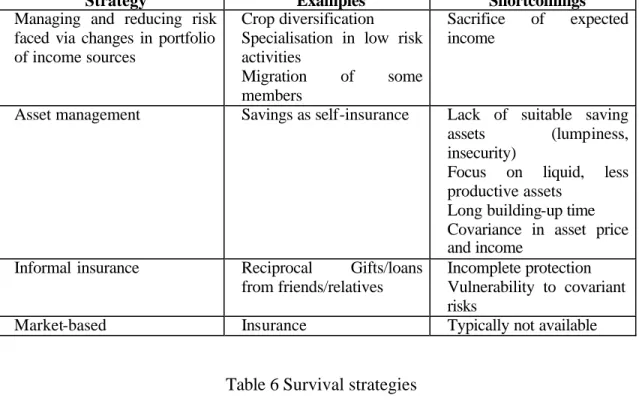
Risk management and coping strategies are part of the general livelihood of the household – and used in most periods. However, if a serious crisis occurs, households resort to more extreme actions, survival strategies, i.e. ‘emergency’ actions to be taken when the income fall is unavoidable. Table 6 summarises these. Details on these strategies can be found in Dercon (2002); a related approach, the Social Risk Management Approach, is discussed in Holzmann and Jorgensen (2000) and in World Bank (2000).
Table 5 Risk management and coping strategies
Strategy Examples Shortcomings
Managing and reducing risk faced via changes in portfolio of income sources
Crop diversification Specialisation in low risk activities
Migration of some members
Sacrifice of expected income
Asset management Savings as self-insurance Lack of suitable saving assets (lumpiness, insecurity)
Focus on liquid, less productive assets
Long building-up time Covariance in asset price and income
Informal insurance Reciprocal Gifts/loans from friends/relatives
Incomplete protection Vulnerability to covariant risks
Market-based Insurance Typically not available
Table 6 Survival strategies
Strategy Examples Shortcomings
Changes in portfolio of income sources
Children’s labour Sacrifice of human capital
Asset management Selling/Pawning of
real/productive assets
Long time to rebuild them up
Informal insurance Charity Incomplete protection
Vulnerability to covariant risks
Market-based Bank loans for
consumption credit
Usually not available
Much of this literature was developed using data sets from Asia and more recently from Africa, but many of these responses can be found back from data sources in LAC countries. A few striking conclusions emerge, in common with the overall empirical literature on this issue. First, the key way in which households cope with risk is by using income-based strategies – such as diversification of income sources – and by using assets for buffering consumption. A related result is that informal insurance and credit is used, but overall, only in a relatively limited number of cases. For example, Chacaltana (2002), and reported in table 7, suggests that most Peruvian households (72 percent) dealt with the reported shock on their own, either through changes in their portfolio of income sources (sending an additional household member to the labour market), or through asset management (consuming their savings, selling off or pawning their assets). Informal insurance is not widespread in Peru. Only 23 percent of households resorted to it through loans or gifts from relatives or friends. Interestingly, although we should expect rural villages to develop stronger social networks, this type of insurance is more common in urban
areas. However, it is unclear that the same pattern should be expected in other countries. Similarly, in Guatemala, Tesliuc and Lindert (2002) found that self- help accounted for more than half the responses used to cope with a shock, and informal insurance via transfers only accounted for about 13 percent of the responses. Government transfers and support was minimal in both countries; the most significant support came for the Peruvian rural poor – but then ‘relying on state support’ still accounted for only about 4 percent of the responses reported5.
Table 7 Exogenous shocks and household responses, Peru 2001
Urban Rural Total
Did something to solve the crisis 87.5 71.0 81.7
Self-help 76.1 65.3 72.3
Informal insurance 28.6 13.0 23.1
Public sector 1.0 4.3 2.2
Market-based 0.5 0.1 0.3
Other 8.8 5.7 7.7
Did nothing to solve the crisis 12.5 29.0 18.3 From Chacaltana (2002), based on ENAHO 2001-IV.
These strategies are not without cost. As has been widely documented, both income and asset based strategies imply efficiency losses in the generation of income, and thus may lead to poverty traps (e.g., Rosenzweig and Binswanger, 1993; Rosenzweig and Wolpin, 1993; Dercon 2002).6 The key mechanism is that lack of insurance – whether formal or informal – causes households to go for a safe portfolio of activities and assets, which typically implies a lower mean return. A poverty trap may arise, whereby the poor have no access to insurance, and lack of insurance precludes the poor from taking risks and raising their income, so as to perpetuate their poverty. The process is exacerbated since, after depletion, asset holdings are difficult to rebuild. In emergency cases, households are also forced to sacrifice human capital, as is the case when children drop out from school and start working (Pizarro, 2001). In Peru, Jacoby (1994) finds that “children from households with lower income (…) and greater childcare responsibilities begin withdrawing from school earlier”. In urban areas, a further usual sacrifice is housing privacy, as families rent out some rooms, or children come back to the parental house in order to rent out their own house (Zaffaroni, 1999). In fact, Tesliuc and Lindert (2002) conclude from their Guatemala data that “the poor have lower resilience than the rich to the effects of shocks. The probability of restoring household income to the level that prevailed before the occurrence of the shock rises with income”.
In short, risk strategies tend to have efficiency losses, and since the poor have to resort more to them than the rich, the result is that the efficiency losses are especially borne by the poor (Rosenzweig and Binswanger, 1993). It also means that the
5
Note that these are reported responses when a shock materialized. Those households that successfully avoided shocks by skewing their activities towards safe activities would not have faced as many shocks as those that did not, implying that the percentage relying on income based strategies is actually higher than these data would suggest.
6
It is worth noting that most studies focus on rural poverty traps. Hence, the effect of risk exposure on urban investment decisions remains to be explored. In the case of Latin America, this research is especially relevant.
welfare losses related to lack of insurance are well beyond those in terms of fluctuations and other transient effects in consumption and other welfare indicators. They involve permanent or chronic poverty effects, implying substantially higher welfare costs, including in the form of lower efficiency. These efficiency losses also mean that there is scope for interventions of a specific type: where there is no efficiency-equity trade-off, but where increasing equity (by focusing spending on the poor) is in fact efficiency-enhancing (for a more detailed discussion, see Dercon (2004); for a theoretical discussion on poverty traps induced by risk, see Banerjee (2004)). It implies that schemes to promote insurance for the poor may well have a subsidy element that could be efficiency enhancing. If providing insurance would mean that the poor can take on more risky, but higher return activities, then in principle, these schemes may be able to pay for themselves in efficiency terms. It establishes more clearly the case for interventions to encourage insurance with public (and aid) money beyond a clear case for promoting equity (see Dercon (2004)).
3. The Scope for Insurance Provision to the Poor
The previous section made the case for facilitating and enabling efforts to ensure that the consequences of risk are reduced for the poor. It also identified a number of key risks – natural risks, health and related risks, economic risks and social risks – that are especially harmful for the poor. Indeed, there may be an efficiency case for government action in the form of providing financing and subsidising these efforts, beyond obvious equity arguments for supporting the poor. Still, this does not address the question which form these efforts should take. More specifically, is it ‘insurance’ that provides the answer, or should other mechanisms be considered? The underlying cause of hardship linked to risk is a missing insurance market, so efforts could focus on establishing or fostering these markets. Still, this is not the typical policy answer observed. The more traditional view about dealing with ‘risks’ has been to provide safety nets, systems of targeted interventions focused on particular groups affected by hardship, including through shocks. In fact, this is typically the
only option considered.
This focus has some justification: insurance market failures are not easily addressed. For example, if asymmetric information is at the root of the lack of private insurance markets, there is little reason in general that the public sector can simply resolve these informational problems. Similarly, even if informational problems can be partly resolved, transaction costs linked to providing insurance to the poor are, as discussed before, likely to be high, so that administrative insurance provision may become excessively expensive, with efficiency losses well above the plausible gains in efficiency linked to better protection against risk. Also, large covariate and catastrophic risks are unlikely to be easily insured via insurance, unless the further development of international reinsurance markets for catastrophic risks in developing countries is fostered. Until then, public safety net systems, financed by taxes and aid are likely to be more reliable and sustainable. Furthermore, the advantage of simple safety nets in the form of targeted and redistributive transfers is that they may be able to address many causes of poverty and hardship within one system. For example, hardship could be linked to low assets or to a bad shock. Also, risk has a more substantial impact on the poor due to their lack of assets and other resources to cope with shocks, which excludes them from credit markets. A safety
net or other redistributive effort focusing on those with currently low income would not need to distinguish between hardship caused by a particular shock, by low assets or any other form of exclusion from markets.
A singular focus on ‘safety nets’ has serious problems as well. First, it does not need to be the most cost-effective means of addressing the problem of risk. They typically would only offer support once any uninsured risk has already caused serious hardship. Secondly, they are typically characterised by serious problems related to their functioning and inclusiveness, including in Latin America (Lustig, 2000). Indeed, the discussion in section 2 suggests serious shortcomings in the protection offered at present. From the point of view of the poor, current safety nets are then in fact in themselves at best a source of uncertainty, and at worst, the poor are excluded or support comes too late. If one of the desired consequences of better insurance against risk is to allow the poor to engage in risky but efficiency enhancing and high return activities, then this would not be properly achieved by the nature of safety nets currently in place.
The problems related to both safety nets and broader insurance provision suggest that a complementary balanced approach incorporating both elements would be desirable. Much more work would be needed to understand the optimal relative balance of insurance-related activities and safety nets. In fact, a number of alternative policies should be considered as well in the design of a comprehensive system of protection against risk-induced poverty, with complementary action. Broadly speaking, the system should consider both a number of ex-ante instruments – allowing the poor to be better protected against possible shocks, and ex-post measures – a comprehensive safety net providing protection against hardship caused by shocks. Ex-ante measures would provide incentives and means to the poor to protect themselves better against hardship: better insurance products for the poor are the obvious instruments, but they should also include efforts to support self- insurance via savings, and assisting income risk management and asset building by providing access to credit. Ex-ante measures could also include effort to reduce risk itself, and thereby assisting the an insurance-related approach to become more feasible. Ex-post measures would provide a genuine safety net, appropriately targeted to the poor but large enough in scale and coverage to provide broad-based social protection at some minimally accepted and feasible level of standard of living. It could be part of a more general welfare support system, or specifically targeted for risk-related hardship.
Before focusing in more detail on insurance provision for the poor, it is useful to stress the role these other complementary ex-ante measures could take on. A first set of measures involve reducing the risks faced by the poor directly. These measures clearly highlight the need for multisectoral approaches to deal with risk and insurance. For example, better basic health prevention and sanitation policies have a substantial impact on health risks. Better information systems on prices and weather conditions, targeted to the poor, could have substantial benefits, as would be technology investments making households less liable to losses of certain sources of risk – irrigation or drought resistant crops are well-known examples. Indeed, this type of measures could make certain risks, that are presently too large or covariate to offer viable insurance for, more easily insurable in a cost-effective way.
Other financial products, beyond insurance, also have a clear role to play to cope with risk. Savings instruments have been largely undervalued as an effective instrument for protection against hardship (Dercon (2002), Morduch (2004)). Relative to the widespread attention to credit market provision to the poor, it has been given relatively little attention, but as an area of subsidized intervention and regulation, it has many advantages. For example, it is not affected by the informational or reinsurance problems affecting credit and insurance, and transactions costs related to these operations, while not negligible, are likely to be largely restricted to the administrative handling of the savings. Key problems include that insurance via financial assets may be risky, not least given the endemic risks related to inflation in Latin America. Financial savings are typically not tailored to the poor, offering low or negative returns, and involving prohibitive transactions costs imposed on the saver. Savings should not just be looked at as reputation building devices or sources of capital mobilisation outside the household economy. The typical products are tailored to long-term deposits, with highly punitive returns for those looking for flexible instruments to handle unexpected hardship. As an area of targeted support, savings for precautionary motives should be encouraged as well, based on flexible savings instruments.
Credit products could also help to provide better protection against risk. Credit can act as an insurance-substitute, and products targeted to these purposes should be part of the standard portfolio of financial products aimed at the poor. Furthermore, it provides a means to diversify income sources and building up assets, increasing incomes or reducing overall risk in incomes, as well as the ability to cope with shocks to income. To be successful in this area, financial products on offer to the poor must be flexible and take into account that they face substantial risks. Interlinked credit and insurance contracts are one option – for example linking credit and health insurance. This form of insurance is not the focus of this paper, but there is definitely a need for more trials and research on such products.
As part of a general system of protection against risk- induced poverty, there is clear scope for insurance targeted at the poor. In the next section, first the risks that can be protected through insurance provision aimed at the poor are identified in more detail, followed by a discussion of the type of insurance products that could be offered. A number of case studies of institutions that have successfully done so are presented as well, focusing on their strategies to deal with the particular challenges of selling insurance to the poor. Based on this analysis, I argue that unsubsidized insurance for the poor is unlikely to be feasible for anything but simple term life insurance, and an important role for state or donor involvement therefore remains, where the state is especially called upon to create a regulatory environment that encourages the proliferation of insurance and financial intermediation. Furthermore, the available evidence suggests that the best mode of operation for offering insurance to the poor is the partner-agent model, in which an established insurer, possibly with public sector support, cooperates with local microfinance institutions. This points to the importance of already existing informal institutions as potential agents and the paper concludes by discussing the important role of such institutions in crowding in the support of established partners.
Insurance involves the pooling of risk over a large number of similar units and is most appropriate for uncertain and expensive losses, which are greater than what a
household can save or repay. As the size of the loss and the degree of uncertainty decline, insurance loses out to credit and saving. Insurance therefore involves exchanging the uncertain prospect of large losses for the certainty of small regular payments and in doing so, policy holders pay for the losses incurred by others and the costs and risk assumed by the insurer. For less uncertain or smaller losses, savings or credit may be more appropriate, so that it would mean that providing savings and credit instruments will be beneficial.7
Brown and Churchill (2000) suggest that there is scope for insurance provision only when the following criteria are fulfilled: (1) a large number of similar units exposed to risk; (2) limited policyholder control over the insured event; (3) the existence of insurable interest; (4) losses are determinable and measurable; (5) losses should not be catastrophic: reinsurance becomes increasingly difficult with increasing covariance across people (such as a hurricane or a flood); (6) the chance of loss is calculable: to estimate the probability of loss, historical information on a sufficiently large number of people or property exposed to the same risk is required; and (7) premia are economically affordable. They propose a rule of thumb that states that if the probability of a loss exceeds 40 %, premiums will definitely be too high to be affordable.
There are numerous examples of insurance schemes that have been introduced without fulfilling these criteria, one of the most infamous examples being the crop insurance programs introduced in the early 1980s in different parts of the world. Many of the above criteria apply to poorer as well as to richer insurance clients. However, some of them make it particularly difficult to insure the poor profitably. The need for premia to be economically affordable often means that the policy portfolio cannot actually be covered by contributions, or that insured amounts are so small that they make little difference to the vulnerability of the poor. SEWA, an Indian health and life insurer is a case in point, with payouts so low that they only cover about 10 % of losses due to illness shocks. Insurance to the poor is traditionally fraught with high per unit transaction costs, because premia have to be small and need to be collected frequently, while the values of the policies are also small. Problems such as moral hazard and adverse selection are not necessarily more damaging among the poor, but the higher transactions costs in dealing with them may mean that these problems make insurance unprofitable. Nonetheless, a number of small scale (microfinance) institutions including in Latin America already cater successfully to the poor, and their experience may help to develop some best practice guidelines for potential entrants into the small scale insurance market that want to target the poor8. Some of these lessons will be discussed below in section 4 and 5.
But a key lesson has to be that ex-ante measures, in the form of a comprehensive system of savings, credit and insurance products, may provide substantial protection to the poor, but ultimately they cannot fully insure individuals and families. In short, some ex-post measures, providing transfers to those affected by uninsured risk,
7
This feature may also explain why the poor in Latin America may be unwilling to purchase some of the existing ‘formal’ insurance products available and instead prefer to rely on ‘autarkic solutions’, including self-insurance, since the lack of appropriately targeted and designed products would make existing products relatively too costly for the poor, possibly outweighing the benefits.
8
would still be necessary as part of a comprehensive system of protection of the poor against risk. Insurance products for the poor will have to be simple, insuring only specific, highly observable risks, with measurable losses, while high risk groups may have to be excluded by design for the sustainability of the scheme. Self- insurance fails if shocks happen to materialise in successive periods. All self-protection strategies require some outlay beforehand, and self- insurance fails if shocks happen to occur in a number of successive periods. Credit as a substitute for insurance may not be available either. Certain highly covariate and rare events are very difficult to insure. This means that some ‘natural’ risks, such as catastrophies, may not be easily covered via a pure insurance system. Other risks ask for other types of measures to handle – and market- based insurance products are unlikely to be the most sensible or only response. ‘Social’ risks such as crime or enforcement of property rights are examples. While it is possible to design insurance products that insure against the consequences of these risks, they only address part of the problem.
But even if there are clear limits to insurance provision for the poor as a solution for their vulnerability to risk, for a number of risks insurance is definitely an option worth focusing on. In particular, life and health insurance, as well as forms of property and asset insurance are within the possibilities, and even insurance against some covariate risks, such as drought or in general weather insurance. In the next few sections, a strategy to implement such insurance schemes will be discussed in more detail.
4. Implementing Insurance for the Poor
To implement insurance provision for the poor, some key issues pertaining to insurance management need to be addressed. This section will first address the institutional arrangements and issues such as financial management, premium calculation, distribution of services and reinsurance, with a particular focus on targeting the poor. In the next section, a number of possible products will be discussed.
For insurance provision towards the poor, it is paramount that the agents involved have very close contact with the poor. This is unlikely to be achieved by either government agencies or by standard private insurance providers. As such, institutions with close links to grassroots organizations or NGOs may be ideal agents – an example would be microfinance institutions (MFIs), which have become relatively widespread within developing countries. But, since purchasing insurance involves a payout only in the case of an adverse shock, it is paramount that insurance customers can be absolutely certain of the benefits they receive. This requires a simple and clearly stated policy, swift processing of claims and careful financial management of the insurance portfolio by the insurance provider. To inspire trust among the clientele, adequate reserves need to be held and financed through both underwriting, reinsurance and investment. To be financially viable, insurers need to have a sufficiently diversified investment portfolio. This is something that MFIs or other institutions working with close contacts with the poor, may often find hard to achieve.
A partner-agent arrangement, in which a local institution or the MFI undertakes only the distribution of insurance services, linked with a private or possibly public sector
insurance provider may therefore be more appropriate when targeting poor customers. Its advantages are that it eliminates agent risk and allows the institutions involved to focus on their particular strengths. It also allows local institutions and MFIs to offer greater benefits at a similar cost to policy holders. The biggest limitation of the partner-agent model is the limited availability of potential partners. Fostering these relationships may well be a crucial area for public policy, by providing a clear institutional and regulatory environment. In section 6, this will be discussed further. Within the context of a partner-agent arrangement, mutual insurance funds may overcome some of the resistance against insurance, since they mimic features of informal insurance arrangements in which funds are often distributed back to members at regular intervals. This may, however, also be achieved by making existing informal arrangements part of the set-up of an MFI.
Turning to the issue of premium setting, most of the existing insurers surveyed by Brown and Churchill (2000) calculated their premiums either in- house or by partnering with an established insurer to gain access to the required expertise. Brown and Churchill find in their survey that MFIs who cooperate with established insurers are usually able to offer coverage at better prices. IFOCC in Peru attempted to find partners to help them with the actuarial expertise they lacked, but were unable to find an established insurer willing to provide a product to the low income market. Instead they used their own simple calculations based on historical mortality statistics within their credit portfolio. ASA in Bangladesh, however, followed a different and far more risky approach and based their premiums on customer demand, starting out with very high premiums on their mandatory insurance policy inducing numerous complaints from their clients. Premiums were then lowered successively until customers stopped complaining. While this ensures that clients are able to afford their premia and are satisfied with the rates at which insurance is offered, it obviously entails a higher risk than the calculation of premiums based on actuarial principles.
As Rutherford (1999) points out, one of the most important demands the poor make on their financial services is easy access, and regular small payments, which are frequently collected to impose the necessary payment discipline. An agency, which employs home service distribution and collects premiums on weekly basis would be well suited to the needs of low income households, however, it may incur high transaction costs. Integrated distribution, such as practised by SEWA in India, where life insurance is distributed through already existing fixed deposit accounts could help to curb these costs.
One element that is almost completely absent in existing micro- insurance and similar insurance institutions focused on relatively poor customers is reinsurance. Being able to purchase reinsurance would have several benefits: it can improve the ability of insurers to grow, it helps to stabilise financial results, it protects against catastrophic losses and it improves underwriting expertise. The promising use of reinsurance in low- income markets is to open up markets for some of the large-scale covariant risks such as many natural disasters (Skees et al., 2004). However, to attract reinsurance, it is paramount that primary insurers have sound pricing policies and control against abuse. Among the survey respondents in Brown and Churchill, all the partner institutions in partner-agent arrangements were likely to have reinsurance contracts as well as some of the cooperative insurers. However, few of the MFIs and other
smaller organisations in their study have reinsurance and are therefore highly exposed to sudden increases in claims and are missing out on a potentially valuable source of expertise.
5. Insurance Products for the Poor
So which products are most promising to offer to the poor? In this section, I will focus on four types of products – their strengths and problems. In particular, it will discuss life insurance, health insurance, property-related insurance and finally, weather insurance. Life insurance is a relatively low risk product and the one most widely available to the poor. Most existing schemes offer mandatory term life insurance as part of an outstanding loan or savings account, thus minimising their distribution costs. The majority of the institutions surveyed by Brown and Churchill (2000) also limit coverage to only those policies that are not in arrears when the policy holder dies. Often exclusions for causes of death are also applied, for exa mple AIDS related deaths are not covered. While such life insurance for outstanding loans with simple terms works reasonably well, it is important to note that it often protects the MFI more than the client, since many MFIs would otherwise write off losses due to death regardless of the availability of insurance9. Additional benefits, such as insurance tied to savings rather than credit, and stand-alone term and endowment policies offer coverage that is more focused on the needs of the policy holder rather than the institution. ACODEP’s (Nicaragua) life saving insurance is a good example. Its policy provides a benefit, double the amount held in savings to the client’s beneficiaries. In Venezuela, COOPERAR’s basic product provides a benefit equal to the amount held in savings with an option of increasing the coverage to double the amount for an increased premium. In this sense, these are much better products to promote and develop as part of insurance provision to the poor, but currently their availability is limited.
In theory, endowment life insurance can provide low- income households with complete protection against death risks and, through a saving and loan components, partial insurance against other risks and life cycle needs. Delta Life in Bangladesh has been a pioneer in marketing this kind of product to the poor. However, Delta Life has experienced difficulty in managing its loan portfolio, potentially jeopardising its ability to pay out the promised bonuses as the policies mature. Such a product therefore makes the holding of larger reserves necessary and requires more sophisticated actuarial expertise in its management. Still, the experience of Delta Life is an interesting one, and it would be worthwhile to promote their types of products further – but again suggesting that the best model would be a partner-agent model with a sufficiently strong partner.
An important question when offering insurance to the poor is whether this can be done profitably. All the life insurers surveyed by Brown and Churchill are profitable, but it was evident that institutions with the benefit of access to actuarial expertise in calculating premiums appear to offer greater value for lower premiums. Reserves
9
It is in fact plausible that if reinsurance was properly used as an instrument by MFIs, the cost of mandatory life insurance linked to outstanding loans would be much lower for the customers than it is at present – so that in many ways this form of insurance is not a benefit to customers but rather a cost related to inefficiency.
holdings differed greatly from 1.9 times level of claims to several hundred times for very similar policies. 10-20 times annual claims may be an advisable reserve holding. All insurers had expense ratios of well below 60 % (claims expenses + operating costs / annual premium revenues). For example, IFOCC (Peru), used 44 % of its premium income to cover claims and just 5 % to cover operating expenses (due to integration within its credit operations). Thus it seems reasonable that various forms of outstanding balance insurance can be profitable in low- income communities. The following table, taken from Brown and Churchill gives some preliminary performance guidelines for institutions offering life insurance.
Table 8: Guidelines for Institutions offering Life Insurance Claims Ratio Distribution
Costs Reserves Claims Processing Time Preferred Range < 60 % of annual premiums < 10 % of annual premiums > twice annual claims level < 10 days
Insuring health risks poses different and more complex challenges for providers than offering life insurance firstly because it may suffe r from adverse selection and moral hazard and secondly because it usually entails the provision of a tangible service: health care. To avoid moral hazard and adverse selection, various mechanisms are in use. For example, two Ugandan health insurance institutions, UHC and FINCA Uganda both require that more than 60 % of the members of a group agree to enroll before coverage is extended to a cooperative, trade union, or MFI, or to a village bank. COHI Benin charges a small initiation fee to new members and ha s a one-month waiting period after receiving the first premium before policy holders can receive health care coverage. To control for escalating treatment costs, some insurers implement mandatory reference systems that encourage patients to use the lowest cost treatment facility first. Few of the institutions surveyed required formal underwriting though, before a family purchases a policy. But some clearly make errors in designing their schemes. ASSABA in Guatemala (see box 1) did not manage to enforce that all members of a family had to enroll, so that families enrolled only those most likely to be ill – with disastrous problems for the sustainability of the scheme. It also did not impose any waiting time before one could benefit from in-patient care.
To provide the right incentives to the service provider, various payment mechanisms can be used. One form of payment that works well, when good quality control is in place is capitation payment: the insurance scheme pays the provider a fixed amount per member for all members and the provider agrees to provide all the defined care for any member who needs it during the period. By paying for the number of people instead of the number of services offered, the scheme reduces the provider’s incentive to provide more, possibly unnecessary services. ASSABA in Guatemala used this scheme. However, it also leaves the provider with all the risk in case of excessive usage and the provider may be unwilling to agree to such a scheme. Therefore, fee for service may be more practical. Alternatives are fixed cash subsidies which are given to each member to pay for their health charges regardless of actual claims.
Three different methodologies are employed to fund the health-care services provided for by their policies: salaried service provision, dedicated health-care facilities and indemnity coverage. Naturally, there are strengths and weaknesses to each of these approaches. Salaried service provision, whereby the health service is provided by staff exclusively dedicated to the health plan, often provides the most convenient access. ASSABA (Guatemala) used this system. However, many types of health care services cannot be provided in a cost-effective manner by salaried personnel dedicated to only serving members of a health plan. If they are provided locally, dedicated health-care facilities can offer convenient, quality care, but this approach requires increased administration to monitor the services that are provided and members' usage of the covered services. Indemnity coverage reduces the administrative difficulties for the health plan, but gives it less control over the quality of care and may not provide effective coverage for members who cannot afford to pay for services up front and receive reimbursement later.
Unfortunately, health insurance schemes aimed at relatively low income customers are often liable to serious losses. For example, three out of four providers to whose financial results Brown and Churchill (2000) obtained access were not covering their costs. One had expense ratios of 216 %, highlighting the challenge of offering health care insurance profitably to low-income households. The only non-loss making plan they found, COHI (Benin) only offers very limited coverage with many exclusions and restrictions, thus also limiting the value of health insurance to its customers.
Box 1 Health Insurance by ASSABA, Guatemala
In poor rural communities, access to basic health care is often severely limited. Community initiatives to generate health care financing through voluntary prepayment schemes are an attempt to overcome the limited access to basic health care in poor rural countries. An example from Guatemala highlights some of the problems that can lead to failure. This discussion is based on the experience of the Asociacion por Salud de Barillas (ASSABA) in Guatemala, based on a paper by Ron (1999). The author contrasted the ASSABA experience with a study of a similar scheme, the ORT Health Plus Scheme (OHPS) in the Philippines that was much more successful.
ASSABA started a community heath financing scheme in 1994 following suggestions by the WHO. Preliminary estimates were made on current costs and out-of-pocket health care expenditures in the existing public and private facilities. The concept proposed was to define a contribution level that would be affordable to the vast majority of families, as opposed to a contribution, which would cover all the costs of an optimal benefit package. Donor funding was then mobilised to cover start up costs. Limitations on benefits were imposed, in particular illnesses, which were not ‘emergencies’, were excluded.
ASSABA, as a grass-roots, participatory community association created to improve the health of its members was well motivated and prepared, compared to similar schemes in other places, such as in the Philippines. However, at the conceptual stage, ASSABA, was not yet sufficiently established as an administrative body. By the time it was finally registered as a legal entity, local conflicts made progress difficult, since the local Catholic Church — also a health care provider — contested the capitation contract of ASSABA with a hospital sponsored by the Protestant Church in the United States. Furthermore, ASSABA, was attempting to provide community health insurance before the national authorities in Guatemala had come out with a clear policy. Although ASSABA implied that all members of a family must register, this was not stated explicitly in the registration rules, exposing the ASSABA scheme to adverse selection. The design of the benefits package also posed a serious disincentive to potential members. In contrast to the original design, inpatient care was limited to 3 days. Additional charges would fall on the patients, who in the majority of cases would not be able to afford them. This was clearly a contributing factor to failure, and more successful schemes typically strictly enforced their registration rules and did not