Invariants of binary forms
Inauguraldissertation
zur
Erlangung der Würde eines Doktors der Philosophie
vorgelegt der
Philosophisch-Naturwissenschaftlichen Fakultät
der Universität Basel
von
Mihaela Ileana Popoviciu Draisma
von Rumänien
auf Antrag von
Prof. Dr. Hanspeter Kraft und Prof. Dr. Jerzy Weyman
Basel, den 12. November 2013
Acknowledgments
I thank Hanspeter Kraft for trusting me with the study of invariants, for oering
me this work that gave me joy and inspiration, for his guidance and advice.
I thank Andries Brouwer for being such a nice and supportive collaborator and
co-author. It is a joy and an honour to work with him.
I thank Jerzy Weyman for the crash course on invariant theory he gave me in
the short moments we met in Basel and Boston.
I thank Varga Csaba, one of the brightest gures from my childhood and later
times. His maths circles were spots of light in the gray of communistic
school-time.
I thank my professors at Babes-Bolyai University and at Kaiserslautern
Univer-sity for the many inspiring lectures. I thank my colleagues and friends at the
Mathematical Institute Basel for the nice moments we had together.
I thank Renate and Hanspeter for hosting me in Basel whenever I came there
for working on my thesis, for listening to me, encouraging me, and supporting
me in their kind way. I thank them and my friends Joswitte, Simon, Regula,
Andreas, Jonas, Monika, Marine, Stéphane, Sebastian, Christoph, and Jaqueline
for making returning to Basel feel like returning to a second home.
I thank Oana, Catalin, and Marius for being such good friends, despite the
geographical distance. I thank my friends and relatives in the Netherlands for
their support.
I thank my parents, especially my mother, for unconditionally coming to help
me whenever I need.
I thank Jan and Mirona for making my days so bright.
Contents
1 Introduction
7
2 Invariant Theory
15
2.1 Denitions and notation
. . . 15
2.2 The symbolic method
. . . 19
2.3 Bounds on the degrees and orders of the generating covariants
. . 22
2.4 Cohen-Macaulayness
. . . 25
2.5 The Poincaré series
. . . 27
2.5.1 A result of Broer and Poincaré series
. . . 29
2.6 The quotient variety and nullforms
. . . 30
2.7 Finding a hsop
. . . 31
2.7.1 Hilbert's criterion
. . . 31
2.7.2 Dixmier's criterion
. . . 33
2.8 Schur modules
. . . 34
2.9 The type of the generating covariants
. . . 37
3 Computational methods
39
3.1 The method
. . . 39
3.2 The computation of invariants and covariants
. . . 40
3.3 The computation of the Poincaré series
. . . 40
3.4 Linearly independent invariants
. . . 42
3.5 The example of the binary octavic
. . . 43
4 Invariants of binary forms
48
4.1 The invariants of the binary quadratic
. . . 49
4.2 The invariants of the binary cubic
. . . 49
4.3 The invariants of the binary quartic
. . . 50
4.4 The invariants of the binary quintic
. . . 50
4.5 The invariants of the binary sextic
. . . 52
4.6 The invariants of the binary septic
. . . 53
4.7 The invariants of the binary octavic
. . . 56
4.8 The invariants of the binary nonic
. . . 58
4.9 The invariants of the binary decimic
. . . 65
5 Invariants of several forms
72
5.1 The invariants of
mV
1⊕
W
. . . 74
5.2 The invariants of
mV
1⊕
nV
2. . . 76
5.3 The invariants of
mV
1⊕
nV
3. . . 79
5.3.1 The invariants of
V
1⊕
V
3. . . 82
5.3.2 The invariants of
2
V
3. . . 82
5.3.3 The invariants of
V
1⊕
2
V
3. . . 83
5.3.4 The invariants of
2
V
1⊕
V
3. . . 83
5.4 The invariants of
mV
1⊕
nV
4. . . 85
5.4.1 The invariants of
V
1⊕
V
4. . . 87
5.4.2 The invariants of
2
V
4. . . 87
5.4.3 The invariants of
V
1⊕
2
V
4. . . 88
5.4.4 The invariants of
2
V
1⊕
V
4. . . 89
5.5 The invariants of
V
1⊕
V
5. . . 90
5.6 The invariants of
V
1⊕
V
6. . . 92
5.7 The covariants of
V
7. . . 95
5.8 The covariants of
V
8. . . 98
5.9 The invariants of
V
2⊕
V
3. . . 100
5.10 The invariants of
V
2⊕
V
4. . . 101
5.11 The invariants of
V
2⊕
V
5. . . 102
5.12 The invariants of
V
2⊕
V
6. . . 104
5.13 The invariants of
V
3⊕
V
4. . . 106
5.14 The invariants of
V
1⊕
V
2⊕
V
3. . . 108
5.15 The invariants of
V
1⊕
V
2⊕
V
4. . . 110
5.16 The invariants of
V
1⊕
V
2⊕
V
5. . . 111
5.17 The invariants of
2
V
2⊕
V
3. . . 113
5.18 The invariants of
2
V
2⊕
V
4. . . 115
5.19 The invariants of
V
1⊕
V
3⊕
V
4. . . 116
6 Homological dimension
120
6.1 The main results
. . . 120
6.2 Bounds on
hd
O
(
V
)
G. . . 121
6.3 The proofs of the main results
. . . 123
A Computations
126
A.1 Implemented functions
. . . 126
A.2 The invariants of the binary septic
. . . 130
A.3 The invariants of the binary nonic
. . . 135
A.4 The invariants of the binary decimic
. . . 140
A.5 The invariants of
V
1⊕
V
5. . . 147
A.6 The invariants of
V
1⊕
V
6. . . 149
A.7 The covariants of
V
7. . . 153
A.8 The covariants of
V
8. . . 166
A.9 The invariants of
V
2⊕
V
3. . . 174
A.10 The invariants of
V
2⊕
V
4. . . 175
A.12 The invariants of
V
2⊕
V
6. . . 180
A.13 The invariants of
V
3⊕
V
4. . . 184
A.14 The invariants of
V
1⊕
V
2⊕
V
3. . . 186
A.15 The invariants of
V
1⊕
V
2⊕
V
4. . . 188
A.16 The invariants of
V
1⊕
V
2⊕
V
5. . . 190
A.17 The invariants of
2
V
2⊕
V
3. . . 194
A.18 The invariants of
2
V
2⊕
V
4. . . 197
A.19 The invariants of
V
1⊕
V
3⊕
V
4. . . 200
Chapter 1
Introduction
We work over the eld
C
of complex numbers. We denote by
SL
2the group
of complex 2
×
2-matrices with determinant 1. Let
Vn
=
C
[
x, y
]
nbe the
SL
2-module of binary forms (homogeneous polynomials in
x
and
y
of degree
n
), on
which
SL
2acts via
g
·
f
(
v
) =
f
(
g
−1v
)
,
for
g
∈
SL
2,
f
∈
C
[
x, y
]
and
v
∈
C
2. The algebra of polynomial functions on
Vn
, denoted by
O(
Vn
)
, is a polynomial ring in
n
+ 1
variables. The group
SL
2acts on
O(
Vn
)
via the action
g
·
j
(
f
) =
j
(
g
−1·
f
)
,
for
g
∈
SL
2,
j
∈ O(
V
n)
and
f
∈
V
n. An invariant of
V
nis an element
j
∈ O(
V
n)
such that
g
·
j
=
j
for all
g
∈
SL
2. The set of invariants of
V
nforms the algebra
of invariants
I
:=
O(
V
n)
SL2.
The theory of invariants originated in England about the middle
of the nineteenth century as the genuine analytic instrument for
describing congurations and their inner geometric relations in
pro-jective geometry. The functions and algebraic relations expressing
them in terms of projective coordinates are to be invariant under all
homogeneous linear transformations. ([Wey46, page 27])
In the nineteenth century mathematicians studied invariants of binary forms
motivated by the philosophy that `any' property of polynomials unaected by
linear transformations can be expressed by the vanishing of invariants. The
polynomial
ax
2+ 2
bx
+
c
for example has a double root if and only if the
invariant
b
2−
ac
of
ax
2+ 2
bxy
+
cy
2vanishes. Consider, as another example,
the non-zero quartic
q
(
x, y
) =
ax
4+
bx
3y
+
. . .
+
ey
4; the solutions of the equation
q
(
x, y
) = 0
correspond to 4 points on the projective line. These four points form
a harmonic division if and only if the invariant
j
3=
a
b
c
b
c
d
c
d
e
7
of the quartic
q
vanishes (cf. Dixmier [Dix90], p.42). The invariants of binary
forms are related to the study of algebraic equations as well. For example,
the binary form
q
(
x, y
)
of degree 5 has an invariant of degree 18 with a nice
property: if this invariant vanishes, then the equation
q
(
x,
1) = 0
can be solved
by radicals (cf. Dixmier [Dix90], p.43).
Early in the 1800s it was known that the invariants of
V
2are spanned by
the discriminant
b
2−
ac
of
ax
2+ 2
bxy
+
cy
2, and that the invariants of
V
3are
generated by the discriminant
(
ad
−
bc
)
2−
4(
ac
−
b
2)(
bd
−
c
2)
of
ax
3+ 3
bx
2y
+
3
cxy
2+
dy
3. About the binary forms
ax
4+ 4
bx
3y
+
. . .
+
ey
4of degree 4 it
was known that the invariant
j
3dened above and
j
2=
ae
−
4
bd
+ 3
c
2are
algebraically independent and generate the invariants of
V
4. The invariants
j
2and
j
3were discovered in the period 1840-1850 by Boole, Cayley, Eisenstein
(cf. Dixmier [Dix90], p.41). Regarding the invariants of
V
5, Hermite ([Her54])
proved in 1854 that they were generated by 4 irreducible invariants of degrees
4, 8, 12, and 18. Before that, only the invariants of degrees 4, 8, and 12 had
been known, and for a long time people believed that all invariants of
V
5had
degrees divisible by 4 (cf. Dixmier [Dix90], p.41).
Cayley [Cay56] claimed in 1856 that that the algebra
I
of invariants of
V
nhad no nite bases for the cases
n
= 7
and
n
= 8
. However, twelve years later,
in 1868, Gordan [Gor68] proved the contrary: he showed that
I
has a nite basis
for all
n
.
Im
146
stenBande der Philosophical Transactions pag. 101 hat Herr
Cayley sich mit der Frage beschäftigt, ob alle aus einer binären
Form entstehenden Covarianten und Invarianten als ganze
Functio-nen einer begrenzten Anzahl von Former mit numerischen
Coe-cienten darstellbar seien; er hat gezeigt, dass bei Formen zweiten,
dritten und vierten Grades sich alles in der verlangten Weise
aus-drücken lässt. Im Folgenden gebe ich für binäre Formen
n
tenGrades
ein endliches System von Covarianten und Invarianten an, von
de-nen ich zeige, dass und wie alle aus der Form abgeleitete Formen
sich als ganze rationale Functionen derselben mit numerischen
Coef-cienten darstellen lassen. Dieses für den allgemeinen Fall gegebene
System ist immer zu gross und lässt sich in jedem besonderen Falle
reduciren; für Formen fünften und sechsten Grades habe ich auch
diese Reduction ausgeführt und ein möglichst kleines System von
Grundformen geliefert. ([Gor68])
The study of invariants of binary forms was an important part of a new
disci-pline, die neue Algebra (the new Algebra), as Clebsch named it in 1872. At
that time Clebsch wrote that
die fundamentalen Untersuchungen von Gordan über die Endlichkeit
der Formensysteme [
. . .
] eine Perspective in eine neue Classe tiefer
und wichtiger Forschungen errönet.[Cle72]
About twenty years later, in 1890, Hilbert [Hil90] generalised the result of
Gor-dan to a system of several homogeneous forms in a nite number of variables.
His proof was non-constructive and did not provide any tools to determine such
nite bases. Hilbert `only' proved that these nite bases existed, to which
Gor-dan reacted with the famous exclamation ([Rei96]):
Das ist nicht Mathematik. Das ist Theologie.
Hilbert [Hil93] returned to the problem and in 1893 gave a proof which was
this time constructive. Eventually Gordan appreciated Hilbert's new ideas,
remarking
I have convinced myself that Theology also has its merits.[Rei96]
With his article from 1893 Hilbert opened a new chapter in mathematics: the
article contains famous results such as Hilbert's basis theorem and Hilbert's
Nullstellensatz (as they are known nowadays), without which it is hard to
imagine the mathematics of today.
It is known, hence, since the nineteenth century, that the algebra
I
of
in-variants of binary forms of degree
n
is nitely generated over
C
, i.e. there exist
nitely many invariants
j
1, . . . , j
r∈
I
, such that
I
=
C
[
j
1, . . . , j
r]
. Nevertheless,
nding the generators of
I
is, in general, a dicult problem. Two methods were
developed in the nineteenth century: the symbolic method, and the enumerative
method.
The symbolic method was developed by Aronhold and Clebsch in the middle
of the nineteenth century. Called by Hermann Weyl the great war-horse of
nineteenth century invariant theory, the symbolic calculus allows the reduction
of the computations with binary forms of degree
n
to the special cases of the
n
thpower of a linear form
(
α
1x
+
α
2y
)
n. The classics proved that the invariants
of binary forms have symbolic representations as products of factors of type
[
αβ
]
, where
[
αβ
]
stands for the determinant
α
1β
2−
α
2β
1. The manipulation of
invariants got simplied by representing them in succinct symbolic expressions.
Kung & Rota [KR84] gave in 1984 a rigorous and yet manageable account of the
umbral or symbolic calculus that was performed in the nineteenth century (see
also Chap.
2.2). With the help of the symbolic method, Gordan [Gor68] proved,
in 1868, that the covariants of a binary form
f
of degree
n
are generated by a
nite number of iterated transvectants
f,
(
f, f
)
d,
(
f,
(
f, f
)
d)
e, . . .
. For a modern
interpretation of Gordan's algorithm we refer to Weyman [Wey93]. Gordan's
proof was constructive and provided sets of generators for the invariants and
covariants of
V
6([Gor87]). Following Gordan's method, von Gall [Gal88] found
in 1888 a set of generating covariants of
V
7, but this set was not minimal. In
two papers published in 1880, von Gall [Gal80] computed a set of generating
covariants of
V
8, but this set was again not minimal (he did found the correct
number of the generating invariants of
V
8). No sets of generating invariants
of covariants of
Vn
for
n
≥
9
were computed in the nineteenth century using
Gordan's method.
The enumerative method was developed by Sylvester in the nineteenth
cen-tury and aimed to nd lower bounds for the number of generators of the
invari-ants of binary forms. This method used the Poincaré series of the algebra
I
of
in-variants of binary forms and tamisage for nding these bounds. Tamisage meant
the following: suppose that the Poincaré series of
I
is
P
(
t
) = 1+
a
2t
2+
a
3t
3+
. . .
.
We look for the smallest
i
such that the coecient
a
iis nonzero, as long as such
an
i
exists. If
a
i>
0
, we put
m
i:=
a
i, replace
P
(
t
)
by
P
(
t
)(1
−
t
i)
mi, and
repeat the procedure. If
a
i<
0
, we stop. Undened
m
iare considered equal to
0. Sylvester claimed that the number of generators of
I
is at least
P
i
mi
(more
precisely, that the number of generators of
Ii
is at least
mi
). For illustration,
the Poincaré series of the algebra of invariants of binary forms of degree 10 is:
P
(
t
) = 1 +
t
2+ 2
t
4+ 6
t
6+ 12
t
8+ 5
t
9+ 24
t
10+ 13
t
11+ 52
t
12+ 33
t
13+
97
t
14+ 80
t
15+ 177
t
16+ 160
t
17+ 319
t
18+ 301
t
19+
· · ·
(
see Chap.
4
.
9
)
Using tamisage we obtain the following bounds
mi
on the number of generators
of invariants of degree
i
of
V
10(the last row contains the actual number
di
of
generators of degree
i
, obtained in Chap.
4.9):
i
2 4 6 8 9 10 11 12 13 14 15 16 17 18 19 21
mi
1 1 4 5 5 8
8 12 15 13 19 5
3
0
0
0
di
1 1 4 5 5 8
8 12 15 13 19 5
5
1
2
2
Sylvester formulated a postulate as well, which stated that in a degree
i
one gets
either a new generator of
I
, or new relations among the already found generators,
but not both. This was not true: Hammond [Ham82] found a counterexample
in 1882. Assisted by Franklin, Sylvester [Sy79b] used tamisage and his postulate
for nding the number of generators of invariants of binary forms of degree up
to 10. His predictions regarding the invariants of
Vn
were correct for
n
≤
6
and for
n
= 8
. For the remaining cases, Sylvester's numbers were correct up to
degree 18 for
n
= 7
and for
n
= 9
, and up to degree 16 for
n
= 10
.
Both techniques were not powerful enough for solving complicated cases.
Grace and Young noted in 1903:
Theoretically then Gordan's process gives an upper limit to the
ir-reducible systems. The enumerative method
[
. . .
]
gives a lower limit
to the system and when the two methods give the same result the
irreducible set has been obtained. The results even when identical
have to be received with some caution on account of the enormous
labour involved. It may be recalled in fact in connection with the
si-multaneous system of a cubic and quartic (Gundelnger, Math.Ann.
Bd.iv.) that the two results originally agreed, but a revision of the
generating function led to a reduction of the lower limit which it
theoretically gives, and afterwards two forms included in the
irredu-cible system as derived by the methods of Gordan and Clebsch were
found to be reducible. The complete systems for the binary forms
up to the octavic may be considered as accurately determined by
the two methods combined.([GY03, page 131])
In reality, the cases
n
= 7
and
n
= 8
were surrounded by a shade of doubt until
late in the 20th century. Gall's results [Gal88] regarding the generating
invari-ants of
V
7were corrected by Dixmier & Lazard [DL86] in 1986. Shioda [Shi67]
proved in 1967 that the algebra of invariants of
V
8was generated by the nine
invariants found by Gall in 1880 and also explicitly calculated the relations
be-tween these nine invariants. Regarding the covariants of
V
7, Cröni [Crö02] and
Bedratyuk [Bed09] indicated that Gall [Gal88] had six superuous generatoring
covariants in his set. However, they didn't prove that Gall's set was indeed a
generating set for the covariants of
V
7(in particular they did not give an
inde-pendent proof of the fact that there were no generators in higher degrees than
the one indicated by Gall, but instead relied on Gall's results). Bedratyuk &
Bedratiuk [BB08] showed in 2008 that the set of generating covariants of
V
8found by Gall [Gal80] contained a superuous generator, conrming a result of
Sylvester [Sy79b]. Again, they did not prove that no generators will appear in
degrees higher than the one indicated by Gall, but relied on this information. In
Chap.
5.7
and
5.8
we nd sets of generating covariants of
V
7, respectively of
V
8,
independently of von Gall's work. As for the case of the simultaneous system
of a cubic and quartic, this was settled in 2012 by Brouwer and me [BP12] (see
also Chap.
5.19).
Earlier work on the cases
n
= 9
and
n
= 10
was done by Cröni [Crö02], and,
respectively by Hagedorn (unpublished). These last two cases were completed in
2010, when Brouwer and I [BP10a,
BP10b] found sets of generators of
O(
V
n)
SL2for
n
= 9
and
n
= 10
(see also Chap.
4.8
and
4.9
in this thesis). The existence
of a generator of degree 22 in the case
n
= 9
and the existence of a generator of
degree 21 in the case
n
= 10
were new. No sets of generators of
O(
Vn
)
SL2are
known for
n
≥
11
. The bigger
n
is, the more dicult it is to nd the generating
invariants of
Vn
. The computations required for nding such sets of generators
for the cases
n
= 11
and
n
= 12
are still too large.
An upper bound on the degree of the generating invariants of
Vn
is known
from the nineteenth century, found by Camille Jordan [Jor76,
Jor79]. He proved
that the degree of the generating invariants of
Vn
was
≤
n
6. About a century
later, Popov [Pop81,
Pop82] generalised this result and determined a bound
on the degree of the generating invariants of a
G
-module, where
G
was any
semi-simple group. However, applied to the particular case of the binary forms,
Popov's result gives a weaker bound, compared to the one found by Jordan.
In 2001 Derksen [Der01] improved Popov's result, but again, applied to the
particular case of the binary forms, Derksen's bound was weaker than Jordan's
bound.
Another direction that the classics followed in the nineteenth century was
to nd the generators of the invariants and of the covariants of several binary
forms
Vn
1⊕
. . .
⊕
Vn
p, with
p
≥
2
and
ni
≥
1
. Table
1.1
contains results of
computations made in the nineteenth century, for some particular
SL
2-modules
(we use the notation
mVn
for the direct sum
L
mi=1
Vn
of
m
copies of
Vn
).
The references [Bes69,
Ell95,
Gor69,
Gor87,
GY03,
Per87] give sets of generating
invariants of
mV
1⊕
nV
2in few particular cases, with small
m
and
n
. Gordan and
Grace & Young ([Gor75,
GY03]) gave an algorithm for computing the generators
of the covariants of
V
2⊕
V
. Gordan ([Gor69,
Gor87]) gave good estimates on the
number of generators of the invariants of
nV
1and of
V
1⊕
nV
2, with
n
≥
2
. Peano
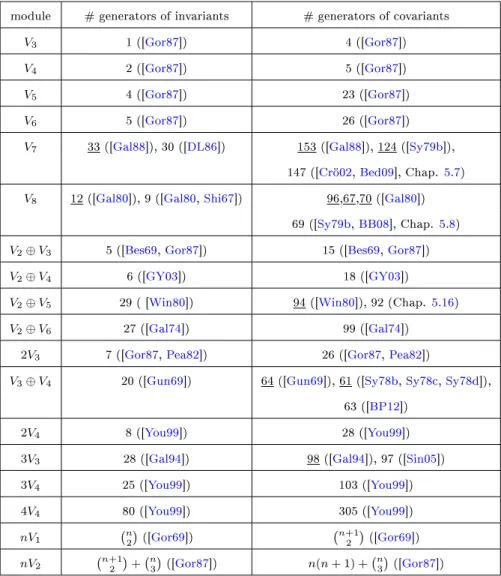
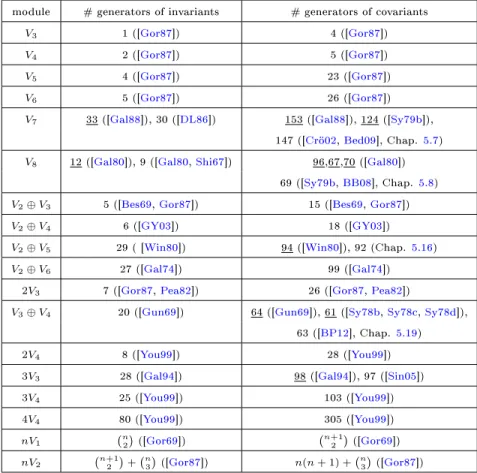
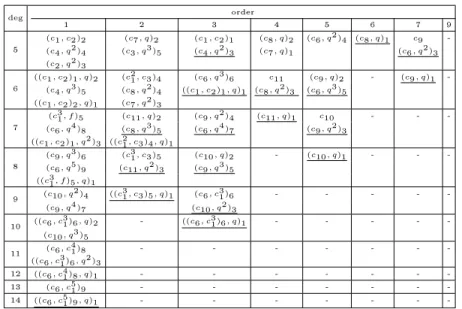
module #generators of invariants #generators of covariants V3 1 ([Gor87]) 4 ([Gor87])
V4 2 ([Gor87]) 5 ([Gor87])
V5 4 ([Gor87]) 23 ([Gor87])
V6 5 ([Gor87]) 26 ([Gor87])
V7 33 ([Gal88]), 30 ([DL86]) 153 ([Gal88]), 124 ([Sy79b]),
147 ([Crö02,Bed09], Chap. 5.7)
V8 12 ([Gal80]), 9 ([Gal80,Shi67]) 96,67,70 ([Gal80])
69 ([Sy79b,BB08], Chap. 5.8)
V2⊕V3 5 ([Bes69,Gor87]) 15 ([Bes69,Gor87])
V2⊕V4 6 ([GY03]) 18 ([GY03])
V2⊕V5 29 ( [Win80]) 94 ([Win80]), 92 (Chap. 5.16)
V2⊕V6 27 ([Gal74]) 99 ([Gal74]) 2V3 7 ([Gor87,Pea82]) 26 ([Gor87,Pea82])
V3⊕V4 20 ([Gun69]) 64 ([Gun69]), 61 ([Sy78b,Sy78c,Sy78d]),
63 ([BP12])
2V4 8 ([You99]) 28 ([You99]) 3V3 28 ([Gal94]) 98 ([Gal94]), 97 ([Sin05]) 3V4 25 ([You99]) 103 ([You99]) 4V4 80 ([You99]) 305 ([You99]) nV1 `n 2 ´ ([Gor69]) `n+1 2 ´ ([Gor69]) nV2 `n+12 ´+`n3´([Gor87]) n(n+ 1) +`n3´([Gor87])
Table 1.1: Cases treated in the 19th century (the underlined entries are results that
in the rst place turned out to be false and were later corrected)
of degree
≤
6
and order
≤
4
. Young ([You99]) showed that the covariants of
nV
4, with
n
≥
5
, are generated by those of degree
≤
6
and order
≤
6
. These last
results were conrmed and proved with modern methods by Kraft & Weyman
([KW99]) in 1999. They are extended in Chap.
5
of this thesis: we give sets of
generating invariants for
mV
1⊕
nV
2,
mV
1⊕
nV
3, and
mV
1⊕
nV
4, with
m
≥
2
.
The diculty of nding generators of the algebra
I
of invariants is captured
by the homological dimension
hd
I
of
I
. If
r
is the minimal number of generators
of
I
, and
m
is the size of a system of parameters of
I
(set of algebraically
independent elements
P
1, . . . , P
m∈
I
such that
I
is integral over
C
[
P
1, . . . , P
m]
),
then
m
equals
n
−
2
for
n
≥
3
, and the homological dimension
hd
I
equals
r
−
m
([Pop83, Corollary 1]). Popov [Pop83] classied in 1983 all the
SL
2-modules
V
n1⊕
. . .
⊕
V
npwith
hd
I
≤
10
for a single binary form (
p
= 1
) and
hd
I
≤
3
for several binary forms (
p >
1
). It turned out that all these cases
were known classically, as cases in which one could easily nd minimal sets of
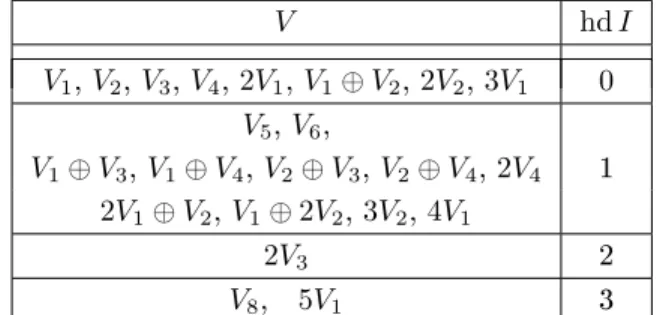
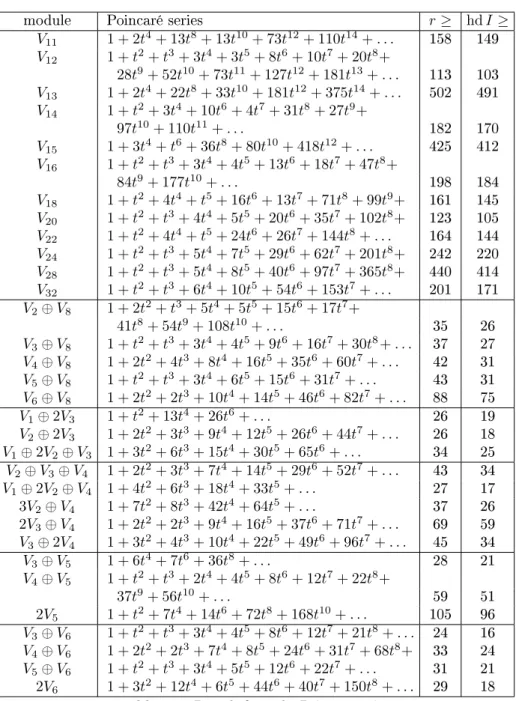
generating invariants. Brouwer and I [BP11] extended Popov's classication
and determined for
p
= 1
the cases with
hd
I
≤
100
and for
p >
1
the cases
with
hd
I
≤
15
(see also Chap.
6
in this thesis). In the case of a single binary
form, the homological dimension
hd
I
rapidly increases if the degree is
≥
9
. The
bigger the homological dimension
hd
I
is, the harder it is to nd generating
invariants of
I
. The following table contains, for illustration, the values of
hd
I
for binary forms of degree less than 14:
degree
1
2
3
4
5
6
7
8
9
10
11
12
13
hd
I
0
0
0
0
1
1
25
3
85
98
≥
149
≥
103
≥
491
r
1
1
1
2
4
5
30
9
92
106
≥
158
≥
113
≥
502
With his book published in 1939 Weyl [Wey46] aimed to give a modern
introduction to the theory of invariants, translating the problem of nding the
generating invariants of binary forms into the language of representation theory
and the study of actions of the semisimple groups. He thought it was high time
for a rejuvenation of the classic invariant theory, which has fallen into an almost
petried state([Wey46]). Parshall [Par90] talks in 1990 about a myth saying
that
the death certicate of invariant theory eectively reads 15 February
1890. On that date, the twenty-eight-years-old David Hilbert signed
o his paper Über die Theorie der algebraischen Formen [Hil90] and
presented his proof of the so-called nite basis theorem to the
read-ership of the mathematische Annalen, a theorem and proof that
killed an entire area. Two and a half years later, he completed
yet another invariant-theoretic work, entitled Über die vollen
Invari-antensysteme [Hil93] and put an end to any lingering hopes of the
theory's resurrection. Thus, after fty years of vigorous life, one
of the nineteenth century's major areas of mathematical research
abruptly ceased to exist.([Par90])
This myth originated probably from Weyl's words on Hilberts papers:
His papers (1890/92) mark a turning point in the history of
invari-ant theory. He solves the main problems and thus almost kills the
whole subject. ([Wey46, page 27])
But we should note the words turning point and almost in Weyl's quote,
as Parshall [Par90] suggested. In the 1960's Mumford [Mum65] translated
pro-blems of invariant theory into the language of algebraic geometry. One of his
key insights was that one could analyse the geometry of group actions without
actually knowing the invariants. For instance, he proved that a vector in a
repre-sentation cannot be distinguished from zero by means of invariants if and only
if there is a one-parameter subgroup sending the vector arbitrarily close to zero.
The remarkable thing here is that a purely algebraic property (namely that all
non constant homogeneous invariants vanish on a vector) can be checked in a
purely geometric fashion (involving orbits of the vector under one-parameter
subgroups). As a consequence, we know for instance that all invariants of
bi-nary forms of degree
n
vanish on the forms having a root of multiplicity
>
n2without any a priori information on the invariants themselves. Mumford's
re-sult generalises Hilbert's criterion mentioned in Chap.
2.7.1, which will be used
throughout this thesis.
In the second half of the 20th century new techniques in commutative algebra
became available that can be applied to invariant theory. These techniques are
both of a theoretical nature, such as Hochster& Roberts's result that invariant
rings of reductive group representations are Cohen Macaulay [HR74], and of an
algorithmic nature, such as the use of Gröbner bases in invariant theory [DK00]
or the computation of Poincaré series of invariant rings [Spr77,
Bri82,
Bro94].
Such algebraic and algorithmic techniques are the starting point of this thesis.
This thesis is organised as follows.
In Chapter
2
we introduce the denitions and notations that will be used in
this thesis. In Chapter
3
we present the computational methods that we use for
nding the generating invariants of
SL
2-modules. In Chapter
4
we nd the basic
invariants of
Vn
for
n
∈ {2
,
3
, . . . ,
10}
, and give explicit systems of parameters in
all these cases (Chap.
4.8
and
4.9
are joint work with Brouwer [BP10a,
BP10b]).
In Chapter
5
we review classical results regarding the invariants of
Vn
1⊕
. . .
⊕
Vn
p, with
p
≥
2
. We correct a result of Winter [Win80] on the generating
covariants of
V
2⊕
V
5(see Chapter
5.16) and results of Gundelnger [Gun69]
and Sylvester [Sy78b,
Sy78c,
Sy78d] on the generating covariants of
V
3⊕
V
4(see
Chap.
5.19, joint work with Brouwer [BP12]). In Chapter
6
we classify the
mo-dules
V
n1⊕
. . .
⊕
V
npwhose algebras of invariants have a homological dimension
Chapter 2
Invariant Theory
2.1 Denitions and notation
Recall from the introduction the denition of the group
SL
2. Denote by
Vn
the
space of binary forms of degree
n
.
Consider a rational, nite-dimensional
SL
2-module
V
. Then there exist
(
n
1, . . . , n
p)
such that
V
'
V
n1⊕
. . .
⊕
V
npas
SL
2-modules (cf. [Spr77, 3.2.2]).
The group
SL
2acts on the algebra of polynomial functions on
V
n1⊕
. . .
⊕
V
npvia
g
·
j
(
f
1, . . . , f
p) =
j
(
g
−1·
f
1, . . . , g
−1·
f
p)
,
where
g
∈
SL
2,
j
∈ O(
Vn1
⊕
. . .
⊕
Vn
p)
and
(
f
1, . . . , fp
)
∈
Vn1
⊕
. . .
⊕
Vn
p.
Denition 2.1.1. Consider
V
=
V
n1⊕
. . .
⊕
V
np. An invariant of
V
is an
element
j
in the algebra
O(
V
)
of polynomial functions on
V
such that
g
·
j
=
j
for all
g
∈
SL
2. The set of invariants of
V
is denoted
O(
V
)
SL2.
Example 2.1.1. Consider the binary form
f
=
a
0x
2+ 2
a
1xy
+
a
2y
2∈
V
2of
degree 2. The polynomial
j
(
f
) =
a
21
−
a
0a
2is an invariant of
V
2.
Indeed, for
g
=
m np q∈
SL
2,
mq
−
np
= 1
, we have
g
·
j
(
f
) =
j
(
g
−1·
f
)
and
g
−1·
f
=
a
0(
mx
+
ny
)
2+ 2
a
1(
mx
+
ny
)(
px
+
qy
) +
a
2(
px
+
qy
)
2=
= (
a
0m
2+ 2
a
1mp
+
a
2p
2)
x
2+ 2(
a
0mn
+
a
1np
+
a
1mq
+
a
2pq
)
xy
+
+ (
a
0n
2+ 2
a
1nq
+
a
2q
2)
y
2.
It follows that
j
(
g
−1·
f
) = (
a
0mn
+
a
1np
+
a
1mq
+
a
2pq
)
2−
(
a
0m
2+ 2
a
1mp
+
a
2p
2)(
a
0n
2+
+ 2
a
1nq
+
a
2q
2) = (
a
21−
a
0a
2)(
mq
−
np
)
2=
a
21−
a
0a
2=
j
(
f
)
,
hence
g
·
j
(
f
) =
j
(
f
)
for all
g
∈
SL
2.
The invariant
j
has a geometric interpretation:
j
(
f
) = 0
if and only if
f
has a
double root.
Example 2.1.2. Let
f, `
∈
V
2⊕
V
1, with
f
=
a
0x
2+ 2
a
1xy
+
a
2y
2∈
V
2and
`
=
b
0x
+
b
1y
∈
V
1. The polynomial
j
(
f, `
) =
a
0b
21−
2
a
1b
0b
1+
a
2b
20is an
invariant of
V
2⊕
V
1. Indeed, for
g
=
m n p q
∈
SL
2,
mq
−
np
= 1
, we have
g
·
j
(
f, `
) =
j
(
g
−1·
f, g
−1·
`
)
and
g
−1·
f
= (
a
0m
2+ 2
a
1mp
+
a
2p
2)
x
2+ 2(
a
0mn
+
a
1np
+
a
1mq
+
a
2pq
)
xy
+
+ (
a
0n
2+ 2
a
1nq
+
a
2q
2)
y
2,
g
−1·
`
= (
b
0m
+
b
1p
)
x
+ (
b
0n
+
b
1q
)
y.
It follows that
j
(
g
−1·
f, g
−1·
`
) = (
a
0m
2+ 2
a
1mp
+
a
2p
2)(
b
0n
+
b
1q
)
2−
−
2(
a
0mn
+
a
1np
+
a
1mq
+
a
2pq
)(
b
0m
+
b
1p
)(
b
0n
+
b
1q
)+
+ (
a
0n
2+ 2
a
1nq
+
a
2q
2)(
b
0m
+
b
1p
)
2=
= (
a
0b
21−
2
a
1b
0b
1+
a
2b
20)(
mq
−
np
)
2=
j
(
f, `
)
,
hence
g
·
j
(
f, `
) =
j
(
f, `
)
for all
g
∈
SL
2.
The invariant
j
has a geometric interpretation:
j
(
f, `
) = 0
if and only if
`
and
f
have a common root.
Denition 2.1.2. Consider
V
=
V
n1⊕
. . .
⊕
V
np. A covariant of
V
of order
m
and degree
d
of
V
is an
SL
2-equivariant polynomial map
φ
:
V
→
V
mwhich
is homogeneous of degree
d
. In other words, for all
g
∈
SL
2we have
φ
(
g
·
v
) =
g
·
φ
(
v
)
, where
v
∈
V
, and for all
t
∈
C
we have
φ
(
tv
) =
t
dφ
(
v
)
, where
v
∈
V
.
The set of covariants of
V
is denoted
C(
V
)
.
Remark 2.1.1. The covariants of
V
of order 0 are the homogeneous
invari-ants of
V
. They form the homogeneous components of the ring
O(
V
)
SL2=
L
d
O(
V
)
SL2
d
of invariants of
V
, where
O(
V
)
SL2
d
are the invariants of
V
of
de-gree
d
. The covariants form a doubly graded ring
C(
V
) =
L
d,e
C(
V
)
(d,e), where
C(
V
)
(d,e)are the covariants of
V
of degree
d
and order
e
.
Denition 2.1.3. For a covariant of
V
nof order
m
and degree
d
we dene its
co-order to be
(
nd
−
m
)
/
2
.
The main way to construct covariants is via transvectants (Überschiebungen).
They are derived from the Clebsch-Gordan decomposition of the
SL
2-module
Vm
⊗
Vn
, with
m
≥
n
:
Vm
⊗
Vn
'
Vm
+n⊕
Vm
+n−2⊕
. . .
⊕
Vm
−n([
KP96
,
9
.
1])
.
This decomposition denes for each
p
,
0
≤
p
≤
n
, an
SL
2-equivariant linear map
Vm
⊗
Vn
→
Vm
+n−2p, denoted
(
f, h
)
7→
(
f, h
)
p, and called the p-th transvectant.
It is given explicitly by the following formula:
(
f, h
)
7→
(
f, h
)
p:=
(
m
−
p
)!(
n
−
p
)!
m
!
n
!
pX
i=0(−1)
ip
i
∂
pf
∂x
p−i∂y
i∂
ph
∂x
i∂y
p−i(2.1)
(see [Olv99, Chap. 5]). The maps
(
f, h
)
7→
(
f, h
)
pare clearly bilinear. Also, if
f
=
`
m1
and
h
=
`
n2, with
`
1=
a
0x
+
a
1y
and
`
2=
b
0x
+
b
1y
, we have then
(
`
m1, `
n2)
p=
`
m−p 1`
n−p 2[
`
1, `
2]
pwhere
[
`
1, `
2] := det
a0a1 b0 b1=
a
0b
1−
a
1b
0.
Furthermore, if
g
=
m np q∈
SL
2, with
mq
−
np
= 1
, we have
(
g
·
`
m1, g
·
`
n2)
p= (
g
·
`
1)
m−p(
g
·
`
2)
n−p[
`
1, `
2]
p(
mq
−
np
)
p=
= (
g
·
`
1)
m−p(
g
·
`
2)
n−p[
`
1, `
2]
p=
g
·
(
`
m1, `
n 2)
p.
Because
V
mand
V
nare linearly spanned by powers of linear forms, it
fol-lows that
(
f, h
)
7→
(
f, h
)
pare
SL
2-equivariant. They are also non-zero and
as
V
m+n, V
m+n−2, . . . , V
m−nare irreducible representations, it follows that
Vm
⊗
Vn
→
Vm
+n⊕
Vm
+n−2⊕
. . .
⊕
Vm
−n,(
f, h
)
7→
nX
p=0(
f, h
)
pis surjective. But
Vm
⊗
Vn
and
Vm
+n⊕
Vm
+n−2⊕
. . .
⊕
Vm
−nhave the same
dimension, which implies that the map is actually a bijection.
Example 2.1.3. Let
f
=
a
0x
3+ 3
a
1x
2y
+ 3
a
2xy
2+
a
3y
3. The map
V
3→
V
2,
f
7→(
f, f
)
2= 2(
a
0a
2−
a
21)
x
2+ 2(
a
0a
3−
a
1a
2)
xy
+ 2(
a
1a
3−
a
22)
y
2=
=
1
18
[
∂
2f
∂x
2∂
2f
∂y
2−
(
∂
2f
∂x∂y
)
2]
,
denes a covariant of
V
3of order 2 and degree 2. Note that the transvectant
(
f, f
)
2coincides, up to a constant, with the Hessian of
f
. This transvectant
vanishes if and only if
f
is the
3
thpower of a linear form (see Proposition
2.7.2).
Remark 2.1.2. The covariants of
V
can be identied with the invariants of
V
1⊕
V
: we have
V
1⊕
V
'
V
1∗⊕
V
as
SL
2-representations and the algebra of
covariants of
V
is isomorphic to
O(
V
1∗⊕
V
)
SL2(see [Pro07, Chap. 15]). Each
covariant
φ
of
V
of order
m
corresponds to the invariant of
V
1⊕
V
dened by
the transvectant
(
φ
(
v
)
, `
m)
m, where
`
∈
V
1.
Notation agreement. Consider
f
∈
Vm
. One obvious covariant of
Vm
of
degree 1 and order
m
is the identity map on
Vm
. From now by the covariant
f
we will mean the identity map on
Vm
.
Given two covariants
φ
1:
V
m→
V
dand
φ
2:
V
m→
V
eof
V
mof orders
d
,
re-spectively
e
, they dene the covariants
ψ
p:
V
m→
V
d+e−p,
f
7→
(
φ
1(
f
)
, φ
2(
f
))
p,
with
0
≤
p
≤
min(
d, e
)
. By the covariant
(
φ
1, φ
2)
pwe will mean the map
V
m→
V
d+e−p,
f
7→
(
φ
1(
f
)
, φ
2(
f
))
p.
Theorem 2.1.3. (Gordan [Gor68]) Let
f
∈
V
n. Then, the covariants of
V
nare generated by a nite number of iterated transvectants
f,
(
f, f
)
p,
(
f,
(
f, f
)
p)
q, . . .
In particular (see [Gor68, 2]), if
C
is a covariant of
f
of degree
d
, then
C
can be written as a linear combination of transvectants
(
f, Ci
)
ri, where
Ci
are
covariants of
f
of degree
d
−
1
.
This gives a method for nding the generating covariants of
f
: suppose
we know the generating covariants of
f
up to degree
d
−
1
. In order to nd
the generating covariants of degree
d
, we have to write down all transvectants
(
f, Cd
−1)
r, for suitable
r
, where
Cd
−1is a covariant of degree
d
−
1
, namely a
generating covariant of degree
d
−1
or a product of total degree
d
−1
of generating
covariants of lower degrees. Then we select out of this set the irreducible ones
(we call a covariant
C
reducible if
C
is contained in the algebra generated by
all covariants of degree
≤
deg
C
and order
≤
ord
C
, where at least one of the
inequalities is strict).
Lemma 2.1.4. [KW99] Let
V
=
V
n1⊕
. . .
⊕
V
npbe a representation of
SL
2and
C
1, . . . , Cr, C
covariants of
V
, of orders
ord
Ci
=
ei
. Then the
transvec-tant
(
C
1. . . Cr, C
)
kis reducible if there is a strict subset
S
⊂ {1
,
2
, . . . , r
}
and
integers
ki
≤
ei
such that
k
=
P
i∈S
ki
.
Proposition 2.1.5. Let
f
∈
Vn
and consider covariants
C
1, . . . , Cr
of
f
, with
r
≥
2
. If the covariant
C
= (
C
1. . . Cr, f
)
kis irreducible, then
ord
C
≤
n
−
r
. If
n
is even, then
ord
C
≤
n
−
2
r
+ 2
.
Proof. Denote
mi
= ord
Ci
. W.l.o.g. we can assume
m
1≥
m
2≥
. . .
≥
mr
>
0
.
From the denition of transvectants,
k
must be
≤
n
. From Lemma
2.1.4
we
obtain:
m
1+
m
2+
. . .
+
m
r−1< k
≤
m
1+
m
2+
. . .
+
m
r.
Then,
ord
C
=(
m
1+
m
2+
. . .
+
m
r) +
n
−
2
k
≤
≤(
m
1+
m
2+
. . .
+
mr
) +
n
−
2(
m
1+
m
2+
. . .
+
mr
−1+ 1) =
=
n
−
(
m
1−
mr
+ (
m
2+
. . .
+
mr
−1) + 2)
≤
≤
n
−
r
If
n
is even, then all
m
iwill be even as well and then
n
−
(
m
1−
m
r+ (
m
2+
. . .
+
m
r−1) + 2)
≤
n
−
2
r
+ 2
.
Example 2.1.4. Consider
f
∈
V
1. Then, we have
(
f, f
)
p= 0
for
p
6= 0
. The
covariants of
V
1are generated by
f
.
Consider
f
∈
V
2. The covariants of
V
2are generated by
f
and
(
f, f
)
2; the
invariants of
V
2are generated by
(
f, f
)
2(see Chap.
4.1).
Consider
f
∈
V
3. The covariants of
V
3are generated by
f,
(
f, f
)
2,
(
f,
(
f, f
)
2)
1,
((
f, f
)
2,
(
f, f
)
2)
2=
−(
f,
(
f,
(
f, f
)
2)
1)
3(see Chap.
5
.
3
.
1
).
The invariants of
V
3are generated by
((
f, f
)
2,
(
f, f
)
2)
2(see Chap.
4.2).
Consider
f
∈
V
4. The covariants of
V
4are generated by
f,
(
f, f
)
2,
(
f, f
)
4,
(
f,
(
f, f
)
2)
1,
(
f,
(
f, f
)
2)
4(see Chap.
5
.
4
.
1
).
The invariants of
V
4are generated by
(
f, f
)
4and
(
f,
(
f, f
)
2)
4(see Chap.
4.3).
For further examples see Chap.
4
and
5.
Hilbert [Hil90] generalised Gordan's result to a system of several homogeneous
forms in a nite number of variables. Formulated for the particular case of the
SL
2-module
V
n1⊕
. . .
⊕
V
np, Hilbert's result is:
Theorem 2.1.6. (Hilbert [Hil90]) Consider
V
=
Vn1
⊕
. . .
⊕
Vn
p. The algebra
of invariants of
V
is nitely generated, i.e. there exist nitely many invariants
j
1, . . . , j
r∈ O(
V
)
SL2such that
O(
V
)
SL2=
C
[
j
1, . . . , j
r]
.
Example 2.1.5. Let
f
1, f
2∈
V
3. The invariants of
V
3⊕
V
3are generated by
(
f
1, f
2)
3,
((
f
1, f
1)
2,
(
f
1, f
1)
2)
2,
((
f
2, f
2)
2,
(
f
2, f
2)
2)
2,
((
f
1, f
1)
2,
(
f
2, f
2)
2)
2,
((
f
1, f
1)
2,
(
f
1, f
2)
2)
2,
((
f
2, f
2)
2,
(
f
1, f
2)
2)
2,
((
f
1,
(
f
1, f
2)
2)
2,
(
f
2,
(
f
1, f
2)
2)
2)
1(see Chap.
5.3.2).
Let
f
∈
V
2and
g
∈
V
4. The invariants of
V
2⊕
V
4are generated by
(
f
3,
(
g,
(
g, g
)
2)
1)
6,
(
f
2,
(
g, g
)
2)
4,
(
f
2, g
)
4,
(
g,
(
g, g
)
2)
4,
(
g, g
)
4,
(
f, f
)
2(see Chap.
5.10).
For further examples see Chap.
5.
2.2 The symbolic method
The symbolic method was developed by Aronhold and Clebsch in the middle
of the nineteenth century. The symbolic calculus permits the reduction of the
computations with binary forms of degree
n
to the special cases of the
n
th power
of a linear form
(
α
1x
+
α
2y
)
n. The classics proved that the invariants of binary
forms have symbolic representations as products of factors of type
[
αβ
]
, where
[
αβ
]
stays for the determinant
α
1β
2−
α
2β
1. The manipulation of invariants got
simplied by representing them in succinct symbolic expressions.
Kung & Rota [KR84] gave in 1984 a rigorous and yet manageable account of
the umbral or symbolic calculus that was performed in the nineteenth century.
We introduce in this section the symbolic calculus, closely following the ideas
of Kung & Rota [KR84].
Consider an alphabet
A
=
{
α, β, . . . , ω, u
}
consisting of an innite
num-ber of Greek letters and the Roman letter
u
. The letters in
A
are called
umbral letters. To each Greek letter
α
and to
u
we associate two variables,
α
1and
α
2, respectively
u
1and
u
2. The ring of polynomials in the variables
α
1, α
2, β
1, β
2, . . . , ω
1, ω
2, u
1, u
2is an innite-dimensional vector space called the
umbral space
U
. We dene a linear operator
U
from the umbral space
U
to the
space
C
[
A
0, A
1, . . . , An, X, Y
]
of polynomials in the variables
A
0, . . . , An, X, Y
in the following way (we denote the image of an element
P
∈ U
under
U
by
h
U
|
P
i
):
h
U
|
α
j1α
k2i
=
(
A
k,
if
j
+
k
=
n,
0
,
if
j
+
k
6=
n.
h
U
|
u
i1i
= (−
Y
)
i,
h
U
|
u
j2i
=
X
j,
h
U
|
α
i1α
j2β
1kβ
2l. . . u
p1u
q2i
=
h
U
|
α
1iα
j2ih
U
|
β
1kβ
2li
. . .
h
U
|
u
p1ih
U
|
u
q2i
.
U
is called the umbral operator associated to the space of binary forms of degree
n
. If
f
=
P
ni=0
n i