Influencer on Social Network
Pajaree LiengpraditTechopreneurship and Innovation Management Program, Graduate School, Chulalongkorn University, Bangkok, Thailand
Sukree Sinthupinyo
Department of Computer Engineering, Faculty of Engineering, Chulalongkorn University, Bangkok, Thailand
Pongpun Anuntavoranich
Faculty of Architecture,
Chulalongkorn University, Bangkok, Thailand
Abstract - One popular marketing strategy used by SMEs is Viral Marketing through Social Network such as Facebook. Therefore, the ability to find out and identify who the influencer is in the Social Network such as Facebook is very important to the marketing scheme and implementation. Influencers who are directly related to the topic of the interested marketing issue is the most essential because it is not likely that everyone just anybody would be interested or looked upon as the specialist in everything. Furthermore, it is important to be able to screen influencers so that the chosen influencer is a specialist in the marketing and sales support or campaigning for the product or service that is at hand. Otherwise, time and money will be invested ineffectively or the results obtained may not be as efficient as it should be. This article suggests a model to be used for screening and identifying an influencer that directly serves to influence the target group accurately.
Keywords - Social Network, Influencer, Viral Marketing, Heterogeneous Network
I. INTRODUCTION
The role of Social Network in our lives has gained greater importance over the years. The
influences from the Social Network on the decision to buy products and services are created through means such as postings on Facebook about food, songs, movies, series or fashion. For example, imagine if 3-4 friends have been to a specific restaurant near work place or the university and posted good comments about the place or the food at similar times, that would surely trigger your interest and make you want to go and try it out. This is most likely because your friends’ posts are already something of your interest. On the other hand, if your friends’ post is not something that you are interested in then you would probably overlook it or just let it be. Therefore, identifying the influencer is not identifying the user with the most friends but rather the user with the most influence in specific topics. For example, if a restaurant near a university and wants to make themselves known, they will try to find an influential user on Facebook and send them an invitation to a free meal at the restaurant. Likewise, it must be noted that if the influencer is more than a 100 km away from the restaurant, shop, fashion store, photography shop or even food experts are likely to ignore the invitation. This means a loss in marketing and investment of the stores. This would also mean that people would also completely ignore the invitations sent and therefore, the investment lost. Thus, wouldn’t it be better if we can identify an influencer
B C D E A F In-degree=5 Out-degree=4
that is not only standing out because of specific topics but is also situated in the area? This way, the word-of-mouth or viral marketing will be most effective. From the information presented above, the basis for in-depth analysis of the behaviour and the relationship of consumers for product and service development that serves the needs of the target group is formed.
II. LITERATURE REVIEW
A. Social Network
When two people meet, they will find a common interest and discuss about it. That common interest is the starting point of connection with other people and can also be called the node [1]. Network centrality can be found from the Degrees which are the numbers of members that are directly connected to that node [2].
Fig 1. Social Network Map: In-Degree and Out-Degree
Fig 1. shows the activity of members in the Social Network where the A node is the node which other nodes would like to build a relationship most. The figure shows that there are 5 in-degrees for the A node. At the same time, node E is the node which interacts with others the most. The Fig1. shows that there are 4 out-degrees for node E.
In Thailand, the most popular Social Network platform is most likely Facebook, based on the statistics from February 2014 which shows that there are 26 million Facebook users in Thailand which ranks Thailand at third place in ASEAN for the amount of Facebook user [3]. There are many reasons that make Facebook popular in
Thailand and many contributing factors. Some of these factors are such as the decrease in the price of gadgets such as smartphones, tablets and notebooks which allows people to have more access and ownership. In addition, the 3G internet network which was only officially launched in Thailand in mid-2013 promoted the use of the internet and users are still increasing on a yearly basis [4]. Other than that, Facebook is easy to use and has the ability to connect people and find long lost friends. Today, it has become a port for gathering between families and friends as well. Therefore, this Social Network platform can be used as a medium for business marketing such as advertisement, campaigns, online activities and sometimes even direct sales.
B. Influencer
The study of peoples’ behaviour will show that everyone is somehow influenced by their friends’ behaviour to a certain degree. People are likely to connect and exchange ideas with others who are similar in the concept of thought in one way or the other [5]. These behaviours will lead to a relationship between users who are netted in the complex network but still, there is a channel for the flow of thought which influences each other in that relationship all the time. The thought leader in each network will be the person who is praised by the members as the one with the most knowledge on a specific topic. This person may be the one who others sought out for advices when making the decision to buy because analysis of interactions shows that most people will consult with their friends before making the decision to buy certain products or services [6]. Some users are more popular than others and have many connections. The degree of centrality is the indicator in the graph theory to determine the relative importance based on the links and users. The person with the higher degree of centrality will be the more influential in the specified Social Network platform [7]. In viral marketing scheme, this most influential person will be selected and the message sent to this person will be disseminated in their network.
This is also referred to as the “performance” of a centrality measure [8]. Therefore, from Fig1, the in-degree indicators show that A is the top influencer of this Social Network because it is the one where friends like to come and interact with most. However, this analysis doesn’t specify the topic of interaction as yet.
C. Viral Marketing
The marketing scheme that can make most efficient use of network value of customers is viral marketing [9]. This is because viral marketing uses the benefits from networks of influence on their customers in order to change their behaviours and reaches their goals with low budget. Moreover, viral marketing is an economical way to promote products and services. Most of the marketing and public relations are done through the strongest influencer in the market. The relationship between people in the network makes viral marketing more cost-effective and gains more benefits than direct marketing [10].
Viral marketing or word-of-mouth differs from other marketing schemes in that it depends on confidence and trust amongst friends, co-workers and family. Research results show that people will believe in information that they have received from their close social circle more than other sources of information and channels of communications such as television, newspaper and online media [10, 11]. The growing popularity of various online Social Network platform such as Facebook, Myspace and Twitter allows for higher use of online viral marketing scheme because online Social Network platforms are like large scale society [12]. Viral marketing has become one of the trend setting mechanism for marketing in creating awareness and buzzing [13]. Word-of-mouth can lead to the decision to buy of a customer and today’s technological innovations have helped marketing personnel to have a tool which can control the word-of- mouth which influences the customers’ decision to buy [14]. SMEs like to use viral marketing in creating
brand awareness. This method can create clear visibility and has rapid and almost immediate results such as higher sales volume as the number of the viewers on the web becomes more and their frequency of visits are higher. For example, the video campaign on Youtube receiving more than a billion viewer or the increase in the number of friends on Facebook may indicate the success of the viral marketing campaign. The sales revenue may increase by not so much if prior to the viral marketing campaign [15].
D. Heterogeneous Network
On social websites, for example Facebook and Twitter, users seems to have the chance to follow influential friends in their social network and can retweet information or pass it on by clicking like or share. The influences from each user will vary depending on the topic such as entertainment, marketing and research. Therefore, apart from the network structure, the information shared on the network is also important in determining whether it will be disseminated through the network or not. It is important to perform data mining in the heterogeneous networks as well. For example, the topic of research for students is a result of the influences from their advisors whereas their hobbies will receive more influence from their family and close friends in their daily life. Therefore, it can be concluded that the degree of influence from different groups on a person is different according to the topic [7].
Most of the study prior to this focuses only on finding the influencer from the Social Network platform as the one with the most links. It was believed that the one with the most links is the influencer that should be targeted without further analyzing the topic of influence or any other factors [16]. This is essential, especially for marketing schemes that would like their influencer to talk about and promote their products or services positively to increase sales. Think about what the impact may be, if Mr. A falls in the conditions of being an influencer in the cyber network likes Facebook a great deal of
followers consistently reading his post and liking it or commenting on it. What would happen if Business B hires Mr. A to talk and post about their product without knowing that A is an influencer on food and likes to post about places to eat whereas the product of B is car parts. The result of this would be that A’s friends may see the posts on B’s product from his wall but are likely to ignore them because it is not in their common interest and A is not specifically the expert on this topic as accepted by his friends. We assume that the topic of influence is hidden in the users’ posts. From that, the degree of influence will be considered one by one and only the top one shall be selected per user.
III. HYPOTHESES
It is generally expected that viral marketing will allow information to be disseminated by themselves. However, in reality, it is not the case. This is because most users will not share information that is posted by friends or general users like themselves. Assuming that all users set their privacy on Facebook to “Friends”, that would mean if A updates their status by posting a comment or picture then B, A’s friend, can come in and like or comment on the post but C, B’s friend, cannot like/comment/share that post because that information is from A and it was set to only be able to be dispersed for 2 hops only.
H1: Most information (>80%) posted by users will not be shared
H2: Most Users (>80%) will be interested in about 3-4 topics only
IV. METHODS
Data collection from Facebook will be performed using the convenience sampling method. The information collected will be the last 10 statuses or wall posts from 100 users. A total of 1,000 statuses will be collected. These statuses will be screened for the ones posted by the users themselves, not shared
from other sources such as big brands, games, YouTube, Pantip, and etc.
V. RESULTS
From the 1,000 statuses collected, there were 53 statuses that were shared information from other sources. This means that shared information makes up only 5.3% of the posts by a user and 94.7% will be information from the user themselves which will stop at 2 hops, their friends and the friend’s of friend only. This is in line with the hypothesis of this research. Users have different interests but generally, there are variety main topics of interests that are posted on an individual wall. The research results found that 43% of users posts about 4 topics on their wall, 38% posts 3 topics and 14% posts about 5 topics. Users posting 1-2 topics and more than 5 topics make up only 5% of the total users. This means that more than 80% of the users are interested in 3-4 topics (43%+38%=81%). This result is in line with the hypothesis. The top five topics that interest most users are food (restaurants/cooking), fashion (clothes/cosmetics), music/movies/series, politics and idols/celebrities accordingly. These 5 topics support the finding of previous researches but in different order of importance. Therefore, from the results above, it can be concluded that viral marketing will be at its highest efficiency if the influencer identified is the one who can distribute the information which directly supports their direct interest. This is because most information will only be transferred to 2 hops.
VI. CONCEPTUAL FRAMEWORK FOR IDENTIFY SPECIFIC INFLUENCER
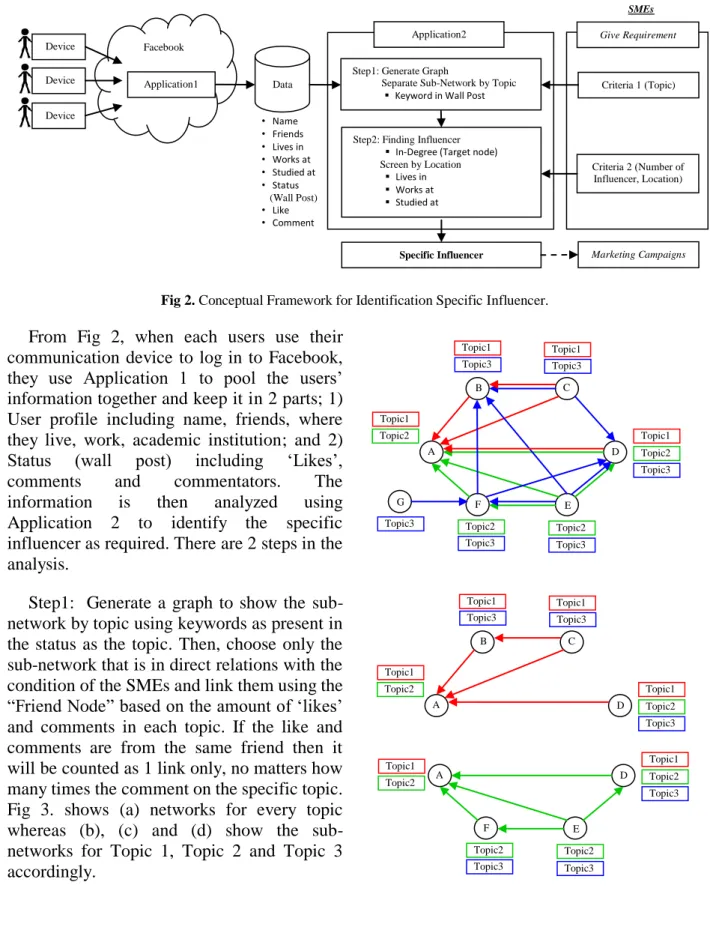
The result as stated above shows that the information that the users post on their wall can spread to 2 hops. Therefore, in identifying the influencer for marketing scheme, it is essential that the chosen person must fit the needs accurately. The researcher would like to s u g g e s t t h e f o l l o w i n g c o n c e p t u a l
A B C F E D Topic2 Topic1 Topic3 Topic1 Topic3 Topic1 Topic2 Topic3 Topic2 Topic3 Topic2 Topic1 Topic3 G Topic3 A B C D Topic2 Topic1 Topic3 Topic1 Topic3 Topic1 Topic2 Topic1 Topic3 Device Data • Name • Friends • Lives in • Works at • Studied at • Status (Wall Post) • Like • Comment
Step1: Generate Graph
Separate Sub-Network by Topic
Keyword in Wall Post
Step2: Finding Influencer
In-Degree (Target node) Screen by Location Lives in Works at Studied at SMEs GiveRequirement Criteria 1 (Topic) Criteria 2 (Number of Influencer, Location) Application2
Specific Influencer Marketing Campaigns
Device
Device
Application1
framework for identification of specific influencer as follows;
Fig 2. Conceptual Framework for Identification Specific Influencer.
From Fig 2, when each users use their communication device to log in to Facebook, they use Application 1 to pool the users’ information together and keep it in 2 parts; 1) User profile including name, friends, where they live, work, academic institution; and 2) Status (wall post) including ‘Likes’, comments and commentators. The information is then analyzed using Application 2 to identify the specific influencer as required. There are 2 steps in the analysis.
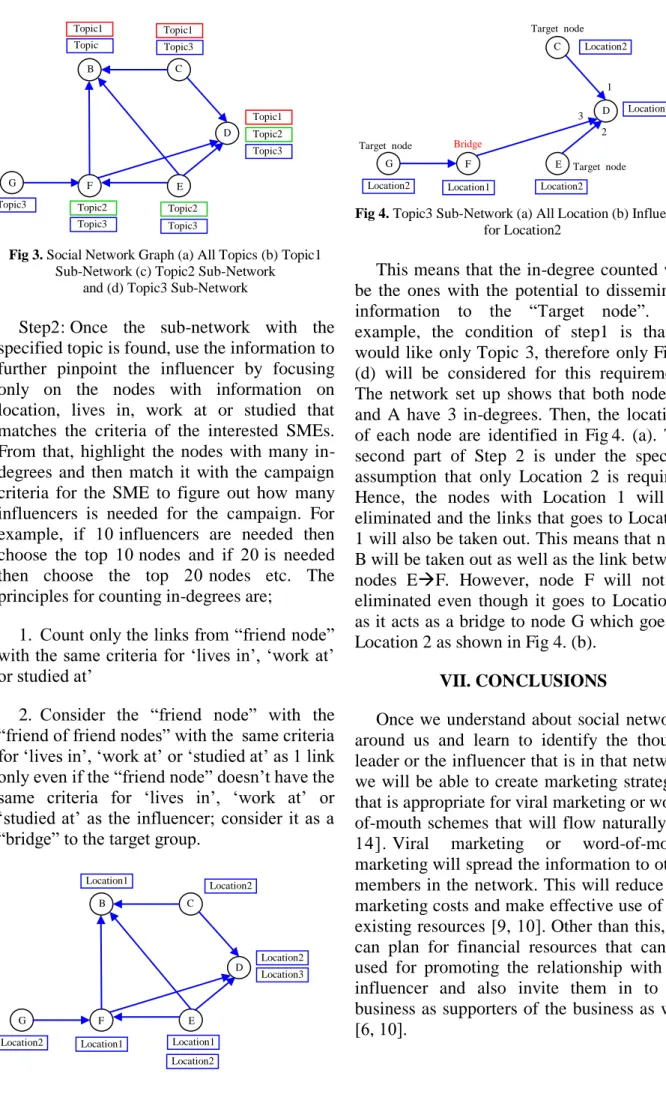
Step1: Generate a graph to show the sub-network by topic using keywords as present in the status as the topic. Then, choose only the sub-network that is in direct relations with the condition of the SMEs and link them using the “Friend Node” based on the amount of ‘likes’ and comments in each topic. If the like and comments are from the same friend then it will be counted as 1 link only, no matters how many times the comment on the specific topic. Fig 3. shows (a) networks for every topic whereas (b), (c) and (d) show the sub-networks for Topic 1, Topic 2 and Topic 3 accordingly. A F E D Topic2 Topic1 Topic2 Topic3 Topic2 Topic3 Topic2 Topic1 Topic3
Fig 3. Social Network Graph (a) All Topics (b) Topic1 Sub-Network (c) Topic2 Sub-Network
and (d) Topic3 Sub-Network
Step2: Once the sub-network with the specified topic is found, use the information to further pinpoint the influencer by focusing only on the nodes with information on location, lives in, work at or studied that matches the criteria of the interested SMEs. From that, highlight the nodes with many in-degrees and then match it with the campaign criteria for the SME to figure out how many influencers is needed for the campaign. For example, if 10 influencers are needed then choose the top 10 nodes and if 20 is needed then choose the top 20 nodes etc. The principles for counting in-degrees are;
1. Count only the links from “friend node” with the same criteria for ‘lives in’, ‘work at’ or studied at’
2. Consider the “friend node” with the “friend of friend nodes” with the same criteria for ‘lives in’, ‘work at’ or ‘studied at’ as 1 link only even if the “friend node” doesn’t have the same criteria for ‘lives in’, ‘work at’ or ‘studied at’ as the influencer; consider it as a “bridge” to the target group.
Fig 4. Topic3 Sub-Network (a) All Location (b) Influencer for Location2
This means that the in-degree counted will be the ones with the potential to disseminate information to the “Target node”. For example, the condition of step1 is that it would like only Topic 3, therefore only Fig 3 (d) will be considered for this requirement. The network set up shows that both nodes B and A have 3 in-degrees. Then, the locations of each node are identified in Fig4. (a). The second part of Step 2 is under the specific assumption that only Location 2 is required. Hence, the nodes with Location 1 will be eliminated and the links that goes to Location 1 will also be taken out. This means that node B will be taken out as well as the link between nodes EF. However, node F will not be eliminated even though it goes to Location 1 as it acts as a bridge to node G which goes to Location 2 as shown in Fig 4. (b).
VII. CONCLUSIONS
Once we understand about social networks around us and learn to identify the thought leader or the influencer that is in that network we will be able to create marketing strategies that is appropriate for viral marketing or word-of-mouth schemes that will flow naturally [6, 14].Viral marketing or word-of-mouth marketing will spread the information to other members in the network. This will reduce the marketing costs and make effective use of our existing resources [9, 10]. Other than this, we can plan for financial resources that can be used for promoting the relationship with the influencer and also invite them in to the business as supporters of the business as well [6, 10]. B C F E D Topic Topic1 Topic3 Topic1 Topic2 Topic3 Topic2 Topic3 Topic2 Topic1 Topic3 G Topic3 B C F E D Location1 Location2 Location3 Location1 Location1 Location2 G Location2 C F E D Location2 Location1 Location2 G Location2 Location2 Bridge Target node Target node Target node 1 2 3
Therefore, for viral marketing or word-of-mouth marketing to reach its highest efficiency, it is necessary to be able to identify the influencer that directly relates to our specific business. Moreover, the influencer must appropriately fits the profile of our product or service campaign. Influencers should be identified by topic prior to selecting the most appropriate lead. Then, the last but not least important of criteria is to select the influencer that is within accessible distance of our products or services so that they can come and try out our products and services during our campaigns and share their first hand experiences with their cyber social network. This will help to create and trigger the interests of their friends in the same topic. Most importantly, if they are in the nearby area, it is most likely that they will come back for more services and products.
ACKNOWLEDGMENTS
The author’s wishes to thank the Graduate School, Chulalongkorn University for providing the grant “CU. Graduate School Thesis Grant” to carry out this research.
REFERENCES
(Arranged in the order of citation in the same fashion as the case of Footnotes.)
[1] Travers, J. and Milgram,S. “An Experimental Study of the Small World Problem”. Sociometry, 1969. 32(4): p. 425-443.
[2] Kim, D.K. “Identifying Opinion Leaders by Using Social Network Analysis: A Synthesis of Opinion Leadership Data Collection Methods and Instruments”. Faculty of the Scripps College of Communication. 2007, Ohio University. p. 220.
[3] ZocialInc. “Thailand Social Network Connection”. 2014 [cited 2014 April 3 0 ] ; Available from: <http://www.ZocialInc.com/thailand-socialnetwork-connection/#more-750>.
[4] NECTEC. “Internet User and Statistics in Thailand”. Internet Information Research. 2014 [cited 2014 15 March];
Available from:
<http://internet.nectec.or.th/webstats/ho me.iir>.
[5] Singla, P. and Richardson, M. “Yes, there is a correlation: - from social networks to personal behavior on the web. WWW ’08”. Proceeding of the 17th international conference on World Wide Web. New York, NY, USA: ACM, 2008: p. 655-664.
[6] Doyle, S. “The role of social networks in marketing”. Journal of Database Marketing & Customer Strategy Management, 2007. 15(1): p. 60-64. [7] Liu, L., et al. “Learning influence from
heterogeneous social networks”. Data Min Knowl Disc, 2012. 25: p. 511-544. [8] Kiss, C. and Bichler, M. “Identification
of influencers - Measuring influence in customer networks”. Decision Support Systems, 2008. 46(1): p. 233-253.
[9] Domingos, P. and Richardson, M. “Mining the network value of customers”. Proceedings of the seventh ACM SIGKDD international conference on Knowledge discovery and data mining. 2001, ACM: San Francisco, California. p. 57-66.
[10] Richardson, M. and Domingos, P. “Mining knowledge-sharing sites for viral marketing”. Proceedings of the eighth ACM SIGKDD international conference on Knowledge discovery and data mining. 2002, ACM: Edmonton, Alberta, Canada. p. 61-70.
[11] Nail., J. “The consumer advertising backlash”. Forrester Research and Intelliseek Market Research Report, 2004. May 2004.
[12] Wang, C., Chen, W., and Wang, Y. “Scalable influence maximization for independent cascade model in large-scale social networks”. Data Mining and Knowledge Discovery, 2012. 25(3): p. 545-576.
[13] Ferguson, R. “Word of mouth and viral marketing: taking the temperature of the hottest trends in marketing”. The Journal of Consumer Marketing, 2008. 25(3): p. 179-182.
[14] Ahrens, J., Coyle, J.R., and Strahilevitz, M.A. “Electronic word of mouth: The effects of incentives on e-referrals by senders and receivers”. European Journal of Marketing, 2013. 47(7): p. 1034-1051.
[15] Hasic, A. and Sobtsenko, O. “The Impact of Viral Marketing on Brand Awareness: The Study of SMEs”. Business Administration 2 0 0 9 , Jönköping University.
[16] Bi, B., et al. “Scalable Topic-Specific Influence Analysis on Microblogs”. 2014.