REPOSITORIES TO STRUCTURED
DATA IN DATABASE
A thesis submitted to the University of Manchester for the degree of Master of Science
in the Faculty of Engineering and Physical Sciences
2007
By Lu Mao
Abstract 9
Declaration 11
Copyright 12
Acknowledgements 13
1 Introduction 14
1.1 Types of Information Storage Management . . . 15
1.2 Challenges in Distributed Data Management . . . 16
1.3 Project Objectives . . . 19
1.4 Structure of this Dissertation . . . 20
1.5 Summary . . . 21
2 Background 23 2.1 Content Management System . . . 24
2.1.1 The Content to Be Managed . . . 24
2.1.2 Components in a CMS . . . 25
2.2 Content Repository . . . 27
2.3 Java Content Repository API . . . 28
2.3.1 Apache Jackrabbit . . . 31
2.4.2 Key Components in UIMA . . . 35
2.4.3 Text Analysis Levels . . . 37
2.5 Apache Derby . . . 38
2.6 Summary . . . 39
3 Linking Data Architectures 40 3.1 User Interfaces . . . 43
3.2 Linking Data System Model . . . 46
3.3 Data Flow Model . . . 47
3.4 Linking Data Architecture . . . 48
3.5 Summary . . . 50
4 Linking Data Extraction 51 4.1 Document Annotation . . . 52
4.1.1 Annotation Function Design . . . 55
4.1.2 Annotator Generation . . . 57
4.2 Annotator Descriptor . . . 59
4.3 Annotation Output . . . 59
4.3.1 Text Span . . . 60
4.3.2 Annotation Result Representation . . . 60
4.4 Summary . . . 61
5 Data Correlation Approach 63 5.1 Correlation Query . . . 64
5.1.1 Correlation Overhead . . . 65
5.1.2 Correlation Query Evaluation . . . 68
5.3.1 Approaches in Sentiment Analysis . . . 72
5.3.2 A Sentiment Analysis Example . . . 73
5.4 Summary . . . 74
6 Experimental Study 76 6.1 Prototype System . . . 76
6.1.1 Technological Solutions . . . 77
6.1.2 Correlation Correctness Test . . . 78
6.2 Performance Experiment Design . . . 79
6.2.1 CQT vs. Data Volume . . . 81
6.2.2 CQT vs. Hit Rate . . . 81
6.2.3 Correlation Overhead vs. Data Volume . . . 82
6.2.4 Correlation Overhead vs. Hit Rate . . . 82
6.2.5 Automatic Document Generator . . . 83
6.3 Result Analysis . . . 83
6.3.1 CQT vs. Data Volume of Unstructured Document . . . . 84
6.3.2 CQT vs. Hit Rate . . . 87
6.3.3 Correlation Overhead vs. Data Volume of Documents . . . 87
6.3.4 Correlation Overhead vs. Hit Rate . . . 90
6.4 Summary . . . 90
7 Related Work 91
8 Conclusion and Future Work 94
Bibliography 97
B Build an Annotator Using the UIMA SDK 105 C Populating Database with Unstructured Data 118 D Implementation of the Correlation Query Evaluation 125
E Lindas GUI Demo 128
2.1 Repository Components . . . 28
2.2 Different ways to use the JSR-170 for accessing content repository 30 2.3 Apache Jackrabbit Architectural Layers (source: [Ove]) . . . 32
2.4 Document-Level Text Analysis Engine . . . 38
3.1 Email documents include annotation . . . 42
3.2 Correlation Query GUI in Lindas . . . 44
3.3 Administrator Interface in Lindas . . . 45
3.4 Linking Data System Model . . . 47
3.5 Data-flow Model . . . 48
3.6 Linking Data System Architecture . . . 49
4.1 Customer support requests in web-form . . . 54
4.2 Customer support requests in web-form . . . 55
4.3 Aggregated Text Annotation Engine (Annotator Pipeline) . . . . 56
4.4 An annotation algorithm . . . 58
4.5 Document annotation result in XML . . . 62
5.1 Task Decomposition in a Correlation Query . . . 64
5.2 Correlation Overhead . . . 67
5.3 Correlation Query Evaluation . . . 69
6.1 CQT vs. Data Volume of Documents . . . 85
6.2 CQT vs. Hit Rate . . . 86
6.3 Correlation Overhead vs. Data Volume of Documents . . . 88
6.4 Correlation Overhead vs. Hit Rate . . . 89
A.1 A Jackrabbit repository for emails . . . 101
A.2 Initialising a Jackrabbit repository . . . 102
A.3 Add a file to Jackrabbit repository . . . 103
A.4 Retrieve a files from Jackrabbit repository . . . 104
B.1 Type System Descriptor for an annotator . . . 107
B.2 UIMA SDK Component Descriptor Editor . . . 108
B.3 A Java implementation of the annotation algorithm for email ad-dresses . . . 110
B.4 UIMA SDK Component Descriptor Editor . . . 112
B.5 The Capability page of the UIMA SDK Component Descriptor Editor . . . 113
B.6 the UIMA Document Analyzer . . . 115
B.7 the UIMA ’Analysis Results’ window . . . 116
B.8 Viewing the result of annotation . . . 117
C.1 Step 1: prepare input . . . 119
C.2 Step 2a: Analysis unstructured documents . . . 120
C.3 Step 2b: Analysis unstructured documents . . . 121
C.4 Step 3: Output annotated documents . . . 122
C.5 Step 4: Process annotated unstructured documents . . . 123
D.1 the Correlation Query Evaluation Implementation . . . 127
E.1 The Correlation Query Control GUI (a) . . . 129
E.2 The Correlation Query Control GUI (b) . . . 130
E.3 The Correlation Query Control GUI (c) . . . 131
As business becomes more and more complicate, data is now emerging as a ma-jor market battleground. All business information are expressed in three kinds of forms which are unstructured and semi-structured documents in content reposi-tories as well as structured data residing in databases. Faced with growing knowl-edge management needs, enterprises are increasingly realising the importance of interlinking critical business information distributed across various kinds of data sources. Different forms of data are managed under different data management systems. One of the major challenges that companies face is that of extracting value from the combination of data assets they amass. The question to be ad-dressed here is that how to query in such a way as to obtain added value from the combination of un- and semi-structured documents with structured data.
This dissertation presents the project that aims to specify a software archi-tecture for correlating unstructured and semi-structured documents managed by content management systems and structured data managed by database man-agement systems. Moreover, a prototype system called the Linking Data System (Lindas in short) will be designed and implemented as a tool for realising the architecture above. This system is built upon existing pieces software infras-tructures and tools, and capable of eliciting data from unstructured and semi-structured documents; processing and evaluating queries that link unsemi-structured
das.
No portion of the work referred to in this thesis has been submitted in support of an application for another degree or qualification of this or any other university or other institution of learning.
Copyright in text of this thesis rests with the Author. Copies (by any process) either in full, or of extracts, may be made only in accordance with instruc-tions given by the Author and lodged in the John Rylands University Library of Manchester. Details may be obtained from the Librarian. This page must form part of any such copies made. Further copies (by any process) of copies made in accordance with such instructions may not be made without the permission (in writing) of the Author.
The ownership of any intellectual property rights which may be described in this thesis is vested in the University of Manchester, subject to any prior agreement to the contrary, and may not be made available for use by third parties without the written permission of the University, which will prescribe the terms and conditions of any such agreement.
Further information on the conditions under which disclosures and exploita-tion may take place is available from the Head of the School of Computer Science.
I would like to thank my MSc. project supervisor Dr Alvaro A.A.Fernandes for his ongoing support and guidance throughout the course of this project.
Introduction
As business becomes more and more complicated, data is now emerging as a major market battleground. In every minute of our life, while business activities con-ducted by companies around the globe are continuously progressing, increasingly large and varied amounts of data, such as financial reports, customer records, memos, HTML documents, are being generated. At the same time, companies also continuously receive new customer emails, product request forms, field ser-vice notes and customer comments. Nowadays, many more database researchers than prior to the acceptance of the Internet being used in business communication are focusing on how to unity data management systems of various for different types of data (customer reports, customer complaint letters and key customer in-formation) so as to provide the ability to jointly query and manipulate data from different sources. This project will make a small contribution to this emerging issue.
1.1
Types of Information Storage Management
Business information is expressed in three major kinds of data, i.e., unstructured and semi-structured documents, and structured data in table form. Different kinds of data are, for the most part, managed by different data management systems.Unstructured and semi-structured data are normally stored as documents and managed inside document repositories by enterprise content management systems, which take the responsibilities of organising, retrieving and analysing document populations. Examples of unstructured documents include customer comments, financial reports, emails, etc. XML and HTML documents are exam-ples of semi-structured documents.
Unstructured documents usually hold only the data itself with no accompany-ing metadata. Semi-structured documents, on the other hand, hold data together with metadata. An information retrieval system, such as a content search engine, can be used to retrieve either unstructured documents or semi-structured docu-ments. Content search engines allow one to ask for content that meets specific criteria, typically that of containing a given word, and retrieves a list of items that matches those criteria. A web search engine is a kind of content search engine that targets information in public web sites. Semi-structured HTML documents and unstructured text files are the typical format for holding static web content. Although HTML documents are semi-structured, the metadata in HTML docu-ments consists mostly of instructions on how to present the data content in the documents, and do not describe the structure of the data. Therefore, in most cases, content in HTML documents are searched by using web based content search engines, for instance Google has been widely accepted by web users to find
HTML web pages. By way of contrast, XML documents are also semi-structured but unlike HTML documents they hold the data together with structural infor-mation in the form of metadata. The computer may be able to understand the meaning of the data content by the meta-data. These type of documents can be queried collectively by using XQuery [(XQ] for retrieving a fragment of data. However, it can also be searched as textual documents by content search engines.
Structured data residing in databases are normally managed by Database Management Systems (DBMS). The relational model is one data model for struc-tured data. It is widely implemented in Relational Database Management System (RDBMS). Traditionally, data that originates in business transactions or is re-quired for business transactions to be carried out, e.g., customer data or sale data, is stored as relational data (as collected transactional data, e.g. by means of forms).
1.2
Challenges in Distributed Data Management
Faced with growing knowledge management needs, enterprises are increasingly realising the importance of interlinking critical business information maintained distributively over various kinds of data sources. One of the major challenges that companies face is that of extracting value from the combination of data assets they amass. As mentioned previously, customer emails, customer reports and HTML documents are expressed in the form of unstructured and semi-structured documents managed by document repositories, while customer and sale data ex-pressed in the form of structured data are stored and managed by database man-agement system. To manage data in this isolated way can, however, lead to asituation when a database management system and a document repositories be-come silos that isolate transactional data from emails and reports, and prevent its combined use to enhance customer experience and improve business perfor-mance. The question to be addressed here is how to query in such a way as to obtain added value from the combination of un- and semi-structured documents with structured data. The results would be in the form of a pairwise combination of structured and un-/semi-structured data.
As an example, in the context of a broadband service provider, there is busi-ness value in linking emails from customers with demographics, or with the pack-age and options that the customer subscribes to. While an email might contain the customer reference number as a piece of text, no use can be made of that unless the text is analysed and the corresponding string identified and parsed as of such type (e.g. a key) as to allow the application to retrieve, by querying, the corresponding structured information stored in the company database. If this process could be carried out programmatically, the company would be able to mine the emails from customers, e.g, to identify sentiment. Extracting and analysing data about customers, partners and vendors gives a business the upper hand over their competitors. Anecdotal evidence [Sha07] suggests that customer service personnel in call centres would benefit from having knowledge of customer sentiment to address customer needs in the course of a call, for example.
As another example, consider a banking company, in which the structured data comprises of information about customer accounts, customers and banking services problem. The bank provides an Internet Banking Service for its cus-tomers to manage their account via the Internet and receives a steady inflow of comments on the Internet Banking Service which are hold in a centralised com-plaint repository. These comcom-plaints are accepted using a range of means, such
as a web-form, email, fax and voice-mail (which is then transcripted). Each such complaint is typically a free-flow narrative text about one or more service prob-lems raised by the Internet Banking Service, and it might contain the problem reference number or the customer ID. Using this limited information, we can discover matches customer records, together with account information, in the customer and customer account databases, such matches can be used to link the given complaint with the customers and their accounts. Occasionally, we may not be able to find the identifiers of customers; instead, it might disclose, by way of context, limited information such as the customer date of birth, the account sort-code, a simple description of the problem encountered, etc. Using some of this information, we may be able to find the customer’s identifier in the customer database, and jointly retrieve customer account information from the database if the customers identifier appears as the foreign key in the customer account relation.
One other challenge that needs to be overcome is how to integrate structured and unstructured data stored across various data sources. Usually, a set of un-structured documents can implicitly contain some data (John Smith) of the same data type (the name of a person) as some structured data stored in databases. By knowing the purpose of the unstructured documents, we can define a common data schema, either semi-structured or relational, then extract data from the unstructured documents to populate a relational or a semi-structured database. For instance, a set of problem-reporting emails sent by customers of the Internet Banking Service provided by a bank may include customer information which can be collected into a relational database. From those emails, we can find a set of newly raised problems that haven’t been seen before or data with a new data type, for example the occupation of customers, which would be useful to
be added into existing relational tables that hold customer information as a new occupation attribute. Likewise, we can extract data in unstructured documents into an XML repository and do analytical work using an XML query language, like XQuery. For example, we can collect customer’s opinions about a particular service into a sentiment database table which can be used as the key resource in analysing the performance of a business service (more discussion on this example in Chapter 5).
The respective linkage of unstructured and semi-structured data with struc-tured data residing in databases is a knowledge-intensive, time-consuming pro-cess, which makes it both prohibitively expense to delegate to humans and quite challenging to fully automate.
1.3
Project Objectives
The aim of this project is, firstly, to specify a software architecture for correlating unstructured and semi-structured documents managed by content management systems and structured data managed by database management systems. Sec-ondly, a prototype system called the Linking Data System (Lindas, for short) will be designed and implemented as a tool for realising the architecture above. This system has the following major functional requirements:
1. Eliciting linking data from unstructured and semi-structured documents;
2. Populating data in unstructured and semi-structured documents into rela-tional database;
3. Processing and evaluating queries that link unstructured and semi-structured documents with structured data.
Several pieces of software infrastructure and tools can be coordinated to ad-dress some aspects of this data correlation, in a systematic way. These are:
1. Apache Jackrabbit– A Java implementation of the Java Content Repos-itory API for content management systems.
2. UIMA SDK – The Unstructured Information Management Architecture developed by IBM as a software framework for developing text analytical capabilities.
3. Apache Derby Database – An in-memory relational database manage-ment system.
1.4
Structure of this Dissertation
The reminder of this dissertation is organised according to the following structure:
1. Chapter 2: This chapter addresses various background concepts and tech-nologies that the project builds on. The background consists of Content Management Systems, Text Analysis Engines, the IBM Unstructured In-formation Management Architecture (UIMA) and it also briefly touches on the Derby relational database system.
2. Chapter 3: The model, architecture and data flow description of the Lin-das system is discussed in this chapter, which ends with a proposed graph-ical user interface to Lindas.
3. Chapter 4: This chapter discusses how text analysis and mining techniques can be applied for the task of extracting linking data from documents.
4. Chapter 5: A set of cases, where data correlation can be applied will be addressed in this chapter.
5. Chapter 6: This chapter will firstly discuss how the prototype system, Lindas, is implemented, and then moving onto experimental studies of the implemented prototype system.
6. Conclusion: This dissertation will be concluded by discussing related work and by proposing some ideas for future work.
1.5
Summary
This chapter has introduced and motivate the project titled ’Linking documents to repositories with structured data in databases’. Enterprise data are expressed in two ways: structured data, stored in database; as well as unstructured and semi-structured documents, stored in document repositories. The two types of data tend to be managed by separate software artefacts. The challenge that companies face in the management of critical business information that are dis-tributed across various data sources is the inter-linkage of unstructured and semi-structured documents with semi-structured data. The goal of this project is to design an architectural model for eliciting linking data and deliver a prototype software
system, called Lindas, which demonstrates and realises the idea of linking doc-uments to structured data. This software system is built upon a set of existing software infrastructures.
Background
In the previous chapter, the project objectives have been defined, i.e., to speci-fying a software architecture for linking unstructured and semi-structured docu-ments (such as Email, financial report, complaint, etc.) in the document repos-itories to structured data (such as customer and sale information) in databases. Traditionally, the former two types are stored in document repositories and man-aged by a Content Management System (CMSs); while the last type is stored in database and managed by a Database Management System (DBMSs). The link-age of documents to structured data is created by using text analysis technologies which add structured information about documents into a schema for structured data.
This chapter focuses on the background concepts and technologies that will support the design of the linking data software architectures and the prototype system, Lindas. This chapter organises the discussion as follows: Firstly, the concept of a Content Management System, its functionalities and limitations is addressed. This is followed by a discussion of Content Repositories which are the
back-end storage systems underpinning a CMS. Moving forward, a software archi-tecture and framework developed by IBM, namely the UIMA SDK, is introduced, which has been widely used by developers of text analytical capabilities to build Unstructured Information Management (UIM) applications. Finally, Relational Database, namely the Apache Derby Database, used is briefly described.
2.1
Content Management System
A Content Management System (CMS) is a software system that is used for con-tent management. Its main purpose is to manage the full life cycle of data concon-tent and metacontent (the content that is used to describe the main data content) by way of a work flow in a repository, with the goal of allowing dynamic access to the content in an effective and efficient fashion. The most widely used applica-tion of a CMS is the Web Content Management System (WCMS) a company’s website. A less frequently encountered use is as a document content management system in which a company stores, e.g., scanned copies of physical documents.
2.1.1
The Content to Be Managed
Content is informally described as the ’stuff’ that is found on a website. There are two main categories: Information, such as text and images, that can be seen on a website when visiting it; and applications that run on the website for serving requests. Developing a CMS that will works no matter the type of content requires the ability to maintain and follow two distinct work-flows at the same time. It is true that the work-flows of both applications and information have many similarities [Fra02] – both create, change, approve, test and deploy – but
the difference are significant. Very different skill sets are required in creating information as opposed to creating an application, and the difference only widens as are continues through to the stage of deployment.
As mentioned in [Fra02], in practice, most CMSs are not usually devoted to manage only application content or even a combination of information and application content. In most cases, CMS software developers focus on information management only and let other software developers build tools, such as source code management systems, to handle the application content.
2.1.2
Components in a CMS
Usually, a CMS consist of a minimum of three elements [Fra02]: the content man-agement application (CMA), the metacontent manman-agement application (MMA), and the content delivery application (CDA). Some CMSs have more elements, but all will have these three in some form. The CMA manages the content of the CMS. The MMA, on the other hand, manages the information about the content. Finally, the CDA provides a way of displaying content.
A CMA [Fra02] manages the full life cycle of content components from incep-tion through removal. A CMA will create, maintain, and remove content to and from a content repository. The Content Repository acts as the back-end data store. The content repository can be a database, a set of files, or a combination of both.
In an ideal CMS, metacontent and content should be kept separate, hence the separation in the CMS between CMA and the Metacontent Management Application (MMA) [Fra02]. The MMA is a software application that manages the full life cycle of metacontent. Metacontent can be thought as information
about the content. The process of managing the progress of metacontent closely resembles that of the CMA but with a different focus. Thus, the main reason to keep the content and metacontent separate is that the CMA and the MMA have different work-flows.
The job of content delivery application (CDA) [Fra02] is to retrieve the content out of the CMS content repository and display them, using metacontent, to the website user. The CDA is driven by with the CMA and the MMA. They determine what to display and how it is displayed.
The following list [Fra02] shows the most commonly seen features in commer-cial and open source CMS products.
• Standard interface for creating, editing, approving, and deploying content
• Content repository
• Version control, tracking, and rollback
• Content search
• Monitoring, analysing, and reporting content
In this project, no content management system is used. The focus is rather on accessing the content repository than underpins the CMS. The next subsection therefore focuses on this component of the CMS architecture.
2.2
Content Repository
Relational and object databases lack many data management features [Som05] required by modern enterprise applications, such as versioning, rich data refer-ences, inheritance, or fine-grained security. Java database programmers need to complete those features, or some of those, by themselves. Content repositories extend database with such additional capabilities. The JSR-170, short for Con-tent Repository for JavaTM technology API, promises to greatly simplify Java
database programming.
Commercial repositories are often implemented on top of a database on a filesystem. Therefore, repositories can be seen as a layer located between a data store, such as an RDBMS, and an application requiring access to persistent data. A repository typically consists of the following components [Ber98]:
• A repository engine that manages the repository’s content.
• A repository information model that describes the repository contents.
• A repository API that allows applications to interact with the repository en-gine and provides for querying or altering the repository information model.
• Optionally, a repository includes and interface to a persistent store, or a persistence manager.
The relationships between these components are illustrated in Figure 2.1.
According to Microsoft Research’s Phil Bernstein, a repository engine offers six features above a traditional relational or object database management system
Figure 2.1: Repository Components
[Ber98]: object management, dynamic extensibility, relationship management, notification, version management, and configuration management. Repositories can be more desirable to data intensive application developers than traditional DBMS, if the application can use any of the respective features. Database vendors often ship a repository component as part of their high-end DBMS product (the Microsoft Repository ships with SQL Server).
2.3
Java Content Repository API
The Java Content Repository API (JSR-170) defines a standard to access con-tent repositories from Java code, and promises to greatly simplify Java database programming. This section will review the Java Content Repository API, and in the next section its open-source implementation, Apache Jackrabbit will be discussed.
The reason that JSR-170 [jcp] joined the Java Community Process [Pro] is because experts in Data Management have seen drawbacks in the complexity in Java database programming (discussed in the previous section), and in existing
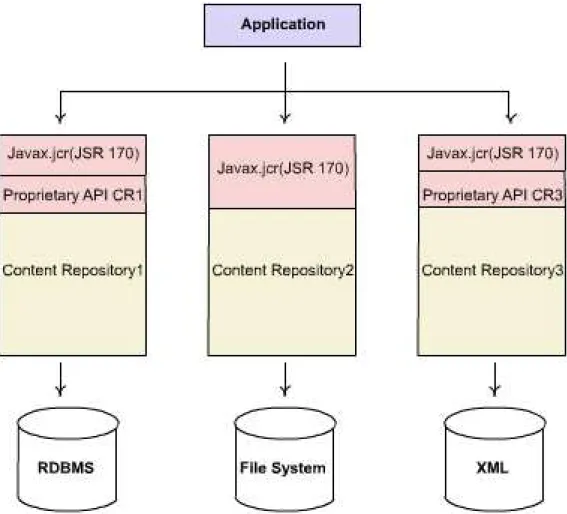
CMS products. Content management systems from different vendors have been available for quite a long time [Pat06]. All of these vendors ship their own version of a content repository with their CMSs, usually providing a proprietary API for accessing their content repository with their CMS systems. JSR-170 tries to solve this problem by standardising the Java API that should be used for connecting to any content repository. Figure 2.2 reveals an application builds upon the JSR-170 API.
JSR-170 features are divided into three parts [Pie05]. First are the Level 1 features, which provide a read-only view of the repository. Level 2 defines the basic features required for read and write operations. In addition to these two levels, JSR-170 defines five optional features – versioning, locking, SQL search, and transactions – that can be implemented by a content repository. That means a vendor who has a Level 1-compliant repository can decide to implement the SQL search feature but none of the other advanced features. A second vendor might implement a different feature set – for example, a Level 2-compliant repository with versioning.
As shown by Figure 2.2, an application may interact with different the content repositories, namely 1, 2 or 3. We can see that two of these three content reposi-tories, 1 and 3, need JSR-170 drivers for interacting with a JSR-170 application, whereas content repositories 2 is natively JSR-170 compliant. One more thing to be noticed is that an application need not to worry about how actual content is stored. The underlying content repository can be a RDBMS, a filesystem, or a native XML management system.
The JSR-170 Specification [Pie05, jcp, Pro] defined the content repository model as comprising a number of workspaces, which should normally contain
similar content. A repository can have one or more workspaces. Each workspace contain a single rooted tree of items. An item is either a node or a property. Properties have one node as a parent and cannot have children; they are leaves of the trees. The actual content in the repository is stored as values of properties.
Appendix 1 presents an example to demonstrate how to store and access documents by using proposed methods in JSR-170 specification.
2.3.1
Apache Jackrabbit
Apache Jackrabbit is Level 2 JSR-170 compliant, and implements all optional feature blocks. Beyond the JSR-170 API, Jackrabbit features numerous exten-sions and administrative features that are needed to run a repository but are not specified by JSR-170. I have decided to use Apache Jackrabbit as the content repository in the Lindas prototype system.
Jackrabbit consists of an general architecture comprising three layers: a Con-tent Application Layer, an API Layer and a ConCon-tent Repository Implementation Layer. The composition of those layers is shown in Figure 2.3 .
The purpose of each layer is summarised below [Ove]:
• Content Applications: Content Applications interact through the JSR-170 API with the Content Repository Implementation. There are numerous applications that are available for JSR-170 repositories.
• Content Repository API: This contains two major sections: The Con-tent Repository API defined by JSR-170; and a number of features of a
content repository, that have been removed from the JSR-170 specification since they are difficult to implement on existing non-Java-based content repositories.
• Content Repository Implementation: This portion of the architecture chart reflects the major building blocks of the Jackrabbit content repository implementation.
2.4
IBM Unstructured Information Management
Architecture
The IBM Unstructured Information Management Architecture (UIMA) [uim06] specifies component interfaces, data representation, design patterns and develop-ment roles for [FL04] developing and deploying multi-model analysis capabilities for unstructured information management (UIM) applications. The UIMA frame-work [uim06] provides a run-time environment in which developers can plug in their UIMA component implementations and with which they can build and de-ploy UIM applications. The framework is not specific to any IDE or platform. The UIMA also provides a Software Development Kit including an all-Java implemen-tation of the UIMA framework for the implemenimplemen-tation, description, composition and deployment of UIMA components and applications. The development of Lin-das was done under the Eclipse Java project development environment which can include a set of tools and utilities for using UIMA.
2.4.1
Text Analysis Technology
As described in [FL04], structured information can be characterised as infor-mation whose intended meaning is unambiguous and explicitly represented in the structure or format of the data. The most representative example of a tool for managing structured information is a relational database management sys-tem. On the other hand, unstructured information can be defined as information whose intended meaning is only loosely implied by its form and therefore requires interpretation in order to approximate its intended meaning. Examples are email messages, speech, audio, images and video.
One reason for deriving implied meaning from unstructured information is that it is estimated that 80% of all corporate information in unstructured [Moo02]. An even more compelling reason is the rapid growth of the Web and the perceived value of its unstructured information to applications that range from e-commerce and life science applications to business and national intelligence. The high-value content in these increasing amounts of unstructured information is normally hidden by in lots of noise. Searching for fragments of desired content or doing sophisticated data mining over unstructured information sources present new challenges.
An unstructured information management (UIM) application may be gen-erally defined as software that can systematically analyse large volumes of un-structured information (text, audio, video, images, etc.) to discover, organise and deliver relevant knowledge to the client or application end-user. An example [uim06, FL04] is an application that processes millions of medical abstracts to discover critical drug interactions. Another example is an application that pro-cesses tens of millions of documents to discover key evidence indicating probable
competitive threats.
The simplest way to describe text analysis on unstructured documents is the process of adding structural information into the documents so that the hidden meaning in unstructured content can be explicitly interpreted. In order to achieve this goal, the unstructured data must be analysed to interpret, detect and locate concepts of interest that are explicitly tagged or annotated in the original arte-fact, for example, named entities like person, organisations, locations, facilities, products etc. More challenging analytic may detect things like opinions, senti-ments, complaints, threats or facts. The list of concepts that are important for applications to detect and find in unstructured resource is large and often do-main specific. Therefore, specialised component analytic must be combined and integrated to do the job.
In analysing unstructured content, UIM applications make use of a variety of analysis technologies including: Statistical and rule-based Natural Language Processing (NLP), Information Retrieval (IR), Machine learning, Ontologies, Au-tomated reasoning and, Knowledge Sources. These technologies are developed independently by highly specialised scientists and engineers using different tech-niques, interfaces and platforms.
2.4.2
Key Components in UIMA
The building blocks of the UIMA architecture are called Analysis Engines
(AEs). AEs are composed to analyse a document and infer and record descrip-tive attributes about the document as a whole, and/or about regions therein.
This descriptive information produced by AEs is referred to generally as anal-ysis results. Analysis results typically represent meta-data about the document
content. Therefore, AEs can, alternatively, be described as software agents that automatically discover and record meta-data about original content.
UIMA is capable of analysing different modalities including text, audio and video. The Lindas system has an analysis engine that only focuses on text docu-ments.
UIMA provides a basic component type intended to house the core analysis algorithms running inside an AE. Instances of this component are called Anno-tators. The primary concern of the developer of an analysis algorithm therefore is the development of annotators. The UIMA framework provides the neces-sary methods for taking annotators and creating analysis engines. (Appendix 2 discusses the path in developing an annotator and analysis engines, through a detailed example of searching customer’s identifiers in unstructured documents, using the UIMA framework). The simplest AE contains exactly one annotator at its core. Complex AEs may contain a collection of AEs, each potentially containing within them other AEs.
How annotators represent and share their results is an important part of the UIMA architecture. UIMA defines a Common Analysis Structure (CAS)
precisely for these purposes. The CAS is an object-based data structure that allows the representation of objects, properties and values. The CAS logically contains the document being analysed. Analysis developers share and record their analysis results in terms of an object that complies with the CAS.
Annotation types are used to annotate or label regions of an artifacts. Com-mon artifacts are text documents, but they can be other things, such as audio streams. The annotation type for text includes two features, namely begin and end. Values of these features represent offsets in the artifact and delimit a span.
Any particular annotation object identifies the span it annotates with the begin and end features.
For every component specified in UIMA there are two parts required for its implementation: The declarative part and the code part. The declarative part contains metadata describing the component, its identity, structure and behavior and is called the Component Descriptor. Component descriptors are represented in XML. The code part implements the algorithm which may be a program in Java.
2.4.3
Text Analysis Levels
There are two levels in which text analysis can be applied to documents [Moo02]: one document (document-level); or a collection of documents ( collection-level). When document-level analysis is applied, the AE takes the document as an input and produce its output in the form of meta-data describing fragments of the original document. The meta-data represents structural information that refers to the document as a whole or to one of its regions. Examples of document-level analyses including language detection (over semi-structured HTML docu-ment or pure by textual docudocu-ment), detagger (remove all the tags that appear in an semi-structured document thereby deriving from it an unstructured docu-ment), name-entity detection (identify recognisable entities or relationships that appear in an unstructured document), and tokenization. In each cases, the anal-ysis component examines the document and produces associated meta-data as a result of its analysis.
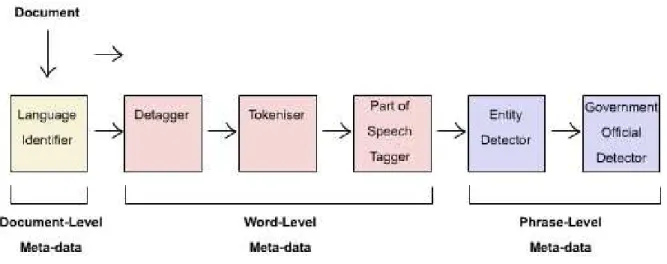
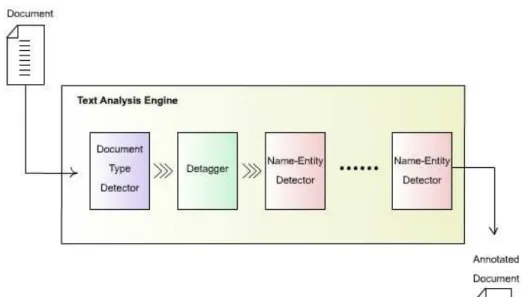
An AE may be implemented by composing a number of more primitive com-ponents, as illustrated in Figure 2.4. In this figure, a number of components
are assembled in series in order to implement a “government official detector” function. The output of each stage consists of a document with the result of the analysis. For example, the output of the detagger component consists of the document with HTML tags identified and context extracted, and so on.
Figure 2.4: Document-Level Text Analysis Engine
In collection-level analysis, the text analysis engine processes an entire collec-tion of documents. Whereas each document may undergo document-level analysis as part of collection processing, the result of collection-level analysis represent in-ferences made over the entire collection. Example of collection-level results are: glossaries, dictionaries, databases and search indexes. The collection-level text analysis is the approach used in the Lindas system.
2.5
Apache Derby
A brief discussion on the Apache Derby Database is provides, since it has been selected as the structured data management system to be used in Lindas.
Apache Derby is an in-memory relational database developed as an Apache DB subproject implemented entirely in Java. It only needs a small amount of simple code to be easily embedded into any Java application. It makes use of JDBC technology to build connection and access to databases, therefore applica-tions use the Apache Derby Database can conveniently switch to other relational database management systems (RDBMSs), such as MySQL and Oracle, with-out the need to spend a great amount of work on code changing. Furthermore, Derby uses conventional SQL to achieve the tasks of querying and manipulating a database as other RDBMSs do.
2.6
Summary
This chapter has touched on a set of background concepts and technologies on which the project of Linking Documents in Repositories to Structured Data in Database builds. Three main fields have been introduced: Content Management Systems (CMS); Text Analysis on Unstructured Information; and the Apache Derby Database Management System was briefly introduced as well.
The following three chapters will mainly focus on how to put those back-ground concepts and technologies into practice for realising the idea of linking unstructured, semi-structured and structured information.
Linking Data Architectures
Having introduced various background concepts and technologies, in this chap-ter, we discuss the system architecture of Lindas. From an architectural point of view, most of the bottom level components of Lindas, are mapped to existing software introduced in the previous chapter, for example: the Apache Jackrab-bit Content Repository; the IBM UIMA Unstructured Information Management (UIM) application development SDK and the RDBMS Apache Derby. The most important point to consider when designing the Lindas architecture is to coordi-nate the contribution of existing software components to the goal of this project. One approach to produce a comprehensive architecture is to take a ’top-down’ ap-proach, which starts by eliciting the business and functional objectives, and then defining a general system model and flow model (because Lindas is a data-and query-intensive system). Finally, the system architecture will be designed based on the system and data model.
An Example Use Case
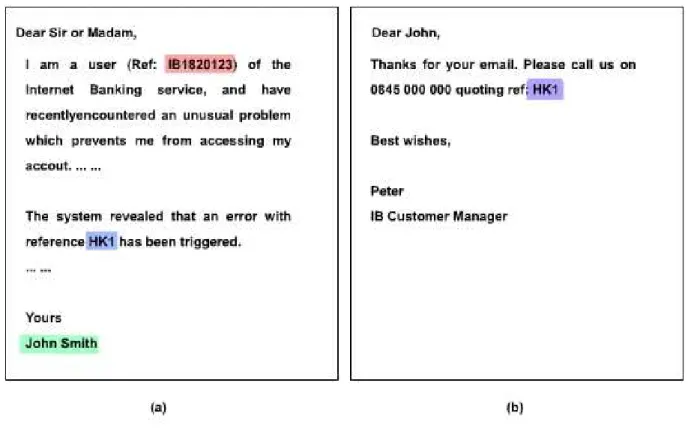
Let us firstly take a use case as an example to understand what functional re-quirements the Lindas system should have. Consider a banking company that provides its customers with an Internet Banking (IB) service for managing their bank account and money through a web interface. The company has a steady flow of complaints sent through the IB service by means of which customers report any problem they meet while using the service. These complaints take the form of emails which are stored in a centralised content repository. An example of an email used for this purpose is shown in Figure 3.1a. When the user produces an email like this, they may provide information (for example, an account number, a username, etc.) in addition to the substantive content of the email. Albeit limited, such information, can be used to discover potential matches with struc-tured customer data, e.g., account information, held in databases. If so, then the unstructured data that conveys the complaint can be linked with the match-ing structured data about the customer in a relational database. The customer service manager may subsequently reply to the users (an example message is shown in Figure 3.1b) and ask them to call the IB customer service in person to solve the problem encountered. This reply email message, as well as the email originally sent by the IB user to report the problem, can be stored together in the content repository, and indexed by the username of the customer. Furthermore, the problem-reporting email can be text-analysed for later use. When the user communicates on the phone with the call centre staff to negotiate ways to solve the encountered problem, the staff can use the customer’s IB service username to retrieve the text-analysed emails shown in Figure 3.1a and 3.1b. From the annotated meta-content produced as the result of the text analysis function, staff can find collated information about the users, their account and the problem they
have encountered.
Figure 3.1: Email documents include annotation
As we learnt from this scenario, the Lindas system should be capable of:
1. Elicitating linking data from unstructured and semi-structured documents by using text analysing techniques;
2. Correlating documents with structured data on the basis of elicited linking data;
3. Populating data obtained by analysing unstructured and semi-structured documents in the form of structured data appropriately into a database;
4. Allowing annotators to be defined for use by the text analysis engine when mining desired entities in unstructured documents;
5. Provide users with graphical user interface to drive the system functionality.
3.1
User Interfaces
After eliciting the functional requirements of Lindas, we describe the Graphical User Interface (GUI) proposed for users to drive the functionality provided by system components. This will later help with the task of defining the system and data-flow models, as well as the eventual system architecture of Lindas, Figure 3.2 illustrates the GUI of Lindas.
As it is shown in Figure 3.2, the GUI contains two major sections: the Corre-lation Query section and the Annotator Control section. Note that an entity is a unit of annotation (see Chapter 4: Eliciting Linking Data for more details). The correlation query section allows the users to input the value of a specific entity type (e.g., an Email, and ID) which Lindas uses to retrieve the set of documents that contain the linking data in question, based on a content search, as well as structured data, in this case relational database entities, based on a SQL query.
In the Annotation Control section of the interface, the user can perform the following tasks:
1. Adding one or more annotators by providing the name of the target anno-tation entity, the type of the annoanno-tation entity and the regular expression to be used by the text search engine;
3. Deleting an annotator using its name.
Lindas also provides a correlation overhead monitor interface (discussed in Chapter 5) that allows a Lindas administrator to view and query information (e.g., elicited linking data and annotated documents) generated via document analysis which can be used to assist the correlation query evaluation process. Furthermore, there is also an annotator control panel for administrators to pause or start an annotation task targeting a directory of documents using a specified path. The reason for providing this interface function is that annotation is a background process. In Lindas, a batch of documents are continuously processed with a 5-second break at the end of each round, therefore the administrators must be allowed to terminate this repetitive process or to adjust the annotation target with this interface function. In addition, a database registration interface is provided that allows the user to flexibly switch to other databases which also have the Java DataBase Connection capability installed. All these interfaces are illustrated in Figure 3.3.
3.2
Linking Data System Model
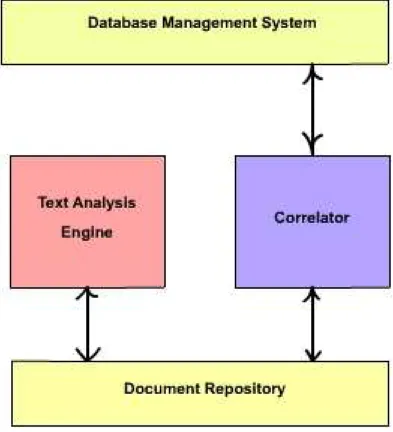
The Lindas system model, illustrated in Figure 3.4, consists of four main com-ponents: a Correlator, a document repository, a database and a text analysis engine. The Correlator takes responsibility for populating unstructured data into the database, or solving a Correlation Query by retrieving data from both the document repository and the database. Unstructured and semi-structured doc-uments are stored and managed in the document repository, while the database holds structured data. Finally, the text analysis engine processes documents in
the document repository in order to generate metacontent. The result of the annotation (the meta-data) is stored and managed by the document repository.
Figure 3.4: Linking Data System Model
3.3
Data Flow Model
Because Lindas is a data-intensive system purposed for data management, it is used to clearly identify the flows of data (un-/semi-structured documents and structured data) that in Lindas. Figure 3.5 illustrates this.
As is shown in Figure 3.5, newly received unstructured and semi-structured documents are continuously added into the document repository. The (original)
Figure 3.5: Data-flow Model
documents held in the document repository are retrieved by the text analysis engine, and the generated metacontent from the annotation process (represented in document format) is stored separately from the original document in the doc-ument repository. On opposite side of the flow, new structured data is also continuously added into the database. With regard to a correlation query issued by a user, the correlator retrieves documents and structured data and assembles them into a unit as an element in the output correlation query result.
3.4
Linking Data Architecture
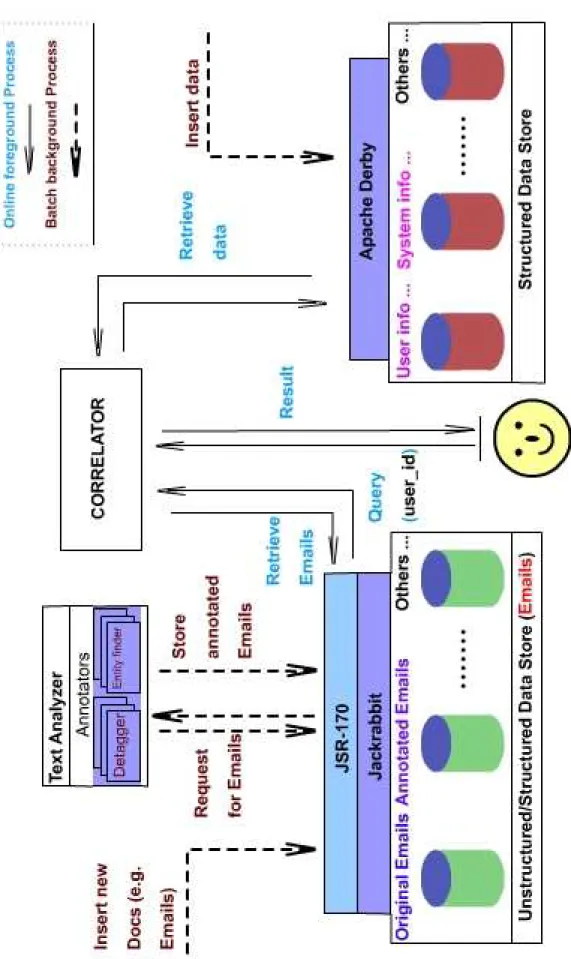
After defining the GUI, data-flow and system model of Lindas, we can now derive the system architecture (Figure 3.6). As illustrated in the general system model, documents are stored in a document repository. This document repository is managed by Apache Jackrabbit which is the implementation of the JSR-170 API defined for building Java content management systems. All the invocations of the Jackrabbit functions for the purpose of storing, accessing, deleting and ma-nipulating the unstructured content have to be done through the JSR-170 API.
The text analysis engine, contains a set of user-defined annotators and con-tinuously works on the documents stored in the document repository. The text analysis engine retrieves the documents by invoking Jackrabbit functions, and this is also the mechanism used for storing back the annotated metacontent. The regular expressions used by the annotators for searching linking data in docu-ments are provided by the users of Lindas. The process of creating annotators is done automatically by the analysis engine given the name of the annotator, the type of linking data to search for, and the required regular expressions to drive the search.
The Apache Derby Database is used as the default management and storage system for structured data, unless the user specifies other database management systems, e.g. MySQL, to be used for such purpose.
3.5
Summary
This chapter defined the Lindas GUI, data-flow model, and system model, from which the system architecture derived which are the blueprint for building the Linking Data System. The next two chapters will move onto discussing the Text Analysis Engine and Correlator components of the system architecture.
Linking Data Extraction
The previous chapter has specified the system architecture of Lindas and various components that realise the idea of linking documents in repositories to structured data in database. This chapter shall focus mainly on the text analysis compo-nent of the system architecture to further understand its purpose, i.e., why text analysis can help us build bridges to connect unstructured and semi-structured documents to structured data residing in, e.g., relational databases.
Unstructured and semi-structured data constitute the majority of corporate information generated from everyday business activities. Even today, only a frac-tion of such informafrac-tion is used by most companies, the rest are buried inside files and, more rarely but increasingly, in document repositories. According to [Sha07], more than 85% of the data within most organisations falls outside of the traditional unstructured data category. Most of this data appears in documents (e.g., in HTML websites, in customer reports and customer comments), still re-mains unanalysed and can not fit smoothly into typical data creation, query and manipulation processes, e.g. those developed for relational database management
system (RDBMS). A key process to gain corporate insight and to obtain knowl-edge from data that resides in document repositories is to perform text analysis.
Consider the Internet Banking (IB) service introduced in the previous chapter. The bank that provides this service has a steady inflow of customer support requests into a centralised customer request repository. These customer requests are accepted using means, such as a web-form (e.g., Figure 4.1) or email (e.g., Figure 4.2). Each of these requests may disclose limited information such as the service reference number or information about the problem encountered, such as a reference code. By using this embedded information, we can query a customer database to retrieve related (linkable) customer information.
Section 4.1 considers how to use document annotation to extract linking data in unstructured and semi-structured document, and guidelines for the design of annotation functions inside text analysis engines. Then, Section 4.2 briefly touches on the topic of annotator descriptors. The last section will concentrate on discussing the format in which the result of document annotation can be represented. This formatted annotation result is an important input for the correlator component in the system architecture.
4.1
Document Annotation
Linking data is defined to be an entity or object that can be used as a reference across, on the one hand, either unstructured or semi-structured documents, and, on the other, tuples in a database. Tables in a relational database can be called entity sets, holding tuples of information that belong and describe a certain type of entity or object. For example, for a relation might store customer information
according to the schema: customer(cid,c name,acco no, dob,email); another might have a unary schema email(address). The former relation holds informa-tion about a set of ‘customer’ entities, each described by value in the columns row of the table carry information about the cid(for customer id), c name(for cus-tomer name),acco no(for account number),dob(for date of birth) andemail(for email address). The second relation stores a set of email entities with the email address as the single attribute describing each email entity.
As represented by the underline mark in each relational schema, the cid and the address attributes are the primary keys for the respective tables. As repre-sented by the italic font, both acco no and email are foreign key attributes that point to other tables in which values in the same domain appear as a primary key.
Data about the customer and email entities mentioned above can also fre-quently appear in unstructured and semi-structured documents. As shown in Figure 4.2, the web-form asks customers to first fill in some required information (e.g., Internet Banking ID, email address) before writing out their comments. We can apply text analysis techniques to analyse this HTML page and annotate (e.g., extract) those entities (i.e., linking data) in unstructured or semi-structured documents. Moreover, the email message sent from the customer, shown in Fig-ure 4.1a also disclosed customer information, such as the Internet Banking ID (IB1820191), which can be picked up by text analysis. By giving the ID, email and account numbers, we can, furthermore, retrieve structured information about the customer and his account together with the email document, and possibly chain it to the web form as well.
Figure 4.2: Customer support requests in web-form
4.1.1
Annotation Function Design
As discussed in Chapter 2, several Analysis Engines (AEs) can be composed to analyse a document inferring and recording descriptive attributes about it, as a whole and/or about regions therein. A simple (or primitive) UIMA AE contains a single annotator working on a specific annotation task, such as de-tagging. However, a complex AEs may be designed to form a chain of AEs organised into a workflow. These more complex analysis engines are called Aggregate Analysis Engines. Annotators tend to perform fairly granular functions, e.g., language detection, tokenisation or named-entity detection.
Advanced analysis, however, may involve an orchestration of many of these primitive functions. An AE that performs named-entity detection, e.g., to retrieve an email address in a fragment of text, may comprise a pipeline of annotators, as is the case in Lindas, such as document type detector, de-tagger, entity-type-1 detector (targeting email addresses), entity-type-2 detector (targeting IDs), etc. Figure 4.3 depict an example aggregate AE pipeline. Each step in the pipeline
is required by the subsequent analysis.
Figure 4.3: Aggregated Text Annotation Engine (Annotator Pipeline)
In Figure 4.3, the document type detector has the responsibility of identi-fying whether a document is unstructured or semi-structured. If the document is semi-structured, e.g., an XML or HTML document, we firstly remove all the tagging information, leaving only the data content to be treated as an unstruc-tured document, and then use a set of name-entity detectors to identity specific entities that appear in the document. Lindas allows the user of the system to specify the entity that they want the Lindas system to annotate by specifying the regular expression that selects the entity value (e.g., a name, an email address, etc.). Lindas can then automatically create and attach a new AE to the chain.
Users of the AE only need to know its name, its published input requirements and output types (will be discussed in the next section), not how it is constructed internally. To develop aggregate AEs in the IBM UIMA framework, these must be
declared in the aggregate AE descriptor. Aggregate AE’s descriptors declare the components they contain and a flow specification. The flow specification defines the order in which the internal component AEs should be run. The internal AEs specified in an aggregate AE are also called the delegate analysis engines.
The aggregate analysis engine descriptor is given to the UIMA framework which uses the information to run all delegate AEs, ensuring that each one gets access to the Common Analysis Structure (CAS) in the precise sequence deter-mined by the flow specification. The UIMA framework is required to handle dif-ferent deployments where the delegate engines, for example, are tightly-coupled (running in the same process) or loosely-coupled (running in separate processes or even on different machines).
4.1.2
Annotator Generation
For the purpose of extracting linking data from documents in repositories, a single primitive annotator can be built through the following procedural steps:
1. Identify the target (input) documents: e.g., a batch of emails or web-forms in HTML format that are to be sent to the annotator as input to be processed.
2. Identify the targeted entities or objects to search for: We might be interested in annotating some of the attributes in a relational schema, e.g., customer(cid, email,. . . room no).
3. Generate the corresponding regular expressions: For example, the Java package java.util.regex provides a language for defining regular ex-pressions so that text fragments can be processed based on them:
(a) room no (Pattern: ##-[0-2]##): 20-001, 31-206; (b) IB ID (Pattern: IB1820[0-8]##): IB1820491.
4. Implement the annotation algorithm (an example is shown in Ap-pendix 2).
Figure 4.4: An annotation algorithm
The first step in writing the Jave code for an annotation algorithm (as shown in Table 4.1) that uses the Java Regular Expression package is to import the package: java.util.regex.Pattern. Then, within the class defination, we firstly give the regular expression as a Patternobject. Secondly, we use the process method to find words that can be matched to the provided regular expression.
We can design, implement and test each individual primitive annotators first, then compose them together to form an annotator chain. A detailed walkthrough on how to develop a text analysis application by using UIMA is discussed in Appendix 2.
4.2
Annotator Descriptor
As mentioned in Chapter 2, Annotators and AEs are two of the basic build-ing blocks in the UIMA framework. Developers implement them to build and compose analysis capabilities and ultimately applications. For every annotator component, there are two parts required for its implementation: one is the declar-ative part and the second one is the code part. The UIMA architecture requires that descriptive information about an annotator be represented in an XML file and provided along with the compiled annotator class file(s) to the UIMA frame-work at run time. The code part implements the algorithm, typically a program in Java.
4.3
Annotation Output
The purpose of document annotation in Lindas is to extract linking data from unstructured and semi-structured documents in document repositories that are valuable in correlating documents to structured data residing in databases. In or-der to realise this goal, apart from designing the text annotation function (clearly, the most crucial task) we also need to think about how the annotation results are shared and represented in order to facilitate future use. Although that we can visualize the annotation in a graphical interface as color-highlighted regions in a text span, this is only human understandable. We need to consider alternative, machine-readable format, and UIMA uses XML (discussed in section 4.3.1.), to represent annotation results.
4.3.1
Text Span
Text analysis results may include statements about the content of a document. For example, the following is an assertion about the topic of a document:
(1)The Topic of Email in Figure 4.1(b) is ‘‘Error HK1 and User IB1820191’’ Analysis results may include statements describing smaller regions than an
entire document. We use the term span to refer to a sequence of characters in a text document. Consider that the email document in Figure 4.1 (b) contains a span, “IB1820191” starting at character position 101. An AE that can detect In-ternet Banking (IB) ID in text documents may represent the following statement as an analysis result:
(2)The span from position 101 to 112 in the email document denote an IB ID
In both statements (1) and (2) above there is a special pre-defined term or what is called in UIMA a Type. They are ID, error reference, etc.
4.3.2
Annotation Result Representation
UIMA defines a Common Analysis Structure (CAS) [uim06] precisely for the purpose of sharing and representing annotation results.
The CAS is an object-based data structure that allows the representation of objects properties and values. Object types may be related to each other in a single-inheritance hierarchy. The CAS logically contains the document being
analysed. The UIMA framework includes an implementation and interfaces to the CAS.
A CAS that logically contains statement (2) above would include objects of the (IB) ID type. For each ID found in the body of a document, the AE would create an ID object in the CAS and link it to the span of text where the ID was mentioned in the document.
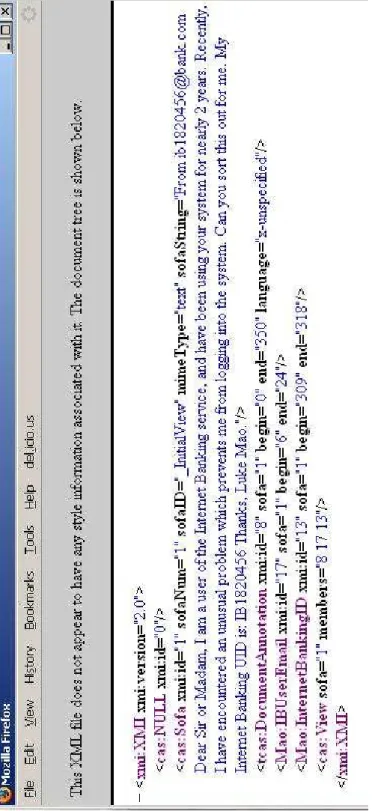
The UIMA can convert the annotation result represented in CAS to an XML document which contains the original text as the text content of an XML ele-ment together with the annotated span in terms of the character position in the analysed text fragment. Figure 4.5 shows an example of the annotation results being represented in an XML document.
4.4
Summary
This chapter has discussed the text analysis component in the Lindas system ar-chitecture. Text analysis is a key process to gain corporate insight and to obtain knowledge from data that resides in document. In this project, it is applied to ex-tract linking data from unstructured and detagged semi-structured documents so as to facilitate the future use of that data in correlating documents to structured information held in databases. The design of the annotation function involves identifying how to assign responsibilities to each annotator in the annotation chain. The overall process is guided by database schemas, insofar as linking data is that which appears both in documents and in database tuples.
Data Correlation Approach
Having discussed the Text Analysis component of the Linking Data System Ar-chitecture in the previous chapter, this chapter moves on to discuss the Correlator component, which does the job of accessing document repositories and databases to solve correlation queries. A correlation query asks for a result that pairs unstructured or semi-structured documents with structured data. This can be done after the outcome of analysis of unstructured and semi-structured data is made as part of the database in which structured data resides. Unstructured and semi-structured documents are continuously added into document reposito-ries and continuously analysed by the Analysis Engine described in the previous chapter. Similarly, on the structured side, information in the form of relational data is continuously populated into relational databases.
Section 5.1 introduces the notion of correlation query and the evaluation strat-egy for solving correlation queries implemented in Lindas. Section 5.2 describes how analyses unstructured data are used to populate a database. Finally, Sec-tion 5.3 briefly discuss how to perform sentiment analysis by using advanced text analysis techniques and the correlation query function.
5.1
Correlation Query
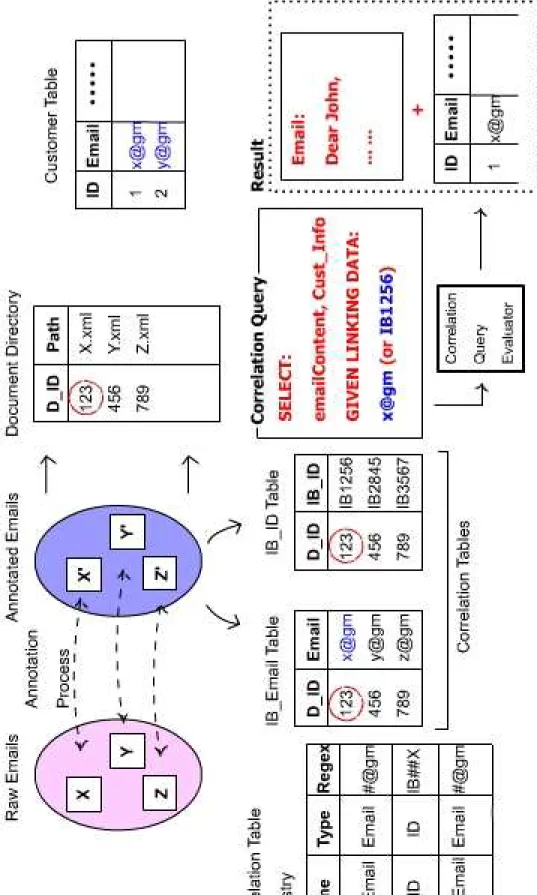
Supporting correlation queries requires supporting content search over a set of unstructured and semi-structured documents, as well as database query evalua-tion for retrieving structured data residing in databases. This split into two tasks can be visualised in Figure 5.1. One or more items of linking data are given as the input condition for the correlation query. Based on such linking data, we can narrow down the size of query result. For the content search part of the correlation query, only the documents that contain the linking data in question need to be retrieved. For the database query, a table of tuples, which have one or more attributes that match the linking data, are returned. The final result of the correlation query is a pair combining documents with corresponding structured data that share the linking data items given.
Figure 5.1: Task Decomposition in a Correlation Query
The query in Figure 5.1 is issued for the purpose of retrieving the (in this case, email) documents that contain the linking data ‘x@gm’ or ‘IB1256’, paired with
some relational data retrieved by a SQL query. The next subsection describes how this decomposition is carried out.
The formalisation of the Correlation Query will be as one of the future work. For the scope of this project, all the correlation queries are issued by from the Correlation Query Control Panel of the Graphical Interface described in Chapter 3.
5.1.1
Correlation Overhead
By correlation overhead is meant the additional tables that are required in order to evaluate correlation queries. These are described now.
Unstructured and semi-structured documents are passed through one or more application-specific text analyser for extracting linking data. An item of linking data acts as a bridge (in a similar way to a foreign key) for connecting an un-structured document with relational data. The outcomes of document analysis are stored as - XML documents, each of which includes the original document content together with annotation information (the start index and end index of a character span in a text fragment). In order to evaluate the correlation query, we need to provide some subsidiary information.
Firstly, a relational table is created, called Document Directory, so that each tuple in the table holds an assigned document identifier as well as the path of the XML document in which the result of document annotation is recorded. The Document Directory is assumed by Lindas (i.e., it has to have been created before Lindas can do any useful work). Potentially, a new entry is added to the table whenever a document has been processed by the Text Analyser.
Furthermore, for each detector target, i.e., each user-defined named-entity, such as an email address, there is potentially a set of documents in which it could occur. A Correlation Table is created to hold the value of that entity and the identifier of each document in which the value appears. The identifier, therefore, acts as a foreign key which points to a document identifier in the Document Directory table. A correlation table is created whenever a new annotator (named-entity detector) is started. Henceforth, an entry is added to the table whenever the corresponding target is found in a new document (or in a new place in an existing document).
Finally, a Correlation Table Registry is created as an index for all the Corre-lation Tables. An entry is added to the registry when a new annotator is started. It contains the name of the annotating entity and its type. It is used for finding which type a linking data entity belongs. Two entities may have different names (e.g., “Internet Banking User Email” and “Complaint Sender Email”), but they belong to the same type (e.g., “Internet Banking User Email” and “Complaint Sender Email” all belong to the type “Email”). Figure 5.2 shows, with an ex-ample, an overview of the additional tables required by correlation process, i.e., the Document Directory and the Correlation Table Registry together with one Correlation Table per target, so that, in the running example, there are two Cor-relation Tables: one holds the results of Email annotation; the other holds the results of IB ID annotation.
![Figure 2.3: Apache Jackrabbit Architectural Layers (source: [Ove])](https://thumb-us.123doks.com/thumbv2/123dok_us/10762109.2964359/32.918.186.878.113.954/figure-apache-jackrabbit-architectural-layers-source-ove.webp)