Lessons Learned from Observing Teaching Practices: The Case of
Ghana
Corinne Brion1* Paula Cordeiro2**
1. Educational Administration, University of Dayton, 300 College Park, Dayton, OH 45469 2. School of Leadership and Education Sciences, University of San Diego, San Diego CA
* [email protected] **[email protected] Abstract
The Sustainable Development Goals (SDGs) call for providing a quality education for all by 2030. In order to achieve the SDGs and improve educational outcomes globally, it is essential to understand what teaching strategies teachers use and to comprehend if students are learning. The purpose of this study is 1) to understand what teaching pedagogies Ghanaian teachers use in their Low-Fee Private Schools (LFPSs); and 2) to determine whether students stay on task. Using the Stallings Snapshot Observation instrument, the researchers observed 19 class periods in numerous grades in four schools. Findings reveal that the teachers used a combination of active and passive pedagogies and that there is no direct relationship between the pedagogies used and time on task. This study is important because it paves the way for others and poses the question of how to operationalize quality education in diverse cultures.
Keywords: Classroom observation, teaching, pedagogies, Stallings, Ghana, Low-Fee Private Schools DOI: 10.7176/JEP/10-12-02
Publication date: April 30th 2019 1. Introduction
The year 2000 was pivotal for the developing nations of the world. During the Millennium Summit, 189 member nations of the United Nations and 23 international organizations came together to adopt the United Nations Millennium Declaration and committed to help achieve eight Millennium Development Goals (MDGs) (United Nations, 2015). Those goals were to eradicate extreme poverty and hunger; achieve universal primary education; promote gender equality and empower women; reduce child mortality; improve maternal health; combat HIV/AIDS, malaria, and other diseases; ensure environmental sustainability; and develop a global partnership for development. These ambitious goals had specific targets to be achieved by 2015 (United Nations, 2016). Although some progress between 2000 and 2015 was made, the second Millennium Development Goal—Achieving Universal Primary Education by 2015—was particularly challenging for most developing countries due to weak public-school systems, lack of infrastructure, a dearth of student data, and a paucity of trained teachers. In order to build upon the Millennium Development Goals, 193 countries came together in 2012 and created the Sustainable Millennium Goals (SDGs) to be achieved by 2030.
With 17 goals and 169 targets, The Sustainable Development Goals (SDGs) advocate for quality education. Goal # 4 reads: Ensure inclusive and equitable quality education and promote life-long learning opportunities for all. This study explored Goal 4 target 4.1 which strives to: Ensure that all girls and boys complete free, equitable and quality primary and secondary education leading to relevant and effective learning outcomes (United Nations, 2016). In this study, the researchers aimed to 1) understand what teaching pedagogies Ghanaian teachers working in Low Fee Private Schools (LFPSs) used; and 2) determine whether students stayed on task. The second section contains a brief literature review on teaching in Africa, instruments used to assess learning, LFPSs and the Ghanaian context. The third section presents a description of the methodology, while the fourth part covers the results followed by a discussion. Finally, the concluding section offers recommendations for policymakers and a conclusion.
2.Literature Review 2.1. Teaching in Africa
Good teaching is one element of successful student learning (Hattie, 2012). Other factors include student engagement, support and opportunity. Teachers play a key role in offering a quality education (Hoy & Hoy, 2013). Providing a quality education globally remains a challenge (Borges & Rodriguez Dorta, 2015). The task becomes even more difficult in the Least Developed Countries (LDCs) because often teachers are not trained, and they lack resources (author, forthcoming).
According to Hoy and Hoy (2013), there isn’t one best way to teach as long as students stay on task and take full advantage of their academic learning time. The authors posit that in a school day, students have allocated time, engaged time, also known as time on task, and academic learning time. Allocated time is the amount of time allotted for a subject area whereas time on task is the time the students are engaged in the subject area. Academic learning time is the time students are actively, creatively, and successfully engaged in learning with a high rate of
success.
Effective teachers use different approaches depending on their students’ needs, their learning objectives, and the types of knowledge they are trying to impart to students. In this scenario, teachers may use direct instruction, such as lecturing, to teach declarative knowledge (Anderson, 1989b). In contrast, Pratt (1993) asserts that learning is a construction of meaning acquired through experiences and as such, direct instruction cannot ensure that students understand and make the knowledge their own. Following this philosophy, teachers become facilitators of learning and are tasked with giving the participants the skills necessary to become self-directed learners. In other words, facilitators guide learning rather than manage it (Laird, Holton, & Naquin, 2003).
Seminal researchers posit that active learning approaches combined with differentiating instruction help students become critical thinkers, motivate students to stay on task, and help students take full advantage of their academic learning time (Cunningham & Cordeiro, 2013; Hattie, 2012; Hoy & Hoy, 2013). These techniques are based on experiential education from the philosophies of Dewey, Vygotsky, and the development theories of Piaget and include problem-based learning, project-based learning, cooperative learning, service learning, field-based projects, role play, simulations, and reflective learning (Roberts, 2012).
To date, it is rare to see active learning in classrooms in Africa. This is because teachers in most cases have been trained to deliver lessons using the lecture approach, also known as stand and deliver. In this approach, teachers lecture, and students listen, repeat, and copy content in their notebooks. Students are quiet, sit still and are disciplined, which is perceived by parents, school leaders, and teachers to be the most effective way to learn (forthcoming). Using a reliable classroom observation instrument, this research intends to shed some light on the teaching pedagogies teachers use in Ghana.
2.2 Instruments Used to Assess Teaching
In the United States, there are various instruments that teacher Education Programs use various instruments to assess the progress of future teachers enrolled in a Teacher Education Program. These instruments focus on preparation, the classroom environment, and instruction, including pedagogies used to foster student learning. Among these instruments are the Candidate Preservice Assessment of Student Teaching (CPAST), the Educative Teacher Performance Assessment (edTPA), and the Resident Educator Summative Assessment (RESA). Once teachers have graduated from school and are teaching in their own classrooms, the Danielson Framework, and the Stallings instrument are often used to evaluate teaching.
CPAST was developed by Erica Brownstein at Ohio State University. It is a formative and summative assessment used during the student teaching practicum. The assessment has two subscales: Pedagogy (13 rows) and Dispositions (8 rows). Each of the 21 rows contains detailed descriptors of observable, measurable behaviors to guide scoring decisions.
edTPA was created by faculty and staff at the Stanford Center for Assessment. The instrument aims to demonstrate the candidate’s ability to effectively teach subject matter to all students. The RESA is used after Teachers in Ohio’s Teacher Education programs have completed their studies, including their residency time in schools. The RESA’s goal is to demonstrate the ability of new teachers to meet or exceed the Ohio Standards for the teaching profession.
The Danielson Framework, created by Charlotte Danielson, was meant to be used as a catalyst for conversation and reflection of one’s teaching; however, many school districts across the United States have chosen this framework to evaluate teachers. The framework includes four domains and numerous competencies under each domain. The four competencies are Planning and Teaching, The Classroom Environment, Professional Responsibilities and Instruction. In this study, the researchers used the Stallings Snapshot Observation instrument to understand what pedagogies teachers used in LFPSs in Ghana.
The Stallings Snapshot Observation Instrument was developed by Jane Stallings for research on the efficiency and quality of basic education teachers in the United States in the 1970s (Stallings, 1977; Stallings and Mohlman, 1988). The Stallings instrument generates robust quantitative data on the interaction of teachers and students in the classroom, with a high degree of inter-rater reliability (0.8 or higher) among observers with relatively limited training, which makes it suitable for large-scale samples in developing country settings. (Abadzi, 2007; Schuh-Moore, DeStefano, & Adelman,2010). The instrument is language- and curriculum-neutral so it is a suitable instrument to use in developing country settings. It also allows for comparisons among schools and/or countries. In previous studies, the instrument has had an impact on teacher and leader training, influenced policies, and changed the way teachers were screened prior to being employed. World Bank studies that have used the instrument have shown that the use of the four main dimensions of teacher practice has correlations with student learning outcomes (Bruns & Luque, 2014).
The classroom snapshot records the activities of the teacher and students, and the materials being used in the classroom, at 10 separate instances throughout a class period. The method makes a record of the people and activities in a classroom at a single moment in time as if they were being photographed, hence the word “snapshot." Each “snapshot” observation lasts for 15 seconds. The strength of the Stallings method is that it converts the
qualitative activities and interactions among a teacher and students that occur during class into robust quantitative data on teachers’ instructional practice and students’ engagement.
The instrument uses 4 variables that provide quantitative measures at the classroom, school, and school system level.
1. Teacher’s use of instructional time 2. Teacher’s use of materials
3. Teacher’s use of teaching pedagogies
4. Teacher’s ability to keep students engaged and on task
For the teaching pedagogies, the instrument is divided into active and passive instruction. In the Stallings snapshot observation instrument, active instruction includes activities such as reading, lecture, discussion, and practice of drills. Passive instruction incorporates monitoring seatwork and copying from chalkboard, and classroom management include students passing out papers, returning to seats, transitioning without anything to do or being uninvolved. In this paper, the researchers report the findings of teachers who worked in LFPSs in so far as the teachers’ use of teaching pedagogies and their ability to keep students engaged and on task.
2.1.1 LFPSs
As a result of the MDGs, there was a sudden influx of students in schools and a lack of public-school infrastructures to welcome all children. Due to of the increased number of students in schools, LFPSs have become a universal phenomenon in least developed countries (Day et al., 2014; Heyneman & Stern, 2014; Rose, 2009). LFPSs are privately owned and are funded by tuition. LFPSs are also called Affordable Private Schools (APSs), or Low-Cost Private Schools (LCPSs). These terms are used interchangeably in this study of Low-Fee Private Schools (LFPSs) in Ghana. The next section provides some contextual information for the study.
2.1.2 Ghana Background and Context
Ghana is located along the Gulf of Guinea and the Atlantic Ocean. Ghana is slightly smaller than the state of Oregon. It shares borders with Cote d’Ivoire on the West, Burkina Faso in the Northwest, and Togo on the East. Ghana has approximately 27 million people on 92,099 square miles. Today Ghana holds the 140th position out of 188 on the Human Development Index (HDI, 2016). The HDI measures the average capabilities that people have to live long healthy lives, to have access to education, to be free to work, and to have a decent standard of living. Ghana was created when the British colony of the Gold Coast and Togoland Trust Territory merged (Mendonsa, 2002). The country claimed its independence from the British in 1957. Ghana follows the British educational system; hence the language of instruction is English. Ghana has a literacy rate—defined as people over 15 years old who can read and write—of 76.6% (CIA, 2016). The students pass through two years of Kindergarten (KG1 and KG2); six years of primary school (from grades 1 to 6 referred to as P1-P6); three years of junior high school (JHS 1 to JHS 3); and, three years of senior high school (SHS 1 to 3). In 1992, the Ghanaian constitution allowed the recognition of private schools, however, they do not receive any government support. Since then, anyone can open a private school in accordance with the law (Akyeampong, 2009). Presently there is a lack of studies that examine what teaching pedagogies teachers use in LFPSs in Ghana and there are no studies that discuss if students are on task. This study aimed to fill these gaps in the literature.
3. Methodology
This study is part of a larger research project that used a longitudinal design allowing the two American researchers to study in-depth four LFPSs over a period of 13 months between September 2016 to October 2017. In this paper, the researchers report the quantitative findings of 19 classroom observations using the Stallings Classroom Snapshot instrument. Specifically, the study was guided by the following research questions: 1) What teaching strategies do teachers use? 2) Are students on task?
3.1.Selection of Sites and Participants
The research participants were first drawn from the database of a Non-Government Organization (NGO) called Edify. After identifying schools that fit the selection criteria, Edify’s Ghanaian education specialists and the researchers created a questionnaire in order to allow the head teachers from potential school sites to understand the scope of the study and commit accordingly. All schools were located in the Greater Accra region, the capital of Ghana. This research design relied on a purposive and convenience sampling of schools’ head teachers. Once the head teachers gave permission to the researchers to observe classrooms, the researchers selected classrooms randomly based on what lessons were in session when the researchers were on the four school sites.
3.1.1 Data Collection
Quantitative data were collected using the Stallings Classroom Snapshot instrument also called “Stanford Research Institute Classroom Observation System.” The researchers used the paper pencil version of the test. Before starting the data collection in the four sites, the researchers read the instrument’s user guide and completed practice exercises separately. Once the researchers had finished the exercises, they met and discussed their coding, and compared notes. The next day, the researchers piloted the Stallings instrument in a school that was not part of this
study.
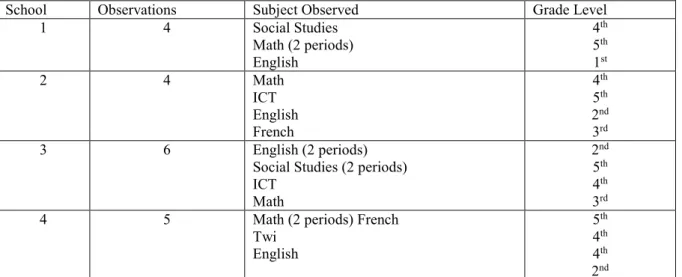
As Table 1 indicates, the researchers observed a total of 19 lessons that ranged from first grade to fifth grade classes in the four schools studied. The researchers observed English, math, French, Twi (local language), social studies, and information and communication technology (ICT) classes. Some schools had double periods in math, English and social studies, which explain why the researchers observed two periods in a row. The researchers observed a total of three social studies periods in grades four and five, six periods of math in grades three through five, five periods of English in first and second grades, two periods of ICT in grades four and five, two periods of French in third and fourth grades and one period of Twi in fourth grade. To respect anonymity, the researchers refer to the schools in the sample as school 1-4.
Table 1. Classroom Observations
School Observations Subject Observed Grade Level
1 4 Social Studies Math (2 periods) English 4th 5th 1st 2 4 Math ICT English French 4th 5th 2nd 3rd 3 6 English (2 periods)
Social Studies (2 periods) ICT Math 2nd 5th 4th 3rd
4 5 Math (2 periods) French
Twi English 5th 4th 4th 2nd
For each classroom observation, the researchers filled out a classroom demographic sheet. The observations consisted of 10 snapshots of 10-15 seconds each, during which, the researchers coded the teacher-student interactions. A coding sheet was used for each snapshot.
3.1.2 Data Analysis
Two researchers led this study. These researchers conducted 19 classroom observations in 16 different classrooms in four schools, verified the results of these observations with the education specialists at Edify who are familiar with Ghanaian education and classroom practices, and used an instrument with a high degree of inter-rater reliability (0.8 or higher).
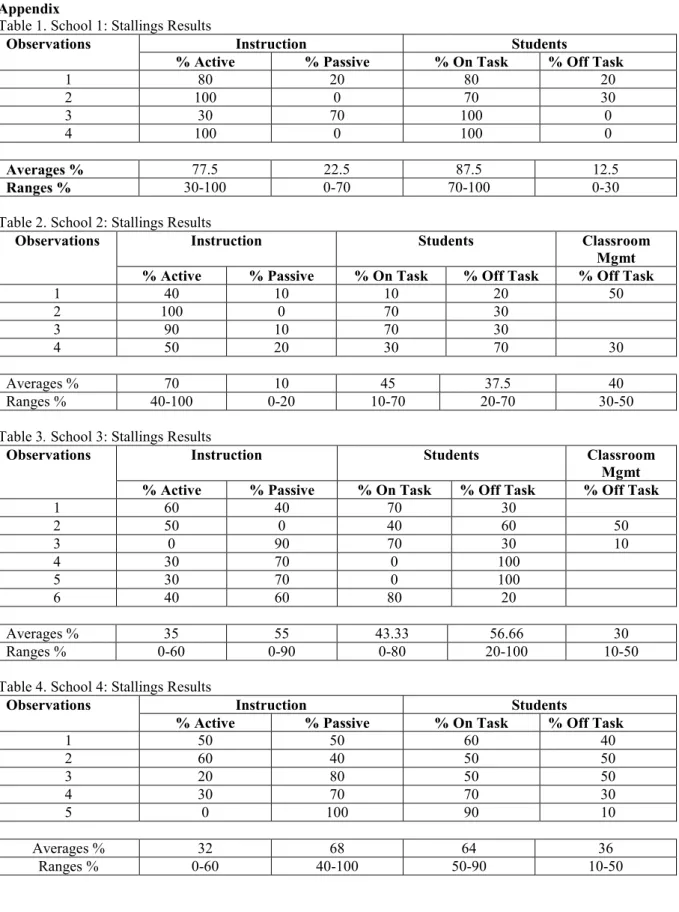
Using the coding instructions provided by the manual, the researchers coded the data separately, checked each other’s results before coding collectively for each school in order to obtain percentages for active and passive instruction as well as classroom management. The results of the four schools are presented in the Appendix. 3.1.3 Limitations
The observations took place in four LFPSs. The researchers selected classrooms to observe randomly based on teachers’ availability and willingness to host them. The 19 observations took place in the course of one day only, preventing the researchers from looking at pedagogies longitudinally. There are a few limitations related to the instrument as well. First, there is a clear potential for Hawthorne effects, as teachers are aware of the observers physically present in the classroom. One operating assumption, therefore, is that Stallings observations capture teachers performing at their very best. Second, in the Stallings instrument, activities such as reading, lecturing and practicing drills are considered active pedagogies, whereas educators usually understand active pedagogies as being debates, case studies, and projects. In the next sections, the researchers use the term active pedagogies as they are defined by the instrument- choral reading, drills, lecture and discussion.
Therefore, one weakness of the instrument used was that it lacked qualitative overview and space to describe in detail what other active pedagogies and strategies the teacher may have been using at the time (MacKinnon, Schep, Borden Murray-Orr, Orr, & MacKinnon, 2016).
4. Results
The first research question sought to understand what teaching pedagogies teachers used in Ghanaian LFPSs. After analyzing the snapshot data of the four schools, it was deemed that the instruction was almost evenly active and passive. The researchers presented their collective results for each school first before presenting the average for all four schools to get feedback and check their data and findings with the participants.
During the four observations in School 1, average active instruction was coded at 77.5% and passive instruction at 22.5%. Teachers lectured, read out loud and asked students to read chorally, asked questions, and practice drills. Often in Ghanaian classrooms, the researchers heard: “Repeat after me” and “again.” The choral
repetitions frequently happened in math, English and language classes. Passive instruction included copying from the board or redoing exercise in writing students had done orally with the teacher and doing exercises in Math or responding to questions in writing in English.
The researchers conducted four observations in the second school. Active instruction represented 70% of the time, whereas passive instruction 10% and classroom management 30%. In this school, the researchers saw evidence of classroom management issues when students were often uninvolved because the teachers were looking for materials, stepping outside the classroom, or transitioning without giving students any tasks, resulting in students talking to each other.
In the third school, the researchers observed six periods of instruction. Active instruction was coded at 35%, passive instruction at 55% and classroom management at 10%. Passive instruction was higher as students were mainly copying from the board and doing exercises in their classes.
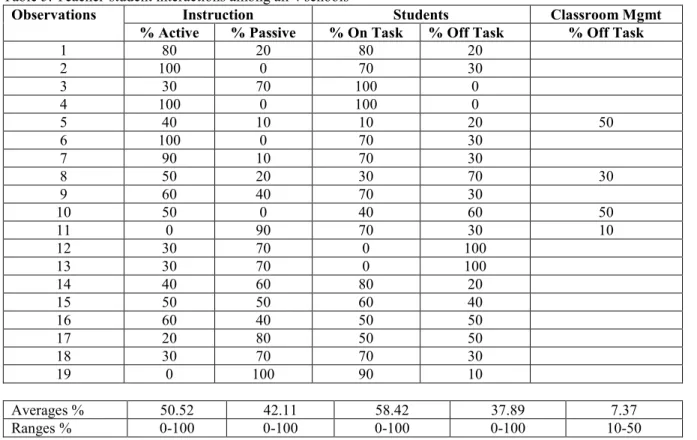
The researchers witnessed five class periods in School 4. They coded active instruction at 32% and passive at 68%, suggesting that there was a large amount of instructional time spent on copying and seat work. For all four schools, the average for active instruction was coded at 50.52%. Passive instruction was coded at 46.31%, while classroom management was 7.68%. Teachers used pedagogies such as copying from the board, lecturing, drills, responding to questions, seat work, and reading chorally or individually. The results also revealed that teachers had difficulties with classroom management in three out of the four schools.
The second research question aimed to determine whether students were on task. Once again, the researchers present their collective results for each school first before presenting the average for all four schools.
In school 1, students were on task an average of 87.5% of the time and off task an average of 12.5%. This finding could be explained by the fact that teachers used mostly active pedagogies such as choral repetitions, drills, and copying in that school. In school 2, students were on task an average of 455% of the time and off task 37.5%. Classroom management was coded at 30% in this school, which explains the high percentage of students off task.
The researchers coded students in School 3 to be on task 43.33% of the time and off-task 56.66% of the time on average. This school had an average of 30% in classroom management. Again, this result may be explained by the high percentage of passive instruction. Lastly, in School 4, students were on task an average of 64% of the time and off task 36%. This is surprising because 68% of the instruction used passive pedagogies, suggesting that even when using passive pedagogies, students were mostly on task. One possible explanation for this result is the small class size in this school and a teaching supervisor going from class to class regularly.
Among the four schools, students were on task an average of 58% of the time and off task 37.89%. Based on these findings, it appears that whether teachers used active strategies to teach or not, students were mainly on task. These findings could be explained by the fact that these four schools were Christian LFPSs where discipline of teachers and students is valued and expected. The results could also be justified by the small class sizes that varied between 10-30 students.
5. Discussion
5.1 Relationship between Pedagogies and Time on Task
Based on the findings, there is not a clear relationship between teaching pedagogies, as defined by the instrument, and time on task. In School 1 where active pedagogies were dominant, students were on task, but in School 4, students were on task despite the fact that teachers used mostly passive pedagogies. This finding suggests that other factors may play a role in keeping students on task. Such factors may include the size of the classroom, the number of students in a class, the teacher-student ratio, the discipline policy, and the amount of supervision available for teachers and students. Teacher-student relationships may also influence time on task, students’ interests in the subject matter and the capacity of the teachers to monitor and individualize teaching practices to each student’s needs. In the four schools studied, teachers were managing the learning rather than facilitating it (Laird, Holton, & Naquin, 2003). Teachers lectured, copied on the blackboard, asked students to do exercises and repeat drills. The researchers never witnessed independent learning or student-centered pedagogies as we understand them in the West, which begs the question, how do Ghanaians define quality education?
5.2 Perceived Quality Education Differs Among Culture
LFPSs have emerged in Ghana because of the lack of infrastructures for public schools and the perceived absence of quality in public institutions. Quality holds different meanings to different people, countries, and cultures. Based on the researchers’ experience in working over six years in Ghana, parents who pay to send their children to LFPSs expect students to have homework, to be drilled, to remain silent in class, and to listen to their teachers. Some parents even expect their children to be caned when needed. These expectations emerged from the parents’ perceived views of a quality education. As a result of parents’ expectations, teachers use lecture and drill, and expect students to repeat chorally as their main pedagogies. These pedagogies are also utilized due to a lack of teacher training, resources, and materials (forthcoming). Emmer and Gerwels (2006) assert that students who have the necessary resources are more likely to stay involved in schoolwork. The authors also maintain that if teachers
pique the curiosity of students, they will tend to be more engaged and motivated, particularly when activities are linked to real life scenarios.
In the West, quality education is usually associated with student-centered approaches such as problem-based and collaborative learning, as these techniques augment time on task and academic learning time and foster critical thinking, a skill needed for 21st century learners. Goal number 4 of the SDGs aim to provide a quality education for all (United Nations, 2015). It appears that quality is operationalized differently among cultures, so how would we know if teachers provide a quality education and whether we can achieve goal number 4 by 2030? Does quality education mean graduating and being able to repeat knowledge, or is quality education the ability to think critically and transfer knowledge in various contexts and situations that are not exactly the same as those in the textbooks? If the answer to the latter question is yes, then policy makers should dedicate resources on training and supporting teachers globally so that they can teach using various pedagogies and approaches to meet the needs of all students. 5.3 Stallings Snapshot Observation Instrument
The Stallings Snapshot Observation instrument was appropriate to use in Ghana because teachers mainly used lecturing and drills for their teaching pedagogies. If teachers were to use more diverse pedagogies such as case studies and problem-based learning and utilized technology in the classrooms, the instrument might need to be modified to fit the context and provide more detailed qualitative explanation on the types of activities witnessed in classrooms (MacKinnon et al., 2016).
6. Recommendations
In this section, the researchers provide three chief recommendations for policy makers and practitioners. First, the researchers recommend altering the Stallings Snapshot instrument depending on where in the world it is intended to be used. For example, the instrument could include role play, project-based learning, or case study. The researchers also suggest using the electronic version when possible because the paper pencil version yields many papers and requires one to have a desk and chair for the timer and papers. The researchers opted to use the paper pencil version because conducting research internationally is expensive and technology has the potential to fail, particularly in hot and humid countries with dust, and no reliable WIFI or electricity. The researchers also recommend practicing with the instrument prior to conducting official observations. The guide provided by the World Bank provides explanations, practice exercises, and answers.
Second, future research studies could investigate how much time students spend on academic learning. Such studies could be conducted in Ghana or other countries with similar circumstances in primary, middle and high schools to provide a deeper understanding of the teaching and learning strategies used locally, and to inform training needs.
Third, teachers in Ghana should be trained on classroom management techniques. Based on our observations, teachers did not walk around the classroom and did not have routines and procedures in place, enabling students to be off task. Teachers could also be trained on how to use student-centered approaches such as problem-based and collaborative learning or how to utilize case studies in their classrooms. These active pedagogies would require teachers to receive new moveable furniture, extra materials, and resources. Learning new pedagogies would provide teachers with additional tools for their teaching tool box and would allow them to choose between approaches depending on their learning objectives and the knowledge they intent to impart. Alternating teaching approaches would enhance the students’ experiences, empower teachers to differentiate their instructions, and augment the quality and impact of their teaching by increasing students’ time on task and academic learning time (Hoy & Hoy, 2013). Learning new pedagogies would require changing mindsets. Teachers themselves were taught using rote learning, so they teach the same way they were taught.
7. Conclusion
This study aimed to understand what teaching pedagogies teachers used in Ghanaian classrooms and if students were on task. Findings revealed that teachers used almost equally active and passive pedagogies and that students were mainly on task whether teachers used active or passive pedagogies, suggesting that there was not a definite relationship between active pedagogies as defined in the instrument, and time on task. This research paves the way for similar investigations in other developing countries. This inquiry is significant to comprehend the Ghanaian context and the viewpoint of educators and parents regarding quality education. If we are to reach SDGs by 2030, policy makers should have a common understanding of what quality education includes, and furthermore, gain an understanding that the definition of quality education varies within and across cultures. Quality education should mean universally educating all children with their diverse learning differences and styles; and in order to do that, teachers need to have the necessary pedagogical skills, content knowledge, and disposition for differentiated teaching and learning.
References
Abadzi, H. (2007). Absenteeism and beyond: Instructional time loss and consequences. The World Bank.
Anderson, L.M. (1989b). Classroom instruction. In M. Reynolds (Ed.), Knowledge base for beginning teachers (pp.101-116). New York: Pergamon.
Akyeampong, K. (2009). Public-private partnership in the provision of basic education in Ghana: Challenges and choices. Compare 39(2), 135-149.
Borges, Á., & Rodríguez-Dorta, M. (2015). Assessment of the teaching quality of teachers of primary and special education. Journal of Education Research, 9(3).
Bruns, B., & Luque, J. (2014). Great teachers: How to raise student learning in Latin America and the Caribbean. The World Bank.
CIA (2018). Ghana. Retrieved from
https://www.cia.gov/library/publications/resources/the-world-factbook/geos/gh.html
Cunningham, W. G., & Cordeiro, P. A. (2013). Educational leadership: A bridge to improved practice. Pearson Education, Inc, United States.
Day A., L. C., Mcloughlin, C., Aslam, M., Engel, J., Wales, J., Rawal, S., & Rose, P. (2014). The role and impact of private school in developing countries: A rigorous review of the evidence. London: Department for International Development.
Emmer, E.T., & Gerwels, M.C. (2006). Classroom management in middle and high school classrooms. In C. Everson & C.S. Weinstein (Eds.), Handbook for classroom management: Research, practice, and contemporary issues. Mahwah, NJ:Erlbaum.
Hattie, J. (2012). Visible learning for teachers: Maximizing impact on learning. Routledge.
Heyneman, S. P., & Stern, J. M. (2014). Low cost private schools for the poor: What public policy is appropriate? International Journal of Educational Development, 35, 3-15.
Hoy, A. W., & Hoy, W. K. (2013). Instructional leadership: A research-based guide to learning in schools. Pearson Education New Zealand.
Laird, D., Holton, E. F., & Naquin, S. (2003). Approaches to training and development: Revised and updated. New York, NY: Basic Books.
MacKinnon, G., Schep, L., Borden, L. L., Murray-Orr, A., Orr, J., & MacKinnon, P. (2016). Evaluating classroom interaction with the iPad®: An updated Stalling's tool. International Journal of Education and Development using Information and Communication Technology, 12(3), 93-107.
Mendonsa, E. L. (2002). West Africa: An introduction to its history, civilization and contemporary situation. Durham, NC: Carolina Academic Press.
Pratt, D. D. (1993). Andragogy after twenty-five years. New Directions for Adult and Continuing Education, 57(57), 15-23.
Roberts, J. W. (2012). Beyond learning by doing: Theoretical currents in experiential education. New York, NY: Routledge.
Rose, P. (2009). Non‐state provision of education: evidence from Africa and Asia. Compare, 39(2), 127-134. Schuh Moore, A., DeStefano, J., & Adelman, E. (2010). Opportunity to learn and early grade reading fluency to
measure school effectiveness in Ethiopia, Guatemala, Honduras, and Nepal. prepared for USAID/EQUIP2 Project. Washington: US Government Printing Office.
Stallings, J. (1977). Learning to look: A handbook on classroom observation and teaching models. Wadsworth Publishing Company.
Stallings, J. A., & Mohlman, G. G. (1988). Classroom observation techniques. Educational research, methodology,
and measurement: An international handbook, 469-474.
United Nations. (2016). Sustainable development goals.
Retrieved from http://www.un.org/sustainabledevelopment/sustainable-development-goals/#
United Nations Educational, Scientific and Cultural Organization (UNESCO). (2015). Education for all 2000-2015: Achievements and challenges (EFA Global Monitoring Report). Paris, France: UNESCO.
Appendix
Table 1. School 1: Stallings Results
Observations Instruction Students
% Active % Passive % On Task % Off Task
1 80 20 80 20 2 100 0 70 30 3 30 70 100 0 4 100 0 100 0 Averages % 77.5 22.5 87.5 12.5 Ranges % 30-100 0-70 70-100 0-30
Table 2. School 2: Stallings Results
Observations Instruction Students Classroom
Mgmt % Active % Passive % On Task % Off Task % Off Task
1 40 10 10 20 50 2 100 0 70 30 3 90 10 70 30 4 50 20 30 70 30 Averages % 70 10 45 37.5 40 Ranges % 40-100 0-20 10-70 20-70 30-50
Table 3. School 3: Stallings Results
Observations Instruction Students Classroom
Mgmt % Active % Passive % On Task % Off Task % Off Task
1 60 40 70 30 2 50 0 40 60 50 3 0 90 70 30 10 4 30 70 0 100 5 30 70 0 100 6 40 60 80 20 Averages % 35 55 43.33 56.66 30 Ranges % 0-60 0-90 0-80 20-100 10-50
Table 4. School 4: Stallings Results
Observations Instruction Students
% Active % Passive % On Task % Off Task
1 50 50 60 40 2 60 40 50 50 3 20 80 50 50 4 30 70 70 30 5 0 100 90 10 Averages % 32 68 64 36 Ranges % 0-60 40-100 50-90 10-50
Table 5. Teacher-student interactions among all 4 schools
Observations Instruction Students Classroom Mgmt
% Active % Passive % On Task % Off Task % Off Task
1 80 20 80 20 2 100 0 70 30 3 30 70 100 0 4 100 0 100 0 5 40 10 10 20 50 6 100 0 70 30 7 90 10 70 30 8 50 20 30 70 30 9 60 40 70 30 10 50 0 40 60 50 11 0 90 70 30 10 12 30 70 0 100 13 30 70 0 100 14 40 60 80 20 15 50 50 60 40 16 60 40 50 50 17 20 80 50 50 18 30 70 70 30 19 0 100 90 10 Averages % 50.52 42.11 58.42 37.89 7.37 Ranges % 0-100 0-100 0-100 0-100 10-50