Implications of the use of different payment models – the context of PPP Road Projects in the UK
Journal: International Journal of Managing Projects in Business
Manuscript ID IJMPB-09-2015-0095 Manuscript Type: Research Paper
Keywords: Payment structures;, Private Finance Initiative (PFI); , Public Private Partnerships (PPPs);, Financial markets; , Innovation; , Roads.
For Peer Review
Implications of the use of different payment models – the context of
PPP Road Projects in the UK
Abstract
Purpose – This paper sets out to illustrate the payment models and financing structures used for road Infrastructure projects under Public Private Partnerships (PPP) in the UK. Comparison of funding and financial structures in the selected case studies exposes the risks and values of the models of payment utilised. This research also aims to identify relationships with payment certainty and financing debt restructuring.
Design/methodology/approach – The paper compares several case studies representing the evolution of Private Finance Initiative (PFI) road infrastructure in the UK context. Templates were completed using semi- structured interviews during data collection; and a Qualitative Content Analysis (QCA) approach was employed for case study analysis.
Findings – Lessons learned from using different payment methods show the benefit and limitations of adopting different forms of PPP in road development. Refinancing of projects presents substantial risks to the viability of a project, and benefits gained by the private sector. Further, refinancing brings no significant benefits to the public sector as well.
Practical implications – Performance of selected case studies highlights emerging issues that need to be considered when adopting a PPP procurement route in roads projects. Financial markets have supported these projects under different risk profiles and payment models. They also have the potential to play a greater part in capitalising long-term investment in road projects and increase private sector participation in infrastructure development, generating more competition and innovation.
Originality/value - This paper provides case study comparison and practical implications of recent PPP developments in road provision in the UK and the evolution of public policy in the subject.
Key words – Payment structures; Private Finance Initiative (PFI); Public Private Partnerships (PPPs); Financial markets; Innovation; Roads.
3 4 5 6 7 8 9 10 11 12 13 14 15 16 17 18 19 20 21 22 23 24 25 26 27 28 29 30 31 32 33 34 35 36 37 38 39 40 41 42 43 44 45 46 47 48 49 50 51 52 53 54 55 56 57 58
1. Introduction
The term “Partnership” suggests a close relationship of two or more separate groups for the
mutual benefit and the improvement of the overall environment in which they are operating.
The mutual benefit of each partner should not be at the detriment of the other partner or
partners. Thus, Public Private Partnerships (PPPs) refer to arrangements where the private
sector supplies infrastructure assets and services that traditionally have been provided by
the government (IMF, 2004). According to Burger et al. (2008), a PPP is an agreement between a government and one or more private partners (which may include the operators
and the financiers) by which the private partners provide the service in such a manner that
the service delivery objectives of the government are aligned with the profit objectives of the
private partners and where the effectiveness of the alignment depends on a sufficient
transfer of risk to the private partners.
PPPs are complex contractual arrangements, and due to its long-term nature, they extend
into an unpredictable future, which has been exacerbated by the current economic crisis in
2007/08. There has been a plethora of work done in the past on the subject of PPP to
understand many complexities withstand these projects, i.e. Critical Success Factors (CSF)
(Qiao et al, 2001), (Hardcastle et al, 2005), (Zhang 2005); risk allocation (Akintole et al. 2003, Li et al 2005), and the assessment of Value for Money (VfM) and use of Public Sector Comparator (PSC). Project financing is also an area which has been already covered by
many researchers, in general (Finerty 2007; Yescombe 2014), and particularly within the UK
context (De Lemos, 2003; Akbiyikli, 2006).
It is long sensed that a relationship between both public authorities and the private sector
can be of mutual benefit and allow both parties to grow together. The public authority wants
to ensure that a service or asset is of benefit to the regional economy or to the environment
of the country, and the private sector is commercial in its approach and driven by ensuring
3 4 5 6 7 8 9 10 11 12 13 14 15 16 17 18 19 20 21 22 23 24 25 26 27 28 29 30 31 32 33 34 35 36 37 38 39 40 41 42 43 44 45 46 47 48 49 50 51 52 53 54 55 56 57 58 59
profitability to survive in a competitive market place. This suggests that there are conflicts of
interests inherent within PPPs. Apart from the public and private sectors, other stakeholders
also have different expectations from the PPP projects. For example, the users are the
eventual beneficiaries of the project, and in the case of direct tolling, they are the unitary
payer. There are also the financial contributors such as banks, investment funds and bond
holders, who hope a high return on their investment over the course of their involvement in
the PPP projects.
The term partnership relays the idea of a relationship that is symbiotic and is garnered with
trust. This is perhaps an important element when considering the risk factors employed in
such complex and capital absorbing projects. The understanding of the partnership between
the public and private sectors is further divested into elements of stakeholders and
respective political context, society, market economics, and private industry (Agyemang,
2011). These stakeholder groups contribute to the successful implementation of PPPs, in
that, their inputs are enabling the partnership to be created and the outputs being the
benefits gained by each group. It is important to understand the individual needs of these
groups and their subsequent relationships against the required outputs of a project when
identifying projects that are being overall success. There is a synergy between partnering
formation and relationships which requires exploration to ensure that success is a predicted
outcome in all cases where PPP procurement is employed.
Another important term in PPPs is “funding”, which may be misleading and often is confused
with the term financing. In the area of infrastructure, funding is related to the origin of the
payments to cover the costs of the public services, that is to say, who pays for it in the end;
whereas, “financing” considers the source of the funds needed to build the infrastructure.
Therefore, the party who lends or provides the money in the beginning usually requires a
return as a compensation for the risk assumed and also expect the funds to eventually be
repaid. The resulting amount of payments should cover the initial investment of the assets,
the cost to maintain and replace them and usually an amount for expansion. There are
3 4 5 6 7 8 9 10 11 12 13 14 15 16 17 18 19 20 21 22 23 24 25 26 27 28 29 30 31 32 33 34 35 36 37 38 39 40 41 42 43 44 45 46 47 48 49 50 51 52 53 54 55 56 57 58
basically two funding mechanisms: public budget that eventually is supported by tax payers,
and direct charges to users. The private sector will only participate if the project is financially
feasible, which means that the expected payments will cover all costs including a return for
the finance provided. Therefore, the first question to be answered by the public sector before
promoting any public infrastructure is “how is it going to be funded?”. Within this setting, the
main idea of the paper is to identify the benefits and issues inherent in different approaches
to payment of the services acquired through PPP procurement route. In order to fulfil the
purpose of the paper, the on-going financing structures are analysed and their impact upon
the risk factors of the projects are highlighted. Herein, PPP projects chosen are particularly
chosen from road transport projects within the UK context.
2. PPP Road projects in the UK
In 1989 a public policy was adopted in the UK concerning measures for private sector
integration in the provision of the road network expansion using the instrument of ‘Tolls’ as
its basis. This led to the formulation of UK legislation such as the “New Roads and Street
Works Act 1991” (Butcher, 2010). The act laid out the provision of concessionary
agreements between the government department and private group to design, construct and
operate “special roads” (HM government, 1991). Infrastructure provision is a growth enabler,
borne out by the ability to create infrastructure networks for commerce and citizens (Treasury
UK, 2012). Within the current economic climate, it is perhaps important to note the capital
investment needed is “intensive” for projects such as those in transport sectors (Gramlich,
1994).
The service delivery form of PPP has been adopted in the UK through the use of private
sector where additional management of the infrastructure is needed. The term Public Private
Partnership is not a specific form of procurement and the literature reviewed embodies the
pantheon of different models which fall under the umbrella of PPP. The variety of
3 4 5 6 7 8 9 10 11 12 13 14 15 16 17 18 19 20 21 22 23 24 25 26 27 28 29 30 31 32 33 34 35 36 37 38 39 40 41 42 43 44 45 46 47 48 49 50 51 52 53 54 55 56 57 58 59
For Peer Review
arrangements used can be complex and may suit specific industries or projects better than
another.
In 1992, the UK government launched the PFI programme, under PPP, to facilitate the public
and private sector co-operation, as a way of benefiting the public sector from the private
sector expertise and managerial project capacity. In order to procure some roads, the
Highways Agency was formally started in August 1994. The main approach adopted herein
was Design, Build, Finance and Operate (DBFO), with the exception of previously designed
Built-Operate and Transfer (BOT) model for M-6 Toll Road. The objectives of this DBFO
contract basically aimed to promote innovation in financial and commercial arrangements,
transferring the appropriate level of risk to the private sector, minimising the financial
contribution required from the public sector. By 2012, the UK, overall, has had 717 PPP road
projects, of which 648 are already in operation. This was an increase from 712 (and 631 in
operation) in 2011. In value terms, this amounts to capital costs of £54.7 billion (HM
Treasury, 2012).
The Highways Agency used some of the aforementioned schemes to provide new and
improved roads to ensure the maximum benefit to road users at the minimum financial
contribution requirement (Highways Agency, 2012). To cater for this, the Agency promotes
the involvement of the private sector road-operating industry, transferring many of the risks
to the private sector and promoting innovation in many areas such as technical, operational,
commercial and financial. Thus, UK was a pioneer in introducing innovations in new models
of PPPs, but also adapting the PPP framework to new needs and market trends. The UK
authorities have also been active in producing new regulation and standardisation in PPPs
(HM Treasury, 2007), (HM Treasury, 2012).
Despite expansion of PPP road sector, in July 2012, the Chancellor of the Exchequer and
Chief Secretary to the Treasury announced that the UK guarantees scheme, which aims to
kick start critical infrastructure projects, may have been blocked because of adverse credit
3 4 5 6 7 8 9 10 11 12 13 14 15 16 17 18 19 20 21 22 23 24 25 26 27 28 29 30 31 32 33 34 35 36 37 38 39 40 41 42 43 44 45 46 47 48 49 50 51 52 53 54 55 56 57 58
conditions. Around £40 billion of projects could qualify for the provision of guarantees in
infrastructure sectors such as transport, subject to meeting some criteria. In 2012, the UK
government also carried out a review of the performance of PFIs in general, and has
concluded that VfM is not, in reality, being achieved in many PPP road projects. From this
review, a number of measures were put into place including a voluntary code to improve
transparency and improvement of the strategic relationships (HM Treasry , 2012). The most
fundamental change instigated from this review is the implementation of a new scheme
called ‘PF2’, by looking at the lessons learnt from the original PFI structure (HM Treasury -
Infrastructure, 2012). There are main reforms introduced with the new model with regard to
new finance measures, risk allocation (greater risk retention by the public sector),
procurement (new standard documentation and timetable), transparency (government
annual report and higher control as well as equity return publication) and services (excluding
soft services such as cleaning and catering). In terms of finance measures, the government
is planning to take a minority interest share in future projects, introduce a funding competition
for a portion of private sector equity mainly looking to long term investor such as pension
plans), implement new measures that aims to limit the ability of investors to generate
excessive profits on sale of their equities and facilitate alternative debt providers.
A new model called Non-Profit Distribution model (NPD) conceived as an alternative to the
PPP/PFI was also developed in Scotland, and is being used to fund projects in three main
sectors – further education, health and transport. Benefits perceived by the NPD model, in
the view of the Scottish government, are: ‘capping’ to ensure a “normal” level of return to the
private sector; improved transparency; SPV operational surpluses reinvested in the public
sector; stakeholder involvement included in the model facilitating a more pro-active and
stable partnership. The NPD model is already being used with a package of road schemes in
Scotland worth approximately £1 billion. The first of these is the M8 road (Scottish Policy
Now, 2012). At the end of March 2015, the total value of NPD projects under construction
has reached £1.8bn. 3 4 5 6 7 8 9 10 11 12 13 14 15 16 17 18 19 20 21 22 23 24 25 26 27 28 29 30 31 32 33 34 35 36 37 38 39 40 41 42 43 44 45 46 47 48 49 50 51 52 53 54 55 56 57 58 59
The image of a coming together of public bodies and private providers to procure a service
or infrastructure asset in PPPs is ambiguous when set against the methods used by different
investment criteria. The use of investment from the private sector is significant in times of
wider austerity and the adoption of partnering for such large projects can benefit the needs
of both the public and private sectors. However, a number of issues can occur when
proposing the use of PPP procurement methods as opposed to more traditional and
accepted methods.
3. Road investment and payments – The UK PPP Context
The UK is a significant market for the delivery of large capital investment projects through the
use of PPPs. Due to current macro-economic issues in the UK; the government adopted a
policy which utilises the PPP model in the creation of large scale infrastructure projects. This
is an aid to driving economic growth and connecting industry efficiently, in order to wider
global economic markets, particularly directed to the expansion of the road networks. Within
a reduced spending policy of the government, the involvement of the private sector and
alternative financial institutions is now regarded as the only real alternative. The benefits of
creating PPPs (Spackman, 2002) has been acknowledged as lower costs in projects than if
carried out wholly by the private sector; and a higher rate of quality than if the project was
wholly operated by the public sector (Mozoro & Gasiorowski, 2008; Rangel & Galende,
2010). Historically, the investment vehicles employed in a significant number of road
infrastructure projects have been wholly financed without recourse to public funds. The
Public partner pays for the service provided by the private sector partner, thus, creating a
market which the private sector may find attractive for long term investment. The return of
the investment on such projects in terms of revenue streams and payment structures have
altered due to political and social pressures during the last 20 years.
3 4 5 6 7 8 9 10 11 12 13 14 15 16 17 18 19 20 21 22 23 24 25 26 27 28 29 30 31 32 33 34 35 36 37 38 39 40 41 42 43 44 45 46 47 48 49 50 51 52 53 54 55 56 57 58
The evolution of DBFO contracts for road infrastructure is reflected with the changing
methods of payment employed. A payment criterion encourages the private sector to
participate, however, there are a number of issues which are critical to private sector
participation and value to the public sector. A number of payment strategies are employed on
PPP road projects including direct tolling, shadow tolling and also performance related
payment systems. Shadow tolling refers to usage payment based on number and type of
vehicles using the road, made by the Government (usually Highways Agency for roads),
whilst performance payment is based on the results achieved in some performance
measures (e.g. safety, reliability) in accordance with targeted objectives. The adoption of
direct tolling as payment method associated with PPP roads may have a negative impact
since users are reluctant to accept direct charges. In effect, taxation has been historically
used for funding roads in the UK; and the general public’s understanding is that the
government has to provide and maintain free road network for the public interest. This
tradition may adversely affect the potential income that a project may generate and is
needed as future revenue streams in order to finance road projects. For this reason, there is
often a risk of optimistic bias in demand estimates on the part of the public sponsor. As a
result, the cost to finance the project may become prohibitive. Notwithstanding these risks,
one of the main benefits of using direct tolling is the avoidance of burden upon the public
budgets, therefore, ensuring no impact in government deficit, a result that is very appealing
within the political system.
Alternative payment models employed bypass these concerns of the public, as the payment
is made by the government rather than by the user, such as shadow tolling, and performance
related techniques. However, shadow tolling reverses the effect of optimistic bias on the
government and, therefore, there is a risk that payments may increase beyond anticipated
levels, unless payments are capped to a maximum level. The private sector is more content
to operate within contracts that use shadow tolling because of lower traffic volatility and,
therefore, higher revenue predictability.
3 4 5 6 7 8 9 10 11 12 13 14 15 16 17 18 19 20 21 22 23 24 25 26 27 28 29 30 31 32 33 34 35 36 37 38 39 40 41 42 43 44 45 46 47 48 49 50 51 52 53 54 55 56 57 58 59
Hybrid shadow tolling methods attempt to overcome this risk, incorporating performance
criteria into the contract. This, in effect, incentivises the private sector to ensure the road is
available and safe to use. There are penalties where there are failures in these key
performance measures. Performance related payments benefit both the public and private
sectors, by incorporating it into the payment structure. This method of payment structure is a
preferred option for many in the private sector and those involved in the financing of these
projects. The risk profiles of projects using performance measures as payment are lower
than those for projects just as direct or shadow tolling translating into competitive stable
interest costs. This though can also lead to a potential benefit to the private sector provider in the event of refinancing.
Refinancing often takes place after project completion, when there is a different risk profile,
once design and construction risks are eliminated. This process usually generate a
refinancing gain that may be calculated to compare the resulting Net Present Value (NPV)
after refinancing with the original NPV at the initial financial close, which typically is reached
after contract is granted in order to finance the required works. Refinancing gain should be
shared with the public sector either through a lump-sum payment, or by reducing the unitary
charge for the users (HM Treasury, 2002). The market may offer substantially improved rates
during the restructuring of debt as the risks are reduced, which, in turn, enhances the
profitability of the project for the private sector. This can lead to suggestions that the project
does not represent value for money (VfM) to the public finances, as the original agreed costs
might have been inflated to incorporate over assumed risk factors (HM Treasury, 2005). The
assessment whether PPP projects are implemented well and generate VfM is assessed by
the National Audit Office (NAO) that follows a defined framework at any phase of a PPP
project’s lifecycle (NAO 2006). HM Treasury holds responsibility for setting PPP Policy for
England, and this is devolved in Scotland, Wales and Northern Ireland, following similar
frameworks. For example, Transport Scotland (the Scottish national transport agency) who
manages the provision and procurement of roads in Scotland, seeks to deliver a safe,
3 4 5 6 7 8 9 10 11 12 13 14 15 16 17 18 19 20 21 22 23 24 25 26 27 28 29 30 31 32 33 34 35 36 37 38 39 40 41 42 43 44 45 46 47 48 49 50 51 52 53 54 55 56 57 58
efficient, cost-effective and sustainable transport system for the benefit of the people. The
value assessment of their projects is carried out following Scottish Executive VfM
Assessment Guidance in conjunction with the HM Treasury VfM Guidance (SFT, 2011).
Other important procurement feature, introduced by the Scottish Government, was the
Competitive Dialogue (CD) procedure under the Public Contracts (Scotland) Regulation in
2006. Competitive Dialogue is a procedure usually conducted in successive stages, whereby
an Institution is able to conduct dialogue with bidders directly with the aim of developing one
or more suitable alternative solutions to meet its requirements. Hoezen et al (2010 and 2012) has extensively studied the CD contracting dynamics, forms, framework and processes
applied in the Dutch highways, particularly from the Coen Tunnel project.
The financial crisis produced a credit crunch which strongly affected to privately financed
infrastructure projects and road projects in particular, shortening the overall financing
availability and increasing the cost of financing. This had a special impact on the funding
arrangements worldwide considering the dependency of PPP funding from capital markets
(Regan 2011). According to NAO (2010a), in the UK, interest rate margin increased from
0.79% (2007 pre-crisis) up to 4.50% (April 2009) and final interest cost from 5.9% to up to
8.91%. As a result, financing large projects such as construction of the Olympics stadium in
London was a big challenge. Within this, alternative financing options were considered and
government plans to ensure lending included the creation of the Infrastructure Finance Unit,
with the purpose of funding shortfalls in bank finance on privately financed infrastructure
projects.
It is hoped that the above changes will last long to improve the operation of PPP/PFI
schemes within the UK (HM Treasury, 2012). Alan Cook (Chair of the Highways Agency)
highlights the need to be more strategic in the approach to financing and delivering road
infrastructure in the UK over a long period of time with improved relationships with providers
(Cook, 2011). The answer to the above was introduction of strategies by the government to
look at “radical” alternatives to the financing of roads in the future (Transport, 2012).
3 4 5 6 7 8 9 10 11 12 13 14 15 16 17 18 19 20 21 22 23 24 25 26 27 28 29 30 31 32 33 34 35 36 37 38 39 40 41 42 43 44 45 46 47 48 49 50 51 52 53 54 55 56 57 58 59
4. Payment Mechanisms and Strategies
Researches on payment mechanisms have been carried out from different perspectives in
diverse countries, mainly some countries that have a similar context to the UK in terms of
level of adoption of PPP. Aziz (2007) has conducted a survey on payment mechanisms and
financing structures for transport DBFO projects in Canada. Regan (2009) and Regan et al
(2013) have carried out researches on the financing mechanisms and public funding instruments in Australia in PPPs.
For a project to be of interest to the private sector, project ‘profitability’ needs to be
assessed. Shadow tolling and performance payments are predominant amongst these
methods of assessing profitability. Within this context, one of the first matters to be
considered is the payer of the road services. In a pure toll road, the user pays directly to the
concessionaire; whilst in other PFI projects, the Highways Agency is the one who is
responsible for payments for the service provided to the user. However, such payments can
differ according different payment mechanisms used; and based on usage, demand,
availability of services and performance of the contractor/operator can be evaluated. There
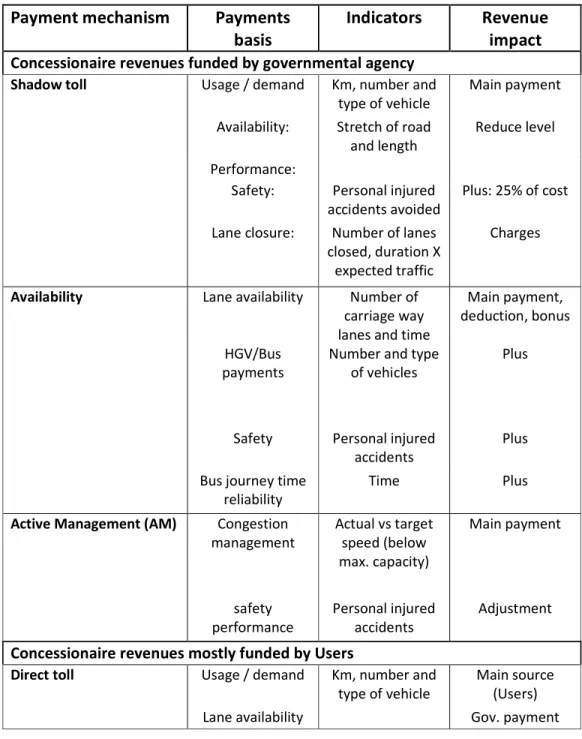
are three payment mechanisms commonly used within the PFI projects; 1) Shadow toll plus safety payment minus lane closure charges; 2) Availability plus safety performance; and 3)
Active management, congestion payments plus safety performance. These different forms and mechanisms are presented in Table 1.
It is worth noting how some of the basis of the payments are based on, are adapted and are
combined in every contract according to the objectives of the road project, and the areas
which special operating management is focussed. In this regard, one of the most innovative
features is the congestion management base. This considers actual speed in comparison
with the target speed to make payments. This promotes the PFI operator’s ability to manage
the traffic congestion. However, the mechanism does make allowances depending on
3 4 5 6 7 8 9 10 11 12 13 14 15 16 17 18 19 20 21 22 23 24 25 26 27 28 29 30 31 32 33 34 35 36 37 38 39 40 41 42 43 44 45 46 47 48 49 50 51 52 53 54 55 56 57 58
whether or not the operator has control over recurrent congestion when the volume of traffic
demand approaches the full capacity of the road. The following presents the case analysis
adopted for the study based on these different payment mechanisms.
Insert Table 1: PFI UK payment mechanisms
5. Case Analysis – Methodology
This paper is based on an EU COST (European Cooperation in Science and Technology)
Action TUD1001 (Transport and Urban Development) on “Public Private
Partnerships in Transport: Trends and Theory”. Due to the complex nature of PPPs, the
different arrangements of PPP projects need to be looked at on a common platform for easy
comparisons. Therefore, a case study methodology using a structured narrative was used for
the COST TUD1001 Action (Roumboutsos and Liyanage, 2012). The narrative included
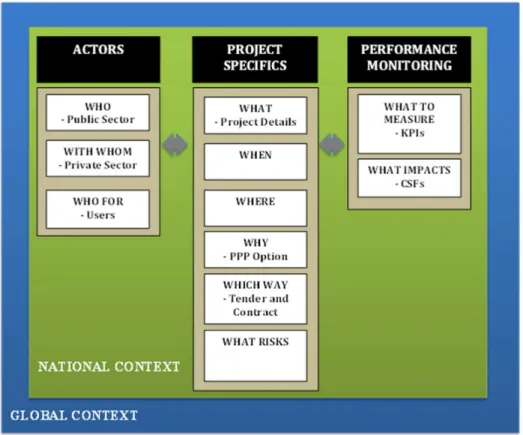
different elements (i.e. actors, project specifics and performance monitoring). The
descriptions for these different elements are given below.
Insert Figure 1: P3T3 Case Template (Roumboutsos and Liyanage, 2012)
Herein, actors are the participants in the project, i.e. the public contracting agency and
sponsors, the private participants and the users who benefit from the project. Secondly, the
specifications of the project are described, mostly with regard to what the project is all about
(what), project timelines (when), location (where), why the PPP option was selected for the
project, the tendering procedure (which way), etc. Finally, the template focuses on identifying
the key performance indicators (KPI) and also the critical success factors (CSF) to evaluate
the success criteria of a project.
Primary data for this study are basically obtained from these filled case templates (which
were then transferred to a case database). Semi-structured interviews were conducted and
3 4 5 6 7 8 9 10 11 12 13 14 15 16 17 18 19 20 21 22 23 24 25 26 27 28 29 30 31 32 33 34 35 36 37 38 39 40 41 42 43 44 45 46 47 48 49 50 51 52 53 54 55 56 57 58 59
secondary data was also collected to fill in the templates. A manual Qualitative Content
Analysis (QCA) approach was employed to provide contextual and evaluative understanding
of the data collected. This enables a diagnostic study of the outcomes to be carried out
(Ritchie & Spencer, 2002).
Four road case studies that are currently in operation in the UK were selected to achieve the
main purpose of this paper (see the introduction section). The four projects selected are;
M80 Haggs Motorway, A19 Dishforth, M6 Toll road and the M-25 Orbital. These projects
represent differing government sponsors, methods of repayment structures, geographical
demands, tendering processes, innovative approaches, user acceptance, etc; thus, it was
one of the main criteria used when selecting the projects. The following sections detail the
case study information.
6. Project Descriptions, Funding Methods and Financing
6.1A19 Dishforth
A19 Dishforth is a brownfield project and it is one of the several PFI road projects developed
during the mid-1990s as part of the government Tranche 1A PFIs (Partnership UK, 2009).
This tranche was more sophisticated than its predecessors, with a scope for the private
partner to improve the road through innovation and better service delivery. The initial
construction costs were only £29.4 million, although the contract value is worth more than
£300 million. The term of the concession is 30 years. The small size of the project means
that, financing could be obtained by the contractor fairly easily. The original bank lenders
were CIBC Bank from Canada and IBJ Bank from Japan. This was important as the banks
held the bonds and guarantees during the construction phase. However it is noted that, for
this project, the construction phase was smaller compared to other projects.
The current incumbent of the Special Purpose Vehicle (SPV) is Sir Robert McAlpine Ltd. with
no shareholders and loans facilitating the venture. This is different to the original scheme
3 4 5 6 7 8 9 10 11 12 13 14 15 16 17 18 19 20 21 22 23 24 25 26 27 28 29 30 31 32 33 34 35 36 37 38 39 40 41 42 43 44 45 46 47 48 49 50 51 52 53 54 55 56 57 58
where there was a consortium including a number of shareholders. Currently the only
“external form of investment” is bank loans. It is worth noting the role that the 30-year
contract has on the financial structures; the public sector acknowledge that the contract
period was beyond the limits of conventional finance instruments, and this meant the
adoption of innovation to the factors of success in the formation of the project (Highways
Agency 2012).
The proposal of refinancing appears to be a function that the public sector believes will be
carried out by the private sector partners (Highways Agency, 2012). The project agreement
is on a Design, Build, Finance and Operate (DBFO) procurement model. The contract is fully
privately financed and it mainly covers operation and maintenance.
6.2M6 Toll
The M-6 toll road is mostly a Greenfield project, and it is the only direct toll road in the UK.
The initial construction costs of the project were £485 million, but the value of the contract is
estimated at £900 million. The term of the concession is 53 years, to allow investment
recovery. Its private partner is named Midland Expressway Ltd. The principle equity holder
within the SPV is Macquarie Infrastructure Group.
Originally known as the Birmingham Northern Relief Road (BNRR), the project was initially
developed as a traditional public sector road scheme, but local objections ended in a public
inquiry in 1988. Later, BNRR was chosen as a ‘test case’ for private financing and tenders
were called in 1990; and a detailed proposal was prepared by the successful bidder.
The original Concession was held by a consortium of Kvaerner and Autostrade, but it was
later passed to Macquarie group. This refinancing option proved a contentious issue to the
public sector as it enabled a profit to the equity provider. The project presents 30% of the
asset value for the equity holder portfolio (M6 Toll, 2008).
3 4 5 6 7 8 9 10 11 12 13 14 15 16 17 18 19 20 21 22 23 24 25 26 27 28 29 30 31 32 33 34 35 36 37 38 39 40 41 42 43 44 45 46 47 48 49 50 51 52 53 54 55 56 57 58 59
During the contract formation of the project, it was specifically mentioned that this project will
be financed without recourse to the government. This was due to the then government (in
1991, the Prime Minister was Margaret Thatcher) lacking the ability to directly fund large
infrastructure projects and the desire to encourage the private sector to invest in the
infrastructure of the UK. The financial close of the project was reached in Feb 1992. This
scheme originally was conceived as a traditionally public procured road but eventually the
model proposed was that of a Build, Operate and Transfer (BOT) DBFO that was only
exceptionally used within UK PFI. The Financiers for this project were Banque Indosuez
(primary), NatWest Bank and Barclays de Zoete Wedd (U.S. department of Transportation,
2007).
In September 2006, Macquarie IG restructured the debt on the M6 toll project, which enabled
the SPV to release £392 million back to its single owner, Macquarie IG (Bain, 2006). As the
financing is wholly at the risk of the private sector provider, there is no sharing of the benefits
brought with refinancing for the public sponsor. No evidence of sharing the potential
refinancing gain with the Authority, nor value for money positive implications, has been found
in this project. Financing of projects reliant upon usage and patronage creates a higher risk
profile than other payment methods, what is due in part to the optimism bias inherent in
measuring future use of the project. A significant risk is also borne from the methodology of
the financing instruments employed in the refinancing and it may be noted how the historical
investment structure of the project differs greatly from the present position.
The issue of refinancing gain and arrangement for sharing is already included in the
Standardisation of PFI contracts and Amended refinancing provisions of October 2008,
stating that the grantor (“Authority”) is entitled to around 50% of such refinancing gains.
6.3M80 Haggs
M80 Haags project, is mostly a greenfield project, and is sponsored by the Scottish
government under the UK PFI. The initial construction costs of the project were over £250
3 4 5 6 7 8 9 10 11 12 13 14 15 16 17 18 19 20 21 22 23 24 25 26 27 28 29 30 31 32 33 34 35 36 37 38 39 40 41 42 43 44 45 46 47 48 49 50 51 52 53 54 55 56 57 58
million, although final costs exceeded £300 million. The term of the concession is 33 years
and the debt volume is estimated at £250 million. Its private partner is a SPV named as
Highway Management (Scotland) Ltd. The principle equity holder within the private
consortium is Bilfinger Berger Project investments. During the bidding and construction
phases, banks and bond holders, including the European Investment Bank (EIB), were
stakeholders. The main driver for the public agency was ensuring value for money. The
change of ownership during the contract from multiple shareholders to a single equity holder,
although not legislated for, had been anticipated by the public sector agencies and
presented no issue. This was because the original stakeholders in the SPV were a
construction company and, as the contract led into the operational phase, their input and
expertise diminished leaving Bilfinger as the company with the resources and expertise to
complete the contract. The other parties also lost interest in the project. The majority of risks
are passed to the private sector partner including the financial risk associated with DBFO
projects. Regulatory Risks have shared benefit to changes as expressed by both the public
and private partners. This shared approach is to ensure good working relationships. There
are several aspects to the funding of this scheme which are of significant relevance.
Although the DBFO model suggests financing is the premise of the private sector, the public
body did, in fact, work with the SPV to organise substantial investment. This came in 2009, in
the form of a € 150 million loan from the European Investment Bank (Willis, 2009). The loan was given, at the request of both the SPV and the public regulatory agency, to finance 50%
of the project which translates into 50% of the senior debt. The EIB recognised, along with
the European Commission, that the road represented a valuable project and has strategic
importance for transport movement in the UK.
In Scotland, the Non-Profit Distribution model (NPD) (refer to section 2) is considered a fairer
form of finance than pure PFI, avoiding the kind of excessive returns and poor taxpayer
value which have been observed in the past. However, according to Vass (2010) a report
issued by the parliamentary Public Accounts Committee (PAC) indicates that banks drove up
3 4 5 6 7 8 9 10 11 12 13 14 15 16 17 18 19 20 21 22 23 24 25 26 27 28 29 30 31 32 33 34 35 36 37 38 39 40 41 42 43 44 45 46 47 48 49 50 51 52 53 54 55 56 57 58 59
interest cost up to 33% over the lifetime of the project and some critics claim that no
mechanism monitors the windfalls that providers can make from selling on their stakes. In
late 2010, HSBC purchased 42% share of the project through its special vehicle HICL (The
Construction Index, 2010). In 2012, Bilfinger Berger carried out a remodelling of their
portfolio, and this preferred investment remained within the group, since this payment
method offers predictability low risk volatility for investments (Bilfinger Berger Global
Infrastructure SICAV S.A., 2012).
6.4M-25 Orbital
The M-25 Orbital road is a brownfield project that has been conceived in different forms.
Since 1905 there was an official road planning for two roads as part of the project, but in
1975, it was subsumed to a single ring road - the London Orbital Motorway. However, the
Highways Agency in 2006 brought a plan to widen 63 miles of the project from six to eight
lanes, between junctions 5–6 and 16–30, as part of a DBFO project. After some
modifications, in 2009 a final contract was awarded to Connect Plus to widen the sections
between junctions 16 and 23 and between junctions 27 and 30, and maintain the M25 and
the Dartford Crossing for a 30-year period. There have been many criticisms about the
length of the procurement process and also about the cost, which, according to the House of
Commons Committee of Public Account (2011), involved advisers for a total of £ 80 million
from April 1994 to March 2010.
The works, initially estimated at a cost of £580 million, took place over three years in stages.
NAO (2010b) estimated that the contract has a present value cost of £3.4 billion, of which
present value of construction is £900 million and delivers £2.3 billion present value benefit.
However, the nominal contract value over the 30-year contract is £6.2 billion. Works were
completed in May 2012. In January 2013, the Highways Agency granted an additional £321
million construction contract to Balfour Beatty and Skanska, via Connect Plus, for works
already planned but not included intwo sections between junctions 5 to 7 and junctions 23 to
3 4 5 6 7 8 9 10 11 12 13 14 15 16 17 18 19 20 21 22 23 24 25 26 27 28 29 30 31 32 33 34 35 36 37 38 39 40 41 42 43 44 45 46 47 48 49 50 51 52 53 54 55 56 57 58
27. This is to be completed by February 2015. Connect Plus is a consortium of Balfour
Beatty (40%), Skanska (40%), WS Atkins (10%) and Egis Projects (10%).
The project consists of maintenance and operation of the road and many technical
innovations were also required to be incorporated onto the road project. These innovations
have also improved time reliability, road safety and driver’s information.
Following the credit crunch that started to emerge by the end of 2007, there were
uncertainties about the funding capacity to raise the necessary funds by the bidders. For this
reason, the Highways Agency decided that it was essential for the bidders to submit a
funding plan, and deliver evidence to show that the funding plans are realistic and
deliverable.
After the evaluation of these later retenders, the Connect Plus consortium was appointed as
the preferred bidder in June 2008, although it was only in February 2009, when the contract
was officially awarded.
However, the funding was an issue and the Department for Transport (DfT) came forward to
provide up to £500m of senior debt itself as a co-founder, in line with the new role of TIFU,
(Treasury's Infrastructure Financing Unit). Finally, the funding structure of the project
consisted of commercial bank debt provided by a 16-bank club deal for £700 million, EIB
credits for £400 million and shareholder equity for £200 million. Part of the EIB participation
was backed by an additional commercial bank facility for £215 million provided as EIB
guarantees, whilst the rest £185 million consisted of EIB structured finance facility.
Therefore, in total, it raised a £1.1 billion senior debt loan facilities, that represented about
85% of the total funding (85/15). The legal tenor was 27 years, although it includes some
incentives to shorten the term, as margins became more expensive as time goes by.
Financial markets were not easy after the economic downturn in 2007/08. There were many
provisions and compensation introduced by banks in last moment, such as margin ratchet
and cash sweep. In effect, banks were reluctant to lend long term debt and these two
3 4 5 6 7 8 9 10 11 12 13 14 15 16 17 18 19 20 21 22 23 24 25 26 27 28 29 30 31 32 33 34 35 36 37 38 39 40 41 42 43 44 45 46 47 48 49 50 51 52 53 54 55 56 57 58 59
elements were introduced to heavily encourage an earlier refinancing. In addition, a rebate
mechanism was introduced by the Highways Agency (Project Finance International 2013).
According to NAO (2010), the interest rate margin for the M-6, considered a medium level of
project risk was 2.5-3.5% and the total interest cost 6.9-7.9% for different stages.
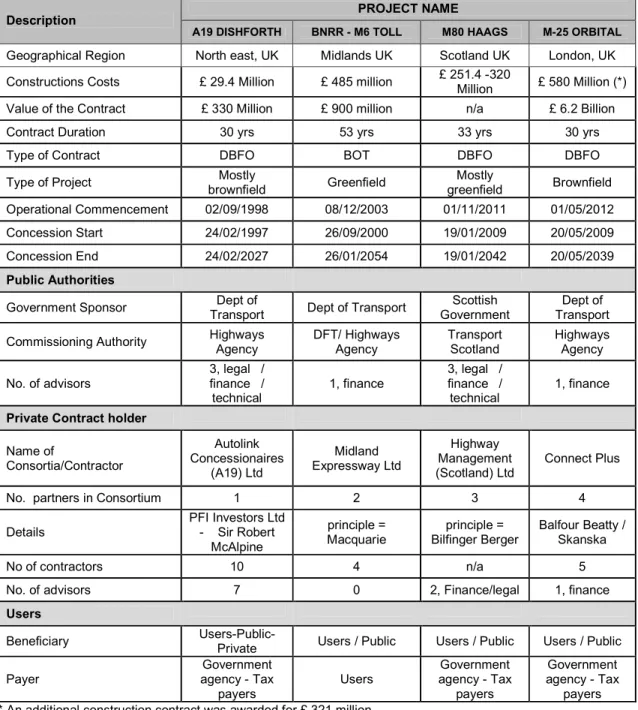
Given all the details discussed above, the following table (Table 2) summarises the main
features of the four case studies in three dimensions: i.e. public, private and users.
Insert Table 2: Case study Descriptions
7. Case Studies Analysis and Discussion
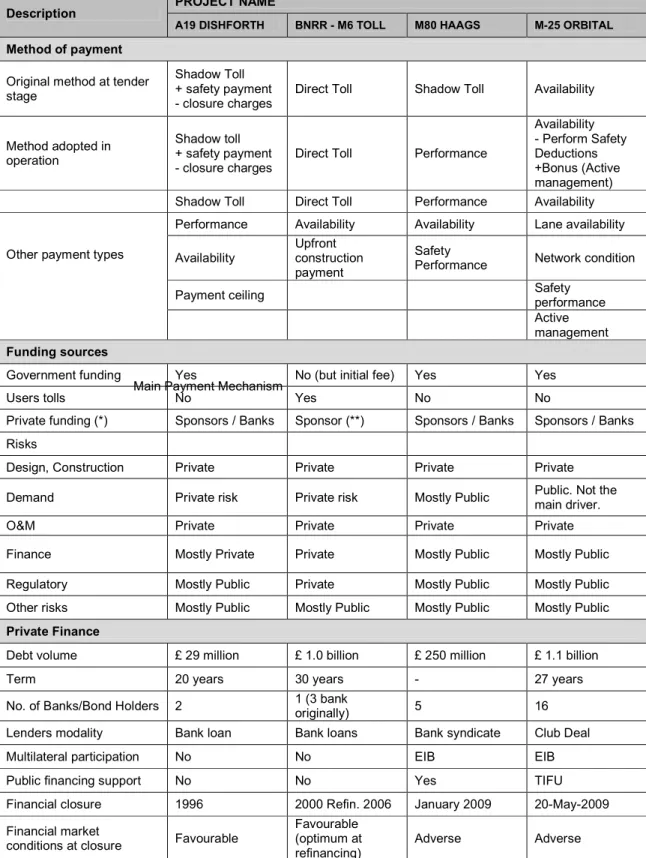
A detailed analysis of the selected case studies is presented in Table 3. The summary
includes applied methods of payments, funding sources, risk profiles and financing details.
Insert Table 3: Case study comparisons
In A19 project, the method of payment adopted was shadow tolls. The adoption of shadow
tolling as a payment structure is based on vehicle KM travel with penalty measures against
availability and safety performance. The issue of changes to the financial position of the SPV
and its shareholders was not explicitly incorporated into the contract at the beginning;
therefore, the flexibility of the form of contract meant that, although change was not
envisioned, there were review processes to allow protection of government’s interests.
Within the contract there was no provision to share the potential “windfall” brought with
refinancing, which in the case of M6 Toll led to a parliament enquiry.
In a typical PFI payment scheme, shadow toll revenues steadily increase as project gets
mature and, in the final phase of the project, revenues sharply decrease, as the debt is
3 4 5 6 7 8 9 10 11 12 13 14 15 16 17 18 19 20 21 22 23 24 25 26 27 28 29 30 31 32 33 34 35 36 37 38 39 40 41 42 43 44 45 46 47 48 49 50 51 52 53 54 55 56 57 58
perceived to have been cleared off by this time. Due to the shadow toll payment mechanism,
i.e. grantor pays the full fees; the volatility of the revenue under this model is low. The traffic,
therefore, is not directly affected by the economic trend; however, other factors such as the
rise of fuel price and unemployment may have a negative impact on it.
As for the M6 toll, the payment method employed is direct tolls. The government originally
considered reviewing the toll every twelve months; however, according to the concession
agreement, tolls are to be reviewed on a six-month cycle. The toll charges were established
to ensure that the project is self-financed and the only recipient of the toll revenues is the
SPV. The impacts of the economic downturn had a significant reduction in usage of the road,
thus, a reduction in revenue generation. The government also pays an availability fee (capital
payment) to the private partner as set out in the concession agreement, based on the data
from the principle equity holder (Macquarie Atlas Roads, 2011). However, this assessment
conflicts with data analised by the Post Opening Project Evaluation (POPE) (Highways
Agency, 2009), which shows that M6 Toll traffic has declined in 2007 even before the
economic downturn was actually recognised. This suggests that a better tariff management
system is needed to maximise revenues.
The M6 toll road was introduced to relieve over capacity in the M6 motorway
(Birmingham/London road). However, M6 motorway has traffic levels that are similar to the
levels prior to opening of the Toll operated section. This means that the cost/benefit rationale
offered by this scheme does not seem to create value for money for users. The typical
revenue flow profile in the pre-analysis phase usually consider a “ramp up” period when high
increases in revenues are produced to be followed by a consolidation phase in which a small
but steady average growth, similar of that of the population growth, is achieved. However,
under this model, the volatility of the revenues is high, especially because it’s reliant on the
user fees. Thus the income is directly correlated to the economic trend. Notwithstanding that
revenue volatility, availability payments made by the government induce some income
stability, anticipating some of the benefits of a blended payment model.
3 4 5 6 7 8 9 10 11 12 13 14 15 16 17 18 19 20 21 22 23 24 25 26 27 28 29 30 31 32 33 34 35 36 37 38 39 40 41 42 43 44 45 46 47 48 49 50 51 52 53 54 55 56 57 58 59
M80 project was the first road project to adopt Competitive Dialogue method in Scotland for
tendering. This was carried out in 2008. The use of a DBFO was the outcome during the
competitive dialogue process. At the end of the dialogue, Transport Scotland’s view was that
the dialogue ensured a meaningful relationship could be built considering the long-term
nature of the project. However, from private sector viewpoint, they felt that potential
innovations were not taken up due to the dialogue being restricted to talk only about the
needs of the public sector. This could be due to the lack of familiarity of the form of tender
employed. Thus, instead of outlining the required outputs in the form of deliverables with
attached KPIs, the public sector have focussed more on detailing the specifications of the
project.
The competitive dialogue process was also the driver for changing the payment mechanism
from shadow toll to performance related pricing structure in the project. The performance
relate payment suggested was based on availability, carriage way performance and safety
impacts. However, there were lack of incentives for improvements over and above the
agreed performance levels. This means that, although the project is successful overall, it has
not fully reaped the full benefits of performance related payment mechanisms.
M25 Orbitalhas a payment scheme based on availability and performance safety. There are
several components of this payment mechanism: lane availability, network condition, safety
performance, route performance, active management and incident management. As part of
the project, considering that there is an existing road with consolidated traffic, it was very
important to have the roads available at all times to avoid congestions, and to find a quick
and effective action in case of road works and/or unfavourable weather conditions. In
addition, it was it was also needed to improve the safety level, offering the best quality of the
road and, therefore, reducing the number of accidents. Due to all above, payment
mechanism based on availability and performance safety was identified as the most
appropriate. 3 4 5 6 7 8 9 10 11 12 13 14 15 16 17 18 19 20 21 22 23 24 25 26 27 28 29 30 31 32 33 34 35 36 37 38 39 40 41 42 43 44 45 46 47 48 49 50 51 52 53 54 55 56 57 58
Deductions may apply for lane availability based on restriction due to traffic management
adopted by the company (this is a more sophisticated version of lane closure management),
on the condition of the network, on the condition of the carriageway, and failure to promptly
attend defects.
Pain/gain measures may also apply with regard to safety performance, incident management
focussed on restoring capacity after critical incidents, and with regard to route performance -
a similar measure to congestion management that may be positive for reliable journeys, or
negative for delays. Finally, a bonus for helping to achieve aims and objectives may also be
obtained as a proactive management strategy. Overall, the discussions given in this section
is summarised in previous table 4.
8. Implications
The selected four case studies have used different payment mechanisms, i.e.
performance-related payments 80), shadow toll (A19), availability payments 25) and direct toll
(M-6). Thus, they present a diversity of issues regarding financing gain (mainly in M-6),
operation, demand, risks, and/or innovation in term of traffic and road management (M-25),
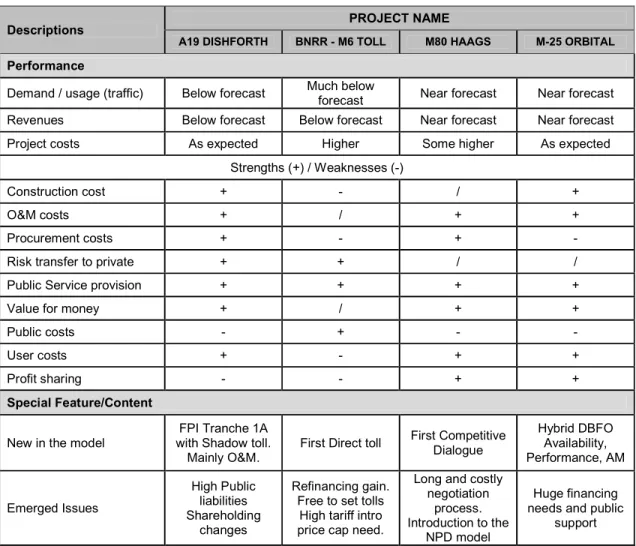
etc. A summary of the identified implications of the case study findings are presented in
Table 4. It clearly shows differences in project performance as well as the strengths and
weaknesses of the project. It also points out the main features of the projects that may
illustrate evolution of UK PPP/PFI.
Insert Table 4: Case study implications
Within the main benefits of the DBFO contracts included in the different PFI tranches, as A19
Dishforth, it may be highlighted the development of a private sector road operating industry,
3 4 5 6 7 8 9 10 11 12 13 14 15 16 17 18 19 20 21 22 23 24 25 26 27 28 29 30 31 32 33 34 35 36 37 38 39 40 41 42 43 44 45 46 47 48 49 50 51 52 53 54 55 56 57 58 59
improving the partnerships between public and private sector and transferring appropriate
levels of risks to the private sector. But is also notable how this initiative has provided many
improvements in public policy related to cost certainty, more reliable and accurate
expenditure forecast and also has open scope for innovation in many areas, including
financing, but specially in the method of service delivery aiming at cost saving in the road
operation. This project also shows a high degree of output specifications which defines how
the service has to be delivered. In the end, the main objective of this policy has been to
provide better value for money. It is clear from the case studies that ‘demand’ is a key
criterion implemented into the business case for road transport schemes, particularly those
adopt PPP as the preferred procurement route. In all cases, demand was measured over a
considerable period of time. Demand is a measurable quantum, which is also utilised as a
mode to encourage investment and private sector participation.
The issue where risk is transferred without allowing the private sector to innovate in
mitigation does raise the potential that costs are transmitted back to the public sector for this
service. The most significant current risk in effect for the M6 Toll is that of demand risk. From
the data analysis it can be seen that demand is strongly weakened by the macro-economic
effects, although this has accelerated the down-ward trend for use of this carriage way, there
was a weakening demand prior to 2007. Public acceptance has a direct bearing, due
significantly to the cost of use and this implies that for direct tolling to be an effective method
of payment, the government needs to work in conjunction with the private sector in promoting
direct tolling.
Demand in use can be seen a risk for the public sector providers as demonstrated in the
M80 project. Where the potential use is underestimated in appraising the procurement and
payment methodology, the outcome as identified by the data, is a significant increase in
revenue for the private sector partner and the risk of reduced value for money to the public
purse. Had the use of competitive dialogue been employed, then a structure of cost
reductions could be used as the road reaches its capacity limit, in effect, offering a share of
3 4 5 6 7 8 9 10 11 12 13 14 15 16 17 18 19 20 21 22 23 24 25 26 27 28 29 30 31 32 33 34 35 36 37 38 39 40 41 42 43 44 45 46 47 48 49 50 51 52 53 54 55 56 57 58
the revenue back to the public sector for a profitable and sustainable income to the private
sector partner. This sharing of the income benefit was not explored as the tendering
procedure, although a dialogue was led by the public sector sponsor. Herein, flexible and
blended payment structures which offer benefits to both parties in the partnerships will
encourage trust. This approach will also have positive effects on the financial sector and user
groups of stakeholders.
It is suggested that Financing and refinancing of these projects may incur additional burden
to the risk profiles of the projects. However, this will differ in how they affect the public and
private organisations involved. It is also suggested that the contracts used for the case study
projects offer no ability for the public sector to seek benefit from refinancing of the projects’
debt. This is in contrast to the monetary benefits acquired by the owners of the SPVs,
suggesting that value for money to the public will diminish without tools to seek mutual
convenience. This was clearly the case in the M80 project. In a situation like this, the
response by the Public sector sponsor may be to launch a review and instigate a new
procurement model, e.g. NPD model introduced by the Scottish government (please refer to
section 2).
The M25 orbital case study is a good example for financial development and innovation.
This project shows how a large and strategically significant deal may attract finance to road projects, even in adverse financial market conditions derived from the economic downturn. Nevertheless, there were doubts about the capacity to fund such big projects, and one of the
suggestions was the switch to short-term lending that became a trend since then. Moreover,
even though banks could still commit some kind of long-term facilities, the capital markets
have reacted imposing tough conditions in prices – thus, in practice, it meant that shifting to
shorter term solutions was much better. High profit margins by the private sector absorbed
value for money of the project and eroded the attraction to PFIs in comparison to other
procurement methods. The main lesson learnt from this case is, even in hard times there is
appetite in the financial markets for PFIs using project financing; however, successful
3 4 5 6 7 8 9 10 11 12 13 14 15 16 17 18 19 20 21 22 23 24 25 26 27 28 29 30 31 32 33 34 35 36 37 38 39 40 41 42 43 44 45 46 47 48 49 50 51 52 53 54 55 56 57 58 59
development of the project requires favourable financial conditions to launch this type of
large projects (Project Finance International 2013). From the above, with regard to the
financial markets and their influence on the lifecycle of road projects in the UK, it seems
evident from the analysis of the four case studies, especially from the most recent project of
the four cases (i.e. M25), that the market trend is to offer short term capital provision. This
approach of utilising short term capital from the financial markets and the use of consortia for
the construction phase passes to a single operating equity provider in some of the cases
reviewed. This means that, only private sector providers with the capacity to provide
substantial equity long term enter into the market. An alternative could be incentives for the investment and capital markets to take a long-term interest in PFI projects and offer support
to the private sector. A potential change in the funding structure from short-term capital
support to longer-term equity by the financial markets is a suggestive improvement, which
can bring many benefits. However, this may depend on the market conditions. This approach
will open the UK road PPP market to alternative providers which will bring with them
experience and alternative solutions. In this regard, the government needs to adopt greater
expertise and confidence when operating with the private sector. Confidence is critical to
increase value for money to the public sector and the experience obtained from projects
needs to inform newer proposals. The government is also an influencing factor over the user
and communities. For this reason, transparency is paramount to ensure acceptance of not
only the need for expansion of the road network, but also the method of procurement and
payment structures employed.
Payment methods are possibly the utmost method for expressing whether a project is
successful. It is evident, though that a balance is necessary to ensure that viability of the
project for both public and private partners. A structure that operates to give surety of income
to the private sector whilst ensuring the public sector is not overly burdened with paying for
the risk provisions could provide a balanced cost/benefit system.
3 4 5 6 7 8 9 10 11 12 13 14 15 16 17 18 19 20 21 22 23 24 25 26 27 28 29 30 31 32 33 34 35 36 37 38 39 40 41 42 43 44 45 46 47 48 49 50 51 52 53 54 55 56 57 58
9. Conclusions
The term Public Private Partnership is not a specific form of procurement and the literature
reviewed embodies the pantheon of different models which fall under the umbrella of PPP.
The variety of arrangements used in PPP models can be complex and may suit specific
projects better than another. These arrangements become even more complex when set
against the methods used by different payment criteria. For example, the adopted shadow
toll model in A-19 has attracted private sector participation, however, it holds a significant
burden, in the future, to the public budget. By trying to make a higher risk transfer to private sector, M-6 toll project releases liabilities from the public at the expense of the users who
suffer a high toll price with an applied no cap regulation. Refinancing this project at
operations start, brought substantial benefit to the private holder but there is no evidence to
sharing gain with public users. The Scottish government, following PFI policy, have
introduced the competitive dialogue as a trial to best adopt performance methods of payment
instead of fully transferring demand risk to the private sector – this is the case in M-80. M-25
is an example as to how innovations and mixed payment methods can be adopted, as it was
developed under adverse market conditions and low willingness to accept demand risk
profiles.
Different payment methods for PPP road project (or in general) can be used, if certain
conditions are met. Use of shadow toll can be advantageous as it transfers demand risk to
the private sector, however, it can be further improved if Public Sector Comparator (PSC)
and Value for Money (VfM) are considered heavily during contract initiation/renegotiation.
Direct tolls should be adopted with care, as, although it also transfers demand risk to the
private sector, it may come a high cost to the user. Improved payment mechanisms based
on performance seem appealing as well, however, public sector should take steps in
reducing private sector risks according to its capacity and level of financing. Since all the
payment methods have their own pros and cons, the use of hybrid funding models could
become more appropriate for many PPP project as they can combine the strengths of two or
3 4 5 6 7 8 9 10 11 12 13 14 15 16 17 18 19 20 21 22 23 24 25 26 27 28 29 30 31 32 33 34 35 36 37 38 39 40 41 42 43 44 45 46 47 48 49 50 51 52 53 54 55 56 57 58 59
For Peer Review
more payment methods, whilst cancelling out their disadvantages. Perhaps more future
research is needed to investigate the implications of hybrid models of funding/payment in
PPP transport projects.
References
1. Abdel Aziz, A. (2007) A survey of the payment mechanisms for transportation DBFO projects in British Columbia. Construction Management and Economics 25:5, 529-543
2. Agyemang, P. (2011). Effectiveness of Public Private Partnership in Infrastructure Projects. Master Paper. Arlington, Texas, USA: The University of Texas at Arlington.
3. Akbiyikli, R., Eaton, D., and Turner, A. (2006). Project Finance and the Private Finance Initiative (PFI). The Journal of Structured Finance, Vol. 12, No. 2 (2006), pp. 67-75.
4. Akintoye, A., Beck, M., and Hardcastle, C. (2003). Public-Private Partnerships: Managing Risks and Opportunities. Oxford: Blackwell
5. Bain, R. (2006, June 12). Risks and risk mitigants in refinancing. Retrieved from PFI Journal:
http://www.publicservice.co.uk/article.asp?publication=The%20PPP%20Journal&id=242 &content_name=Finance&article=6811
6. Bilfinger Berger Global Infrastructure SICAV S.A. (2012). Fact Sheet. Retrieved from Bilfinger Berger Global Infrastructure : http://www.bb-gi.com/~/media/Files/B/Bilfinger-Berger/Attachments/PDFs/2012/2012-factsheet.pdf
7. Boles, C. and Liyanage C. L. (2013) M6 Toll Road in Roumboutsos, A, Farrell, S., Liyanage, C. and Macario, R. “COST Action TU1001 – 2013 Discussion Papers: Part II Case Studies”, ISBN: 978-88-97781-61-5
8. Burger, P., Bergvall, D., Jocobzone, S., & An, D. (2008). Public Private Partnerships: In Pursuit of Risk Sharing and Value for Money. Winterthur, Switzerland: Organisation for Economic Co-operation and Development.
9. Butcher, L. (2010). Roads: tolls. London UK: House of Commons Library.
10. Cook, A. (2011). A fresh start for the Strategic Road Network. London UK: Department of Transport.
11. De Lemos, L., Betts, M., Eaton, D., and De Almeida, L.T. (2003). The Nature of PFI. Journal of Structured and Project Finance, Vol. 9, No. 1 (2003), pp. 59-76.
3 4 5 6 7 8 9 10 11 12 13 14 15 16 17 18 19 20 21 22 23 24 25 26 27 28 29 30 31 32 33 34 35 36 37 38 39 40 41 42 43 44 45 46 47 48 49 50 51 52 53 54 55 56 57 58
For Peer Review
12. Finnerty, J.D. Project Financing: Asset-Based Financial Engineering, 2nd ed. Hoboken, NJ: John Wiley and Sons, 2007.
13. Gramlich, E. (1994). Infrastructure Investment: A Review Essay. Journal of Economic Literature, XXXII, 1176-1196.
14. Hardcastle, C., Edwards, P., Akintoye, A., & Li, B. (2005). Critical Success Factors for PPP/PFI Projects in the UK Construction Industry: A Factor Analysis Approach. Construction Management & Economics, 1-9.
15. Highways Agency. (2009). Post Opening Project Evaluation- M6 Toll. London: Highways Agency.
16. Highways Agency. (2012). DBFO -Value in Roads. Retrieved 08 29, 2012, from The National Archives: http://webarchive.nationalarchives.gov.uk/20120810121037/
http://www.highways.gov.uk/roads/2987.aspx
17. HM government. (1991). New Roads and Street Works Act. London: Parlimentary Press. 18. HM Treasury - Infrastructure. (2002) “Guidance note: calculation of the authority´s share
of a refinancing gain”
https://www.gov.uk/government/uploads/system/uploads/attachment_data/file/225368/0 6_pfi_refinancingguidance21307.pdf (last accessed 08/05/15)
19. HM Treasury - Infrastructure. (2005) “Application note: value for money in refinancings”
https://www.gov.uk/government/uploads/system/uploads/attachment_data/file/225371/0 8_application_note_value_for_money_280205.pdf (last accessed 08/05/15)
20. HM Treasury (2007) Standardisation of PFI Contracts. Version 4 March 2007
21. HM Treasury - Infrastructure. (2012). Private Finance 2. Retrieved 12 2012, from HM Treasury - Infrastructure: http://www.hm-treasury.gov.uk/infrastructure_pfireform.htm
22. HM Treasury. (2012). Summary Data as at March 2012. Retrieved 06 12, 2012, from HM Treasury:
http://www.hm-treasury.gov.uk/d/summary_document_pfi_data_march_2012.pdf
23. IMF. (2004). Public-Private Partnerships. INTERNATIONAL MONETARY FUND, Fiscal Affairs Department, Washington UK.
24. Hoezen, M., Van Rutten, J. Voordijk, H. and Dewulf, G. (2010). “Towards better customized service-led contracts through the competitive dialogue procedure.” Construction Management & Economics. 28 (11): 1177-1186.
25. Hoezen, M., Voordijk, H. and Dewulf, G. (2012). “Contracting dynamics in the
competitive dialogue procedure.” Build Environment Project and Asset management. 2 (1): 6-24.
26. House of Commons Committee of Public Account (2011). M-25 Private Finance Contract. United Kingdom Parliament (last accessed 08/05/15).
3 4 5 6 7 8 9 10 11 12 13 14 15 16 17 18 19 20 21 22 23 24 25 26 27 28 29 30 31 32 33 34 35 36 37 38 39 40 41 42 43 44 45 46 47 48 49 50 51 52 53 54 55 56 57 58 59