Volume 9 - Issue 27 / March 2020
367 DOI: http://dx.doi.org/10.34069/AI/2020.27.03.40
Technology "Debate" as a tool for communicative competence development
Технология «Дебаты» как средство формирования коммуникативной компетентности
Received: January 2, 2020 Accepted: February 3, 2020
Written by: Olga I. Vaganova127 ORCID: https://orcid.org/0000-0001-8347-484X Larisa V. Tsyganova128 ORCID: https://orcid.org/0000-0003-2784-9234 Elena A. Chelnokova129 ORCID: https://orcid.org/0000-0001-8673-6032 Anna V. Lapshova130 ORCID: https://orcid.org/0000-0001-7017-3589 Lyudmila A Turchina131 ORCID: https://orcid.org/0000-0001-5550-1943 Abstract
The task of a modern university is to produce a highly qualified and competent specialist, ready for independent implementation of professional activities. Communicative competence is one of the fundamental in such preparation. The purpose of the article is to review the experience of implementing the Debate technology as an effective means of developing communicative competence of future vocational training teachers. The article focuses on the specifics of their future activities, its features and conditions, as well as their role in the field of professional education. The teacher of vocational training carries out pedagogical, educational-production and organizational-methodological activities in students training in secondary vocational schools. The basis for the implementation of his professional activity is the construction of effective interaction in the classroom between the teacher and students. For this, future teachers of vocational training must master communicative competence which is one of the main components of their future activities success. The article reveals features of the "Debate" and their capabilities in students’ training. The study allowed us to check the level of communicative competence development in dynamics, as well as to identify the level of students' motivation before using the Debate technology and after. Based on
Аннотация Задачей современного вуза является формирование компетентного высококвалифицированного специалиста, готового к самостоятельному осуществлению профессиональной деятельности. Коммуникативная компетентность является одной из основополагающих в его подготовке. Цель статьи заключается в рассмотрении опыта реализации технологии «Дебаты» как результативного средства формирования коммуникативной компетентности будущих педагогов профессионального обучения. В статье сделан акцент на специфику их будущей деятельности, ее особенности и условия, роль в сфере профессионального образования. Педагог профессионального обучения осуществляет педагогическую, учебно-производственную и организационно-методическую деятельность в подготовке обучающихся средних профессиональных учебных заведений. Основой осуществления его профессиональной деятельности является построение результативного взаимодействия на занятиях между педагогом и студентами. Для этого будущим педагогам профессионального обучения необходимо овладеть коммуникативной компетентностью, которая является одной из
127 Minin Nizhny Novgorod State Pedagogical University, Russia 128 Togliatti State University, Russia
129 Minin Nizhny Novgorod State Pedagogical University, Russia 130 Minin Nizhny Novgorod State Pedagogical University, Russia 131 V.I. Vernadsky Crimean Federal University, Russia
www.amazoniainvestiga.info ISSN 2322 - 6307
the data obtained, we can talk about the effectiveness of technology implementation. "Debate" provides ample opportunities for students to develop interaction skills, conduct constructive dialogue, select arguments, effective interaction strategies, the ability to balance emotional stress during the discussion, the ability to speak in public and other skills that contribute
to the development of communicative
competence and provide highly qualified specialist training.
Key Words: interaction, communicative competence, debate, educational technology.
главных составляющих успешности их будущей деятельности. В статье раскрываются особенности проведения «Дебатов», их возможности в подготовке студентов. Проведенное исследование позволило проверить уровень сформированности коммуникативной компетентности в динамике, а также выявить уровень мотивации студентов до использования технологии «Дебаты» и после. Основываясь на полученных данных, мы можем говорить о результативности внедрения технологии. «Дебаты» предоставляют широкие возможности для развития у студентов навыков взаимодействия, проведения конструктивного диалога, подбора аргументации, эффективных стратегий взаимодействия, способности выравнивания эмоционального напряжения в ходе дискуссии, способности к выступлению на публике и других умений и навыков, способствующих формированию коммуникативной компетентности и подготовке высококвалифицированного специалиста. Ключевые слова: взаимодействие, коммуникативная компетентность, дебаты, образовательные технологии. Introduction
The main strategic goal of modern higher schools is to train highly qualified specialists capable of performing productive independent professional activities (Abramova et al., 2019). Achieving this goal is carried out through complex, multifaceted
processes, including implementation of
educational technologies in the learning process (Bulaeva et al., 2018). The active use of educational technologies was due to new requirements for graduates training from the state and society (Cirdan et al., 2019). This trend is one of the most relevant in the development of vocational education. Today, society needs qualified teachers of vocational training able to carry out high-quality professional activities (Garnevska et al., 2018).
The process of training a vocational education teacher deserves special attention (Ihnatenko et al., 2018). Attention should be paid to the specifics of his future activities, its features and conditions and its role in the field of professional education (Ilyashenko et al., 2018). The teacher of vocational training carries out pedagogical,
educational-production and
organizational-methodological activities students training in secondary vocational schools (Ilyashenko et al., 2019). The basis for professional activities implementation is the construction of effective interaction in the classroom between the teacher and students (Vaganova et al, 2019b). For this, future teachers of vocational training must master communicative competence, which is one of the main components of their future activities success (Kamenez et al., 2019). Communicative competence implies the ability to establish and maintain contacts with people and the ability to actively interact (Klinkov et al., 2019). For a vocational education teacher, this competence is one of the key since his professional activity involves constant interaction, dialogues, and answers to questions. In order to carry out future professional activities at a high level, the student needs to master the process of dialogue (Denysenko et al., 2018). This is a rather lengthy
process in which various educational
technologies are used (Koshechko et al., 2018). For example, the development of independent and effective interaction skills can be carried out in the process of implementing game, design
Volume 9 - Issue 27 / March 2020
369
technologies, training technologies in
cooperation, case technologies and others (Kobernyk et al., 2018). However, in this article we focus on discussion technologies that can be applied in conjunction with other technologies (Tsarapkina et al., 2019b). A type of discussion technology is Debate (Markova et al., 2018). In this article we will consider their functionality, opportunities in the preparation of vocational education teachers and the development of their communicative competence (Markova et al., 2019).
Theoretical framework
Most domestic and foreign researchers who have studied the development of communicative
competence distinguish several of its
components (Prokhorova et al., 2018). Firstly, this is theoretical knowledge about building interaction, interpersonal relationships, secondly, the ability to predict the development of events, thirdly, using the mechanisms of communicative influence (persuasion, suggestion, infection),
creating favorable emotional conditions
(Pichugina et al., 2019). Communicative competence is usually considered as knowledge, experience, human abilities, allowing performing communicative functions (Nikonova et al.,
2019a). A person with communicative
competence is able to show organizational and communicative skills and control himself in the process of interaction as well as has culture of verbal and non-verbal interaction (Nikonova et al., 2019b).
Scientists and educational practitioners note the need to develop students' independent activity, expanding the types of activities in which students can self-actualize (Pliushch et al., 2018). That is why they distinguish various methods of organizing interactive interaction: disputes, focus conversations, solving cases, where dialogue is the forming element (Sedykh et al., 2019). However, among them they assign a special place to the technology of "Debate", which allows us to comprehend the existing and
acquire new emotional, communicative
experience (Smirnova et al., 2019). The debate is divided into two types: formal and informal (Vaganova et al, 2019a). Their difference lies in the fact that the former do not have rules, while the latter provide for a clear regulation. Most often, the first option is used in vocational education (Vaganova et al, 2019f). Debate is a formal dispute resolution method in which participants actively interact with each other. Each of the parties at the same time tries to bring weighty arguments in its favor (Vaganova et al,
2019c). The quality and depth of the debate depends on having specialized knowledge (Vaskovskaya et al., 2018). In order for the students' discussion to be productive, it is necessary that they be motivated to study professional disciplines in a high-quality manner and strive to expand their own knowledge in this area (Vaganova et al, 2019d). It is worth noting that a feature of the debate is the optionalness of finding the final solution to the issues (Ivanova et al., 2019). The task of the debate is to teach students to give reasons and arguments as well as analyze concepts (Vaganova et al, 2019e). Various researchers note that debate contributes to:
− the development of the ability to look at
a problem from different points of view;
− logical building of argumentation and
persuasion (Rakhimbaeva et al., 2019);
− form the moral consciousness of the
future teacher of vocational training (Tsarapkina et al., 2019a);
− development of the ability to analyze
concepts, concepts, ideals (Grigoriev et al., 2019).
The technology of debate allows you to expand students' perceptions of professional activity and prepare them for independent creative work. Methodology
A study was conducted at the Pedagogical University to test the level of communicative competence of future vocational education teachers. The study involved students whose major is "Vocational training (by industry)" in the amount of 82 people. The audit was carried out over three years. We tracked in dynamics a change in the level of its development. The statistical calculation was carried out over three stages. The first stage of the study was conducted in 2015, the second - in 2016, the third - in 2017. The development of communicative competence was divided into three levels (high, medium, low). A high level is characterized by the student’s ability to clearly argue their position, the ability to smooth out conflict situations in the process of interaction, to relieve emotional stress during the discussion; listen to the opinion of the opponent; show leadership skills and take
responsibility; build effective interaction
strategies leading to high results.
Students’ motivation is of utmost importance in
the development of professional and
www.amazoniainvestiga.info ISSN 2322 - 6307
higher its level is, the more students strive to study courses, the more they are ready for effective interaction and the development of a skill in conducting constructive dialogue and building effective relationships in future professional activities. To check the level of motivation, a questionnaire was developed and a survey was conducted among study participants. The questionnaire revealed the motivation to study professional courses. The survey was conducted over three years (2015, 2016, 2017). Results and discussion
We conducted a study to identify the communicative competence of future teachers of vocational training, in which students whose major is "Vocational training (by industry)" in the amount of 82 people (3 groups) took part. The development of communicative competence was determined by the following indicators: the
degree of conflict; the adequacy of the perception of others' opinions; correction of one’s own opinion under the influence of arguments; the ability to ask questions and answer them, the implementation of feedback (that is, to inform the partner that he was heard and understood); the ability to balance emotional stress during the discussion; ability to interact effectively with other students, to carry out cooperation; ability to
select effective interaction strategies;
argumentation of one’s opinion; ability to resolve disputes; ability to speak to the public; involvement in the situation, manifestation of the initiative; effective teamwork.
The development of communicative competence was determined by three levels: high, medium, low. Table 1 presents the characteristics of each level.
Table 1. Development levels of communicative competence of students of a pedagogical university
Level characteristic Level
The student is reasoned but defends his point of view; non-conflict; able to smooth out conflict situations in the process of interaction, relieve emotional stress during the discussion; y s an listen to opinion of the opponent; shows leadership qualities, takes responsibility; able to build effective interaction strategies leading to high
results; easily speaks to the public, is maximally involved in the situation.
High
The student is able to defend his point of view, bringing arguments to his advantage; tries not to enter into conflicts, to relieve emotional stress during discussion, if any; he has to listen to his opponent; most often is not a leader in the team, however,
shows coordinating qualities; responsibly approaches the fulfillment of assigned
tasks, listening to the opinion of their classmates; most often focuses on the discussion of a specific issue, shows involvement in the situation.
Middle
The student defends his point of view, without giving sufficient if -operation arguments in its favor; often initiates a conflict, does not try to listen to his opponent; refuses to take responsibility for the actions of the team; speaking in public is a difficult task for him; often distracted during the discussion of issues, shows inattention.
Low
The study was conducted on Length SRI three years (2015, 2016, 201 7). Checking the level of development was carried out during the observation by teachers of students' interactions during business games, the implementation of projects and case studies within the courses of
“Pedagogical Technologies”, “Interactive
Learning Technologies”, and “Project Activities of a Vocational Education Teacher” in which
students communicated and accepted joint decisions affecting the final result. At the first stage of the study in 2015, students were trained without the introduction of the Debate technology. It should be noted that q art was carried out on individual topics and quite rarely.
The results of the development of
communicative competence in 2015 are shown in Figure 1.
Volume 9 - Issue 27 / March 2020
371
Fig. 1. Results of checking the level of students' communicative competence in 2015
A statistical calculation showed that in 2015 the number of students with a low level of development of communicative competence prevails.
We also revealed the level of motivation of students to study. For this, a survey was conducted. The questionnaire is presented in table 2.
Table 2. Questionnaire to identify students' motivation to study professional courses
Question Answer options
Do you seek to participate in professional contests and conferences?
Yes
Rather yes than no Sooner than yes No
Do you like to solve problems related to future professional activities?
Yes
Rather yes than no Sooner than yes No
Would you like to study professional courses more deeply?
Yes
Rather yes than no Sooner than yes Not
Would you like to participate in various discussions on vocational education?
Yes
Rather yes than no Sooner than yes No
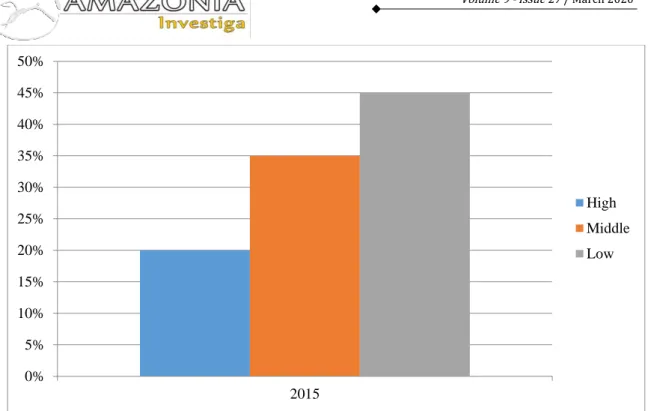
The level of motivation at the beginning of the study is shown in Figure 2. 0% 5% 10% 15% 20% 25% 30% 35% 40% 45% 50% 2015 High Middle Low
www.amazoniainvestiga.info ISSN 2322 - 6307
Fig. 2. Students motivation level in 2015
We can say that the level of motivation of students to study professional courses for the period of 2015 is quite low. Many students like to solve professional problems and they are confident in the choice of future professional activities. However, we cannot but note a large percentage of students for whom the learning process does not cause much interest. Therefore, the development of competence becomes difficult. The activation of students' interest, their motivation for active cognitive activity becomes one of the main tasks in the development of communicative competence. For this, in 2016, a system of conducting the "Debate" was developed. During the study of each key topic of
professional courses (“Pedagogical
technologies”, “Interactive teaching
technologies”, “Project activities of a teacher of vocational training”), discussions were held. Students were prepared in advance, selected the appropriate material, evaluated the relevance of interactivity for building their reasoned position,
and evaluated the opinions of various
researchers. The debate system covered topics: “The history of the development of pedagogical technologies”; "The didactic process - the basis for the development of pedagogical technology"; “Classifications of pedagogical technologists”; “Designing a system of learning goals”; "Interactive tools and equipment"; “Basic technological methods when working with interactive equipment”; "Pedagogical design as a way of innovative trans development." In the process of conducting the debate, students mastered ways to detect the strengths and
weaknesses of opposing judgments, selected evidence that refutes the fallacy of one opinion and confirms the truth of another. Students analyzed many sources, worked with documents, reference materials.
The debate was held as part of business games, projects, or independently.
Preparing for a debate is a lengthy and multifaceted process that goes through several stages:
− the teacher, together with the students,
establishes a range of issues that are discussed within the framework of a specific topic (usually 5-6 questions);
− Further, the teacher selects literature for
students, relevant sources that can be analyzed by students;
− students are divided into teams (three
speakers from each team are selected to protect the position and to deny it);
− each of the parties prepares a speech
(participants develop selected
arguments using evidence and
reasoning);
− at the final stage, the speakers
summarize (pay attention to the main contradictions position).
According to the results of the control measures, the teachers evaluated the level of development of communicative competence. 0% 5% 10% 15% 20% 25% 30% 35% 40% 45% 2015 High Middle Low
Volume 9 - Issue 27 / March 2020
373 The debate has been actively started since 2016,
at the end of which another check of the development of communicative competence was
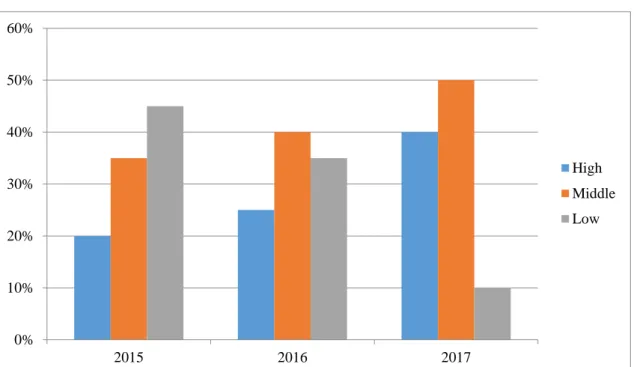
carried out. Figure 3 shows the results of the verification.
Fig 3. The results of the level of development of communicative competence (2015,2016,2017 year)
By 2017, the level of development of
communicative competence has grown
significantly. Technology "Debate" also had a
positive impact on the level of motivation of students. Figure 4 shows the results of the motivation test for the period from 2015 to 2017.
Fig 4. Students motivation level in 2015, 2016, 2017 0% 10% 20% 30% 40% 50% 60% 2015 2016 2017 High Middle Low 0% 10% 20% 30% 40% 50% 60% 2015 2016 2017 High Middle Low
www.amazoniainvestiga.info ISSN 2322 - 6307
The level of motivation of students has grown significantly. Students are ready for active inclusion in the educational process, are interested in a deeper study of the topics of professional courses, tend to take part in various professional competitions and conferences, their interest in professional activities has increased and they note an increase in the intensity of training due to the implementation of the Debate technology. The statistical calculation in 2016-2017 showed significant improvements in the development of communicative competence. Conclusions
In the process, we reviewed the experience of implementing the Debate technology as an
effective means of developing the
communicative competence of future vocational training teachers. We found that the debate helps to develop the skills necessary for effective interaction both in the professional sphere of activity and in everyday life, develop the ability to critical thinking, the ability to work in a team and concentrate on the essence of the problem. A statistical survey showed that the level of motivation of students to study professional courses for the period of 2015 was quite low. Many students liked to solve professional problems, and they were confident in the choice of future professional activities. However, there was a large percentage of students for whom the learning process did not cause much interest.
Consequently, competency building was
difficult. In accordance with the level of motivation was low and the level of development of communicative competence. 45% of students had a low level. By 2017, the level of development of communicative competence has increased significantly (50% of respondents have
an average level of development of
communicative competence, 40% - high). The Debate technology also had a positive effect on the level of student motivation (by 2017, 50% of students have a high level of motivation, 42% have an average level). The results of the study allow us to conclude that the "Debate" technology prepares students for making independent, responsible decisions, develops the ability to form effective interaction strategies, equalize emotional stress during the discussion, ability to speak in public and other skills that contribute to the development of communicative competence.
Bibliographic references
Abramova, N.S., Vaganova, O.I., Kutepova, L.I. (2018) Development of educational and
methodological support in the context of the
implementation of indevelopment and
communication technologies. Baltiyskiy
gumanitarnyy zhurnal (Baltic Humanitarian
Journal), 7, no. 2 (23), 181-184. (in Russ.).
Andrienko, O.A. (2019). On the need for application of game training technologies.
Balkan Scientific Review, 2 (4), 5-8.
Bulaeva, M.N., Vaganova, O.I., Gladkova, M.N. (2018). Activity technologies in a professional
educational institution. Baltiyskiy gumanitarnyy
zhurnal (Baltic Humanitarian Journal), 7, no. 3
(24), 167-170. (in Russ.).
Cirdan, A.P. (2019). Innovative technologies of professional training of future economists in the
system of continuous education. Humanitarian
Balkan Research, 2(4), 27-30.
Denysenko, S.M. (2018). Application of quest technology in the professional training Of Bachelor of Publishing and Polygraphy in Higher
School. Balkan Scientific Review, 1, 29-33.
Garnevska, S.M. (2018). Opportunities for forming communication technology images in training in technology and entrepreneurship.
Balkan Scientific Review, 1, 34-37.
Grigoriev, S. G., Shabunina, V. A., Tsarapkina, Ju. M., Dunaeva, N. V. (2019). Electronic library system as a means of self-development of students of digital generation Z (on the example of studying the course "Basics of the counselor
activity"). Scientific and technical libraries, 7,
78-99. 29.
Ihnatenko, H.V., Ihnatenko, K.V. (2018).
Development of self-dependence as a
professional ly-important personality trait of a future vocational education teacher by means of
case-technology. Humanitarian Balkan
Research, 1, 40-42.
Ilyashenko, L.K., Gladkova, M.N., Kutepov, M.M., Vaganova, O.I., Smirnova, Z.V. (2019 b). Development of communicative competencies of students in the context of blended learning.
Amazonia Investiga, 8 (18), 313-322.
Ilyashenko, L.K., Markova, S.M., Mironov, A.G., Vaganova, O.I., Smirnova, Z.V. (2019 a). Educational environment as a development
resource for the learning process. Amazonia
investiga, 8 (18), 303-312.
Kamenez, N., Vaganova, O. Smirnova, Z.,
Kutepova, L., Vinokurova, I. (2019).
Development of content of educational programs of additional education for professor-teaching composition in organization of educational
services of training with disability. Amazonia
investiga, 8 (18), 267-278.
Klinkov, G.T. (2019). Person-oriented learning as an educational and behavioral paradigm.
Volume 9 - Issue 27 / March 2020
375 Koshechko, N.V. (2018). Innovations from
educational discipline "Pedagogical
conflictology" in professional preparation of
students. Scientific Vector of the Balkans, 1,
59-63.
Kobernyk, O.M., Stetsenko, N.M., Boichenko, V.V., Pryshchepa, S.M. (2018). Improving professional and pedagogical training of future teachers by moodle platforms (On the example of
the course "Pedagogy"). Scientific Vector of the
Balkans, 1, 5-7.
Markova, S.M., Zanfir, L.N., Vaganova, O.I., Smirnova, Z.V., Tsyplakova, S.A. (2019). Department of educational process in conditions of implementation of interactive training of
future engineers. Amazonia Investiga, 8 (18),
450-460.
Markova, S.M., Narcosiev, А.К. (2018). Professional education of vocational school
students. Vestnik Mininskogo universiteta
(Vestnik of Minin University), 6, (3), 3. (in
Russ.). DOI: 10.26795/2307-1281-2018-6-3-3. Nikonova, N.P., Vaganova, O.I., Smimova, Z.V., Bystrova, N.V., Markova, S.M. (2019a). Providing partnerships and promotion of
additional educational services. International
journal of applied exercise physiology, 8 (2.1),
347-355.
Nikonova, N.P., Vaganova, O.I., Smirnova, Z.V., Chelnokova, E.A., Kutepov, M.M. (2019b). Methodological support in partnerships with the institution of additional education and
teachers. International journal of applied
exercise physiology, 8 (2.1), 339-346.
Pichugina, G.A., Bondarchuk, A.I. (2019). Structure of the training case in the organization
of the educational process. Humanitarian Balkan
Research, 2(4), 5-7.
Prokhorova, M.P., Semchenko, A.A. (2018).
Involving of trainees-future teachers of
professional training in project activities in the
discipline. Vestnik Mininskogo universiteta
(Vestnik of Minin University), 6, (2), 6. DOI:
10.26795/2307-1281-2018-6-2-6.
Pliushch, V.M. (2018). Independent work of students as a factor of improving education
quality. Balkan Scientific Review, 1, 69-71.
Sedykh, E.P., Zanfir, L.N., Vaganova, O.I., Smirnova, Z.V., Bulayeva, M.N. (2019). Use of training technology in the preparation of students
of engineering specialties. Amazonia Investiga, 8
(18), 461-470.
Smirnova, Z.V., Kamenez, N.V., Vaganova, O.I., Kutepova, L.I., Vezetiu E.V. (2019). The experience of using the webinar in the
preparation of engineering specialists. Amazonia
Investiga, 8 (18), 279-287.
Tsarapkina, Ju. M., Dunaeva, N. V., Kireicheva, A. M. (2019a). Application of BYOD technology in education on the example of Lecture Racing
mobile application. Informatika i obrazovanie —
Informatics and Education, 9 (308), 56-64.
Tsarapkina, Ju.M., Petrova, M.M., Mironov, A.G., Morozova, I.M., Shustova, O.B. (2019b). Robotics as a basis for Informatization of
education in children's health camp. Amazonia
Investiga, 8 (20), Mayo – junio.
Vaganova, O.I., Konovalova, E.Yu., Abramova, N.S., Lapshova, A.V., Smirnova, Z.V. (2019a). Increasing the level of teachers' readiness for
pedagogical project. Amazonia Investiga, 8 (22),
286 – 294.
Vaganova, O.I., Odarich, I.N., Popkova, A.A., Smirnova, Z.V., Lebedeva, A.A. (2019b). Independent work of students in professional
educational institutions. Amazonia Investiga, 8
(22), 295 – 304.
Vaganova, O.I., Sirotyk, S.D., Popkova, A.A., Smirnova, Z.V., Bulaeva, M.N. (2019c). Additional education in higher professional
educational institution. Amazonia Investiga, 8
(22), 305 – 310.
Vaganova, O.I., Smirnova, Z.V., Gruzdeva, M.L., Chaykina, Z.V., Ilyashenko, L.I. (2019d). Development of training content for master students in course "mechatronics and robotics" at
the University. Amazonia Investiga, 8 (22), 694
– 700.
Vaganova, O. I. (2019e). Development of competence in the possession of modern educational technologies at a university.
Amazonia Investiga, 8 (23), 87-95.
Vaganova, O. I. (2019f). Organization of practical classes in a higher educational
institution using modern educational
technologies. Amazonia Investiga, 8 (23), 81-86.
Vaskovskaya, G.A. (2018). Features of
implementation of pedagogical technologies of
profile training. Balkan Scientific Review, 1,
76-79.
Ivanova, N. L., Korostelev, A. A. (2019). The impact of competitive approach on students'
motivation in sport. Amazonia Investiga, 8 (18),
483-490.
Rakhimbaeva, Inga E.; Korostelev, Aleksandr A., Shakirova, Indira A., Ayshwarya, B., Phong Thanh Nguyen, Hashim, Wahidah, Maseleno, Andino. (2019). Integration of the Educational and Didactic Systems in the Training of Future
Teachers. International Journal of Applied