Open Research Online
The Open University’s repository of research publications
and other research outputs
State of the App: A Taxonomy and Framework for
Evaluating Language Learning Mobile Applications
Journal Item
How to cite:
Rosell-Aguilar, Fernando (2017). State of the App: A Taxonomy and Framework for Evaluating Language Learning Mobile Applications. CALICO Journal, 34(2) pp. 243–258.
For guidance on citations see FAQs.
c
2017 Equinox Publishing Version: Accepted Manuscript
Link(s) to article on publisher’s website: http://dx.doi.org/doi:10.1558/cj.27623
Copyright and Moral Rights for the articles on this site are retained by the individual authors and/or other copyright owners. For more information on Open Research Online’s data policy on reuse of materials please consult the policies page.
State of the App: a taxonomy and framework for evaluating language learning mobile applications
Fernando Rosell-Aguilar
School of Languages and Applied Linguistics
The Open University
Fernando Rosell-Aguilar is a Senior Lecturer in Spanish and Open Media Fellow at the Open University, United Kingdom. His research focuses on online language learning, mainly the use of apps, Twitter, and podcasting as teaching and learning tools, as well as the use of CMC learning environments (such as audio and video conferencing) and digital literacies.
Abstract
The widespread growth in availability and use of smartphones and tablets has facilitated an
unprecedented avalanche of new software applications with language learning and teaching
capabilities. However, little has been published in terms of effective design and evaluation of
language learning apps. This paper reviews current research about the potential of apps for
language learning and presents a taxonomy of available apps and their use for language
learning. The paper also presents a framework consisting of four categories for evaluating
language learning apps (technology, pedagogy, user experience, and language learning) and a
set of criteria within the categories. Finally, the paper proposes areas for further research.
Keywords: Apps; Language Learning; Taxonomy; Evaluation; Framework
1 Introduction
The market penetration of smartphones and tablets has been very fast and widespread. The
impact of these devices is due in part to features that at the time of launch were either new or
vast improvements on previous mobile phones, including larger screen size, responsive touch
screen, enhanced text-entry, high-quality audio and video playback, recording and editing,
voice recognition, enlarged storage, and faster connectivity (Godwin-Jones, 2011). Other
Before 2007 most mobile phones only carried the software provided with the device,
but this changed with smartphones as they included the ability to add additional software
applications. These software applications for mobile devices are commonly known as apps
(or mobile apps). Apps can be downloaded from app stores for different operating systems,
which offer a category of apps named Education, with apps aimed at wide-ranging learning
subjects, including languages. Many Apps can be downloaded for free, whereas others need
to be paid for, usually at quite a low cost. Some apps offer a free “lite” version of the app so
users can try them and decide whether to buy the full version and other apps offer in-app
purchases to access further content or remove advertisements.
2 Apps for language learning: a literature review
2.1 Potential, criticisms, previous studies and taxonomies
The availability of apps has provided affordances for educational activity in terms of what
can be done, where and when, with a single device. Among the potential advantages first
identified for language teaching and learning were the opportunities to teach, practice or
enhance a number of language learning skills as well as learners’ knowledge of the areas
where the target language is spoken (Rosell-Aguilar, 2009). Other authors have further
highlighted the potential of smartphone and tablet devices, as well as apps, for language
learning (Burston, 2014; Godwin-Jones, 2011; Kim & Kwon, 2012; Kim, 2013; Lys, 2013;
Sweeney & Moore, 2012). This potential is based on the theoretical principles and evidence
from the field of Mobile-Assisted Language Learning (MALL). Among these are the
provision of resources that can be used autonomously, taking screen size into consideration in
the design of resources, and chunking knowledge as independent learning objects to facilitate
processing of information (Ally, 2005). Other principles that apply to the use of mobile apps
for language teaching are from the field of gamification, the use of game design elements in
App design for language learning has come under criticism: Burston (2014) argued
that language learning activities on mobile apps are basic and have mostly replicated what
was done before with other technologies. Although most practitioners in Computer-Assisted
Language Learning (CALL) would agree that design for online language learning and
teaching should be pedagogy-driven (Colpaert, 2006), many language learning apps often
provide exercises that test the user without providing teaching first, or provide only a few
very brief examples of use. In addition, feedback on performance tends to be limited to a tick
or a cross to indicate whether an answer is correct or incorrect. They also tend to lack full
instructions and their help sections, if at all available, address technical rather than
pedagogical issues. Further criticisms related to the design of language learning apps include
too much focus on translation, poor navigation and user-interface design, and little use of the
unique properties of smartphones - connectivity with other users in particular (Godwin-Jones,
2011; Burston, 2014).
Other researchers agree: in their review of language learning mobile apps, Kim and
Kwon (2012) highlighted that most apps focus on cognitive processes (recognition, recall and
comprehension) and receptive language skills. They note the lack of socio-cognitive activities
or opportunities for collaborative learning, more consistent with more modern approaches to
CALL and MALL. What a CALL practitioner considers good practice, however, may not be
what users want. As classroom practice has moved towards more modern approaches,
learners may feel the need for more grammatical reinforcement in the form of drilling, given
that many learners equate learning a language with learning grammar. Since individualized
feedback on performance is something many learners rarely get outside formal tuition,
getting answers correct in quizzes, or using apps to memorize verb forms and vocabulary, are
rewarding activities and users are afforded the satisfaction of knowing they got something
feedback or support, some examples of good practice are now available, particularly among
apps that offer a full language-learning experience (e.g. Duolingo, Busuu).
A number of studies into the use of apps for language learning have been carried out.
Yildiz (2012) found that using apps with young learners of English as a second language led
to positive effects on vocabulary acquisition, phonological awareness and listening
comprehension skills. A study with 33 undergraduate students of Spanish by Castañeda and
Cho (2013) showed significant improvements in verb conjugation knowledge after using an
app. Their participants also reported enjoyment of the gaming features of the app. Lys (2013)
carried out a study of 13 university students of German. She found that the devices were
suitable for speaking and listening activities at advanced level, and her students both felt
comfortable using the devices and had the necessary competency to use them. Kim (2013)
found improvements in listening comprehension among a group of Korean students and also
reported positive attitudes towards the use of apps for this purpose, as did Khaddage and
Lattemann (2013). Steel (2012) carried out a study of 134 language learners. Students
reported that the features they liked best about using apps to support their learning outside
class were flexibility, convenience, portability, and the ability to personalise their learning as
well as using it on-the-go. The language areas that benefitted students most were vocabulary,
reading and writing, grammar and translation activities. Steel found that many students used
more than one app and valued the opportunities to engage with language learning outside the
classroom. In a study with 85 distance learners of Spanish, Rosell-Aguilar (in press) also
found that learners use apps mostly for vocabulary development, translation, and grammar
practice. Students used apps often (44% used them at least once a day), mostly informally
rather than in planned study sessions, and for relatively short periods of time. They liked the
ability to practise specific areas, rapid access to information, ease of use, and gamification
of grammar explanations, software errors, advertising, and poor feedback among others. All
users reported that using apps improved their language skills to different degrees. Further
studies have focused on specific skills for certain languages, such as learning non-western
scripts (Rosell-Aguilar & Kan, 2015) with very positive results.
Although the use of apps can maximize the opportunities to engage in learning, the
experience of learning on mobile devices can be highly fragmented and fraught with
distractions (Kenning, 2007). One aspect of this fragmentation is the fact that users access
their mobile devices for short amounts of time. This may affect learner choice of which app
to use, as, for example, an app that requires listening or speaking may discourage use in a
public place. Furthermore, Education apps have to fight for users’ attention from strong
competition from other apps within the device, such as games, and from pop-up notifications
from social media, messaging or email, for example.
Most research into the evaluation of education apps has part focused on using one
particular app within a concrete educational setting. This is no more useful than looking at a
book as a single decontextualized learning solution. Apps are in many cases part of a suite of
tools that a learner will use as part of their learning. This use of several apps to complement
each other for a purpose is normally referred to as appsmashing.
The classification of the apps that can be used for language learning purposes can be
approached from different angles. Previous classifications by Sweeney and Moore (2012),
Rosenthal Tolisano (2012), and Schrock (2012) have mainly focused on learning skills, but
these classifications did not clearly differentiate between those apps that have been developed
for language learning purposes and those that have been developed for other purposes and
can be of use to the language learner. A new taxonomy is proposed in section 3.
A number of frameworks for the evaluation of education apps have been proposed (Walker,
2011; Schrock, 2011, 2013; Vincent, 2012; Peachey, 2013). Among the factors for the
evaluation of effectiveness, a number of criteria are common to most frameworks. These
include technical aspects, design, and whether the app is fit for purpose. The most
frequently-mentioned criteria are curriculum connections / relevance and authenticity -whether targeted
skills are practiced in an authentic format/problem-based learning environment. Other criteria
include good navigation, support, accessibility, security, image and sound quality, usability,
price, feedback, interaction, appropriateness of content, and instructions.
Typically, three approaches are used to evaluate software for CALL: checklists,
methodological frameworks, and Second Language Acquisition (SLA)-based approaches
(Levy and Stockwell, 2006). Jamieson, Chapelle and Preiss (2005) presented six criteria for
evaluating CALL software which are in many ways still applicable today. They are: language
learning potential, learner fit, meaning focus, authenticity, positive impact, and practicality.
To these, others have added more detailed criteria (e.g. Hubbard, 2006). Many of these
questions and criteria, however, looked at software (e.g. CD-ROMs) in the way it was
provided at the time: as a single solution to be used extensively that had to be carefully
selected considering price, platform, and necessary peripherals among other factors. In
contrast with previous computer-based software, there is an enormous app market, cost is a
fraction of what it used to be (which means apps can be downloaded, tested and deleted
without huge investment loss), and the apps will be used on mobile devices rather than
language labs or at a fixed location at a predetermined time. Most importantly, although some
teachers may recommend the use of certain mobile apps or introduce them into their
curriculum, it is mostly the users (autonomous learners in particular) who will make these
Two frameworks have been proposed for evaluating language learning apps
specifically: Sweeney and Moore (2012) listed the following criteria for evaluation: allowing
personalization, visible progress indicators, covering relevant language, covering more than
one skill, maximizing exposure to target language, appropriateness for the device (content,
activity, interface), and encouraging learning behaviours which correspond with what we
know about general mobile-enabled behaviour patterns (including social and gamification
aspects). Rodríguez-Arancón, Arús and Calle (2013) presented a framework for evaluation of
language learning apps covering the following criteria: cognitive value and pedagogic
competence, content quality, capacity to generate learning, interactivity and adaptability,
motivation, format and layout, usability, accessibility, visibility, and compatibility. This later
framework is very detailed, presented with long descriptors in a rubric, which can be very
helpful to the evaluator but adds complexity to the process. The descriptors of some of the
criteria (format and layout, usability and accessibility in particular) overlap in ways that make
them difficult to differentiate. Their criteria also miss out very relevant categories such as
feedback, included in other frameworks.
Some authors (e.g. Walker, 2011) provide a minimum score they consider necessary
for an app to be effective. Others suggest that the more criteria an app meets, the better it is
(Vincent, 2012). Such statements are highly contentious. Since apps will serve different
purposes for different learners depending on a number of circumstances such as the learner’s
language level or their personal learning preferences, to establish all the criteria as
determining factors for the generic evaluation of an app could be misleading. Whilst some
criteria are undoubtedly more crucial than others (e.g. some of the technical criteria – if the
app does not work there is no possible learning value), one should not dismiss the potential of
Another issue related worth mentioning in relation to evaluating apps is that most
frameworks so far have been written by and for teachers and educators. It could be argued,
however, that most app use will be outside formal learning opportunities and it is mainly
autonomous users who need to evaluate the suitability of apps for their learning needs.
3 A taxonomy of mobile apps for language learning
The importance in education of establishing taxonomies is long established, dating back at
least as far as what is known as Bloom's Taxonomy (Bloom, Engelheart, Furst, Hill &
Krathwohl, 1956). Taxonomies are important and useful. As Krathwohl (2002) stated, Bloom
believed that his taxonomy could serve, among other things, to provide a common language
of reference, defining educational goals, and provide a panorama of educational possibilities
(Krathwohl, 2002).
With the rise of new educational tools, such as apps, it is crucial that attempts are
made to provide a similar taxonomy for the same reasons. Classifying apps into different
types should help learners, teachers, and researchers to conceptualise and visualise the
different varieties of apps available, which in turn can help to evaluate their potential, as this
may depend on the type of app, intended audience and use (for formal tuition or autonomous
learning, for example).
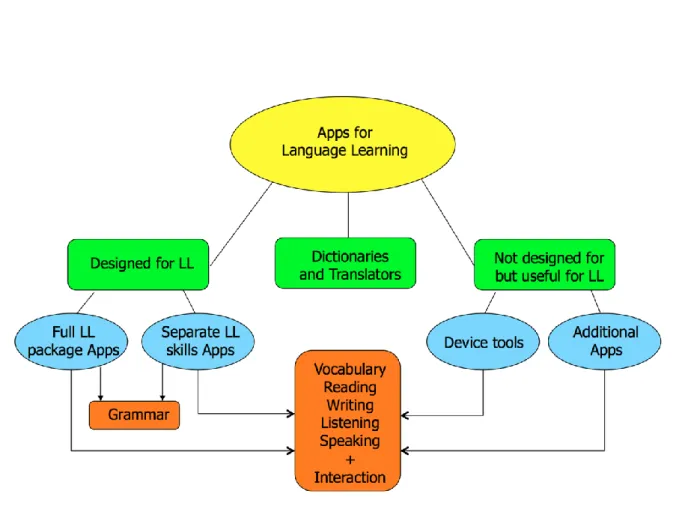
In Figure 1 a new classification of apps that can be used for language learning is presented,
categorized in three groups according to whether they are primarily designed as language
Figure 1: taxonomy of apps for language learning
3.1 Apps designed for language learning: the first group of these are apps that provide
whole language learning packages: these apps are designed as full language learning
solutions and offer a variety of exercises, grammatical explanations, and interaction with
other students and native speakers as well as support from communities of learners. Some are
mobile versions of previously-existing offerings. Most are free to download but many require
a subscription to access full content. The most popular are DuoLingo and Busuu. Others
include Rosetta Stone, Speakeasy and Babbel. Other apps aim to promote and keep alive
lesser-known or endangered languages, such as the Mixteco app.
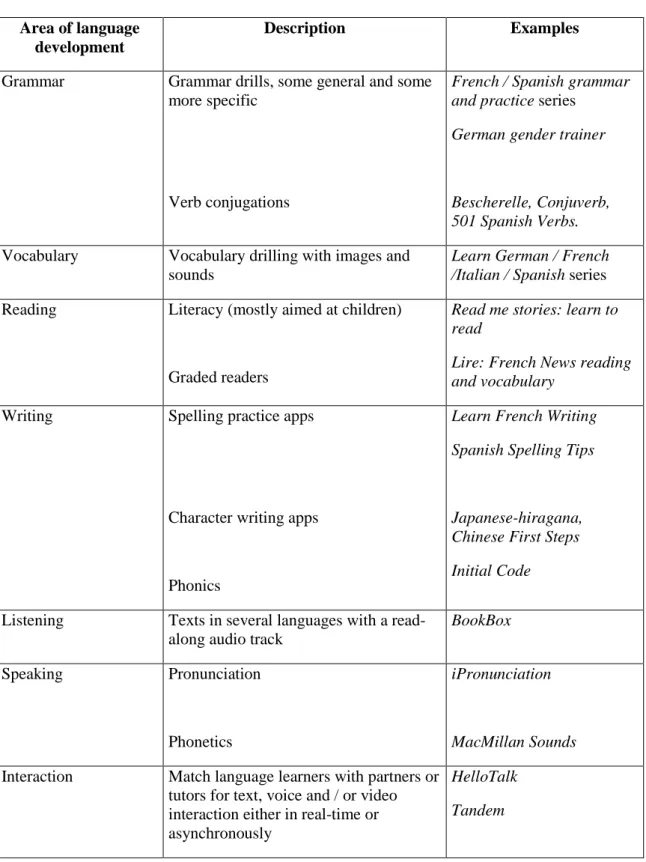
The second main groups of apps designed for language learning are those that offer
activities to develop different areas of language such as grammar, vocabulary, reading,
Area of language development
Description Examples
Grammar Grammar drills, some general and some more specific
Verb conjugations
French / Spanish grammar and practice series
German gender trainer Bescherelle, Conjuverb, 501 Spanish Verbs.
Vocabulary Vocabulary drilling with images and sounds
Learn German / French /Italian / Spanish series Reading Literacy (mostly aimed at children)
Graded readers
Read me stories: learn to read
Lire: French News reading and vocabulary
Writing Spelling practice apps
Character writing apps
Phonics
Learn French Writing Spanish Spelling Tips Japanese-hiragana, Chinese First Steps Initial Code
Listening Texts in several languages with a read-along audio track
BookBox
Speaking Pronunciation
Phonetics
iPronunciation MacMillan Sounds
Interaction Match language learners with partners or tutors for text, voice and / or video interaction either in real-time or asynchronously
HelloTalk Tandem
Table 1: taxonomy of apps designed for language learning
3.2 Apps not designed for language learning but useful to language learners. These may
be device-native apps provided by default or additional apps that can be installed. The
device-native tools that can aid the language learning process include language settings
installed, will be in the target language); web browsers, which offer access to language
learning web resources; multilingual text input (dictionary, grammar and auto-correct
features can be set to the target language); speech-to-text tools, which can act as tools for
testing pronunciation and to check spelling; communication tools such as email / messaging /
telephone / video conferencing, which can provide opportunities for synchronous or
asynchronous communication among learners, teacher-student, or with native speakers; the
photo / video camera, which provide possibilities for creating content which can be the basis
of or illustrate communicative exchanges; and even satellite navigators (if the language
setting has been changed, directions will be provided in the target language).
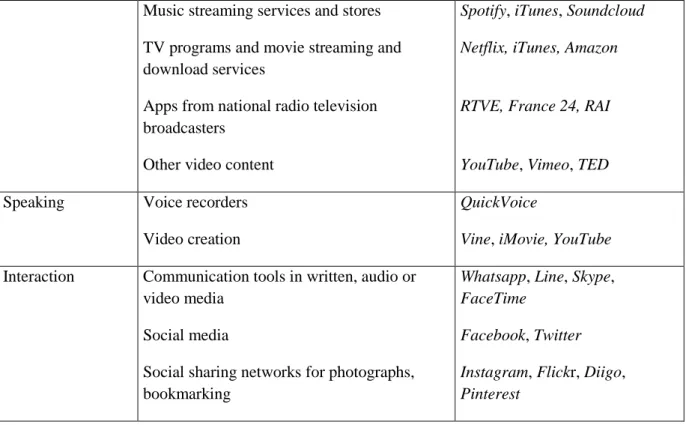
Additional apps not native to the device that have uses for language teaching and
learning are presented in Table 2:
Area of language development
Description Examples
Vocabulary Flashcard packages: although developed for any subject, learners can create their own sets with vocabulary, translations or conjugations to test their recall.
Memrise, Quizlet
Reading Reading materials in the target language which cater for a variety of interests: e-books, comic books, news and magazine subscription apps.
Kindle, Comic! Marvel Comics, BBC News, National
Geographic
Writing Word processors with spell checkers Text sharing:
Presentation apps Multimedia poster Storytelling Journal writing
Blogging and microblogging
Pages, Microsoft Word PowerPoint, Slideshare Phoster
Our Story Day One
Blogger, Wordpress, Twitter
Music streaming services and stores TV programs and movie streaming and download services
Apps from national radio television broadcasters
Other video content
Spotify, iTunes, Soundcloud Netflix, iTunes, Amazon RTVE, France 24, RAI YouTube, Vimeo, TED
Speaking Voice recorders Video creation
QuickVoice
Vine, iMovie, YouTube
Interaction Communication tools in written, audio or video media
Social media
Social sharing networks for photographs, bookmarking
Whatsapp, Line, Skype,
FaceTime Facebook, Twitter Instagram, Flickr, Diigo,
Table 2: taxonomy of apps not designed for language learning but useful for language
learners
In addition, other useful apps for the language learner and teacher include information
resources (such as news apps), maps and geography (Geomaster) and geolocated information
(Aurasma, Wikitude). Games can also be played in the target language (traditional games
such as Scrabble or Hangman, or more current ones like Clash of Clans).
3.3 Dictionaries and translation apps: dictionary apps can be integrated into other apps,
such as e-book readers, so that words can be looked up directly within the app. Some
dictionary and phrasebook apps also include pronunciation examples. Translation apps offer
machine translations with the option of entering text or speaking, and will pronounce the
translation. Some examples are Google Translate and iTranslate. In this taxonomy they are
classified separately as they are designed for both language learners and people who may not
Although opposition to the use of translation apps has been raised by some language
teachers, realistically these apps remain the first place where many language learners turn to
when composing texts in the target language. The machine translation algorithms have
improved vastly in recent years, but translations can be erroneous, especially when words are
looked up decontextualized, and learners should be encouraged to evaluate their output for
possible errors or editorial needs, as they would with a dictionary.
4 A framework for evaluating language learning apps
Apps can provide a vast array of affordances for language learners and teachers, but aside
from highlighting their potential, and given the large number of apps of varying quality
available to download, it is essential that learners, teachers and researchers have the tools to
evaluate them. The framework for app evaluation proposed here is based on some categories
from frameworks presented in section 2 as well as on SLA principles of task design,
presented in a simple format for ease of use by both learners and educators.
When designing activities for language learning, cognitive and interactionist SLA
principles advocate Task-based Language Teaching based on concepts including noticing,
negotiation of meaning, learning by doing, focus on form and collaborative learning (Skehan,
2003; Doughty & Long, 2003). From SLA literature we surmise that language learning tasks
should be interactive and include reporting back of the communicative outcome (Skehan
2003), collaborative, interesting, rewarding, and challenging (Meskill, 1999), meaningful and
engaging rather than repetitive or stressful (Oxford, 1990), provide opportunities to produce
target language (Chapelle, 1998), and make use of authentic materials (Little, 1997).
Furthermore, it is known that learners’ performance improves if they feel in command of the
situation, and if they are familiar with their environment (Oxford, 1990) so the usability of
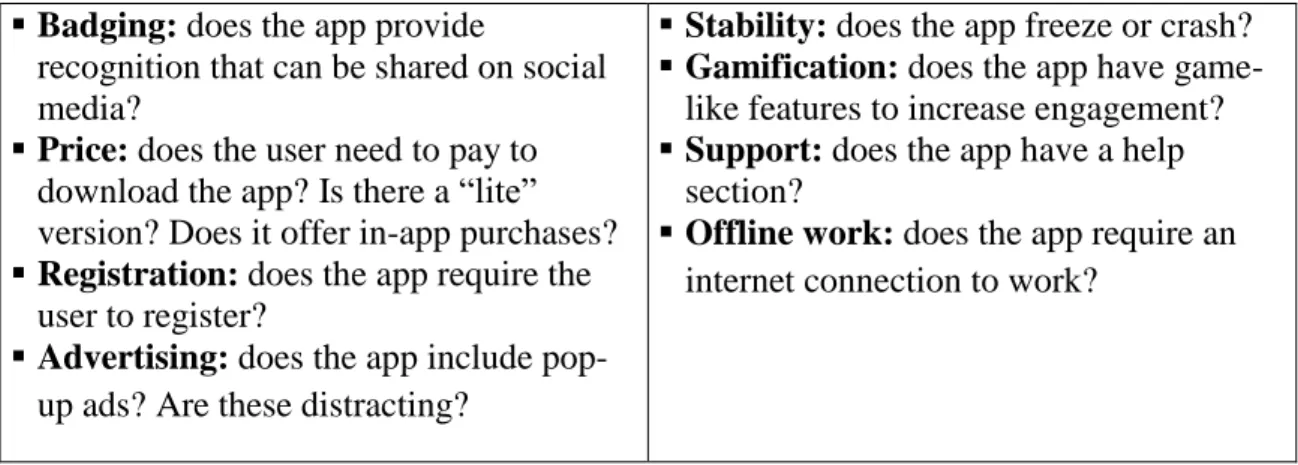
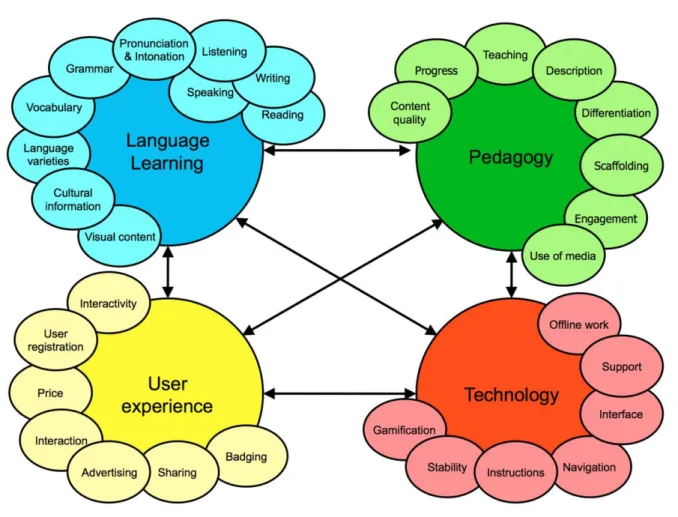
The new framework proposed here is divided into four primary categories:
technology, user experience, pedagogy and subject specific (in this case language learning),
each with a number of criteria. The evaluation framework is presented in Table 3 as a list of
questionsfor use by learners and educators alike to help them decide whether an app meets
their learning and teaching needs.
Language learning Pedagogy
Reading: does the app provide texts in the target language?
Listening: does the app provide audio in the target language?
Writing: does the app offer opportunities to write in the target language?
Speaking: does the app offer opportunities to speak in the target language?
Vocabulary: does the app offer specific activities for vocabulary acquisition?
Grammar: does the app offer specific activities for grammar practise?
Pronunciation and intonation: does the app offer specific activities for
pronunciation and intonation?
Cultural information: does the app include information about customs and traditions in the areas where the language is spoken?
Use of visual content: are images and videos stereotypical or stock images? Do they represent the diversity of the areas where the language is spoken?
Language varieties: does the app include different regional or national varieties of the language?
Description: does the app store description match what the app does?
Teaching: does the app present, explain or model language or does it just test it?
Progress: does the app allow the user to track progress or see previous attempts?
Scaffolding: do activities in the app progress in difficulty in a way that supports the learner?
Feedback: does the app provide feedback? Is it just right/wrong or meaningful explanations?
Quality of content: does the content have any errors / omissions?
Use of media: does the app make use of sound, images and video in a meaningful way?
Differentiation: does the app offer different levels depending on ability? Can these be accessed directly?
Engagement: does the app keep the user interested or are activities repetitive?
User experience Technology
Interaction: does the app allow users to interact with each other?
Interactivity: is engagement with the app content active or passive?
Sharing: does the app allow or encourage sharing content?
Interface: is the interface clear and uncluttered?
Navigation: is the app intuitive to navigate, with clear menus and options?
Instructions: does the app offer instructions on how to use it?
Badging: does the app provide
recognition that can be shared on social media?
Price: does the user need to pay to download the app? Is there a “lite” version? Does it offer in-app purchases?
Registration: does the app require the user to register?
Advertising: does the app include pop-up ads? Are these distracting?
Stability: does the app freeze or crash?
Gamification: does the app have game-like features to increase engagement?
Support: does the app have a help section?
Offline work: does the app require an internet connection to work?
Table 3: Framework for Language Learning app evaluation
There is a degree of overlap between the criteria, and some of them apply to more than one of
the four main categories. For example, Feedback could apply to technology (in terms of how
it is presented), pedagogy (how it relates to teaching), language learning (the quality of the
feedback) and user experience (how well the feedback fits in the learning process, where it
appears, how it can be accessed). In Figure 2 the framework is presented in visual form,
Figure 2: categories and criteria for the evaluation of mobile learning apps
This list of questions does not offer a rubric with detailed descriptions of each
criterion for two reasons: to keep the questions clear and uncluttered, and because the aim of
the questions is not to award a mark or value to each question, but for the questions to act as a
reflection tool for both learners and teachers, as well as app developers and researchers.
There is no indication in the framework about how many of the criteria an app needs to meet
to be considered apt for language teaching or learning because different learners may find an
app useful or not depending among other reasons on their purpose, learning preferences,
location and personal circumstances. In addition, some criteria will only apply to an app
depending on what it is supposed to do. There would be no gain, for example, in appraising a
vocabulary app negatively for not offering speaking practice, although a more comprehensive
evaluation, with positive appraisals for a higher number of the criteria, would be expected for
It is important to stress that this evaluation framework applies to commercially
available self-contained apps that can be installed on devices such as smartphones and
tablets, and not to all resources that can be accessed through such devices, such as ebooks or
web resources.
An early version of this framework was tested in a workshop in Ireland with a group
of 18 language teachers in October 2014. After a presentation of the framework, participants
were asked to evaluate the apps they use for language teaching using the criteria in the
framework. Participants provided oral feedback in a short focus group activity at the end of
the workshop. All participants were positive about the use of the criteria and supported that
the criteria helped them shape their own evaluation of language learning apps. It was
mentioned that, since most students own smartphones and / or tablets, it would be a
worthwhile activity to spend time in class presenting the framework to language learners to
enable them to make better-informed decisions about which apps are suitable for them
depending on the curriculum as well as their own learning preferences and needs.
Suggestions for changes to the framework included revising the descriptions for clarity, and
separating some of the categories. The original framework only had two main categories
(Pedagogy and Technology) and, upon further reflection after the workshop, the
four-category model was created.
In addition, a second workshop with a different group of 26 language teachers took
place in Cyprus in November 2015. Following a similar format, the feedback this time
focused on the Language Learning category, which some the teachers felt was too abstract.
Based on this feedback, that section was rewritten to change criteria that referred to SLA and
MALL theories for the current criteria presented, thus making it clearer to use and dispensing
5 Further research
Although the experience of mobile device use in the classroom has been well documented,
the amount of research examining how learners engage in mobile learning outside the
classroom is much smaller (Stockwell, 2013). There is much potential for research in the
field of mobile apps for language learning, including the following:
App design and quality: Can apps offer true language learning solutions? What do language learning apps offer to the learner that other more traditional methods do not
(and vice versa)?
Users: As part of research into the use of apps, questions that should be asked include: Who uses language learning mobile apps? Why? Where? How? What do they think
about learning with apps?
Appsmashing: how apps are used in combination with other resources remains an interesting topic still under-researched.
Normalization: at what point do we consider the use of smartphones and tablets normalized (Bax, 2003) to the point that they are fully integrated into learning
activity? Can we assume learners own such devices and have the competencies to
know how to use them, select appropriate resources, and utilize them when and where
they are best served by them?
Attainment: although the potential for learning is there, further research is needed on learning outcomes.
Some of this research, in particular research into actual gains in language proficiency,
supplement other forms of learning, formal or informal, which makes causality difficult to
prove.
6 Conclusion
This paper has provided an evaluation framework for language learning mobile apps, but has
not evaluated the apps themselves. A proposal to make this framework available on a
dedicated website for language apps evaluation is currently being considered.
Developments in mobile app software are fast and it is difficult to foresee what
direction software and hardware will take next. Wearable technologies will undoubtedly
provide new affordances for learning, but whether they succeed in penetrating the
mainstream (or not, as the Google Glass initiative has proven so far) and their effect on
mobile learning will be an interesting development to ‘watch’.
Acknowledgements:
I would like to thank Anna Comas-Quinn for her useful comments on an earlier draft of this
paper.
In memoriam: I would like to dedicate this paper to Lesley Shield, a true CALL pioneer and
wonderful colleague, from whom I learnt a lot about the evaluation of CALL resources
References:
Ally, M. (2005). Using learning theories to design instruction for mobile learning devices. Mobile learning anytime everywhere, 5--8.
Bax, S. (2003). CALL—past, present and future. System, 31(1), 13--28.
Bloom, B. S., Engelhart, M. D., Hill, W. H., & Furst, E. J. Krathwohl (1956).Taxonomy of educational objectives. Handbook I: Cognitive domain. New York: McKay.
Burston, J. (2014). The Reality of MALL: Still on the Fringes. CALICO Journal, 31(1), 103--125. Castañeda, D. & Cho, M.-H. (2013). Using Smartphone Applications to Improve Students' Verb Conjugations in Spanish: An Exploratory Study. Paper presented at the CALICO Conference, Navigating the Complexities of Language Learning in the Digital Age, Hawaii, US, 24th May 2013.
Chapelle, C. (1998). Multimedia CALL: lessons to be learned from research on instructed SLA.
Language Learning and Technology, Vol. 2, No. 1, 22--34. Retrieved from http://llt.msu.edu/vol2num1/article1/index.html
Colpaert, J. (2006). Pedagogy-driven design for online language teaching and learning. CALICO journal, 477--497.
Domínguez, A., Saenz-de-Navarrete, J., De-Marcos, L., Fernández-Sanz, L., Pagés, C., & Martínez-Herráiz, J. J. (2013). Gamifying learning experiences: Practical implications and outcomes.
Computers & Education, 63, 380--392.
Doughty, C. & Long, M. H. (2003). Optimal Psycholinguistic Environments for Distance FL Learning. Language Learning and Technology, 7 (3), 50--80. Retrieved from
http://llt.msu.edu/vol7num3/doughty/default.html
Godwin-Jones, R. (2011). Emerging technologies: Mobile apps for language learning. Language Learning & Technology, 15(2), 2--11.
Hubbard, P. (2006). Evaluating CALL Software. Chapter 13 from L. Ducate and N. Arnold (eds) 2006. Calling on CALL: From Theory and Research to New Directions in Foreign Language Teaching. San Marcos: CALICO.
Jamieson, J., Chapelle, C., & Preiss, S. (2005). CALL Evaluation by developers, a teacher, and students. CALICO Journal, 23 (1), 93--138.
Kenning, M. M. (2007). ICT and language learning: From print to the mobile phone. Palgrave Macmillan.
Khaddage, F., Lattemann C., (2013). The Future of Mobile Apps for Teaching and Learning. In Berge, Z. L., & Muilenburg, L. (Eds.).Handbook of Mobile Education. Routledge, 119--128.
Kim, H., & Kwon, Y. (2012). Exploring smartphone applications for effective Mobile-Assisted Language Learning. Multimedia-Assisted Language Learning, 16(1), 31--57.
Kim, H. S. (2013). Emerging Mobile Apps to Improve English Listening Skills. Multimedia-Assisted Language Learning, 16(2), 11--30.
Krathwohl, D. R. (2002). A revision of Bloom's taxonomy: An overview. Theory into practice, 41(4), 212--218. Retrieved from http://www.unco.edu/cetl/sir/stating_outcome/documents/Krathwohl.pdf Levy, M., & Stockwell, G. (2006). CALL dimensions: Options and issues in computer-assisted language learning. Mahwah, NJ: Lawrence Erlbaum.
Little, D. (1997). Responding authentically to authentic texts: a problem for self-access language learning? In Benson, P. & Volley, P. (eds.), Autonomy and Independence in Language Learning: Longman, 225--236.
Lys, F. (2013). The development of advanced learner oral proficiency using iPads. Language Learning & Technology, 17(3), 94–116. Retrieved from
http://llt.msu.edu/issues/october2013/lys.pdf
Meskill, C. (1999). Computers as Tools for Sociocollaborative Language Learning. In K. Cameron (Ed) CALL: Media, Design and Applications. The Netherlands: Swets & Zeitlinger. Retrieved from http://www.albany.edu/etap/Faculty/CarlaMeskill/publication/cameron.pdf
Oxford, R. (1990). Language learning strategies: What every teacher should know. New York. Newbury House.
Peachey, N. (2013). Criteria for Evaluating Web Tools and Apps. Retrieved from:
http://nikpeachey.blogspot.co.uk/2013/04/criteria-for-evaluating-web-tools-and.html
Rodríguez-Arancón, P., Arús, J., & Calle, C. (2013). The use of current mobile learning applications in EFL. Procedia-Social and Behavioral Sciences, 103, 1189--1196.
Rosell-Aguilar, F. (2009). Podcasting for language learning: re-examining the potential. In L. Lomicka & G. Lord (Eds.), The Next Generation: social networking and online collaboration in foreign language learning, (pp. 13--34), San Marcos, TX: Calico.
Rosell-Aguilar, F. (in press). User evaluation of language learning mobile applications: a case study with learners of Spanish. In A. Palalas & M. Ally (Eds), The International Handbook of Mobile-Assisted Language Learning. China Central Radio & TV University Press.
Rosell-Aguilar, F. & Kan, Q. (2015). Design and user evaluation of a mobile app to teach Chinese characters. JaltCALL Journal,11(1), 19--40.
Rosenthal Tolisano, S. (2012). iPad App Evaluation for the Classroom. Retrieved from http://langwitches.org/blog/wp-content/uploads/2012/06/iPadAppEvaluation.pdf
Shrock (2012). Bloomin' Apps.Retrieved from http://www.schrockguide.net/bloomin-apps.html Skehan, P. (2003). Focus on Form, Tasks, and Technology. Computer Assisted Language Learning, 16 (5), 391--411.
Steel, C. (2012). Fitting learning into life: Language students’ perspectives on benefits of using mobile apps. In: M. Brown, M. Hartnett and T. Stewart, ascilite2012 Conference
Sweeney, P., & Moore, C. (2012). Mobile Apps for Learning Vocabulary: Categories, Evaluation and Design Criteria for Teachers and Developers. International Journal of Computer-Assisted Language Learning and Teaching (IJCALLT), 2(4), 1--16.
Vincent, T. (2012). Ways to Evaluate Educational Apps. Retrieved from
http://learninginhand.com/blog/ways-to-evaluate-educational-apps.html
Walker, H. (2011). Evaluating the effectiveness of apps for mobile devices. Journal of Special Education Technology, 26(4), 59--63.
Yildiz, S. (2012, June). Use of iPad applications to introduce English as a foreign language to young Turkish learners. Paper presented at the 2012 CALICO Conference, University of Notre Dame, South Bend, IN.