73 73
The Role of the Private Sector in Education
The Organisation for Economic Co-operation and Development (OECD) in its recent report on the Programme for International Student Assessment (PISA) 2009 defined superior education performance as high participation, high quality, high equity, and high efficiency (OECD 2010b). For governments to achieve this objective, Schleicher and Stewart (2009) have argued that they must ensure that education promotes the following:
1.
High universal standards
: by focusing on outcomes, raising aspirations, and defining educational excellence2.
Accountability and autonomy
: by responding to local needs and strengthening accountability relationships3.
Teacher professionalism
: by recruiting strong teacher candidates, preparing them well, and offering them ongoing professional development4.
Personalized learning
: by ensuring that teachers are responsible for engaging constructively with the full range of students’ interests, capacities, and socioeconomic contextsCHAPTER 7
Engaging the Private Sector
Laura Lewis
ost school systems are predominantly state funded and therefore subject to
top-down policy making that can sometimes stifle innovation and change at the
local level. The involvement of nonstate players such as nongovernmental
organizations (NGOs), communities, faith-based organizations, trade unions,
private companies, and individual practitioners can therefore improve school
performance through competition and autonomy—provided that the government
ensures accountability mechanisms for all schools. This chapter outlines a
framework for ensuring effective school provision, regardless of the type of
provider—be it public or private—and then shows how the private sector can
improve the quality of education and allow parents and students increased school
choice. In terms of the SABER (
System Assessment and Benchmarking Education for Results) pilot, the analysis of nonstate engagement in education in East Asia shows
that although the public sector remains the dominant player, the private sector is
increasingly active. Evidence suggests that economies in the region are willing to
innovate in order to expand access and improve quality. However, a supportive
and secure regulatory environment is crucial to engaging the private sector
effectively.
SUMMARY
M
74 74 Although the public sector remains the dominant player in education in East Asian economies, private sector programs and initiatives can complement state efforts to provide high-quality education that is accessible to all. There are ways in which the public and private sectors can join together to complement each other’s strengths in providing education services, meeting education goals, and improving learning outcomes. Given the ability of the private sector to innovate, these partnerships can be tailored to meet the needs of specific communities.
A Model for Education Service Provision
The recent World Bank publication by Patrinos, Barrera-Osorio, and Guáqueta (2009) cites evidence that engaging the private sector can
Create competition in the education market
Promote flexibility—for example, with teacher contracts that match the supply of education with demand
Enhance efficiency when providers are selected by means of an open bidding process and when contracts include measurable outcomes and cost-effectiveness measures
Increase risk sharing between the government and the private sector
Building on the key elements of an effective system outlined by Patrinos, Barrera-Osorio, and Guáqueta (2009); Schleicher and Stewart (2009); and the World Bank (2004) model of service provision, this chapter outlines a model developed by the World Bank that measures four key elements of effective school provision:
Autonomy:
Autonomous schools that can tailor teaching and learning to meet the needs of all of students and that have control over the quality of educational professionals in the school
Competition:
A competitive environment within which schools offer a range of models to meet the needs of all students
Parental engagement:
Informed parents who can use both their voice and, if the system permits, their choice to ensure that the schooling supplied to their children is of the highest quality and who also hold the government accountable through the political process, whether at the local, regional, or national level
Accountability:
A strong and transparent accountability system in which autonomy is accompanied by responsibility and policy makers hold all schools to account for the quality of their education75 75
Types of Private Sector Engagement
The engagement of the private sector in education cannot be seen in isolation from other education policies and government interventions. The government must decide how it would like the private sector to participate and how such participation fits in its overall education strategy.
The model does not advocate any specific arrangement for private sector engagement—there is no right answer. Each country should use the private sector in a way that suits its specific needs. The range of options open to governments includes
•
Private schools:
Schools that are owned by the private sector (private businesses, churches, religious groups, NGOs, foundations, charities, or individuals) and are financed privately, typically through fees (in other words, they receive no public subsidies).•
Privately funded schools:
Schools that are owned and managed schools by the private sector (private businesses, churches, religious groups, NGOs, foundations, charities or individuals) that receive funding from the government, but this funding is not specifiedin a contract on a per student basis.•
Privately contracted schools:
Schools owned and managed by the private sector that receives funding from the government and the funding is specified in a contract on a per student basis. The transfer of public funds to the school requires that the school satisfy specified conditions.•
Privately managed schools
:
Schools owned by the government but operated or managed by private organizations (for example, charter schools, academies, and concession schools).•
Market-contracted schools
:
Public schools, privately contracted schools, or privately managed schools that are implicitly contracted by the student in that public funding follows the students to their school of choice (for example, vouchers).76 76
Evidence
A body of evidence from around the world shows how effective these different models of private sector engagement have been in terms of academic performance and cost-effectiveness (Lewis and Patrinos 2011).
Private Schools
The evidence with respect to private schools is mixed. The results of PISA 2009 suggest that there is no difference in the performance of students in public and private schools after controlling for their backgrounds. Another argument is that private schools increase competition, thus forcing all schools to improve. The degree to which this happens depends on the extent to which public schools view private schools as a threat for drawing students away.
Nannestad (2004) analyzed whether private schools in Denmark improved the quality of local municipal schools and found no evidence that their existence increased competition. This finding is in direct contrast to that of Sandström and Bergström (2004), who found that increased competition arising from the existence of private schools in Sweden led to improvements in the standards of public schools. Nannestad partly explained this difference as being due to the different perceptions of the “threat” posed by private schools to the public school system in each country. As a consequence, one would expect the incentive effects of competition from private primary schools on actors in the public school system in Sweden to be stronger than they are in Denmark. This could partly explain why competition from private primary schools improves quality in public schools in Sweden but not in Denmark (Nannestad 2004).
Privately Funded Schools
McEwan (2000) evaluated the impact of privately funded schools in Argentina and showed that Catholic school attendance lowers the probability of students repeating a grade by 4 percentage points.
Privately Contracted Schools
The Department of Education in the Philippines uses Education Service Contracts with qualified private high schools. These schools are paid a fixed amount per grantee to accept students who cannot be accommodated in nearby, highly congested public high schools but who are willing to pay the unsupported portion of their private school tuition and all other fees. An impact evaluation of the program showed that students in these contracted private schools scored 60 points higher on the TIMSS (Trends in International Mathematics and Science Study) test than did students who attended public schools. Even after controlling for student and family background, students at private schools scored 33 points higher (World Bank 2011).
In Pakistan, Foundation-Assisted Schools are low-cost, privately contracted schools. To receive public funding, the schools must meet strict criteria. The program has had a positive influence on total test scores of between 0.361 and 0.457 standard deviations, particularly in math and science at grade 5 and in English at grade 8 (Barrera-Osorio 2010).
77 77 Lefebvre and Merrigan (2009) examined privately contracted schools in Quebec. They found that the effect of changing from a public grade school to a private high school increases the percentile rank of a student’s math score by between 5 and 10 points and by between 0.13 to 0.35 of a standard deviation, depending on the specifications and samples.
Privately Managed Schools
Several evaluations of publicly funded and privately operated and managed public schools have found positive effects. Hoxby and Rockoff (2004) showed that students who won the lottery to attend a charter school in the United States achieved scores that were 11 percentage points higher in reading and 10 percentage points higher in math than those who did not win the lottery. Booker et al. (2008) found that initially students in charter schools perform worse on standardized tests than their peers in public schools, but that after three years, the scores of charter school students catch up with those of their public school peers.
Barrera-Osorio (2007) reached similar conclusions for Colombia. He found that students in privately managed schools achieved higher test scores at the end of their basic education (grade 11) than those in public institutions. Clark (2009) found that schools in the United Kingdom that converted to grant-maintained status achieved as much as a quarter of a standard deviation improvement in pass rates on standardized examinations.
Market-Contracted Schools
Numerous empirical evaluations of voucher schemes have also found positive effects. In Colombia, Angrist, Bettinger, and Kremer (2006) found that vouchers improved the test scores of both average students and those in the highest decile. Himmler (2007) found positive links between the intensity of competition that a voucher scheme creates and academic achievement in the Netherlands. Patrinos (forthcoming), who also examined market-contracted schools in the Netherlands, found private school effects on math, reading, and science achievement of 0.17, 0.28, and 0.18, respectively.
The results for Chile’s voucher system, however, are mixed. Gallegos (2004) found that 1.0 standard deviation in private enrollment generates about a 0.20 standard deviation in test scores and 0.24 standard deviation in productivity. However, Contreras, Bustos, and Sepulveda (2008) found that, after they controlled for self-selection, there was no difference between public and private schools.
78 78
Types of Private Sector Education in East Asia
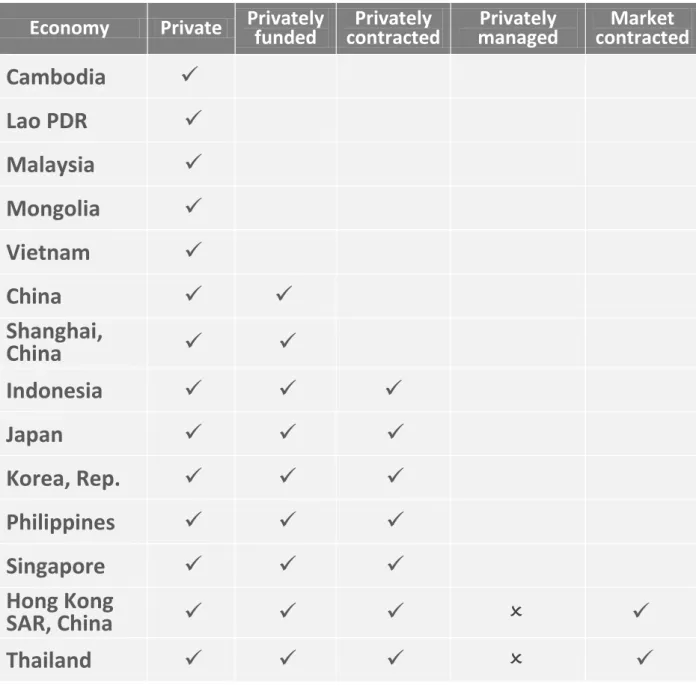
East Asian education systems all employ some private provision but in different ways. Private schools operate in all East Asian education systems. In China and Shanghai, China, privately funded schools operate with no explicit government contract; in Indonesia, Japan, the Republic of Korea, the Philippines, and Singapore, private schools are explicitly contracted and funded. Both Hong Kong SAR, China, and Thailand use vouchers to increase school choice (table 7.1).
Table 7.1. Comparison of Types of Private Sector Engagement
across East Asia
Economy
Private Privately
funded
contracted
Privately
managed
Privately
contracted
Market
Cambodia
Lao PDR
Malaysia
Mongolia
Vietnam
China
Shanghai,
China
Indonesia
Japan
Korea, Rep.
Philippines
Singapore
Hong Kong
SAR, China
Thailand
79 79
Source: OECD 2010a, choice indicators; United Nations Educational, Scientific, and Cultural Organization Institute of Statistics; SABER East Asia Benchmarking Study; Shanghai Statistical Yearbook.
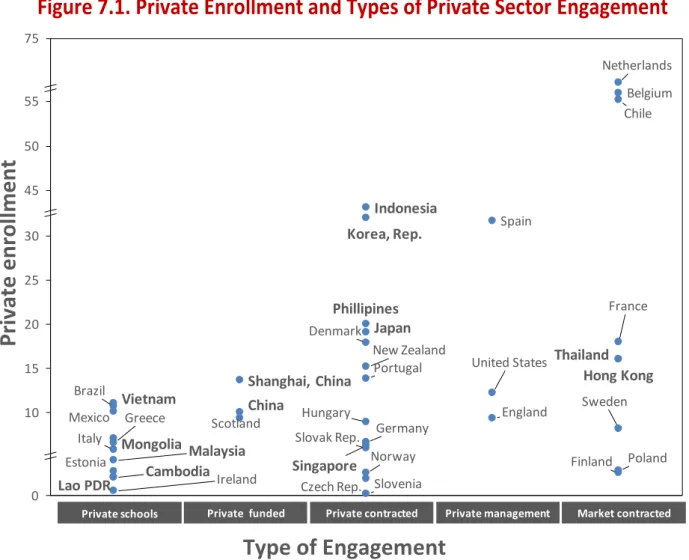
Figure 7.1 combines the types of private sector provision and enrollment data to outline how the private sector is engaged in the education sector in East Asia, the OECD, and other regions. The types of private sector engagement outlined in this chapter are not exclusive; however, the five key
questions listed here can help discern the degree to which they are used. Answering “yes” to questions 1 to 3 automatically moves a country to the right of the figure as they are sequential. Questions 4 and 5 are nonsequential, so answering “no” to 4 does not mean an economy could not also engage the private sector by using market-based contracts.
The key questions are as follows:
1.
Are private schools allowed to operate?
2.
Is public funding for private schools allowed?
3.
Is there a contract that governs the conditions under which funds are
transferred to nonpublic schools?
4.
Is the private operation and management of public schools permitted?
5.
Does public funding follow students to their school of choice?
Figure 7.1. Private Enrollment and Types of Private Sector Engagement
Korea, Rep. Japan Shanghai, China Malaysia 75 Phillipines Vietnam Lao PDR Hong Kong Mongolia Estonia Brazil Mexico Italy Ireland Greece Scotland Slovenia Slovak Rep. Portugal Norway New Zealand Hungary Germany Denmark Czech Rep. United States 55 England 50 45 30 25 20 15 10 0 Indonesia Spain Cambodia China Thailand Sweden Poland Netherlands France Finland Chile Belgium Singapore
Private schools Private funded Private contracted Private management Market contracted
Type of Engagement
Priv
ate
e
n
rol
lmen
t
80 80 For East Asian economies, information was provided by in-country experts. For the OECD and others, we consulted the OECD’s Education at Glance 2010 school choice indicators (OECD 2010a); however, because the OECD choice indicators do not cover question 4, experts were also interviewed.
Combining types of private sector provision with private enrollment figures revealed a wide variation in the scale of private sector engagement across the world. Indonesia and Korea have a high level of private enrollment—comparable to the levels found in Spain. All other East Asian economies have over 10 percent private enrollment except for Cambodia, Lao People’s Democratic Republic, Malaysia, Mongolia, and Singapore. Even in Finland, where the quality of public schools is very high, the private sector plays a role, albeit a small one.
Figure 7.1 also highlights the subjectivity involved in answering survey questions. In Ireland, 50 percent of secondary schools are aided by the Department for Education and Skills, of which 49 percent are Catholic-denominated schools. This statistic is not shown in OECD data because these schools are considered to be public. As a result, the private sector seems to play only a limited role in Ireland. This situation contrasts with that of France, where the extent of the role played by the Catholic Church in providing education is explicitly recognized in the data: France has one of the largest Catholic education systems in the world (Dreycke 2007: 1).
Capturing the Potential Benefits of Private Sector Education
Provision
Increasing the role of the private sector can have several potential advantages over the traditional public delivery of education. Whether these benefits are in practice realized depends greatly on how well designed the partnership between the public and private sector is, on the regulatory framework of the country, and on the capacity of the government to oversee and enforce its contracts and partnerships with the private sector (Patrinos, Barrera-Osorio, and Guáqueta 2009).
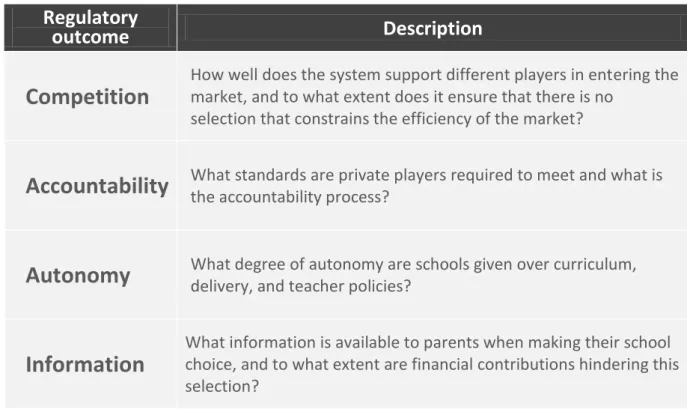
We have developed a tool that categorizes East Asian economies on the basis of the policies they have implemented to regulate the private sector. We analyze these policies to see how well each supports the four key regulatory outcomes from our model of effective school provision: competition, accountability, autonomy, and information. Table 7.2 outlines the regulatory outcomes and poses questions that will examine the extent to which governments are currently meeting them.
81 81
Table 7.2. Regulatory Outcomes
Regulatory
outcome
Description
Competition
How well does the system support different players in entering the
market, and to what extent does it ensure that there is no
selection that constrains the efficiency of the market?
Accountability
What standards are private players required to meet and what is
the accountability process?
Autonomy
What degree of autonomy are schools given over curriculum,
delivery, and teacher policies?
Information
What information is available to parents when making their school
choice, and to what extent are financial contributions hindering this
selection?
Source: Author’s compilation
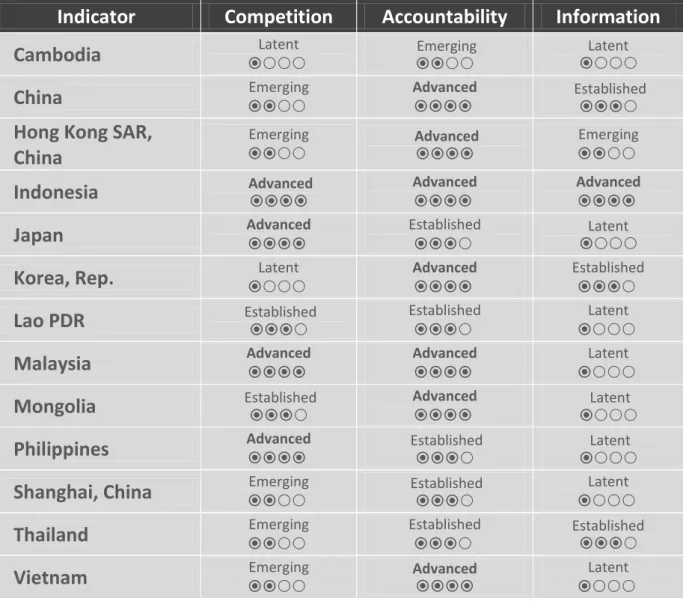
Table 7.3 compares the extent to which each East Asian economy currently regulates private schools. There is a wide variation across the region, particularly in the degree of competition. In Cambodia and Korea, private school fees are set by the government, while in China; Hong Kong SAR, China; Shanghai, China; Thailand; and Vietnam, the government imposes a ceiling on tuition fees. Indonesia, Japan, Lao PDR, Malaysia, and the Philippines do not limit competition through regulated fees, nor do they restrict competition on the basis of ownership—both nonprofit and for-profit schools are allowed.
All economies in the region set minimum standards for private schools to be established, and all except Cambodia have external inspections of schools. Korea, Malaysia, the Philippines, and Vietnam are considered to be advanced because the inspection regime is risk based; the frequency of future inspections depends on the results of the previous inspection. The tool does not currently assess the quality of the inspection regime or the professionalism of the inspectors.
Most East Asian economies do not supply information to parents to enable them to make an informed choice when choosing a private school. In Cambodia; Japan; Lao PDR; Malaysia; Mongolia; the Philippines; Shanghai, China; and Vietnam, governments are not required to supply performance data to parents and students. In Hong Kong SAR, China, this requirement exists only for primary schools. In China, Indonesia, Korea, and Thailand, governments must supply this information at both the primary and secondary levels. The quality of the information supplied was not assessed in the tool, which is why both are considered advanced. (Autonomy is not included for private schools because it is considered outside the remit of public policy.)
82 82
Table 7.3. The Extent of Regulation of Private Schools
Indicator
Competition
Accountability
Information
Cambodia
Latent Emerging LatentChina
Emerging Advanced Established Hong Kong SAR,
China
Emerging Advanced Emerging Indonesia
Advanced Advanced Advanced Japan
Advanced Established LatentKorea, Rep.
Latent Advanced Established Lao PDR
Established Established LatentMalaysia
Advanced Advanced LatentMongolia
Established Advanced LatentPhilippines
Advanced Established LatentShanghai, China
Emerging Established LatentThailand
Emerging Established Established Vietnam
Emerging Advanced LatentSource: Author’s compilation
China and Shanghai, China, fund private schools with no explicit contract. Recent reforms have expanded the number of privately funded schools, but competition is restricted because the government controls tuition ceilings for nonfunded students and because schools are allowed to set selective admission criteria, thus allowing them to select the students who are the easiest to teach. In general, the Chinese government releases information on school performance, but this does not happen in Shanghai, China, specifically, although there are mandatory examinations at the secondary level and all schools are inspected annually. In China and Shanghai, China, autonomy is also inhibited by the requirement that schools have to follow a standardized curriculum.
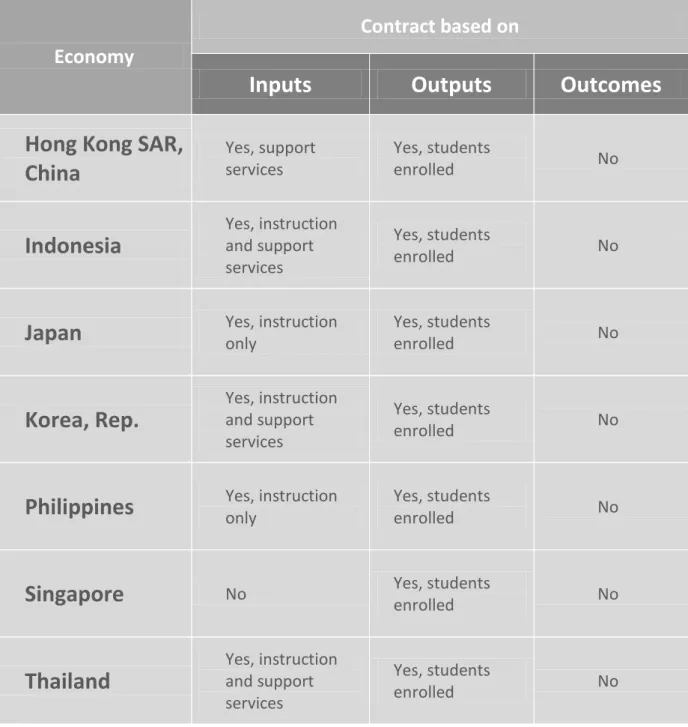
Seven of the East Asian education systems analyzed here use privately contracted schools (table 7.4). In Hong Kong SAR, China; Indonesia; Japan; Korea; the Philippines; Singapore; and Thailand, the contract does not require privately contracted schools to achieve certain outcomes (Singapore uses merit-based student admission criteria to enter the privately contracted schools.) In six of the seven education systems, privately contracted schools are constrained by contractual requirements on the inputs that they can use. Autonomy and competition can also be restricted if—as a precondition for
83 83 public funding—governments require private schools to adhere to the same input standards that are applied in public schools, thus reducing their operational flexibility (Lundsgaard 2002).
Table 7.4. Privately Contracted Schools: Contract Comparisons
Economy
Contract based on
Inputs
Outputs
Outcomes
Hong Kong SAR,
China
Yes, support
services
Yes, students
enrolled
No
Indonesia
Yes, instruction
and support
services
Yes, students
enrolled
No
Japan
Yes, instruction
only
Yes, students
enrolled
No
Korea, Rep.
Yes, instruction
and support
services
Yes, students
enrolled
No
Philippines
Yes, instruction
only
Yes, students
enrolled
No
Singapore
No
Yes, students
enrolled
No
Thailand
Yes, instruction
and support
services
Yes, students
enrolled
No
84 84 Thailand and Hong Kong SAR, China, both use market-contracted schools. Thailand uses vouchers targeted to certain geographic areas and to students from underprivileged socioeconomic backgrounds. Competition is hindered because schools often do not receive their funding on time, which makes it difficult for them to plan. They also receive less funding than do their public school counterparts. Parents are also restricted because they have to make compulsory financial contributions toward their children’s education. Thailand has an established accountability system in which the government sets minimum standards for teachers and annually inspects schools. Students at both the primary and the secondary level are required to take a mandatory exam to assess their academic progress. Schools are also required to report to the government as a condition for the continuation of their funding. However, despite this accountability system, school autonomy is hindered by restrictions imposed by the central government on schools regarding the curriculum and staffing.
Conclusions
The evidence shows that East Asian economies are willing to innovate to expand access and improve quality. However, while it is possible and often desirable to engage the private sector in this process, certain prerequisites are essential—in particular, a supportive and secure regulatory environment. Governments could ensure that the regulatory environment
Supports school autonomy and allows innovation in delivering
education to meet individual students’ needs
Encourages multiple providers so there is a competitive environment
Gives parents access to information on the quality of the education
system to ensure that they can make informed decisions and exercise
their parental choice or their parental voice
Has a rigorous and transparent accountability system that engages all
stakeholders
85 85
References
Angrist, J., E. Bettinger, and M. Kremer. 2006. “Long-Term Educational Consequences of Secondary School Vouchers: Evidence from Administrative Records in Colombia.” American Economic Review 96 (3): 847–62.
Barrera-Osorio, F. 2007. “The Impact of Private Provision of Public Education: Empirical Evidence from Bogotá’s Concession Schools.” Policy Research Working Paper 4121, World Bank, Washington, DC.
———. 2010. ”Accountability: Lessons from a Test-Based Public Subsidy Program for Low-Cost Private Schools.” World Bank, Washington, DC.
Booker, K., S. M. Gilpatric, T. Gronberg, and D. Jansen. 2008. “The Effect of Charter Schools on Traditional Public School Students in Texas: Are Children Who Stay Behind Left Behind?”
Journal of Urban Economics 64 (1): 123–45.
Clark, D. 2009. “The Performance and Competitive Effects of School Autonomy.” Journal of Political Economy 117 (4): 745–83.
Contreras, D., S. Bustos, and P. Sepulveda. 2008. “When the Schools Are the Ones That Choose: Policy Analysis of the Screening in Chile.” University of Chile, Santiago.
Department for Education and Skills, Ireland. “Key Statistics about the Department’s Customers.” Department for Education and Skills, Dublin.
http://www.education.ie/home/home.jsp?maincat=17216&pcategory=17216&ecategory=1 7241&language=EN.
Dreycke, H. 2007. “Catholic Schooling in France: Understanding ‘La Guerre Scolaire.’” International Handbook of Catholic Education: Challenges for School Systems in the 21st Century, ed. G. Grace and J. S. J. O’Keefe, 329–46. Dordrecht, Netherlands: Springer.
Gallegos, F. 2004. “School Choice, Incentives, and Academic Outcomes: Evidence from Chile.” Boston: MIT Press.
Himmler, O. 2007. “The Effects of School Choice on Academic Achievement in the Netherlands.” Georg-August-Universität Göttingen, Sweden.
Hoxby, C., and J. E. Rockoff. 2004. “The Impact of Charter Schools on Student Achievement.” Harvard University, Cambridge, MA.
Lefebvre, P., and P. Merrigan. 2009. “Public Subsidies to Private Schools Do Make a Difference for Achievement in Mathematics: Longitudinal Evidence from Canada.” Working Paper 09-35, Université du Québec à Montréal and CIRPÉE.
Lewis, L., and H. A. Patrinos. 2011. “Framework for Engaging the Private Sector in Education: System Assessment and Benchmarking Education for Results (SABER).” World Bank, Washington, DC.
Lundsgaard, J. 2002. “Competition and Efficiency in Publicly Funded Services.” OECD Economic Studies 35: 79–128.
86 86 McEwan, P. 2000. “Private and Public Schooling in the Southern Cone: A Comparative Analysis of
Argentina and Chile.” Occasional Paper 11, National Center for the Study of Privatization in Education, Teachers College, Columbia University, New York.
Nannestad, P. 2004. “Do Private Schools Improve the Quality of Municipal Schooling? The Case of Denmark.” Presented at the European Public Choice Society Annual Meeting, Berlin, April 15–18. http://www.diw.de/documents/dokumentenarchiv/17/41438/Paper-108.pdf. OECD (Organisation for Economic Co-operation and Development). 2010a. Education at a Glance.
Paris: OECD.
———. 2010b. PISA 2009 Strong Performers and Successful Reformers in Education: Lessons from PISA for the United States. Paris: OECD.
Patrinos, H. A ., F. Barrera-Osorio, and J. Guáqueta. 2009. The Role and Impact of Public-Private Partnerships in Education. Washington, DC: World Bank.
Patrinos, H. A . Forthcoming. “Private Education Provision and Public Finance: The Netherlands.”
Education Economics.
Sandström, F. M., and F. Bergström. 2004. “School Vouchers in Practice: Competition Will Not Hurt You.” Journal of Public Economics 89 (2–3): 351–80.
Schleicher, A., and V. Stewart. 2009. “International Benchmarking.” Asia Society, New York. http://asiasociety.org/education-learning/learning-world/international-benchmarking. World Bank. 2004. World Development Report 2004: Making Services Work for Poor People.
Washington, DC: World Bank.
———. 2011. Philippines: Private Provision, Public Purpose—A Review of the Government’s Education Service Contracting Program. Washington, DC: World Bank.