This is the author’s version of a work that was submitted/accepted for
pub-lication in the following source:
Chew, Sien Wei
, Lucey, Simon, Lucey, Patrick J., &
Sridharan, Sridha
(2012) Improved facial expression recognition via uni-hyperplane
classi-fication. In
Proceedings of the IEEE Computer Society Conference on
Computer Vision and Pattern Recognition
, IEEE, Rhode Island
Conven-tion Center, Providence, Rhode Island, pp. 2554-2561. (In Press)
This file was downloaded from:
http://eprints.qut.edu.au/49809/
c
Copyright 2012 [Please consult the author]
Notice
:
Changes introduced as a result of publishing processes such as
copy-editing and formatting may not be reflected in this document. For a
definitive version of this work, please refer to the published source:
Improved Facial Expression Recognition via Uni-Hyperplane Classification
S.W. Chew
∗, S. Lucey
†, P. Lucey
‡, S. Sridharan
∗, and J.F. Cohn
‡Abstract
Large margin learning approaches, such as support vec-tor machines (SVM), have been successfully applied to nu-merous classification tasks, especially for automatic facial expression recognition. The risk of such approaches how-ever, is their sensitivity to large margin losses due to the in-fluence from noisy training examples and outliers which is a common problem in the area of affective computing (i.e., manual coding at the frame level is tedious so coarse labels are normally assigned). In this paper, we leverage the re-laxation of the parallel-hyperplanes constraint and propose the use of modified correlation filters (MCF). The MCF is similar in spirit to SVMs and correlation filters, but with the key difference of optimizing only a single hyperplane. We demonstrate the superiority of MCF over current tech-niques on a battery of experiments.
1. Introduction
Research into affective computing has been very active over the past decade, mainly driven by social, economic and commercial interests (such as behavioral science, human-computer-interaction, health-care, security, etc). The main goal of this research is to have a computer system being able to automatically detect/infer the emotional state of any per-son based on various modes (e.g., face, voice, body, actions) in real-time.
The plurality of this research has been anchored in facial expression recognition, which consists generally of track-ing/registering faces automatically and then training corre-sponding models for supervised classification. To accom-plish the former, one may opt for a coarse form of face registration (e.g., Viola-Jones [4]) followed by a mapping to higher-dimensional feature spaces (e.g., Gabor
magni-∗S.W. Chew and S. Sridharan are with the SAIVT lab at Queensland University of Technology, Brisbane, Australia. Email: {[email protected], [email protected]}.
†S. Lucey is with the Commonwealth Science and Industrial Research Organisation (CSIRO), Australia; Email:{[email protected]}.
‡P. Lucey is with Disney Research Pittsburgh and J.F. Cohn is with the Department of Psychology, University of Pittsburgh/Robotics In-stitute, Carnegie Mellon University, Pittsburgh, PA, 15260. Email: {[email protected], [email protected]}.
Neutral Intermediate Apex Neutral
A B C D E Intensity Time +1 -1 support vectors (a) +1 -1 (b) Intermediate onset offset Frame-Level Sequence-Level
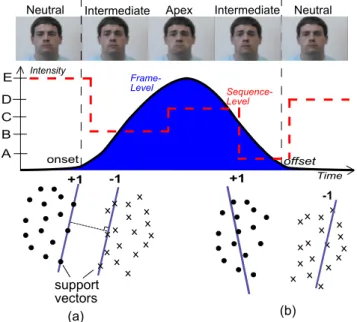
Figure 1. Given labels at the frame-level, facial expression recog-nition may be accomplished relatively accurately, but this accu-racy rapidly declines once coarse labels which produce ambiguous codes are introduced at the sequence-level. (a) Support vector ma-chines require labels which are precisely defined, and therefore do not adapt well to much noisier coarse labels because they require both hyperplanes to be (i) strictly parallel to each other, and (ii) at a tangent to the support vectors. (b) By relaxing one or both these requisites (e.g., in PSVM [1], GEPSVM [2] and TWSVM [3]), the resulting classifier can be accommodated to be much more robust against noisy and outlying training examples.
tudes [5], local binary pattern operators [6], histogram of oriented gradients [7], etc); or choose an algorithm (e.g., active appearance models [8], constrained local models [9], etc) which administers more precise registration but allows the feature extraction step to be bypassed (if illumination conditions are known to be consistent). Whichever the choice, both avenues ultimately lead to the final pattern clas-sification stage, which is usually realized in the literature through support vector machines (SVM).
Unfortunately, the SVM still bears several imperfec-tions in its traditional formulation. Numerous modifica-tions had been proposed over the years, but in spite of all these encouraging recommendations, there remains a
lingering concern regarding the fundamental geometrical reasoning which demands that both hyperplanes are to be strictly parallel and at a tangent to the support vectors. Fung and Mangasarian [1] proposed proximal support vec-tor machines (PSVM) which abolishes the latter rule, and as a consequence managed to deliver impressive improve-ments. Generalized eigenvalue proximal support vector ma-chines (GEPSVM) [2] and twin support vector machines (TWSVM) [3], are two notable advancements to the PSVM which abolish both rules altogether. These valuable con-tributions all persuades one to break free from the tradi-tional “parallel-hyperplanes” train-of-thought (see Fig.1), and begs the question−why is the requirement for two hy-perplanes always necessary?
In this paper, our goal is to improve generalization per-formance by optimizing only a single hyperplane, that of which corresponds to the positive set. Intuitively, the ad-vantages of doing so are twofold−a) the trade-off result-ing from the joint-optimization of two hyperplanes is di-minished, and b) outliers in the negative set are no longer allowed to significantly influence the positioning of the pos-itive hyperplane. The proposed algorithm, which we refer to as “modified correlation filters” (MCF), may be considered very similar in principle to correlation filters, but closely-related mathematically to SVMs.
The central contributions from this paper are,
• Propose a novel supervised classifier (MCF) which is inspired by correlation filters and similar in spirit to support vector machines, but the key difference being that it functions with only a single hyperplane.
• Show that MCF exhibits superior robustness against noisy/outlying training examples, and thus enable sig-nificant improvements in generalization performance to be gained.
• Demonstrate the benefits of MCF on a variety of challenging facial expression databases, which include posed, acted and spontaneous expressions.
2. Related Work
2.1. Classifiers Utilized in Expression Recognition
At the discipline’s infancy, a significant amount of ef-fort had been expended into establishing which classifica-tion algorithm was most suitable for expression recogni-tion. Classifiers that had generated considerable excitement include [10] artificial neural networks, linear discriminant analysis, hidden Markov models, dynamic Bayesian net-works and various expert rules. Following the seminal work of [11], however, a consensus was generally agreed upon that soft-margin support vector machines (SVM hereon) were deemed to be more applicable for expression recogni-tion problems, mainly due to the following properties [11]:
i) good generalization performance, ii) capitalizing well on well-correlated input spaces (a characteristic of facial ex-pressions), and iii) relatively short training times O(102)
required.
Enthusiasm into classifier research had since steadily declined. Recently, the greater part of research interests had been proposed in favour of the classifier, suggesting that a large number of researchers appear generally satis-fied with SVMs. Much of the attention that was diverted away from the classifier appear converged onto interests such as: i) minimizing the registration error resulting from face-tracking [12,13], ii) exploring different forms of fea-ture representations [7,5,14], and iii) modelling space-time relationships of various facial components [14,15]. Even though these research concerns are amply justified, but the relevance of pursuing new suitable classifiers should not be undermined because final decisions are ultimately de-termined at the classification stage. Before proceeding to SVM theory, we shall discuss shortly on correlation filters which was instrumental in motivating our proposed MCF.
2.2. Correlation Filters
Fundamental principles which had aided in the develop-ment of MCF were originally drawn from correlation filters, and as such, due acknowledgments shall be accorded here. However, it should be mentioned that the similarity between these algorithms exist solely in terms of philosophy, and not mathematically. Using a variety of cross-correlation meth-ods, correlation filters are generally employed to detect the presence of a pattern in a target (e.g., face verification [16], visual speaker verification [17], etc). One usually applies the Fourier Transform to speed up computation. For exam-ple, theMinimum Average Correlation Energy (MACE) fil-ter [18] attempts to emphasize the correlation peak by min-imizing the average correlation plane energy, and hence en-hancing the peak-to-sidelobe ratio.
A shared objective between correlation filters and MCF lies in minimizing the energy of non-targets (i.e., negative examples) in order to emphasize the targets (i.e., positive examples). To the best of the authors’ knowledge, there had been no prior application of correlation filters to facial ex-pression recognition problems, probably due to their poor generalization capability. Nonetheless, the empirical per-formance of MACE filters (H =D−1X(X+D−1X)−1u)
[18] shall be presented alongside those of the SVM and MCF in§6. As shall be discussed in§4, the mathematics behind MCF and correlation filters are shown to be entirely unrelated.
3. Evolution of the SVM
In contrast to correlation filters, SVMs have played an instrumental role in the facial expression recognition litera-ture. In this section, we review SVMs from a probabilistic
perspective, and then use the ensuing insights to motivate our proposed MCF in§4. Traditional approaches to super-vised classification consider the following: in a binary prob-lem where we are given two sets of patterns, the goal is to assign an unknown test pattern to one of the two sets,
(xi,yi)∈χ× {±1}. (1) Here, the objective is to learn the mappingf :χ7→ {±1}, where we assume thatXandY are two sets of random vari-ables, and χ consists of m samples which are drawn iid (independently and identically distributed) from the proba-bility distribution X ×Y. This suggests that the random variables must be generated from afixedbutunknown prob-ability distributionp(x, y)from either one set or the other,
p(xi, yi|f) =
m Y
i=1
p(yi, xi|f)p(xi). (2)
The problem of achieving good generalization can then be cast as learning a mappingfχ which reduces the probabil-ity of obtaining incorrect label assignments by as much as possible [19],
zi:=P r(sign(fχ(xi)))6=yi. (3)
(3) can be equivalently interpreted as minimizing the ex-pected or empirical risk,
Rexp[f] = Z X×Y bz+ 0.5c dP, (4) Remp[f] = 1 m m X i=1 bzi+ 0.5c. (5) In practice,Remp[f]is usually employed asRexp[f]is an intuitive quantity; but (5) still manifests as an ill-posed problem due to the set of functions{fχ}which remain un-known. To regularize this, an upper-bound onRemp[f] is enforced onRemp[f], and a subset of feasible regions infχ is constrained to lie within||f||K and bounded byR(this method is commonly referred to as Ivanov regularization),
min fχ∈H,||fχ||K≤R 1 m m X i=1 b(f(xi)6=yi) + 0.5c, (6)
whereKis a positive-definite kernel function [20] living in a Reproducing Kernel Hilbert Space. Even though the for-mulation now appears better defined, the optimization prob-lem (6) is still NP-complete [19], and therefore intractable as a result of the non-smooth and non-convex summands (which are essentially zero-one losses). A remedy for this involves replacing all these loss terms by a smooth and con-vex loss function V(y, f(xi))while still enforcing an up-per bound onRemp[f]. Again, it is not always tractable in
practice for a smoothV(y, f(xi))to co-exist in (6). Instead of minimizingRemp[f]subject to strict bounds on||f||2K, it is far more tractable to smoothly trade-off ||f||2
K and
Remp[f]; thus giving rise to the closely-related Tikhonov regularization problem, min f∈H 1 m m X i=1 V(yi, f(xi)) +λ||f||2K. (7)
Here,λeffectively controls the regularization trade-off be-tween||f||2
KwithRemp[f]. SVMs are often interpreted as a form of Tikhonov regularization problem expressed in the form of (7) where,
V(yi, f(xi)) = [1−yiwTh(xi)]+, (8)
||f||2K =||w|| p
p, (9)
and[f(z)]+=max(0, f(z)), (8) and (9) represent the hinge and margin loss terms respectively, andp∈ {1,2}. A typ-ical choice of SVM in automatic facial expression recog-nition problems is the linear`2-SVM (i.e.,p= 2), mainly
because of their rapid training times and good generaliza-tion capabilities, argmin w,b 1 m m X i=1 [1−yi(wTxi+b)]++ λ 2||w|| 2 2. (10)
3.1. A Limitation of SVMs
One of the inherent drawbacks of SVM lies in its sensi-tivity to large margin losses due to the influence from noisy examples and outliers. Firstly, [21] pointed out that it is not a trivial task for overlapping distributions to be modelled. This is mainly due to a lack of probabilistic insight into the margin lossλ||f||H, where an intuitive procedure of tuning
λstill does not yet exist. However, [21] and [22] did point out that this inadequacy may be redressed to some degree by enforcing an upper bound on the slack variables, so as to diminish the influence from extreme outliers in the train-ing set (since these outliers contribute significantly to the largest margin loss).
Similarly, other researchers had looked at working with the non-twice-differentiable (and hence non-convex) prop-erty of the hinge-loss functional. In [23], non-convexity was dealt with through a multi-stage relaxation of the hinge-loss using semi-definite programming methods. Others had pro-posed to replace the hinge-loss altogether with−a smooth sigmoid function [24], a least-median-loss function [25] and a non-linear Gaussian error function [26] to depreciate the leverage that extreme outliers hold on the margin loss.
From this plethora of literature, we observed one com-monality shared among these modifications was that most had been directed at the loss-functionalV(yi, f(xi)). Equa-tions (1) to (9) had illustrated how SVMs may be interpreted
as a Tikhonov regularization problem that attempts to min-imize the empirical risk (which is equivalent to the loss-functional). From these perspectives, we appreciate the im-portance of the loss-functional’s role in the objective func-tion, and its significance in filtering out outliers inχ. This intuition forms a primary motivation for MCF.
3.2. Recent Advancements of SVMs
More recently, these machines have subtly but clearly evolved into different embodiments of their original form. Keen interest was noted in disputing the elementary axioms of the SVM, which require: i) hyperplanes to be parallel, and ii) hyperplanes to be positioned at the support vectors. Proximal-SVMs (PSVM) [1] defy the latter rule,
arg min w,b ν 2||δi|| 2 2 + 1 2(w Tw+b2) (11) s.t. yi(wTxi+b) = 1−δi.
whereb refers to the bias, andδi refers to the slack vari-ables. It is worth noting that this was achieved by trans-formingV(yi, f(xi))from an inequality constraint into an equality constraint. Here, the equality sign allows the paral-lel bounding planes to “break free” from the support vectors and to be pushed as far apart from each other.
Generalized eigenvalue proximal SVMs (GEPSVM) [2] and Twin-SVMs (TWSVM) [3] are algorithms that have re-cently evolved from the PSVM. Both inherited the PSVM’s concept of ‘hyperplane repulsion’, but the parallelism rule had been further dropped.
4. Modified Correlation Filter
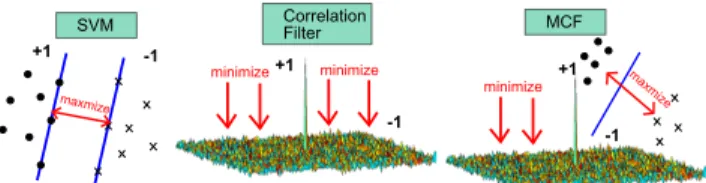
PSVM, GEPSVM and TWSVM all suggest an alternate perspective in how SVMs may be formulated. These mod-ifications, as well as those described in§3.1, all appear to place important emphasis onV(yi, f(xi)). A key concept behind the modified correlation filter (MCF) had emanated from similar standpoints, and then merged with the philos-ophy behind correlation filters (see Fig.2).
Instead of relying on error-loss variables from both posi-tive and negaposi-tive sets to defineV(yi, f(xi)), MCF uses only error variables from the positive set,
w∗= arg min w,b 1 m m X i=1 [1−wTx(+)i +b]++ λ 2w TQw, (12) Q= [X e][X e]T, (13) X= [X(+) X(−)]. (14) +1 -1 SVM Correlation Filter +1 -1 MCF +1 -1 minimize minimize minimize maxmize maxm ize
Figure 2. An intuitive comparison between SVM, correlation fil-ters and MCF. (a) SVM computes the widest margin between classes in order to detect ‘+1’, (b) Correlation filters minimizes the correlation plane energy of ‘-1’ in order to emphasize the cor-relation ‘+1’ peak. (c) MCF had drawn inspiration from both SVM and correlation filters, and operates by seeking to emphasize ‘+1’ by minimizing the energy ofallexamples except ‘+1’ examples, as cast in a SVM optimization framework.
Here, the goal is learn an optimal uni-hyperplane classifier w∗ ∈ Rn, from positive and negative sets which are rep-resented byX(+)∈ Rn×|X (+)| andX(−)∈ Rn×|X (−)| re-spectively,brefers to the bias,λ >0,m=|X(+)|,e∈
Rn indicates a vector of ones, and | · |refers to set cardinal-ity. Note that in (12),onlyexamples from the positive set reside inV(yi, f(xi)). There are several advantages in do-ing so. First and foremost, the number of outliers inχ re-quired for optimization are considerably decreased (since
|X(+)| << |X(+)|), and therefore the empirical risk is in
turn reduced. In order to distinguish positive from nega-tive examples, we insert both posinega-tive and neganega-tive sets into the precomputable matrixQin (13). From a Tikhonov reg-ularization standpoint, this may be interpreted as a trade-off between empirical risk and a margin loss that is defined upon the energy of all training examples inχ. It is in this respect that MCF share a common philosophy with corre-lation filters, but note that the similarity does not extend to their mathematical definitions.
The Lagrangian corresponding to the problem (12) is given by, L(w, b, δ, α, β) = 1 2[Xw+e1b] T[Xw+e 1b] +λe2δ (15) −αT[X(+)w+e2b+δ−e2]−βTδ,
whereαandβ represent the Lagrange multipliers, ande1
ande2are vectors of ones of appropriate dimensions. The
Karush-Kuhn-Tucker [27] necessary and sufficient optimal-ity conditions are given by,
XT[Xw+e1b]−X(+)Tα= 0, (16)
eT1[Xw+e1b]−eT2α= 0, (17)
λe2−α−β= 0, (18)
(a)
(b)
(c)
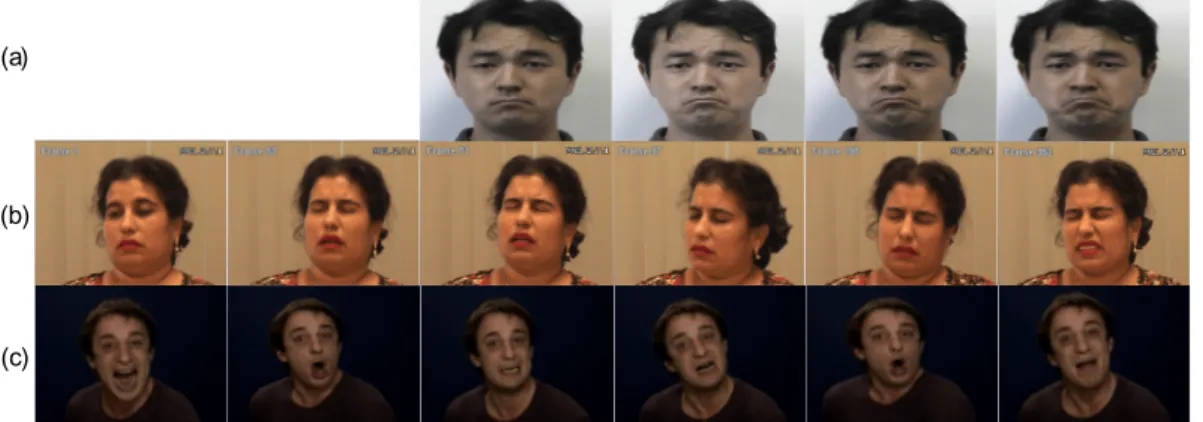
Figure 3. Experiments were conducted on a wide variety of facial expression databases: (a) CK+ dataset (posed expressions), (b) UNBC-McMaster Shoulder Pain Archive (spontaneous expressions), and (c) GEMEP-FERA dataset (acted expressions).
αT(X(+)w+e2b) +δ−e2= 0; βTδ= 0, (20)
α≥0, β ≥0. (21)
From (18) and (21) we have,
0≤α≤λ. (22)
By combining and then simplifying (16) and (17),
[XT eT1][X e1][w, b]T−[X(+)T eT2]α= 0, (23)
G:= [X e1], H:= [X(+)e2], u:= [w, b]T, (24)
u= (GTG)−1HTα. (25) Using (25) and the KKT conditions (16-21) we obtain the Wolfe Dual of MCF as,
arg max 0≤α≤λ e T 1α− 1 2α TH(GTG)−1HTα. (26)
4.1. Robust Primal Form
By relinquishing a need for the joint-optimization of two sets, there is little justification for choosing the value ‘1’ as reference points in the hinge-loss functional (unlike in the SVM). Instead, we can replace the constant with an offset parameterρ, w∗= arg min w,b 1 m Pm i=1[[ρ−w Tx(+) i +b]+]− (27) + λ2wTQw, ρ= 1−sign(min{w0Tx (+) i } m i=1). (28)
where [f(z)]− = min(ρ, f(z)). Because ρ ensures that
[f(z)]+ is never allowed to be negative during the first
iterate, all examples in X(+) are guaranteed to be
opti-mized. Furthermore,[f(z)]−diminishes the influence from extreme outliers by upper-bounding the maximum value of the slack variables to be at mostρ.
5. Facial Expression Databases
All experiments conducted in this paper were designed to evaluate all classifiers under study for the tasks of frame-level action unit (AU) detection and sequence-level emotion-related expression detection. These experiments were designed to: (i) evaluate the classification response of MCF, and (ii) reference the recognition accuracy of MCF with respect to SVM1 and correlation filters2. In this sec-tion, we describe three facial expression databases (Fig.3) which had been carefully selected to reflect varying levels of noise conditions usually encountered in practice.
5.1. The Extended Cohn-Kanade database (CK+)
The CK+ database [28] consists of 593 FACS coded se-quences from 123 subjects eliciting posed facial expres-sions. The image sequences vary in duration (from 10 to 60 frames) and incorporate the onset to peak formation of the facial expressions. In our experiments, we focused on the following AUs: {1 2 4 6 7 12 15 17 25 26}, and all seven emotions (i.e., anger, contempt, disgust, fear, happi-ness, sadness and surprise).
5.2. The GEMEP-FERA Database
The GEMEP-FERA database [6] contains recordings of 10 actors expressing a total of 15 emotions together with a variety of AUs which had been FACS coded. In all of these recordings, actors were instructed to utter meaning-less phrases (such as the sustained vowel ‘aaa’) with the
1We used linear SVM, PSVM and GEPSVM in all of our experiments. 2We used MACE filters in all of our experiments.
0 0.10 0.20 0.30 0.40 0.50 0.60 0.70 0.80 MACE SVMGSVMPSVM MCF F1 S co re (a) 0.48 0.71 0.78 0.76 0.58 0 0.10 0.20 0.30 0.40 0.50 0.60 MACE SVM GSVMPSVM MCF (b) 0.51 0.58 0.57 0.58 0.53 0 0.05 0.10 0.15 0.20 0.25 0.30 0.35 0.40 MACE SVM GSVMPSVM MCF (c) 0.17 0.3 0.38 0.32 0.20 F1 S co re F1 S co re
Figure 4. AU detection performance of MACE, SVM, GEPSVM, PSVM and MCF on: (a) CK+ dataset, (b) GEMEP-FERA dataset, and (c) Pain-AU dataset. Performance was evaluated using the weighted F1-score, which are indicated numerically as shown.
0 10 20 30 40 50 60 70 80 90 100 MACE SVM GSVMPSVM MCF (a) 60.3 70.1 89.4 67.7 80.4 0 10 20 30 40 50 60 70 MACE SVM GSVM PSVM MCF Tr a ce (b) 20.4 58.8 65.6 52.8 41.0 0 10 20 30 40 50 60 70 MACE SVM GSVMPSVM MCF (c) 13.3 28.6 65.5 41.5 35.6 Tr a ce Tr a ce
Figure 5. Emotion detection performance of MACE, SVM, GEPSVM, PSVM and MCF on: (a) CK+ dataset, (b) GEMEP-FERA dataset, and (c) Pain-OPR dataset. Performance was evaluated using confusion matrices computed through majority voting. The trace of the respective confusion matrices are indicated numerically as shown (details for the Pain-OPR intensity confusion matrices can be found in Fig.6).
aid of a professional director. The key difference between this dataset with the CK+ and UNBC-McMaster Shoulder Pain Archive is that expressions had been displayed in the presence of speech, which generated a substantial amount of rigid head and body motion. In our experiments, we fo-cused on the following AUs: {1 2 4 6 7 10 12 15 17 18 25 26}, and all five emotions (i.e., anger, fear, joy, relief and sadness).
5.3. The UNBC-McMaster Shoulder Pain Archive
The UNBC-McMaster Shoulder Pain Expression Archive [29] (Pain dataset hereon) contains 200 video sequences spanning 25 subjects which were recorded of their faces while they moved their affected (these subjects had various shoulder injuries) and unaffected shoulders. Characteristic of spontaneous facial expressions, the video sequences have various durations (from 90 to 700 frames) in which considerable head movement had been exhibited. In the AU portion of our experiments, we focused on the following AUs:{4 6 7 9 10 12 25 26 43}. Heavy emphasis had been placed on the task of distinguishing between observer-rated pain-intensity levels, which were based on a six-point scale−from OPR0 to OPR5, in increasing levels of observed pain intensity.
6. Experiments
As generalization performance was our principal mat-ter of inmat-terest in this paper, a leave-one-subject-out cross-validation procedure had been adopted in all six experi-ments3: i) AU and emotion detection on the CK+ dataset, ii)
3All classifiers had been evaluated in the exact same manner.
AU and emotion detection on the GEMEP-FERA dataset, iii) AU and pain-intensity detection on the Pain dataset hereon. Normalized pixel representations, acquired using subject-independent constrained local models (CLM) [9], were employed as input into the classifiers. Specifically, the pixel representations employed in this study are referred to as canonical normalized appearance features (CAPP). The only exception was in the Pain-OPR experiments where substantial difficulty in achieving even reasonable levels of detection was experienced. For this experiment only, we employed AAM-derived CAPP representations instead. It was postulated in [12,30] that no significant benefits could be obtained from utilizing appearance features once close to ideal registration had been obtained under consistent il-lumination conditions (which is valid for all datasets under analysis here). Hence, we had carefully neglected the use of appearance features in our experiments.
6.1. Frame-level AU Detection
Of all classifiers examined, MACE had exhibited the poorest performance in all AU experiments (Fig.4). Con-sidering that correlation filters are inherently subject-dependent by design, and because the filters had been eval-uated subject-independently, this result was not unusual. MCF offered significant improvements over SVM on the CK+ and Pain datasets, but equal levels in performance on the GEMEP-FERA dataset. GEMEP-FERA contains only seven subjects, therefore implying lower inter-subject vari-ability (i.e., noise and outliers) compared to the other two datasets. Interestingly, MCF still had not performed worse than SVM. PSVM proved well-suited for AU detection as noted by its good performance on all three AU datasets. On
0 1 2 3 4 5 0 1 2 3 4 5 84 93 31 82 94 9 (92) (25) (26) (34) (16) (7)
Confusion Matrix for MCF
N: 100 80 60 40 20 0 MACE Tr ace OPR 100 80 60 40 20 0 SVM Tr ace OPR 0 1 2 3 4 5 100 80 60 40 20 0 GEPSVM Tr ace OPR 0 1 2 3 4 5 100 80 60 40 20 0 PSVM Tr ace OPR 0 1 2 3 4 5 100 80 60 40 20 0 MCF Tr ace OPR 0 1 2 3 4 5 0 1 2 3 4 5 18 10 10 42 0 0 29 60 14 0 2 100 56 10 78 21 32 17 100 39 23 71 16 84 93 31 82 94 9 0
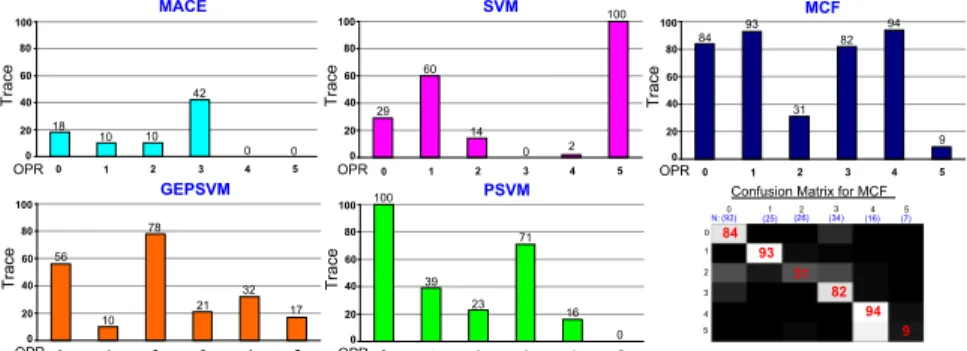
Figure 6. The diagonal elements of the respective confusion matrices obtained for Pain-OPR intensity-level detection experiments are illustrated . Nindicates the number of examples available for each sequence. The traces of these respective confusion matrices can be found in Fig.5(c).
the other hand, GEPSVM had not performed too well. One possible explanation for this could be the sensitivity of its non-parallel hyperplanes towards position and orientation, which may have been adversely affected by the presence of several different AUs that were included in the negative training set.
6.2. Sequence-based Emotion Detection
The best classification rates were achieved by MCF (Fig.5). As with AU detection, similar trends in perfor-mance were observed in MACE, SVM and PSVM, except for GEPSVM on the CK+ dataset. Here, the construction of “non-parallel-hyperplanes” appeared more applicable for the task of distinguishing between emotions, but only if the data was relatively noise-free (posed expressions). This ob-servation, however, became less apparent in the “noisier” GEMEP-FERA dataset.
6.3. Intensity-based Experiments
The most interesting experiment tasked all classifiers to identify between six different levels of pain-intensity in the Pain dataset. The high difficulty of this task lies with the spontaneity of the expressions, marked by substantially in-creased levels of both intra-/ and inter-subject expression variability. Most noticeably, a large component of the diffi-culty is attributed to the visual similarity between adjacent intensity levels (e.g., OPR 0 contained numerous frames which appeared very similar to OPR 1). Hence, there was considerable overlap between positive and negative training examples; and therefore provoking large numbers of out-liers inχ.
As observed in Fig. 5(c), MCF provided the best per-formance, delivering a two-fold improvement over SVM. PSVM and GEPSVM both performed better than SVM. Even so, the difference between MCF and the next-best classifier (PSVM) was still observed to be very significant. Details of the respective confusion matrices are presented in Fig.6. Referring to the last row of the MCF confusion matrix (corresponding to OPR 5), there was some difficulty
encountered by MCF at distinguishing OPR 5 from OPR 4. It should be emphasized again that both these intensity-levels in close proximity to one another appear very similar even visually. Equally important, there were only very few (seven) examples for OPR 5 available for training. In spite of all these, OPR 5 had not been misclassified by MCF to be of lower-intensity levels (i.e., OPR 0 to 3).
7. Conclusion
We propose MCF, a supervised binary classification al-gorithm inspired by correlation filters and SVMs. MCF conserves the energy of the target using linear constraints, and then minimizes the energy of both targets and non-targets in the objective function. Doing so effectively re-duces the influence of outliers and noise in the training set. We demonstrated the advantages of MCF on automatic facial expression recognition problems, but we point out that MCF may also be applied to other similar classifica-tion problems. Rigorous analysis was conducted through a battery of posed, acted and spontaneous facial expression recognition experiments, which had demonstrated the use-fulness of MCF over SVM (plus several of its variants) and correlation filters.
8. Acknowledgments
This research was supported in part by the Coopera-tive Research Centre for Advanced AutomoCoopera-tive Technol-ogy (AutoCRC) and the National Institute of Mental Health grant R01 MH51435. The authors gratefully acknowledge the contribution of National Research Organization and re-viewers’ comments.
References
[1] G. Fung and O. Mangasarian, “Proximal support vector ma-chine classifiers,” inProc. Knowledge Discovery and Data Mining, F. Provost and R. Srikant, Eds., 2001, pp. 77–86. 1,
[2] O. Mangasarian and E. Wild, “Multisurface proximal sup-port vector machine classification via generalized eigenval-ues,” IEEE Transactions on Pattern Analysis and Machine Intelligence, vol. 28, no. 1, pp. 69–74, Jan. 2006.1,2,4
[3] Jayadeva, R. Khemchandani, and S. Chandra, “Twin support vector machines for pattern classification,” IEEE Transac-tions on Pattern Analysis and Machine Intelligence, vol. 29, no. 5, pp. 905–910, May 2007.1,2,4
[4] P. Viola and M. Jones, “Rapid Object Detection using a Boosted Cascade of Simple Features,” inProceedings of the International Conference on Computer Vision and Pattern Recognition, vol. 1, 2001, pp. 511–518.1
[5] M. Bartlett, G. Littlewort, M. Frank, C. Lainscsek, I. Fasel, and J. Movellan, “Automatic Recognition of Facial Actions in Spontaneous Expressions,”Journal of Multimedia, 2006.
1,2
[6] M. Valstar, B. Jiang, M. Mehu, M. Pantic, and K. Scherer, “The First Facial Expression Recognition and Analysis Chal-lenge,” inProceedings of the IEEE International Conference on Automatic Face and Gesture Recognition. 1,5
[7] N. Dalal and B. Triggs, “Histograms of Oriented Gradients for Human Detection,” inIEEE International Conference on Computer Vision and Pattern Recognition, 2005.1,2
[8] T. Cootes, G. Edwards, and C. Taylor, “Active Appearance Models,”IEEE Transactions on Pattern Analysis and Ma-chine Intelligence, vol. 23, no. 6, pp. 681–685, 2001.1
[9] J. Saragih, S. Lucey, and J. Cohn, “Face Alignment through Subspace Constrained Mean-Shifts,” inProceedings of the International Conference on Computer Vision (ICCV), 2009.
1,6
[10] B. Fasel and J. Luettin, “Automatic Facial Expression Anal-ysis: A Survey,”Pattern Recognition, vol. 36, no. 1, pp. 259– 275, 2003.2
[11] G. Littlewort, M. Bartlett, I. Fasel, J. Susskind, and J. Movel-lan, “Dynamics of facial expression extracted automatically from video,” in Computer Vision and Pattern Recognition Workshop, CVPRW, Jun. 2004, p. 80.2
[12] S. Chew, P. Lucey, S. Lucey, J. Saragih, J. Cohn, and S. Srid-haran, “Person-independent facial expression detection us-ing constrained local models,” inIEEE Workshop on Facial Expression Recognition and Analysis Challenge, at AFGR, 2011.2,6
[13] A. Dhall, A. Asthana, R. Goecke, and T. Gedeon, “Emotion recognition using phog and lpq features,” inAutomatic Face & Gesture Recognition and Workshops (FG 2011), 2011 IEEE International Conference on, 2011, pp. 878–883.2
[14] B. Jiang, M. Valstar, and M. Pantic, “Action unit detection using sparse appearance descriptors in space-time video vol-umes,” inAutomatic Face & Gesture Recognition and Work-shops (FG 2011), 2011 IEEE International Conference on, 2011, pp. 314–321.2
[15] T. Wu, M. Bartlett, and J. Movellan, “Facial expression recognition using gabor motion energy filters,” inComputer Vision and Pattern Recognition Workshops (CVPRW), 2010 IEEE Computer Society Conference on, 2010, pp. 42–47.2
[16] M. Savvides, B. Vijaya Kumar, and P. Khosla, “Face ver-ification using correlation filters,” in Proceedings of the Third IEEE Automatic Identification Advanced Technolo-gies, March 2002, pp. 56–61.2
[17] D. Ramli, S. Samad, and A. Hussain, “A umace filter ap-proach to lipreading in biometric authentication system,”
Journal of Applied Sciences, vol. 8, pp. 280–287, 2008.2
[18] A. Mahalanobis, B. Kumar, and D. Casasent, “Minimum average correlation energy filters,”Applied Optics, vol. 26, no. 17, pp. 3633–3640, Sep 1987.2
[19] R. Rifkin, G. Yeo, and T. Poggio, “Regularized least-squares classification,”Nato Science Series Sub Series III Computer and Systems Sciences, vol. 190, pp. 131–154, 2003.3
[20] G. Wahba, “Support vector machines, reproducing kernel hilbert spaces and the randomized gacv,” Technical Report 984rr, University of Wisconsin, Department of Statistics, Tech. Rep., 1998.3
[21] L. Xu, K. Crammer, and D. Schuurmans, “Robust support vector machine training via convex outlier ablation,” inProc. of the Twenty-First National Conference on Artificial Intelli-gence (AAAI), 2006.3
[22] L. Wang, H. Jia, and J. Li, “Training robust support vector machine with smooth ramp loss in the primal space,” Neuro-computing, vol. 71, pp. 3020–3025, 2008.3
[23] X.-C. Zhou, H.-B. Shen, and J.-P. Ye, “Integrating outlier filtering in large margin training,”Journal of Zhejiang Uni-versity - Science C, vol. 12, no. 5, pp. 362–370, 2011.3
[24] Y.-J. Lee and O. Mangasarian, “Ssvm: A smooth support vector machine for classification,”Computational Optimiza-tion and ApplicaOptimiza-tions, vol. 20, no. 1, pp. 5–22, 2001.3
[25] Z. Kou, J. Xu, X. Zhang, and L. Ji, “An improved support vector machine using class median vectors,” inProc of 8th Intl Conf on Neural Information, 2001.3
[26] Y. Zhan and D. Shen,Increasing Efficiency of SVM by Adap-tively Penalizing Outliers. Springer Berlin / Heidelberg, 2005, ch. Energy Minimization Methods in Computer Vi-sion and Pattern Recognition, Lecture Notes in Computer Science, pp. 539–551.3
[27] M. O.L.,Nonlinear Programming. Society for Industrial Mathematics, 1994, vol. 10.4
[28] P. Lucey, J. Cohn, T. Kanade, J. Saragih, Z. Ambadar, and I. Matthews, “The extended cohn-kanade dataset (ck+): A complete dataset for action unit and emotion-specified ex-pression,” inProceedings of the IEEE Workshop on CVPR for Human Communicative Behavior Analysis, 2010.5
[29] P. Lucey, J. Cohn, K. Prkachin, P. Solomon, and I. Matthews, “Painful data: The unbc-mcmaster shoulder pain expression archive database,” inAutomatic Face & Gesture Recognition and Workshops (FG 2011), 2011 IEEE International Confer-ence on. IEEE, 2011, pp. 57–64.6
[30] P. Lucey, S. Lucey, and J. Cohn, “Registration Invariant Rep-resentations for Expression Detection,” inInternational Con-ference on Digital Image Computing: Techniques and Appli-cations: Techniques and Applications, 2010, pp. 255–261.