FLY TIMES
ISSUE 42, April, 2009
Stephen D. Gaimari, editor Plant Pest Diagnostics Branch
California Department of Food & Agriculture 3294 Meadowview Road
Sacramento, California 95832, USA
Tel: (916) 262-1131
FAX: (916) 262-1190
Email: [email protected]
Welcome to the latest issue of Fly Times! Let me first thank everyone for sending in such interesting articles – I hope you all enjoy reading it as much as I enjoyed putting it together! This issue is a rather large one, with nearly 60 pages! With that, please let me encourage all of you to consider contributing articles that may be of interest to the Diptera community. Fly Times offers a great forum to report on your research activities and to make requests for taxa being studied, as well as to report interesting observations about flies, to discuss new and improved methods, to advertise opportunities for dipterists, and to report on or announce meetings relevant to the community. This is also a great place to report on your interesting (and hopefully fruitful) collecting activities!
The electronic version of the Fly Times continues to be hosted on the North American Dipterists Society website at http://www.nadsdiptera.org/News/FlyTimes/Flyhome.htm. The Diptera community would greatly appreciate your independent contributions to this newsletter. For this issue, I want to again thank all the contributors for sending me so many great articles! That said, we need even more reports on trips, collections, methods, updates, etc., with all the associated digital images you wish to provide. Feel free to share your opinions or provide ideas on how to improve the newsletter (as the “new guy,” I am very happy to hear ways that I can enhance the newsletter!).
The Directory of North American Dipterists is constantly being updated and is currently available at the above website. Please check your current entry and send all corrections to Jeff Cumming. There is a form for this on the last page of the newsletter.
Issue No. 43 of the Fly Times will appear next October. If possible, please send your contributions by email, or disc, to the editor at [email protected]. All contributions for the next Fly Times should be in by 10 October 2009.
N
EWS
Jose Henrique Guimarães, 1937 – 2008
By Phil Scholl
Retired from USDA-ARS Midwest Livestock Insects Research Unit, Lincoln, Nebraska, U.S.A.; relocated to Brazil; [email protected]
Dr. Guimarães was born in the city of Rio de Janeiro, Brazil on 8 October 1937. He graduated in Veterinary Medicine from the Federal University of Rio de Janeiro in 1962. He was a student of Dr. Hugo de Souza Lopes at UFFRJ in collaboration with the Oswaldo Cruz Institute where he initiated his studies in the taxonomy of the Tachinidae. He obtained his MS degree in 1969 on the Nearctic species of Winthemia spp. at the University of California-Riverside with Dr. Lauren Anderson, in collaboration with Dr. Curtis Sabrosky. In 1973 he received his PhD from the University of São Paulo with Dr. Claudio G. Froehlich on the systematics of the Mesembrinellidae.
Dr. Guimarães was an internationally-respected taxonomist because of his voluminous contributions to Neotropical Diptera, especially in the families Tachinidae, Calliphoridae and Oestridae, notably Cuterebrinae and Gasterophilinae. He authored nearly a hundred works including scientific journal articles, book chapters, and books including Myiasis in Man and Animals in the Neotropical Region, Systematic Database of Diptera of the Americas South of the United States (Family Culicidae), Ectoparasites de Importância Veterinaria, to name just a few. He was also responsible for an impressive list of new descriptions including 16 genera and 163 species.
Dr. Guimarães, who passed on 14 October 2008, will be remembered for his prodigious contributions to Dipterology, the large number of students he mentored, and for his wonderful personality.
***************************************
Brandberg Massif (Namibia) serves up another living fossil!
by Bradley J. Sinclair1 & Ashley H. Kirk-Spriggs2
1Ottawa Plant & Seed Laboratories – Entomology, Canadian Food Inspection Agency,
K.W. Neatby Bldg., C.E.F.,960 Carling Ave.
Ottawa, Ontario, Canada K1A 0C6; [email protected]
2
Head of Entomology, National Museum, P.O. Box 266,
Bloemfontein, 9300, Free State, South Africa; [email protected] There are numerous examples of present-day genera of flies represented in Tertiary ambers (40–15 Mya), but far fewer from Mesozoic fossils; such examples are restricted to “nematocerous” Diptera (Evenhuis 1994). In the “dance flies” (Empidoidea), onlyone example is recorded (i.e., the genus Apalocnemis), known from Santonian-aged (76–80 Mya) ambers of Canada (Grimaldi & Cumming 1999). In all these cases, the extant genus was initially known from present-day species, being
subsequently identified in amber (e.g., the genus Valeseguya) (Grimaldi & Engel 2005). Empidoids are the most diverse lineage of Brachycera known from Cretaceous ambers (Grimaldi & Engel 2005).
By contrast, the genus Alavesia Waters & Arillo was originally named for a series of amber inclusions dated from the Early to Late Cretaceous (112–89 Mya) from outcrops in northern Spainand Burma (Waters & Arillo 1999; Peñalver & Arillo 2007; Grimaldi et al. 2002) (Figs. 1A). We report here the discovery of two extant new species of Alavesia, sampled on the Brandberg Massif, Namibia
(21°13.5′S, 14°31.1′E) (Fig. 1B). Specimens were sampled using Malaise traps and yellow pans positioned over dry or episodic riverbeds at, or exceeding, elevations of 1750 m a.s.l., as part of a faunal inventory project undertaken in 1998 (Kirk-Spriggs & Marais 2000), and in March 2002. It was not until early 2007 that these specimens were recognized as this Mesozoic genus. Consequently, Alavesia can truly be regarded as a living fossil and its discovery is similar to, but perhaps less astonishing, than the discovery of extant specimens of the Coelacanth in 1938. The thorny lacewings (Neuroptera: Rhachiberothidae), although not presently recorded from the Brandberg, have a similar distribution, restricted today to sub-Saharan Africa, but were widespread in the Cretaceous (Grimaldi et al. 2002).
Alavesia is characterized by a large, broad third antennomere (postpedicel), three-articled stylus, and wing venation with a distinctive diminutive dm cell and divergent M1+2 and M4 (4th and 5th veins) (Fig.
1A). The wings of the extant species of Alavesia measure 1.8–2.3 mm in length.
The Brandberg comprises a massive inselberg 650 km2 in size, rising 1.8 km above the Namib peneplain. It consists of a granitic ring complex, which pre-dates the break-up of Gondwana and thus also the change in continental climatic and environmental conditions that prevailed during the
Plio-Pleistocene (Kirk-Spriggs & Marais 2000). The extensive undulating upland plateau (ca. 2000 m a.s.l.) exhibits a winter rainfall climate and associated flora. The significance of the Brandberg as a refugium for living fossils has been previously highlighted by the discovery of the first living examples of Mantiphasmatodea (Zompro et al. 2003). Many notable endemics in the Diptera have been
documented in several families and the discovery of Alavesia further serves to highlight the evolutionary significance of the Brandberg.
References
Evenhuis, N. L. (1994) Catalogue of the Fossil Flies of the World (Insecta: Diptera). Backhuys Publ., Linden.
Grimaldi, D. & Cumming, J. (1999) Brachyceran Diptera in Cretaceous ambers and Mesozoic diversification of the Eremoneura. Bulletin of the American Museum of Natural History, 239, 1–124.
Grimaldi, D. A. & Engel, M. S. (2005) Evolution of the Insects. Cambridge University Press, New York.
Grimaldi, D.A., Engel, M.S. & Nascimbene, P.C. (2002) Fossiliferous Cretaceous amber from Myanmar (Burma): Its rediscovery, biotic diversity, and paleontological significance. American Museum Novitates, 3361, 1–71.
Kirk-Spriggs, A. H. & Marais, E. (2000) (eds) Dâures – biodiversity of the Brandberg Massif, Namibia. Cimbebasia Memoir9, 1–389.
Peñalver, E. & Arillo, A. (2007) A new species of the family Hybotidae in the Lower Cretaceous amber of El Caleyu (Asturias, Spain); Alavesia prietoi n. sp. Alavesia, 1, 63–68.
Waters, S.B. & Arillo, A. (1999) A new genus of Hybotidae (Diptera, Empidoidea) from Lower Cretaceous amber of Alava (Spain). Studia dipterologica, 6(1), 59–66.
Zompro, O., Adis, J., Bragg, P.E., Naskrecki, P., Meakin, K., Wittneben, M., & Saxe, V. (2003) A new genus and species of Mantophasmatidae (Insecta: Mantophasmatodea) from the Brandberg Massif, Nambia, with notes on behaviour. Cimbebasia 19, 13–24.
Acknowledgements. We are indebted to David Grimaldi (American Museum of Natural History) for information and the original sketch of fossil Alavesia, Henri Goulet (Canadian National Insect
Collection) for photo of extant Alavesia. Sponsorship for the 2002 Brandberg expedition was provided by the National Museum of Namibia, Conservation International and the Max-Planck-Institute for Limnology.
Fig. 1.A, Alavesia sp. (Diptera: Empidoidea) in Burmese amber (ca. 100 Mya) (AMNH), B, extant
Alavesia sp. 1, one of two new species from the upland plateau of the Brandberg Massif in Namibia. Abbreviations: atnm 3 = antennomere 3; dm= discal medial cell; M = medial veins; pped = postpedicel; R = radial vein; st = stylus. Scale bars: A = 0.20 mm; B = not to scale.
***************************************
Status of the Biosystematic Database of World Diptera (BDWD)
by Chris Thompson1 & Thomas Pape2
1 National Museum of Natural History, Smithsonian Institution, 10th & Constitution NW
Washington, DC 20560-0169; [email protected]
2 Natural History Museum of Denmark, Zoological Museum, Universitetsparken 15
2100 Copenhagen, Denmark; [email protected]
The Biosystematic Database of World Diptera (BDWD) is moving again! So be sure that you are using the correct and proper URL – www.diptera.org, which will in due time point you to our new server hosted by the Natural History Museum of Denmark, University of Copenhagen.
Years ago, the BDWD made its first online appearance on the Smithsonian internet server as part of the now defunct Diptera web site (April 1996). Later the BDWD switched to the USDA SEL server. Unfortunately, in recent years USDA has not been able to provide much support for the BDWD beyond the salary of one of the editors (who had many other duties also). So, when that scientist retired and the position was abolished, even that minimal support came to an end.
We are working on a new improved version (11.5), which will be current to 2009 by incorporating names from Zoological Record, volume 144. The Nomenclator and Reference File will be served as before, and much of the web site will remain the same. This version should be online shortly.
Our plans still include a new online species interface and online editing features for specialists, but due to lack of support these features will take longer to implement. However, the BDWD is a community project and it remains the best and most comprehensive nomenclatural and taxonomic information system for any group of organisms. So, as the community continues to support the BDWD, we will continue to improve, enhance and provide a better and more comprehensive product for ALL.
Remember Aesop and his fable about the rabbit and the turtle. Then smile: We will get there together and be first in the end!
***************************************
Sharing your Diptera images with the Encyclopedia of Life
by Torsten Dikow
Biodiversity Synthesis Center, The Field Museum, 1400 S. Lake Shore Dr. Chicago, Illinois 60605, USA; [email protected]
In the last Fly Times I introduced the Encyclopedia of Life (EOL, www.eol.org) and its aim to provide a web-page for every species living on our planet. Although there are 1.8 Million web-pages already available, most of them are empty at this stage and only contain the species name and author. To increase the number of images for species and attract input from both the scientific community and the public, the EOL developed a partnership with the photo sharing site flickr (www.flickr.com). Sharing your Diptera images with the EOL might be a great way to showcase your Diptera images widely as well as populate a growing web-based project providing information about species on our planet freely
to everybody in the world! To date, more than 20,000 images have been added to the EOL through sharing of images with flickr.
I would like to briefly outline the procedure necessary to upload images to flickr so that they appear on the EOL. First, if you have a flickr account your are all set, if not you can use yahoo account credentials or make a new account on www.flickr.com. Second, you will need to join the ‘Encyclopedia of Life Images’ group (http://www.flickr.com/groups/encyclopedia_of_life). Only images from members of this group will be displayed on the EOL. Third, the actual image upload can be done through either the web-site or software downloadable from flickr (this will allow batch upload, for example). There are minimum standards for each image that EOL requires in order to display the image on the respective species page. These are (1) a scientific name (it facilitates placement on the correct web-page and it is desirable to include family, genus, and species to avoid problems with botanical and zoological names, which could coincide at the genus and species level), (2) the image needs to be set to public, and (3) a creative commons license other than ‘None (All Rights Reserved)’ needs to be selected (EOL provides all information free to everybody and it therefore cannot display images with full copyright. However, note that all images on EOL are attributed to the author/photographer so that your name will always be associated with your image (Fig. 1)).
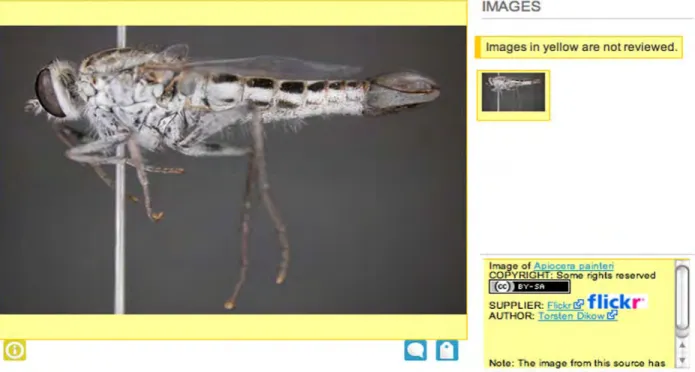
Fig. 1. Apiocera painteri specimen image submitted through flickr on the EOL.
The scientific name needs to be added by using machine tags in the following format as exemplified by a specimen of Apiocera painteri Cazier, 1963 (Asiloidea: Apioceridae) that I collected and later photographed after pinning (Fig. 2; http://www.eol.org/pages/744497):
taxonomy:family=Apioceridae taxonomy:genus=Apiocera taxonomy:species=painteri
Note the space between each tag and that the binomial name has to be in double quotation marks because the space between genus and species would otherwise be interpreted as two separate tags. Additional machine tags can be added in reference to the latitude and longitude where the photo was taken (or specimen collected) in the following format: geo:lat=31.21 geo:long=-109.78.
The creative commons license (http://creativecommons.org) needs to be changed by using the tool in flickr under
‘Additional Information’ (Fig. 2). One of the following four licenses is allowed:
(1) Attribution- NonCommercial-ShareAlike Creative Commons; CC-BY-NC-SA –
http://creativecommons.org/licenses/by-nc-sa/3.0 (2) Attribution- NonCommercial Creative Commons; CC-BY-NC –
http://creativecommons.org/licenses/by-nc/3.0 (3) Attribution Creative Commons;
CC-BY – http://creativecommons.org/licenses/by/3.0), and (4) Attribution-ShareAlike Creative Commons;
Fig. 2. Tags and other information for the Apiocera painteri image in flickr. CC-BY-SA – http://creativecommons.org/licenses/by-sa/3.0
The last thing you will need to do is send the image to the
Encyclopedia of Life Images group with a button just above the image called ‘Send To Group’. Once done, you can verify that it appeared in the group
(http://www.flickr.com/groups/encyclopedia_of_life). Fig. 2 shows how the image information on flickr should look.
The EOL servers will visit the flickr group at midnight (US Eastern Standard Time) and your image should be in the correct web-page the following day. If you can’t see your image it can have two reasons. First,you will need to set the Information slider on the EOL web-page to ‘All’ as the images from flickr come to EOL as unvetted and surrounded by a yellow margin indicating that the curator for that page has not yet approved the image for display as accurate, scientific information (see Fig. 1). Second, if a species does not exist in the EOL species catalogue, which we get from the Catalogue of Life (http://www.catalogueoflife.org/search.php) that combines Species2000 (http://www.sp2000.org) and ITIS (http://www.itis.gov), there is no place to put the image. I have recently seen images being added and labelled as ‘Taxon recognized by EOL Group on Flickr’ and ‘Name not in 2008 Catalogue of Life’, which accommodates the images but ultimately the catalogue needs to be changed. EOL recognizes that there are problems with the species catalogue being used, but the data come ultimately from taxonomists who can provide their updated species catalogue to the Catalogue of Life in the future. The Biosystematic Database of World Diptera (BDWD, http://www.diptera.org) provides the Diptera names to the Catalogue of Life annually and in case of problems with the species catalogue this database needs to be updated (you can contact Chris Thompson and Thomas Pape in order to do so). I hope many of you will join the flickr Encyclopedia of Life Images group and provide images of Diptera so that the EOL species pages for Diptera get populated quickly with your great photos.
***************************************
Searching for Digitized Diptera Literature Online: a brief overview
by Neal L. Evenhuis
Bishop Museum, 1525 Bernice Street,
Honolulu, Hawaii 96817-2074, USA; [email protected]
There was a time long ago and far away when people used to go to libraries to find the articles they wanted and wrote reprint requests on little postcards. Yes, Virginia, they actually did! It is not a myth! However, now, with the increasing numbers of articles available online, visiting the library is an antiquated and laborious duty that some seem to think is only done by those who can’t type. And sending a postcard requesting a reprint? Sheesh! That went out of fashion about 10 years ago (although I still get one every couple of years — usually from those who can’t type). Needless to say, libraries still serve a useful purpose and until all of the literature ever printed has been digitized, we will still be scouring the library shelves for literature we cannot find online. But with the various digitizing projects taking place worldwide, there is indeed a large amount of literature available online and more and more articles and books are being added daily. But where to start? Where to go? What is out there and how does one easily find it?
The following is a brief annotated list of free resources that are currently available when searching for a particular work. There are many subscription-based services available online (usually a publisher’s website) and article for a fee may be purchased there or you can download articles for free if you are affiliated with a library that subscribes to one of those services or journals. There are too many to list here but the Smithsonian link below can give you a start. And if you cannot find something online, but you have a hunch it is indeed available in digital form (usually pdf), you can always resort to emailing the author to request a copy of the work.
GENERAL RESOURCES Google
There are three ways to find literature using Google. Each has its own pros and cons.
Main Search Engine
http://www.google.com/
This is the most popular search engine on the web and is usually the first place one goes when
searching for anything to do with what you are interested in. However, if you are interested in finding something publicly published about an organism, this is not necessarily the best place to go, but it will still find things that may not be found any place else. What can be found here that may not be found in the other search resources listed below are documents on the websites of institutions or individuals that have not been picked up by the Google Scholar or Google Books web crawling algorithms.
Google Scholar
http://scholar.google.com/
This is not a complete collection of scholarly articles but lists a lot of them that have been published since 2000. If you are looking for articles published earlier, you may need to use another approach although a few articles covered by BioOne and JSTOR can be found here (these last two require subscription services for access to entire articles). Down side to this search engine: unless there is a
[pdf] indicated for the search result, most often, the results that come back are taken straight from fee-for-services publishers’ web sites. Unless you are staff, student, or affiliated with a library that subscribes, you will have to pay for the article (which is often exorbitant). It may be far easier to just request a copy from the author. Or if your library carries the journal, OMG! you might have to make a photocopy and turn it into a pdf yourself....
Google Books
http://book.google.com
This, and the Biodiversity Heritage Library (BHL) (see below), are the largest sources of digitized books and older journals. These massive digitizing projects add books and journals daily. Google Books scans in black and white (some plates are scanned in color). BHL scans in color (but see
archive.org below for additional versions). Google has entered into agreements with various libraries to scan their books and make them available online. Pre-1923 works are copyright free and these are the ones that usually show up as “Full Version” in green when you get a search result back. Still, some publishers have not given permission to make available full text versions and these show up in the search results as “Snippet View”, Preview”, or “No preview available”.
One of the down sides of Google Books is the resulting book or journal you find may be text searchable via the web, but once you download the pdf file onto your desktop, it most often is not OCRd so you have to perform an OCR on it yourself before you can start searching text.
Search tip: when searching for books or journals that list a particular taxon you are interested
in and you only want something published in a particular timeframe, click on “Advanced Search” (see screenshot) and fill in the boxes for beginning and ending date and then search again and all the books only published in those intervening years will show up. This feature does not work with the general Google web search.
Search tip 2: if you are only interested in searching a particular journal, enter the name as
complete as possible (watch for spelling). When you find your journal among the results, click on “other editions” and up will come all the volumes of that journal that have been digitized. In some cases, not all are “Full view” and the default viewing option is “All books”. You can limit the results to that by changing the radio button that says Book showing “All books”: change to “Full view”. That should give you only those volumes in which that you can do a full text search.
Archive.org
http://www.archive.org/
This is the firm in the California Bay Area that takes the raw scanned files from BHL and converts them to various formats. BHL takes back the color scans and OCRd text and makes them available from the BHL site. Additional versions are available from the archive.org site. After finding a particular work in the “text” section and clicking to get the result, the metadata shows up. Just investigate the box to the left for all the variations on the theme (including color and b/w pdfs, full text, and other nifty formats for those so inclined to that sort of thing.
Biodiversity Heritage Library (BHL)
http://www.biodiversitylibrary.org/
This large digitizing project is based on the partnership of major libraries and institutions in the Northern Hemisphere (including Woods Hole, Smithsonian, Missouri Botanical, and the Natural History Museum, London). the home page allows for searching by author, title, subjects, name, map, year. A nice feature of this service is the taxa that have been OCRd on each page show up in the bottom left corner as you go from one page to another. that helps speed up searching for a particular taxon. but another way is to download the pdf file and just search the whole pdf for each instance.
Down side: Years of publication are often missing from desired journals. I suppose BHL figures you know what year a particular volume was published. So, if you were searching for, say, an article by Rondani (1845) in the Nuovi annali delle scienze naturali di Bologna, you will have to know what volume in which to search because only the volume number is listed. Or, in the case of books published as volumes, sometimes only the year is given, so you have to know the year a particular volume was published to hit the right one. Example: Kertész, Catalogus Dipterorum. Still, despite this, BHL offers the best quality scans and all the files are OCRd, so downloading the pdf means you won’t have to do anything to it to do a full text search.
Gallica
http://gallica.bnf.fr/
An excellent source for old French publications. One of my favorites for French titles. Great search interface and results allow you to request a pdf by page or all at once. Pretty much all in French. If you want a book and know the author and/or the title, searching is easy. If the article is in a journal, you can select from the categories they have and pinpoint the journals they have digitized. A general browse shows you all broken into specific categories. They have recently upgraded the search in Gallica2 but I am more familiar (and comfortable) with the old interface.
Göttingen University Digitizing Project
http://gdz.sub.uni-goettingen.de/
An excellent source for some of the older German natural history works. Contains a number of journals not found in other digitizing projects.
Down side: not a very user friendly interface and the web browser sometimes hangs when you want to go to the next page when you are searching a journal page-by-page for a particular article.
Animalbase
http://www.animalbase.uni-goettingen.de/zooweb/servlet/AnimalBase/list/references
A great source for many of the older zoological taxonomy works. They claim to have everything digitized up to 1800 and a number of post-1800 article are there as well.
Smithsonian Links to Online Journals
http://www.sil.si.edu/eresources/tfr_ej_alpharesults_all.cfm
This is a page with links to a number of journals with online articles. Those that are free are indicated as such. Handy reference if you wish to browse the contents of a particular journal.
Links to Free Online Journals
http://hbs.bishopmuseum.org/dipterists/online-journal-links.html
This new website has recently been set up (primarily for dipterists) as a one-stop shop to links to open-access journals and to as many entomological journals as possible that have been digitized (either by Google, BHL, Gallica, etc.). Rather than search each of the search engines for a particular journal, we’ve done the searching and filtering for you. You can go here first and see if the journal you want is linked. If not, check elsewhere. If you find something missing, send me an email with the url and I will add it since we are continually updating the links as more journals become available.
MORE SPECIFIC RESOURCES
The following is a list of more specifically focused resources for articles and books dealing with general entomology, specific geographical areas, natural history, and Diptera.
Fiji Arthropods
Full bibliography with available pdfs linked http://hbs.bishopmuseum.org/fiji/biblio.html
Pacific Insects
All articles indexed via Google Search Engine -- very handy http://hbs.bishopmuseum.org/pi/
Pacific Insects Monographs
All articles indexed via Google Search Engine -- very handy http://hbs.bishopmuseum.org/pim/
Insects of Micronesia
http://hbs.bishopmuseum.org/pubs-online/iom.html
Catalog of the Diptera of the Australasian and Oceanian Regions
Checklist gives you current stats plus links to original 1989 chapter and current updated html
http://hbs.bishopmuseum.org/aocat/
Catalogue of the Fossil Flies of the World (Insecta: Diptera)
Updated web version of the original 1994 book
http://hbs.bishopmuseum.org/fossilcat/
Asilidae
A list of pdfs available by contacting Fritz Geller-Grimm http://www.geller-grimm.de/catalog/pdf.html
Mydidae + Apioceridae
A bibliography compiled by Torsten Dikow, with links to available online pdfs http://www.mydidae.tdvia.de/biblio.html
***************************************
Using digitized Diptera literature from the Biodiversity Heritage Library
by Torsten Dikow
Biodiversity Synthesis Center, The Field Museum, 1400 S. Lake Shore Dr. Chicago, Illinois 60605, USA; [email protected]
One amazing component of the Encyclopedia of Life (EOL, www.eol.org) is the Biodiversity Heritage Library (BHL, www.biodiversitylibrary.org), which aims to digitize all taxonomic literature ever published and linking it with the species pages on the EOL. I am introducing you to this great tool to make you aware of the ongoing digitization project and hope you will use it for your research. The number of journal volumes and books hosted by BHL is growing rapidly and I have downloaded several old publications for my research already. It pays off to check back from time to time or subscribe to the RSS feed to find out about new volumes being added. Below is some information about the BHL, some hints for downloading, and information on new developments that will be introduced later this year.
All literature digitized by the BHL is made freely available to any researcher or amateur in the world through the web-site. Currently, nine institutional libraries are partners in the BHL with additional ones surely joining in the future. Initially, all core literature pre-1923, which is out of copyright in the USA, amounting to approximately 400,000 titles (= 80 million pages) will be digitized. Then all pre-1923 literature (approximately 600–750,000 titles, 120–150 million pages) and all taxonomic literature (estimated at 1.4–1.6 million titles, 280–320 million pages) will be digitized in high-resolution. In cases where books or journals are still covered by copyright the BHL will approach the publisher and try to make an agreement to digitize the journal and provide access to the PDFs to the publisher as well as to users through the BHL web-site. Smaller natural history museums, for example, might be interested in waiving the copyright and getting their journals digitized as they might not have funding to do so by themselves. The digitization service by the BHL is completely free to the
institutions/publisher.
Digitization is being done through the use of two SLR cameras photographing pages in at least 300 dpi as TIF images. The text in the images is then recognized using sophisticated OCR algorithms (BHL uses ABBYY Finereader http://finereader.abbyy.com) and all taxonomic names are identified by using TaxonFinder from uBio (http://www.ubio.org) to be able to search the documents for their taxonomic information. To date, 12,604,873 pages are available from 11,435 titles and 31,097 volumes (9 April 2009). All pages digitized have permanent URLs (e.g., http://biodiversitylibrary.org/page/8340143 shows the page of the original description of Nemomydas venosus (Loew, 1866) Asiloidea: Mydidae)
and therefore this page can be linked to a taxonomic web-site or links included in your taxonomic publication. More detailed information about the BHL can be found on their web-site as well as their blog (http://biodiversitylibrary.blogspot.com).
Library catalogues are great tools to provide access to journal volumes or books, but are not capturing data concerning every article within a journal volume. The BHL is currently no different in that one could initially only download entire journal volumes from which one had to extract the article of choice. Now, a new implementation is being tested in which one can download an article/chapter of a digitized journal volume/book if one has page numbers at hand. The BHL asks the user to voluntarily provide the bibliographic information about the article/chapter of choice so as to provide direct access to the article/chapter for future users. For Diptera we can get this information from the Biosystematic Database of World Diptera (BDWD, http://www.diptera.org/). Details of how to download articles in this way can be found on the BHL blog
(http://biodiversitylibrary.blogspot.com/2009/01/article-download-now-available.html).
In some instances, complains have been voiced that figures in the provided PDF are of a lower quality. This is related to the text being recognized with OCR and the figures being compromised in the process. The BHL provides three types of data for download (Fig. 1), (1) a PDF (with text OCR), (2) a plain text file (with the OCR text itself), and (3) the page image. All figures can therefore be viewed when downloaded as an image in high quality.
I hope you will start using the Biodiversity Heritage Library for your research. ***************************************
The *new* Diptera Site
by Irina Brake1 & Gail Kampmeier2
1
European Distributed Institute of Taxonomy (EDIT),
Department of Entomology, Natural History Museum, Cromwell Road, London SW7 5BD, United Kingdom; [email protected]
2 University of Illinois, Illinois Natural History Survey, 1101 W. Peabody,
Urbana, Illinois 61801 USA; [email protected]
The *new* Diptera Site (http://www.diptera.myspecies.info) has been online for over a year now. In April 52 users were registered. Together we have accumulated 1561 bibliographic citations, 422 images, 205 descriptions and 66 pages. Among the species pages available are the 1st tier taxa of FLYTREE and several species of Carnidae, Empididae and Therevidae. These species pages will later be used by EOL.
During the last 12 month the site had 8,336 visits, 28,603 page views and average time on site lasted 2 min 37 sec (Google Analytics, all activities by IB excluded). Altogether there were 6,412 unique visitors to the site coming from 126 countries, mainly the UK (2,250), US (1,838), Brazil (521), Canada (340), and Australia (303). Most traffic comes through Google, with "Diptera" as keyword, followed by direct access to the site. Interestingly, the family most searched for is the Cecidomyiidae, so it would be good to have some more data on this family available.
The next weeks will see an upgrade of the website to Drupal 6, with several new features available, for example a taxonomy manager and a NEXUS editor enabling the use of phylogenetic data.
We hope to encourage you to take part in populating the new Diptera Site with data and building species pages. IB has written several help pages and is keen to help you with the site. At the moment we are urgently looking for a couple of photos to make the front page more attractive. If you have any suitable photos, preferably of live specimens, please send them to [email protected] or directly upload them to the website.
***************************************
The Lower Brachycera Digitization Project
by Kevin C. Holston
Department of Entomology, Swedish Musem of Natural History Stockholm, Sweden; [email protected]
The primary objective of the Lower Brachycera Digitization Project (LDBP) was to develop a
biodiversity informatics resource for Swedish Lower Brachycera in natural history museum collections, thereby improving the scope and availability of data for studies on the included species. The
morphology, behaviour, and host/habitat associations of Lower Brachycera species have attracted the interest of many researchers and insect collectors; this is demonstrated by extensive collections at many museums. Recent study of these collections has augmented the few published summaries of species occurrences leading to an exceptionally high conservation status for these flies in northern Europe. Many species are locally extinct, rare, or threatened according to recent assessments: 45% of the 172 Swedish Red List Diptera species, for example, are classified in these families although Lower Brachycera includes only 870 species, or 15% of the Swedish fly fauna. The LDBP was also intended to initiate digitization programmes at Swedish entomology collections anticipated for the upcoming years, with project results used to improve data capture and sharing strategies (Fig 1).
The LDBP database currently includes records for 25,000 specimens (representing nearly 500 species) most of which are found at the two largest Swedish entomology collections – the Swedish Natural History Museum, Stockholm, (NHRS) and Zoological Museum, Lund University (MZLU). Digital images submitted to Morphbank provide visual references for Swedish Asilidae species and serve as vouchers for taxonomic determinations made during this project
(http://www.morphbank.net/myCollection/?id=464600). This project is among the few GBIF
providers of European insect data and is the only specimen-level data resource for many of the included species (http://data.gbif.org/datasets/resource/1043). Scheduled activities will support efforts to coordinate large-scale digitization of entomology collections and increase the scope of and accessibility to biodiversity informatics data for the included species.
As the project ends in 2010, I hope records generated during this project will to be demonstrate their usefulness within the Dipterist community and contribute to further digitization initiatives (perhaps as Mike Irwin, Gail Kampmeier, and Chris Thompson provided the conceptual groundwork for this project – by the way, feel free to [mis]direct complaints about the project to my mentors!). Most LBDP records reflect substantial coverage for Swedish Asilidae species (over 7,000 records) but large datasets are forming for other groups such as Tabanidae, Bombyliidae, Stratiomyidae and of course, Therevidae.
Feel free to contact me; I welcome your advice and comments. And be sure to visit the project website: http://www.nrm.se/forskningochsamlingar/djur/entomologi/forskning/pagaendeprojekt/digitaliseringb rachycera.5949.html
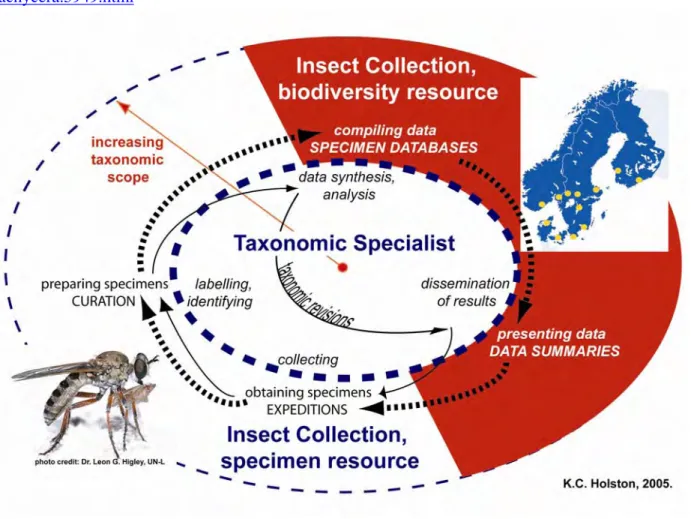
Fig. 1: Comparing the current “specimen acquisition to specimen curation” cycle (narrow solid
arrows) of collections-based research to the ideal “specimen to biodiversity data” cycle (wide broken arrows). The current cycle is sub-optimal and yields summarized rather than digitized biodiversity data, often scattered among taxonomic revisions. The “specimen to biodiversity data” cycle, completed during this project, yields complementary repositories of insect specimens and their associated biodiversity data as a step towards this paradigm shift in collections-based studies.
***************************************
Crane Hollow ATBI Update
by Gary A. Coovert 19681 Keifel Rd. Laurelville, Ohio 43135, U.S.A.
Crane Hollow and the Hocking Hills in SE Ohio were visited by the North American Dipterists at their Annual Meeting way back in May 16-20, 2003. Much has happened since then. This report is an update of our progress, plus some background for those who have not been there.
Crane Hollow (Laurel Twp., Hocking Co., OH) is a 3-mile long, 1,200 acre valley rimmed by rugged sandstone cliffs and over 50 major waterfalls. Nestled in the Hocking Hills region of south-central Ohio this scenic treasure is part of the state nature preserve system but is privately owned by a non-profit dedicated to its preservation and study. The deep ravines formed in Crane Hollow are a haven for typically Appalachian biota, with hemlock being especially abundant in the moist
environment. Lying within the unglaciated Allegheny Plateau, the area is on the western edge of the Mixed Mesophytic Forest region, typified by a high diversity of tree species (e.g. Yellow & Black Birch, Red Elder, Hercules’ Club). The drier uplands are composed of mostly mixed oak woods, oak-pine woods, and lichen-ericad openings near the cliff edges. The large size of the preserve and the wide variety of habitats leads to a very rich diversity of native species.
Since mid-2002, an intensive ATBI has been in progress. Because this is a full-time, focused effort, a great deal of progress has already been realized. What makes this effort unique is that the ATBI is merely the initial stage to ultimately map out the entire ecology of the area – what I’ve termed a Comprehensive Ecological Inventory (CEI). The ATBI supplies the names and a wealth of ecological data, which then lead to ecological interrelationships. This concept is illustrated in my recently published book The Ants of Ohio (published by the Ohio Biological Survey), in which an appendix illustrates the myriad specific interrelationships of one of the 126 species of Ohio ants (the silky ant preyed upon by a slave-making ant, parasitized by a rarely recorded braconid that targets these slave raids, robbed by a tiny thief ant, the ant nests shared with a syrphid larva that eats the ant young, and the winged queen ants preyed upon by a wasp specialist which is, itself, the target of a sarcophagid thief. In addition, the ant has a fascinating mutualistic association with a treehopper). This has been my focus since the beginning at Crane Hollow, and is all being meticulously documented and vouchered. This ATBI (CEI) is significant because of these ecological connections and the centrally located, extensive voucher collections. At the time of the NADS/BFW meeting in 2003, the Crane Hollow collection totaled around 2,000 specimens; now the pinned/labeled collection is over 81,000 specimens with an equal number in alcohol. To date, this ATBI has tallied 6,583 species, including 720 vascular plants, 1,024 fungi, and 4,092 insects (incl. 1,153 moths & butterflies, 1,215 beetles, and 65 ants - over half the state’s ant total). Although a great deal of ID work remains in the Diptera, currently there are 627 species identified in 66 families. This includes 49 Tipulidae (being worked on by Ben Foote), 74 Cecidomyiidae (mostly based on galls), 42 Asilidae, 116 Syrphidae, 12 Conopidae, 10 Clusiidae, 2 Odiniidae, 18 Lauxaniidae, and 47 Chloropidae. The latest addition was a specimen of the rare
Synneurondecipiens (Synneuridae). Many families remain to be sorted (e.g. Mycetophilidae, Sciaridae, Psychodidae, Cecidomyiidae, Ceratopogonidae, Chironomidae, Empididae, Dolichopodidae, Phoridae, Pipunculidae, Agromyzidae, Dryomyzidae, Chamaemyidae, Sphaeroceridae, Drosophilidae,
Ephydridae, Anthomyiidae, Muscidae, Oestridae, and Tachinidae). These are the families that I’m most in need of identification resources. At this point, I generally prefer to initially identify them myself so as to gain familiarity with the taxa, then will eventually seek specialists to review specimens (by already being sorted and identified, this will greatly simplify the task of the specialist). Given the proper keys and references, I’m not afraid to tackle new groups. (I recently had all of my chrysomelid beetles verified by a Smithsonian specialist at 100% accuracy; I then tackled the entire collection of weevils, and most recently started in on ichneumonids). Thus, my plea right now is to ask for donations especially of taxonomic reprints in all groups (but particularly those listed above), and donations of entomological, ecological, and general biological journals. Given the apparently unique ecological approach to this ATBI and the long-term commitment, I view this project as our best hope at completely inventorying the biota and its vast ecological connections in a single location. Any duplicate papers, journals, etc. would be invaluable to this work and would be greatly appreciated.
I would be glad to answer any further questions. I can be contacted at: Gary A. Coovert, 19681 Keifel Rd., Laurelville, Ohio 43135; phone 740-385-0021; email [email protected] (dial-up, so not my preferred means of communication).
***************************************
New Dance Fly Project: Graduate Research Assistantship Available
by Brian Wiegmann & Isaac Winkler
Department of Entomology, North Carolina State University Raleigh, North Carolina 27695, USA; [email protected]
We are happy to announce that our collaborative project studying the phylogeny of dance flies (Empididae: Empidinae) and evolution of mating-related traits was funded by the National Science Foundation beginning March 2009. The project PI's are: Brian Wiegmann (North Carolina State University), Jeffrey Cumming (Canadian National Collection, Ottawa), Christophe Daugeron
(Museum national d'Histoire naturelle, Paris), Ken Collins (Fullerton College, California), and postdoc Isaac Winkler (North Carolina State Univ.). We are seeking a graduate student with interest in
systematics and evolution to work on the project at North Carolina State University beginning in the fall 2009 term. If any of you know of qualified students who may be interested in this position, please have them contact Brian Wiegmann.
Dance flies are well-known for their elaborate mating behaviors, which typically involve male swarming and presentation of nuptial prey. Other unique behaviors found in some groups are female swarms, with associated female ornamentation, and presentation of "balloons" made of silk or froth instead of nutritious prey. Extreme morphologies involving the modification of the legs or male terminalia are also common. Pictures of dance flies exhibiting these traits can be seen at our project website: http://www4.ncsu.edu/unity/users/bwiegman/public_html/labweb/webpages/Emp.home.html The main goal of our project is to develop a robust phylogeny for the subfamily Empidinae, focusing especially on the large genera Empis and Rhamphomyia, and to use this phylogeny to map the
evolution of mating behaviors and associated morphologies. One overarching question is whether these traits have lead to demonstrably higher rates of species diversification in some groups. The North American subgenus Empis (Enoplempis) will be one important focal group, and we plan a full species revision of the subgenus, in addition to a phylogenetic study investigating the evolution of their unique ballooning behavior and strange male hindleg modifications.
We would be grateful for any fresh specimens of dance flies in alcohol for DNA sequencing, especially of Empis or Rhamphomyia, from any region.
***************************************
Wanted – Enigmatic Sciaroidea
Dr Mathias Jaschhof
Senckenberg Deutsches Entomologisches Institut, Eberswalder Strasse 90, D-15374 Müncheberg, Germany; [email protected]
Certainly you have heard of the unplaeable, or enigmatic, Sciaroidea, which hitherto resist
classification on the family level. For the non-expert they look like Mycetophilidae or even Sciaridae. In recent years their study has stimulated sciaroidologists to think more intensively than before about the family classification of fungus gnat-like flies and their relationships to the gall midge family, Cecidomyiidae. The intensified study resulted in the discovery of new taxa in an unexpected number, so today “unplaceables” are known from all the biogeographic regions but the Nearctic Region (even though they must occur also there). Not all the phylogenetic problems regarding the “unplaceables” were solved, though, so we are eager to continue searching for additional taxa, hoping that new material will allow new insights!
Most of these enigmatic Sciaroidea, at present 42 species classified into 18 genera, not counted the family Rangomaramidae (1 genus with 5 species), are rarely encountered both in the field and museum collections. Any unpublished specimens, even of the named species, are of great interest, since species distributions are usually known in fragments only. Please keep me informed, so specimens, either dry or in ethanol, can be identified, their distributions recorded or their morphology described.
As a guide, this is to make you aware of the diversity of sciaroid enigmatics and to ask you to keep an eye on them when working through insect samples, particularly those taken by Malaise traps in mature timber habitats. In spite of the diversity of taxa and morphological structure, there are a very few key characters distinguishing quite easily the enigmatic from ordinary sciaroids. First, enigmatics lack the wasp-like waist of fungus gnats, so remind one on Sciaridae rather than Mycetophilidae s.l. (In specimens made transparent you will note the postphragma that is strikingly large in both enigmatics and Sciaridae, but very small in almost all Mycetophilidae s.l.) Second, enigmatics are only
exceptionally as black as typical Sciaridae (common name: “black fungus gnats”), but rather brownish or yellowish. Third, the antennae of enigmatics, especially of males, are comparatively long and thin. And fourth, with the exception of the Ohakunea group, their vein pattern includes a very important detail: vein CuA1 does not join CuA2 to form a fork, instead it enters the longitudinal vein bM-cu. In Ohakunea-like, veins are conspicuously basalized, so Rs comes to lie in an unusual position far basally. These features are marked by arrows in the wing figures on the following pages. Depicted below are the wings of two Mycetophilidae (A and B) and two Sciaridae (C and D) to remind you of the
“ordinary” vein patterns. At the end you will find wing figures of Rangomaramidae and Catotrichinae (in Cecidomyiidae) – their vein patterns are similar to those of the “unplaceable” Sciaroidea. Any specimens of Rangomaramidae and Catotrichinae are wanted as well, as they are also rare and phylogenetically intriguing!
***************************************
Request for material of Neotropical Hydrophorinae (Dolichopodidae)
by Stefan Naglis
Zoological Museum, University of Zurich, Winterthurerstrasse 190, CH-8057, Zurich, Switzerland; [email protected]
After the completion of my revision of the Neotropical Neurigoninae (see references below, PDF’s available on request) I have started with a revision of the Neotropical Hydrophorinae (Dolichopodidae). As a basis for this work I am looking for material from Central and South America (dry material would be preferred). I would also be willing to sort-out specimens from unsorted or unidentified
Dolichopodidae. Any kind of support would be highly appreciated.
Naglis, S. 2001. Revision of the Neotropical Neurigoninae (Diptera: Dolichopodidae) I: Coeloglutus Aldrich, Neotonnoiria Robinson, and Paracoeloglutus gen. nov., with the definition of the tribe Coeloglutini stat. nov. Studia dipterologica 8 (1) 189-206.
Naglis, S. 2002. Revision of the Neotropical Neurigoninae (Diptera: Dolichopodidae) II: Argentinia Parent, Dactylomyia Aldrich, Macrodactylomyia gen. nov, and Systenoides gen. nov., with the definition of a new tribe Dactylomyiini. Studia dipterologica 8 (2) 475-504.
Naglis, S. 2002. Revision of the Neotropical Neurigoninae (Diptera: Dolichopodidae) III: Bickelomyia gen. nov., with the definition of a new tribe Neurigonini. Studia dipterologica 9 (1) 225-241. Naglis, S. 2003. Revision of the Neotropical Neurigoninae (Diptera: Dolichopodidae) IV: Viridigona
gen. nov. Studia dipterologica 9 (2) 561-604.
Naglis, S. 2003. Revision of the Neotropical Neurigoninae (Diptera: Dolichopodidae) V: Neurigona Rondani. Studia dipterologica 10 (1) 267-314.
***************************************
Request for material of adelgid-feeding Chamaemyiidae
by Stephen D. Gaimari
Plant Pest Diagnostics Branch, California Department of Food & Agriculture, 3294 Meadowview Rd., Sacramento, California 95832, USA; [email protected]
In a joint project with Drs. Adalgisa Caccone (Yale University) and Nathan Havill (US Forest Service), we are approaching some questions about the adelgid-feeding Chamaemyiidae, which includes species of Neoleucopis, Lipoleucopis, Anchioleucopis and the Leucopis
argenticollis-group. This project is an off-shoot of Dr. Havill’s doctoral and postdoctoral research at Yale on hemlock woolly adelgid. This group of genera has been an interest of mine for some time (the circumscriptions of and boundaries among these groups are vague), and this seems to be a good impetus to get it moving!
So, I am asking if any of you enthusiastic collectors out there might keep an eye out for any chamaemyiids you might find on adelgids attacking gymnosperms – it doesn’t matter if you sweep them off the colony, rear them out of the colony or just sweep them off a gymnosperm– I’ll know if they are part of this group! It would be ideal to take the adelgids too, for more complete label data to include their identifications (which I can have done). I would greatly appreciate any specimens (from anywhere in the world) of such chamaemyiids in ethanol. The project is both morphological (my part, of course) and molecular (Nathan’s and Adalgisa’s part). I have pinned specimens for many of the species, but access to fresh and ethanol-preserved specimens will be greatly appreciated! … of course, I am always happy with any chamaemyiids or other lauxanioids!
***************************************
Mystery minuten pin mount
by Doug Craig
Department of Biological Sciences, University of Alberta, Edmonton, Alberta, T6G 2E9, Canada; [email protected]
Does anyone know what this type of minuten pin mount was called? Tonnoir used them extensively in the 1920's to mount smaller flies. The reason I'd like to know is that I am attempting to make full descriptions of the Simuliidae types in the New Zealand Arthropod Collection. A description such as ' long minuten pin bent in the middle with curly end and a standard pin inserted' doesn't go over very well. You get the idea.
So far I have come up against a brick wall. Even very experienced and more aged taxonomists don't seem to know. The pin shown here is, oddly, de novo from the Strickland Collection , but still no name available. All the pins I have examined clearly have been batch made and were no doubt sold commercially.
Any help would be appreciated.
***************************************
Needed - A Willing Courier to Hand Carry material from St. Petersburg, Russia
by Art Borkent 691-8th Ave. SE,
Salmon Arm, British Columbia, V1E 2C2, Canada; [email protected]
I am in the middle of a systematic study of the pupae of Ceratopogonidae at a generic level (on a worldwide basis). The late Valentina Glukhova studied the immatures of this family for many years in St. Petersburg and created a large collection there. The present curator, Natalia Brodskaya is willing to lend material but only if it is hand carried outside of Russia. They have some unique specimens that I am very interested in studying. If you or anyone you know is going there in the next few months, will you please contact me? I’d be grateful!
M
EETING
N
EWS
North American Dipterists Society Field Meeting California’s North Coastal Region
by Peter Kerr
Plant Pest Diagnostics Branch, California Department of Food & Agriculture, 3294 Meadowview Rd., Sacramento, California 95832, USA; [email protected]
WHERE: Crescent City, California and vicinity WHEN: 1-4 June 2009
This year’s NADS Field Meeting is being organized by Peter Kerr and the rest of the dipterists (Steve Gaimari, Martin Hauser, Alessandra Rung) at the California Department of Food and Agriculture in Sacramento. Laboratory and presentation facilities will be provided by The College of the Redwoods, Del Norte campus in Crescent City
(http://www.redwoods.edu/delnorte/).
Participants making flight arrangements are advised to fly into Arcata, CA (ACV; 1 hour south of Crescent City), Medford, Oregon (MFR; 2 hours northeast of Crescent City), or Eugene, Oregon (EUG; 4 hours north of Crescent City), then arrange for a rental car or other transportation. Crescent City is approximately 6 hours north of San Francisco and Sacramento, California. Crescent City is surrounded by a number of
protected areas including Tolowa Dunes State Park, Lake Earl State Wildlife Area, Jedediah Smith Redwoods State Park, Del Norte Coast Redwoods State Park, and Prairie Creek Redwoods State Park. Field meeting participants will get a 20% discount at the Best Western Northwoods Inn (655 US
Highway 101 S, Crescent City, CA 95531, tel. 800-485-0134; http://www.bwnorthwoodsinn.com/); just mention that you part of the North American Dipterists group when you call to book a room. Breakfast is included in the cost of accommodations. The meeting registration fee is $20/person, and $10/accompanying person if they will be attending group functions (still to be finalized!). Fees can be paid when registering. Please contact Peter Kerr ([email protected]) or Steve Gaimari
([email protected]) ASAP if you are planning to come and if you would like to give a presentation on current research topics or activities involving Diptera. We hope for a lively set of presentations, as well as fantastic collecting in this beautiful part of California!
Howland Hill Road, Jedediah Smith Redwoods State Park. (photo: Peter Kerr)
The guest speaker will be John O. Sawyer, Professor of Botany, Emeritus, at Humboldt State
University, and author of several books including Northwest California, a Natural History; Trees and Shrubs of California (with John Stuart); and A Manual of California Vegetation (with Todd
Keeler-Wolf and Julie Evens). He is also a contributing author to the second edition of the Jepson Manual and the Flora of North America North of Mexico. He is honored as a Fellow of the California Native Plant Society and was named Scholar of the Year at Humboldt State University in 1997. His talk is tentatively titled “Not Just Redwoods.”
A schedule and further details will be sent to participants by mid-May, so please let us know if you are coming as soon as possible! Among the 26 registrants so far, the speakers lined up include Gregory Curler, Wayne Mathis, Gary Dodson, Riley Nelson, Torsten Dikow, Chris Thompson, and someone from Brian Wiegmann’s lab. Their talks will cover a variety of topics including the Psychodidae of Thailand, Diptera of the Delmarva states, mating system of a hilltopping bombyliid in Australia, the Encyclopedia of Life & Diptera research, the status of the BioSystematic Database of World Diptera, and the Diptera Tree of Life Project.
***************************************
Invitation and First Announcement
XVII International Symposium on Chironomidae
http://entomology.nankai.edu.cn/17chiro/ by Xinhua Wang
Life Science College, Nankai University Tianjin, 300071 China; [email protected] WHERE: Nankai University, Tianjin, China
WHEN: 6-10 July 2009
The 17th Symposium on Chironomidae will be held at Nankai University in Tianjin, China, from 6-10 July, 2009. It will be sponsored by the Life Science College, Nankai University, and Dr. Xinhua WANG will serve as the symposium organizer. Please see the website for details about the symposium and for registration information.
On behalf of the Symposium Committee, I am pleased to invite you to visit China to attend the Symposium at Nankai University. I also hope that you will distribute this symposium information to colleagues and friends who may be interested in the conference. We believe your attendance will be a significant contribution to the development of the study of chironomids. We hope that your visit to China in 2009 will be a memorable one.
The official language of the conference will be English. The symposium will cover all aspects of chironomid midges. Oral and poster presentations of research related to Chironomidae are invited. “Powerpoint” presentation format will be available and encouraged. Oral presentations should be no longer than 20 minutes including 5 minutes discussion. Participants requiring additional audiovisual equipment should make arrangements in advance.
Preliminary Schedule
July 5 (Saturday): Arrival and registration; social gathering in the evening July 6 (Sunday): Scientific sessions, symposium banquet
July 7 (Monday): Scientific sessions
July 8 (Tuesday): Mid-conference tour: Tianjin sightseeing (Riverboat Cruise) July 9 (Wednesday): Scientific sessions
July 10 (Thursday): Post meeting excursion (one day): Beijing sightseeing
Accomodations
The campus of Nankai University is in Tianjin City, about 120 km east of Beijing. Accommodations and meals will be available in Mingzhuyuan guesthouse of Nankai University. Each double room has a bathroom and cable TV. Please indicate if you wish a single room or prefer to share with someone in particular.
Delegates can choose between 2 international airports for arrival and departure:
Beijing Capital International Airport, or
Tianjin International Airport (from Seoul, Korea; Nagoya, Japan; and Hong Kong).
Fees (provisional)
Delegates: 360 Euro (€), includes transportation between airport and Nankai University, 5 nights’ accommodations, all meals from dinner of July 5 to breakfast of July 10, abstracts and published proceedings.
Spouse and accompanying persons: 260 Euro (€). Children under 10 free. Optional post-meeting excursion: (one day) 40 Euro (€).
We are presently considering a separate program for spouses and accompanying persons including sightseeing and shopping trips in Tianjin, depending on how many accompanying persons are going to attend.
Looking forward to meeting you all at Nankai University, China, in 2009. For inquiries, please contact Dr. Xinhua Wang at [email protected], Tel. +86 22 23508389, and Fax. +86 22 27828145.
***************************************
7th Annual Meeting
North American Forensic Entomology Association
by Diana Johnson
NAFEA Secretary; [email protected] WHERE: Miami, Florida, at the Ocean Point Resort
WHEN: 16-17 July 2009
Contact: Dr. Linda-Lou O’Connor, 830 Azalea PL SE, Aiken, SC 29801, [email protected] For more information, visit www.nafea.net. Early bird registration deadline is 15 May 2009.
T
RAVEL
N
EWS AND
T
IPS
Great New Zealand Sandfly Expedition: Part II.
by Doug Craig
Department of Biological Sciences, University of Alberta, Edmonton, Alberta, T6G 2E9, Canada; [email protected]
Hunting for Simuliidae in New Zealand, or sandflies as they are known in that neck of the woods, has come to an end for the present. Now the hard work to analyse the substantial collections and to write it all up begins. Well not really, because some of that all was started in 2006/2007 when preliminary collections were made. The intervening time was spent by myself and Ruth trying to come to grips with some fiendishly difficult material and waiting for DNA analysis of the CO1 gene to help us out. Well that did and it didn’t. At 600 base pairs (bp), the resolution of closely related species just wasn’t up to snuff. The neighbour joining tree did, however, tell us that Jack Dumbleton, whom published a significant work on New Zealand Simuliidae in 1972/73, had gotten the basic species groups correct. What was surprising was that the scourge of South Island, Austrosimulium ungulatum, was not one uniform species as generally previously thought, but now appears to be of some five haplotypes My goodness, what a great excuse to go back and try to get to the bottom of that mess. Realistically though, that will not be done by me.
Oh yes, why are we doing this anyway?? Well, at the XXII International Congress of Entomology, Brisbane, 2004, Trevor Crosby, Curator of the New Zealand Arthropod Collection, Landcare Research Inc., chatted me up to do a taxonomic revision of New Zealand Simuliidae. Nothing had really been done since that major work by Dumbleton. Since we have a daughter and grand daughter in Auckland and the country is awash in good wine, this seemed like a no-brainer to Ruth and myself ...! But more to the point, after the earlier expedition (see 2007, Fly Times 39), marred as it was by a stint of serious illness on both our parts, and hence us being too late for some species, this time around we knew where to go and at what time – ‘targeted collecting’ as it were. So, once again, for three months, we hired a camper van (VW Classic Campers) and headed off up to the top of the North Island. Nothing very surprising or new and we expected that, however, we pushed the boundaries north a bit for Austrosimulium australense, the most common species in North Island. Well, one has to have some fun and holding the record for the most northerly simuliid on the main islands of New Zealand is not without some thrill – is it? Come on, that’s what gives us taxonomist a buzz!
Much of what we did on the North Island was to recheck localities and see what was going on at slightly different times. The knowledge base of biology of New Zealand simuliids is skimpy to say the least. That rechecking was somewhat disturbing at times. New Zealand is going though a boom in dairy farming and that takes a great deal more water than does sheep farming. So, apart from water extraction from rivers and streams for irrigation to grow grass, the pollution by E. coli and nutrients is in ‘full steam ahead and damn the rocks’ mode. The current economic downturn is slowing that a bit, but not a great deal. One can make pretty dire predictions as to general water quality in the future for New Zealand. Some fine streams we sampled a few years ago are now just foul trickles.
restricted to high altitudes in the Southern Alps. But such expeditions as ours are not always
straightforward. On our way south down the east coast near Kaikoura, I got the van into a bit of trouble by trying to drive onto a gravel river bed. Bad idea! In the process of getting well and truly stuck, I pulled the front bumper off the van. Did you know that bumpers are not designed to be pulled forwards and come off remarkably easily? Also they are quite large and driving around with that in the back of the van quite vexatious. Later a few pop rivets and a bit of strapping had it back on snug and sound. That wasn’t the end of mechanical problem either, but of that later.
e
s Our first whack at the high altitude material was at
Arthurs Pass, about midway down South Island. From the top of the pass, it was an hour and three quarters climb up to Temple Basin ski field at 1,385m. Not high by some standards, but in New Zealand one pretty much starts any climb at sea level. Well not exactly, but the altitudinal gain can be breath taking, in more senses than one. But we were up to it – or
wer
that got progressively heavier and colder as we went higher – gosh, who would have thought that it gets colder the higher one goes! So, by the time we got to the site we were soaked and I was cold. Ruth was insistent that I put on a dry woolen sweater and that probably saved my backside. By the time we were actually collecting material the air temperature wa 7ºC and that of the water 6ºC. Very quickly I couldn’t hold forceps or operate properly. Gosh, sounds like hypothermia doesn’t it. By the time one realizes that though it is generally too late. Hence, after getting only a few specimens we got ourselves out of there and staggered off down the trail. I only fell over once on the way down. This was in
November, basically New Zealand’s spring. We did it all later at the end of December in finer weather (Fig. 1) and did quite well in terms of collecting there and nearby.
Figure 1. Temple Basin ski field, Arthurs Pass, South Island. Type locality for Austrosimulium bicorne Dumbleton.
Figure 2. Camper van and Mount Cook/ Aoraki in fine weather.
we? It was raining slightly when we started and
The stupid thing was that I did the same thing all over again while collecting near Mount Cook (Aoraki) somewhat further south. The moral of this story is
pigmented.
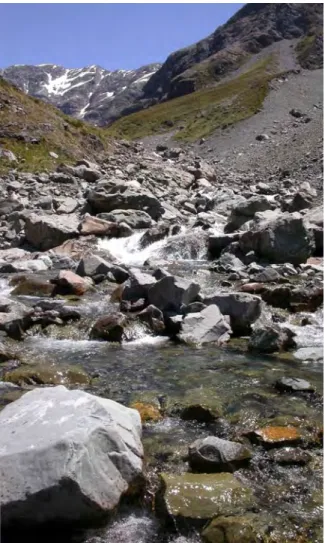
that one needs to be very careful when fooling around in the mountains in New Zealand. Weather conditions can change rapidly. And indeed, they did for us too. The next day was stunningly fine (Fig. 2). The moral here was rammed home a number of times over the summer with at least a dozen deaths climbing mountains and crossing rivers. Not to mention mind-bogglingly idiotic wandering by two people into the ice cave at the mouth of Fox Glacier on the west coast – they came out, but not alive. Nice place that New Zealand, but one does not fool around! New Zealand’s South Island rivers are interesting. Coming rapidly off the backbone Southern Alps they fall rapidly to the sea and many of them carry large amounts of greywacke rock gravel. It is not until one gets up higher than about 760m where large boulders stabilize the bed (Fig. 3), that an unusual high altitude, cold-water macroinvertebrate fauna occurs.
Interesting mayflies, stoneflies, caddisflies,
blepharicerids and of course simuliids. Lower down than that the river-bed profile is unstable and the fauna is depauperate. The simuliids at these altitude are unusual, in that they are found under fist sized stones that are perched on others. Not in the raging flow, but on the lip of pools where the water is flowing over and up under the stones (see foreground of Fig. 3). Also unusual, is that the larvae are quite pale. I am strongly of the opinion that the under-stone habit and the pale nature of the larvae is related to staying out of UV - vicious at these altitudes.
Simuliid larvae that occur on vegetation, or on tops of rocks, and in full insolation, even at lower altitude, are almost always darkly
Figure 3. Upper Otira River, Arthurs Pass, South Island. A typical high altitude stable river.
Two places that we targeted specifically were the Homer Tunnel, entrance to Milford Sound, and then Stewart Island, New Zealand’s third southern-most island. The former because that is where we think the most-basal of all New Zealand simuliids lurks, and the latter because we missed going there two years ago. Well, there was also the impetus of a new Stewart Island species too.
So, Homer Tunnel first. This is one of the heaviest rainfall areas (6-8 meters a year) in New Zealand. and we were there during some of the best of it. It is really most peculiar to see a river in raging flood, but full of clear water! Nothing left to flush out. But with the steep terrain there, after all it is Fiordland, a day later one really wonders if it had been raining. Still, trying to collect there in the rain has its detriments (Fig. 4). Unfortunately that is where Ruth did what in New Zealand is called a full ‘face plant’. Walking along with hands in pockets (it was cold), she slipped and fell fully onto a nasty rock. What followed was a lot of blood and a hour and a half dash to Te Anau, the nearest town. Sunday of course, so there were emergency calls to doctors, and then her with a four stitch wound and then days later a shiner that was wondrous to behold. For weeks she was being asked what she had done that I had