A Dijkstra’s Mobile Web Application
Engine for Generating Integrated Light
Rail Transit Route
A. M. Haziq Lim 1, N. S. Wan Sazli 2, B. Hussin 3, A. A. Azlianor 4, S. M. Suhaizan 5, K. Massila 6
Faculty of Information and Communication Technology Universiti Teknikal Malaysia Melaka
Locked Bag 1752 Pejabat Pos Durian Tunggal 76109 Durian Tunggal, Melaka, Malaysia
{1 haziq, 2 wansazli, 3 burairah, 4 azlianor, 5 suhaizan, 6 massila}@utem.edu.my
Abstract-In the capital city of Malaysia, Integrated Light Rail Transit (LRT) System is one of the most importance public transportation as it connects some key districts to historical, interesting places, business areas and shopping malls are concentrated. The train services are running independently but have interchanges to integrate from one different LRT lines to the others. These interchanges could cause traveler a troublesome when they are choosing incorrect destination station especially on different LRT lines which contribute to time consuming and high costing. In previous research we are implemented the mobile web application using rules based algorithm where the destination-oriented routes need to be dynamically generated by determining the nearest station according to the specific places. Currently, our research is focusing on Dijkstra’s algorithms to provide more effective and intelligent shortest path system to provide the solution for traveler to reach the desired destination. In this paper, we discuss the results from our Dijkstra’s application prototype.
Key-Words: - Mobile application, Shortest path, Dijkstra, Dynamic route map
1.0 INTRODUCTION
At some of Asia's megacities, light railway systems (LRT) become crisscrossed including bustling Kuala Lumpur that allowing even harried business travelers to keep their trip on track and is said to be the most
convenient public transport. In Kuala Lumpur, there are three lines operated by different companies which are part of Kuala Lumpur's Integrated Transit Network and it is a fully independent metro network. RapidKL operates the Kelana Jaya Rail Line and the Ampang Rail Line whereas KL Monorail operates Monorail Line. This integrated transportation network transports approximately 4 million passengers every week with 908 buses and 48 rail stations operating daily [10]. See Fig. 1.
Traveling from one appointment to another in this bustling metropolis can be difficult to the users. This research addresses the problem of selecting nearest destination station to a given places of interest such as shopping places, historical places and interesting places which may involve at least two LRT lines and need of interchange station. Thus, the traveler may face difficulty when they choose incorrect station especially on different LRT lines which led to time consuming and high cost [8].
Producing a mobile application that could use in handheld device such as Personal Digital Assistant (PDA) for traveler on-the-move has becoming wide spread. People percentage having access to mobile devices is rapidly increasing and need to have access to information anytime, anywhere. Therefore, we propose mobile web based application to assist travelers to travel via LRT.
2.0 RELATED WORK
With the rapid growth of the means of communication, mobile technologies have played an important role in the diffusion of information as well as business activity. People need to have access to information anytime, anywhere. Mobile services appear to be an obvious choice for travel and tourism as the travelers are on the move, which is the first criterion for mobile services to be relevant [9].
The travel and tourism industry have been undergoing many dramatic changes during the last decade, due to the possibilities offered by Internet technology.
PDAs and smart phones are becoming increasingly capable and more affordable, and they provide an excellent platform for business Web applications running a variety of software applications from some mini version of management tools to text, document or even PDF readers [6].
The importance of supporting mobility of users has also been argued recently whereby there are many mobile frameworks/architectures has adopted technology based systems such as adaptive mobile applications [1], mobile commerce application [2], mobile web services [3], mobile tourist services [4] and mSpace Mobile [7]. These trends have created a growing need for applications that take advantage of mobile environments
Many factors contribute to the success (or failure) of a mobile solution. These include the mobile device, wireless network connectivity, enterprise integration, and most important, the application architecture. Many people do not realize that several application models are available for mobile development, each with a different set of characteristics that make it appropriate for some applications and inappropriate for others [11].
Research [22], show that genetic algorithm demonstrates favorable performance on solving the combinatorial optimization problems and Dijkstra’s is an exact algorithm. It always determines the optimal route. Other research [23], already apply the Dijkstra’s in to their system and from the testing, the system was able to provide a
path, an alternate path and map directions to the users depending on the requested service. The system will respond to the users request using mobile device and reply with a SMS or MMS.
3.0 MOBILE WEB APPLICATION ARCHITECTURE
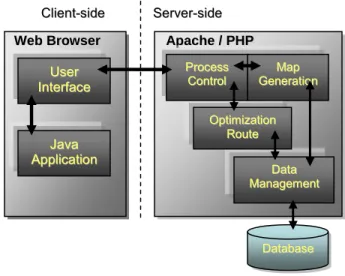
In this section, we describe the mobile architecture that is composed of a number of components for developing mobile application. Figure 3 gives an overview of the relevant components and how they interact. In this architecture, we distinguish two sides, a client-side and a server-side. They play distinctive roles and require different mechanisms for their implementation.
Fig. 2 Components view of the architecture
Client and Server Integration
In Fig. 3, each component integrates as client-server application by communicating between client-side and server-side applications where consists of 2 and 4 components respectively. Client-side has User Interface and Java Application components whereas server-side has Process Control, Map Generation, Optimization Route, and Data Management components.
Mobile client using PDA will communicate with a web server through an HTTP request via mobile browser (or micro browser). It is essential of using mobile browser in the sense of its capability like image and browser capability and the types of markup languages supported for web-based application. Due to the existing limitations of portable devices, the User Interface component needs to consider its screen size and resolution whereas the Java Application Client able to execute, if and only if the PDA has java-enabled browser.
In order to enable mobile client to communicate, the Apache is installed with configured PHP as web application server. Apache will serve as web server whereas PHP will be used as application server. Process Control component will act as interface to process inputs and organize it prior to respond to the mobile clients. After it receives request from mobile client, this component will send to Optimization Route component to obtain shortest, fastest, and cheapest route to desired destination by accessing it to database (MySQL) via Data Management component. Next, it will generate the map to visualize the route and respond back to mobile client for
D Daattaabbaassee A Appaacchhee // PPHHPP W Weebb BBrroowwsseerr U Usseerr I Inntteerrffaaccee J Jaavvaa A Apppplliiccaattiioonn C Clliieenntt--ssiiddee SeSerrvveerr--ssiiddee D Daattaa M Maannaaggeemmeenntt O Oppttiimmiizzaattiioonn R Roouuttee M Maapp G Geenneerraattiioonn P Prroocceessss C Coonnttrrooll P PDDAA WeWebb AApppplliiccaattiioonn S Seerrvveerr
him/her to decide. This is how mobile web applications work across mobile clients.
4.0 OPTIMIZATION ROUTE
ENGINE
A rule based classification method is used on the subset to identify new rules to describe the subset [19] and will result a tree like graphs. Each node represents an attribute test, while leaves represent conclusions. Therefore, each path from the root to a leaf can be interpreted as a decision rule [19].
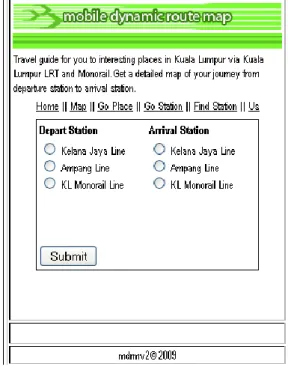
In our previous work, we already implement the destination route system used rules based technique [20]. The system was developed in two versions, one for web browse and the second version is for mobile view. With this system, users can find a route to the selected destinations.
Fig. 3: Interface of Destination Route System used Rule Based
Three main properties for rules based methods are locality, detachment and
truth-functionality. Locality in logical system, whenever we have a rule of the form A => B, we can consider B given A, without worrying about any other rules [18]. Based on that, our rules are set for example from Bangsar on Kelana Jaya Line to Plaza Rakyat on Ampang Line
we have 5 routes using our rules based system as show in Figure 5. It presents the total ticket price to represent the shortest path and in this case, route 1 and 2 is the chippers with only RM1.20. In this system, we already set the rules which station the users need to change train. Using this method, if one of the stations in between the changing station is not operating because of technical problems, the system can not identify it while the rules still the same. So, to find the shortest path, rules based technique is not very practical as we need to consider all others path and station connected, either it operating or not. This is because, the connection of each station can be change or disconnect.
Fig. 4: Route using Rules Based Based from this previous research [20], we successfully built a prototype for testing purpose of our rules based destination route by using an open source, cross-platform implementation and implement the Dijkstra’s algorithms. This prototype was built to enhance the route calculation and system for alpha testing [24][25]. The complete version will be developing for actual testing. The used of algorithms help making the route performance more optimized and dynamic. If one or more station is not working, Dijkstra’s algorithms can performs new calculation and update the
route. Not like the rule based technique where we found that it’s hard to detect if one or few station is out of service or not working.
Dijkstra’s Algorithms
There are others algorithm that can be used to find the shortest path. Dijkstra’s algorithm is perhaps one of the most efficient algorithms [12, 13] that can be used for shortest path problem. Dijkstra’s is modeled as finding the shortest path between two nodes in a weighted network G = (N,A) with node set N and arc set A. In route finding, G is the road network [14].
Research [15] show that by combining Dijkstra’s shortest path algorithm with location-based services (LBS) result a highly efficient in route plan than previous used ways by only cumulative approaches.
Dijkstra’s algorithms can be applied on various platforms using deference technique. For examples by using AS3 [16] or Excel [17], Dijkstra’s algorithms still can be applied. In this study, we apply the Dijkstra’s algorithms to perform and find the shortest destination route of train transportation in Kuala Lumpur area. The used of algorithms basically to enhance the effectiveness and reliability of destination route. Dijkstra’s algorithms solves the single-source path and produce a graph with nonnegative edges path costs, producing the shortest path tree. Each route will be calculated to find the shortest path. Each path will have a weighted either the distance, cost or time take. We will use the train ticket price as the weighted in our research. For the prototype and testing purpose, we will used and modify
from our previous project. Figure 6 below show the 13 stations that involved in finding the shortest path from
Bangsar to Plaza Rakyat. We used the ticket price as the path value to find the shortest path which we define by the cost saving route.
Fig. 5: Paths from Bangsar to Plaza Rakyat
Bangsar station is point 9 while Plaza Rakyat is point 40. Based on the point above, we create the metric as below to show the connection between stations that create a path:
Table 1: Stations connection metric
Next, we will insert the weight for each point connection. The weight will be the ticket. Other weight option can also be used such as time taken, destination or any that suite. Below is the step by step operation of Dijkstra’s from [21]:
Step1: point to nodes reachable from the startnode.
The distance to: b=10. There are no other arrows coming in to b.
Node b will be colored orange to indicate 10 is the length of the shortest path to b.
Step 2: point to nodes reachable from nodes that already have a final distance.
The distance to: c=20, f=22. Node c has the minimum distance.
There are no other arrows coming in to c. Node c will be colored orange to indicate 20 is the length of the shortest path to c.
Step 3: point to nodes reachable from nodes that already have a final distance.
The distance to: d=30, f=22. Node f has the minimum distance.
There are no other arrows coming in to f. Node f will be colored orange to indicate 22 is the length of the shortest path to f.
Step 4: point to nodes reachable from nodes that already have a final distance.
The distance to: d=30, g=34. Node d has the minimum distance.
There are no other arrows coming in to d. Node d will be colored orange to indicate 30 is the length of the shortest path to d.
Step 5: point to nodes reachable from nodes that already have a final distance.
The distance to: e=40, g=34, m=42. Node g has the minimum distance.
There are no other arrows coming in to g. Node g will be colored orange to indicate 34 is the length of the shortest path to g.
Step 6: point to nodes reachable from nodes that already have a final distance.
The distance to: e=40, h=46, m=42. Node e has the minimum distance.
There are no other arrows coming in to e. Node e will be colored orange to indicate 40 is the length of the shortest path to e.
Step 7: point to nodes reachable from nodes that already have a final distance.
The distance to: h=46, l=42, m=42. Node m has the minimum distance.
Any other path to m visits another red node, and will be longer than 42.
Node m will be colored orange to indicate 42 is the length of the shortest path to m.
Step 8: point to nodes reachable from nodes that already have a final distance.
The distance to: h=46, l=42. Node l has the minimum distance.
There are no other arrows coming in to l. Node l will be colored orange to indicate 42 is the length of the shortest path to l.
Step 9: point to nodes reachable from nodes that already have a final distance.
The distance to: h=46, k=54. Node h has the minimum distance.
Any other path to h visits another red node, and will be longer than 46.
Node h will be colored orange to indicate 46 is the length of the shortest path to h.
Step 10: point to nodes reachable from nodes that already have a final distance.
The distance to: k=54. There are no other arrows coming in to k.
Node k will be colored orange to indicate 54 is the length of the shortest path to k.
Step 11: point to nodes reachable from nodes that already have a final distance.
The distance to: j=66. There are no other arrows coming in to j.
Node j will be colored orange to indicate 66 is the length of the shortest path to j.
Step 12: point to nodes reachable from nodes that already have a final distance.
The distance to: i=78. There are no other arrows coming in to i.
Node i will be colored orange to indicate 78 is the length of the shortest path to i.
Algorithm has finished, follow orange arrows from startnode to any node to get
the shortest path to the node.
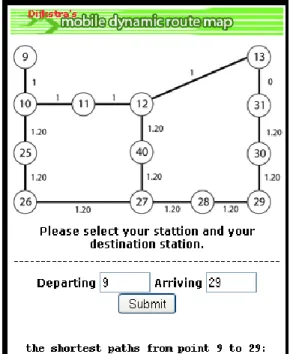
Fig. 6: Interface of Destination Route System used Dijkstra’s Algorithm
As shown in Fig 6, the shortest route will be station 9, 10, 25, 26, 27 and 28 with a cost only RM7.00. Thus, if any station in between the route is not working, alternative shortest route will be proposed.
5.0 CONCLUSION AND FUTURE WORK
Mobile applications are indispensable for everyone who needs to deliver robust, high-value mobile solutions. This paper presents the results and comparisons of two our previous research regarding the proposed idea of mobile web application engine using Dijkstra’s algorithms. We have described the motivation for an intelligent route system. Next, we plan to build a complete version of our dynamic
LRT route system that used open source, cross-platform implementation of Dijkstra’s-DRM for mobile devices, and trial this implementation at actual environments. We also might consider the used of PHP and database for better optimizing in administration side of the system. GUI will be enhancing. It is hoped that it is useful for travelers and capable to help them to make their decision easily, directly and successfully ubiquitously.
Acknowledgement
This work has been supported by Ministry of Higher Education, Malaysia under the Fundamental Research Grant Scheme (FRGS), no. FRGS/2007/FTMK (6) – F0053 and by University Industry Center (UNIC), UTeM coordination action.
References
[1] Kunz, T. and Black, J.P., An Architecture For Adaptive Mobile Applications, Proceedings of Wireless 99, the 11th International Conference on Wireless Communications. Canada, 1999, pp. 27-38.
[2] Varshney, U. and Vetter, R., A Framework for the Emerging Mobile Commerce Applications. Proceedings of the 34th Hawaii International Conference on System Sciences. Hawaii, 2001. [3] Cheng, S.T. et al, A new
framework for mobile Web services. Proceedings of the 2002 Symposium on Applications and
the Internet (SAINT) Workshops. US, 2001.
[4] Schmidt-Belz, B. et al, Location-based mobile tourist services - first user experiences, ENTER 2003 Int: Congress on Tourism and Communications Technologies. Helsinki, Finland, 2003.
[5] Robert Schwandl, UrbanRail.net.
http://urbanrail.net/as/kual/kuala-lumpur.htm, 2004.
[6] Moira J. McAlister and Peng Hui Xie, Using a PDA for Mobile Learning, WMTE '05: Proceedings of the IEEE International Workshop on Wireless and Mobile Technologies in Education. Washington, DC, USA, 2005. [7] Wilson, M. L., et al, mSpace
Mobile: A Mobile Application for the Semantic Web, End User Semantic Web Workshop, ISWC2005. Galway, Ireland, 2005. [8] S.M Suhaizan, et al,
Destination-Oriented Route in Integrated LRT Web-Based System for Tourism. Proceedings of International Conference on Electrical Engineering and Informatics. Bandung, Indonesia, 2007.
[9] Naji S. A. Alzaza & Abdul Nasir Z., Mobile- Based Library Loan Service (MBLLS), Rural ICT Development Conference 2007 (RICTD '07). UUM, Malaysia, 2007.
[10] RapidKL, Integrated bus and rail public transportation in Klang Valley,
[11] Wireless Center, Mobile Application Architectures, http://www.wirelesscenter.net/Mob ile-and-Wireless/Mobile-Application-Architectures.html, 2008.
[12] G. Gallo, and S.Pallottino, “Shortest path methods : a unified approacg,” Mathematical Programming Study, 26, 38-64, 1986 [13] R. Sedgewick, Algorithms, Addison-Wesley Publishing Company, Chapter 11, 145-163, 1988.
[14] B. Liu, Intelligent Route Finding : Combining Knowledge, Cases and An Efficient Search Algorithm, ECAI 1996, 12th European Conference on Artificial Intelligence, Edited by W. Wahlster. Published in 1996 by John Wiley & Sons, Ltd.
[15] YB Kang, SS Kim, A Fastest Route Planning for LBS based on Traffic Prediction, Proceedings of the 9th WSEAS International Confrance 2005,
[16] Dijkstra’s Algorithm AS3,
http://www.signalsoundplay.com/b log/?p=127 retrieved on 6 August 2009.
[17] Dijkstra’s With Excel,
http://compsci.ca/v3/viewtopic.php ?t=18135 retrieved on 6 August 2009.
[18] Stuart Russell, Peter Norvig.
Artificial Intelligence A Modern
Approach. Prentice Hall
Publishing. Page 460, 461
[19] S Richter, C Ortmann, T Reiners, Passenger Classification for an Airport Movement Forecast System – Proceedings of the International MultiConfrence of Engineers and Computers Scientisists 2009 Vol 1 IMECS 2009, March 18 – 20, 2009, Hong Kong
[20] A. M. Haziq Lim, A. A. Azlianor, S. M Suhaizan, K. Massila, Architecture of Mobile Web Application for Generating Dynamic Route Map, International Journal of Computers Issue 2, Volume 2008.
[21] Online
http://www.dgp.toronto.edu/people /JamesStewart/270/9798s/Laffra/D ijkstra’sApplet.html Dijkstra’s. [22] A. John sanjeev Kumar, J.
Arunadevi and V. Mohan.
Intelligent Transport Route
Planning Using Genetic
Algorithms in Path Computation Algorithms, European Journal of Scintific Research ISSN 1450-216X Vol25 No3 (2009), pp.463-468
[23] Joel C. de Goma, Jose F. Abisado Jr. Paolo Alekseis P. Carolino, Juan Carlos L. Guevarra and Joemerick B. San Gabriel. Route Navigator: Path Finder Service
For Mobile Phone. 2007
[24] A.M. Haziq Lim, N.S. Wan Sazli, B. Burairah, S.M. Suhaizan, A.A. Azlianor and K. Massila and (2009), A Mobile Web Application Engine for
Generating Destination-oriented LRT Route, Proceeding of The 9th WSEAS International Conference on Applied Conputer Science, WSEAS Genova, Italy
[25] A.M. Haziq Lim, N.S. Wan Sazli, B. Burairah, S.M. Suhaizan, A.A. Azlianor and K. Massila and (2009), Optimization of LRT Route for Mobile Web Application Engine. Proceedings of The International Conference of Soft Computing and Pattern Recognition, Malacca, Malaysia.
![Fig. 1 KL’s Integrated LRT Network [5]](https://thumb-us.123doks.com/thumbv2/123dok_us/9791888.2863817/1.918.499.752.704.961/fig-kl-s-integrated-lrt-network.webp)
![Fig. 4: Route using Rules Based Based from this previous research [20], we successfully built a prototype for testing purpose of our rules based destination route by using an open source, cross-platform implementation and implem](https://thumb-us.123doks.com/thumbv2/123dok_us/9791888.2863817/5.918.150.424.98.699/previous-research-successfully-prototype-testing-destination-platform-implementation.webp)