c
�ECCOMAS, Portugal
NUMERICAL SIMULATION OF ELECTRICAL PROBLEMS
IN A VACUUM DISJUNTOR
S. Clain1 and J. Rodrigues 21: Departamento de Matem´atica e Aplica¸c˜oes Campus de Gualtar - 4710-057 Braga
e-mail: [email protected] 2: ´Area Departamental de Matem´atica Instituto Superior de Engenharia de Lisboa
e-mail: [email protected]
Keywords: Finite element methods, Domain decomposition methods, Helmotz equa-tions, Biot-Savard
Abstract. A vacuum circuit breaker is a device that allows the cutting of electrical power. This device consists essentially of two electrodes, one of them being mobile and is subject to a mechanical force produced by a spring, giving rise to the contact between the two electrodes. The current passing between two electrodes is determined by the extension of the contact zone. Moreover, the passage of current generated Laplace forces in areas bordering the contact, but not yet in contact. Due to the curved geometry of the electrodes, these Laplace forces are opposite and therefore cause the repulsion of the electrodes. This means that for a given power we have to evaluate the electric potential, the magneticfield corresponding to the contact zone. bbm
1 INTRODUCTION
A vacuum circuit breaker is a device that allows the cutting of electrical power. We refer figure 1 to showing the main parts of a typical vacuum interrupter. The apparatus core is essentially constituted of two electrodes, one of them beingfixed (1) and the other one is mobile (3) and subject to a mechanical force produced by a spring, maintaining the contact between the two electrodes (2). The current passing between two electrodes is determined by the extension of the contact zone and generated Laplace forces in areas bordering the contact, but not yet in contact. Due to the curved geometry of the electrodes, Laplace forces are opposite and cause the repulsion of the electrodes. When the intensity reach a critical value, the forces separate the two electrodes and the circuit is breaking. For a given intensity and a contact length, we wish evaluate the repulsive Laplace force deriving from the electric and magnetic fields.
2 4 5 8 6 7 1 9 2 3 1 2 3
Figure 1: The circuit-breaker [1]
2 THE ELECTRICAL PROBLEM 2.1 Domain definition
At initial stage domain Ω = Ωa∪Ωb corresponds to the initial situation where no force
acts. Applying the gravity and the spring we get a displacement u over Ω and a new configuration characterized by an effective contact area A between the two subdomains. Due to the displacementu, domainΩis mapped into a new domain denotedΩ� =Ω�(u) = �
Ωa(u)∪Ω�b(u) depending on the displacement field. In the same way, on has domains
� Ωℓ, �Γℓ
same notations n, t to denote the outward normal vector and the tangential vector on the boundary. Notice thatA=�Γa
C∩�ΓbC.
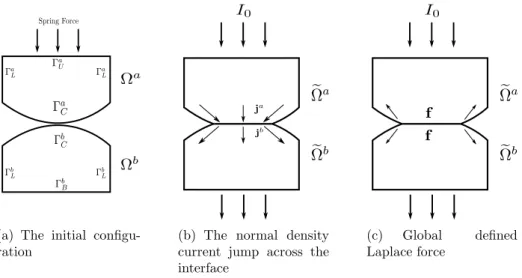
When the circuit breaker is close (the electrodes are in contact with a common area A), the current flows across the interface governing by two main principles: conservation of the normal density current and a null potential jump across the interface, as represented at Figure 2 (a). Moreover, the electric current generate a Laplace force ( as represented at Figure 2 (b) ), repulsive at contact zone, which plays the fundamental role of a circuit breaker mechanism. When current increases, the Laplace force increases and the geomet-rical design of the apparatus results to a reduction of the contact surface till we reach a complete separation. The present chapter is dedicated to the construction of the electrical model where one computes the electric and the magnetic field in function of the contact surface.
(a) The initial confi gu-ration
(b) The normal density current jump across the interface
(c) Global defined Laplace force
Figure 2: Electric-Magnetic problem outline
2.2 Mathematical modelling
A medium voltage circuit breaker is designed to work with continuous or low frequency current (for instance 50 Hz). It results that a common approach use the low frequency approximation (see Rappaz and Touzani [2]) where we neglect the displacement current and the induction effect. Consequently, we use the standard scalar potential formulation and denote byφthe scalar electrical potential whileE=−∇φstands for the electricfield andj=σE represents the current density withσ >0 the conductivity we suppose to be constant for the sake of simplicity. When necessary, we shall use the notations φℓ, Eℓ,
jℓ, ℓ=a, b to characterise the quantities associated to domain Ω�ℓ respectively. Moreover component of the global vector writes j = �ja,jb� = �(ja
1, j2a,), � jb 1, j2b, �� , E = �Ea,Eb�
andφ=�φa,φb�.
Assuming that no electrical charge are present in the domain, the density current conser-vation writes
∇·j= 0, inΩ� (1)
and deduce the scalar electrical potential formulation
−∇·(σ∇φ) = 0, in Ω� (2)
We equipped the equation with the following boundary conditions: φ= 0 on the basement �
ΓB, a uniform distribution on the upper side
j·n= I0
|�ΓU|
(3)
with I0 the intensity current while we prescribe an homogeneous Neumann condition for the rest of the boundary to model that fact that no current crosses the boundary which are in contact with the vacuum.
2.3 The two domains formulation
From a practical point of view, the electrical problem will be seen as the coupling of two subproblems defined in each subdomain. Here classical Sobolev spaces are used to obtain a variational formulation. We rewrite equation (2) in the following way: findφa and φb
such that
−∇·(σ∇φℓ) = 0, in Ω�ℓ (4)
withφb= 0 on the basementΓ�
B, ja·na =
I0
|Γ�U|
while we assume homogeneous Neumann condition condition for the vacuum boundary. To complete the new model, we prescribe continuity for the normal current and potential across the contact zone:
ja·na+jb·nb= 0, φa=φb, on A. (5) Indeed, assume thatφ∈H1(Ω�)∩C0(Ω�) is a solution of the one domain problem then from the continuity we deduce φa = φb on A. On the other hand, let ψ ∈ H1
0(Ω�), integration by part yields 0 = � � Ω σ∇φ∇ψdx= � � Ωa σ∇φ∇ψdx+ � � Ωb σ∇φ∇ψdx
Now, integration by parts on each subdomains provide
0 = � � Ωa−∇· (σ∇φ)ψdx+ � � Ωb−∇· (σ∇φ)ψdx+ � A σ(ja·na+jb·nb)ψds.
Relation (4) yields that for anyψ ∈H1 0(Ω�) we have � A σ(ja·na+jb·nb)ψds= 0 which implies ja·na+jb·nb = 0 .
3 THE MAGNETICAL FIELD
With Ein hand, we deduce the current density jand we aim to compute the associated electrical field to at last deduce the Laplace force. To this end, let us byBthe magnetic inductionfield. For three-dimensional configuration, the Amp`ere-Maxwell law writes
∇×B= µ0j, in R3 (6) withµ0 the magnetic permeability in the vacuum or non-ferromagnetic material.
Assuming invariance following thezdirection and that the magnetic field only depend on
xandy, we deduce that the only non-vanishing component isB(x1.x2) =Bz(x1, x2) and the Amp`ere-Maxwell equation writes
∂2B =µ0j1, −∂1B =µ0j2, inR2 wherejis a given function on R2 with compact support.
Dealing with the rotational operator ∇× in R2, we deduce that B is also the solution of problem µ0∇×j = ∇×∇×B = −ΔB (see [2]) with the asymptotic behaviour
B(x) =O(|x|−1) when |x|→ ∞.
Another alternative is to introduce the potential magnetic vectorAsuch thatB=∇×A whereA is the solution of problem
∇×(∇×A) =−ΔA=µ0j, in R2 with the asymptotic behaviour|A(x)|=O�ln(|x|)�.
However this relationship is not useful for magnetic field computation since the function is defined in the whole domain R2 while we just need to determine B on domain Ω�. An alternative approach consists to use the integral representation, namely the Biot-Savart formula. For two-dimensional geometriesΩ�⊂R2(see [3]). The vector potential magnetic field and the magneticfield at a point xare given by
A(x) = −µ0 2π � � Ω j(y) ln(|x−y|)dy (7) B(x) = ∇x×A=− µ0 2π � � Ω j(y)×∇xln(|x−y|)dy, (8)
for a current j flowing in the direction of e1 and e2 where × represents the external product between two vectors. After some algebraic manipulation, equation (8) writes
B(x) = µ0 2π � � Ω det[j(y),(x−y)] |x−y|2 dy. (9)
At least, the Laplace force is given by
f =j×B,
and in our specific case withB=Be3, the force writes � f1 f2 � =B � j2 −j1 � . (10) 4 MATRICIAL REPRESENTATION 4.1 Representation for Aa eh
Usingfinite element methods we will introduce the matricial representation for this prob-lem. We identify the new meshes ofΩ�ℓ by T�ℓ
h, ℓ= a, b, respectively, and To enforce the
Dirichlet condition we use a penalisation method which seems more adapted. Indeed, the contact zone may change with respect to the elasticity problem hence to avoid a new codification of the boundary and to reshape the matrix, we always use the same stiff matrix and introduce the Dirichlet condition by multiplying the entries corresponding to the nodes ofAa
η,h.
I
Figure 3: Discrete active zone definition The rigid matrix writes
[Aa e] = � Aa eh � φa i,φaj �� i,j=1,...,na while the associated write-hand side is given by
[Θa] i= 0 ⇐ i∈{1, . . . ,n˜a} � � ΓUh I0 |Γ�Uh|ϕ a i ds, ⇐ i∈{n˜a+ 1, . . . , na}
Let denote by Ea
η,h the nodes which correspond to domain Aaηh. Once we compute the system matrices at each step, the Dirichlet condition correspondent toAa
ηhcan be imposed by substitution method.
Resolution of the elliptic problem turns to solve the simple matricial problem [Aa
e] [Φa] = [Θa]
where [Φa] are the unknowns on the nodes.
4.2 Representation for Ab eh
Since the Dirichlet condition does not change with the iteration, we do not use a penal-ization method for operatorAb
eh and recall thatPi,i= 1,· · ·,n˜
b, correspond to the nodes
of�b except the node of boundary�
B. The rigid matrix then writes
� Ab e � = �Ab eh � φb i,φbj �� i,j=1,...,n˜b Let ρb
h be a given constant piecewise function on �ΓaCh characterized by vector [ρ] =
�
ρ1· · ·ωsb C
�T
. We introduce the Neumann conditions with vector � Θb([ρ])�i = � T⊂Γ�b Ch � T ρbhφbi ds,⇐i∈�1, . . . , nbC�.
The elliptic problem consist in solving the matricial problem �
Ab e� ��Φb
�
=�Θb�
where �Φ�b� are the unknowns on the nodes. We complete the vector setting �Φb� =
�� �
Φb�,0�taking into account the homogeneous boundary condition.
4.3 Current density and normal projection Setting jℓ
h = ∇φℓh∈Xhℓ, we obtain a constant piecewise vector over Ω�ℓh which represents
the current density field. We shall represent the vector in two vectors depending on the coordinates, � jℓ 1 � = � jℓ1,1· · ·jℓnℓ K,1 �T and �jℓ 2 � = � ja1,2· · ·janℓ K,2 �T . that we gather in the matrix form
� jℓ� = � �jℓ 1 � � jℓ 2 � �T .
We report here the definition of the matricial expression of the projection following the normal direction. We denote by�Nℓ�∈Rnℓ
C×2nℓC the matrix of the outwards normals over
Γℓ C and set � Nℓ� = nℓ h1,1 · · · 0 nℓh1,2 · · · 0 . .. . .. 0 · · · nℓ h nℓ C,1 0 · · · n ℓ h nℓ C,2 We introduce the global matricial representation of�Nℓ�onΩℓ
h:
�
Nℓ� = � �Nℓ� 000 �
with [Na]∈Rnℓ
C×(˜na+na) and�Nb�∈RnℓC×2˜nb.
4.4 Representation for the mappings on contact zone We recall the matricial representation �Cℓ,I�∈RnI×nℓ
C and�CI,ℓ�=�Cℓ,I�T ∈RnℓC×nI for operatorsCh,ℓ,Iη andCηI,,hℓ respectively
�
Cℓ,I�ki = �
I
µk(ξ)φℓi(ξ)dξ, k= 1,· · ·, nI, i= 1,· · ·, nℓC.
In the same way, we represent operatorsDh,ℓ,Iη andDI,η,hℓ with�Dℓ,I�∈RsI×sℓ
C and�DI,ℓ�= � Dℓ,I�T ∈Rsℓ C×sI with � Dℓ,I�ki= � I λk(ξ)ϑℓi(ξ)dξ, k = 1,· · · , sI, i= 1,· · · , sℓC.
4.5 The iterative problem within the matricial form
We now give the iterative procedure at the matricial level. Notice that the procedure corresponds to the one one really implemented on computer thus the importance to define completely all the step. The iterator index isrand we shall compute a sequence of vectors [ν]r which shall converge.
Assume that vector [ν]r is known such that [ν]r
k = 0 for the nodes Nk outside of Jη. the procedure is given by the following substeps (we omit subscript k for the sake of simplicity):
1. Compute vector [wa] =�DI,ℓ�[ν]r
2. Compute [Φa] solving problem
[Aae] [Φa] = [Θa] with penalization with respect to [ωa].
3. Compute [ja] with∇φa h and compute [ρa] = [Na][ja]. 4. Compute [τ] =�Dℓ,I�[ρa] and [ρb] =−�Dℓ,I�[τ] 5. Compute�Φb�=��Φ�b�,0�solving � Abe� ��Φb�=�Θb�
6. Extract [ωb] from�Φb�and compute [˜ν] =�Cℓ,I�[ωb] where we cancel the entries k
which correspond to the nodesNk outside ofJη. 7. Compute the new vector [ν]r+1=θ[ν]r+ (1−θ)[˜ν]
We repeat the algorithm till we satisfy the convergence criterion. 5 NUMERICAL SIMULATION
5.1 One domain case
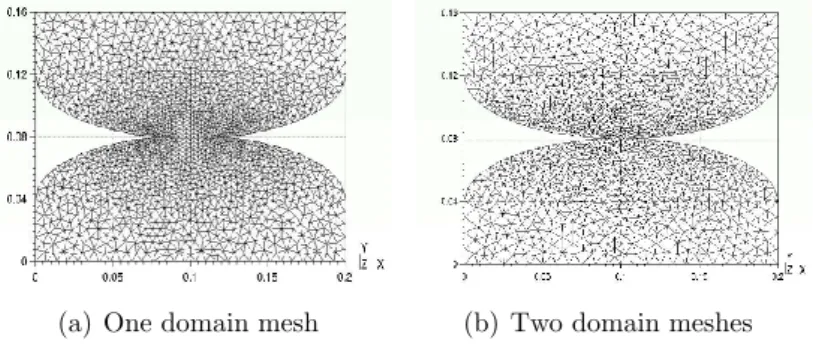
We begin by considering the case with one domain. Once the length of Jη is determined we solve the discrete electric problem on the domain have the configuration of the two electrodes in contact, Figure 4. We this domain we do not have to worry about the potential continuity at the contact zone. More, these results will give us a benchmark for the later results obtained with the domain decomposition technique and two domains. For this case we considerm(Jη) = 0.0468 and I0= 10kA.
(a) One domain mesh (b) Two domain meshes Figure 4: Domain mesh
Figure 4 shows that with both strategies we obtain very similar results. This validates the results and in particular our technique for passing information between the domains at domain decomposition method.
At Figures 6 and 7 although the range of values are similar, the observed difference is justified by the mesh difference, since the density is approximated numerically in the
(a) One domain (b) Two domains Figure 5: Potential scalarfield
(a) One domain (b) Two domains Figure 6: Current densityfield
barycentric coordinates in the element from the given potential at the nodes. Also in thesefigures we can see the continuity of density at the the contact zone.
The magnetic induction (component following e3 ) is exactly the same Figure 8. About Laplace force there is a reduction though the magnitude is equal and we have almost the symmetry between the two domains Figure 9, where we recall again that the meshes are not symmetrical and that the Laplace force are calculated is approximated numerically in the barycentric coordinates in the element.
At this section we will analyse the numerical solutions produced at electro-magnetic state when the electrodes are in contact through a determined active zone.
For each numerical problem we determine the volume repulsive force generated for a given
m(J) and intensity currentI0, for two profiles cases: elliptic and circular. 5.2 Two domains case
We are interested to analysing the profiles of the potential contact zone: elliptic and circular. From [4] we use two intensity values I = 10 kA , I = 20 kA, I = 40 kA and
Figure 7: Zoom of current densityfield at contact zone
(a) One domain (b) Two domains Figure 8: Magnetic induction (component followinge3 )
(a) One domain (b) Two domains Figure 9: Laplace force
I = 60 kA. We consider that a inicial spring force has applied, characterized by
F =κ×α(N) (11)
with
κ= E×A
L (12)
named the axial stiffness, where
A, the contact zone area (in m2) and
Lthe circuit breaker height (in m).
The value αrepresents the vertical displacement, so here we will suppose α≤0.2 5.3 Elliptic profile
Here we consider a contact with a elliptic profile with a contact zone lengthm(Jη) = 0.032, corresponding to α= 0.1 .
Table 1: Repulsive force generated with an elliptic profile and large active zone and test for several values ofθ
intensity current (A) θ repulsive force generated (N)
1×10⁴ .125 44.53 1×10⁴ .25 44.53 1×10⁴ .5 44.53 2×10⁴ .125 178.13 2×10⁴ .25 178.13 2×10⁴ .5 178.13 4×10⁴ .125 712.53 4×10⁴ .25 712.53 4×10⁴ .5 712.53 6×10⁴ .125 1603.2 6×10⁴ .25 1603.2 6×10⁴ .5 1603.2
From the results explained at Table 1, we can expect a function of the kind
Using least squares method we obtain a1= 44.53. represented at Figure 10. 0 500 1000 1500 2000 2500 3000 0 1 2 3 4 5 6 Force (N) Itensity ×104 (A) Fit line Repulsive force generated
× ×
×
×
×
Figure 10: Elliptic profile and large active zone: Repulsive force generated ”×” and least squares approx-imation ”line”
Now we test a reduction of the contact zone,m(Jη) = 0.012, corresponding to α= 0.01.
Table 2: Repulsive force generated with an elliptic profile and small active zone intensity current (A) repulsive force generated (N)
1×10⁴ 51.1
2×10⁴ 204.42
4×10⁴ 817.69
6×10⁴ 1839.82
From the results explained at Table 2, we can expect a function of the kind
Using least squares method we obtain a2= 51.1. represented at Figure 11. 0 500 1000 1500 2000 2500 3000 0 1 2 3 4 5 6 Force (N) Itensity ×104 (A) Fit line Repulsive force generated
× ×
×
×
×
Figure 11: Elliptic profile and small active zone: Repulsive force generated ”×” and least squares ap-proximation ”line”
6 Circular profile
Here we begin by consider a circular contact profile after deformation withm(Jη) = 0.045, corresponding to α= 0.1.
From the results explained at Table 3, we can expect a function of the kind
fR(I0) =a3I02. (15)
Using least squares method we obtain
a3= 186.71. represented at Figure 12.
Like as above Consider now a small contact zone, m(Jη) = 0.016, corresponding to
α= 0.01.
From the results explained at Table 4, we can expect a function of the kind
Table 3: Repulsive force generated with an circular profile and large active zone intensity current (A) repulsive force generated (N)
1×10⁴ 186.71 2×10⁴ 746.85 4×10⁴ 2987.42 6×10⁴ 6721.69 0 2000 4000 6000 8000 10000 0 1 2 3 4 5 6 Force (N) Itensity ×104 (A) Fit line Repulsive force generated
× ×
×
×
×
Figure 12: Circular profile and large active zone: Repulsive force generated ”×” and least squares approximation ”line”
Using least squares method we obtain
a4= 200.35. represented at Figure 13.
Observingfigures we note that the repulsive force depends on the electrode profile being more important in the case of a circular profile. It also appears that the repulsive force increases as the extent of the active area decreases.
Table 4: Repulsive force generated with an circular profile and small active zone intensity current (A) repulsive force generated (N)
1×10⁴ 200.34 2×10⁴ 801.39 4×10⁴ 3205.59 6×10⁴ 7212.59 0 2000 4000 6000 8000 10000 0 1 2 3 4 5 6 Force (N) Itensity ×104 (A) Fit line Repulsive force generated
× ×
×
×
×
Figure 13: Circular profile and small active zone: Repulsive force generated ”×” and least squares approximation ”line”
7 CONCLUSION
From the results we have obtained can conclude that the proposed domain decomposi-tion algorithm converges to a continuous soludecomposi-tion of the scalar electrical potential field, independently of parameterθ.
Comparing figures 10 - 12 and 11 - 13 we note that the repulsive force depends on the electrode profile and being more important in the case of a circular profile.
With this tests, we can also observe that the repulsive force is inversely proportional to the length of the active zone.
real problem is three-dimensional and brings more difficulties. The contact zone is more complex and the computational effort is larger.
8 REFERENCES
[1] R. Garzon.High Voltage Circuit Breakers: Design and Applications. Pitman Advanced Publishing Program, Boston, 1985.
[2] J. Rappaz R. Touzani. Mathematical Models for Eddy Currents and Magnetostatics With Selected Applications. Springer - Scientific Computation, New-York, 2014. [3] J.-C. Suh. The evaluation of the biot-savart integral. Journal of Engineering
Mathe-matics, pages 375–395, 2000.
[4] A. Slama. Modlisation des sources de courant en mouvement et des efforts lectro-dynamiques dans les appareils de coupure. PhD gnie electrique, Institut National Polytechnique de Grenoble - France, 2001.
![Figure 1: The circuit-breaker [1]](https://thumb-us.123doks.com/thumbv2/123dok_us/10927404.2981622/2.892.321.581.508.768/figure-the-circuit-breaker.webp)