Exploring Learner Autonomy in a Saudi Arabian EFL Context
Noha Sami Halabi
PhD
University of York
Education
2
Abstract
Learner autonomy has been deemed an effective channel through which learning takes place. Its significance in the context of language learning has long been studied by defining its various concepts and the roles played by teachers, learners, and institutions in advocating and promoting autonomous learning. This study explores the meanings and practices of autonomous learning in a Saudi higher education EFL context. It determines classroom activities and learner attributes that may help to enhance the development of learner autonomy and language learning in Saudi Arabia. To ascertain perceptions on learner autonomy, a survey was carried out with 44 female teachers working in an English Language Centre in a Saudi university and with 480 first-year female students. Additionally, in-depth interviews were conducted with 16 teachers and 15 students. These perceptions were then used as a point of reference for comparisons between teachers and students.
The survey indicated that teachers were more positive about implementing learner autonomy in the classroom than students. However, when participants were interviewed, students revealed a high level of desirability and motivation to become autonomous. From the teachers there was general consensus on learner autonomy being beneficial, but they had limited experience on how it could be applied in the language classroom. The findings from both surveys and interviews confirmed that teachers and students have different perceptions on learner autonomy as a concept and in practice.
Overall, this study presents further understanding of learner autonomy in the context of Saudi Arabia. Moreover, the study challenges the belief that young Saudi students are not interested in becoming autonomous learners. The study highlights the institutional and social barriers that both teachers and students need to overcome. One of the main contributions of this study is the insight given to the changes occurring in Saudi society and the generational gap between young female students and the older generation.
3
Table of Contents
Abstract ... 2 Table of Contents ... 3 List of Tables ... 10 List of Figures ... 13 Acknowledgements ... 17 Author’s declaration ... 18 Chapter 1: Introduction ... 19 1.1 Introduction to Study ... 191.2 Contextual Background of Study ... 20
1.2.1 The Education System in Saudi Arabia: An Overview ... 20
1.2.2 The Preparatory Year Programme (PYP) at KAU ... 21
1.2.3 The English Language Programme in KAU ... 22
1.2.3.1 Determining students’ levels of proficiency: Placement test .. 23
1.2.3.2 Exemption from English courses... 23
1.2.3.3 English Modules ... 23
1.2.3.4 Curriculum, textbooks, and the language classroom ... 23
1.2.4 English as a Foreign Language in KSA ... 24
1.3 Critical Review of Teaching and Learning English as a Foreign Language in KSA... 24
1.4 Personal Inspiration and Positionality ... 26
1.5 Aims and Objectives of the Study ... 29
1.6 Procedures ... 31
1.7 Significance of the Study ... 31
1.8 The Structure of the Thesis ... 32
Chapter 2: Literature Review ... 34
2.1 Introduction ... 34
2.2 Theoretical Framework for the Study ... 34
2.3 Defining Learner Autonomy ... 37
2.4 Autonomy in Language Learning ... 42
2.5 Applications of Learner Autonomy ... 44
2.6 The Role of the Teacher ... 44
2.7 The Role of the Learner ... 51
2.8 Approaches to Developing Learner Autonomy ... 54
4
2.9.1 Collaborative Learning ... 57
2.9.2 Task Work ... 58
2.9.3 Decision-making and Elements of Choice ... 60
2.9.4 Projects ... 61 2.9.5 Learning Strategies ... 62 2.9.6 Reflective Practice ... 64 2.9.7 Portfolios ... 66 2.9.8 Extension Learning ... 67 2.10 Cross-cultural Differences ... 70
2.11 The Saudi Context ... 73
2.12 Summary... 76
Chapter 3: Research Methodology... 78
3.1 Introduction ... 78
3.2 Research Questions ... 78
3.3 Research Approach ... 79
3.3.1 Method of Reasoning: Inductive Approach ... 79
3.3.2 Philosophical Assumptions: Positivism/ Interpretivism ... 80
3.3.3 Research Choices: Mixed Methods Research ... 81
3.3.4 Appropriateness of Mixing Methods for this Research ... 82
3.3.5 Research Strategy: Concurrent Mixed Methods ... 82
3.4 Sampling: Criteria for Selecting the Study Sample ... 83
3.5 Research Questionnaire ... 85
3.5.1 Questionnaire as Data Collection Method ... 85
3.5.2 Designing the Questionnaire ... 86
3.5.2.1 Section One: Activities and teaching practices for developing learner autonomy in the classroom ... 87
3.5.2.2 Section Two: Characteristics of autonomous learners ... 88
3.5.2.3 Section Three: General views on learner autonomy ... 90
3.5.2.4 Section Four: Personal information ... 90
3.5.3 Piloting the Questionnaire ... 91
3.5.3.1 Questionnaire Participants for Pilot Study ... 91
3.5.3.2 Procedures for the Pilot Study ... 92
3.5.4 Improving the Questionnaire ... 93
3.5.5 Main Study ... 93
5
3.5.5.2 Procedures for the main study ... 94
3.5.6 Processing and Analysis of Quantitative Data ... 95
3.5.6.1 Analysing data using SPSS ... 95
3.5.6.2 Measurement scale... 95
3.5.6.3 One and two independent sample tests ... 96
3.5.6.4 Simple Correlation and Regression Analysis ... 96
3.5.6.5 Internal consistency ... 96
3.6 Research Interviews ... 97
3.6.1 Semi-structured Interviews as Data Collection Method ... 98
3.6.2 Interview Schedule ... 99
3.6.3 Piloting the Interviews ... 100
3.6.3.1 Interview Participants for Pilot Study ... 100
3.6.3.2 Procedure for the Pilot Study ... 101
3.6.4 Improving Interview Schedule ... 101
3.6.5 Main Study ... 101
3.6.5.1 Interview participants for the main study ... 101
3.6.5.2 Procedures for the main study ... 102
3.6.6 Processing and Analysis of Qualitative Data ... 105
3.6.7 Issues Concerning Qualitative Design ... 106
3.7 Validity ... 106
3.8 Reliability ... 108
3.9 Ethical Considerations ... 108
3.10 Summary ... 110
Chapter 4: Results from the Survey ... 111
4.1 Introduction ... 111
4.2 Teachers’ Results ... 111
4.2.1 Teachers’ Demographic Information ... 111
4.2.1.1 Years of experience ... 112
4.2.1.2 Qualifications ... 112
4.2.1.3 Native language and nationalities ... 113
4.2.1.4 English levels ... 115
4.2.2 Results for General Views on Learner Autonomy ... 115
4.2.2.1 LA overall usefulness and its role in helping language learning ... 116
6
4.2.2.3 LA desirability and feasibility ... 118
4.2.2.4 LA meaning ... 120
4.2.3 Results for Section One: Classroom Activities for Fostering Learner Autonomy ... 124
4.2.3.1 Overall effectiveness of classroom activities ... 125
4.2.3.2 ‘Very effective’ classroom activities ... 126
4.2.3.3 ‘Effective’ classroom activities ... 127
4.2.3.4 ‘Slightly effective’ activities ... 130
4.2.4 Results for Section Two: Characteristics of Autonomous Learners 130 4.2.4.1 Results for Question 1: Do teachers want their students to develop autonomous characteristics? ... 131
4.2.4.2 Results for Question2: Does the development of characteristics enhance Learner Autonomy (LA)? ... 133
4.2.4.3 Results for Question 3: Does the development of characteristics enhance language learning (LL)? ... 144
4.2.5 Relationship between Learner Autonomy Enhancement and Language Learning Enhancement... 154
4.2.6 Summary of Teachers’ Results ... 156
4.3 Students’ Results ... 158
4.3.1 Students’ Demographic Information ... 158
4.3.1.1 Age and nationality ... 158
4.3.1.2 English level and language learning experiences ... 158
159 4.3.2 Results for General Views on Learner Autonomy ... 160
4.3.2.1 LA overall usefulness and its role in helping language learning ... 160
4.3.2.2 LA without teacher’s help ... 161
4.3.2.3 LA desirability and feasibility ... 162
4.3.2.4 LA meaning ... 164
4.3.3 Results for Section One: Classroom Activities for Fostering Learner Autonomy ... 166
4.3.3.1 Overall effectiveness of classroom activities ... 167
4.3.3.2 ‘Very effective’ classroom activities ... 168
4.3.3.3 ‘Effective’ classroom activities ... 169
4.3.3.4 ‘Slightly effective’ classroom activities ... 170
7
4.3.4 Results for Section Two: Characteristics of Autonomous Learners 173
4.3.4.1 Results for Question1: Do students want to develop autonomous
characteristics? ... 173
4.3.4.2 Results for Question 2: Does the development of characteristics enhance learner autonomy (LA)? ... 175
4.3.4.3 Results for Question 3: Does the development of characteristics enhance language learning (LL)? ... 186
4.3.5 Relationship between Learner Autonomy Enhancement and Language Learning Enhancement ... 197
4.3.6 Summary of Students’ Results ... 199
4.4 Comparison between Students’ and Teachers’ Views ... 200
4.4.1 Comparing Teachers’ and Students’ Views on Learner Autonomy in General ... 200
4.4.2 Comparing Teachers’ and Students’ Views on Effectiveness of Classroom Activities ... 201
4.4.3 Comparing Teachers’ and Students’ Views on the Usefulness of Developing Autonomous Characteristics ... 205
4.4.3.1 Comparison between teachers’ and students’ evaluation for the importance of developing characteristics ... 205
4.4.3.2 Comparison between teachers’ and students’ views on learner autonomy (LA) enhancement ... 207
4.4.3.3 Learners’ characteristics enhancing language learning(LL) . 209 4.5 Summary of Survey Findings ... 211
Chapter 5: Results from the Interviews ... 213
5.1 Introduction ... 213
5.2 Teachers’ Results ... 213
5.2.1 Interviewees ... 213
5.2.2 Understanding Autonomy ... 214
5.2.3 Teachers’ Roles ... 216
5.2.4 Teachers’ Perceptions of Students ... 221
5.2.5 Cultural Constraints ... 223
5.2.6 Institutional Constraints ... 226
5.2.7 Influence of Home ... 228
5.2.8 Activities Promoting Autonomy ... 230
5.3 Students’ Results ... 234
5.3.1 Interviewees ... 234
8
5.3.3 Studying at University ... 236
5.3.4 Attributes for Autonomy ... 240
5.3.5 Support and Constraints ... 242
5.3.6 Proposed Autonomy-supportive Activities ... 245
5.4 Summary of Interview Findings ... 247
Chapter 6: Discussion ... 249
6.1 Introduction ... 249
6.2 Perceptions of learner autonomy ... 249
6.2.1 Teachers’ Perceptions ... 249
6.2.2 Learners’ Perceptions ... 251
6.3 Classroom Activities Enhancing the Development of Learner Autonomy 254 6.3.1 Collaborative Group Work ... 254
6.3.2 Reducing Teacher Talk, Facilitating Student Talk ... 255
6.3.3 Relevance and Choice ... 256
6.3.4 More Engaging Activities... 258
6.3.5 Vocabulary Learning and Oral Activities ... 259
6.3.6 Minimising Individual Work ... 260
6.3.7 Online dictionaries, mobile technology and authentic texts ... 261
6.4 Characteristics of Autonomous Learners ... 262
6.4.1 Taking Charge of Learning ... 263
6.4.2 Demonstrating Willingness to Learn ... 263
6.4.3 Having Self-Motivation and Positive Attitude Towards Learning 264 6.4.4 Developing Effective Learning Strategies and Study Skills ... 265
6.4.5 Being Diligent or a High Achiever ... 265
6.4.6 Having Self-Confidence and Strong Personality ... 266
6.4.7 Being Socially Skilful and Socially Responsible ... 267
6.5 Relationship Between Learner Autonomy and Language Learning ... 268
6.5.1 Impact of Learner Autonomy on Language Learning... 268
6.5.2 Learner Autonomy and Levels of Proficiency... 270
6.5.3 Autonomy in Language Learning and Other Subjects ... 271
6.6 Constraints Regarding Promoting Learner Autonomy in the Saudi Educational Context ... 272
6.6.1 Schooling System and Learning Habits ... 272
9
6.6.3 Curriculum... 275
6.6.4 Strategy Training ... 276
6.6.5 Lack of Teacher Training ... 276
6.6.6 Institutional Constraints and Absence of Teacher Input ... 278
6.6.7 Relationships ... 280
6.6.8 Culture and Tradition ... 282
6.7 Summary ... 284
Chapter 7: Conclusion ... 286
7.1 Introduction ... 286
7.2 Summary of Findings ... 286
7.3 Limitations ... 292
7.4 Contribution of the Study ... 292
7.5 Recommendations ... 293
7.6 Directions for Further Research ... 295
7.7 Reflections ... 296
7.8 Conclusion of the Thesis ... 297
Appendix 1: Questionnaire for pilot study ... 299
Appendix 2: Questionnaire for main study (Teachers) ... 305
Appendix 3: Questionnaire for main study (Students) ... 311
Appendix 4: Interview schedule for main study (Teachers) ... 318
Appendix 5: Interview schedule for main study (Students) ... 320
Appendix 6: Interview transcript (Sample) ... 322
Appendix 7: Informed consent form for questionnaire (Teachers) ... 329
Appendix 8: Informed consent form for questionnaire (Students) ... 331
Appendix 9: Informed consent form for interview (Teachers) ... 333
Appendix 10: Informed consent form for interview (Students) ... 335
Abbreviations ... 337
10
List of Tables
Table 3.1 Autonomy-supportive classroom activities ... 88
Table 3.2: Five characteristics of autonomous learners ... 89
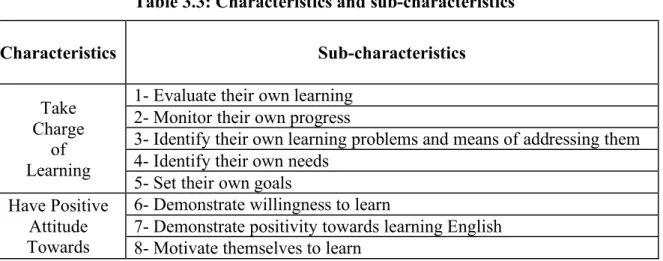
Table 3.3: Characteristics and sub-characteristics... 89
Table 3.4: Cronbach’s alpha for constructs ... 97
Table 4.1: Wilcoxon test for LA usefulness (Teachers) ... 116
Table 4.2: Wilcoxon test for LA without teacher help (Teachers) ... 118
Table 4.3: Wilcoxon test for LA desirability and feasibility (Teachers) ... 119
Table 4.4: LA meaning (Teachers) ... 122
Table 4.5: Activity points length ... 124
Table 4.6: Overall effectiveness of classroom activities (Teachers) ... 125
Table 4.7: ‘Very effective’ classroom activities (Teachers) ... 127
Table 4.8: ‘Effective’ classroom activities (Teachers) ... 128
Table 4.9: ‘Slightly effective’ classroom activities (Teachers) ... 130
Table 4.10: Length of response to characteristics of autonomous learners ... 131
Table 4.11: Overall score for evaluating the importance of developing characteristics using the Wilcoxon test (Teachers) ... 132
Table 4.12: Descriptive statistics and Wilcoxon test for overall importance and ranking of 5 characteristics (Teachers) ... 132
Table 4.13: Overall score for LA enhancement using the Wilcoxon test (Teachers) ... 133
Table 4.14: Descriptive statistics and Wilcoxon test for overall LA enhancement by developing 5 characteristics (Teachers) ... 134
Table 4.15: Descriptive statistics and Wilcoxon test for LA enhancement by taking ... 136
Table 4.16: Descriptive statistics for LA enhancement by having positive attitude items (Teachers)... 137
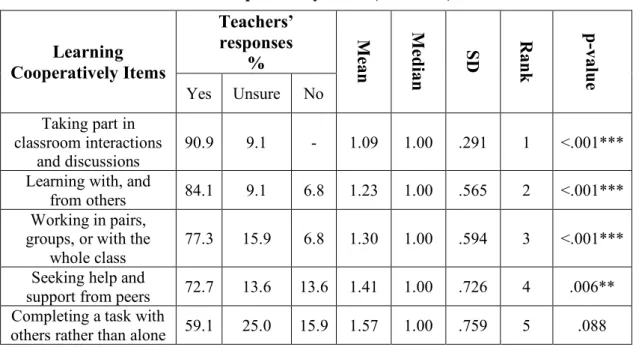
Table 4.17: Descriptive statistics and Wilcoxon test for LA enhancement by learning cooperatively items (Teachers) ... 139
Table 4.18ː Descriptive statistics and Wilcoxon test for LA enhancement by identifying and developing study skills items (Teachers) ... 141
Table 4.19: Descriptive statistics and Wilcoxon test for LA enhancement by building a positive relationship with teacher items (Teachers) ... 143
Table 4.20ː Overall score for LL enhancement using the Wilcoxon test (Teachers) ... 144
Table 4.21ː Descriptive statistics and the Wilcoxon test for overall LL enhancement by developing 5 characteristics (Teachers) ... 144
11
Table 4.22ː Descriptive statistics and the Wilcoxon test for LL enhancement by taking
charge items (Teachers) ... 146
Table 4.23ː Descriptive statistics and the Wilcoxon test for LL enhancement by having positive attitude towards learning items (Teachers) ... 147
Table 4.24ː Descriptive statistics and the Wilcoxon test for LL enhancement by working cooperatively in the classroom items (Teachers) ... 149
Table 4.25: Descriptive statistics and the Wilcoxon test for LL enhancement by identifying and developing study skills items (Teachers)... 151
Table 4.26: Descriptive statistics and the Wilcoxon test for LL enhancement by building positive relationship with teacher items (Teachers) ... 153
Table 4.27: Results of simple correlation and linear regression between learner autonomy and language learning (Teachers) ... 156
Table 4.28: General views on learner autonomy using the Wilcoxon test (Students) ... 164
Table 4.29: LA meaning (Students) ... 166
Table 4.30: Overall effectiveness of classroom activities (Students) ... 167
Table 4.31: ‘Very effective’ classroom activity (Students) ... 169
Table 4.32: ‘Effective’ classroom activities (Students) ... 170
Table 4.33: ‘Slightly effective’ classroom activities (Students) ... 171
Table 4.34: ‘Slightly ineffective’ classroom activities (Students) ... 172
Table 4.35: Overall score for evaluating the importance of developing characteristics using the Wilcoxon test (Students) ... 173
Table 4.36: Descriptive statistics and Wilcoxon test for overall importance by Characteristics (Students) ... 174
Table 4.37: Overall score for LA enhancement using the Wilcoxon test (Students) ... 175
Table 4.38: Descriptive statistics and Wilcoxon test for overall LA enhancement by developing 5 characteristics (Students) ... 176
Table 4.39: Descriptive statistics and Wilcoxon test for LA enhancement by taking ... 178
Table 4.40: Descriptive statistics and Wilcoxon test for LA enhancement by having positive attitude items (Students) ... 180
Table 4.41: Descriptive statistics and Wilcoxon test for LA enhancement by learning cooperatively items (Students) ... 181
Table 4.42: Descriptive statistics and Wilcoxon test for LA enhancement by developing study skills items (Students) ... 183
Table 4.43: Descriptive statistics and Wilcoxon test for LA enhancement by building a positive relationship with teacher items (Students) ... 185
Table 4.44: Overall score for LL enhancement using the Wilcoxon test (Students) ... 186
12
Table 4.45: Descriptive statistics and the Wilcoxon test for overall LL enhancement
by developing 5 characteristics (Students) ... 187
Table 4.46: Descriptive statistics and the Wilcoxon test for LL enhancement by taking charge items (Students) ... 189
Table 4.47: Descriptive statistics and the Wilcoxon test for LL enhancement by having positive attitude items (Students) ... 190
Table 4.48: Descriptive statistics and the Wilcoxon test for LL enhancement by working cooperatively in the classroom items (Students) ... 192
Table 4.49: Descriptive statistics and the Wilcoxon test for LL enhancement by developing study skills items (Students) ... 194
Table 4.50: Descriptive statistics and the Wilcoxon test for LL enhancement by establishing positive relationship with teacher items (Students) ... 196
Table 4.51: Results of simple correlation and linear regression for effect of learner autonomy on language learning (Students) ... 198
Table 4.52: General views for teachers and students ... 200
Table 4.53: Ranking and opinions of classroom activity for teachers and students 202 Table 4.54: Summary statistics and tests for comparing classroom activities between teachers and students using the Mann-Whitney test ... 204
Table 4.55: Ranking of importance of characteristics for teachers and students .... 206
Table 4.56: Comparison of importance of the five constructs of characteristics between teachers and students Using Mann Whitney test ... 206
Table 4.57: Ranking characteristics and sub-characteristics for LA enhancement for teachers and students... 207
Table 4.58: Comparison of characteristics for enhancing learner autonomy between teachers and students using the Mann Whitney test ... 208
Table 4.59: Insignificant characteristics for LA enhancement for teacher and students ... 208
Table 4.60: Ranking characteristics and sub-characteristics for LL enhancement for teachers and students... 209
Table 4.61: Comparison of characteristics for enhancing language learning between teachers and students... 210
Table 4.62: Insignificant characteristics for LA enhancement for teacher and students ... 210
Table 5.1: Teachers interviewed ... 214
Table 5.2: Characteristics of autonomous learners (Teachers) ... 222
Table 5.3: Suggested activities for promoting autonomy (Teachers) ... 231
Table 5.4: Students interviewed ... 234
Table 5.5: Characteristics for autonomous learners (Students) ... 241
13
List of Figures
Figure 4.1: Teaching experience ... 112
Figure 4.2: Highest qualification (Teachers)... 113
Figure 4.3: Distribution of native language (Teachers) ... 114
Figure 4.4: Distribution of nationality (Teachers) ... 114
Figure 4.5: Distribution of English level (Teachers) ... 115
Figure 4.6: LA usefulness (Teachers) ... 116
Figure 4.7: Does LA help or hinder language learning (Teachers) ... 117
Figure 4.8: LA without teachers’ help (Teachers) ... 118
Figure 4.9: Distribution of LA desirability (Teachers) ... 119
Figure 4.10: LA feasibility (Teachers) ... 120
Figure 4.11: Distribution of the overall effectiveness of classroom activities (Teachers) ... 126
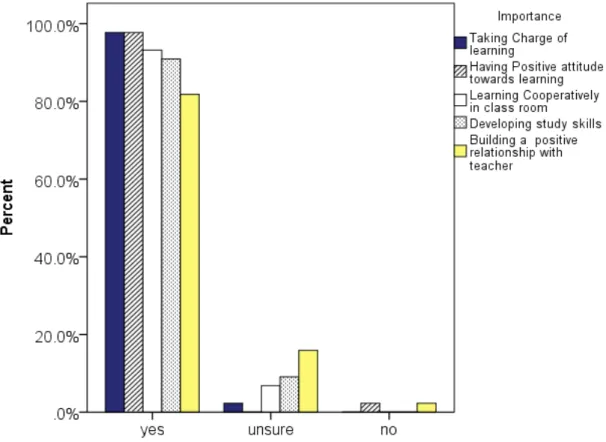
Figure 4.12: Distribution of percentage for evaluating the importance of characteristics (Teachers) ... 133
Figure 4.13: Distribution of percentage for overall LA enhancement by developing 5 characteristics (Teachers)Figure 4.12: Distribution of percentage for evaluating the importance of characteristics (Teachers) ... 133
Figure 4.13: Distribution of percentage for overall LA enhancement by developing 5 characteristics (Teachers) ... 135
Figure 4.14: Distribution of LA enhancement by taking charge items (Teachers)Figure 4.13: Distribution of percentage for overall LA enhancement by developing 5 characteristics (Teachers) ... 135
Figure 4.14: Distribution of LA enhancement by taking charge items (Teachers) ... 137
Figure 4.15: Distribution of LA enhancement by having positive attitude (Teachers) ... 138
Figure 4.16: Distribution of LA enhancement by learning cooperatively in the classroom (Teachers)... 140
Figure 4.17: Distribution of LA enhancement by identifying and developing study skills (Teachers) ... 142
Figure 4.18ː Distribution of LA enhancement by building a positive relationship with teacher items (Teachers)Figure 4.17: Distribution of LA enhancement by identifying and developing study skills (Teachers) ... 142
Figure 4.18ː Distribution of LA enhancement by building a positive relationship with teacher items (Teachers) ... 143
Figure 4.19ː Distribution of percentage for LL enhancement by developing 5 characteristics (Teachers)Figure 4.18ː Distribution of LA enhancement by building a positive relationship with teacher items (Teachers) ... 143
14
Figure 4.19ː Distribution of percentage for LL enhancement by developing 5 characteristics (Teachers) ... 145 Figure 4.20ː Distribution of LL enhancement by taking charge of learning items
(Teachers)Figure 4.19ː Distribution of percentage for LL enhancement by developing 5 characteristics (Teachers) ... 145 Figure 4.20ː Distribution of LL enhancement by taking charge of learning items
(Teachers) ... 147 Figure 4.21ː Distribution of LL enhancement by having positive attitude items
(Teachers)Figure 4.20ː Distribution of LL enhancement by taking charge of learning items (Teachers) ... 147 Figure 4.21ː Distribution of LL enhancement by having positive attitude items
(Teachers) ... 148 Figure 4.22ː Distribution of LL enhancement by learning cooperatively items
(Teachers)Figure 4.21ː Distribution of LL enhancement by having positive attitude items (Teachers) ... 148 Figure 4.22ː Distribution of LL enhancement by learning cooperatively items
(Teachers) ... 150 Figure 4.23 Distribution of LL enhancement by developing study skills items
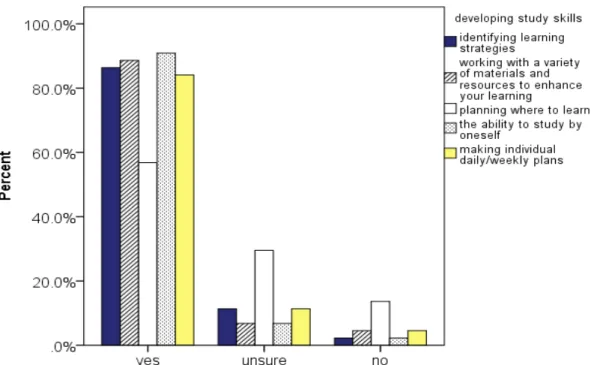
(Teachers)Figure 4.22ː Distribution of LL enhancement by learning cooperatively items (Teachers) ... 150 Figure 4.23 Distribution of LL enhancement by developing study skills items
(Teachers) ... 152 Figure 4.24: Distribution of LL enhancement by building a positive relationship
with teacher items (Teachers) ... 154 Figure 4.25: Distribution of age (Students)Figure 4.24: Distribution of LL
enhancement by building a positive relationship with teacher items (Teachers) ... 154 Figure 4.25: Distribution of age (Students)... 158 Figure 4.26: Distribution of English level (Students)Figure 4.25: Distribution of age
(Students) ... 158 Figure 4.26: Distribution of English level (Students) ... 159 Figure 4.27: Distribution of Language course outside university (Students)Figure
4.26: Distribution of English level (Students) ... 159 Figure 4.27: Distribution of Language course outside university (Students) .. 159 Figure 4.28: LA usefulness (Students) ... 160 Figure 4.29: LA helps or hinders LL (Students) ... 161 Figure 4.30: LA without teachers’ help (Students)Figure 4.29: LA helps or hinders
LL (Students) ... 161 Figure 4.30: LA without teachers’ help (Students)... 162
15
Figure 4.32: LA feasibility (Students)Figure 4.30: LA without teachers’ help (Students) ... 162 Figure 4.31: Distribution of the overall effectiveness of classroom activities
(Students)Unsure ... 163 Figure 4.31: Distribution of the overall effectiveness of classroom activities
(Students) ... 168 Figure 4.32: Distribution of percentage for evaluating the importance of
characteristics (Students) ... 175 Figure 4.33: Distribution of percentage for overall LA enhancement by developing
5 characteristics (Students)Figure 4.32: Distribution of percentage for evaluating the importance of characteristics (Students) ... 175 Figure 4.33: Distribution of percentage for overall LA enhancement by developing
5 characteristics (Students) ... 177 Figure 4.34: Distribution of LA enhancement by taking charge items
(Students)Figure 4.33: Distribution of percentage for overall LA enhancement by developing 5 characteristics (Students) ... 177 Figure 4.34: Distribution of LA enhancement by taking charge items (Students)
... 179 Figure 4.35: Distribution of LA enhancement by having positive attitude items
(Students)Figure 4.34: Distribution of LA enhancement by taking charge items (Students) ... 179 Figure 4.35: Distribution of LA enhancement by having positive attitude items
(Students) ... 180 Figure 4.36: Distribution of LA enhancement by learning cooperatively in the
classroom (Students) ... 182 Figure 4.37: Distribution of LA enhancement by developing study skills (Students)
... 184 Figure 4.38: Distribution of LA enhancement by building a positive relationship
with teacher items (Students)Figure 4.37: Distribution of LA enhancement by developing study skills (Students) ... 184 Figure 4.38: Distribution of LA enhancement by building a positive relationship
with teacher items (Students)... 186 Figure 4.39: Distribution of percentage for LL enhancement by developing 5
Characteristics (Students) ... 188 Figure 4.40: Distribution of LL enhancement by taking charge of learning items
(Students) ... 189 Figure 4.41: Distribution of LL enhancement by having positive attitude items
(Students)Figure 4.40: Distribution of LL enhancement by taking charge of learning items (Students) ... 189 Figure 4.41: Distribution of LL enhancement by having positive attitude items
16
Figure 4.42: Distribution of LL enhancement by learning cooperatively items (Students) ... 193 Figure 4.43: Distribution of LL enhancement by developing study skills items
(Students)Figure 4.42: Distribution of LL enhancement by learning cooperatively items (Students) ... 193 Figure 4.43: Distribution of LL enhancement by developing study skills items
(Students) ... 195 Figure 4.44: Distribution of LL enhancement by building a positive relationship
with teacher items (Students)Figure 4.43: Distribution of LL enhancement by developing study skills items (Students) ... 195 Figure 4.44: Distribution of LL enhancement by building a positive relationship
with teacher items (Students) ... 197 Figure 4.44: Distribution of LL enhancement by building a positive relationship
17
Acknowledgements
I am indebted to many people who have made the creation of this thesis possible. This work would not have been completed without the support and help of many remarkable individuals.
First of all, I express my debt to my supervisor Dr Jan Hardman for her sincere assistance and valuable suggestions, and I am really grateful to her for her patience and caring. I am also very grateful to my former supervisor Dr Florentina Taylor for her guidance during the first two years of my PhD.
Respect and appreciation are due to Professor Chris Kyriacous, PhD programme leader in the Department of Education at the University of York, and to my examiners Professor Terry Lamb and Dr Andrzej Cirocki.
I would also like to express my deep gratitude to Dr. Badia Hakeem, Vice Dean of the ELI at King Abdulaziz University; Dr. Faiza Al Johani, former Vice Dean of the ELI; and to the ELI teachers and student who have been a great help during my data collection.
All the love and appreciation are due to my daughter Yara and my son Salman, to my beloved mother, my husband, my three brothers, my cousins, and to all my family members for their support during my PhD journey.
Very special thanks go to my amazing friends in the UK and in Saudi Arabia. Thank you for always being there for me, through thick and thin.
Finally, my love and devotion go to a very special person who is no longer with us today, my father. I dedicate this thesis to him.
18
Author’s declaration
I declare that this thesis is a presentation of original work and I am the sole author. This work has not previously been presented for an award at this, or any other, university. All sources are acknowledged as references.
19
Chapter 1:
Introduction
1.1
Introduction to Study
Theories and practices of language learning and teaching have long been a topic of debate, and learner autonomy is a concept that has produced much controversy. Many conflicting views of the importance of learner autonomy have emerged, especially since the shift from teacher-centred to learner-centred approaches in English language teaching. The conflict arises from the difficulty in defining the concept of autonomy, with some believing that autonomy means learners working independently, and others feeling that it means dispensing of the need for a teacher altogether. Originally the term “autonomy” was derived from the field of politics and moral philosophy, but the term’s meaning is elusive as it changes according to one’s point of view. Furthermore, it is a multifaceted concept whose meaning has been discussed from many perspectives by theorists (Benson, 2001). However, there is general consensus that an autonomous learner, as defined by Holec (1981), is one who is able to take charge of his or her own learning.
Developing autonomy plays a significant role in language learning. Learning a foreign language is a lifelong effort, not one that begins and ends in a classroom, and it takes hard work and commitment on the part of the learner. Many factors, such as motivation and interest, have an influence on individuals and their attitude towards learning. These factors may all have an impact on learner independence, which involves learners being able to direct and control their learning skills. Thus, learners can set their own objectives and apply a strategy devised by themselves to meet their goals. Consequently, it can be argued that the development of learners’ autonomy may start in a classroom environment but could also extend beyond it.
However, there is interdisciplinary discussion among academics and researchers with respect to the autonomy of learners and whether it is beneficial or not. It is clear that there is a need to re-examine this subject in greater depth, particularly in specific contexts such as foreign language learning in non-Western areas, and to conduct that examination more empirically while taking cognisance of the many developments that have occurred in this field over the last few decades. Finding appropriate strategies and developing autonomous characteristics that may support learners in their desire for independence is an ongoing quest.
20
1.2
Contextual Background of Study
This study was conducted in the English Language Institute (ELI) at King Abdulaziz University in Jeddah, Saudi Arabia, and the individuals under investigation were EFL female university teachers and learners. The presentation of the contextual background aims to provide essential information on the overall Saudi educational system as well as English language education for university students. The background information is presented to help the reader to make sense of this investigation of learner autonomy in a higher education Saudi context. The perceptions and opinions of the female participants make more sense when viewed within the contextual and cultural background of the study. This chapter therefore sheds light on the Saudi educational system in general and on the Saudi English language education in particular, with specific reference to the university in which the study was conducted.
1.2.1 The Education System in Saudi Arabia: An Overview
The education system in the Kingdom of Saudi Arabia (KSA) is segregated by gender: boys and girls study separately during all their schooling and university years as per the requirements of the Islamic Holy law (Shari’ah). Consequently, male participants are excluded from this study due to segregation, as the study has been conducted by a female researcher. However, the separation of genders in the Saudi schooling system does not affect the quality of education (Huyette, 1985). They all study the same curriculum and take the same examinations.
Students from years one to twelve (ages 6-18 years old) can attend public, private, or international schools, all of which are monitored by the Saudi Ministry of Education (MOE). English language education in public schools starts in year four (age 9) as a compulsory subject in the school curriculum, whereas it starts at an earlier stage (as early as pre-school) in private and international schools. Tertiary education in KSA begins after students have passed examinations in year twelve.
If students wish to pursue their higher education abroad, the Saudi government offers overseas scholarship opportunities for both male and female citizens who are able to meet
21
specific requirements. These requirements mainly relate to the citizens’ field of study and academic levels. Scholarships are available for both male and female students who have graduated from domestic as well as foreign universities. The overseas institutions approved by the government scholarship programme are carefully selected based on academic excellence and competitiveness in global rankings (MOE, 2016). Alternatively, students who wish to study in Saudi Arabia can choose from 26 registered state universities, 10 (established and licensed) private universities, and 41 (established and licensed) private colleges geographically distributed across the different regions of KSA (MOE, 2017).
King Abdulaziz University, the university in which the study was conducted, occupies a leading position among higher education sectors in KSA and is now considered one of the “most prominent universities in KSA in terms of the number of students, the diverse and integral scientific and theoretical fields of study. It offers educational programs for the preparation of graduates to do works in line with the community's changing educational needs” (MOE, 2016). Like all educational institutions in KSA, King Abdulaziz University (KAU) has two separate campuses for men and women. Each of the two campuses is equipped with academic services and facilities including a large library with up-to-date technologies and free Wi-Fi providing resources and access for students. KAU has witnessed immense progress, and it is now ranked 4th in the Arab region (QS University Rankings: Arab Region, 2016). Students who choose to pursue their studies in KAU can select from a wide variety of majors from a number of specialist fields reflecting the diversity of academic programmes in both social and natural sciences. Initially, however, students need to pass the preparatory year as part of the university rules and regulation.
1.2.2 The Preparatory Year Programme (PYP) at KAU
First-year students in KAU, as in most state universities in Saudi Arabia, must undertake a Preparatory Year Programme (PYP) before they get to choose their major at the university. The PYP launched in 2010 and, according to the Dean of Student's Affairs in KAU, “is designed to provide the new students with necessary information about the university's facilities, faculties and academic programmes” (KAU, 2010). All of the PYP courses are fixed. In other words, students are not allowed to elect, add, or delete any of the PYP courses, and they must pass all of the courses successfully. Students who fail to finish all courses in one year are allowed to study one extra semester. Moreover, the English
22
language course forms a major and mandatory component of the PYP for all full-time students. The importance of this course puts pressure on students as well as English teachers at the university, as failing the English course means that students will not be allowed to progress with their degree. Teachers must cover the curriculum in a limited timescale, and students are completely focused on passing their end-of-course exams.
1.2.3 The English Language Programme in KAU
KAU has a special English language programme for PYP students that is organised and operated by the ELI at the university. The ELI Dean, supported by Six Vice-Deans from the Men's and Women's campus, leads and manages all ELI administrative and academic operations. The ELI was the first institute within a Saudi university to be accredited by the Commission on English Language Program Accreditation, which is the only body that is formally recognised by the US Department of Education. This accreditation began in April 2013 and lasts for five years. The ELI takes its responsibilities for quality provision seriously; within the ELI there is also a Development Unit tasked with organising training sessions for teacher development to ensure that teachers’ continuing professional development needs are addressed.
The mission of the ELI at KAU, as stated in their website, is to provide quality intensive instruction of EFL using a comprehensive and communicative curriculum in order to enhance students language skills and facilitate their college entry (2018). The ELI employs mainly Saudi staff, but a considerable number of teachers are from other nationalities, such as Egypt, Jordan, Tunisia, Pakistan, and India. A few teachers also come from English-speaking countries like South Africa, the USA, and the UK. The Saudi teachers must have a minimum qualification of a Bachelor’s degree in English literature, linguistics, or translation. More recently many of the Saudi teachers have benefited from the overseas scholarship programme and hold higher qualifications, such as a Master’s degree and a PhD. Some have also participated in national postgraduate courses open to Saudi citizens. Many of these Saudi and non-Saudi teachers have experience working in different contexts, including private schools, international schools, and English-speaking environments.
23
1.2.3.1 Determining students’ levels of proficiency: Placement test
Upon starting a course at KAU, all PYP full-time students are obliged to take an initial diagnostic test; this test is the Oxford Online Placement Test (OOPT), which is aligned to the Common European Framework of Reference for Languages (CEFR). The OOPT determines levels of proficiency in English and enables the students to be placed in classes according to their language ability. Students who do not attend are automatically placed in the lowest level as complete beginners; these students are known as the ELI 101 group.
1.2.3.2 Exemption from English courses
Exemption from English language classes is possible. The pass grade to ensure entry to degree courses is Lower Intermediate (CEFR B1+), so anyone who already has evidence of achieving this level or higher is automatically exempt. Exemption requires provision of a current iBT TOEFL certificate showing a score of 45 or above or an IELTS certificate with an overall score of 4.5 or above. Students must apply in good time for exemptions as the process takes five working days to complete, and any grades they have accrued before applying for exemption stay on their KAU academic record.
1.2.3.3 English Modules
A modular system is used for delivery of the English language programme to PY students. Altogether, the programme comprises four modules over the year, each lasting seven weeks. At 18 hours of tuition per week, the programme is very intensive. The university states that the English language teaching programme employs a communicative curriculum based on student-centred pedagogy. Each of the four modules corresponds to one level of the CEFR proficiency framework:
ELI 101 (Level 1): Beginner (CEFR A1) ELI 102 (Level 2): Elementary (CEFR A2) ELI 103 (Level 3): Pre-Intermediate (CEFR B1) ELI 104 (Level 4): Intermediate (CEFR B1+)
1.2.3.4 Curriculum, textbooks, and the language classroom
The curriculum for the English programme is based on learner outcomes and, consequently, the assessments at the end of each module are designed to show achievement
24
of these outcomes. Course materials support this goal, as the materials are mapped to the CEFR proficiency level band descriptors. One textbook is provided for each level; these textbooks are produced in partnership with Cambridge University Press and have been developed for a one-year course to take students from Beginner level to Intermediate level. The language classrooms are well resourced, with computers and other technology aids provided to facilitate interactive teaching and learning. Students can access a wide range of up-to-date digital and electronic services. Teachers are encouraged to make the language classroom as interactive and communicative as possible.
1.2.4 English as a Foreign Language in KSA
English as foreign language holds a high status in Saudi Arabia. In fact, English is the only foreign language that is taught as a compulsory subject in schools and universities in KSA. In higher education, English is the medium of instruction in many specialised majors such as medicine, sciences, and engineering. In addition, proficiency in English is now considered one of the main requirements for jobs and postgraduate studies (Mahboob & Elyas, 2014). English is also a requirement for acceptance into the government overseas scholarship programme. Therefore, more and more Saudis believe that the English language is key for their own prosperity as well as the prosperity of their country (Al-Seghayer, 2014). Indeed, teaching and learning English has been very important to the Saudi economy, and there has been much investment in this area (Shabbir, 2006). Nonetheless, the outcomes are well below the expectations of the government; Saudi students’ language proficiency and competence is still unsatisfactory.
1.3
Critical Review of Teaching and Learning English as a Foreign
Language in KSA
Although communicative approaches have been recently advocated and highly encouraged in language education, the language classrooms in Saudi Arabia are still described as teacher-centred (Darandari & Murphy, 2013. Students rely heavily on memorisation techniques; they memorise grammar rules, new vocabulary, and reading and writing passages (Al-Sheghayer, 2015). Introducing communicative teaching methods into Saudi
25
classrooms has long been regarded as challenging mainly due to this cultural aspect of teacher dominance. Despite the best efforts of the Saudi Ministry of Education, teachers still tend to use traditional methods such as grammar-translation, audio-lingual, rote learning, and exam preparation (Abahussain, 2016).
The teacher is the central focus of any teaching or learning approach (Gulnaz, Alfaqih, & Mashhour, 2015). Therefore, a lack of English language competence on the part of the teachers is seen as a key barrier in introducing communicative activities into the English language classroom. Teachers may find it difficult to use communicative activities in the language classroom as they are reluctant to give control to the learners. Teachers may see sharing power as a loss of their position and, perhaps, of their authority.
It has been argued that teacher-centred approaches are still dominant in the Saudi classroom due to the lack of experience and professional training. Rahman and Alhosaini (2013) noted that many language teachers are not professionally trained and lack experience in the classroom. Alseghayer (2014) reports that teacher training programmes fail to prepare Saudi teachers well, and teachers need to be provided with ongoing professional development to enhance their knowledge. Khan (2011) states that Saudi teachers are not interested in attending training programmes because some teachers felt that attending such sessions would cause them academic embarrassment. This attitude is a barrier, in many ways, to teachers becoming autonomous learners in their own right. If teachers do not understand the concept of lifelong learning and take responsibility for their own professional development, they will not be able to offer effective support for self-directed learning activities for their own students.
In many ways, teacher-centred approaches act as a barrier to learner autonomy, as learners are taught to memorise the knowledge imparted to them by the teacher. Some have attributed adherence to this memorisation technique to the influence of the Islamic religion; memorisation of texts from the Quran, for example, has been fundamental to the Islamic education system (Alotaibi, 2014). Nevertheless, the importance of active learning involving student participation is also highly regarded in Islamic teaching methodology (Azram, 2011). It is recognised that learners should be active, not passive recipients of knowledge. On the basis of this, language teachers should be expected to use activities whereby their students could be active learners and apply knowledge of the language. It has also been recommended that English teachers should be taught how to apply new
26
technology in teaching English (Abebe & Woldehanna, 2013). Thus, teachers would be able to introduce new activities into the classroom.
Few studies have been conducted in Saudi Arabia relating to learner autonomy, and limited research has considered the perspectives of both teachers and students. This research gap exists despite the topic being of importance in the Saudi context, where learner autonomy at the level of higher education is fundamental to the Saudi government’s aspirations of generating a knowledge economy. Powell and Snellman (2004) define a knowledge economy as having greater reliance on the production of knowledge-based outputs through use of intellectual capabilities, and such knowledge-intensive activities require independent thinkers who can create and find solutions to problems.
Pedagogical challenges for education tend to centre on training young people to be able to work in a globally competitive knowledge economy. Graduates need academic knowledge, but they also need the creative capability expected of an educated workforce. Much debate has surrounded these challenges, with researchers reporting concerns that school curricula are very similar around the world and largely based on Western values (Baker & LeTendre, 2005; Meyer, Ramirez & Soysal, 1992). It is therefore important to gain more understanding of education in other non-Western contexts. In addition, there is a need for a study that will help recognise and bring into focus knowledge and practices regarding learning autonomy, as this area promotes creativity and empowerment. It should, however, be noted that any study of learner autonomy cannot be separated from an understanding of the social and cultural context within which that learning operates, and that is why this study of learner autonomy has been conducted in a Saudi context.
1.4
Personal Inspiration and Positionality
Personal reasons drove me towards researching learner autonomy in A Saudi Arabian EFL context. I have an MA in Teaching English to Speakers of Other Languages (TESOL) and have taught English in Saudi Higher Education for a number of years. My own desire to see learner autonomy more widely recognised and practised in Saudi education inspired and initiated this research.
I had very limited knowledge on language teaching methods when I was teaching at KAU, since I studied English Literature in my (first) Master’s at KAU. In addition, pre-service training was not available at the university when I was hired; academic
27
qualifications and English language competence were enough for the position of a lecturer at the ELC at that time. I recalled my first attempts of teaching as being a copy of my own lecturers at the university. However, it soon became clear to me that language teaching is complex and requires informed knowledge and on-going development. The new generation cannot be taught in the same way as my generation. I finally realised that relying on my language competence and experience or copying my lecturers would not allow me to improve in my profession, and that was when I decided to pursue my postgraduate studies in the UK. Studying abroad was an ideal plan for personal and professional development and to take a step back from teaching and spend time learning about language teaching pedagogy and contemporary language teaching methods.
My own introduction to the concept of learner autonomy came during my MA in TESOL studies in the UK. I came across the terms ‘autonomy’ and ‘learner autonomy’ for the first time in a TESOL Forum session. The speaker started the session by defining learner autonomy, then explained its pedagogical benefits and suggested ways to promote autonomy in different educational contexts. I felt an immediate interest in the topic, and I started comparing and contrasting my autonomous learning behaviour in the UK and in Saudi Arabia. As a Saudi female, being independent and totally in charge was rather unusual to me. I may have been a responsible learner, but I was not in charge of all aspects of my own learning, and certainly not of my life. I was rather seeking directions and sometimes instruction from others.
From my own experience of studying and living abroad, I can say with great confidence that developing autonomy has potential benefits not only in formal education, but also in all aspects of life. I wanted to make a contribution and be an active participant in elevating the quality of language learning in higher education in general and helping university students develop skills for their future. Experiencing for myself an autonomous way of learning in the UK made me feel that Saudi students deserve to be given the same learning opportunities in their home country.
In addition, writing a reflective portfolio at the end of the Master’s programme in the UK greatly contributed to developing my interest in autonomous learning. The portfolio allowed me to recall and document my learning experiences and teaching practices, and I reflected on the past, present, and future of myself as a learner and a language teacher. I selected ‘learner autonomy’ to be the main theme in my portfolio, and researching this
28
theme inspired me to further investigate the construct by conducting a small-scale project (in 2012) to explore the concept in my teaching context in Saudi Arabia. The aim of this project was to gain initial insights and general views on learner autonomy in my teaching context.
Consequently, I sent an online survey to 22 in-service English language teachers to seek their general perceptions on learner autonomy. It was clear that the term ‘learner autonomy’ appeared to be a new concept to Saudi teachers at the university, but there was a positive reaction towards this ‘new’ concept in terms of desirability. However, some teachers were unsure about the feasibility of implementing an autonomous way of learning in the classroom. In other words, learner autonomy was perceived as an abstract concept rather than a realistically applicable approach. I decided then that I should pursue a systematic investigation of the phenomenon.
To systematically investigate learner autonomy in my teaching context, it took much careful thought on how to position myself in order to inform my research study. To start with, I had to consider my advantageous position of being familiar with the study context, educational culture and possibly some of my potential participants. I was aware that many of my initial assumptions were possibly based on my knowledge and personal teaching experience at the university. On the other hand, I was not fully aware of the current English language programme at KAU, or of other major changes in the English language Institute, since I had been away for a number of years. For example, I had little knowledge and no experience in teaching within the modular system to understand its impact on language teaching and learning. I was also unfamiliar with the new administration and teaching staff, as well as the new generation of students.
When I started teaching at the ELC in 2005, undergraduate students were required to complete only two General English courses (ELCA 101 and ELCA 102), not necessarily in the first year. Students had the option to select the year/ term they wished to take the English courses. In other words, they did not have to be enrolled in the English courses in their first year, unlike the foundation year students at the moment. This allowed me to experience teaching a diverse group of students at different levels, from year 1 to year 4. Language teachers at the English Language Centre (ELC), including myself, participated in preparing exam questions and were personally monitoring their students’ grading and achievements, but now there is a special committee which consists of a group of trained
29
coordinators assigned to prepare coursework and exams to be unified across all language classrooms. Moreover, the curriculum and textbooks were set, but there was flexibility in terms of how each teacher delivered classroom activities and textbook materials. Course duration was also different; it was 14 weeks long.
As mentioned above, the English Language Institute has grown in size and the number of students has increased significantly. Being both familiar and unfamiliar with certain aspects of the study context created in me a sense of insider/ outsider. I predicted that it was going to be difficult to extract myself from the research context, due to the many familiarities I shared with the study setting and participants. In other words, I had the advantage of the insider’s knowledge of the sociocultural context of language teaching and learning in Saudi Arabia, yet I had to take the position of an outsider in some ways because of the many changes that had occurred at the university over the long period of my absence. Many researchers are confronted with this dilemma of how to position themselves and how to control the influences of their positionality throughout the study. However, the researcher’s positionality does not always fit into a neat category, and might even shift during the study (Herr & Anderson, 2005). Thus, I have positioned myself as an insider/ outsider researcher, and have based all the decisions for conducting the study accordingly. I have also carefully handled the ethical considerations and implications of being an insider.
1.5
Aims and Objectives of the Study
The overall aim of this study, exploring learner autonomy in the Saudi EFL context, is to assess to what extent the meaning of learner autonomy exists in Saudi culture and to determine language classroom activities that might help to enhance the development of learner autonomy. The study explores how learner autonomy promoted by teachers serves to reinforce society’s values and those values provided through language education. Although learner autonomy is a concept that is theorised in Saudi education circles, little research has been carried out on the practical aspect of application. Therefore, this study seeks to fill the gap and investigate the reality of learner autonomy from the perspectives of both teachers and learners.
The study also aims to explore and discuss issues related to learner autonomy in practice, with particular reference to the nature and experience of learner autonomy in Saudi Arabia. In addition, it investigates strategies and attributes intended to promote
30
learner autonomy in the field of higher education, as well as to determine the effectiveness of such strategies, their impact on language education, and how they might be improved and developed.
The study therefore has the following specific objectives:
1. To explore teachers’ and students’ perceptions of learner autonomy in a Saudi educational EFL context.
2. To explore teachers’ and students’ attitudes towards autonomy development. 3. To investigate and assess classroom activities and practices fostering learner
autonomy in the language classroom.
4. To investigate any learner characteristics that may have a positive impact on enhancing learner autonomy and language learning.
5. To explore any relationship between learner autonomy and language learning. 6. To investigate motivations and constraints regarding the development of learner
autonomy from a Saudi perspective.
To achieve these objectives, a comprehensive review of the literature on learner autonomy in Saudi Arabia has been carried out. Then a survey was conducted with teachers and students to ascertain their perceptions of learner autonomy. In addition, interviews were conducted with teachers and students to explore the practices of learner autonomy in the classroom and how these practices contribute to English language teaching. These perceptions were used as a point of reference for comparisons between teachers and students.
However, since it was not yet clear whether there was evidence of autonomous characteristics in the context of study, autonomy was treated as a ‘new’ concept to learning and teaching. This assumption was based on the fact that in a collectivist culture (such as Saudi Arabia), the traditional teacher-centred approaches are still dominant. The notion of giving learners a bigger role, and allowing them to take charge and control is not a common practice in educational settings. Therefore, introducing this ‘new’ concept was likely to need structured representation and promotion.
Thus, the research questions that have been formulated to reach a better understanding of the reality of learner autonomy from the perspective of Saudi university teachers and students, and are as follows:
31
1. What are their perceptions of learner autonomy?
2. What classroom activities do they perceive to be enhancing the development of learner autonomy?
3. What are the main characteristics of an autonomous learner?
4. What is the relationship between learner autonomy and language learning?
5. What are the major constraints to promoting learner autonomy in the Saudi university EFL context?
1.6
Procedures
This research was conducted in Saudi Arabia at King Abdulaziz University. To carry out any research in an educational establishment, permission is required from the Ministry of Education; accordingly, permission was obtained. The research involved 44 teachers and 480 students altogether. In addition, as the study was carried out within a UK institution, the appropriate approvals were also obtained from the university.
1.7
Significance of the Study
Little research has been carried out on learner autonomy in the context of Arab countries such as Saudi Arabia, where traditions of teacher-centred learning predominate. This study is therefore a significant step towards providing research focusing on the concept of learner autonomy within Saudi higher education language classrooms, as there is a definite lack of research in this field. This study is important because learner autonomy is fundamental to the Saudi government’s needs for creative individuals who can contribute to the knowledge economy that Saudi Arabia is promoting. Understanding the barriers to learner autonomy may benefit Saudi society as it moves towards an education system that must compete in a global environment.
This study is also important for the methodology used, as this research marks the first time that both surveys and interviews have been employed to gauge in depth the perspectives of learner autonomy of both teachers and students in a Saudi public university context. Such views and opinions have been absent from other studies, where the phenomenon has been studied purely from the perspective of either teachers or students, employing either purely quantitative or purely qualitative methods. Exploring learner
32
autonomy in a non-Western context, such as Saudi Arabia, can lead to new discoveries about the topic. In addition, students’ voices seem to be missing in most existing studies, including the small-scale study that I conducted in my Master’s. It makes much more sense to investigate learner autonomy from the perspective of the actual learners as well as the teachers, and indeed being able to compare and contrast both sides has provided a unique contribution to existing literature.
1.8
The Structure of the Thesis
This first chapter has provided a rationale for the study and explained what the research is seeking to achieve. The chapter has also given a contextual background to the education system in Saudi Arabia and the English language courses taken by the participants in this study. The aims and objectives of this study have been set out, and the significance of the research has been explained. The rest of the thesis is presented in the following chapters.
Chapter Two: The Literature Review presents, explains, and evaluates findings from previous studies on this subject. It takes a wider perspective to look at other contexts where learner autonomy has been studied. Additionally, it provides the theoretical framework within which this study takes place. This framework is located within the domain of active learning and encompasses a humanist approach, constructivism, and learning preferences. The emphasis in this chapter is on learner autonomy, the characteristics of those learners who are most likely to develop autonomy, and the role of the teacher in supporting this development in the classroom by promoting specific activities.
Chapter Three: The Methodology describes the methods and methodologies. It provides information on why a mixed methods approach was undertaken, and it states the benefits that have been attributed to this approach. The chapter describes the design of the questionnaire, the piloting process, and the main study procedures. It describes the interviewing and data analysis for both qualitative and quantitative data. The validity and reliability of the data are discussed, and the ethical considerations are presented.
Chapter Four: Results from the Survey presents the findings of the survey carried out with teachers and students. Firstly, it presents the results from the teachers and provides an interpretation. Then it presents the results from the student questionnaires. A comparison is then made between both teachers and students in their views on activities that support learner autonomy, in their views on the importance of developing autonomous
33
characteristics, and in their views on how these characteristics can be enhanced to support learner autonomy in language learning.
Chapter Five: Results from the Interviews presents and analyses the results of the qualitative interviews by using a narrative format. The results are presented by providing the teachers’ views on their understanding of learner autonomy and their role in developing autonomy in the classroom. The teachers’ perceptions of the students, the constraints that prevent autonomy, and the activities that may promote autonomy are then presented. Students’ views on their study at university, the attributes needed for autonomy, and any constraints and support they perceive are then presented. Students’ suggestions for activities that may promote learner autonomy are outlined as well.
Chapter Six: Discussion synthesises and discusses the results. The chapter presents how the findings answer the research objectives and research questions. The ways in which both teachers and students perceive learner autonomy are discussed, followed by learner characteristics believed to promote such autonomy. Activities that may develop learner autonomy and the impact of learner autonomy on language learning are then discussed. Further discussions from the findings include motivations, relationships, levels of proficiency, and changing attitudes.
Chapter Seven: Conclusion summarises the key findings and the contributions to knowledge that this study makes. In this chapter, the recommendations and limitations of the study are also discussed, and ideas for further research studies are provided.
The next chapter presents a review of the literature, thereby giving context for the topic of this study.
34
Chapter 2:
Literature Review
2.1
Introduction
This chapter introduces the concept of autonomy in education, which is important to the understanding of this study. Autonomy has been much discussed in literature over the past thirty years and has evolved together with models of learning delivery. This chapter presents the theoretical framework underpinning this study, then reviews the importance of learner autonomy in an educational context. As the focus of this study is on investigating learner autonomy in a language context, the chapter explores the literature relevant to language learning autonomy and learner characteristics where successful autonomy may take place. Some issues related to cultural differences may create barriers to becoming autonomous, and these issues are also discussed in this chapter. The chapter further reviews approaches for developing learner autonomy and presents arguments for autonomy in the language learning classroom. Teachers and students role are discussed, and the concept of teacher autonomy is also introduced. It then investigates ways in which these approaches are being implemented and identifies classroom activities and tasks that have been found to promote learner autonomy. All of these aspects are then placed in a Saudi context, and literature relating to Saudi education and autonomy is reviewed – although it is limited. The summary of the chapter discusses areas in which there are gaps in the literature and, therefore, potential for further investigation.
2.2
Theoretical Framework for the Study
Theories supporting this study relate to the pedagogical principles of active learning. Such principles encourage learners to actively participate in their learning and promote a more inclusive approach through which all students are engaged in learning activities (Petty, 2014). Consequently, the activities introduced into the classroom can determine the engagement and participation of learners. Likewise, the selection of such activities is significant to learner achievements. Petty (2014) suggests that passive methods (such as listening) do not improve learning and understanding for weaker students. Both weak and strong students benefit greatly from a learning experience which includes active methods. According to Benson’s (1997) theory, there are three different kinds of learner autonomy, which he refers to as technical autonomy, psychological autonomy and political autonomy. Active learning falls within the psychological version of autonomy, which relates to the