Learning to Adapt in Dialogue Systems:
Data-driven Models for Personality
Recognition and Generation
Franr;ois Mairesse
Submitted in partial fulfillment of the requirements for the degree of Doctor of Philosophy
Department of Computer Science University of Sheffield, United Kingdom
Dialogue systems are artefacts that converse with human users in order to achieve some task. Each step of the dialogue requires understanding the user's input, de-ciding on what to reply, and generating an output utterance. Although there are many ways to express any given content, most dialogue systems do not take lin-guistic variation into account in both the understanding and generation phases, i.e. the user's linguistic style is typically ignored, and the style conveyed by the system is chosen once for all interactions at development time. We believe that modelling linguistic variation can greatly improve the interaction in dialogue sys-tems, such as in intelligent tutoring syssys-tems, video games, or information retrieval systems, which all require specific linguistic styles. Previous work has shown that linguistic style affects many aspects of users' perceptions, even when the dialogue is task-oriented. Moreover, users attribute a consistent personality to machines, even when exposed to a limited set of cues, thus dialogue systems manifest per-sonality whether designed into the system or not. Over the past few years, psy-chologists have identified the main dimensions of individual differences in human behaviour: the Big Five personality traits. We hypothesise that the Big Five provide a useful computational framework for modelling important aspects of linguistic variation. This thesis first explores the possibility of recognising the user's person-ality using data-driven models trained on essays and conversational data. We then test whether it is possible to generate language varying consistently along each personality dimension in the information presentation domain. We present PER-SONAGE: a language generator modelling findings from psychological studies to project various personality traits. We use PERSONAGE to compare various gener-ation paradigms: (1) rule-based generation, (2) overgenerate and select and (3) generation using parameter estimation models-a novel approach that learns to produce recognisable variation along meaningful stylistic dimensions without the computational cost incurred by overgeneration techniques. We also present the first human evaluation of a data-driven generation method that projects multiple stylistic dimensions simultaneously and on a continuous scale.
Acknowledgements
Here I would like to express my sincere gratitude to the many people who have contributed to making this thesis an enjoyable and rewarding experience.
First of all, I would like to thank Lyn Walker for her enthusiastic supervision, and for making me discover the field of computational linguistics, as well as re-search methods in general. This thesis could not have existed without her. I am also grateful to Roger Moore for our fruitful conversations, as well as to Rob Gaizauskas for his valuable advice. On a different continent, I would like to thank Matthias Mehl, James Pennebaker and Cindy Chung for their collaboration, and for intro-ducing me to the world of psychology research.
On a more personal note, I would like to thank my family-An nick, Pierre, Cecile and Jeremie-who I should have seen much more often, as well as Matt Gibson, Sarah Creer and Helen Cross for their humour, kindness and friendship throughout these three years, and the Cobden View staff for making Thesday the quiz day. Many thanks to John Allan, Joe Polifroni, Jonathan Laidler and Nathaniel King for their conversations, lunches and the occasional pint. I am also grateful to the departmental staff and support for making the department work, and es-pecially to Gillian Callaghan for her northern humour. I also had the pleasure of living with many people-with whom I hope I have shared a bit more than a house-including Rachel Fairlamb, Jonathan Chambers, Catherine Quigley, Dean Young, Jonathon Rudkin, Dave Robinson, Hector Marin Reyes, Bouka Maamra, Yannis Balaskas, Sotiris Saravelos, Thdor Grecu and Daniele Musumeci.
While Sheffield has been my new home for the past three years, I must also thank the people who made me want to go back to Belgium (and not forget about strong fizzy beers): Fran~ois Delfosse, Simon Dubois, Geoffroy Tassenoy, Guillaume De Bo, Benoit Roland, Lionel Lawson, Ludovic Lecocq, Fabrice Quinet, Quentin Vroye, Rebecca Deraeck, Nathalie Hargot, Maxime Melchior, Benjamin Cogels, Gerard Paquet and many others.
Lastly, and most importantly, I would like to thank Veronique Lefebvre for her constant affection and smile.
1 Introduction
1.1 Modelling the user's linguistic variation . 1.2 Generating linguistic variation to the user 1.3 Dimensions of linguistic variation . . .
1.3.1 Definitions of linguistic style. . 1.3.2 Factors affecting linguistic style
1.3.2.1 Formality... 1.3.2.2 Politeness... 1.3.2.3 Dialects and sociolects . 1.3.2.4 Personality . . . .
1.4 Motivation for personality-based dialogue modelling 1.4.1 Recognising the user's personality. .
1.4.2 Controlling the system's personality . 1.5 Research hypotheses . . . . 1.5.1 Boundaries . . . . 1.6 Contributions and organisation of the thesis 2 Background
2.1 Elements of personality psychology
2.1.1 The main dimensions of personality 2.1.2 Biological causes . . . .
2.2 Language and personality . . . . 2.2.1 Markers of extraversion . . . . 2.2.2 Markers of other Big Five traits 2.3 User modelling in dialogue .
2.3.1 Individual preferences 2.3.2 Expertise . . . . 2.3.3 Personality . . . . 1 2 2 3 3 4 4 5 5 6 7 8 9 11 12 13 16 16 17 18 19 20 21 22 23 23 24 2.4 Modelling individual differences in natural language generation . 26 2.4.1 Early work: ELIZA and PARRY . . . 26 2.4.2 The standard NLG architecture . . . 27 2.4.3 Template and rule-based stylistic generation 28
TABLE OF CONTENTS iii I 3 II 4 2.4.3.1 Pragmatic effects . 29 2.4.3.2 Linguistic style . . 30 2.4.3.3 Politeness... 30
2.4.3.4 Personality and embodied conversational agents 32 2.4.4 Data-driven stylistic generation . . . .
2.4.4.1 Overgenerate and select methods. . . . 2.4.4.2
2.5 Summary . . .
Direct control of the generation process
...
Recognising the User's Personality in Dialogue
Personality Recognition from Linguistic Cues 3.1 Adapting to the user's personality . . . . . 3.2 Experimental method. . . . 3.2.1 Sources of language and personality 3.2.2 Features . . .
3.2.2.1 Content and syntax 3.2.2.2 Utterance type 3.2.2.3 Prosody . . . 3.2.3 Correlational analysis 3.2.4 Statistical models . 3.3 Classification results 3.3.1 Essays corpus . . . 3.3.2 EAR corpus
....
3.3.3 Qualitative analysis . 3.4 Regression results. . 3.4.1 Essays corpus 3.4.2 EAR corpus 3.4.3 Qualitative analysis. 3.5 Ranking results...
3.5.1 Essays corpus 3.5.2 EAR corpus 3.5.3 Qualitative analysis.3.6 Discrete personality modelling in related work . 3.7 Discussion and summary . . . .
Generating a Recognisable System Personality
From Personality Markers to Generation Decisions 4.1 Personality marker studies .
4.1.1 Sources of language
. . .
33 33 35 3637
38 38 40 41 43 44 46 46 47 53 55 55 57 59 61 61 62 64 65 66 67 68 69 7276
77 78 784.1.2 Personality assessment methods . 4.2 NLG parameter mapping . 4.3 Extraversion.... 4.4 Emotional stability 4.5 Agreeableness.. . 4.6 Conscientiousness 4.7 Openness to experience 4.8 Summary . . . .
5 Implementing Personality Markers in a Generator 5.1 Framework overview . . . . 5.2 Projecting personality in a specific domain 5.3 Input structure . . . . 5.4 PERSONAGE'S architecture . . . . 5.5 Implementation of generation decisions
5.5.1 Content planning . . . . .. 5.5.2 Syntactic template selection 5.5.3 Aggregation... 5.5.4 Pragmatic marker insertion 5.5.5 Lexical choice . . . 5.5.6 Surface realisation 5.6 Summary . . . . 80 82 83 89 94 96 99 · 102 103 · 103 · 105 · 105 .106 · 107 · 108 .112 .114 .117 · 122 · 125 · 126
6 Psychologically Informed Rule-based Generation 127
6.1 Methodology . . . . 127
6.2 Human evaluation . 130
6.3 Results.. . 133
6.4 Summary . . . 139
7 Stochastic Generation Capabilities 141
7.1 Generation coverage and quality . . . 143 7.1.1 Ratings distribution . . . . 143 7.1.1.1 Comparison with the rule-based approach. . 145
7.1.2 Inter-rater agreement . 147 7.1.3 Naturalness... . 150 7.2 Feature analysis. . . 152 7.2.1 Generation decisions. . 153 7.2.2 Content-analysis features . 159 7.2.3 N-gram features . . 164
TABLE OF CONTENTS
8 Generation of Personality through Overgeneration 8.1 Methodology . . . .
8.2 Statistical models . . . . 8.3 Results with in-domain models
8.3.1 Modelling error . . . 8.3.1.1 Discussion ..
8.3.1.2 Modelling error distribution. 8.3.2 Sampling error . . . . 8.3.3 Psychologically informed selection models 8.4 Results with out-of-domain models . .
8.4.1 Out-of-domain model accuracy 8.4.2 Domain adaptation .
8.5 Summary . . . ..
9 Generation of Personality through Parameter Estimation 9.1 Methodology . . . .
9.1.1 Pre-processing steps . . . . 9.1.2 Statistical learning algorithms . 9.1.3 Qualitative model analysis. 9.1.4 Model selection ..
9.1.5 Generation phase. 9.2 Large-scale evaluation ..
9.2.1 Evaluation method 9.2.2 Evaluation results
9.2.3 Comparison with rule-based generation 9.2.4 Perception of fine-grained variation. 9.2.5 Inter-rater agreement .
9.2.6 Naturalness evaluation. 9.2.7 Socio-cultural analysis 9.3 Discussion and summary . 10 Discussion and Conclusion
10.1 Contributions of this thesis. 10.2 Generalisation to other domains. 10.3 Future research
10.4 Conclusion . . . .
A Utterances Generated using PERSONAGE-RB B Utterances Generated using Random Parameters C Utterances Generated using PERSONAGE-PE
v 169 · 170 172 · 173 · 173 · 178 · 179 · 182 · 187 · 189 · 190 · 192 · 195 198 .199 .201 .203 .204 .205 .206 .207 .208 .209 .211 .212 .214 .214 .215 .217 220 .220 .227 .231 .233 235 249 257
Introduction
As machines increase in complexity, so do the communication mechanisms required to control them. This complexity typically requires specialised training, putting the burden on the human operator to adapt to its tool. Recently, the evolution of computing has reached a point where machines are capable of understanding and imitating natural human behaviour. This implies that the future is likely to see a shift of the burden from the user to the machine, as computers are expected to communicate using a complex, ill-defined protocol that is the most familiar to the user: natural language.
As a result, a new type of computer system has emerged-referred to as dia-logue systems-whose purpose is to communicate with human users using natural language. These systems typically need to (1) understand the user's utterance, (2) decide on what action to take (dialogue management), and (3) produce a corre-sponding output utterance, while making sure the dialogue is natural enough to be successful. Figure 1.1 illustrates the resulting information flow during a conversa-tion with the user.
While language is sometimes seen as a protocol for exchanging information ex-plicitly, it is more than that: language provides cues which are used by the hearer to infer properties about the speaker's state or intentions. The whole field of pragmat-ics is dedicated to the study of information that is not conveyed explicitly through language. Furthermore, speakers also use linguistic cues-consciously or not-to project their emotions, moods and personality, regardless of the information they communicate. The resulting individual differences in language are referred to as linguistic variation.
1.1. Modelling the user's linguistic variation r Input meaning representation~ Dialogue management Input understanding e.g. speech recognition, language understanding,
user modelling User's input ' utterance Output meaning ~ represenration Output generation e.g. natural language generation, speech synthesis . . , System's output utterance
Figure 1.1: High-level architecture of a dialogue system.
1.1 Modelling the user's linguistic variation
2
Most current dialogue systems do not take linguistic variation into account. During the language understanding phase, keyword spotting techniques are generally used to associate the user's utterance to a meaning representation, without affecting the model of the user's state. For example, let us assume that an anxious user tries to book a flight through the phone. Even if the system understands his or her request, it will treat the user as any other, and ignore any cue revealing the user's anxiety. Given a high recognition confidence score, the system is likely to choose not to confirm the user's request, which can then lead the anxious user to request a confirmation, thus adding complexity to the dialogue as well as potential sources of error. If the system had detected the user's anxiety, it could have acted accordingly,
e.g. by enforcing implicit confirmations. Even more so, the system could have changed its linguistic output to produce more reassuring utterances. This leads us to another essential aspect of adaptation in dialogue: the use of appropriate linguistic variation in the system's output.
1.2 Generating linguistic variation to the user
Computers are generally associated with monotonic, formal and repetitive lan-guage, as most commercial dialogue systems output generic template utterances
to the user. The flexibility is usually limited to the insertion of variables within these templates, such as the variables AIRPORT, DATE and TIME in 'your flight will depart from AIRPORT on DATE, at TIME'. Additional flexibility can be provided us-ing a natural language generator, which is a software component that is dedicated to the generation of comprehensible language that conveys the system's commu-nicative goal, e.g. the confirmation of the user's flight.
Although a large body of work has focused on natural language generation [Re-iter and Dale, 2000], most generators aim at producing a single, coherent output given a specific communicative goal, thus implicitly ignoring the effect of linguistic variation. The example of the anxious speaker in the previous section suggests a utility for controlling this variation, in order to improve the user's experience as well as the dialogue's efficiency.
This chapter provides additional motivation for modelling linguistic variation in dialogue, by describing various findings related to this issue as well as potential applications. But first of all, what should the dimensions of linguistic variation be? The next section addresses this question by presenting some of the most important variation dimensions.
1.3 Dimensions of linguistic variation
Whenever we produce an utterance, we make many consistent conscious and sub-conscious choices in order to convey the information in the desired way. Why don't we only express basic facts in the most unambiguous way? That is just what com-puters do when they communicate between themselves, and it seems to be the most efficient way to accomplish a particular task. A possible reason is that speakers try to satisfy mUltiple goals simultaneously, such as communicating information, min-imising their vocal effort, and projecting a specific image to the hearer. Individual speakers value these goals differently, resulting in different linguistic styles.
1.3.1 Definitions of linguistic style
Intuitively, linguistic style refers to a specific point within the space of all possible linguistic variation. More formally, Bell [1997] defines it as 'the range of variation within the speech of an individual speaker', while Labov [1984] proposes a more
1.3. Dimensions of linguistic variation general definition:
By 'style .. .' we mean to include any consistent [set of] linguistic forms used by a speaker, qualitative or quantitative, that can be associated with a [set of] topics, participants, channel, or the broader social con-text.
4
From these definitions, it seems that linguistic style can be considered as a temporary characteristic of a single speaker, as well as a long-lived property of a large group of the population. The most important element in Labov's definition is probably the reference to consistent language forms, i.e. a set of linguistic cues that are repeated over time, and that can thus be measured.
These definitions do not say anything about the causes of linguistic variation. The next section therefore explores factors affecting linguistic style, in order to investigate what variation dimensions should be modelled within human-machine conversations.
1.3.2 Factors affecting linguistic style
Linguistic style is affected by many variables. Some can be consciously manipulated by the speaker based on the situation (e.g. formality), while others are typically acquired over a long period of time (or are innate) and more likely to be the result of early conditioning (e.g. dialects or personality). This section presents some of these factors.
1.3.2.1 Formality
Formality is one of the most studied dimensions in sociolinguistics. Labov [1984] relates formality to the speaker's level of attention towards language. He charac-terises it by a series of principles, which include:
Principle of formality: Any systematic observation defines a formal con-text in which more than the minimal attention is paid to speech. Principle of attention: Styles may be ordered along a single dimension, measured by the amount of attention paid to speech.
Labov therefore considers formality as one of the most important dimensions in sociolinguistics. Some researchers also associate formality with the level of ex-plicitness [Heylighen and Dewaele, 2002]. This dimension can thus be related to the speaker's (non-)reliance on the context. From a goal-oriented perspective, the level of formality is influenced by the speaker's goals regarding communication ef-ficiency (e.g. unambiguity), adaptation to the hearer (e.g. a distant superior), as well as the image that the speaker wishes to convey (e.g. professionalism, respect-fulness).
1.3.2.2 Politeness
Other human goals include the need for self-esteem and respect from others [Brown and Levinson, 1987]. These goals have an enormous effect on language. By trying to fulfill them, people tend to bias their messages in a way that computer systems do not. This phenomenon is referred to as politeness. Politeness theories suggest that the use of politeness is dependent on the social distance and the difference of power between conversational partners, as well as on the threat of the speaker's communicative act towards the hearer [Brown and Levinson, 1987].
1.3.2.3 Dialects and sociolects
While formality and politeness are controlled by the speaker based on his or her goals and environment, we now turn to variation dimensions that are more culture-dependent. These dimensions are typically used to analyse variation between large groups of speakers.
Among the factors affecting the speaker's linguistic style is geographical loca-tion, resulting in different dialects. The use of a dialect can reinforce the speaker's feeling of being part of a community. Dialectical variation is important, but it typi-cally concerns a localised part of the population, which limits the utility of dialect modelling in dialogue systems.
A sociolect is a language characterising speakers from a specific social back-ground or status. For example, markers of British English tend to indicate upper class when used in American English. While sociolects can indicate socio-economic class, they can also be representative of the speaker's gender, age and ethnic back-ground.
1.3. Dimensions of linguistic variation 6 1.3.2.4 Personality
While dialects and sociolects refer to patterns of language that are collective by nature, individual linguistic style can also be rooted in education as well as genetic factors. Different people behave in different ways irrespective of their social group, and some behavioural cues are consistent over time. As language can be seen as the main interface between a human being and its social environment, language should be assumed to be strongly affected by individual differences. We believe that such idiosyncracies can be categorised in terms of personality traits. While there exists different frameworks for analysing personality, the Big Five model has recently emerged as a standard in psychology [Norman, 1963]. The Big Five di-mensions are:
• Extraversion vs. introversion (sociable, assertive, playful vs. reserved, shy) • Emotional stability vs. neuroticism (calm, unemotional vs. insecure, anxious) • Agreeableness (friendly, cooperative vs. antagonistic, faultfinding)
• Conscientiousness (self-disciplined, organised vs. inefficient, careless) • Openness to experience (intellectual, creative vs. shallow, unimaginative) These personality traits influence more temporary changes of behaviour, such as emotions [Watson and Clark, 1992], which again have a large influence on language. Personality also affects the way speakers tend to fulfill their individual goals, therefore it can be considered as the highest source of behaviour variation between people.
Although each variation dimension presented in this section has its specificities, we believe that principled work on modelling individual differences in dialogue should first focus on the most independent dimensions, as more specific behav-iours can be approximated as a combination of them. We thus choose to model linguistic variation using personality dimensions, based on the Big Five framework. Personality provides the following advantages for modelling linguistic variation:
• By definition, personality traits represent the most fundamental dimensions of variation of human behaviour;
• Personality traits are well defined in the psychology literature;
• A large amount of research has studied the relation between personality traits and behavioural cues, including language;
• Specific personality traits can be approximated by combining major traits, e.g. the Big Five;
• Personality can be assessed easily using validated questionnaires;
• As personality is a permanent characteristic, personality judgements can be collected for many different language samples;
• Personality modelling has been shown to be an important factor for the design of dialogue systems (see Section 1.4).
As machines are programmed by humans, their personality is usually defined by the programmer once for all interactions at development time, whether or not he or she is aware of it. While not much attention is currently given to this aspect of human-computer interaction, the next section presents evidence for the need for personality modelling in dialogue systems.
1.4 Motivation for personality-based dialogue modelling
Being able to recognise the personality of the user as well as controlling the per-sonality conveyed by the system can have many benefits.
As personality is usually considered as a fundamentally human concept, one might think that users of a machine will keep that in mind when interacting with it. Reeves and Nass [1996] suggest that it is not true; people tend to treat computers and other media as real people. Users associate a personality to the machine they interact with, and they even prefer working with machines exhibiting the same personality as themselves. This similarity-attraction effect suggests that there is a need for modelling both the user's and the system's personality, in order for dialogue systems to adapt to the user, like humans do [Byrne and Nelson, 1965, Funder and Sneed, 1993].
1.4. Motivation for personality-based dialogue modelling 8 While our long-term objective is to use personality as a mediating layer for adapting to the user, each aspect of this dual task-Leo personality recognition and generation-presents many other benefits.
1.4.1 Recognising the user's personality
Psychology research shows that personality traits influence many aspects of indi-vidual behaviour when performing specific tasks. For example, personality traits influence leadership ability [Hogan et a1., 1994], attitude towards machines [Sig-urdsson, 1991], general job performance and sales ability [Furnham et a1., 1999], teacher effectiveness [Rushton et a1., 1987], and academic ability and motivation [Furnham and Mitchell, 1991, Komarraju and Karau, 2005]. A system capable of recognising personality could thus adapt its behaviour based on the user's capa-bilities. For example, Sigurdsson [1991] shows that neurotics have more difficul-ties using computers, while Komarraju and Karau [2005] show that introverts are less engaged in learning. Based on this information, an intelligent tutoring system could improve its performance by providing more navigational support for neurotic users, while engaging more with introvert users.
Recent work in artificial intelligence explores methods for the automatic detec-tion of other types of pragmatic variadetec-tion in text and conversadetec-tion, such as emo-tion [Oudeyer, 2002, Liscombe et a1., 2003], decepemo-tion [Newman et a1., 2003, Enos et aI., 2006, Graciarena et aI., 2006, Hirschberg et a1., 2005], mood [Mishne, 2005], dominance and leadership in meetings [Rienks and Heylen, 2006], point of view or subjectivity [Wilson et a1., 2004, Wiebe et a1., 2004, Wiebe and Riloff, 2005], and sentiment or opinion [1urney, 2002, Pang and Lee, 2005, Popescu and Etzioni, 2005]. In contrast with these pragmatic phenomena, which may be rela-tively contextualised or short-lived, personality is usually considered to be a long-term, stable aspect of individuals [Scherer, 2003]. However, there is evidence that personality affects these other aspects of linguistic production. For example, there are strong relations between the extraversion and conscientiousness traits and positive affect, and between neuroticism and disagreeableness and negative affect [Watson and Clark, 1992]. Outgoing and energetic people (Le. extravert) are more successful at deception, while apprehensive (i.e. neurotic) individuals are not as successful [Riggio et a1., 1988]. Concerning leader identification, Hogan
et a1. [1994] show that effective leaders are more extravert, conscientious and emotionally stable. Finally, Oberlander and Nowson [2006] suggest that opinion mining could benefit from personality information. Thus this evidence suggests that incorporating personality models into these other tasks may improve accuracy. On a broader scale, personality recognition could also affect the way companies customise their products, as Reeves and Nass [1996] suggest that personality would be a good indicator for market segmentation, i.e. to tailor solutions to different customers in order to maximise their satisfaction.
1.4.2 Controlling the system's personality
Many psychological studies suggest that controlling the personality projected by computer interfaces would be beneficial for human-computer interaction.
The generation of more human-like language was shown to reduce the user's cognitive load, resulting in better task performance [Campana et aI., 2004]. Reeves and Nass [1996] find that users prefer systems which exhibit any kind of person-ality rather than an inconsistent set of cues. The only way to avoid such incon-sistencies is to take personality into account when designing the system. Rut-tkay et a1. [2004] suggest that personality is an important design variable for developing embodied conversational agents. Interestingly, Giles and Powesland [1975] have shown that impressions about a student's intelligence, enthusiasm and self-confidence are more dependent on language samples than on photographs or school work samples. This suggests that language is one of the most important in-dicators of personality. As dialogue systems often represent a specific company, it is therefore important that the system's personality-or persona-reflects the desired corporate image [Cohen et aI., 2004]. We believe that the design and development of a persona would be greatly simplified if the designer could specify the person-ality of the system using a small number of high-level parameters. It is important to note that our objective is not to mislead the user into thinking that he or she is interacting with a human being. As well as raising ethical issues, doing so would increase the user's expectations to a level that cannot be met by machines, which is likely to result in poor user satisfaction.
Additionally, many dialogue applications would benefit from specific personal-ity types, some of which are listed in Table 1.1. Rushton et a1. [1987] find that
1.4. Motivation for personality-based dialogue modelling 10 extravert teachers are more effective, suggesting that an intelligent tutoring sys-tem should produce extravert language. Furnham et a1. [1999] report that general job performance is associated with conscientiousness and emotional stability, while potency (extraversion) correlates positively with sales figures and superior ratings. The authors also show that impulsivity is a significant performance predictor of telesales employees selling insurance. These findings can guide dialogue system designers to optimise the personality conveyed by an automated sales agent. Fur-thermore, we hypothesise that a system gathering information from the user-e.g. a database modification interface--should be receptive (introvert), agreeable and conscientious. Whenever time is crucial-e.g. when requesting stock quotes or emergency advice-information should be clear and concise. This suggests the need for a conscientious, introvert and non-agreeable operator, avoiding superflu-ous politeness forms.
I
Application System's personalityI
Thtoring system extravert
agreeable conscientious Telesales system extravert (potent)
impulsive System learning from user introvert
agreeable conscientious Financial information retrieval conscientious not extravert not agreeable Video game characters any personality type Interactive drama system any personality type Realistic training system any personality type Psychotherapy any personality type
Table 1.1: Hypothesised optimal personality traits for various dialogue system ap-plications.
Some applications require multiple personality types. Those include systems used in the entertainment industry, such as embodied conversational agents or video game characters. Interactive narrative systems-which automatically gen-erate interactive stories with complex characters-currently require the creation of many handcrafted dialogues [Mateas, 2007]. This 'authoring bottleneck' could be partially resolved by using a parameterisable language generator conveying dif-ferent personality traits. Training systems would also benefit from the projection
of various personalities. Examples include systems training practitioners to inter-view anxious patients [Hubal et aI., 2000], as well as systems training soldiers to gather information from uncooperative civilians through tactical questioning [De-partment of the Army, 2006]. Finally, a recent line of research has focused on the use of virtual environments for psychotherapy. For example, a patient scared of public speaking can learn to manage his or her fear by giving a talk in front of a virtual audience made of various types of characters [Slater et aI., 2004].
1.5 Research hypotheses
While the previous sections suggest that personality modelling can enhance dia-logue applications, this work investigates how to model both the personality of the user and the system. To clarify our objectives, it is important to define the research questions that this thesis will address, as well as the issues that are beyond the scope of this work.
This thesis investigates two major hypotheses about how individual differences can be modelled in dialogue systems:
Hypothesis 1 Statistical models can learn to predict the personality of unseen indi-viduals from conversational data, on a continuous scale.
Hypothesis 2 The personality conveyed by generated utterances can be controlled by a computational model, which can be either derived from psycholinguistic knowledge or learnt from personality-annotated linguistic data.
As this thesis represents one of the first large bodies of work on personality recognition and generation through language, it aims at answering many research questions. While some of these questions have been investigated in previous work, they have not been studied in the context of a dialogue interaction.
• Personality recognition:
- Can statistical models trained on spoken language annotated with judge-ments of personality successfully predict the personality of unseen indi-viduals?
1.5. Research hypotheses 12 - How does the personality assessment method-e.g. using the speaker's
own judgement or observer reports-affects modelling accuracy? - What linguistic features are the most useful for personality recognition? - Should personality be modelled as a set of continuous or discrete
dimen-sions?
• Personality generation:
- How can personality markers identified in psychological studies be re-produced in a natural language generation system?
- Can these personality markers be used to convey recognisable personal-ity in a specific application domain?
- Can the perception of multiple personality traits be controlled continu-ously using statistical models trained on personality judgements of gen-erated utterances?
- Can general-domain personality recognition models successfully predict the personality of generated utterances?
- Can the system project a target personality through a single utterance, or is more information needed?
- What generation decisions are the most useful for conveying a specific personality trait?
- How do data-driven generation techniques compare to a rule-based ap-proach purely based on findings from the psychology literature?
While each of these questions will be addressed in the following chapters, it is also important to specify the limitations of the scope of this thesis.
1.5.1 Boundaries
As the modelling of personality in dialogue is a vast topic, this work focuses on the presentation and evaluation of personality recognition and generation methods, without investigating whether personality modelling improves task performance in specific applications. We speculate that the adaptation can be informed by existing
psychological studies, such as those presented in Section 1.4.2. This thesis thus fo-cuses on personality modelling accuracy-rather than dialogue task performance-by assuming that personality traits represent a suitable layer of parameters for dia-logue system adaptation.
Furthermore, the models presented in this thesis are not meant to reproduce the cognitive mechanisms found in the brain. Although the architecture of lan-guage generators presents similarities with models of human lanlan-guage production, the implementation proposed in this thesis does not attempt to imitate how person-ality affects the human language production process. Our objective is to propose a tractable implementation that reproduces the effect of personality on language, as perceived by an observer.
A final limitation is that the present work focuses on personality modelling at the linguistic level, leaving aside high-level dialogue strategy and acoustic mod-elling.I However, we believe that the methodology presented in this thesis can be applied to model non-verbal markers of personality as well, both in the recognition and generation phases.
1.6 Contributions and organisation of the thesis
The research questions are addressed by following a principled methodology, based on data-driven approaches to personality modelling. While the next chapter sum-marises the related work, the rest of the thesis consists of two main parts, investi-gating techniques for (1) recognising the personality of the user and (2) controlling the personality conveyed by the system's utterances.
The first part presents and evaluates data-driven models for personality recog-nition (Chapter 3). The models are trained on personality judgements of written and spoken language, as well as on ratings of self-reported personality. As it is not clear whether personality is best modelled as a continuous variable, we suc-cessively treat the personality recognition task as a classification, regression and ranking problem. We find that recognition models outperform the baseline on un-seen individuals for each trait of the Big Five model. Additionally, results show that observed personality is easier to model than self-assessed personality.
IThis is only valid for the generation phase, as prosodic cues are included in personality recogni-tion models in Chapter 3.
1.6. Contributions and organisation of the thesis
14
The second-and most important-part of this thesis investigates various meth-ods for projecting personality using a natural language generation (NLG) system. For each of the Big Five traits, Chapter 4 reviews findings from psychological stud-ies and systematically maps them to generation parameters within the standard NLG architecture. The resulting mappings offer a principled approach to the gen-eration of personality markers, as they represent our hypotheses about how each finding can be reproduced in a computational artefact to convey personality in a new dialogue domain. While the parameter mappings are application-independent, Chapter 5 presents a detailed implementation of each parameter in PERSONAGE, a psychologically-informed generator that produces restaurant recommendations. This generator is used as a building block for comparing various generation par-adigms in the following chapters. The PERSONAGE-RB rule-based generator uses predefined parameter settings derived from psychology findings to project extreme personality traits within the Big Five model. An evaluation of PERSONAGE-RB is presented in Chapter 6, showing that human judges recognise the personality of its output utterances for each end of the Big Five dimensions.While PERSONAGE-RB relies on hypotheses derived from the psychology liter-ature, Chapter 7 presents a 'bottom-up' correlational analysis of the linguistic fea-tures that influence the personality perceived by the judges. This analysis provides an implicit evaluation of the hypotheses made in Chapter 4, i.e. testing whether or not the psychology findings generalise to a specific application domain. Addi-tionally, Chapter 7 analyses whether PERSONAGE can generate utterances covering the full range of the Big Five personality scales, by randomly varying its parameter values. While PERSONAGE-RB can only target a discrete set of traits, Chapter 8 presents a data-driven generation technique based on the 'overgenerate and select' paradigm, that can target any arbitrary personality value along the Big Five scales. This technique is implemented in the PERSONAGE-OS data-driven generator, which uses PERSONAGE to randomly generate many utterances, and then selects the utter-ance projecting the desired personality using a statistical regression model trained on human personality judgements. Results show that the models predict the per-sonality of unseen utterances better than the mean value baseline, for each Big Five trait. Finally, Chapter 9 presents a novel approach for data-driven language gener-ation with stylistic control, without the computgener-ational cost incurred by
overgener-ation methods. This technique-implemented in the PERSONAGE-PE generator-requires the training of parameter estimation models that predict each generation parameter value given target personality scores along the Big Five dimensions. Chapter 9 also presents the first large-scale human evaluation of the linguistic vari-ation produced by a data-driven generator. Results show that the personality con-veyed by PERSONAGE-PE's utterances is successfully recognised by human judges, for all Big Five traits apart from conscientiousness. Although PERSONAGE-PE's data-driven models do not improve over the handcrafted parameter settings defined in Chapter 4 when generating extreme personality, parameter estimation models pro-vide an efficient way to (1) generate personality varying over a continuous scale and (2) target multiple personality traits simultaneously.
Chapter 10 concludes with a discussion of the generalisation of PERSONAGE to new application domains-e.g. interactive narrative systems-while summarising the results, implications and limitations of this research.
Chapter 2
Background
The present work lies at the intersection of two distinct fields of research: person-ality psychology and natural language processing. As the objective of this chap-ter is to give the reader background information on both aspects of this thesis, Section 2.1 presents elements of personality psychology underlying the stylistic di-mensions that we aim to model, and Section 2.2 reviews findings about how these dimensions affect language. Section 2.3 then details previous work related to user modelling in dialogue, with an emphasis on personality recognition. Finally, Sec-tion 2.4 presents an overview of the natural language generaSec-tion process, as well as recent advances in the control of linguistic variation using rule-based and data-driven techniques.
2.1 Elements of personality psychology
Philosophers and psychologists have tried to identify important dimensions of hu-man behaviour for thousands of years, beginning with Theophrastus in Ancient Greece (B.C. 371-287), who detailed various characters such as 'the Coward', 'the Flatterer' and 'the Unpleasant Man'. In more recent times, the study of personality gained popularity with psychologists such as Sigmund Freud, Carl Jung or Abra-ham Maslow. Personality has been characterised in many different ways: as a com-plex interaction between subconscious and conscious processes (psychoanalytic ap-proach, e.g. Freud), as the set of goals of an individual (humanistic apap-proach, e.g. Maslow), as a result of genetic factors (biological approach, e.g. Gray), and as a combination of invariant characteristics (trait theory, e.g. Allport). As mentioned
in Section 1.3.2, trait theories have become the most standard approach to person-ality psychology, we therefore choose to model personperson-ality as a set of independent traits. Additionally, we believe that it is the most suitable approach for computa-tional modelling, as it summarises an individual's personality in a concise set of scalar values representing each personality dimension.
2.1.1 The main dimensions of personality
Personality traits describe consistent patterns of individual behaviour [Allport and Odbert, 1936, Norman, 1963]. When talking about a close friend, one can usu-ally come up with hundreds of descriptive adjectives. To be able to reason about personality, psychologists have therefore tried to identify the most essential person-ality traits. The most popular method relies on the Lexical Hypothesis, i.e. that any trait important for describing human behaviour has a corresponding lexical token. These lexical tokens are typically adjectives, e.g. trustworthy, modest, friendly, spon-taneous, talkative, dutifu~ anxious, impulsive, vulnerable, etc. Allport and Odbert [1936] collected 17,953 trait terms from English and identified 4,500 as 'stable traits'. This approach led to a great deal of subsequent work over the last century, and a lively debate over the definition of the most essential traits. However, in the last 20 years, a standard framework has emerged of the Big Five personality traits [Norman, 1963, Peabody and Goldberg, 1989, Goldberg, 1990], which consist of extraversion, emotional stability, agreeableness, conscientiousness and openness to experience. Table 2.1 provides a description of each trait. These traits were repeti-tively obtained empirically by extracting the main components of a factor analysis over adjective descriptors, they are thus considered as the dimensions explaining the most variance of behaviour among people.
Even if they have become a standard in psychology, they suffer from some lim-itations [Eysenck, 1991, Paunonen and Jackson, 2000]. A first weakness is that the Big Five dimensions are not fully orthogonal, as it was found that extraver-sion and emotional stability are usually correlated. Furthermore, psychologists ar-gue that many dimensions of personality cannot be represented in this framework, such as honesty, sense of humour, or the level of self-monitoring. For example, self-monitoring individuals tend to adapt their behaviour to what is expected from them. Although they could be represented as a combination of high extraversion
2.1. Elements of personality psychology 18
I
High LowExtraversion wann, gregarious, assertive, so· shy, quiet, reserved, pas· ciable, excitement seeking, ac· sive, solitary, moody, joyless tive, spontaneous, optimistic,
talkative
Emotional stability calm, even-tempered, reliable, neurotic, anxious, de· peaceful, confident pressed, self· conscious,
oversensitive, vulnerable Agreeableness trustworthy, friendly, consider· unfriendly, selfish,
suspi-ate, generous, helpful, altruistic cious, uncooperative, mali· cious
Conscientiousness competent, disciplined, dutiful, disorganised, impulsive, achievement striving, deliberate, unreliable, careless, forget·
careful, orderly ful
Openness to creative, intellectual, imagina· narrow· minded, conserva-experience tive, curious, cultured, complex tive, ignorant, simple
Table 2.1: Example adjectives associated with the Big Five traits.
and high agreeableness, it would fail to represent the concept fully. A final criticism is that the Big Five are not based on any underlying theory, but purely extracted from data.
2.1.2 Biological causes
The Big Five framework is a descriptive model: it does not provide insight into the underlying mechanisms that cause such traits to be expressed in the population. Nevertheless, there has been some research investigating the biological causes of personality traits. Eysenck et a1. [1985] proposed a biolOgically-motivated model of personality, consisting of three dimensions: extraversion, neuroticism and psychoti-cism (the PEN model). The first two traits are also part of the Big Five framework, but psychoticism-which is related to tough·mindedness-can be interpreted as a combination of the three remaining traits. Eysenck's theory is based on the ascend-ing reticular activatascend-ing system (ARAS), which is a part of the brain that regulates the level of arousal by controlling the amount of stimulation entering the brain. Eysenck hypothesised the ARAS to be associated with extraversion. For instance, the ARAS of introverts provides them with too much sensory input, they therefore avoid any additional stimulation. On the other hand, extraverts do not receive enough stimuli, hence they look for more sensations to maintain their level of sen-sory input. Eysenck's hypotheses have been confirmed by his experiments, which show that introverts tend to blink quicker when exposed to light, they turn the
volume down sooner when listening to loud music, and they produce more saliva to counteract the acidity of lemon juice [Eysenck et aI., 1985]. Eysenck also sug-gests that introverts divide their short-term memory usage into task-related and self-related concerns. They thus need to access their long-term memory more fre-quently, which explains why they produce more hesitations and take more time to retrieve lexical items.
Eysenck also hypothesised a biological explanation for neuroticism. This di-mension is linked to activation thresholds in the sympathetic nervous system, which is the part of the brain responsible for preparing the organism to face danger. Neu-rotics have a low activation threshold, i.e. they react strongly to a small threat. Their organism is more likely to switch to a 'fight or flight' state, resulting in an increase of the heart rate, sweating and muscular tension. An interesting extreme effect of neuroticism is the panic attack: it occurs when the organism reacts to a threat by amplifying the perception of that threat, creating a chain reaction that paralyses the victim with fear. This can be seen as an unstable feedback loop, like when putting a microphone next to a speaker.
Biological correlates of other Big Five traits have not been studied as extensively. However, DeYoung et a1. [2005] have recently found that openness to experience is associated with 'cognitive exploration', which is modulated by dopamine-a hor-mone that associates novelty with a positive reward, as well as improving memory retrieval capabilities.
Interestingly, each of the Big Five traits has been shown to result from both the environment and genetic factors. Bouchard and McGue [2003] review stud-ies comparing the personality of monozygotic (i.e. identical) twins with dizygotic (i.e. non-identical) twins raised apart, showing that the percentage of the variance accounted for by genetic factors-i.e. the heritability-is approximately 50% for each Big Five trait.
2.2 Language and personality
Why do we believe it might be possible to recognise and convey personality using linguistic cues? Psychologists have documented the existence of such cues by dis-covering correlations between a range of linguistic variables and personality traits,
2.2. Language and personality 20
across a wide range of linguistic levels, including acoustic parameters [Smith et aI., 1975, Scherer, 1979], lexical categories [Pennebaker and King, 1999, Pennebaker et aI., 2003, Mehl et aI., 2006, Fast and Funder, 2007], n-grams [Oberlander and Gill, 2006] and speech-act types [Vogel and Vogel, 1986]. Of all Big Five traits, extraversion has received the most attention from researchers. However, studies focusing systematically on all Big Five traits are becoming more common.
2.2.1 Markers of extraversion
Studies of markers of extraversion generally show that there is a high correlation between extraversion and oral language, especially when the study involves a com-plex task. Extraverts talk more, louder and more repetitively; with fewer pauses and hesitations. They have higher speech rates, shorter silences, a higher verbal output, a lower type/token ratio and a less formal language, while introverts use a broader vocabulary [Siegman and Pope, 1965, Scherer, 1979, Furnham, 1990, Gill and Oberlander, 2002]. Extraverts also use more positive emotion words, and show more agreements and compliments than introverts [Pennebaker and King, 1999]. Extravert students learning French as a second language produce more back-channels, and have a more implicit style and a lower lexical richness in for-mal situations. It seems that the more complex the task and the higher the level of anxiety; the easier it is to differentiate between introverts and extraverts [Dewaele and Furnham, 1999].
Heylighen and Dewaele [2002] also note that extraversion is significantly cor-related with contextuality; as opposed to formality. Contextuality can be seen as a high reliance on shared knowledge between conversational partners, leading to the use of many deictic expressions such as pronouns, verbs, adverbs and interjections, whereas formal language is less ambiguous and assumes less common knowledge. In order to measure this variation, Heylighen and Dewaele suggest the use of a metric called formality; defined as:
F
=
(noun freq + adjective freq + preposition freq + article freq pronoun freq -verb freq - ad-verb freq - interjection freq+
100)/2They argue that this measure is the most important dimension of variation be-tween linguistic expressions, as shown in Biber's factor analysis of various genres
[Biber, 1988]. In addition to introversion, the authors also find that formality cor-relates positively with the level of education and the femininity of the speaker.
Scherer [1979] shows that extraverts are perceived as talking louder and with a more nasal voice, and that American extraverts tend to make fewer pauses, while German extraverts produce more pauses than introverts. Thus personality markers are culture-dependent, even among western societies.
Oberlander and Gill [2006] use content analysis tools and n-gram frequency counts to identify markers in extravert and introvert emails. They replicate pre-vious findings and identify new personality markers such as first person singular pronouns and formal greetings (e.g. hello) for introversion, while extraverts use less formal expressions such as take care and hi.
2.2.2 Markers of other Big Five traits
Pennebaker and King [1999] identify many linguistic features associated with each of the Big Five personality traits. They use the Linguistic Inquiry and Word Count [LIWC; Pennebaker et aI., 2001] tool to count word categories of essays written by students whose personality has been assessed using a questionnaire. The authors find small but significant correlations between their linguistic dimensions and per-sonality traits. Neurotics use more first person singular pronouns, more negative emotion words and less positive emotion words. On the other hand, agreeable people express more positive and fewer negative emotions. They also use fewer articles. Conscientious people avoid negations, negative emotion words and words reflecting discrepancies (e.g. should and would). Finally, openness to experience is characterised by a preference for longer words and words expressing tentativity (e.g. perhaps and maybe), as well as the avoidance of first person singular pronouns and present tense forms.
Additionally, Mehl et a1. [2006] study markers of personality as perceived by observers. They find that the use of words related to insight and the avoidance of past tense indicates openness to experience, and swearing marks disagreeableness. The same authors also show that some linguistic cues vary greatly across gender. For example, males perceived as conscientious produce more filler words, while females do not. Gender differences are also found in markers of self-assessed per-sonality: the use of second person pronouns indicates a conscientious male, but an
2.3. User modelling in dialogue 22 unconscientious female.
Gill and Oberlander [2003] study correlates of emotional stability in emails: they find that neurotics use more concrete and frequent words. However, they also show that observers do not use those cues correctly, as observer reports of neuroticism correlate negatively with self-reports.
Concerning prosody, Smith et a1. [1975] show that speech rate is positively cor-related with perceived competence (conscientiousness), and that speech rate has an inverted-U relationship with benevolence (agreeableness), suggesting a need for non-linear computational models.
Some traits have produced more findings than others. A reason for this might be that some are better reflected through language, like extraversion. However, another reason could be that linguistic markers of extraversion are easier to analyse (e.g. verbosity).
The interested reader can find a more extensive review of personality markers of each Big Five trait in Chapter 4, together with a series of hypotheses regarding their ability to control the personality conveyed by a natural language generator.
2.3 User modelling in dialogue
Task-oriented dialogue systems typically try to optimise two aspects of the dia-logue's outcome: user satisfaction-e.g. according to questionnaires-and applica-tion-dependent task performance metrics, e.g. the number of conversation turns required to successfully book a flight. As users have specific needs and preferences, one way to improve dialogue interaction is to model these individual differences. Previous research has thus investigated various types of user models, whose pur-pose is to categorise each user-either explicitly (e.g. through an elicitation phase) or implicitly (e.g. though keyword spotting)-in order to tailor the interaction to that specific user, or user group. The scenario in Section 1.1, in which the system changes its dialogue strategy based on the user's anxiety, is an example of user modelling. While Chapter 1 provides evidence supporting the utility of personality modelling, most previous work has focused on models of the user's preferences and level of expertise.
2.3.1
Individual preferences
Research on user modelling can be traced back to the GRUNDY system [Rich, 1979], which categorises users in terms of stereotypes in order to find and present relevant books to the user. Stereotypes are handcrafted sets of user properties (e.g. the 'educated person' stereotype), which are triggered by specific keywords uttered by the user. Each active stereotype is associated with a confidence score, which can be modified in real-time whenever the system detects a change in user satisfac-tion. The stereotypes affect user features that are relevant to literary preferences-e.g. the 'educated person' stereotype yields a high value for the 'likes literature' feature-which in tum influence the book selection process. An evaluation shows that users prefer GRUNDY'S selection over a randomly selected book.
Walker et al. [2004] model content selection preferences in the MATCH multi-modal system, by producing user-tailored restaurant recommendations based on the attributes that are important for the user (e.g. food quality). User preferences for each attribute are modelled as a scalar value collected in an elicitation phase. The MATCH system outputs the restaurant selection maximising the sum of objective attribute ratings (e.g. from a tourist guide) weighted by user preference values, e.g. restaurants with high food quality ratings are only selected if the user expresses a high preference for that attribute. In the same domain, Mairesse and Walker [2005] model the user's syntactic and lexical preferences by training utterance selection models from individual user feedback. Individual models are shown to outperform models trained on the preferences of the average user, suggesting a need for modelling the user's linguistic preferences in dialogue.
2.3.2 Expertise
User expertise has also been modelled in dialogue systems, as users that are famil-iar with a system interact differently than novice users. Models of the user's ex-pertise can be traced back to the TAILOR question-answering system [Paris, 1988],
which provides different content presentation strategies based on the user's domain knowledge. Expertise affects the quantity of information that is presented, as well as the way the information is conveyed, as expert texts typically describe a device in terms of its subparts (i.e. using a constituency schema) whereas descriptions aimed
2.3. User modelling in dialogue 24 at novice readers tend to focus on the device's underlying process.
While TAILOR models the system's response based on the user's knowledge, it
assumes that the level of expertise is given to the system. Jokinen and Kanto [2004] propose a speech-based email system in which user expertise is inferred dynami-cally from dialogue-related variables, such as the number of previous sessions with the user, the number of requests for help, and the number of time-outs. The system can adapt to the user over multiple dialogues, by controlling the level of explicit-ness of its prompts.
In earlier work, Chu-Carroll [2000] also models user expertise dynamically, resulting in changes in the system's level of initiative. The MIMIC system-which presents movie showtime information-updates the probability of an initiative shift based on user cues, including utterances providing ambiguous or invalid informa-tion, or unnecessary repetitions. While MIMIC does not model expertise explicitly, an evaluation shows that its adaptive models improve both user satisfaction and dialogue performance.
2.3.3 Personality
While Reeves and Nass [1996] show that users respond positively to changes in the system's personality (see Chapter 1), they assume that the user's personality is known by the system. As the assessment of the user's personality using question-naires is an intrusive, time-consuming task, there is a need for automated person-ality recognition methods. To our knowledge, there are only two other studies on the recognition of personality through language, both focusing on the classification of self-reported personality from text. As these studies are the closest to the one presented in the next chapter, we review them in more detail.
Argamon et al. [2005] learn to classify the personality of students from stream-of-consciousness essays. They associate each essay with a set of linguistic features, consisting of the relative frequencies of function words and word categories based on networks of the theory of systemic functional grammar. They train support vector machine binary classification models predicting the student's level of extra-version and neuroticism, by training their models on the two thirds of the essays with the most extreme personality ratings. A 10-fold cross-validation shows that their models produce 58% correct classifications for both traits. Argamon et al.
identify that relative frequencies of function words are the best predictor for extra-version, suggesting that those that refer to norms are the most salient (e.g. nor-mally, enough, particular). Concerning neuroticism, the feature set characterising appraisal produces by far the best results. Appraisal features are relative frequen-cies of positive and negative words as well as frequenfrequen-cies of each category in the 'attitude network' (e.g. affect, appreciation, judgement). They find that neurotics tend to use more words related to negative appraisal and affect, but fewer words related to appreciation (e.g. beautiful, innovative, hideous), suggesting that they focus more on their personal feelings.
Oberlander and Nowson [2006] train Naive Bayes and support vector machine classifiers predicting four of the Big Five traits on a corpus of personal weblogs. They follow a bottom-up feature discovery method, by comparing various n-gram feature sets. When building Naive Bayes models using the most frequent bi-grams and tri-grams computed over the full corpus, the authors find that the model of agreeableness is the only one outperforming the baseline (54% accuracy, no level of significance mentioned). When keeping only n-grams that are distinctive of two extreme sets of a given trait, accuracies range from 65% for extraversion to 72% for emotional stability. Finally, when applying an automatic feature selection algorithm to the filtered set, accuracies increase to range from 83% for emotional stability to 93% for agreeableness. In order to be able to compare with Argamon et aI., the authors also report experiments where they remove texts with non-extreme personality scores from their corpus, resulting in accuracies up to 100%.
When testing whether these models generalise to a different corpus of weblogs, Nowson and Oberlander [2007] report binary classification accuracies ranging from 55% for extraversion to 65% for conscientiousness. Interestingly, models trained on the most extreme instances of the original corpus outperform models trained on the full corpus, although no level of significance is mentioned. These studies show that n-grams can be appropriate to model self-reports of personality.
2.4. Modelling individual differences in natural language generation 26
2.4 Modelling individual differences in natural language
generation
While most commercial dialogue systems still use pre-recorded prompts, the past 20 years have seen the emergence of natural language generation (NLG) compo-nents, that aim at automatically converting the system's communicative goal into an utterance. As dialogue systems become more flexible, pre-recording all the pos-sible outputs becomes impractical, and language generators become necessary to produce a wide range of utterances.
Most NLG systems have focused on the production of grammatical and natural language, usually in the written form [Bateman, 1995, Elhadad and Robin, 1996, Reiter and Dale, 2000, Langkilde-Geary, 2002]. The rules for the production of spoken language are not as well-defined, as spoken language is more dependent on the speaker's linguistic style, e.g. level of formality, dialect or sociolect (see Section 1.3.2). Furthermore, natural dialogue involves a large range of pragmatic effects that are not found in written text, e.g. grounding, conversational impli-cature, or social hedging expressions. While most NLG systems ignore linguistic variation by producing a single output satisfying the system's communicative goal, a recent line of research investigates techniques for controlling the generated lin-guistic variation-referred to as stylistic generation-which is also the focus of the second part of this thesis (see Chapters 4 to 9).
2.4.1 Early
work: ELIZA and PARRYThe ELIZA chatterbot is usually considered as the first interactive dialogue system [Weizenbaum, 1966]. ELIZA imitates a psychotherapist's initial interview, by sys-tematically asking the user to follow up on his or her input. For example, if the user says '/ have a headache', ELIZA would reply 'Why do you say you have a headache?' or 'Please elaborate on that'. This particular domain allows the production of long dialogues without requiring specific knowledge sources. Although the language generation mechanism is limited to canned phrases, Weizenbaum [1976] found that users enjoy interacting with ELIZA, and they even attribute emotions to the system.
chat-terbot uses a more disagreeable, anxious tone, simulating a paranoid schizophrenic [Colby, 1975], e.g. to the question 'Why are you in the hospital?' it would answer 'I shouldn't be here'. The PARRY system involves more advanced natural language
processing techniques, as it models the beliefs and intentions of a paranoiac. Its output is thus a function of the user's input, the topic under discussion, and its relation to PARRY'S set of paranoid beliefs.
2.4.2 The standard NLG architecture
While ELIZA and PARRY were successful at conveying specific personalities, their generation capabilities were limited to canned text. Since then, many candidate NLG architectures have emerged. Researchers have tried to identify commonalities between them, which has resulted in a 'consensus' NLG architecture [Reiter and Dale, 2000]. Figure 2.1 illustrates the pipelined architecture, which consists of a sequence of components that successively transform the input meaning represen-tation into an utterance string:
• Content planning: The content planner refines the input communicative goals, by selecting and structuring the propositional content, e.g. using a rhetorical structure tree [Mann and Thompson, 1988]. Its output is a content plan, which defines what will be talked about in the utterance. The content planner performs two main tasks:
- Content selection: The choice of the propositional elements to be ex-pressed in the utterance;
- Rhetorical structuring: The definition of the relations between each propositional element, e.g. using a CONTRAST rhetorical relation for contrasting two propositions.
• Sentence planning: The sentence planner-also known as the micro-planner-is responsible for converting the content plan into a syntactic representation, which typically includes the following tasks:
- Content ordering: The choice of linear ordering of the propositional content to be expressed;

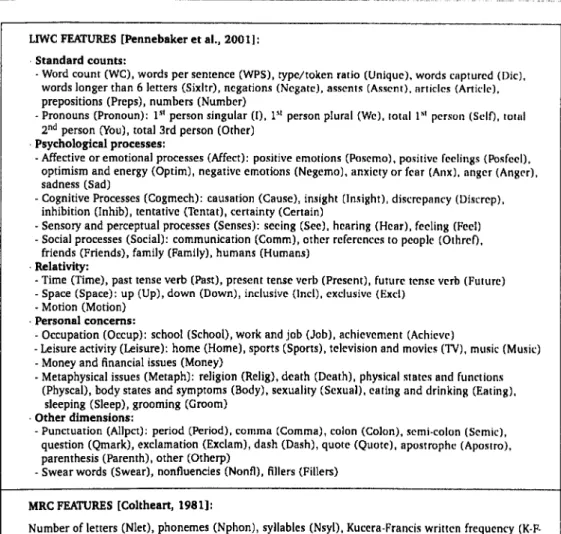
![Table 3.4: Examples of LIWC word categories and MRC psycholinguistic features [Pennebaker et aI., 2001, Coltheart, 1981]](https://thumb-us.123doks.com/thumbv2/123dok_us/10981397.2986030/51.839.188.659.184.423/table-examples-liwc-categories-psycholinguistic-features-pennebaker-coltheart.webp)
![Table 3.7: Pearson's correlation coefficients between LIWC features and personality ratings for the essays dataset, based on the analysis from Pennebaker and King [1999] (* = significant at the p < .05 level, ** = p < .(1](https://thumb-us.123doks.com/thumbv2/123dok_us/10981397.2986030/56.842.166.692.144.842/pearson-correlation-coefficients-features-personality-analysis-pennebaker-significant.webp)