Decision Analysis For Renewable Energy
Technology Selection: Delta State Of Nigeria As A
Case Study
Oseweuba Valentine Okoro,
Abstract: Recent concerns over global warming as well as other well documented environmental impacts which arise from the utilisation of fossil fuels has led to intensified investigations to identify possible energy alternatives. These investigations sought to establish the feasibility of alternative energy sources to meet not only the increasing demand requirement but ultimately facilitate the realisation of the hypothetical ‘Zero net Carbon’ pollution target. However, while energy and environment enthusiasts consistently insist on the viability of Renewable Energy Technologies (RETs) as a conduit for meeting energy demand without compromising the need for sustainability, deciding which RET or indeed combination of RETs will be most appropriate based on the existing economic, legal as well as environmental framework remains a realistic challenge. This investigation therefore attempted to present a decision making process that will consider the four criteria inputs widely recognised as requirements for sustainable development. The RETs where subsequently evaluated via the consideration of these criteria as the only requirement for RET selection assuming the region under consideration was independent of the grid or a fossil fuel generator. The approach employed therefore presented a valid method for an initial and basic appraisal of RETs in the development of sustainable energy systems, with the defining assumption being that the technical indicator incorporated the ability of the RET to meet the primary load. A preferential ranking was finally achieved via the utilisation of simple matrix models thus facilitating the development of a theoretical basis for the practical implementation of the most appropriate RET.
Keywords: Renewable Energy Technology, Zero net Carbon, Sustainable energy systems, Sustainable development, Matrix model, Decision making
————————————————————
I.
I
NTRODUCTIONConcerns over carbon dioxide accumulation, considered as a necessary requirement for global warming and the increasing global energy demand has encouraged efforts to increase the share of renewable energy in the global energy mix [1]. While this trend is expected to continue globally, the relevance of Renewable Energy Technology (RET) is further reinforced by need to improve the quality of life as well as the potential enhancement of livelihood in developing countries with over 350 million households currently without access to electric power supply [2]. Indeed, [3] stated that the attainment of sustainable development in Africa is limited by the imminent energy crisis in the continent while suggesting that Africa will sufficiently resolve the existing energy problems via appropriate infrastructural support to facilitate the utilisation the abundant renewable resources in the continent. According to [4] the Nigerian state is therefore uniquely poised to explore conclusively the possibilities of RET utilisation due to her vast alternative energy resource base emphasising that the utilisation of only 0.1% of the total solar energy radiant on the country's land mass converted at an efficiency of 1% would sufficiently meet the total energy demands of the nation. Having appreciated fully the nature of the energy challenge facing the continent and indeed the Nigerian state [5] suggested that a decentralised energy generation based on renewable energy technologies will be sufficient to meet the energy needs of the country and indeed Delta state. However, the problem of selecting the appropriate renewable energy source suitable for the region remains largely undisputed with [6] establishing that multi-criteria analysis can provide a technical-scientific decision making support that will justify and clearly rank the renewable energy alternatives under
consideration. The study will therefore explore possible Renewable Energy Technologies that can be utilised in meeting the energy needs of Delta state of Nigeria while establishing an appropriate hierarchy for the identified RETs based on the peculiarities of the region. The analysis considered all common RETs with the exception of Biodiesel and Bio ethanol due to the poor technology maturity of the 3rd generation bio fuels processes and the possible competition with existing food sources within the state [7]. This study therefore explored the following RETs:
Wind energy (WE) Geothermal energy(GE) Solar energy(SE)
Biomass energy via Anaerobic Digestion Conversion technology(AD)
Small hydro(SH)
Wave and tidal technologies(WT)
This targeted investigation is based on an absolute recognition of the unfortunate reality of an almost not existent stable energy source within Delta state even though the region accounts for a bulk of the GDP via oil exports [8].
II.
DETERMINATION OF THE RELEVANT
CRITERIA AND INDICATOR FOR THE ANALYSIS
According to [9] in considering the sustainability indicators for energy systems it is important to introduce criteria that illustrate the efficiency, installation cost, anticipated CO2 emissions as well as the area utilised by the energy source. Lior[10] also suggested that since the RET considered are relatively very large and complex the choice of criteria or indicators must incorporate both quantitative and qualitative determinants inherent in the technical, economic, environmental and social components. Indeed [11] emphasised that these selected criteria must clearly show the inter linkages and trade-offs among various dimensions of sustainable development while clearly illustrating the longer-term implications of current decisions and behaviour. Therefore, if M alternatives are to be considered with respect ___________________
Oseweuba Valentine Okoro, Energy Management, Department of Physics , University of Otago ,
184
to N criteria then the best alternative is the RET that will satisfy and maximise the following expression: Where is the actual value of the ith alternative in terms of the jth criterion, and wj is the weight of importance of the jth criterion. The total value of each alternative is equal to the sum of products. In the determination of the most appropriate criteria for sustainable energy planning [12] emphasised that the choice of the criteria is largely dependent on the purpose of the indicators. Blackwood and Kurka [13] subsequently stated that the determination of the relevant criteria, which can be selected via the utilisation of a participatory-based methodology involving identified stakeholders must reflect the four distinct aspects of sustainability that interrelate namely environmental, economic, social and technical, thus presenting an appropriate range of indicators that will be utilised in this analysis. While these indicators can be explored via a myriad of criteria [14] suggested that the most appropriate criteria selected must be relevant across the State, reflect the characteristics of the RETs under consideration as well as incorporate localised concerns such as impacts due to possible noise and odour pollution within Delta State. Demirtas [15] therefore suggested a potentially decisive range of criteria, which he asserts, upholds the sustainable development doctrine in renewable energy planning. Indeed, he inferred that an assessment of RETs via the utilisation of criteria identified as inputs for the analysis would guarantee self-sufficiency within any region and indeed Delta State. Table 1 therefore examines the selected criteria, which includes both quantitative and qualitative aspects. A consideration of table 1 will show that each criterion identified will support the development of an appropriate hierarchy structure that is not only operational but also upholds completeness and decomposability while also eliminating redundancy. Goodwin and Wright [16] subsequently emphasised that these characteristics constitute the core requirements underlying the viability of the any hierarchy structure utilised in MCDA.
Table 1: The identified indicator and criteria for RET in Delta State [17], [18], [19]
Indicators Criteria
Technical
The capacity of energy production or Conversion efficiency : Refers to the actual energy output feasibility and the ability to meet the load
Technological Maturity: The level of existing utilisation of the technology
Reliability: The reliability of the technology , the level of variability
Safety(Public): Level of risk involved
Economic
Capital Cost: The start-up cost required for the RET
Operation and Maintenance Cost: The running cost required for the RET
Lifespan: the expected life cycle of the RET
Payback: the period required for the RET to break even
Environmental
(GHG) Emission (CO2 equivalent)
Impact on the Ecosystem
Social
Social Benefits:
Acceptability of the RET: Based on the perceptions of the local residents
III.
CHOOSING THE APPROPRIATE DECISION
MAKING APPROACH
As earlier established the study area will be restricted to Delta state located in the South - South geopolitical region of Nigeria, with Multi Criteria Decision Analysis (MCDA) utilised as suitable decision-making tool to establish a suitable hierarchy which illustrates the suitability of selected RET via the exploration of quantitative and qualitative data. According to [20] MCDA is considered as an umbrella term used to describe a collection of formal approaches which seek to take explicit account of multiple criteria to facilitate decision making. According to [21], while several MCDA methods, such as the ANP, fuzzy TOPSIS and fuzzy ELECTRE exist, the extreme difficulty in establishing a convincing decision and the complexity of the ANP as well as the ‘fuzzy’ nature of other MCDA techniques, which attempt to reflect vague rather than the definite judgments of decision makers suggested the need for a more systematic approach in this investigation. It was therefore suggested that Analytical Hierarchy Process (AHP) which incorporates a hierarchical structure analysis developed via definite decisions will be most appropriate for the analysis. According to [22], the AHP is a MCDA tool that uses a multi-level hierarchical structure of objectives, criteria (or sub-criteria) as well as alternatives while simultaneously incorporating pair-wise comparisons as a method to obtain the weights of importance of the decision criteria consequently significantly improving the consistency of the weightings. Alessio and Ashraf [23], subsequently identified a potentially critical characteristic of this tool by identifying the completeness of the AHP approach for ‘qualitative–quantitative’ investigation while simultaneously emphasising that the technique facilitates the analysis of quantitative as well as qualitative criteria and alternatives on the same preference scale.
Table 2: Fundamental scale for assigning numerical values to judgements [24]
Intensity of
Importance Definition Explanation
1 Equal Importance
Two RET contribute equally to the objective
3
Moderate Importance
Experience and judgement
5 Strong Importance
Experience and judgement
strongly favour one RET over another
7
Very strong Importance
A RET is favoured very strongly over another; its
dominance is
demonstrated in practice
9 Extreme Importance
The evidence favouring oneRET over another is of the highest possible order of affirmation
2,4,6,8
For compromise between the above values
Sometimes one needs to interpolate a compromise judgement numerically because there is no good word to describe it
Reciprocals of above
If activity i has one of the above values assigned to it when compared with activity
j, then j has the reciprocal
value when
compared to i.
A comparison mandated by choosing the smaller element as the unit to estimate the
larger one as a multiple of that unit
Ratios Ratios arising from the scale
If consistency were to be forced by obtaining n numerical values to span the
matrix
1.1 – 1.9
For tied activities
When RETs are close and
nearly indistinguishable, moderate is 1.3 and extreme
is 1.9
IV.
METHODOLOGY
This investigation was approached through the utilisation of both secondary data obtained via desk study (literature review) and primary data obtained via questionnaires and interviews to achieve the identified objective of the study. Since the relevance of stakeholder views to RET implementation is largely undisputed, primary data was obtained to establish the qualitative perceptions regarding the selected RET. Indeed, the research ultimately presented a problem which may be considered as a decision matrix m × n where m refers to the renewable energy alternatives to be assessed based on n
attributes with each element Yij being the j-th attribute value of the i-th alternative [25]. The investigation subsequently utilised both quantitative attributes such as cost and qualitative attributes based on social impacts as well as individual
perception. Indeed the Analytical Hierarchy Process (AHP) model utilised expressed a Multi- Attribute Rating Technique (MART) that reflected the unique peculiarities of the selected rural area while also facilitating the ranking of the established renewable energy sources. The proposed technique also belongs to the Decision Support Systems (DSS) and is based on a pair-wise comparison model [26].
Figure 1 therefore summarises possible parameters that will serve as a suitable criteria for the ranking of identified
Renewable Energy Technology
Figure 1: showing possible parameters that will constitute the source of the attributes [27].
186
VI.
QUALITATIVE
PRIMARY
DATA
COLLECTION- PHASE 1
Recognising the importance of the accuracy of data collected, this study was undertaken via a stage wise data collection process, to guarantee sufficient time for analysis and minimise judgemental errors. The first phase of the data collection, involved an initial structured face-to-face interview with five energy experts at a location close to the University of Abertay, to facilitate a presentation of the perceived data challenge. A period of eight days, from 10th of July 2014 to the 17th of July 2014 was encouraged to increase the accuracy of judgments with respect to the weightings of the criteria and the indicators previously identified. While the subjectivity of the data collected was fully recognised, attempts were made to extensively analyse data collected to establish the consistency of responses. All questionnaires (5) were collected on the 17th of July from the Energy Experts.
VII.
QUALITATIVE
PRIMARY
DATA
COLLECTION- PHASE 2
Due to the technical nature of the study and the recognition of the fact that the survey will involve individuals with varying levels of understanding, an attempt was made at utilising simple representations in the questionnaires to fully illustrate the anticipated outcomes regarding the qualitative aspects of the study. This approach attempted to provide an insight into the qualitative aspects of the investigation via incorporation of the perceived social benefits and acceptability. The questionnaires were subsequently sent electronically via e-mail to different respondents, resident in Delta state and a period of about two weeks, from the 17th of July to the 31st of July, encouraged for the completion of the questionnaires. 18 of the 25 administered questionnaires were returned within the stipulated period, with only 15 of the respondents indicating an understanding of RETs. This response of the respondents was however largely encouraging since an ‘above average’ response rate as suggested by [30] for questionnaire-based surveys was achieved.
VIII.
QUANTITATIVE
SECONDARY
DATA
ANALYSIS
Having established quantitative assessment of the RETs via secondary data collation for the technical, environment and economic indicators, objective comparison was achieved via the utilisation of arbitrary scales as shown in table 3 and table 4 to facilitate a numerical comparison.
Table3: Proposed Scale for comparing RETs (Inverse relationships with magnitude)
Comparisons adapted from literature
Negligible Small Moderate Large Very Large
Proposed Scale (Numerical)
8 6 4 2 0
Table 3 will facilitate comparisons for parameters that exhibit inverse relationships with magnitude, such as cost (both
economic and environmental) and the payback period
Table 4: Proposed Scale for comparing RETs (Direct relationships with magnitude)
Comparisons adapted from literature
Negligible Small Moderate Large Very Large Proposed Scale
(Numerical) 0 2 4 6 8
Table 4 will facilitate comparisons for parameters that exhibit direct relationships with magnitude, such as reliability, safety,
acceptability and the lifespan.
IX.
MODEL DEVELOPMENT
The model to be explored for the indicators is therefore illustrated in Table 5.
Table 5: Showing the determination of the elements of the comparison matrix
Indicators Technical (T)
Economic (Ec)
Environmental (En)
Socia l ( S) Technical(T)
Economic (Ec) Environmental (En)
Social (S)
Resulting comparison matrix A =
Where will illustrate the importance of indicator i as
compared with indicator j Similarly, comparison matrix models for each criteria identified
X.
ANALYSIS OF DATA
Having successfully identified the goal of this MCDA while simultaneously determining suitable criteria to facilitate the realisation of the goal, the AHP as illustrated by [31] involved the following steps: Establishing the Multi Criteria Challenge as a hierarchy (Indicators, criteria and RET alternatives);
Comparing each element in each corresponding level with 1-9 Saaty scale;
Undertaking calculations to find the maximum Eigen value, consistency index (CI), consistency ratio (CR). and normalising values for each criteria and;
Finally, taking a decision regarding the validity of the maximum Eigen value, CI and CR. The procedures were repeated if the values are unsatisfactory until the desired range is reached.
0.05 for a 3-by-3 matrix;
0.08 for a 4-by-4 matrix; and
0.1 for larger matrices
These standards as presented where strictly adhered to in the utilisation of the online AHP utility tool
(Software
source: http://bpmsg.com/academic/ahp_calc.php)
All possible combinations for the four indicators are determined by the combination function , (2 indicators selected at a time from 4)
= = = 6 possible arrangements
Similarly the Technical and the Economic indicators having four criteria will have six possible comparisons, while the Environmental and Social indicators having two criteria will have ;
,
= = = One (1) possible comparison.
Similarly all possible combinations for the six RET is determined by the combination function , (2 criteria selected
at a time from 6) indicating = =15 possible
comparison for the RET based on each of the criteria identified from literature.
XI.
RESULTS
Having explored the Analytical Hierarchy Process (AHP) as the suitable decision making tool to facilitate the MCDA for the selected RETs, the weightings of the indicators and criteria were subsequently determined via the utilization of the AHP online utility tool while also ensuring that the consistency ratio requirement was firmly upheld. The technique utilised facilitated the determination of the Eigen value which according to [33] is considered as the scalar λ associated with an Eigenvector V such that considering the selected indicators, the pair wise comparison matrix A is given by:
Where will illustrates the importance of indicator i compared
with indicator j, with the subsequent square of each pair wise comparison matrix B defined such that:
B x V = λ V, where B is the square of the matrix generated (or comparison matrix) and CR is:
CR= , where RI is the random index;
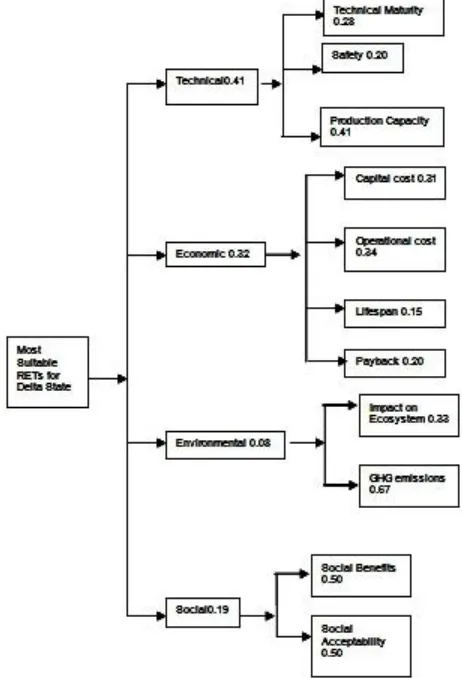
And CI = , where = maximal Eigen value Indeed, the final Eigen value indicates the weightings required for the analysis. This investigation was therefore able to establish the comparison matrix as well as the weightings of the identified indicators and criteria based on the expert perceptions, views of the sample population considered as well as secondary data obtained from literature. At the end of the pair wise comparisons executed via the AHP online utility tool the final relative weightings of the indicators and selected criteria considered were established and shown in Figure 2. A consideration of the weightings indicated in Figure 2 will suggest that the technical Indicator is the most important consideration in the analysis of the alternatives based on assertions as presented by the Energy Experts. Finally, to
resolve the MCDA challenge, this analysis summarised the data obtained into resolution matrices such that: The final result: 6 ×12 matrix [which is RET × Criteria weightings] matrix
× 12 × 1matrix [which is Corrected Criteria weightings] = 6 ×12 matrix [RET Ranking]
Figure 2: Final relative weightings of the indicators and criteria
The matrix resolution resulted in the determination of an appropriate ranking as shown in table 6.
Table 6: The final ranking of the RETs considered
RET
Weightings Ranking Anaerobic Digestion 0.172 Third
Wave and Tidal Energy 0.129 Fifth
Wind Energy 0.194 Second
Small Hydro Energy 0.251 First (Best)
Solar Energy(Thermal and PV) 0.124 Sixth
188
XII.
DISCUSSION OF RESULTS
It satisfies logic to suggest that the ‘hydro geological’ structure of Delta state, cost competitiveness, reliability as well as the obvious familiarity of hydro power as a core component of the Nigerian energy mix supports the validity of the selection of the Small Hydro Energy plant as the most appropriate RET for Delta State. Indeed the Small hydro is widely recognised as the best solution to power generation and electrification difficulties in isolated rural communities. Small Hydro plants therefore aid in filling the gap of decentralised production for both private and municipal activity production subsequently placing the RET in the forefront of targeted attempts by the developing world to achieve self-sufficiency in energy generation [34]. Kaunda, Kimambo and Nielsen [35] also supported this assertion when they suggested that Small Hydro Power (SHP) remains a very efficient energy technology because electricity is generated directly from the shaft power. Indeed, the RET is considered as a well-matured technology as in the case with solar Photo Voltaic and wind energy systems. This important observation perhaps constitutes the core consideration in most Asian countries such as India, Peru, and China where SHP technology is already being applied as one of the major energy interventions [36], [37], [38]. It is therefore clear that the selected RET will be critical in strengthening energy security while significantly reducing energy dependency on the National grid provided of course that policies that encourage investment in the technology are conceived and initiated.
XIII.
CONCLUSION
Having recognised the significance of RETs as a realistic alternative to the existing non-sustainable power systems operating in Delta State this investigation sought to establish the most suitable RET for Delta State of Nigeria based on the unique peculiarities of the state without compromising the need for sustainable development. The investigation, while elucidating the most pivotal criteria in the MCDA, achieved the sole aim of the analysis: To evaluate each selected renewable energy source based on identified attributes: This challenge was resolved via an establishment of criteria that will constitute the basis of the AHP analysis to be explored as determined from literature. It involved an exploration of the MCDA method while simultaneously highlighting the advantages of the AHP methodology selected for the ranking procedure. Primary and secondary data were subsequently utilised as inputs for the analysis. While it is clear that the aim of this research were achieved, the results cannot be generalised due to the relatively small sample size utilised, suggesting the need for a more robust research with respect to the ranking of RETs. This analysis however sought to propel critical thinking with special attention given to the identification of attributes and criteria considered as pivotal constituents of the AHP. These criteria were subsequently invoked in ranking the identified RETs while simultaneously ensuring that the need for sustainability was firmly upheld.
XIV.
RECOMMENDATION
While this investigation was able to recognise the viability of the AHP as a powerful decision making tool, limitations with respect to secondary data collection as well as the limited spread of the questionnaire survey utilised suggests the need for a more thorough approach to data collection. Indeed the utilisation of workshops involving identified energy experts to
aid primary data collection presents a realistic medium to significantly improve the quality of energy expert responses. A more holistic approach that incorporates a greater respondent sample size should also be explored to guarantee a better representation of the views and perceptions of the residents of the state while also ensuring that residents are provided with the necessary information with respect to the advantages and disadvantages of various RETs. This ‘education-themed’ approach will facilitate a more educated response with respect to the qualitative datacollation, which is the integral requirement for the analysis of the social indicator component. It also satisfies logic to recommend the possibility of future researches involving other Multi- Criteria Decision Analysis methods such as ANP, fuzzy TOPSIS and fuzzy ELECTRE thus facilitating a comparison of results obtained. While the exploration of the ‘optimum mix’ of RETs should also be considered as a future research possibility, the determination of the ability of the suggested RET systems to meet demand should be modelled via simulation software (such as Homer), thus further eliminating the need for extrapolation of secondary data from literature. Indeed future research into the viability of sustainably combining RETs will constitute an invaluable step towards the resolution of power generation challenges of the African continent via a clear promotion of micro generation in homes in rural areas.
A
CKNOWLEDGMENTI would like to thank Professor David Blackwood of Abertay University for his input throughout this investigation. His enthusiasm for research made the research progress steadily.
R
EFERENCES[1] Openshaw, K. 2010. Renewable Energy and Development. Journal of Tropical Forest Science 22(1): pp. 5-6
[2] Sadorsky, P. 2012. Modeling renewable energy company risk. Energy Policy.40(1): pp 39-48
[3] Bugaje, I.M. 2006. Renewable energy for sustainable development in Africa: a review. Renewable and Sustainable Energy Reviews.10(6): pp. 603- 612
[4] FMST.1987. Policy guidelines on energy for Nigeria. The Federal Ministry of Science and Technology (FMST) Abuja, Nigeria
[5] Okoro,O.V. 2014.Electric Power Industry Restructuring In Nigeria. International Journal of Scientific and Technology Research.3(4): pp78-84
[6] Catalina, T. Virgone, J. ; Blanco, E. 2010. Multi-Criteria Decision Analysis of Multi-Source Systems and Renewable Energy Integration. Scientific Bulletin. Series, Mathematical Modeling in Civil Engineering . 4(1):pp. 18-24.
[8] Oviasuyi, P.O. and Uwadiae, J. 2010. The Dilemma of Niger-Delta Region as Oil Producing States of Nigeria. Journal of Peace, Conflict and Development.1(16): pp. 110-126
[9] Afgan, N.H, Carvalho,M.G. and Hovanov, N.V. 2000. Energy system assessment with sustainability indicators. Energy Policy. 28. pp. 603-612
[10] Lior, N. 2010. Sustainable energy development: The present (2009) situation and possible paths to the future. Energy. 35(10): 3976-3994.
[11] International Atomic Energy Agency (IAEA) et al.2005.Energy indicators for sustainable development:Guidelines and methodologies. Vienna: IAEA
[12] DESA. 2007. Indicators of Sustainable Development:Guidelines and Methodologies.3rd edition. New York. United Nations
[13] Blackwood, D. and Kurka, T.2013.Participatory selection of sustainability criteria and indicators for bioenergy developments. Renewable and Sustainable Energy Reviews.24: pp.92-102
[14] Defra et al .2004. Planning for Renewable Energy:A Companion Guide to PPS22. Queen’s Printer and Controller of Her Majesty’s Stationery Office. [online]. Available
www.waveney.gov.uk/site/scripts/download.php?fileID=8 22 [Accessed 30 August 2014].
[15] Demirtas, O. 2013a. Evaluating the Best Renewable Energy Technology for Sustainable Energy Planning. International Journal of Energy Economics and Policy.3: pp.23-33
[16] Goodwin, P., and Wright, G. 2010.Decision Analysis for Management Judgement. 4th edn. Chichester: John Wiley and Sons Ltd
[17] Demirtas, O. 2013b. Evaluating the Best Renewable Energy Technology for Sustainable Energy Planning. International Journal of Energy Economics and Policy.3: pp.23-33
[18] Afgan, N.H, Carvalho,M.G. and Hovanov, N.V. 2000. Energy system assessment with sustainability indicators. Energy Policy. 28. pp. 603-612
[19] Baysal, M.E. et al .2011. The Selection of Renewable Energy Power Plant Technology Using Fuzzy Data Envelopment Analysis. Proceedings of the World Congress on Engineering Vol II WCE July 6 - 8, London, U.K
[20] Belton, S. and Stewart, T.S., 2002. Multiple Criteria Decision Analysis. An Integrated Approach. Massachusetts.: Kluwer Academic Publishers
[21] Aruldoss, M., Lakshmi,T.M. and Venkatesan,V.P. 2013. A Survey on Multi Criteria Decision Making Methods and Its Applications. American Journal of Information Systems 1(1):pp. 31-43
[22] Mann, S.H. and Triantaphyllou, E. 1995. Using the Analytic Hierarchy Process for Decision Making In Engineering Applications: Some Challenges. International Journal of Industrial Engineering: Applications and Practice. 2 (1):pp. 35-44
[23] Alessio, I. and Ashraf, L. 2009a. Analytic Hierarchy Process and Expert Choice: Benefits and Limitations. ORInsight 22(4): p. 201–220
[24] Saaty, T.L, 1994a. How to make a decision: The analytic hierarchy process. Interfaces. 24(6): pp.19-43.
[25] Xu, L. and Yang, J. 2001. Introduction to Multi-Criteria Decision Making and the Evidential Reasoning Approach. Working Paper No. 0106. [online]. Available from:
https://php.portals.mbs.ac.uk/Portals/49/docs/jyang/XuY ang_MSM_WorkingPaperFinal.pdf[Accessed 09 May 2014].
[26] Leleur,S.2012. Complex Strategic Choices: Applying Systemic Planning for Strategic Decision Making. London: Springer.
[27] Haralambopoulos, A., Munda, G. and Vreeker, R. 2006. Selecting an Appropriate Multi-Criteria Decision Analysis Technique for Renewable Energy Planning. Energy Sources, Part B. 1: pp181-193
[28] Naoum, S.G. 2007. Dissertation research and writing for construction students. 2nd ed. London: Butterworth-Heinemann publisher
[29] Bryman, A.2012. Social Research Methods.4th ed. Great Clarendon: Oxford.
[30] Instructional Assessment Resources (IAR) 2011. Response rates. [online]. Available from: https://www.utexas.edu/academic/ctl/assessment/iar/tea ching/gather/method/survey-Response.php [Accessed 21 August 2014].
[31] Saaty, T.L. 1980. The analytic hierarchy process: planning, priority setting, resource allocation. California: Mcgraw-Hill International Book Company
[32] Saaty, T.L, 1994b. How to make a decision: The analytic hierarchy process. Interfaces. 24(6): pp.19-43.
[33] Alessio, I. and Ashraf, L. 2009b. Analytic Hierarchy Process and Expert Choice: Benefits and Limitations. ORInsight 22(4): p. 201–220
http://www.e-190
renewables.com/documents/Hydro/Small%20Hydropow er%20Projects.pdf[Accessed 16 August 2014].
[35] Kaunda, C.S., Kimambo, C.Z. and Nielsen, T.K. 2014. A technical discussion on microhydro power technology and its turbines. Renewable and Sustainable Energy Reviews. 35(1): pp. 445–459
[36] Singal, S. 2009. Planning and implementation of Small Hydropower(SHP) projects. HydroNepal,No. 5, July. [online]. Available from: http://www.mtnforum.org/sites/default/files/pub/6220.pdf. [Accessed 16 August 2014].
[37] Ghosh,A., Majumdar, S. and Kaur, A. 2012.Steady growth in small hydro power, however significant, challenges remain. ICRA (Investment Information and Credit Rating Agency of India Limited) Rating Feature. [online]. Available from: http://www.icra.in/Files/ticker/SHP%20note-.pdf.
[Accessed 16 August 2014].
![Table 1: The identified indicator and criteria for RET in Delta State [17], [18], [19]](https://thumb-us.123doks.com/thumbv2/123dok_us/9047513.1440770/2.612.35.292.496.740/table-identified-indicator-criteria-ret-delta-state.webp)
![Figure 1: showing possible parameters that will constitute the source of the attributes [27]](https://thumb-us.123doks.com/thumbv2/123dok_us/9047513.1440770/3.612.41.297.53.595/figure-showing-possible-parameters-constitute-source-attributes.webp)