UNIVERSITY OF UDINE
Department of Electrical, Management and Mechanical Engineering
PhD in Industrial and Information Engineering
CYCLE XXVII
PhD THESIS
A system for recognizing human emotions based on speech analysis and
facial feature extraction: applications to Human-Robot Interaction
Supervisor:
Professor Alessandro Gasparetto
By:
Mohammad Rabiei
analysis and facial feature extraction: applications to Human-
Robot Interaction
Foremost, I would like to express my deepest thanks to my
Professor Alessandro
Gasparetto for allowing me to conduct this research under his auspices. I am especially
grateful for his confidence and the freedom that he gave me to do this work. Without a
coherent and illuminating instruction, this thesis would not have reached its present form.
I wish to thank to my family for their encouragement. Without the support of all members of
my family, I would never finish this thesis and I would never find the courage to overcome all
these difficulties during this work. My thanks go to my parents for their confidence and their
love during all these years.
I extend my sincere thanks to all members of the Department of Electrical, Mechanical and
Managerial Engineering (DIEGM) of University of Udine, (ITALY) and all those who
contributed directly or indirectly to the dissertation.
I am deeply grateful to all members of the jury for agreeing to read the manuscript and to
participate in the defense of this thesis.
I also want to thank the all my friends and my colleagues in the laboratory for their kindness
and help. Finally, I express my sincere gratitude to who kindly agreed to recordings their
speech and facial emotion in the emotion recognition system.
To my parents
For unconditionally providing their love, support, guidance and
encouragement throughout my education.
Abstract
X 1- 1- Related work in the speech emotion recognition and Facial features extraction 11-1 Speech emotion recognition 2
1-1-1 Speech processing recognition on basic emotion 3
1-1-2 Speech recognition research in the past 5 years 8
1-1-3 Databases on speech emotion recognition system 12
1-1-4 Modelling and software for classification of speech emotion recognition 14
1-2 Facial feature expression system 15
1-2-1 Facial feature expression on basic emotion 16
1-2-2 Facial feature expression on basic emotion in the past 5 years 24
1-2-3 Databases for facial feature extraction system 28
1-2-4 Face detection and facial expression APIs and software 30
1-3 New hybrids model on emotion recognition system 32
2- 2. Methodology and scenarios for emotion recognition system 34
2-1 Ontology for human robot interaction 35
2-1-1 Ontology for conceptslayer 35
2-1-2 Ontology for device layer 37
2-1-3 Ontology for speech recognizer 37
2-1-4 Ontology for facial detection 39
2-1-5 Ontology for design layer 39
2-1-6 Ontology for interaction layer 41
2-2 Methodology in speech emotion recognition system 44
2-3 Methodology in facial feature extraction system 46
2-4 Hybrid algorithm for emotion recognition system 49
2-5 Basic emotion Theory 50
2-6 Mathematical Methods for emotion recognition 51
2-6- Bezier curve 51
2-6-2 Support Vector Machine (SVM) 57
2-7 Open-source toolkit for sound recognition 58
2-7-1 OpenEAR toolkit 58
2-7-2 PRATT Software 58
2-8 Programming in C/C++ and open CV 60
3- Implementation the emotion recognition system 62
3-1 Speech features extraction 62
3-1-1 Pitch features extraction 63
3-1-4 Speech rate features extraction 77
3-2 Facial features extraction 78
3-1-1 Eyes and Mouth Localization 78
3-1-2 Eyebrows and Nose Localization 79
3-3 Speech features classification 82
3-4 Facial features classification 84
3-4-1 Bezier curves for facial features classification 84
3-4-2 Action Units (AUs) for facial features classification 86
4- Evaluation the human emotion recognition system 92
4-1 Rules extraction for emotion recognition system 92
4-1-1 Rules extraction on speech interaction 92
4-1-2 Facial features rules extraction 93
4-2 Evaluation and the results of implementation emotion recognition system 96
4-2-1 Results on speech emotion recognition 96
4-2-2 Results on emotion recognition facial features expression 102
4-3 Training of the emotion recognition system 107
4-4 Evaluation of the results on emotion recognition in hybrid system 109
5- Conclusion 111
Figure
Figure 1-1 Emotion recognition in two-dimensional 3 Figure 1-2 Three-dimensional emotion space (activation, potency, and valence) and six basic emotions 4 Figure 1-3 Feature groups and number of features for speech emotion recognition 8 Figure 1-4 The role of muscles in facial expression in (FACS) 16 Figure 1-5 Different source of facial expressions 17 Figure 1-6 Distinction of feature extraction and representation 18 Figure 1-7 Outline of the facial point detection method based on Viola–Jones face detector algorithm 20 Figure 1-8 Overview of the system based on PCA and SVM for detection of Action Units and emotions 20 Figure 1-9 Outline of the proposed the system for recognition of AUs 21 Figure 1-10 The main functionalities for facial emotion recognition 22 Figure 1-11 FDPs used for recognizing facial expression and definition of distances 22 Figure 1-12 Vikia has a computer generated face and different face robots (Science University of Tokyo) 23 Figure 1-13 SVM classifier system used for facial expression recognition 25 Figure 1-14 Example of landmarks, geometric features and texture regions 27 Figure 1-15 Framework on automatic facial expression system 30 Figure 2-1 Map of architecture, relationships between the architecture, design and ontology 36 Figure 2-2 The architecture of a speech emotion recognition engine 37 Figure 2-3 Automatic speech recognition (ASR) and storage in global context (data base) 38 Figure 2-4 The HRI system architecture showing task-skill action from top to bottom 40 Figure 2-5 Behavior controller system to connected action and behavior 42 Figure 2-6 Example of speech analysis with the PRAAT program 45 Figure 2-7 Model of the system for emotion recognition 45 Figure 2-8 Diagram of the proposed methodology for facial features expression 47 Figure 2-9 Original image (left side) and the binary image (right side) 47 Figure 2-10 Face detection steps: (a) full frame photo (b) Zoom on face (c) feature candidate areas 48 Figure 2-11 Diagram of the hybrid system methodology 49 Figure 2-12 Interaction of the basic emotions with each other 50 Figure 2-13 The two initial functions base on Bézier curves model 51 Figure 2-14 The graph of Bézier Curve with four point 53 Figure 2-15 Result of Bézier curve form five principle facial feature 53 Figure 2-16 Change non liner space to linear with kernel 57 Figure 3-1 Example of speech analysis with the PRAAT program 63 Figure 3-2 Some pitch results from the 15 interviewed persons (Europeans, Americans, and Asians) 64 Figure 3-3 European pitch contours for Happiness and Surprise 65
Figure 3-5 American pitch contours for Happiness and Surprise 66 Figure 3-6 European pitch contours for Anger and Sadness 66 Figure 3-7 Asian pitch contours for Anger and Sadness 67 Figure 3-8 American pitch contours for, Anger and Sadness 67 Figure 3-9 European pitch contours for Anger, Fear and Disgust 68 Figure 3-10 Asian pitch contours for anger, fear and disgust 69 Figure 3-11 American pitch contours for Anger, Fear and Disgust 69 Figure 3-12 European, Asian and American pitch contours for Neutral 70 Figure 3-13 European speaker typical formant contour of basic emotions 71 Figure 3-14 Asian speaker typical formant contour of basic emotions 72 Figure 3-15 American speaker typical formant contour of basic emotions 73 Figure 3-16 European speaker typical intensity contour of basic emotions 74 Figure 3-17 Asian speaker typical intensity contour of basic emotions 75 Figure 3-18 American speaker typical intensity contour of basic emotions 76 Figure 3-19 Anthropometric of human face for features detection 78 Figure 3-20 Eyebrows detection and localization boundary 80 Figure 3-21 Extraction main facial features from image 81 Figure 3-22 Model of the system for speech emotion classification and recognition 82 Figure 3-23 Result of Bézier curves for five principal facial features 84 Figure 3-24 Mutual interaction between facial features and Action Units (AUs) in the proposed system 87 Figure 3-25 Interaction between facial features, basic emotions and Action Units (AUs) 88 Figure 3-26 Facial matrix and 52 landmark points (eyebrows 16, eyes 16, nose 4, lips 16) 89 Figure 4-1 The location of the pitch (range, peak and value) graph for six basic emotions 99 Figure 4-2 Bar chart of the six basic emotions 99 Figure 4-3 The location of the emotions in the three-dimensional graph: pitch (range, peak and value) 100 Figure 4-4 The location of the basic emotions in: total pitch score, intensity and speech rate 100 Figure 4-5 Accuracy in detection of facial features for Europeans, Asians and Americans 102 Figure 5-1 speech recognition database for the participants to experiment 113 Figure 5-2 Graphical interface of speech emotion recognition program 114 Figure 5-3 Extract the facial distances based on universal basic emotions 115 Figure 5-4 Facial feature database (Access) for 32 Action Units 116 Figure 5-5 Interaction between Facial feature database and person emotion 117 Figure 5-6 Fusion of database for emotion recognition system in hybrid system 118 Figure 5-7 Sample of database for play audio file in emotion recognition system 119 Figure 5-8 Software package with hybrid algorithm on emotion recognition system 119
Table 1-1 English Speech Databases for speech recognition 13 Table 1-2 Divided methods that used in facial expression analysis 18 Table 1-3 Action Units included in the facial features detection 19 Table 1-4 Summary of some of the facial expression databases 29 Table 3-1 Speech rate on emotions (average of the 30 experimental tests 77 Table 3-2 Summarizes the procedure for localization of the face features 80 Table 3-3 Basic emotion with different features for recognizing facial expression 85 Table 3-4 Basic emotions and 32 Action Units resulting from feature extraction 86 Table 3-5 Facial features distance measurements for basic emotion expression (15 codes) 90 Table 3-6 Shows the average distances from the corresponding values and neutral. 91 Table 4-1 Rules for emotion classification based sound signal 93 Table 4-2 Basic emotion recognition base on extracted facial Action Units 93 Table 4-3 Set of rules for emotion recognition on hybrid system 95 Table 4-4 Likert type scale for emotion recognition 97 Table 4-5 Percentage of emotions recognized correctly in speech analysis phase-Part (a) 98 Table 4-6 Percentage of emotions recognized correctly 98 Table 4-7 The accuracy recognition of the basic emotions 101 Table 4-8 Facial detection accuracy for (European, Asian and American) 103 Table 4-9 Facial expression detection accuracy in the proposed system 104 Table 4-10 Facial expression recognition accuracy for Europeans, Asians and Americans 105 Table 4-11 Emotion recognition rate (average) for Europeans, Asians and Americans 106 Table 4-12 Facial expression recognition accuracy using the Cohn-Kanade database 108 Table 4-13 Emotion recognition accuracy in hybrid system 109 Table 5-1 Evaluation of proposed system with another literature report 120
With the advance in Artificial Intelligence, humanoid robots start to interact with ordinary people based on the growing understanding of psychological processes. Accumulating evidences in Human Robot Interaction (HRI) suggest that researches are focusing on making an emotional communication between human and robot for creating a social perception, cognition, desired interaction and sensation. Furthermore, robots need to receive human emotion and optimize their behavior to help and interact with a human being in various environments.
The most natural way to recognize basic emotions is extracting sets of features from human speech, facial expression and body gesture. A system for recognition of emotions based on speech analysis and facial features extraction can have interesting applications in Human-Robot Interaction. Thus, the Human-Robot Interaction ontology explains how the knowledge of these fundamental sciences is applied in physics (sound analyses), mathematics (face detection and perception), philosophy theory (behavior) and robotic science context.
In this project, we carry out a study to recognize basic emotions (sadness, surprise, happiness, anger, fear and disgust). Also, we propose a methodology and a software program for classification of emotions based on speech analysis and facial features extraction.
The speech analysis phase attempted to investigate the appropriateness of using acoustic (pitch value, pitch peak, pitch range, intensity and formant), phonetic (speech rate) properties of emotive speech with the freeware program PRAAT, and consists of generating and analyzing a graph of speech signals. The proposed architecture investigated the appropriateness of analyzing emotive speech with the minimal use of signal processing algorithms. 30 participants to the experiment had to repeat five sentences in English (with durations typically between 0.40 s and 2.5 s) in order to extract data relative to pitch (value, range and peak) and rising-falling intonation. Pitch alignments (peak, value and range) have been evaluated and the results have been compared with intensity and speech rate.
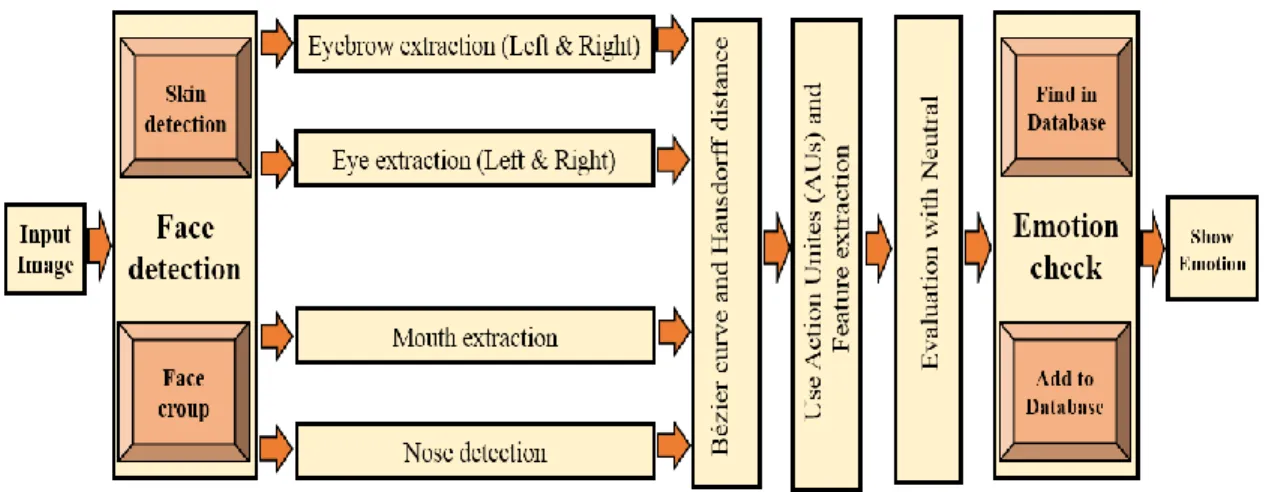
The facial feature extraction phase uses the mathematical formulation (Bézier curves) and the geometric analysis of the facial image, based on measurements of a set of Action Units (AUs) for classifying the emotion. The proposed technique consists of three steps: (i) detecting the facial region within the image, (ii) extracting and classifying the facial features, (iii) recognizing the emotion. Then, the new data have been merged with reference data in order to recognize the basic emotion.
to design a hybrid technique for emotion recognition. Such technique have been implemented in a software program, which can be employed in Human-Robot Interaction.
The efficiency of the methodology was evaluated by experimental tests on 30 individuals (15 female and 15 male, 20 to 48 years old) form different ethnic groups, namely: (i) Ten adult European, (ii) Ten Asian (Middle East) adult and (iii) Ten adult American.
Eventually, the proposed technique made possible to recognize the basic emotion in most of the cases.
Keywords:
Action Units (AUs), Emotion recognition, Facial expression, Human-robot Interaction, Speech analysis.CHAPTER 1
Related work on speech emotion recognition
And
Page | 1 Human-robot interaction has been a topic of science fantasy stories even before any robots existed. Currently uses of human-robot are increasing, costs are going down and sales are growing up. In addition capabilities have been improved specially, in the safest physical communication. However, emotion is fundamental for human’s communication and perception in everyday activities. Although, we are still far from to have an effective emotional interaction between human and robot.
The system for emotion detection refers to the quantitative analysis of verbal and non-verbal communication; focus on behavior, gestures and facial expressions. The researchers in human robot interaction filed have been proposed the new freeware to increase accuracy emotional communication (verbal and non-verbal) between human and Robot.
The core part of this work, introduce the new methodology and program that uses for analysis of emotional states in speech communication, facial features extraction, emotion classification and evaluating the quality of emotion recognition system. By means of designing the new model for emotion recognition system we have been mixed the theory of sound signals and facial features recognition system. We have controlled the implementation of system with new results to create highly optimized emotion states.
In the emotion recognition system have been bused two experiments for classification of emotion stats. Experiment 1 proposed the algorithms for speech emotion recognition. The model have been used (pitch, formant, intensity, speech rate and voice quality) plots. Also, in Experiment 2 the proposed algorithm increases the accuracy of facial emotion detection and recognition system. Then, for improvement the accuracy of classification, the results with fusion of pairwise (speech emotion recognition and facial features extraction).
Finally, the proposed system have been developed on emotion recognition for different ethnic groups with new hybrid emotion recognition software.
In this work the capture 1 divided in three sections. Section 1 gives a brief overview of the previous work on speech emotion recognition, section 2 describes some of the related work on facial features extraction and section 3 gives a short overview of the hybrids model on emotion recognition system.
2 | P a g e
1.1. Speech emotion recognition
With the advance in human-robots interaction robot have been used in society such as toys , service, security guards, teachers, e-learning, diagnostic tool for therapists, search and rescue [1]. Speech emotion recognition has also been used in call center applications and mobile communication [2]. Some works tried to incorporate spoken dialogue system technology and service robots. Psychologists believe that faces to face communication and analysis of speech sounds (words and sentences) are considered as one of the prompt methods for human emotional interaction.
We are still far from having an emotional interaction between human and robot because the machine does not have sufficient intelligent to understand human voice, speech and basic emotional state of the speaker. In human–human communication process, determination of a speaker’s states is more easier than to assessment of communication in human machine interaction, because partner’s in speech process constantly adapt their manner of speaking, based on the culture, mood, gender, mother- tongue age and pre emotion.
Emotion is conveying significantly by verbal and non-verbal signals (body posture, gestures and facial expressions) expressed for determining the conversation. Psychologists believe that for emotional interaction between human and machine, a system must be developed to understand the human emotions in various environments.
However in Encyclopedia emotion means “A mental positive or negative state that present in the life and consistent responses to internal or external events”. Although, the definition of ‘emotion’ in psychologist article is “what is present in most of life but absent when people are emotionless”; this is the concept of pervasive emotion [3].
The human to human interaction consists of two channels, the implicit and explicit channel. The task of speech emotion recognition is very challenging, because it is not clear which speech features are the most suitable, in different cultures and manner to distinguish basic emotions. It is very difficult to determine the boundaries between these portions of basic emotions, sometimes they have slightly overlap with each other. nevertheless, beside the emotional states, the voice and speech signal can conveys a rich source of information about a speaker’s such as; physiological state, age, sex/gender and regional background.
The speech signal is the fastest, efficient and natural method of communication between humans and robot for this reasons numerous studies have been done on speech emotion recognition, for various purposes [4]–[7].
3 | P a g e
1.1.1. Speech processing recognition for basic emotion
Psychiatrists in the 20th century started the empirical investigation of the effect of emotion on the voice signals. The most important works done on emotion recognition through speech analysis are the famous Ekman’s and Fox’s models. In the early 1990s, Ekman and his colleagues have performed extensive work, which led to categorization of emotions into seven basic emotion models (sadness, surprise, happiness, anger, fear, disgust and neutral) and more emotions can be defined by mixtures of the basic emotions [8]. While Fox’s is a multi-level emotional model and involving stimulus evaluation subsequent steps in the generation of emotion [9].
Davidson et al. in 1979 for increases the emotion recognition time, proposed new model to categorize emotions. In this method emotions specified in two axes (arousal and valence). As shown in Figure. 1-1 in vertical axis the arousal represents the quantitative activation and the valence in horizontal axis refers to the quality of basic emotion (positive and negative valence) [10].
Fig. 1-1. Emotion recognition in two-dimensional.
In different comprehensive research Schlosberg proposed a three dimensional emotion space: activation (arousal), potency (power), and valence (pleasure, evaluation). Figure. 1-2 shows the locations of six common basic emotions in the three dimensional emotion space [11].
4 | P a g e
Fig. 1-2 Three-dimensional emotion space (activation, potency, and valence) and six basic emotions. Accordingly, a lot of researches have been done on speech emotion recognition, which is defined as extracting the emotional states of a speaker from his or her speech. It is believed that speech emotion recognition can be used to extract useful semantics from speech [12]. Hence, improves the performance of speech recognition systems.
Several reviews on emotional speech analysis have been done with focused on content of speech signals and classification techniques for recognition of emotions. The most extensive work about automatic emotion recognition from speech signals was done by Yang and Lugger. They had proposed a new set of harmony features for automatic emotion recognition based on the psychoacoustic harmony perception [13]. They had estimated pitch contour of an utterance. Then, calculated the circular autocorrelation of the pitch histogram on the logarithmic semitone scale. In more comprehensive research, several approaches have been proposed to identify the emotional content of a spoken utterance [14]–[16].
Most researchers had reported emotion recognition consists of two major steps, speech feature extraction and emotion classification. However the classification theory in emotion recognition from sound signals developed well extraction of features from speech signals depends on database, algorithm and software design.
The design of speech emotion classification and recognition system have three main aspects. The first one is the choice of suitable features for speech representation. The second issue is the design of
5 | P a g e
an appropriate classification scheme and the third issue is the proper preparation of an emotional speech database for an evaluating system performance [17].
Another challenging issue that helps technical researchers and social psychologists to better recognition of emotions have been designing a model that define culture dependency, regional background and environment of speaker [18].
To date, research on the verbal expression of emotion has demonstrated that many features may be involved. Whereas there has tended to be an overwhelming focus on pitch variables, pitch contour, speech rate, intensity, pausing structure, accented and unaccented syllables and duration of speech. They can provide powerful indications of the speaker’s emotion [19]–[22]. Although researchers tend to pitch, spectral and formant are fundamental importance, relatively little is known about the interaction of pitch, speech rate, intensity and formant in communication.
Experimental support for the basic importance of voice quality can be found by Scherer et al. in1984. Scherer suggests that tense voice is associated with anger, joy and fear; and that lax voice (at the phonation level essentially the same as breathy voice) is associated with sadness [23]. Also, the most extensive work about sound analysis was done by Scherer. This research was based on the vocal communication of emotion and model the complete process, including both encoding (expression), transmission and decoding (impression) of vocal emotion communication. Special emphasis is placed on the conceptualization and operationalization of the major elements of the model (i.e., the speaker’s emotional state, the listener’s attribution, and the mediating acoustic cues) [24].
Some works tried to incorporate feature extraction and analysis the different aspects of emotions in voice [25]–[28]. Also, some researches have been improved the analysis of speech signals graph (pitch value, pitch rate and pitch range) [29]. In 1986 Scherer further asserts that ‘‘although fundamental frequency parameters (related to pitch) are undoubtedly important in the vocal expression of emotion, the key to the vocal differentiation of discrete emotions seems to be voice quality and intensity’’[23].
Numerous studies have been done on the influence of emotions on intonation patterns (more specifically F0/pitch contours) and design a new coding system for the assessment of F0 contours in emotion [30]. Nonetheless, few studies on emotions influence from sound signals have attempted to describe F0 contours (average F0, F0 level or F0 range) for different emotional expressions [31]. A number of authors have claimed that specific intonation patterns (F0/pitch and other vocal aspects) reflect specific emotions [32] [33]. However in recent year, very few empirical studies have focused on
6 | P a g e
the tone sequence models. Tone sequences have been used more extensively than pitch movement algorithm for the description and analysis of linguistic intonation.
The (MSFs) system, described by Siqing et al. (2011). They proposed system (spectral features (MSFs)) for the automatic recognition of human emotion and affective information from sound signals. The features were extracted from Mel-frequency cepstral coefficients and perceptual linear prediction coefficients [34]. The features were extracted from an auditory-inspired long-term spectrum temporal representation and proposed algorithm check classification of discrete emotions and estimation of continuous emotions (e.g. valence, activation) under the dimensional framework. Also, selected features were based on frequency analysis of the temporal envelopes (amplitude modulations) of multiple acoustic frequency bins, thus capturing both spectral and temporal properties of the speech signal [34] . In the past years, researchers were focused on prosodic features, more specifically on pitch, duration and intensity and less frequently on voice quality features as harmonics-to-noise ratio (HNR), jitter, or shimmer [3].
Past researches carried out in the field of automatic recognition of emotion from speech has tended to focus on speech feature extraction, classification, robustness, evaluation, implementation and system integration. One of the most important questions in emotion recognition is how many and which kind of features must be choosing. The answer to this question is important to processing speed of system and memory requirements. The feature selection strategies have been used the most common techniques, namely; Principal Component Analysis (PCA), Linear or Heteroscedastic Discriminant Analysis (LDA), Independent Component Analysis (ICA), Singular Value Decomposition (SVD) and Non-negative Matrix Factorization (NMF) [35]. Arguably the most important phase in emotion recognition is extraction of a meaningful and reasonably set of features. So far there has not been a large-scale Linguistic features. Also, this analyzing and classification depend on the database. The feature extraction method requires some kind of division of features into basic emotion classes.
Principal Component Analysis (PCA) is based on multivariate analyses that use statistical procedure. The model have been invented in 1901. Schölkopf in 1997 used integral operator kernel functions and proposed a new method for performing a nonlinear form Principal Component Analysis (PCA) in speech emotion recognition. By the use of new functions can efficiently compute principal components in high dimensional feature spaces, related to input space by some nonlinear map [35].
Linear discriminant analysis (LDA) is closely related to regression analysis and used in machine learning, pattern recognition and statistics. In emotional speech recognition field researcher used linear discriminant analysis by means of combination of sound features. Potamianos et al. in 2003 proposed
7 | P a g e
a new work on modeling of audiovisual speech feature and decision fusion combination with linear discriminant analysis (LDA). The proposed algorithm have three main subject, namely; bimodal databases, ranging from small- to large-vocabulary recognition tasks, recorded in both visually control and challenging environments [36]. The principle component analysis (PCA) method has been used for improve the accuracy of feature extraction and emotion classification. Also, linear discriminant analysis (LDA) with floating search compares the emotion features extraction.
Independent component analysis (ICA) is the computational method that use non-Gaussian signals for analyses person's that speech in a noisy room. In this system the source of sound signals must be independent each other. Attempts to generate sound recognition system have been made using Independent component analysis (ICA) by MA Casey in 2001. The proposed system used dimension log-spectral features, select robust acoustic features and a minimum entropy with hidden Markov model classifier [37].
Nonetheless, there have been a number of attempts to recognition of speech and musical instrument with Singular Value Decomposition (SVD) and Non-negative Matrix Factorization (NMF) [38]–[40]. The work by Cho et al. in 2003 proposed the system for classification of speech features. This methods was based on feature extraction from Spectrum-Temporal sounds and using the non-negative matrix factorization (NMF) [41].
A speech emotion recognition system consists of various types of classifiers. However, each classifier have its own limitations and advantages. For example in recent year, Hidden Markov Models (HMM) and Gaussian Mixture Models (GMM) generally used in the article with solid mathematical basis and classifier on emotion classification probably [42]–[44].
8 | P a g e
1.1.2. Speech recognition research in the past 5 years
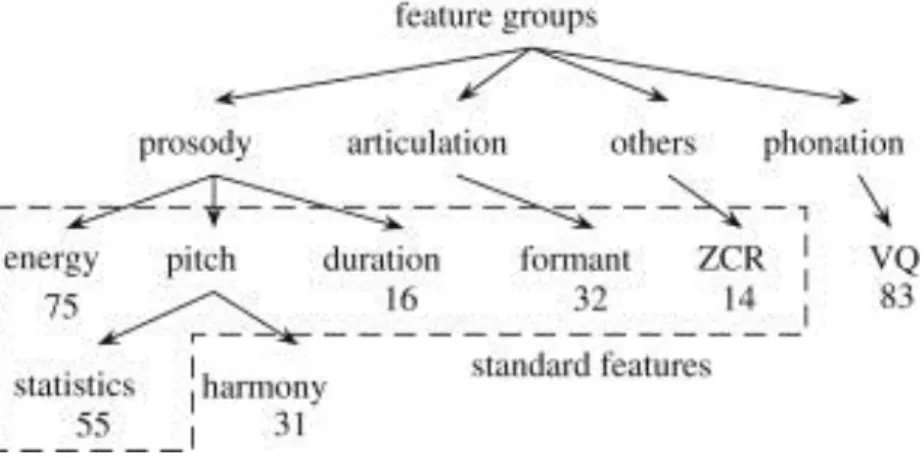
Some of the high quality articles in that issue were dealing with the Automatic Speech Recognition (ASR) model, Speaker Recognition and automatic recognition of realistic emotions in speech with statistical and mathematical procedures. In more comprehensive research Yung and Lugger in 2010 proposed the Mel frequency central coefficients (MFCC) models. The system was successful for speech emotion recognition. As it shows in Figure. 1-3 all features that they used for classification of emotion divided in seven sub branches, namely energy, pitch, duration, formant, statistic, harmony and voice quality [45].
Fig. 1-3 Feature groups and number of features for speech emotion recognition.
As described above some works tried to incorporate the emotional speech with Hidden Markov Models (HMMs), Neural Networks (NNs), Support Vector Machines (SVMs), Gaussian Mixture Models (GMMs) and Meta-Classification by means of extracting certain attributes from speech.
Popular classifiers for emotion recognition such as K-Nearest Neighbor (KNN) classifiers and Linear Discriminant Classifiers (LDCs) have been used since the very first studies. K-Nearest Neighbor (KNN) divide the feature space into cells and are sensitive to outliers.
In the last few years the research in automated speech emotion recognition methods in real time with minimum redundancy – maximum relevance was steadily growing. Kukolja et al. proposed the comparative analysis of methods for physiology-based emotion estimation and the model was combination of mRMR+ KNN for real-time estimator adaptation due to considerably lower combined execution and learning time of KNN versus MLP [46].
9 | P a g e
On the other hand, a natural extension of LDCs is Support Vector Machines (SVM). If the input data have not been transformed linearly, maybe have increased or decreased the number of features and if the linear classifier obeys a maximum-margin fitting criterion, then we obtain SVM.
In obviously related work, Support Vector Machine (SVM) was done with Chen et al. in 2012. They solved the speaker independent speech recognition with new Support Vector Machine (SVM) model for six basic emotions, including happiness, anger, fear, sadness, surprise and disgust. In order to evaluate the proposed system, principal component analysis (PCA) for dimension reduction and artificial neural network (ANN) for classification were adopted to design four comparative experiments, including Fisher + SVM, PCA + SVM, Fisher + ANN, PCA + ANN [47].
As noted in the speech emotion recognition research, small data sets are in general, can better handle by discriminative classifiers [48]. The most used non-linear discriminative classifiers were likely to be Artificial Neural Networks (ANNs) and decision trees. Decision hyper planes learned with Artificial Neural Networks might become very complex and depend on the topology of the network (number of neurons), on the learning algorithm.
With the new approach in speech emotion recognition systems Stuhlsatz et al. proposed the new model for Generalized Discriminant Analysis (GerDA). This model was based on Deep Neural Networks (DNNs) by means of feature extraction and classification [49]. The GerDA was able to optimize the acoustic features in real time and used simple linear classification.
The essence of speech emotion analysis is evaluating the emotional speech in different environments. Gao et al. used Hidden Markov Models (HMMs) to evaluate the emotional recognition performance [50]. Among dynamic classifiers, HMM have been used widely in speech and speaker recognition system. Le and Mower Provost in 2013 proposed the new model to hybrid classifiers which used Hidden Markov Models (HMMs) to capture the temporal property of emotion and DBNs to estimate the emission probabilities [51].
Wollmer et al. in 2010 designed the system for sensitive artificial listener (SAL) in human-robot communication. The proposed algorithms have been used linguistic and acoustic as well as long range contextual. The main system components are hierarchical dynamic Bayesian network (DBN) for detecting linguistic keyword features and long/short-term memory (LSTM). Recurrent neural networks use for emotional history to predict the affective state of the user [52].
The sound signals transmits multiple layers of human information. Most studies related to description of emotion in speech. They have been focused on fundamental frequency (f0), speech
10 | P a g e
duration, speech rate and energy ( intensity of the voice and amplitude) distribution [53]–[56]. Guzman et al. done a study by means of the influence emotional expression in spectral energy. they have been suggested that expression of emotion impacts and the spectral energy distribution. Also, they discovered that emotional state by a breathy voice quality (sadness, tenderness and eroticism) present a low harmonic energy above 1 kHz, and emotional states (anger, joy and fear) by high harmonic energy greater than 1 kHz [57].
There are a number of issues in automatically detection on emotional content from human voice. Origlia et al. in 2013 attempts to analysis of speech for emotion recognition progresses with extraction of acoustic properties in a real time. Feature extraction method built on the basis of a phonetic interpretation of the concept of syllables for the emotions transmission [58].
Furthermore, in an obviously related way, some researchers have been represented a major advance in terms of conceptualizing the neural processes in emotional speech. In doing so, Iredale et al. examined the neural characteristics of emotional prosody perception with an exploratory event [59].
In order to advance the functional model of vocal emotion, they have been examined ERP correlates of affective prosodic processing perception. Finally they proposed model of vocal emotion perception for (happiness, angry and neutral).
Some of the high quality articles in the emotion recognition were dealing with the spontaneous speech analysis. The most extensive work in this field was done by Cao et al. They research was based on ranking approach for emotion recognition. It also incorporates the intuition that each utterance can express a mix of possible emotion and that considering the degree to which emotion was expressed [60]. The proposed system combined standard SVM classification and multi-class prediction algorithm by means of identify the emotion in spontaneous dialog with high accuracy in recognition. In an obviously related work they have been used arousal, valance, power and word usage in emotion recognition for predicting dimensions in spontaneous interactions. For the analysis of acoustics they found that corpus-dependent bag of words approach with mutual information between word and emotion dimensions [61].
With the development of machine learning, digital signal processing and various computer applications in real-world some researchers focused on EEG-based emotion recognition. Wei Wang et al. found that classification from EEG data with machine learning have optimal result on emotion recognition. They proposed a system for removing the noise in speech signals and used EEG features for emotion classification [62].
11 | P a g e
There have been several researches on emotion classification system in the field of Natural Language Processing (NLP) [63]. For instance Li and Xu have done an extensive work on the role of social networks on people’s emotion. Finally, they proposed a model for emotion recognition from personal sound and music on social networks.
Influence of culture in speech emotion has been developed in human interaction and speech communication system. Human emotion recognition dependent on pre emotion state, culture and environment of communication place. Attempts have been made to understand the degree of culture dependency were in human interaction. Most of researchers believe that some common acoustical characteristics have similar emotion across different culture. Kamaruddin et al. in 2012 used Mel Frequency Cepstral Coefficient, (MFCC) method, classified with neural network (Multi-Layer Perceptron (MLP)) and fuzzy neural networks (Fuzzy Inference System (ANFIS). They used Generic Self-Organizing Fuzzy by means of shown the role of cultural dependency for understanding speech emotion [64].
12 | P a g e
1.1.3. Databases for speech emotion recognition system
Database is one of the important issues to the training and evaluation of the emotion recognition system. Database also can be used to assess the system performance. In some cases used low quality database led to incorrect results in conclusion. Moreover, the limitations of the emotional speech and design of the database is an important to the classification of basic emotion [65]–[67].
According to some studies emotional databases divided into two types, namely; speech scenario and type of speakers [68], [69]. The speech scenario cover the emotions in context and connected to speakers that produce specific emotions. However, the types of speakers relate to different ethnic groups with different culture in intonation and accent when the speakers read the sentences.
Accordance with past research to use speech database we have two recording collection emotional database namely, acted and realistic emotions. Williams and Stevens found that acted emotions tend to be more exaggerated than real ones [70].
The emotional real voices are usually stimulated and recorded by nonprofessional or professional speakers. In fact, nonprofessional speakers are invited to produce emotional speech databases. Also, they exaggerated in the specific emotions such as: sadness, happiness, anger and surprise.
Almost all the existing emotional speech databases do not well enough in the quality of the voice analysis. Also, the quality and the size of database is necessary to recognition of the emotion rate [71].
Another challenge is the lack of available emotional speech databases for public use among the researchers on speech emotion recognition. Thus, there are very few benchmark databases that can be shared among researchers [72].
Table. 1-1 summarizes characteristics of a collection on emotional databases. It is based on the human and commonly used in speech emotion recognition.
13 | P a g e
Table. 1-1 English Speech Databases for speech recognition.
Identifier Emotional content Emotion elicitation methods Size Nature of material Language Reading-Leeds database [73] (2001) Range of full blown emotions Interviews on radio/television Around 4 ½ hours material Interactive Unscripted Discourse English France et al. [72] (2000) Depression, suicidal state, neutrality
Therapy sessions & phone Conversations. 115 subjects: 48 females 67 males. Interactive Unscripted Discourse English Campbell CREST database, ongoing [74] (Campbell 2002-2003) Wide range of emotional states
Record the social spoken interactions throughout the day
Target - 1000 hrs over 5 years Interactive unscripted Discourse English Japanese Chinese
Capital Bank Service and Exchange Customer Service [75]
(2004)
Mainly negative - fear, anger, stress
Call centre human-human interactions Unspecified (still being labelled) Interactive Unscripted Discourse English DARPA Communicator corpus [76] (2002) Frustration, annoyance Human machine dialogue system Recordings interactions with a call centre Users Called Systems English KISMET [65] (2009) Approval, attention, prohibition, soothing, neutral Nonprofessional actors 1002 utterances, 3 female speakers, 5 emotions Interactive Unscripted American English FERMUS III [76] (2004) Anger, disgust, joy, neutral, sadness, surprise Automotive environment 2829 utterances, 7 emotions, 13 actors Interactive Unscripted German, English MPEG-4 [77] (2000-2009)
Joy, anger, fear, disgust, sadness, surprise, neutral U.S. American movies 2440 utterances, 35 speakers Interactive Unscripted German, English Fernandez et al. [78] (2000, 2003)
Stress Verbal responses to
maths problems in driving context Data reported from 4 subjects Unscripted Numerical English Mc Gilloway [79] (1999) Anger, fear, happiness, sadness, neutrality Contextualised acting: subjects asked
to read passages for each emotional state
40 subjects reading 5 passages Non interactive and scripted English Belfast structured Database [80] (2000) Anger, fear, happiness, sadness, neutrality Occurring emotion in the Belfast Naturalistic Database 50 subjects reading 20 passages Non interactive and scripted English Pereira [81] (2000)
Anger (hot), anger (cold), happiness, sadness, neutrality Acted 2 subjects reading 2 utterances Scripted (emotionally neutral, 4 digit number) English Yacoub et al. (2003) (data from LDC) [82] 15 emotions Neutral, hot anger, happy, sadness, disgust, …, contempt Acted 2433 utterances from 8 actors Scripted English
14 | P a g e
1.1.4. Modelling and software for categories of speech emotion recognition
Speech emotion recognition can have interesting applications in many fields of sciences, such as medical areas, psychology and human-robot interaction. Although, technologies have been developed to improve the effectiveness of communication system, affective high-level human interaction with robots is still far from ideal.The psychological and engineering approach has been modelled speech emotional system based on categories or dimensions. For example phonetic processing field is strong to focus on categorical perception. In the case of dimensions, it is foremost the question how many and which dimensions we should assume: Traditionally, arousal and valence are modelled, with or without a third category power/dominance/control [3]. Of course, dimensional modelling can be more or less continuous and more than one dimension. The performance of automatic systems for recognition of emotions based on speech analysis is still weak for spontaneous speech. There is evidence, from human interaction experiments, that language models for dialog can be improved by using additional sources of information and by improving the modeling of acoustic and prosodic features.
Most acoustic features that used in speech recognition can be divided into spectral and prosodic categories. Prosodic features have been shown to deliver recognition, including pitch value, pitch peak, pitch range, intonation, accent, mute and rate of speech. Spectral features convey the frequency content of the speech signal. The spectral features are usually extracting over short frame duration. In addition we can express energy features such as low-frequency and high-frequency domain in some kinds of verbal interaction. Spectral features convey the frequency content of the speech signals. Also, Spectral can express energy features such as low and high frequency domain and improve emotion recognition in some kinds of human robot interaction [84].
Many speech analyses program are found as well but two open source software packages that development in the speech recognition. We used software PRAAT tools for feature extraction and Support Victor Machine (SVM) for classification of emotion. Also, the Munich open-source Emotion Recognition Toolkit (openEAR) is free platform in emotion recognition from speech and a similar initiative. The EmoVoice toolkit is a comprehensive framework for real-time recognition of emotions from acoustic properties of speech between speech analysis researchers, but it is not an open source program [83].
In section 2 we extensively explain about PRAAT and open EAR software for recording speech and extraction of features on sound signal graph.
15 | P a g e
1-2 Facial feature extraction
Humans belong to various ethnic groups with different attributes of facial features (shape, color and size). Also, they have diverse emotion expressions, depending on culture, age and gender.
Over the last decade, system for facial emotion expression has become an active research filed in different areas such as: human robot interaction, marketing analysis, facial nerve grading in medicine, social network control and new computer game. Facial expressions reflect of physiological signals and mental activities in social interaction.
Emotion on face to face interaction convey significantly by implicit and non-verbal signals (body posture, gestures and facial expressions) expressed for determining the spoken message.
According to a new study in behavioral, culture is a huge factor in determining the facial expressions. For instance, Americans people tend to look to the mouth for emotional cues, whereas Japans tend to look to the eyes [85].
Facial expressions are one of the important ways in humans and animals to conveying social information in nonverbal communication. Each emotion expression corresponds to a different motion of the facial muscles. Humans can adopt a facial expression and different emotion in each case. There are two brain pathways associated with facial expression namely: involuntarily (neural in the brain) or voluntarily (socially conditioned in the brain). But in the brain neural mechanisms and muscles are responsible for controlling the different expression in each emotion.
Facial emotion expression have been considering as one of the universal and prompt methods for human communication. People view and understand facial expressions in the social situations around them. Face Recognition generally involves two stages: firstly, is searched to find any face in the image (face Detection) and secondly, is detected, processed face and compared the results to a database of known faces (face Recognition). Finally, system decided base on sets of information and rules.
Facial expressions are generate by contractions of facial muscles such as: eyebrows, eyes, eye lids, lips, mouth and wrinkles of the noise. In facial expressions the lips and eyes are often as an important component for emotion recognition. Typical changes of muscular activities are brief, lasting for a few seconds, but rarely more than 5s or less than 250ms [86].
The reasons for this interest in facial research and analysis are multiple that namely: face tracking, face detection and face recognition in different area of the sciences.
16 | P a g e
In this section we would like to gives a short overview of the previous work in facial expressions and introduce the most prominent facial expression analysis methods, facial classification method and facial motion and facial recognition software and data base.
1-2-1 Facial feature extraction for basic emotion
Facial expressions have been studied for more than 150 years. In the 1870s, Charles Darwin wrote a first book about emotion and facial expressions [87]. Darwin was particularly interested in the functions facial expression as evolutionarily important for survival. He looked at the functions of facial expression in terms of the utility of expression in the life on the animal and in terms of specific expressions in species. Darwin deduced that animals were communicating feelings of different emotional states with specific facial expressions. He further concluded that communication was important for the survival of animals in group-dwelling species; the skill to effectively communicate or interpret another animal’s feelings and behaviors would be a principal trait [88].
A century later, in the early 1970s, Ekman and his colleagues have performed extensive work, which led to categorization of facial expressions [89]. Also, Ekman was a pioneer of the Facial Action Coding System (FACS) model [90]. In Figure 1-4 have been shown the role of facial muscles on facial expression (FACS).
.
17 | P a g e
The Ekman system was common standard to systematically categorize the physical expression of emotions. It has proven useful to psychologists and game animators.
In the past 20 years, facial expression analysis has been increasing interest in more comprehensive research such as robotic, computer vision and machine learning. As noted in this research, facial expression is one of the most important channels of nonverbal communication and human behavior (about emotion). This fact motivated researchers to design new algorithm and system in facial features detection and expressions.
The essence of facial features expression analysis is shape or appearance information. They must be extracted from an image and normalized. Thus, they used for classification of emotion in data base. Finally most of the systems have been used in different training algorithm for detecting human facial coder and evaluated accuracy of the system.
Furthermore, number of sources were useful in learning about the facial features expression and connected to non-verbal communication, verbal communication, mental states and psychological activity. As you can see in Figure 1-5 emotions are not the only source of facial emotion expression.
18 | P a g e
Arguably the first survey of the field facial expression recognition published in 1992 with Samal et. al. and has been followed continues with new approach in this field [86], [91]–[97].
We can be categorically divided facial features to transient and intransient base on actions of muscles. As shown in Figure 1-6 this category can help us for evaluating different model for facial features extraction [94].
Fig. 1-6 Distinction of feature extraction and representation.
Furthermore, in an obviously related way, as you can see in Table 1-2 we overview of methods that used in facial expression analysis and computer vision community. In this table we divided the methods base on model base and image base.
Table. 1-2 Methods that used in facial expression analysis.
Deformation extraction
Local methods Holistic methods
Model base
Two view point-based models [98] Active appearance model [99]–[101] Geometric face model [102] Point distribution model [103]
Label graphs [104]–[106]
Image base PCA + Neural networks [107], [108] Neural network [109]
Intensity paroles [110] Gabor wavelets [97]
19 | P a g e
Accordance with past research, feature extraction methods can be focused on deformation of faces or motion the facial muscles. Facial features expression and discreet emotion recognition from an face images has been promising approaches in past 10 years, particular in Action Unites (AUs) and Facial Action Code System (FACS) fields.
In more comprehensive researches to approach the facial expression recognition and emotion detection, researcher proposed the Action Unites (AUs) for classification and detection of the basic emotions [113]. For Example Table 1-4 lists an Action Unites for definition of each facial feature to synthesize emotional facial expressions through systematic manipulation of facial action units.
Table. 1-4 Action Units included in the facial features detection.
AUs Description
1 Inner brow raiser
2 Outer brow raiser
4 Brow lower
6 Cheek raiser
7 Lid tightener
10 Upper lip raiser
12 Lip corner puller
15 Lip corner depressor
17 Chin raiser
18 Lip pucker
25 Lips part
26 Jaw drop
During the past decades, various methods have been proposed for facial emotion recognition algorithm. Significant fundamental work on facial features detection was done by Hefenbrock et. al in 2011. They proposed the Standard Viola & Jones face detection and recognition algorithm [114].
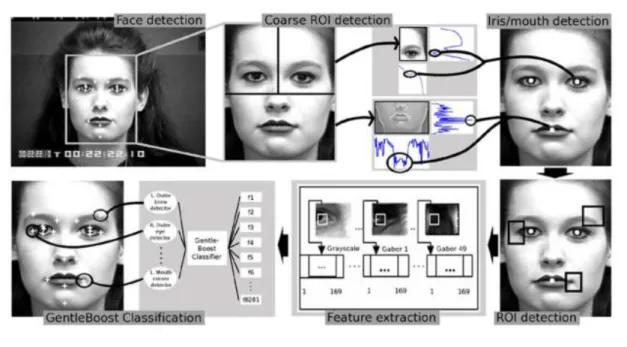
Numerous methods have been developed on face detection. Most of these techniques emphasize statistical learning. As you can see in Figure 1-7 the Viola–Jones face detector used facial point detection method.
20 | P a g e
Fig. 1-7 Outline of the facial point detection method based on Viola–Jones face detector algorithm. The essence of this approach was nearest with our idea. In this method the features are using Principal Component Analysis (PCA) for patterns appearance descriptors. As classifier they employ standard Support Vector Machines (SVMs) basis function kernel. Figure 1-8 have been given an overview of the baseline system’s approach [115].
21 | P a g e
Furthermore, in an obviously related way, Maalej et al. completed this model and used the geometric features. They defined on the landmark points around the facial features (eyes, eye-brow and mouth) to represent the face images and then conducted the emotion recognition with various classifiers [115]. In more comprehensive research Zheng et al. used landmark points to represent the facial images based on Bayes error [116].
As mention above two main streams in the current research on analysis of facial expressions affect (emotion) consider facial muscle action detection and measurements Facial Action Code System [117][118].
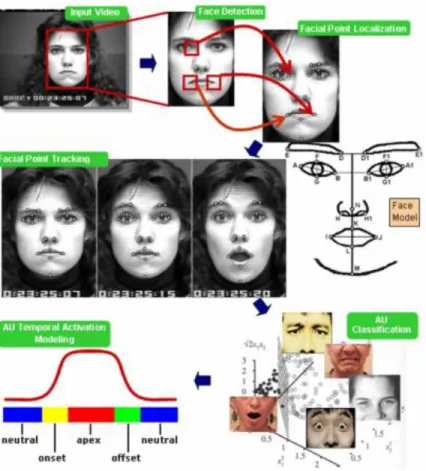
Facial Action Code System associates facial expression changes with movement of the muscles. Additionally, as Cohen et al. shown in the Figure 1-9 , their program defines action descriptors and belonging to the upper or the lower face [119]. Facial Action Code system also provides the rules for the recognition of different Action Unites for classification of the results. In particular, Action Unites and Action Code System attracted the interest of computer vision and robotic researchers.
22 | P a g e
Exceptions from this overall state of the art in the facial analysis field include studies on 3D facial features expression and real time emotion recognition with hidden Markov models (HMMs), neural network (NN), Fuzzy Logic, Discrete Cosine Transform, Dynamic Bayesian networks and others [120]–[122].
For instance, Hoang Thai et al. proposed a solution for Facial Expression Classification using Principal Component Analysis (PCA) and Artificial Neural Network (ANN). For example Figure 1-10 show the main functionalities on Facial Action Coding System, Neural Network and Robot vision for facial emotion recognition [123].
Fig. 1-10 The main functionalities for facial emotion recognition.
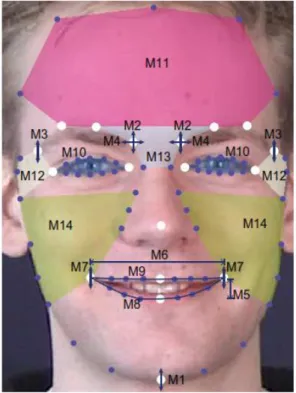
A number of related researches which identified the mapping between Action Units and emotional facial behaviors were also well established. Facial Action Coding System Affect Interpretation Dictionary, consider only emotion-related facial actions [124]. Ekman proposed the new method in (Facial Action Coding System techniques) for measurement the muscles movement and facial emotion detection. Figure 1-11 show the point and measurement the definition of distances principal points in the face.
23 | P a g e
An important functionality of user friendly interface robot will be the capacity to perceive and understand the human emotions as communicated emotionally with human by facial expressions. In more comprehensive research has been done on recognition and generation of emotions for social and humanoid robots [125].
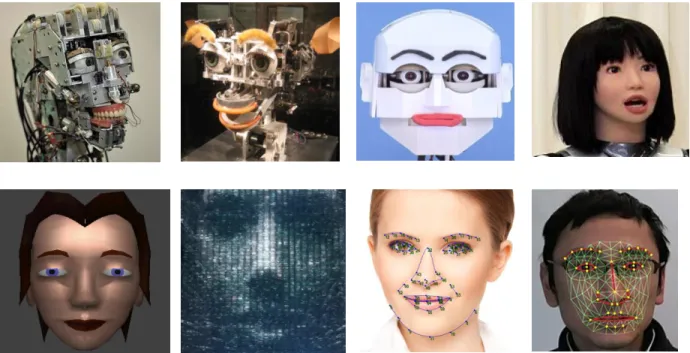
The expressive behavior of robotic faces is generally connected to human robot interaction. In more comprehensive research instead of using mechanical actuation, another approach to facial expression is mechanical movement, computer graphics and animation techniques (see Fig 1-12) [126].
Vikia, for example, has a 3D rendered face of a woman based on different code of facial expressions [127]. Vikia’s face is graphically rendered with many degrees of freedom and are available for generating facial expressions.
Fig. 1-12 Vikia computer generator face (first in the second row) and different face robots (University of Tokyo).
Obviously in a new filed of researches on human robot interaction, Zhang and Shrkay examined how the surrounding emotional context (congruent or incongruent) influenced users’ perception of a robot’s emotion. They founded when there is a surrounding emotional context, people will be better at recognizing robot emotions and they suggested that the recognition of robot emotions can be strongly affected by a surrounding context [128].
24 | P a g e
1-2-2 Facial feature extraction on basic emotion in the past 5 years
In recent years many researches have been done on emotions recognition in the laboratory such as facial expressions [129], texts emotion recognition [130], slides emotion recognition [131], movies actors emotion recognition [132]and music signal emotion recognition [133] [134]. Among this filed, facial emotion recognition is the most important topic for researchers.
In more comprehensive research for extracted emotion from facial image, Majumder et al was using the geometric facial features for emotion recognition. They used Kohonen Self-Organizing Map (KSOM) to classify the features data into six basic facial expressions. The features data first of all clustered with KSOM, then the cluster centers used to train the data for recognition of the basic different emotions [135].
Wan and Aggarwal in 2014 did more comprehensive research on metric learning. They focused on issues that were still under addressed in the spontaneous facial expression recognition field. In comparative experiments they showed spontaneous facial expressions tend to have overlapping geometric and appearance features, making it difficult to find effective spontaneous expression recognition [136].
Zhang et al. inspired many researchers by proposing Hidden Markov Models and a new methodology for automatically recognize emotions based on analysis of human faces from video clip [118].
Significant fundamental work on facial features detection with Neural Network was done by Caridakis et al. They proposed an extension of a Neural Network adaptation procedure, for emotion recognition and training from different emotions. Their results shown that emotion recognition accuracy is improved by using Neural Network. After training and testing on a particular subject, the best-performing network is adapted using prominent samples from discourse with another subject, so as to adapt and improve its ability to generalize [137].
Action Units (AUs) represent the movements of individual facial muscles. Therefore, the combination of AUs produce facial appearance changes and meaningful facial expression [138]. Numerous studies have been done on emotion recognition by extracting Action Units (AUs) for frontal facial images extracted from video clip frames [118].
When an image sequence is presented to a facial expression recognition system, it is necessary to detect the facial regions as a preliminary pre-processing step. There are several methods which can be
25 | P a g e
used to achieve this task. Valstar et al. employed probabilistic and statistical techniques, that used face image sequences for automatic classification of AUs [139].
The most extensive work about facial expression was done by Kharat and Dudul. Their research exploited and combined various feature extraction techniques such as Discrete Cosine Transform (DCT), Fast Fourier Transform (FFT) and Singular Value Decomposition (SVD) to extract facial features [140].
However, some researchers had reported geometrical facial feature point positions in 3D facial. Also, few studies uses Support Vector Machine (SVM) for classifies expressions in six basic emotional categories. Yurtkan and Demirel proposed a feature selection procedure base on Support Vector Machine (SVM) for improved facial expression recognition utilizing 3-Dimensional (3D) [141]. The system designed based on classifiers in two classes with 15 couple of emotion. As shown in Figure 1-13 linear kernel function and Support Vector Machine (SVM) have been used for classifiers basic emotion.
Fig. 1-13 SVM classifier system used for facial expression recognition.
Khan and Bhuiyan worked on the facial feature expressions, especially eyes and lips, which were extracted and approximated using Bézier curves. They defined the relationship between the motion of
26 | P a g e
features and the change of expression. In this research, pictures of 200 individuals have been analyzed and classified into neutral and four basic emotions [142].
Gomathi et al. used Multiple Adaptive Neuron Fuzzy Inference System (MANFIS) [143]. They used Fuzzy logic system for classification of basic emotion. Crosier et al. proposed a method to segment the facial image into three regions. They first used a Local Binary Pattern (LBP), then extracted texture features and finally, they built a histogram descriptor [143]. McDuff et al. introduce an open-source tool that analyzed naturalistic combinations of dynamic face and head movement across large groups of people [144].
There have been many advances reported towards automatic facial expression recognition from 2D static images or 3D in real time [145]–[147].
Recent work on facial expression analysis in video was done by Sebe et al. They proposed a method that measured the distances between frames in 2D image. In image sequence, landmark facial features such as the eye and mouth corners are selected interactively and put mesh for each one [148]. Finally, the shape of the mesh can be changed by changing the locations of the control points and with data in database system can control the basic emotion in real time.
In most of this research, after the algorithm has detected the face, facial feature expressions are extracted and classified into a set of facial actions [149], [150].
Many techniques for facial expression recognition have been proposed, Wang et al. in 2009 extracted trajectories of the feature points contain both rigid head motion components and non-rigid facial expression motion components. The proposed system used the combination of hidden Markov models (HMMs), Facial Action Coding System (FACS) and Action Units (AUs) [151].
Ahmed Khan et al. propose a generalized automatic recognition of emotion in facial expressions for low spatial resolution in facial images and extended the results in human–computer interactions applications [152]. Chia-Te Liao et al. proposed a new technique based on graphical representation of face for emotion detection [153].
Some researchers had reported the system that uses the dynamic information of the facial features extracted from video sequences and outperforms techniques based on recorded static images. Hui Fang proposed a method for facial features extraction based on existing work are reliant on extracting information from video sequences and employ either some form of subjective threshold of dynamic information.
27 | P a g e
The innovation of this system was attempt to identify the particular individual frames for behavior [154]. Also, they proposed to warp the landmarks defined in Figure 1-14 to each face image after dense correspondences between sets of images are built.
Fig. 1-14 Example of landmarks, geometric features and texture regions.
Attempts to facial emotion recognition have also been investigated the possibility to detect the three emotions happy, angry and sadness in video sequences by applying a tracking algorithm by Besinger et al. in 2010. They results shown that the used point tracking algorithm separately applied to the five facial image regions can detect emotions in image sequences [155].