Design and Implementation of Computing-based
Air Conditioner (AC) (ComBAC)
– A Preliminary Work
Afandi Ahmad
1, 2, Muhammad Shafiq Nizar
2, Muhammad Muzakkir Mohd Nadzri
2,
Muhammad Faris Roslan
2and
Abbes Amira
31Department of Computer Engineering, Faculty of Electrical and Electronic Engineering,
Universiti Tun Hussein Onn Malaysia, Johor, 86400, Malaysia
2Reconfigurable Computing for Analytics Acceleration (ReCAA) Research Laboratory,
Microelectronics and Nanotechnology – Shamsuddin Research Centre (MiNT-SRC), Universiti Tun Hussein Onn Malaysia, Johor, 86400, Malaysia
3Department of Computer Science and Engineering, Qatar University, P. O. Box 2713, Doha, Qatar.
Abstract—Computing-based air conditioner (ComBAC)
highlights the concept of spot cooling that helps to reduce energy consumption without sacrificing consumer comfortability, while the conventional air conditioner (AC) cooling down the entire space regardless of occupancy. In this study, National Instruments (NI) myRIO has been explored as a hardware solution, and the advantage of graphical-based programming in LabVIEW has been fully used to design the graphical user interface (GUI) as well as for data acquisition programming. For the input, web camera C170 is used to detect the presence of human/object in a room, while the value of current is being measured using current sensor and later being analysed by NI myRIO to exhibit the energy consumed of an AC. NI myRIO also acts to control the AC, to divert the air flow according to the spot cooling concept and visualisation of energy consumed available via liquid crystal display (LCD). To evaluate the proposed system, ComBAC has been prototyped into a wall-mounted AC unit with 2.5 meter height within a 3 3 square meter room floor area. An evaluation for objects/humans detection and dynamic tracking mechanism has been conducted and results obtained shown promising results. The proposed system has successfully captured the presence of object/human in a room, analyse the data and finally portray the value of energy consumption of the AC.
Index Terms—Air Conditioner (AC); Computing.
I. INTRODUCTION
Climate change appears as the environmental problems that the world will face in the 21st century [1]. Air conditioner
(AC) is a device that reduces heat and humidity towards comfortable interior environment either for building or vehicle to improve thermal comfort and indoor air quality.
Daikin, Hitachi, Blue Star, Carrier and Whirlpool have been listed as Top 5 Best Air Conditioner Brands in the World 2016, and all these companies still struggle to be the champion as an ideal AC solution globally. One of the main issue with AC is about energy consumption, and it generally exhausts for more than 65% of the electric energy of a building [2].
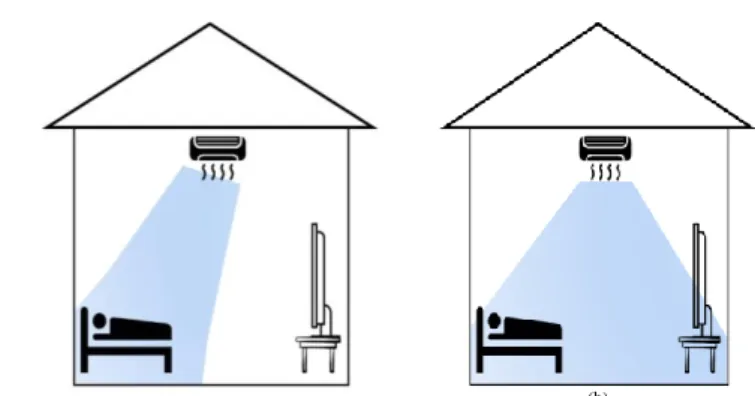
Spot cooling is a concept to help in energy consumption reduction without sacrificing consumer comfortability as depicted in Figure 1. Conventional AC will cool down the entire room or space regardless of occupancy. Cooling down an unoccupied space is considered as a waste of energy. To
answer these issues, computing-based air conditioner (CombAC) concerns with the design and implementation of an AC that combines the elements of computing and embedded electronics towards sustainable AC systems. Computing-based refers to the process of utilising computer technology to complete any task, and it involves computer hardware and/or software.
Figure 1: (a) Air flow to prioritise zone (b) Air flow to all room
ComBAC is also about to design a dynamic tracking mechanism to track a moving object or human in a room to fulfil the spot cooling concept as well as to calculate the energy consumption by a unit of an AC. To execute this project, National Instruments (NI) myRIO, an embedded hardware device plays a role as a brain of the systems to capture, compute, control and visualise the outcomes.
To demonstrate the significance of this study, literature reviews reveal that this topic is still immature and further study needs to be executed.
Adaptive automation and runtime equalisation with real-time monitoring for split AC are proposed in [3]. It is targeted to be applied in telecom application for energy efficiency. An Arduino-based embedded controller is developed and tested with nine (9) ACs as main units and another three (3) as standby units. The status of the AC can be monitored virtually in real time and it is using the static Internet protocol (IP) of the router along with the port of the Apache server. It is also noted and claimed that the entire configuration is an open standard and at the minimal cost.
Katabira et al. [4] propose a novel air-conditioning system
as a combination of two (2) types of sensing technologies, people tracking system by using laser range scanners and temperature monitoring system by using wireless sensor networks (WSN). Interestingly, by integrating the tracked people positions and calculated temperature distribution, a degree of the requirement to ventilate the entire target area is also being evaluated. It is also capable of detecting the location where should be sent a wind, and the evaluation has been executed at Japan railway station.
Towards energy saving control of split and package air-conditioning units, a new non-invasive Zigbee-based wireless controller is proposed in [5]. To develop a sensor network, both ZigBee gateway and sensors have been fully utilised. The wireless sensors were located at the primary cooling demand zones to minimise the cooling requirement as well as to avoid overcooling. This study has been executed in a seminar room at the university with the size of 5.96m × 4.55m × 3.60m (L×W×H). Results achieved have shown that temperature zones of 1°C can be differentiated and 50% of energy saving was achieved in the comparison.
To solve the issue of energy loss in the split type air-conditioning with various parameter including temperature, number and position of people in the room, an actual adaptive load is discussed in [6]. The concepts of the image sequence to estimate the position, a number of people and the demand temperature of the actual load, the adoption of Takagi– Sugeno (T–S) fuzzy models have been used in this study. To assess the proposed method, a room with 12m × 7m × 3m size with three (3) different zones and the various testing pattern has been given. Results obtained show that the proposed method manage to reduce the energy with varies percentage of saving depends on the zone and number of people.
Throughout this review [3–6], the following key conclusions can be made:
1) spot cooling demonstrates a significant shift as a result of remarkable advantages offered towards energy saving [7], but no previous work reporting on this matter;
2) the utilisation of an embedded platform, as well as computing-based proposed solution, have been presented limitedly; and
3) image-based solution, as well as the advancement of the Internet of things (IoT), seem convincing in providing a better solution towards real-time [8–10] data monitoring.
The remainder of this paper is organised as follows. Section II describes the design and implementation of the proposed solution. Experimental results and analysis are described in Section III. Finally, concluding remarks and future works are given in Section IV.
II. PROPOSED SOLUTION
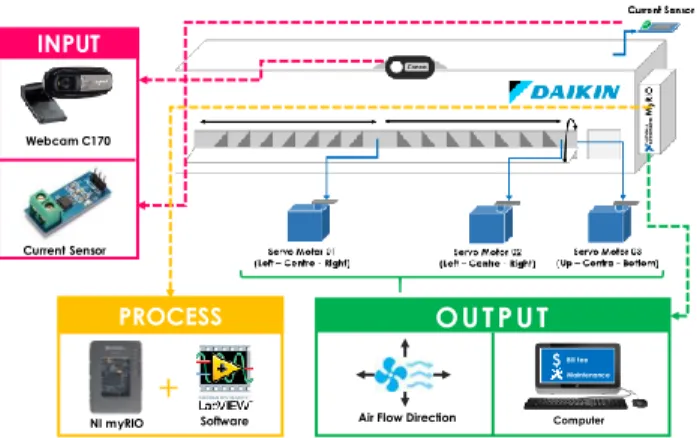
An overview of the proposed solution including an input, processing and output is depicted in Figure 2. Input will act to capture all data towards spot cooling establishment, while an embedded platform of NI myRIO plays a significant role to compute and analyse the data before the users can monitor it.
A. Input
A web camera C170 is used to detect the presence of human or object in a room. At the same time, the value of current is
captured using current sensor and being calculated by NI myRIO to exhibit the energy consumption of an AC.
Figure 2: An overview of the proposed solution for ComBAC
B. Process
NI myRIO has been fully utilised for data acquisition particularly to compute, analyse and visualise all the data obtained from the input. The connectivity between NI myRIO and host computer has been established wirelessly using WiFi.
C. Output
NI myRIO controls the AC to divert the air flow according to the spot cooling concept. At the same time, visualisation of sustainable AC in terms of its energy consumption per item available via the graphical user interface (GUI) as shown in Figure 3. In addition, details of the data can also be downloaded using comma-separated value (CSV) format for future reference.
Figure 3: Overview of the GUI for ComBAC
To establish the prototype, Figure 4 illustrates an overview of the prototype that consist of the spot area in 3 3 meter square (based on the specification given by Daikin) with a split AC unit located in 2.5m height. For objects or humans detection in a room, a web camera has been attached at the top of a wall-mounted AC unit.
+
NI myRIOPROCESS
Software Air Flow Direction OUTPUT Bill fee Maintenance $ Computer Webcam C170 Current Sensor INPUT
Real time image for human/object
Indicator for blade’s movement
Indicator for usage limitation Meter for current and energy consumption
Figure 4: Experimental setup for the proposed solution
III. RESULTS AND DISCUSSIONS
To develop the proposed solution, graphical programming (G-code) by LabVIEW 2015 has been used to program the platform, and it has been divided into four (4) main parts including image matching (for objects or humans in a room), motor movement, current sensor and energy consumption as well as data recording.
A. Objects and Human Detection
To detect objects or humans in a room, selected features of humans/objects have been selected as a condition and it includes a colour of black and brown from the humans. Vision acquisition tool is used to acquire, save, and display images and the video mode with setting up to 640 × 480 YUY 2 30.00 frames per second (fps).
Vision assistant (VA) as a tool for prototyping and testing of an image processing applications is also used to set up a database for objects or human detection as well as to train the system. VA acts to teach the reference image before the matching process can be executed to detect human presence in the room and the colour must be matched with the image at the specific location. Black and brown colours have been selected towards objects or human’s detection in a room since these two (2) colours available commonly in humans. NI vision assistant is being used to teach the system and later to execute the image matching process.
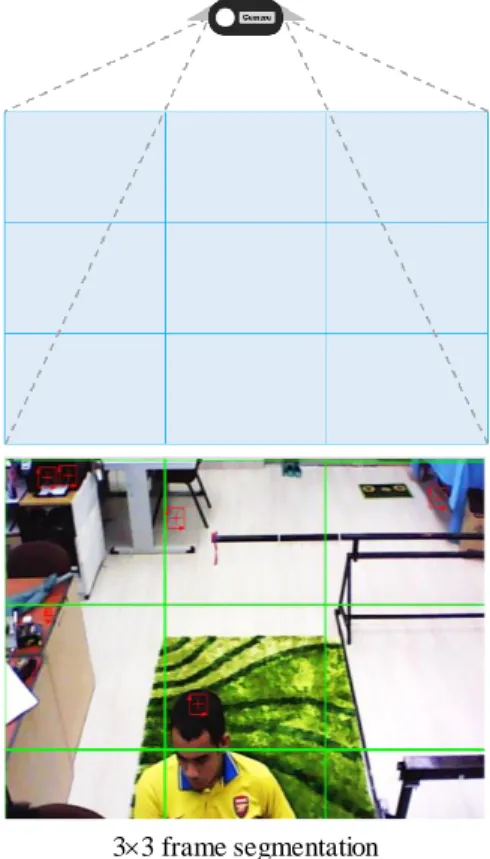
Since the design specification requires a wall-mounted AC unit to divert the airflow to the detected spot within a 3 3 square meter room floor area, an algorithm with nine (9) black colour and nine (9) brown colour as shown has been used as a dynamic tracking mechanism to track a moving object with fast response. It also relates to the segmentation that has been set up in the camera viewer as shown in Figure 5.
B. Dynamic Tracking Mechanism
A dynamic tracking mechanism to track a moving object with the fast response has been established with three (3) servo motors have been attached to the blade in AC unit as shown in Figure 6, while a real implementation is given in Figure 7. Both servo motor 1 and 2 act to move the blade of AC into a position of left – centre – right, hence it established the high accuracy of position tracking of its prioritise zone (spot cooling). In addition to that, servo motor 3 performs for up – centre – the bottom movement of the AC’s blade.
Figure 5: Frame segmentation for objects or human detection
Figure 6: Dynamic tracking mechanism with three (3) servo motors
Figure 7: Real implementation of the dynamic tracking mechanism
C. Testing and Validation
To test the proposed system, testing and validation have been conducted for different cases, and results are given in Figure 8(a) – (e). Based on these results, it is validated that the proposed solution towards dynamic tracking mechanism with fast response of the spot area in 3 3 square meters has been successfully being achieved.
2.5m NI myRIO AC Camera PC (Visualisation) 3m 3m Spot Area 33 frame segmentation Web camera Web camera Servo motor1 Servo motor2 NI myRIO
Figure 8(a): Case 1: Dynamic tracking mechanism – Top
Figure 8(b): Case 2: Dynamic tracking mechanism – Centre
Figure 8(c): Case 3: Dynamic tracking mechanism – Bottom
Figure 8(d): Case 4: Dynamic tracking mechanism - Motor 1 & 2 – Left
Figure 8(e): Case 5: Dynamic tracking mechanism - Motor 1 & 2 – Centre
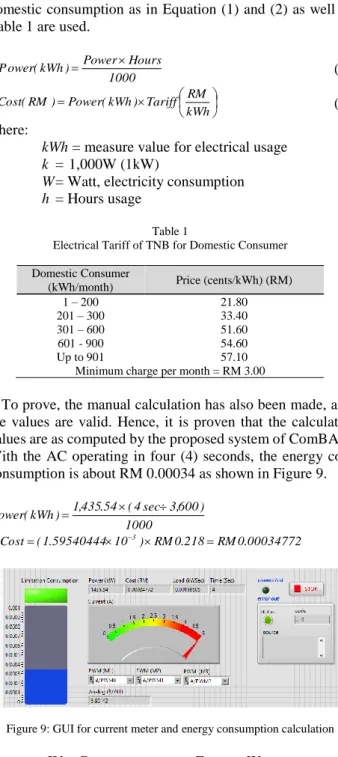
To calculate the energy consumption by a wall-mounted AC unit without a compressor, a basic formula and an electrical tariff of Tenaga Nasional Berhad (TNB) for the domestic consumption as in Equation (1) and (2) as well as Table 1 are used.
1000 Hours Power ) kWh ( ower P = (1) (2) where:
kWh = measure value for electrical usage
k = 1,000W (1kW)
W = Watt, electricity consumption
h = Hours usage
Table 1
Electrical Tariff of TNB for Domestic Consumer Domestic Consumer
(kWh/month) Price (cents/kWh) (RM)
1 – 200 21.80
201 – 300 33.40
301 – 600 51.60
601 - 900 54.60
Up to 901 57.10
Minimum charge per month = RM 3.00
To prove, the manual calculation has also been made, and the values are valid. Hence, it is proven that the calculated values are as computed by the proposed system of ComBAC. With the AC operating in four (4) seconds, the energy cost consumption is about RM 0.00034 as shown in Figure 9.
1000 ) 600 , 3 sec 4 ( 54 . 435 , 1 ) kWh ( Power = 00034772 . 0 RM 218 . 0 RM ) 10 59540444 . 1 ( Cost= 3 = −
Figure 9: GUI for current meter and energy consumption calculation
IV. CONCLUSIONS AND FUTURE WORKS
This study proposes a prototype of computing-based AC and related parameters towards computing-based AC have also been investigated. A dynamic tracking mechanism to track a moving object with the fast response has been implemented and validated.
To further improve the proposed system, an efficient IoT-based implementation to make it available for the mobile platform can be considered. A record of maintenance can also be included towards a better preventive plan maintenance (PPM). Finally, another input tracking such as thermal motion camera can be also considered to enhance the feature of privacy of human presence in this system.
= kWh RM Tariff ) kWh ( Power ) RM ( Cost
ACKNOWLEDGEMENT
The authors would like to thank the National Instruments (NI), Daikin and Dreamcatcher via Innovate Malaysia Design Competition (IMDC) 2017 as well as Reconfigurable Computing for Analytics Acceleration (ReCAA) Research Laboratory – Microelectronic & Nanotechnology Shamsuddin Research Centre (MiNT-SRC) for supporting this research work.
REFERENCES
[1] F. T. Tangang, L. Juneng, E. Salimun, K. M. Sei, L. J. Le, and H.
Muhamad, “Climate change and variability over Malaysia: Gaps in science and research information,” Sains Malaysiana, vol. 41, no. 11, pp. 1355–1366, 2012.
[2] Z. Liu, C. Cao, P. Yang, and Y. Zhou, “Energy Saving Control in Air
Conditioning System Based on Flexible Iterative Learning Control,” 2008 2nd International Symp. Intell. Inf. Technol. Appl., pp. 560–564, 2008.
[3] K. Venkatesan, and U. Ramachandraiah, “Adaptive Automation and
Run Time Equalization with Real Time Monitoring for Split Air Conditioners in Telecom Applications for Energy Efficiency,” Int.
Conf. Robot. Autom. Control Embed. Syst. – RACE 2015, no. February, 2015.
[4] K. Katabira, H. Zhao, Y. Nakagawa, and R. Shibasaki, “Real-Time
Monitoring of People Flows and Indoor Temperature Distribution for Advanced Air-Conditioning Control,” Proc. 11th Int. IEEE Conf. Intell. Transp. Syst. Beijing, China, Oct. 12-15, 2008 Real-Time, pp. 664–668, 2008.
[5] J. Y. Wang, Y. K. Chuah, S. W. Chou, and T. H. Lo, “Non-invasive
Zigbee wireless controller for air- conditioner energy saving,” Wireless Communications, Networking and Mobile Computing (WiCOM), 2011 7th International Conference onpp. 26–29, 2011.
[6] P. Nangtin, P. Kumhom, and K. Chamnongthai, “Adaptive actual load
for energy saving in split type air conditioning,” 2016 16th Int. Symp. Commun. Inf. Technol. Isc. 2016, pp. 182–185, 2016.
[7] S. Wang and J. Xie, “Integrating Building Management System and
facilities management on the Internet,” Automation in Control, vol. 11 (6), pp. 707–715, 2002.
[8] S. Wang, “Dynamic simulation of building VAV air-conditioning
system and evaluation of EMCS on-line control strategies,” Building and Environment, vol. 34 (6), pp. 681–705, 1999.
[9] Z. Haider, F. Mehmood, X. Guan, J. Wu, Y. Liu, and P. Bhan,
“Scheduling of Air Conditioner Based on Real Time Price and Real-Time Temperature,” Control and Decision Conference (CCDC), 2015 27th Chinese, pp. 5134–5138, 2015.
[10] J. Jing and Z. Xuesong, "Temperature control system of
air-conditioning based on the fuzzy theory," 2011 IEEE International Conference on Mechatronics and Automation, pp. 387–391.