Vol. 10, No. 2, May 2018, pp. 537~544
ISSN: 2502-4752, DOI: 10.11591/ijeecs.v10.i2.pp537-544 ! 537
Performance Comparison of Controllers for Suppressing the
Structural Building Vibration
Normaisharah Mamat, Fitri Yakub*, Sheikh Ahmad Zaki Shaikh Salim, Mohamed Sukri Mat Ali Malaysia-Japan International Institute of Technology, Universiti Teknologi Malaysia, Kuala Lumpur, Malaysia
Article Info ABSTRACT
Article history: Received Nov 19, 2017 Revised Jan 27, 2018 Accepted Feb 9, 2018
This paper presents the modelling and simulation of controllers for controlling the position of two degree of freedom (2 DOF) mass spring damper system. Proportional integral (PI), fuzzy logic controller (FLC) and sliding mode controller (SMC) are design to minimize the vibration of the system that represent as building structure towards earthquake. A structural building is simulate based on real earthquake occur in El Centro on May 1940. The algorithm for building structure, actuator and controller is derived. Matlab/Simulink is used to analyze the performance of controllers towards the vibration building structure. At the end of the study the time response for two story building for uncontrolled and controlled system is present. Besides, the result for limitation voltage for each controller is also analyse to determine the maximum voltage consume for the system. The simulation results show the comparison of the controllers’ performance in suppressing the building vibration. From performance analysis, SMC provides better performance compared to PI and FLC based on structural vibration reduction.
Keywords: Earthquake Fuzzy Logic
Proportional Integral Sliding Mode Controller Vibration
Copyright © 2018 Institute of Advanced Engineering and Science. All rights reserved.
Corresponding Author: Fitri Yakub,
Malaysia-Japan International Institute of Technology, Universiti Teknologi Malaysia,
Jalan Sultan Yahya Petra, 54100 Kuala Lumpur, Malaysia Email: [email protected]
1. INTRODUCTION
Natural disaster such as earthquake and strong wind has causes great losses to economic countries especially to existing building. The building damage is not only depending on magnitude of earthquake, but also the structure of building technique. It makes challenging and important for structural engineer to protect the building structure. Therefore in 1972, Yao was the first presented the idea called structural control [1]. Then, an analysis has been made by civil structure to avoid damages to the structure building. Many methods have been propose to prevent it from occur such as by introducing structural control devices.
In structural control, there are many types of control device has been proposed such as passive, active, semi-active and hybrid control system. The paper proposed by [2], [3], were discussed these type of control devices. Based from the paper, the passive devices does not use any external power source and act as energy dissipation devices that are install on the structural building to absorb a significant amount of the seismic. The most used type of passive devices is Tuned Mass Damper (TMD) that attached to the structural building by oscilate the same frequency with the structural building but with phase-shift [2]. Active device has the ability to control in a wide frequency range. The advantages of using passive devices is its simplicity and low cost. However, passive device has limit control capacity. Meanwhile, active control has stronger capacity compared to passive control [4]. Due to the advantages of active devices over passive devices, it has
must be simple, robust and fault tolerant. Proportional integral controller is the simplest control strategies because it uses only two parameters to tuning which is proportional gain and integration gain.
Fuzzy logic controller was firstly introduced by Zadeh in 1965 to his technical society by present his work “Fuzzy Sets” [6]. However, in 1983, fuzzy theory was the first time implement to the engineering structure by Brown and Yao [7]. After that FL is widely used in civil fields especially to control the building system. The paper by [6]-[10] using the FL as the control strategies in suppressing the building vibration. The advantage of fuzzy logic is its concept that simple, flexible and based on natural human language. It allow the researcher to develop expert system by using linguistic variables such as “IF…THEN’ rules [7].
Sliding mode control is known with the robust control technique. It has attaractive characterics that has fast response and has ability to make the control system very robust in rejecting the external disturbance to meet the required condition. Sliding mode control is firstly proposed by Emylyanov in early 1950s [11] and then has been applied in civil structure in 1993 by Yang et. al. [12]. After that many researcher studies this method in their paper [13]-[14]. This type of controller is always been improved by new technique such as higher order sliding mode, and optimal sliding mode control.
The aim of this paper is to analyze the performance of controllers in suppressing the vibration of structural building by using three types of controllers. The paper using the real earthquake data input implemented to the system that taken from the earthquake ground motion at El Centro. This earthquake occurs in 1940 with moment magnitude of 7.1 Mw and caused nine people death.
2. SYSTEM DESCRIPTION
The effect of controllers in suppressing the building vibration can be investigated by applying to two degree of freedom mass spring damper system that acts as the building system. The mathematical model of motion of structural system is written as;
𝑚!𝑥!+[𝑐!+𝑐!]𝑥!−𝑐!𝑥!+𝑥!+[𝑘!+𝑘!] 𝑥!-𝑘!𝑥!= F (t)
𝑚!𝑥!−𝑐!𝑥!+𝑐!𝑥!+𝑘!𝑥! −𝑘!𝑥! = 0
Where m1 and m2 is represent as mass, k1 and k2 is represent as spring stiffness while c1 and c2 is represent damping coefficient, x1 and x2 is the displacement of each floor and will changes during earthquake occur in horizontal direction and F(t) is the total force of the structure.
The structural building is using the modellling of 2 DOF mass spring damper system as shown in Figure 1. The system structure consist of linear motor that function as active isolator has been install at the first floor since the largest destructive is occur at this floor. Actuator generates required forces to control the building structure. The equation used for actuator as written in (3) and (4). Where u is represent as armature coil voltage, i is armature coil current, R is armature coil resistance value, Ke is armature coil induced voltage, Fu is output force by linear actuator, Kf is thrust constant, damper damping coefficient and armature coil inductance is neglected.
(2) (1)
Figure 1. Schematic of Two Storeyed Building Ri + Ke ( ẋ!- ẋ!) = u
𝐹!= 𝐾!𝑖
3. CONTROLLER DESIGN
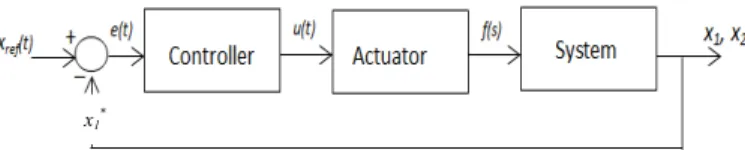
The performance observation on vibration structure is simulated by using three controllers to measure the effectiveness of the controllers to the system. The function of controllers is to minimize the building structure vibration and stabilize the building structure from further damages. In general, the block diagram of closed loop controller system that used in designing in Matlab is shown in Figure 2. Where Xref is the desired value for the system output and this value is set to ‘0’ so that the building will remain at its position. e(t) is error value calculated by the desired value, Xref, minus with the actual value, X1*, then the controller will produce control signal value. Actuator produce force signal to the building and lastly, the system will produce the desired displacement position for the first floor and the second floor building.
Figure 2. Closed Loop Block Diagram with the Controller 3.1 Proportional Integral Controller
Proportional integral controller is the most widely used algorithm in control field due to its simplicity compared to proportional-integral-derivative controller. PI controller only has two tuning parameter to adjust and its function is given by:
𝑢 𝑡 =𝐾[𝑒 𝑡 + 1
𝜏! 𝑒 𝑡 𝑑𝑡]
! !
The control output, u(t) is used as the input to the actuator, K is the controller gain for proportional and integral action and e(t) is the error.
3.2 Fuzzy Logic Controller
The unique of fuzzy sets is due to its linguistic expression such as small, medium and large. In FLC, the relative rules are the most important part to obtain the desired output. The rule used for this controller is shown in Table 1 where P, N, Z, B, M and S that represent as positive, negative, zero, big, medium, and small. A technique of trial and error is used for determine the input variable limit. The best limit value obtain for displacement error (e) are ±0.015 m, velocity error (de/dt) are ±3.5 m/s and control force (u) are ±8.8. The shapes for membership function are triangular and are design as shown in [6].
(3) (4)
(5)
3.3 Sliding Mode Controller
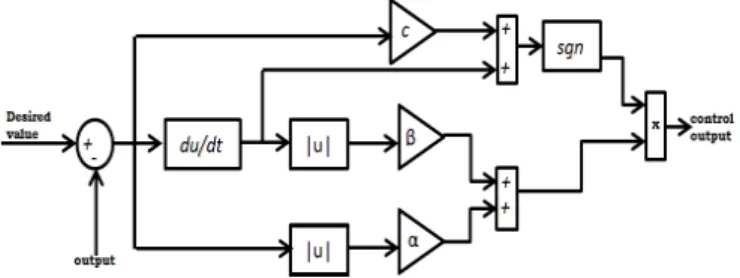
Sliding mode controller is applicable to non-linear system, having high performance and robustness. In designing this type of controller, two stage are involves. Firstly is by designing the sliding surface and secondly is by control law synthesis. The first stage is to drivesthe system variables towards specific surface which is the desired value. Then the state variable trajectory will maintain on the surface.Once the trajectory reach sliding surface, it will remain there for all further times. The mathematical model for sliding surface, S is written as;
S= ce+e
Where c is constant value greater than zero, and e is error [18]. Proportional control law is use to design the controller output u. The equation is written as;
u= αe +β e)sgn (s)
Based from these equations the block diagram of SMC is design in Simulnik is shown in Figure 3.
Figure 3. Sliding Block Diagram in Simulink 4. RESULTS AND ANALYSIS
The simulation result of two storey building structure with three types of controllers is implemented in Matlab/Simulink. The result for the system is analyzed based on performance of building vibration to stable. The structure’s parameter used for the building structure model is provides in Table 2. The force disturbance is used as the input to the structural system. The example input data is taken with earthquake ground motion occurs at El Centro with magnitude of 7.1 Mw as shown in Figure 3.
Table 2. System Parameter Parameter Value/Unit symbol
Mass 1.28kg m1,m2 Damper 15kg c1, c2 Spring 190kg k1, k2 Thrust Constant 2 N/A Kf
Induce Voltage 2 A Ke
Resistance 4.2 Ω R
(6)
Figure 4. Earthquake Excitation Input to the Structure
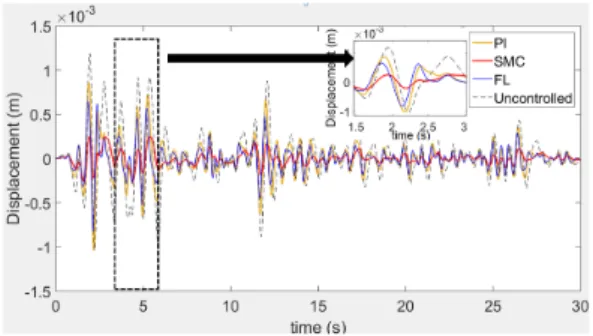
The simulation result of two story building structure with implemented by three types of controllers is carried out by Matlab/Simulink. The result of the system is evaluate based on performance of building vibration is reduce for each floor in the building. Figure 5 and 6 show the results obtain for first floor and second floor. The result for the first floor show that SMC gives a better response compared to the other controller by reduce 74% from uncontrolled system. Followed by FLC controller with 40% and lastly PI controller with 30%. For second floor, SMC reduces around 86%, FLC reduces with 57% and PI controller reduces with 30%. Thus it can observe that among these three types of controller, SMC have superior performance compared to the others. Suitable to it’s characteristic that robustness and suitable for non-linear system. PI controller is known as simplest control strategies but it is hard to tune the PI gains to obtain the desired response such asrise-time and overshoot.Overall, by using these types of controller, it is success to reduce the vibration of the structural system.
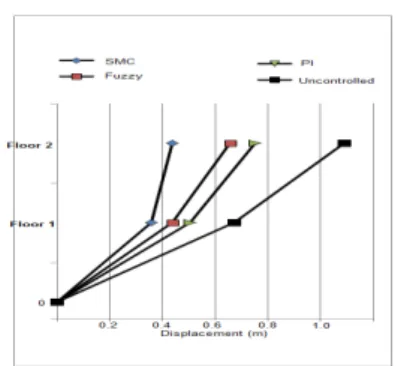
Figure 5. First Storey Displacement Waveform Figure 6. Second Storey Displacement Waveform The simulation continues by recording the data for each floor towards the displacement value to observe the floor movement while earthquake occur. Figure 7 show the result for two floors for each controller implementation. The result is taken at 1.9 second where the maximum vibration occurs. The result shows that the second floor has higher vibration than the first floor.
Implementation of the controller to the structural system can generate the output control voltage for each type of controller used. The result is shown in Figure 8. The limitation voltage consumes for PI controller is in range ±0.24 V, for FLC the limitation voltage consume is ±0.3 V and SMC is ±0.5 V. The biggest limitation voltage is obtain for SMC and this is suitable with its characteristic that using a large amount of power. Then, the limitation for actuator must be set up to ±0.5 V. This can be used as a guide if the experimental setup is built.
Figure 7. Displacement for Each Floor
(a) (b) (c)
Figure 8. Output Voltage for (a) PI (b) FL (c) SMC
5. CONCLUSION
The paper is simulated and analyse the system of two degree of mass spring damper system that represent as building structure and implementation with the controller. The study is using the real analytical input to the structural system. The conclusion is made from the simulation by evaluate based on maximize the structural vibration is reduced. All types of controllers simulated in this study are success to suppress the vibration for the 2-DOF. However, compared between these three types of controllers, SMC has present the better to minimize the vibration control, followed by FLC and then PI controller. It is proved that by using controller, the vibration can reduced. The further improvement will be make by improve the order of the structural system to observe the effect of controller to multi-degree-of-freedom.
ACKNOWLEDGEMENTS
This research was supported financially by a research university grant Tier 2 (Q.K130000.2643.14J35) from the Universiti Teknologi Malaysia.
REFERENCES
[1] J. T. P. Yao et al., “Concept of Structural Control,” Journal of The Structural Division, Vol.98, Issue No.7, pp.1567-1574, 1972
[2] T. Suresh et al., “Advances in Modelling and Vibration Control of Building Structures”. Annual Review in Control, Vol.37 346-364, 2013
[3] G. W. Housneur et al. Present and Future, Journal of Engineering Mechanics, 123, pp. 897-974, 1997
[4] M. A. L Yaghin et al., “Vibration Control of Multi Degree of Freedom Structure Under Earthquake Excitation With TMD Control and Active Control Force Using Fuzzy Logic Method at the Highest and the Lowest Story of the Building,” IOSR Journal of Mechanical and Civil Engineering, Vol. 8 pp.7-12 Sept-Oct 2013
[5] H Nasution., “Development of fuzzy logic control for vehicle air conditioning system,” TELKOMNIKA Telecommunication, Computing, Electronics and Control. 2008; 6 (2): 73
[6] R. Guclu “Fuzzy Logic control of Vibration of Analytrical Multi- degree-Of-Freedom Structural Systems’ Turkish Journal of Engineering and Envireonmental Science, pp. 157-167, 2003
[7] C.B. Brown et al., “Fuzzy Sets and Structural Engineering” C. Journal of Structural Engineering ASCE, No. 109, pp. 1211-1225, 1983
[9] M. Sharma et al., “Fuzzy Logic Based Vibration Control Of Single Degree Of Freedom System” Engineering and Computational Science (RAECS) 2014 Recent Advances in. IEEE, pp. 1-6, 2014
[10] J. J. Zhang et al., “Active Vibration Control For Smart Structure Base on Fuzzy Logic” International Conference on Advanced Computer Control, pp 231-235, 2008
[11] S.V. Emelyanov, “Control of First Order Delay Systems by Means of an Astatic Controller and Nonlinear Correction” Autom, Remote Control, no 8 pp. 983-991, 1959
[12] J.N. Yang et. al. “A Discontinuous Control Method for Civil Engineering Structure,” In: 9th VPI & Symposium On Dynamics And Control Of Large Structures, Blacksburg, VA, pp. 1137-1156, 1993
[13] M. Geethu et al., “Dynamic Analysis and Sliding Mode Vibration Control for A Two Storeyed Flexible Building Structure,” International conference on Control, Communication and Computing India (ICCC,) pp. 24-29 2015 [14] K. Shiba et al., “Active/Passive Vibration Control Systems for Tall Buildings” Smart Material and StructureIOP
Science, vol.7, pp.588-598, 1998
[15] S. Zhang et al., “Vehicle Dynamic Control Based On Sliding Mode Control Technology” Control and Decision Conference (CCDC) Chinese IEEE, pp. 2435- 2439, 2009
[16] Welcome to Vibration data El Centro Earthquake Page http://www.vibrationdata.com/elcentro.htm
[17] F. Yi et al., “Structural Control System Performance Assessment” Proceeding of the American Control Conference, vol.1, pp. 14-18 2000
[18] W. Yu et al., “Stable Active Vibration Control System For Building Structures Using PD/PID Control” Proceeding of the 19th World Congress The International Federation of Automation Control Cape Town, South Africa, pp. 4760-4765, 2014
[19] D. K. Sambariya et al., “Sliding Mode Control Of Continues Stable and Unstable Systems,” National Conference on Power Engineering Practices and Energy Management, pp. 217-219, 2005
[20] R. Guclu et al., “Sliding Mode and PID Control of a Structural System Against Earthquake” Mathematical and Computer Modeling 44 pp 210-217, 2006
[21] F. Yakub et al., “Enhancing Vehicle Ride Comfort through Intelligent Based Control” Automatic Control and Intelligent Systems (I2CACIS), IEEE, pp. 66-71, Oct. 2016
[22] M. F. M. Yakub et al., “Vibration Control Of Two-Mass Rotary System Using Improved NCTF Controller For Positioning Systems” Control and System Graduate Research Colloquium (ICSGRC), IEEE, pp. 61-67, 2010
BIOGRAPHIES OF AUTHORS
Normaisharah Mamat received her BEng. (2012) and MSc. in Electrical Engineering (2015) from Universiti Teknikal Malaysia Melaka (UTeM). She is currently Ph.D student at Malaysian Japan Institude of Technology, Universiti Teknologi Malaysia (UTM). Her research is mainly focus in intelligent control, sensors and actuators, and vibration control.
Fitri Yakub received his DipEng. Mechatronic (2001), and BEng. Electronics (2006) from Universiti Teknologi Malaysia. Then he received his Msc. In Mechatronics Engineering (2011) from International Islamic University Malaysia (IIUM) and Ph.D in Automatic Control Laboratory, Tokyo Metropolitan University (2015). He is currently working as senior lecturer at Department of Electronics System Engineering. His research field interest is in advanced vehicle control, vibration control, automatic and robust control and intelligent control.
Mohd Sukri Mat Ali obtained his BEng. Mech. Aero and MENG. Mech. from UTM and Ph. D Mech. Eng. from Adelaide University. Currently, he is working as senior lecturer at Department of Mechanical Precision Engineering. His research interest in aerodynamics, wind engineering and computational fluids dynamics.