Wayne State University Dissertations
1-1-2015
Rhetoric Of Young Non-Regular Workers In
Post-Bubble Japan: A Genealogical Analysis
Noriaki Tajima
Wayne State University,
Follow this and additional works at:https://digitalcommons.wayne.edu/oa_dissertations
Part of theCommunication Commons, and theRhetoric Commons
This Open Access Dissertation is brought to you for free and open access by DigitalCommons@WayneState. It has been accepted for inclusion in Wayne State University Dissertations by an authorized administrator of DigitalCommons@WayneState.
Recommended Citation
Tajima, Noriaki, "Rhetoric Of Young Non-Regular Workers In Post-Bubble Japan: A Genealogical Analysis" (2015).Wayne State University Dissertations. 1364.
RHETORIC OF YOUNG NON-REGULAR WORKERS IN POST-BUBBLE JAPAN: A GENEALOGICAL ANALYSIS
by
NORIAKI TAJIMA DISSERTATION
Submitted to the Graduate School of Wayne State University,
Detroit, Michigan
in partial fulfillment of the requirements for the degree of
DOCTOR OF PHILOSOPHY 2015 MAJOR: COMMUNICATION Approved By: Advisor Date
© COPYRIGHT BY NORIAKI TAJIMA
2015
ii
ACKNOWLEDGMENTS
This work, the work on pain, struggles and hope, has been soulful for me. So I am very thankful to a number of people who have been involved in the process of developing it. First and foremost, I appreciate Dr. Kelly Young. This work is successfully at this point thanks to his careful examination of a number of past drafts. Even though Kelly was not originally my adviser, he has always welcomed students like me and become an important source of insights, inspirations and encouragements. Like many other students of him, I also profoundly appreciate his smart intelligence and fun-loving, warm-hearted personality. Along with his incredible skills of mentoring dissertation, Kelly has been my role model of a debate coach. Time shared with him, Dr. Ron Stevenson, other graduate assistant coaches and debaters is at heart of my pedagogical life as an instructor of debate and public speaking.
My knowledge of rhetoric and communication is also indebted to lessons of Dr. Mary Garrett. From the first semester of my doctoral student life to dissertation defense meeting, her comments and suggestions have always been very precious. Especially memorable was her emphasis on humanitarian traditions of communication and rhetorical studies, and this has always been cherished when I do my scholarly works.
Also, I feel very grateful to the time shared with Dr. James Cherney. Jim came to Wayne State in my third year, so I had only a smaller amount of time of interactions with him than with other members. Yet it was very fortunate that Jim kindly welcomed my offer of joining the committee and provided me with many discrete comments and meaningful suggestions.
From Dr. Heidi Gottfried at Sociology Department, I had a unique benefit. With respect to the topic, I learned a lot both from direct conversations and from her works. Interacting with
iii
an authority of work, welfare state and political economy in Japan (and beyond) has substantially improved the contents of this work.
I also express my appreciation to those who read and commented on an early version of a chapter, which was presented at the Fourth Tokyo Conference of Argumentation sponsored by Japan Debate Association. I appreciate Dr. David Zarefsky, Dr. Kevin Baaske, and Dr. Junya Morooka, for valuable comments. I also thank Dr. Takeshi Suzuki for organizing the wonderful conference. I feel very proud to be a part of the Association now.
Also, many people have encouraged me to advance this work. I was blessed to have a time with Mr. Makoto Yuasa and to march with our “brothers and sisters” on national bureau and ministry buildings in 2012. This experience has been a great source of my motivation to advance this project. From WSU alumni currently staying in Japan, Satoru, Naoto, Takuzo, Naoki and Arata, I received a number of warm advice and encouragement. Especially, I appreciate time with Naoto, my favorite debate judge, wonderful teacher, and a good colleague at Kanda University of International Studies. His passion to communication education and rhetoric will live forever at Kanda. I also appreciate other faculty members at Kanda, including Professors Robert De Silva, Yasuyo Sakata, Tomoko Masumoto and Takashi Kosaka, for their encouragement.
And, thank you, my parents and Ayako, for your patience, care, and love. This work has been driven by a strong sense of moral obligation for the present and future of Japanese working populations such as you, me and everyone around us. And last but not least, I thank the Town of Detroit for embracing me and giving me a chance to think about manufacturing, welfare and hegemony of capitalism. I thank everything for advancing this work.
iv
TABLE OF CONTENTS
Acknowledgements ii
List of Tables v
List of Figures vi
Chapter 1 “A Rhetorical Study of Young Non-regular Workers in Recessionary Japan: An
Introduction” 1
Chapter 2 “Stability in the Absence of Equality: A Review of Companyism in Post-WWII
Japanese Economic Culture” 35
Chapter 3 “Young Non-regular Workers as an Inferior Species: A Description of a Derogatory
Subject” 72
Chapter 4 “Challenges Against the Oppressive Power: Rhetorics of Two Activists” 147 Chapter 5 “Young Non-regular Workers Abandoned in Recessionary Japan, and Their Future: A
Conclusion” 191
References 213
Abstract 242
v
LIST OF TABLES
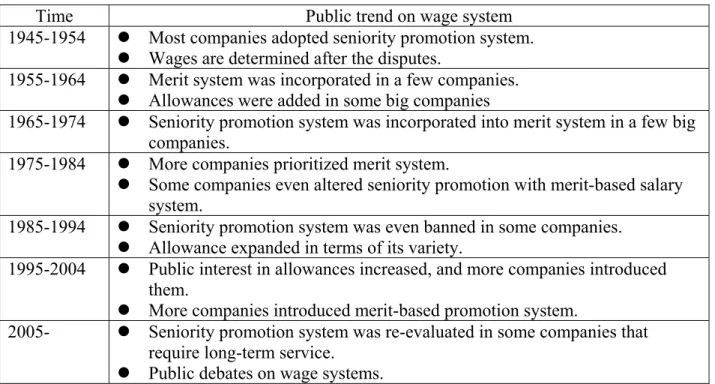
Table 1: Wage System in Post-WWII Japan 46
vi
LIST OF FIGURES
Figure 1: Unemployment Rate of Fifteen Years Old or More Male Labor Force by Age,
1984-2004 100
Figure 2: Change in the Percentage of Japanese Employees Engaged in Non-regular Work by
CHAPTER 1 A RHETORICAL STUDY OF YOUNG NON-REGULAR WORKERS IN RECESSIONARY JAPAN: AN INTRODUCTION
One day, over a beer at a fireworks-viewing party in Tokyo suburb, I spoke of my concern about Japan’s social dislocation with a journalist recently retired from a powerful Japanese newspaper. He confided that he, too, was deeply anxious about the nation’s passive acceptance of failure; its bankrupt banks and corporate malfeasance, rampant political corruption, and the rising pessimism of its people. “Half the people don’t know how bad things are,” he told me. “The rest are in denial.”
Michael Zielenziger. Shutting out the Sun: How Japan Created Its Own Lost Generation. New York: Vintage, 2006. Print. 13.
David Harvey comments that Japan was “the powerhouse of the global economy” in the 1980s (“Neoliberalism as Creative Destruction” 33). In that time, the Japanese economy, known as Japan as number one, was said to be more vigorous than any other industrial nation with its robust growth rates, top-notch manufacturing technologies, and thought-out human resource management. Due to these factors, Japan was a good economic partner with the United States; however, for the same reasons, Japan in the 1970s and 1980s became a far more important threat to America’s preeminent position in the global market than it is now.
While Japanese people were once ironically called economic animals in this time, they were also said to have a strong sense of egalitarianism. For instance, British business magnate Bernard Eccleston notes in 1989 that “for over 25 years opinion surveys conducted actually by the EPA [Economic Planning Agency] and the Prime Minister’s Office show that between 80 and 90 per cent of respondents considered themselves to be middle class” (162). Also, the
Japanese public once recognized its society as classless because it has fortunately avoided major discussions or conflicts over class, poverty or capital distributions.
However, Japan’s stable economic growth ended about two decades ago when the asset and estate bubble burst in 1991. Most notably, the burst firstly plummet the Tokyo average stock price from 38915 yen to less than twenty thousand yen in a year, triggering a number of economic consequences. For instance, the asset prices fell significantly; several major bank companies playing speculative businesses went bankrupt; and many companies have turned down their aggressive growth policies to defensive safeguarding ones. Since then, the slow economy has eroded companies’ and investors’ capitals, causing industrial bases to escape to foreign countries and a number of domestic citizens into poverty. The New York Times, for instance, describes that those under the poverty line—those living under twenty two thousand dollars a year as outlined by the Organization for Economic Cooperation and Development— amounts to twenty million, occupying 15.7 percent of the nation now, many of which are among young generations (Fackler A6).
Their low living standards are most directly due to particular types of employment contracts. Since the end of the World War II (WWII), Japanese working culture has clearly standardized regular full-time status, and discerned it from other non-regular statuses. Called
seishain, a regular working position has been assumed to be for male breadwinner husbands in nuclear families, whereas a variety of non-regular positions was assumed to be for auxiliary income earners—that is, other family members such as housewives, seniors and students. As such, a seishain, a combination of sei or formal and shain or company member, is assumed to stay in the same company for the long term, most likely an entire working career from age eighteen or twenty two to fifty five, or now sixty or sixty five. Accordingly, seishain workers
have enjoyed very good benefits such as ample job-training opportunities, employment stability and (almost) promised salary increases; the legacy that Japanese companies were collectivist, egalitarian and with high coorperative spirit was established in this particular culture.1
On the other hand, non-regulars are usually paid hourly- or daily-based wages with no employment securities or welfare and with little chance of promotions. While they are called differently in Japanese language according to gender, age and the types of contracts, recent neoliberal deregulations have been clearly delineated them as perennial working forces supporting seishain workers in their working places. Therefore, Standing notes that Japan once had “a relatively low level of income inequality, . . . but inequality runs deep in terms of status hierarchy and has been intensified by the proliferating precariat” (8-9). In this sense, non-regular positions in Japan demonstrate the recent rise of “the lower class” centering young generations (Slater n.p.).
Indeed, Japan has constantly increased the proportion of non-regular workers since the bubble burst, and now they occupy as much as one third of the entire domestic working forces (Brinton 22). More specifically, 15-24 years olds have saliently received the influence, as male workers’ non-regular proportions increased from eight per cent to thirty per cent from 1991 to 2013, and as female workers’ proportions almost quadrupled from ten per cent to almost forty in the same time period (Japan Institute for Labour Policy and Training 53). Mostly, this is because the most common corporate strategy against slow economic trend was either to give up providing prospective high school and college graduates with seishain status, or to switch these positions into a variety of newly invented cheap, disposable non-regular positions. Furthermore, in Japan,
1 On the legacy of Japanese company culture, please see Abegglen; Abegglen and Stalk; and
Vogel. Yet, these benefits are in many cases limited to male seishain workers; on gender structure of Japanese employment system, see Gottfried, Reproductive.
the job-market for the already-graduated is clearly segregated, much smaller, and job applicants are generally assumed to equip with some skills by their prior regular jobs. Therefore, young generations have been most vulnerable to corporate austere human resource policies.
Consequently, Japanese precarious workers have gathered attentions by sociologists and anthropologists.2 Typicall, they frame the workers as an example of global precariat3 issues; Guy Standing, for instance, comments that “[t]he most striking example is the withering of Japan’s salaryman model” in the regard that “companies have put a freeze on hiring youths in lifetime positions and have turned to temporary contracts.4 Paid much less, the temporaries are denied training opportunities and benefits” (17). Specifically, their average wage is only forty per cent of those paid to regular full-time workers, and with no biannual bonuses worth about twenty per cent of total pay (Standing 41). Furthermore, Song Jiyeoun notes that Japanese non-regulars are particularly dangerous for they lack the social safety net (1014). Concurring with Song, Standing also notes that “the precariat [in Japan] lacks all those rewards, which is why income inequality is so seriously understated” (9). Furthermore, Japanese post-WWII working culture has disabled many of the beneficial functions of labor unions, so many of them cannot exercise collective bargaining rights (Harvey “Neoliberalism as Creative Destruction” 33; Song 1014); and “there has been little evidence until very recently of young jobless Japanese taking to the streets to march in protest over the fact” that their available jobs are low-paid, short-term and
2 For instance, Allison; Brinton; Fu; Gottfried “Precarity”; Slater; and Song.
3 Precariat is a combined term of qualifier precarious and noun proletariat. It has been used in
the context of contemporary labor relations to refer to laborers with precarious security. It heralds a formation of new precariat class by the changing nature of mass workers’ jobs from factory manufacturing to temporary-based, cheap labors (e.g., Standing, 7-8).
4 To be clear, the model is said as being “withering” to refer to its scarce availability for them;
yet, most of already hired “salaryman” regular workers’ positions were protected. For more details, please see Chapter 3.
without job security (Brinton 182). In short, these literatures have described Japanese young non-regular workers as being both economically and democratically deprived.
Youth unemployment and poverty is a problem all over the world now. Most recently, International Labour Organization’s World Employment and Social Outlook 2015 notes that “the youth unemployment rates reached 13.0 per cent in 2014, which is almost three times higher than the unemployment rate for adults” (21). Accordingly, many of them face similar or even severer situations than Japan. For instance, EuroStat Newsrelease notes in May, 2015, that youth unemployment rates in financially constrained nations such as Greece, Spain and Croatia are all above fifty or forty per cent (“Euro Area” n.p.).
Whereas I acknowledge that these nations have their own characters and contexts of this problem, this study focuses a Japanese case. This is because, I claim, the following three characters make Japan a distinctive case. First, the heteronormative and paternalistic employment structure of Japanese working culture has formed an interesting relations between the neoliberal Japanese state and current Japanese young male workers. As said above, male high school and college graduates until the bubble burst once enjoyed stable and secure seishain
positions. However, after a few periods of what some have called the “ice age” of employment, that is, the period in which very scarce positions of seishain workers are offered in the job market for new graduates, non-regular positions are becoming a de facto employment contracts not just for high school drop-outs and high school graduates; but many college graduates start their first job career with no seishain contract (Slater, n.p.). In this short period of time, Japanese male youth experienced involuntary precarity.
Second, as we will see in Chapter 3, even though the companies treated male young workers as such, the domestic public has circulated a lot of rhetoric about them being “lazy,”
“incompetent,” and even “parasitic” to their parents and the society. These rhetorical manifestations newly emerged in the last two decades demonstrate that Japanese youths have been drastically changing their collective subject or public status. Because this seems not seen much elsewhere, I, a rhetorical scholar, decided to delve into the Japanese case.
Third, and furthermore, contemporary domestic culture’s cruel character to the poor makes Japan an interesting case. Whereas the Japanese society was once said to be egalitarian and classless, the two-decade recession has caused an adversary move in both company culture and general public. That is, while most domestic companies has entitled membership to seishain
workers and protected their working culture of collectivism, multual-assistance and egalitarianism within themselves, their managerial strategies have become increasingly conservative and defensive as they quit hiring new seishain workers. Not surprisingly, these individual company decisions have made young workers’ job experience very different; for instance, Caporale and Gil-Alana’s investigation in 2012 found that, among the twenty four countries across Asia, Australia, Europe and North and South America, unemployment persistence “is particularly high in Japan”—that is, recent Japanese youths have a very hard time getting out of jobless once discharged (7). Furthermore, this mood seems to have spread to the entire society and now suggests even a cruel aspect, as the Pew Research Center’s international survey on public sentiments against the poor reveals that, among thirty four countries of survey, “the Japanese are least likely to support a safety net” for economically disadvantaged people; about “six-in-ten (59%) agree that loking after the very poor is the government’s responsibility, and and just 15% completely agree” (Kohut, Wike and Horowitz 18).5 Combined with the
5 They include the “completely agree” within the “(mostly) agree.” These figures are
second point, a particular mode of rhetoric that treats young and non-regular working populations in the recessionary period, these research results imply that Japanese young workers have experienced substantial changes on their discursive unities in the last twenty years or so.
As these three factors suggest the distinguishnss of the Japanese case, the Japanese case also shares an important aspect with the issue of youth precarity over the world; an effect of neoliberal market-fundamentalism. Sociologist Nakanishi, for example, points that the Japanese case is an instance in which there was once almost no inter-class politics amd struggles (Nakanishi, Yuasa, Kawazoe 100-01). Nakanishi claims that, because there have been very weak labor unions and debilitated socialist and communist backbones over decades, the Japanese public has recognized the issue as being private and familial rather than being public and social (Nakanishi, Yuasa, Kawazoe 99-100). In my understanding, this has allowed a condition in which the state can easily exploit their youth population—that is, advance what David Harvey once called “a process of barbaric dispossession,” or neoliberal deprivation of their private properties and capacities by biopolitical control—of the domestic youths (“Neoliberalism as Creative Destruction” 36). In short, while the Japanese case is distinctive, it is also a part of the world’s youth employment problem.
For a long time, critical, cultural and rhetorical scholars explored how our collective subject has changed in response to the change of the capitalist order. For instance, rhetorical scholar Dana Cloud, incorporating traditional Marxist framework, claimed that rhetoric forms a class identity or consciousness, or what she calls “a little class” (“Rhetoric and Economics” 342-343, 356). John Law argued that the prevalence of spreadsheets—the major technology of simplifying management results—in British companies has changed the subjectivity of Korea, and the United States, to name a few. All of these countries mark above thirty per cent of “completely agree” and above eighty per cent of “mostly agree.”
file employees (29-31). Rhetorical scholar Ronald Greene offered an idea of rhetorical citizens or citizen-rhetorician as an idea to deal with the prevalent neoliberal governmentality, incorporated post-structuralist notions that deal wih capitalism as one of technology of governmentality (“Rhetorical Capital” 329-30). Like this, rhetorical and cultural studies have been interested in how our being is concerned with modes of capitalism.
To this line of scholarly endeavor this study can profitably contribute because the subject of Japanese young non-regular workers offers an example of a rhetorical subject influenced by modern capitalist neoliberal forces in a particular way. That is, as Harvey clarifies, the neoliberal influence is shown in the destruction of the prior institutional frameworks, divisions of labor and distributions, and the power to restore the present class hierarchies in exchange of generating more victims (“Neoliberalism as a Creative Destruction” 23, 29-32). As I argue in Chapter 3, behind the contrasting economic tide has been a series of discourses which confirmed and even applauded the “effective” use of young workers for company management while inventing cheap employment contracts. Likewise, Chapter 4 offers an analysis on how activists’ discourses can contest against the present neoliberal public. As such, a rhetorical study to explore politics of subjectivity over capitalist ideology and neoliberal forces should be a case to understand the power relations at large and our politico-rhetorical agencies.
Accordingly, this study attends to public discourses in recessionary Japan, and explores their signifying practices that legitimizes and retains the present socioeconomic orders as well as attempts to subvert them. Guiding this project, the central questions of this study ask: How does discourse within the context of Japan’s economic decline constitute the cultural conditions and employment status of young workers, and how can they challenge the Japanese neoliberal regime?
The remainder of this chapter first provides a short literature review the main theme of this study, Japanese young non-regular workers as a rhetorical subject. Second, I briefly review neoliberal orientations of the society. Third, based on the discussions I propose specific research questions. Fourth, I outline the method of this study. Fifth, I describe how I outline the following chapters.
Rhetorical Subject of Young Non-regular Workers
Like Foucault found in his explorations of sexuality in France, I understand that recent Japanese society has produced a
multiplication of discourses, . . . in the field of exercise of power itself: an institutional incitement to speak about it, and to do so more and more; a determination on the part of the agencies of power to hear it spoken about, and to cause it to speak through explicit articulation and endlessly accumulated detail. (History of Sexuality Vol. I 18, italics original)
As this study demonstrates in Chapter 3, there was an absence as well as flood of speaking about young non-regular workers in the last two decades—and both the absence and the discourses have unique effects in terms of the current modality of their collective subject. And, like Foucault’s work, I speculate that their effects—that is, a constitutive power to regulate their agencies, dispose their public subject, and legitimate their economic status—have formed and reformed their status over the recessionary period. In short, I recapitulate the formation of their collective public subject in the field of power.
In exploring discourses and narratives of young non-regular workers, I maintain that rhetoric is material in this particular regard. That is, rhetoric is material in that it constitutively forms and reforms subjects. Following Foucault, Greene argues in “Another Materialist Rhetoric”
essay that rhetorical practices function as the technology of deliberation; that is, rhetorical practices “stabilize meaning by distributing populations, discourses and institutions onto the terrain of a governing apparatus so that a series of judgments might be made about the art of government” (30-31). Thus, with the logic of articulation, rhetoric is significant in terms of “generat[ing] the possibility of rematerializing the political, economic, cultural and affective structures of public deliberation as sites of rhetorical effectivity” (35). Extending the “Another Materialist Rhetoric” essay, Greene later argues that we should provide an understanding “of how the rhetorical subject might exist as one particular mode of subjectification” as a result of articulations “in specific political, cultural or economic directions” (“Rhetorical Materialism” 50). Using Greeene’s framework, this study traces how rhetoric is operated to constitute the current subject of Japanese young non-regular workers.
Specifically, I understand “economic discourses,” the discourses and narrative I analyze in this study, as “a form of representational and technological (i.e., ‘cultural’) practice that constitutes the spaces within which economic action is formed and framed” (du Gay and Pryke 2). That is, understanding economic discourses not just as academic discourses of “economics” but more widely as discourses including the “hybrid disciplines” including marketing, accounting, finance and possibly others that, as a whole, offers a reality of the economic status quo as well as authors’ proposals as a countermeasure against it. Also, I take the discourses always interrelated with those in other related realms such as the political and the popular-cultural. Because this view recognizes the discourses as “political, cultural and economic modes of production” in Greene’s terms, or as “particular material-cultural practices” as du Gay and Pryke’s terms, it enables us to understand how the “rationality of economic management” were
formed and how “certain ethical goals” are articulated with it (du Gay and Pryke 3, 10; “Rhetorical Materialism” 49-50).
Accordingly, I understand the subject of contemporary young non-regular workers as their products; that is, as a focal point of discursive units in the political, cultural and above all the economic. With this in mind, this section reviews the following two elements that have affected contemporary young non-regular workers: (1) the promotion of regular working status in post-WWII Japanese working culture; and (2) public surveillance and criticism of young non-regular workers and non-workers in the recessionary public.
Traditionally, the post-WWII Japanese public has had a monolithic understanding of the
seishain workers as being committed to their company throughout their entire working career. Hence, within the culture of regular workers has existed a strong sense of collectivism, which recognized individualistic behaviors as being egoistic and unforgiven. For instance, Walter Edwards argues that these behaviors are regarded as being “wagamama—selfish, heedless of his interdependence with others, unwilling to recognize and accede to constraints that social relations invariably entail” (126) Likewise, Joy Hendry comments that these behaviors may be even regarded as being immature and child-like (58). As a result, sociologist Huiyan Fu concludes that, “given Japan’s reputation as a corporate nation known as ‘Japan.Inc.,’ [or corporate nation] perhaps nowhere is the importance according to kejime [the integrity] more paramount than in the Japanese workplace” (4). Similarly, Abegglen and Stalk concur in contending that regular employees work longer, cause less disputes, and remain smaller days of absence than those in other countries (181-83). While, in Chapter 2, I attend more to historical accounts and their present situations, I would like first to confirm that the Japanese working
culture has a special nuance on regular workers that they are obliged to commit themselves to their companies.
The Japanese working culture that preconditions close ties and the motto of eager engagement has transformed the public recognition of young people and young workers in a certain way as the nation found itself in the mire of recession. Yet, we should be conscious about that fact that this new recognition has been constituted gradually over the course of the last twenty years. The recognition has been made possible by particular discourses, some of which are characterized with particular denominations to designate a certain type of generation, being articulated with the public subject of non-regular workers.
Criticisms against young people can happen everywhere in the world. Yet, Japanese criticisms are unique in two ways; the lack of self-reflexivity and the huge quantity of similar kinds of critiques. While I examine the effects of each specific discourse in Chapter 3, I instead introduce their general features briefly. As sociologist Kitada suggests, “many narratives and discourses on youngsters have been produced mostly based on just writers’ impressions [as opposed to with some experimental or intersubjective proof]” (45).6 Kusayanagi, media scholar, continues to claim that the public subject of young people received an enormous effect from them because it was rearticulated by particular tensions in the discursive spaces in the last two decades (84). Yet, she also notes that many of these narratives commonly shared a similar tone, similar comprehensions on the elements of the social, and similar imageries of young populations. Consequently, Kusayanagi claims that legitimacies of these discourses have been sustained not by solid proofs but by tones and styles of other similar popular narratives. As Kusayanagi continues:
The categorization of <youngsters> has been used very frequently, and there has been a spree of <youngsters> narratives recently. Now actual youngsters are increasingly diverse; they have different characters and hobbies, different degrees of competencies and potentialities. However, this incoherence has not worked to give up discussing the category. Rather, the incoherence has generated further incomprehensibilities of the young people, and boosted more of the similar kinds to emerge in the public. (84)
In these conditions, discourses and narratives that negatively frame young non-regular workers have dramatically increased.
In summary, I reviewed a few key rhetorical conditions concerning young generations and non-regular workers. While I further investigate what it has historically meant to work with a regular status in Chapter 2, and what kind of particular discourses have contributed to the constitution of the particular subject in Chapter 3, this section documented key factors that have produced a particular concern and criticism about Japanese young workers.
Literature Review
This section briefly reviews relevant literature centering neoliberalism; neoliberalism as truth-making regime, neoliberalism in Japan, and neoliberal force against Japanese young non-regular workers. According to David Harvey, neoliberalism, outlined as a set of economic and financial policies “whose fundamental mission was to facilitate conditions for profitable capital accumulation on the part of both domestic and foreign capital,” has been practiced as a political project (Brief 7). As such, neoliberalism has been conceived as a set of pro-market policies such as reductions of public investments, privatization of public services, encouragement of market
investments and foreign investors, among others. Accordingly, Argentina, Chile, South Korea, and United Kingdom, to name a few, are said to be the nations which adopted a neoliberal turn.
However, neoliberalism is also recognized as a set of policy frameworks that industrial nations such as the United Kingdom and United States adopted since the 1970s. In this context, neoliberalism is not limited to a set of economic and financial policies, but more fundamentally it is “the new economic policy regime” that sets the economy as “the overwhelming priority for social organization” (Couldry 4). Neoliberalism in this sense signifies the fundamental shift of social and political principles into the realm of the economy—in short, into market-fundamentalism. Accordingly, neoliberalism is conceived as a force to authorize “a quite different approach to politics and economics which saw market competition as their common practical and normative reference-point, which state intervention in the economy now the aberration” (Couldry 4).
With this definition of neoliberalism, critical and cultural scholars have investigated the force of neoliberalism and explored its discursive effects on people.7 For instance, Henry Giroux claims that the public education within neoliberal America has disabled the function of public education as “bailouts” of lower-class and minority youth (92). Furthermore, Giroux argues that American neoliberal capitalism has been incorporated with “the popular media and, . . . politicians looking for quick-fix solutions to crime, joblessness and poverty,” and reformed the public image of the American lower-class youth (109). The image of the youth, Giroux continues, has been used to “prompt a public rhetoric of fear, control, and surveillance” (109).
7 In addition to the works to be reviewed below, please see, for instance, Brown,
“Neoliberalism”; Brown, Undoing; Foucault, The Birth of Biopolitics; Greene, “Rhetorical Capital”; Grossberg, Cultural Studies; Juris, Networking Futures; and Nakanishi, Yuasa, and Kawazoe.
Therefore, Giroux concludes that they have been the subject of material-rhetorical exploitation by the neoliberal state governance.
Similarly, Wendy Brown traces how the notion of liberal democracy came to be spoiled in neoliberal America and how, as a consequence, American citizens are now governed by neoliberal rationality. Brown argued that neoliberalism has transformed the idea of democracy from political liberty and the equality among the citizens to “the name of the regime, conforming to the neoliberal requirements,” or “a code word” for aggressive attitudes to “non-democratic” countries (“Neoliberalism” 39, 48). Consequently, Brown claims that neoliberal America allowed itself to attend more intently to rhetorics of patriotism and a “permanent state of emergency” at the expense of public spending and welfare (“Neoliberalism” 52). In short, Brown claims that American citizens were rearticulated both by policing by official agents of the state and by neoliberal interpellations.
Similarly, Cloud studied the efforts of rank-and-file employees at Boeing, recognizing neoliberal forces as obstacles of reclaiming their labor rights. Understanding unions as “the paradigm case of the basic paradox in the rhetoric of social change,” Cloud underscores that unions are now increasingly difficult to organize themselves under the “practice of lean, just-in-time production” in which “many workers operate in smaller, isolated groups, without the experience of shop-floor solidarity and the motivation of shared discontent” (We 1, 186). Whereas Cloud described a number of new constraints in a time of neoliberalism, unions at Boeing, her focused group of study, were still able to “negotiate meaning, identity, and control between and among employer, union, and union faction” (We 2). As a result, Cloud describes that they, despite their different positions and jobs, succeeded in revitalizing their union activity by integrating their common interest and in regaining their collective bargaining rights at the end.
While the effect of neoliberalism has also been studied in Japan, there is not a great amount of scholarship similar to Giroux, Brown and Cloud’s works. Structurally, the smaller number of domestic critics—and more broadly speaking, the smaller number of the entire national population—may have contributed to this tendency, or, what Kitada claims “the intellectural laziness” may have been true in case of the studies of neoliberalism. But above all this is due to the fact that neoliberal ideology has become iminent to the nation’s life only recently. As Harvey comments that Japan has avoided the effect of neoliberal market-fundamentalism “under the supervision of the US” and thanks to systems of “full employment, economic growth, and the welfare of its citizens,” it was not recognized as a main exigence to the nation’s life, at least until the bubble burst (Brief 10).
However, neoliberalism as the new policy regime extensively influenced the Japanese citizens since the bubble burst. In the recessionary years that lasted two decades until now, a variety of deregulations and privatizations have been conducted, as the idea of neoliberalism seems to have deeply immersed within the public. Responding to these changes, scholars have sought to understand not only types of neoliberal discourses but also particular types of population effective by this rhetoric. For instance, Hook and Takeda paid attention to epidemic use of the term jiko-sekinin, or self-responsibility or personal responsibility over the last decade. Investigating the use of the term in public criticisms against war hostages caught up in the war in Iraq and non-regular workers in domestic Japan, both of which inflicted the blame on the targeted people’s “irresponsible” behaviors and actions, Hook and Takeda claim that neoliberal rhetoric that assign extensive burdens and duties is rampant in recent Japan. Consequently, they conclude that at risk is the state’s responsibility to guarantee military security and social security
(97). Also, they claim that Japanese citizens are now demanded to “respond to a new normative framework for understanding their own behavior and relationship with the state” (123).
On the latter instance, Hook and Takeda aptly pointed out the neoliberal force that translated non-regular workers’ all the negative consequences into their personal failure. However, their article-length study primarily uses these populations for demonstrating the prevalent discourse of jiko-sekinin in contemporary politico-economic circumstances (113-19). Accordingly, whereas their work speculatively suggests a link between neoliberalism and the precarious life of non-regular workers, it does not demonstrate how the rhetorical subject of young non-regular workers has come to be governed by neoliberal power or how the subject can resist this power.
Elsewhere, Takeda points out an increase of neoliberal rhetoric that promotes “effective” use of female working forces. Especially influencial to this tendency, Takeda argues, was the rhetoric of Junichiro Koizumi Administration (2001-2006), for it clearly shifted the public image of women, especially married women, from conventional “housekeeping wife/peripheral worker” to potential paid workers as well as tax payers and social security contributors (164). Recognizing this as a neoliberal change, Takeda aptly claims that Japanese (married) women are now under the neoliberal biopolitical control that regulates them into “productive individuals” (165).
Like the works of Giroux, Brown, Cloud, Hook and Takeda and Takeda, I am particularly interested in how the Japanese the neoliberalism has effectuated the subject of young male working forces and their conditions. However, there has been very little academic research that examines this point. Furthermore, this small body of literature has its own limitations. Other than Hook and Takeda, Yoshimasa Nishida understands state discourses as an “ideologue,”
the embodiment of the state order; Yuki Honda’s work, while it is far better than Nishida’s, treats media discourses exclusively under Althusser’s idea of interpellation. While each of these projects describes market-fundamentalist ideas in their own vocabularies, their research frameworks have limitations. On the one hand, Nishida’s research directs our attention immediately to the structural—that is, ideological in Marxian sense—elements, for it assumes that the structure has been already established as the dominant structure. In this regard, I share Stuart Hall’s concern that these kinds of Marxian frameworks tends to treat the class issue “[a]s if there is no way of thinking about it in a more decentred way” (Hall and Chen 401). That is, as Tellmann aptly states the problem differently, Nishida “establish[es], . . . power, conduct, subjectivity and truth as a field clearly distinguishable and set aside from the study of economic relations proper” (9).
On the other hand, Honda emphasizes the Althusserian idea of interpellation in her scrutiny of relations of public discourses and the subject of contemporary young workers. That is, recognizing youth criticisms as interpellations to the subject, she conclusively enroots these articles as the root cause of the formation of social relations. Yet, perhaps due to the limited length of her work, Honda does not enunciate how these discourses were made possible—that is, conditions of enunciation in the particular discursive formation on a particular moment in Japanese capitalism (167-72). While this study does not claim the exceptionality of Foucaultian and other poststructuralist positions, my interest is to understand the formation of the subject within relations between multiple forces.
In this section, I have briefly reviewed studies on neoliberalism, the Japanese effect of neoliberalism, and on Japanese young non-regular workers in neoliberal Japan. In contrast to the global trend, there exists a small number of studies on the discursive effects of the neoliberal
force on Japan; more specifically, the subject of young non-regular workers has not been thoroughly explored from this particular perspective. Therefore, this study, deploying a Foucaultian lens, attempts to explore the effects of neoliberal forces on recent young non-regular workers in Japan as well as these workers’ possibilities and limits to resist these discourses.
Research Questions
Concerning these particular economic and cultural conditions affecting young workers in recessionary Japan, sociologist Kitada comments that public opinions and criticisms on the Japanese youth are the products of “intellectually lazy” people (45). Accordingly, he makes the following suggestion to intellectuals:
It seems to be possible to disarticulate the social rationality that tends to accept the false beliefs [within these works], and contemplate to revise the cultural status quo. Especially on snobbish ones, we [intellectuals] all need to think about this affordability. (45)
Incited by Kitada’s call, and given the limitations in previous research on Japanese youth, I pose the following three research questions:
(1) Under what kind of governing apparatus is the subject of young Japanese non-worker generated and transformed?
(2) How has the current negative nuances regarding young non-regular workers been cultivated? (3) And how, if possible, can current efforts of civil activism contest the negative nuances given
their public rhetorical subject and struggle with the dominant neoliberal power?
Setting each of these three questions as overall questions in the following three chapters, this study delves into formations and reformations of the subject of young non-regular workers.
This study is advanced with a central argument that the Japanese post-bubble “democracy” has evolved by the generation of consent via fear and anxiety. We can understand this as a form of neoliberal “crisis management,” in which crises are generated, or, as in the current economic recessions worldwide, in which the state effectively exploits citizens by procuring consent for the privatizations of public institutions, deregulations of employee protections and for the abandonment of welfare protections.8 Yet, the Japanese post-WWII neoliberalization has been conducted in its own way in their post-WWII culture; it has its own origins, processes and effects. And in the end this study aims to illuminate the subject of young non-regular workers as a focal point of the neoliberalization of Japanese capitalism.
Critical analysis is a method for disentangling the subject of contemporary Japanese young non-regular workers. In conducting the analysis this section clarifies how the study is advanced. First, I outline the study’s basic research framework, a genealogical analysis, and explain how I incorporate the notion of ideology with it. Second, I explain how I operate Althusserian and Foucaultian frameworks to understand the ecompany ideology as well as the subject of young non-regular workers. Third, I explain the choice of texts for the analyses in the following chapters.
Understanding Ideology and Discourse. This study scrutinizes the structure of Japanese post-WWII capitalist structure, while investigating its effects to and relations with the formation of subject by discourses and narratives. Because the latter is my central focus, I use Michel Foucault’s genealogy to understand the development and change of public discourse about Japanese youth, modes of policing them, and the ways the public subject may be struggled by activist efforts. As explained by Foucault, genealogy is
an analysis which can account for the constitution of the subject within a historical framework. And this is, . . . a form of history which can account for the constitution of knowledges, discourses, domains of objectives etc., without having to make a reference to a subject which is either transcendental in relation to the field of events or runs in its empty sameness throughout the course of history. (“Truth and Power” 117)
Thus, genealogy is an inquiry into the constitutive process of a given subject from a historico-cultural perspective. With keen attention to the “historically analyzable practice” of discourses, genealogy is able to uncover discursive practices that make up the present status of the targeted subject (Foucault, “On the Genealogy of Ethics” 369).
Foucault also contends that the subject appears “historically in articulation” when he claimed that subject is a historical construct; a subject existing at a certain point in time innately takes over its past experience, and also that the present subject guidelines the possibility of the subject in future (Religion and Culture 165-66). That is, the present subject is “the point where rules of conduct come together and register themselves in the form of memories”; and at the same time it is “the point of departure for actions more or less in conformity with these rules” (Religion and Culture 166). Like Foucault, I understand that the subject of young non-regular workers in post-bubble Japan takes over some elements from their past images.
More specifically on the practice of signification in regards with cultural politics, I borrow from Stuart Hall’s notion of articulation. Specifically when Hall discussed an “essential black female subject,” he argues that a subject is essentially a category constructed in the politics of categorizations and public recognitions. Therefore, the subject is the result of confronted meanings. Hall claims that
the recognition of the extraordinary diversity of subjective positions, social experiences and cultural identities, . . . compose the category “black”: that is, the recognition that “black” is essentially a politically and culturally constructed
category, which cannot be grounded in a set of fixed trans-cultural or transcendental racial categories and which therefore has no guarantees in nature. . . . The end of the essential black subject also entails a recognition that the central issues of race always appear historically in articulation, information with other categories and divisions and are constantly crossed and recrossed by the categories of class, of gender, and ethnicity. (“New Ethnicities” 443-44, italics original)
Like Hall’s explanation of the “black female subject” above, I conceive the formation and reformation of the subject of Japanese young non-regular workers. That is, “he/she” with young non-regular working status is not essentially fixed to his/her physical body or present legal working status, nor does “he/she” comprise a consistent or unitary identity out of it. Rather, “he/she” is within the politics of identification where multiple discourses of economy, legislation, and culture confront and configure with each other. As a result, as Raymond William said, a subject is put into “some convenient formula” and is interpreted by the public; the formula will hold” and the group “become capitalized” in the order of hegemony (319).
A possible objection to using Foucault’s genealogical approach is that it is not properly suited to study economic culture or the political economy, since Foucault was primarily interested in non-economic systems like institutions that governed mental disorders, criminality, or sexuality. On this concern, Nancy Fraser provides a response by explaining how the flexibility of power in post-Fordist economy can be assessed with a Foucaultian approach. For
Fraser, this new form of society can “be profitably analyzable” through Foucault because his methodology allows critics to observe how “ower operates as neoliberal logic (167-70). Accoridngly, an individual citizen in modern capitalism, as Fraser further explains, is “[a] subject of (market) choice and a consumer of services” that leads to a kind of self-regulation and governmentality (168). As Fraser continues,
this individual is obliged to enhance her quality of life through her own decisions. In this new “care of the self” everyone is an expert on herself, responsible for managing her own human capital to maximal effect. In this respect, the fordist project of self-regulation is continued by other means. (168)
As the “other means” of dominance, capitalist biopolitics has reformed citizens into “flexible selves” obliged to govern themselves in accordance to market-fundamentalist logic. This mode of governmentality, according to Fraser, forces individuals to reform themselves according to the “postfordist model of subjectification” (168). Foucault also anticipated this form of the power in post-Fordist capitalism when he claimed that the economy should be understood in relation to the formation of state rationalities:
[e]conomic reason does not replace raison d’État, but it gives it a new content and so gives new forms to state rationality. A new governmentality is born with the
économistes more than a century after the appearance of that other
governmentality in the seventeenth century. The governmentality of the
politiques gives us police, and the governmentality of the économistes introduces us, I think, to some of the fundamental lines of modern and contemporary governmentality. (Security, Territory, Population 348)
As Foucault elaborates elsewhere, the economy is a critical concept “even in its theoretical formulation, inasmuch as (and only inasmuch as, but this is clearly a great deal) it points to the government where it had to go to find the principle of truth of its own governmental practice” (The Birth of Biopolitics 32). Therefore, utilizing Foucualt’s framework enables me to examine the relationship between economic reasons and the constitution of Japanese young workers.
Additionally, genealogy does not merely attempt to unveil the dominant structure or the ruling ideology. By focusing on the constitutive process of a subject, it also illuminates the struggle between domination and resistance, conflicts and confrontations of discursive practices, and the constitution of the subject out of these processes. As Foucaultian scholar Jeff Nealon explains,
subjective phenomenological experience constitutes both the meaning of the present and any possible set of relations to the past. If nothing else holds it together, Foucault’s work sets out to disrupt ‘the promise that one day the subject—in the form of historical consciousness—will once again be able to appropriate, to bring back under its sway, all those things that are kept at a distance by difference and find in what might be called his abode. (16)
In Foucault’s own terms, genealogy “consists of analyzing power relations through the antagonism of strategies” (“The Subject and Power” 780). More specifically to the idea of resistence, he remarks that “resistances are in no way external to power, a mere reaction or revolt. Power relations are not a series of binary conflicts, but a mobile network of struggle” (Shiner 390). “As a chemical catalyst,” says Foucault, resistance “brings to light power relations, locate their position, and find our point of application and methods used”; so investigating forms of resistance also serve “to understand what power relations are about” (“Subject and Power” 780).
Accordingly, investigating effects of (re)appropriation and rhetorics of resistance under this framework serves to uncover the preexisting power/knowledge/truth from outside. Therefore, this study, by uncovering both the mechanism of domination in Chapter 3 and the possibility/limit of resistance discourses in Chapter 4, attempts to provide “a better story of an other world” on young non-regular workers in recent, post-bubble Japan (Grossberg “On the Political Responsibilities” 244).
While my primary focus is to understand the status of young non-regular workers, I also try to unveil the ideological formation of Japanese post-WWII capitalism, for it substantially contributed to form what is now known as corporate citizenship in Japanese culture. Because it provided specific negative meanings with non-regular working status, Chapter 2 scrutinizes structural features of Japanese post-WWII capitalism evolved by the idea of kaisha-shugi, or companyism, and how it characterized rights to and adequate, minimum standard of living in light of western nations’ debate over welfare statism versus libertarianism in the post-WWII period. In order to understand the politics of articulation between the state capitalism and the subject formation of the standard Japanese nations, I use Louis Althusser’s ideas of interpellation and ideological state apparatus. This is because Althusser offers a clear scheme on how the material (priviledged status of seishain workers and family roles) is interpellated (i.e., called out) by the ideal (Japanese post-WWII capitalism). That is, discourses for breadwinning father’s employment status are more clearly outlined as “the realization of an ideology” of Japanese capitalist structure, existing as “an apparatus, and its practice, or practices” (Althusser 125-126). In the reminder of the study where I focus on discourses and narratives of young non-regular workers proper, however, I use Foucaultian framework of genealogy because it is a useful means to track the articulation of subjects. That is, it offers a more meticulous conceptual vocabulary
over the constitution of, stabilization of, and struggles over the subject of young non-regular workers.
Procedures. In this part I explain how I operate Althusserian and Foucaultian frameworks to analyze the topics of this study. In Japanese post-WWII culture, a capitalist structure that legitimated seishain status has long functioned as what Louis Alhusser would call an ideological construct. In short, this is what domestic economic scholars and and the public called as kaisha-shugi, or companyism. According to economist Baba, companyism is “a trinity of life-long employment, seniority system, and enterprise-based unions” (Shin Shihonshugi 321-23). Nomura continues to comment that these three systems have increased their presence so much in the domestic culture that they were frequently compared with the “three sacred weapons,” three of the powerful symbols that enabled the Emperor’s reign in the oldest myth of Japan (Koyō
Fuan 68). Furthermore, Baba does not limit the scope of companyism to systems and status of employment, welfare programs and the form of unions. With the national government’s consistent growth-based economic policies and huge public investments, these three systems effectively linked major elements of social structure and circulated capitals, and they together “formed a particular mode of consciousness in our everyday life,” claims Baba (Shin Shihonshugi 320).
Therefore, Althusserian framework of interpellation is useful as far as it is concerned with how Japanese capitalism is operated to form male workers’ norm of attaining seishain status, because it is what Althusser would call the “constitutive category” that the Japanese capitalist ideology has legitimated (129). That is, it has long been the “logos”—or the meaning that warranted the primary obviousness—of Japanese capitalist ideology which situated Japanese male workers in seishain status (129). Actually, Baba says that companyism represents a
“typical mentality of Japanese [regular seishain] workers” because it embodies their expectation to companies, while it demands workers to meet workload to maintain good productivities (Shin Shihonshugi 322; “Gendai” 63). Wedded with masculine, hard-working and bread-winning father’s role, seishain status has been consolidated over the post-WWII Japan.
Whereas I develop this study under this framework until I outline the relations of
seishain working status to Japanese capitalism, my focus shifts to the politics over the subject of young non-regular workers. At this point, I conceive the subject not as a mere negative reflection of the companyism ideology but within a constitutive process in the matrix of political, legal and economic formations against recessionary trend. This is because the subject of young non-regular workers has not been configured by “highly structured” ideological formations, or with social relations alone (Althusser 132); rather, as Greene explains with Foucaultian framework, it has been outlined within the multiple and multi-dimensional relations with the economic, political and the cultural; in other words, it is “fluid, playful, antagonistic, and flexible” as well as it has been “cultivated” within the last twenty years Japan (“Rhetorical Materialism” 51-52). That is, I conceive the subject as a point of struggles between the preexisting economic culture—formerly a “ruling ideology” in Althusserian framework—and opposing viewpoints including activist rhetorics. At this point, I reconceptualize the Althusserian interpellation, as Greene says, “as the cumulative effect of a process of (re)iteration and citationality” and recapitulate the companyism ideology not as “the ruling” of the meaning of young non-regular workers but as an instance or a reference point in the politics of meanings (“Rhetorical Materialism” 47).
Materially, I conceive the rhetorical subject of young non-regular workers as a construct of biopower, or the power “to foster life or disallow it to the point of death” (History of Sexuality
Vol. I 138). Because non-regular workers have been constrained in terms of far smaller amount of salary and limited access to employment security and welfare services, I understand that they have been inserted bodies into the machinery of their own capitalist structure by the Japanese capitalism’s biopolitical control (Foucault, History of Sexuality Vol. I 140-41). Particularly, whereas they have been a means of maintaining and legitimizing the present hegemonic order of companyism centering seishain regular workers, they were also functioned as a “factor of segregation and social hierarchization, exerting their influence on the respective forces of both these movements, guaranteeing relations of domination and effects of hegemony” (Foucault,
History of Sexuality Vol. I 141). That is, whereas young non-regular workers have been called “a new class,”9 they are also the result of, as Foucaut says, “the ratio for the exercise of the power,” as power controls and regulates the landscape of the class boundaries as we see them now (“Power and Strategies” 142).
In summary, I approach the rhetorical subject of young non-regular workers as shaped and recast by the Japanese domestic regime, neoliberal discourse, and policies of employment and labor relations, and with public discourses. In short, the study attempts to understand how the subject has been cultivated in the post-bubble, recessionary domestic culture and how the subject may be possible to resist against the dominant neoliberal order.
Method Choice. In advancing the analysis as I outlined in the above section, I pay critical attentions to relevant documents. In Chapter 2, where the “trinity of life-long employment, seniority system, and enterprise-based unions” is outlined, I use literature of economists and historians (Baba, Shin Shihonshugi 321-23). After that, I highlight a feature of the companyism ideology in light of the notion of minimum, adequate standard of living. In order to point out the
vacuum of these notions as civic rights in domestic Japan, the study interrogates the rhetoric of
Ohira Sōri no Seisaku Kenkyū Kai Hōkoku Sho, or Masayoshi Ohira’s Proposal: To Evolve the Global Society, a large report of the national status quo and future published in 1980. Released after the era of high growth rate and industrialization, the Proposal offers an idea of stability as a character of the domestic society and suggested it as a replacement with the absence of the notion of economic equalities among all members of the society. Because the Proposal remarks a critical turning point for ideological functions of companyism and consequences of financially disadvantaged workers including young non-regular workers, I choose it as a text of analysis here.
In Chapters 3 and 4, where the focus is rather the politics of articulations of young non-regular workers, I turn my attention to discourses on the realms of the public and the popular. Japanese mass media scholars, however, recognize that the domestic media has rarely fulfilled the role of deliberating public issues and exploring the common goodness of the nation (e.g., Hayashi; Katsura; Matsumoto and Aonuma; Wolferen). Please recall sociologist Kitada’s comment that many works of youth culture and youth employment have reused the same, already-accepted baseline assumptions and reiterated the same negatively-constructed images of them. Furthermore, Katsura, media scholar, contends that “now the sense of self-discipline and autonomy is even more attenuated against market fundamentalism. Recent journalism should be remarked by low-quality products and the deterioration of public culture” (97). Hayashi, professor of journalism and media studies, continues that “beyond utilitarianism and already shared ‘national concerns,’ Japanese mass media, . . . do not equip with good ethics of journalism” (31). Therefore, it is the general tendency of the domestic mass media to pick easily digestive contents and to frame them in already-informed patterns.
For this reason, I attempt a deliberate choice of texts. Because it needs to reflect not just dominant and ruling ideologies but also counter-ideological statements, I use a set of articles on the domestic economy, labor relations, youth culture and young workers in Nihon no Ronten, or
Issues of Japan, annually published companions on major issues of the nation targeting general readers in Chaptrer 3. Released since 1992, Nihon no Ronten has published a wide range of opinions on political, economic, diplomatic, historical and cultural issues in about seven hundred fifty page volume. That is, Nihon no Ronten recapitulates major public topics each year. Particularly unique of Nihon no Ronten is that all individual articles have conformed to a couple of common rules: (1) that sole-authored opinion article is consisted of four-page long10; and (2) that multiple articles on the same topic, in most cases with oppositional or different viewpoints, are followed by a two-page “Dēta Fairu [Data File]” article which provides background knowledge, additional information, summary statements of prior discussions and debates, and related and offshoot issues.
That is, Nihon no Ronten has tried to maintain objective perspective in order to inform critical issues in Japanese society from multiple viewpoints. Actually, the first, 1992 volume’s preface declares its main objective as follows:
Currently, our preexisting values have been changing drastically. In order to understand issues of public controversies and to foresee the nation’s future, Nihon no Ronten will publish articles written by top figures of and/or persons directly involved in the given topic. (n.p.)
While Nihon no Ronten, like many other public and popular sources, is “always-already trapped” by the domestic regime of truth and knowledge, it still tracks how counter-hegemonic discourses
have been positioned and repositioned within the book (History of Sexuality, Vol. I 83). So, by using it with other relevant “primary sources” for individual purposes set within Chapter 3, I aim at extracting the formations of public realities, sentiments and ethical standards. In short, I choose Nihon no Ronten because it best tries to recapitulate major voices on both (or more) sides of the same, major issues in the domestic public.
In Chapter 4, I draw upon two rhetorics of activists to counter the present negative nuances of young non-regular workers. In contrast to the standard of choosing Nihon no Ronten
in Chapter 3, I choose activists and their works rather simply; that activists are most outspoken in domestic Japan, that they address the problem most deeply, and that they adopt very different rhetorical styles. By using these works as a point of departure from which to think about material and rhetorical conditions of young non-regular workers, I analyze how their rhetorics can and cannot challenge the present order of neoliberal Japan. The first work is activist Makoto Yuasa’s book Han-Hinkon, or Anti-Poverty. Released in 2008, the book was rather well received, as it earned two prominent prizes in Japan. One award was for contributions to Japan’s study of economics, international relations, political science, and sociology; and the other was from the Peace and Cooperative Journalist Fund, an annually awarded prize for the most prominent book in domestic and international peace studies and/or cooperative act for global citizenry. Therefore, Han-Hinkon is not only his best known work, but it is also known as one of the best sources to understand the domestic problem of peripheral workers in Japan. As is well expected from the domestic reactions to the book, it is written in a traditional and experimental style on why non-regular workers have been deprived and what kind of supports are needed.
The other is Karin Amamiya’s book, Ikisasero!, a cry or shout meaning “Don’t Kill Us!” or “Give Us the Right to Live!”. Combined with the subtitle—Nanmin Ka Suru Wakamono
Tachi, or Young Generation Becoming Refugees—the title succinctly explains the book’s central claim while highlighting the younger portion of the non-regular working population. Because the book was initially published in hard cover in 2007 and then in paperback in 2010, Ikisasero!
enjoyed a fairly long-term presence in many book stores.11 Like Yuasa’s Han-Hinkon, Amamiya’s book also received Japan Congress of Journalists’ Annual Book Award in 2007. Furthermore, multiple critics accolade this work for representing their sense of anger and frustrations in a style easily accessible to general readers.12 Overall, the book received high praise, while it was written in a highly performative style.
In summary, this study combines Althuser’s framework of interpellation and Foucault’s genealogy. With Althusser, I try to unveil how the ideology of Japanese post-WWII capitalist distribution structure was consolidated. With Foucault, I explore how post-bubble Japan repositioned the subject of young non-regular workers by reading Nihon no Ronten and how the repositioned subjectivity has been challenged by analyzing two activists’ works.
Chapter Outline
In order to advance this study, I set up my contents into four chapters. Chapter 2 firstly describes the systematic and architectural elements of Japanese post-WWII corporate ideology. The Chapter secondly shifts our attention to socio-economic characters of the Japanese capitalist hegemony whether it guaranteed the idea of adequate standard of living as rights of all Japanese citizens. In order to interrogate this, the Chapter reviews the debate of welfare statism versus laissez-faire capitalism in western nations. Based on the discussion, the rhetoric of Masayoshi Ohira’s Proposal is examined if and how already-industrialized Japan in 1980 described the
11 Like the publication of English books, the release of bunko or paperback version after
hard-cover edition is by itself an honor for many writers because it means that publishers acknowledged the book for wider circulation.
contour of their ideology of companyism and attempted to use it for the future of the citizens’ economic life. In the end, the Chapter 2 claims that the idea of minimum standard of living has been scarce as citizens’ rights, and that the Japanese citizens have imagined the idea of adequate standard of living merely as an outcome of stable economic growth resuted from their unique capitalist structure. I also claim that, as a consequence, the masculine and heterosexual norm that male workers attain a seishain status and fulfill a bread-winning role in the family was consolidated.
Chapter 3 analyzes how the contemporary subject of young non-regular workers has been formed in recessionary Japan. Based on the analysis of the systematic and historical conditions revealed in Chapter 2, Chapter 3 interrogates how post-bubble discourses articulated the subject of young non-regular workers. To conduct this analysis, I choose relevant articles on
Nihon no Ronten, or Issues of Japan, as the main text of criticism. By analyzing discourses of domestic economic climate and related topics (i.e., economic measures, layoffs of middle- and old-aged regular workers, and deregulation policies and reforms) and the discourses of both working and non-working young people, I track how the domestic discursive unities have framed and defined young people/young workers. In the end, I argue that domestic media has fabricated the public imagery of young non-regular workers in the way that their precarious and disposable status was legitimated for the convenience of slow economy and the need of flexible working forces in post-industrial Japan.
Chapter 4 draws upon rhetorics and performances of domestic activists on the issue of young precarity from which to think about the malleability and strength of Japanese contemporary neoliberal order. The first half of the Chapter examines Makoto Yuasa’s book